Introduction
Obsessive compulsive disorder (OCD) and bipolar disorder (BD) are prevalent and chronic conditions, frequently comorbid, difficult-to-treat, and highly disabling.Reference Lochner, Fineberg and Zohar1, Reference Amerio, Stubbs, Odone, Tonna, Marchesi and Ghaemi2 Of note, both conditions have been separated into autonomous chapters by the DSM-5, respectively from anxiety disorders and depressive disorders, with other spectrum conditions included within the new chapters.3
While comorbidity in BD represents the rule rather than the exception, OCD seems to show lower, yet appreciable, rates of comorbidity, whereas mutual comorbidity (OCD+BD) prevalence was found to differ according to patients’ primary diagnosis.Reference Amerio, Odone, Liapis and Ghaemi4 In a recent systematic review, patients with a primary OCD diagnosis showed rates of BD comorbidity ranging from 6% to 10%, whereas patients with primary BD were found to have comorbid OCD in 11% to 21% of the cases.Reference Amerio, Odone, Liapis and Ghaemi4 However, given the traditionally early onset of both OCD and BD, it is often difficult to assess which condition appeared first, family history being helpful – when positive – to unravel primary diagnosis along with subsequent longitudinal evaluations.
Indeed, the presence of comorbidity between OCD and BD can determine a different course of illness, according to the primary diagnosis. For instance, in case of primary BD, OCD comorbidity was found to be associated with a more episodic course of OC symptoms, characterized by symptoms’ worsening during depression, symptoms’ improvement during mania/hypomania, and a higher mean number of depressive episodes.Reference Amerio, Odone, Liapis and Ghaemi4, Reference Mucci, Toni, Favaretto, Vannucchi, Marazziti and Perugi5 In contrast, in patients with primary OCD, the prescription of high doses of serotonergic antidepressants could induce mood elevation episodes, confounding the situations of real vs spurious comorbidity in both cases.Reference Amerio, Odone, Liapis and Ghaemi4–Reference Amerio, Tonna, Odone, Stubbs and Ghaemi6 Comorbidity rates, moreover, may vary according to local (e.g., when detected in general psychiatric services vs tertiary clinics), clinical (severity of illness), and cultural variables (e.g., attitudes including stigma, secretiveness, and access to treatment).Reference Amerio, Stubbs, Odone, Tonna, Marchesi and Ghaemi2
In the available literature, different studies addressed this topic, trying to better characterize this phenomenon and mutual influence of these disorders. Indeed, when primary BD is comorbid with OCD, the overall clinical condition may determine a more severe form of illness. In this respect, comorbid patients have been differently associated with relevant disease-related variables, like an earlier age at onset,Reference Jeon, Baek and Yang7, Reference Ozdemiroglu, Sevincok and Sen8 higher frequency of residual symptoms,Reference Issler, Monkul and Amaral9 poorer functioning and poorer quality of life in different domains (i.e., lower GAF scale score,Reference Joshi, Wozniak and Petty10 lower rate of employment in BDI patientsReference Shashidhara, Sushma, Viswanath, Math and Janardhan Reddy11), and a higher rate of suicidal behavior.Reference Ozdemiroglu, Sevincok and Sen8, Reference Magalhães, Kapczinski and Kapczinski12, Reference Krüger, Bräunig and Cooke13 Moreover, additional comorbidity seemed to be higher in the comorbid group especially with anxiety disorders,Reference Jeon, Baek and Yang7, Reference Issler, Monkul and Amaral9, Reference Shashidhara, Sushma, Viswanath, Math and Janardhan Reddy11 alcoholReference Magalhães, Kapczinski and Kapczinski12 and substance abuse,Reference Angst, Gamma and Endrass14 and with impulse control, eating, and tic disorders in BD female patients.Reference Issler, Monkul and Amaral9
Other studies specifically assessed the clinical characteristics of primary OCD patients with vs without BD comorbidity, reporting that comorbid patients present a worse clinical prognosis compared with noncomorbid patients, being associated with a higher suicidal risk,Reference Saraf, Paul, Viswanath, Narayanaswamy, Math and Reddy15 more frequent hospitalizations,Reference Mahasuar, Janardhan Reddy and Math16, Reference Timpano, Rubenstein and Murphy17 more severe obsessive–compulsive symptoms according to Yale–Brown Obsessive Compulsive Scale (Y-BOCS) score,Reference Timpano, Rubenstein and Murphy17 and a poorer response to treatments in a youth OCD sample.Reference Masi, Berloffa and Mucci18 Moreover, an additional comorbid disease has been reported more frequently in these patients, in particular with alcoholReference Perugi, Toni, Frare, Travierso, Hantouche and Akiskal19 and substance abuse,Reference Timpano, Rubenstein and Murphy17 and anxiety disorders.Reference Timpano, Rubenstein and Murphy17, Reference Perugi, Toni, Frare, Travierso, Hantouche and Akiskal19
In light of the above, the aim of the present study was to assess rates and clinical correlates of BD comorbidity in a large, international sample of primary OCD patients, recruited in centers affiliated with the International College of Obsessive–Compulsive Spectrum Disorders (ICOCS). In particular, we hypothesized that BD comorbidity rates in the ICOCS sample could parallel previously reported rates in available studies of primary OCD patients, although the geographical diversity of the sample might also show distinct peculiarities in terms of epidemiology and clinical features. Moreover, based on the existing literature, we hypothesized that BD comorbid vs noncomorbid OCD patients could show a higher burden of the disease, presenting specific clinical characteristics associated with a less favorable outcome like higher severity and related hospitalizations, a more frequent suicidal behavior, more complex therapeutic regimens, and a higher impact on social adaptation.
Methods
Among the whole ICOCS sample of 504 OCD outpatients, we selected and analyzed individuals having available information on bipolar comorbidity. The resulting sample of the present analysis consisted of 401 outpatients of either gender and any age, attending different OCD clinics worldwide, and participating in the ICOCS network. Diagnoses were obtained using the Structured Clinical Interview for DSM-IV-TR Axis I disorders (SCID-I).Reference First, Spitzer, Gibbon and Williams20 After obtaining patients’ written informed consent and approval from local Ethic Committees/Institutional Review Boards for using patients’ information for research purposes, sociodemographic and clinical variables were collected and included in a common web database. Additional details about sample assessment have been published elsewhere.Reference Dell’Osso, Benatti and Buoli21 Suicidal behavior was assessed with Mini-International Neuropsychiatric Interview.Reference Sheehan, Lecrubier and Sheehan22
In a previous ICOCS publication on comorbidity with OC-related and other psychiatric conditions in a slightly different sample (due to additional patients being recruited and the exclusion of other patients with missing data and incomplete information), BD comorbidity had not been evaluated, being set aside for separate subsequent analysis and publication.Reference Lochner, Fineberg and Zohar1
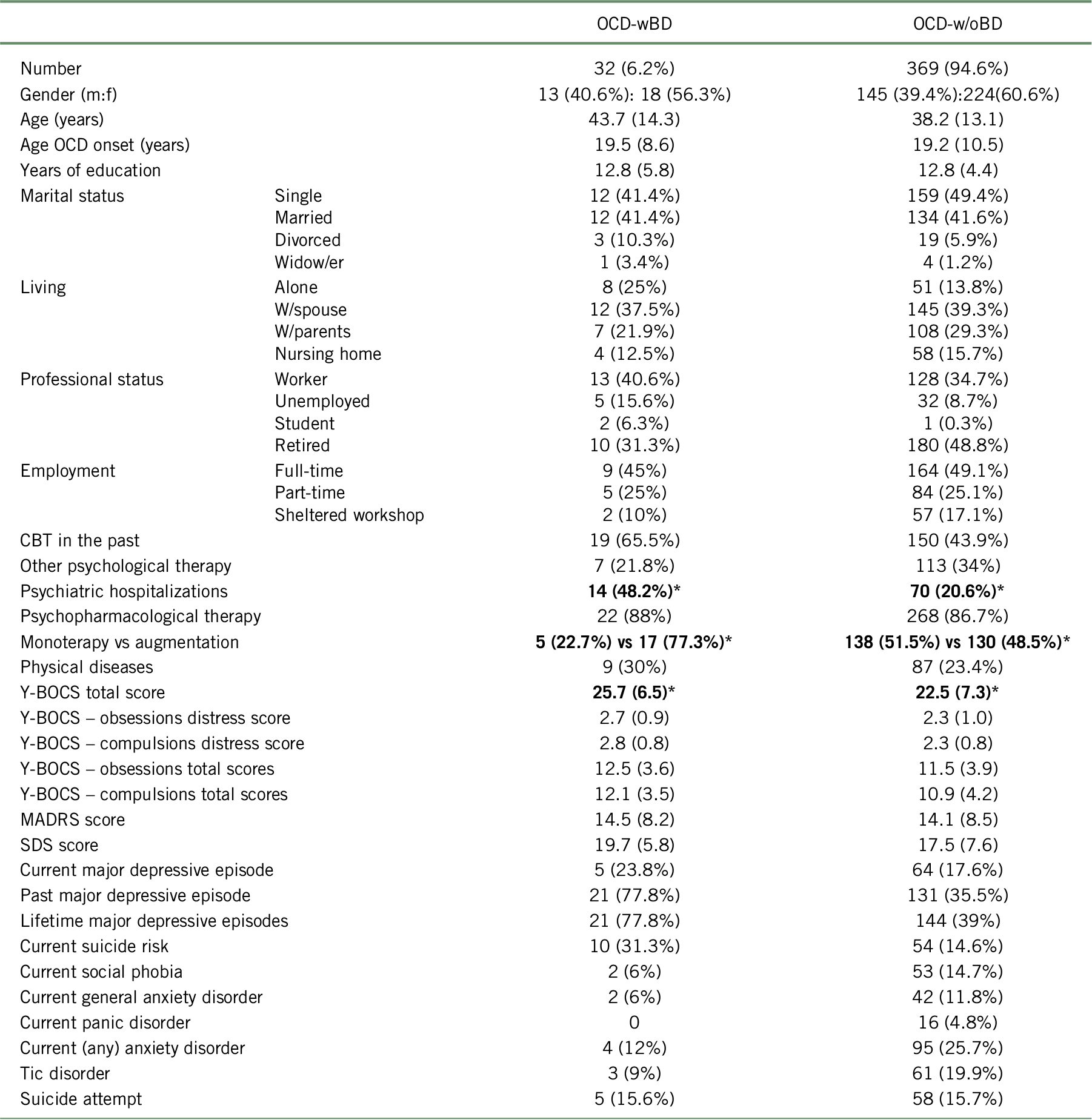
For the purpose of the present study, patients were categorized into two subgroups based on the presence (OCD-wBD) or absence (OCD-w/oBD) of comorbidity with BD. The two subgroups were compared with respect to a series of sociodemographic and clinical variables specified in Table 1. Statistical analyses were performed with Pearson’s chi-squared test for categorical variables and t-test for continuous ones. For all the analyses, the level of statistical significance was set at 0.05.
Comparison of sociodemographic and clinical variables between OCD patients with (OCD-wBD) and without (OCD-w/oBD) comorbid BD

Notes: values for categorical and continuous variables are expressed in percentages and mean ± SD, respectively. Boldface indicates parameters with statistical significant differences between the two subgroups. CBT: cognitive behavioural therapy; Y-BOCS: Yale–Brown Obsessive Compulsive Scale; SDS: Self-rating Depression Scale; MADRS: Montgomery–Asberg Depression Rating Scale.
*p < 0.001.
Results
Within the overall sample, 6.2% (n = 32) of OCD patients had comorbidity with BD. Sociodemographic and clinical variables of the two subgroups of OCD patients with vs without BD comorbidity are reported in Table 1.
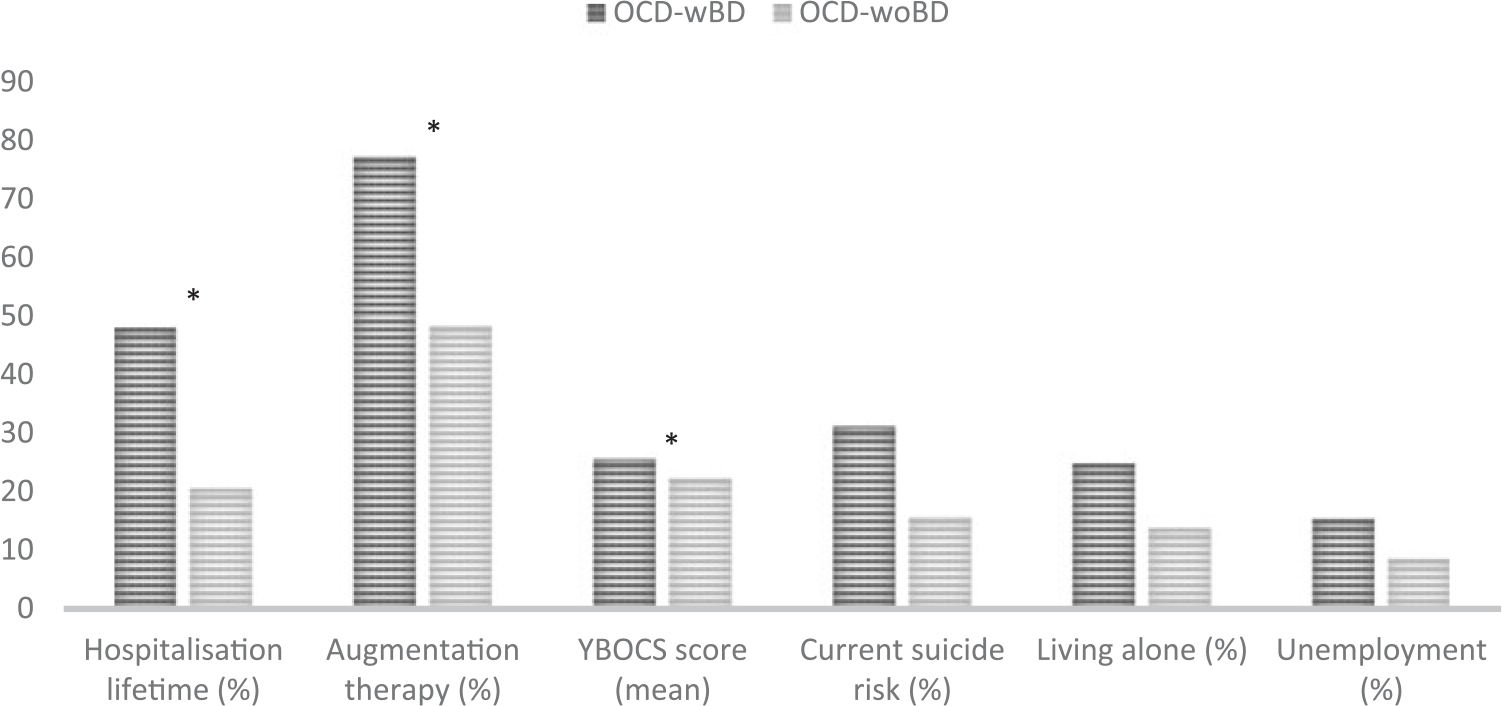
Figure 1 shows sociodemographic and clinical variables that were found to differ between the two subgroups. OCD patients with vs without BD comorbidity showed a higher rate of previous psychiatric hospitalization (48.2% vs 20.6%, p < 0.001) and a higher prevalence of augmentation therapies vs monotherapies (77.3% vs 48.5%, p < 0.001); being augmentation therapies, those compounds were used as add-on for treatment-resistant OCD patients. On both OCD subgroups, the most frequently prescribed augmentation therapies were antipsychotics (OCD-wBD 66.7% and OCD-w/oBD 34.6%), risperidone being the most represented (OCD-wBD 42.2% and OCD-w/oBD 75%); given a high rate of missing data for these specific variables, both analyses did not reach a statistically significant threshold.
Sociodemographic and clinical variables found to differ between OCD patients with (OCD-wBD) vs without (OCD-w/oBD) comorbid BD.

Additionally, significantly higher severity of OCD emerged in OCD patients with vs without BD comorbidity, as measured through the Y-BOCSReference Goodman, Price and Rasmussen23 total scores (25.7 vs 22.5, p < 0.001), with no statistically significant differences in obsession (12.5 vs 11.5) and compulsion (12.1 vs 10.9) subscales.
While differences in terms of suicide attempts between the two groups were not observed, current suicide risk showed as twice the rate in OCD patients with vs without BD comorbidity (31.3% vs 14.6%), without reaching the statistically significant threshold. Lastly, OCD patients with vs without BD comorbidity were more frequently found to live alone (25% vs 13.8%), to be divorced (10.3% vs 5.9%), and to be unemployed (15.6% vs 8.7%), although not a statistically significant level.
Discussion
In this ICOCS report, we focused on prevalence and clinical correlates of BD comorbidity in primary OCD patients. Our observed lifetime prevalence of BD comorbidity (6.2%) can be positioned at the lower range in relation to the available studies in the field.Reference Amerio, Odone, Liapis and Ghaemi4 This is likely due to the composition of the ICOCS sample, constituted by primary OCD patients attending tertiary OCD clinics worldwide, and to the fact that patients with a comorbid BD diagnosis are more frequently referred to community psychiatric centers or BD specialized centers. Additionally, this result might derive from the limited overall comorbidity rate (35%) characterizing our sample. BD comorbidity, therefore, appears to be less frequent in primary OCD patients than is OCD comorbidity in primary BD patients. In this respect, previous international reports showed a higher rate of other comorbid DSM-IV-TR Axis I disorders, compared with BD, with major depressive disorder and anxiety disorders being the most common comorbid conditions in primary OCD patients.Reference Lochner, Fineberg and Zohar1, Reference Brakoulias, Starcevic and Belloch24
The higher rate of previous hospitalization in the comorbid cases seems to be consistent with previous reportsReference Amerio, Odone, Liapis and Ghaemi4, Reference Timpano, Rubenstein and Murphy17, Reference Perugi, Toni, Frare, Travierso, Hantouche and Akiskal19, Reference Kazhungil and Mohandas25, Reference Kazhungil, Cholakottil, Kattukulathil, Kottelassal and Vazhakalayil26 and may likely be determined by the co-occurrence of BD episodes, causing more frequent admission to hospital (following severe manic or depressive episodes), even though it may also be related to OCD worsening due to a higher severity of OCD in comorbid patients (as suggested by the greater severity of illness confirmed by the Y-BOCS in these individuals).
The more complex psychopharmacological regimen observed in OCD with vs without BD comorbidity, reflecting a higher rate of augmentation treatments vs monotherapies in the former group, may also be interpreted as a characteristic of greater severity of OCD and overall illness, making it necessary to frequently add an antipsychotic to the serotonergic reuptake inhibitor (SRI), due to the severe nature of OC symptoms and to prevent manic switches.Reference Koran, Hanna, Hollander, Nestadt and Simpson27 The same result was reported in a study with young OCD subjects, where comorbid OCD+BD patients showed a more frequent polytherapy compared with a SRI only therapy, with second generation antipsychotics, including risperidone, most prevalently used in the comorbid group.Reference Masi, Millepiedi and Perugi28 Literature data support risperidone efficacy as augmentative therapy over SRI alone in OCD-resistant patients,Reference Bloch, Landeros-Weisenberger, Kelmendi, Coric, Bracken and Leckman29, Reference Dold, Aigner, Lanzenberger and Kasper30 particularly in those patients with a history of mood instability,Reference Pfanner, Marazziti and Dell’Osso31 emphasizing risperidone potential pharmacological effect on mood stabilization. Nonetheless, OCD comorbid patients could have received more frequently augmentation therapies just for the occurrence of two diagnoses, each one requiring a different therapeutic regimen. Of note, no significant differences emerged with respect to cognitive behavioral therapy or other psychotherapeutic treatments.
Arguably, another clinically relevant finding was the greater OCD severity in patients with vs without BD comorbidity. Previous analyses showed mixed results in this respect.Reference Timpano, Rubenstein and Murphy17, Reference Zutshi, Reddy, Thennarasu and Chandrashekhar32 As the Y-BOCS focuses exclusively on obsessions and compulsions, it is not likely that the higher scores would have been confounded by the presence of comorbid BD symptomatology per se. In fact, while obsessions might possibly determine higher scores due to concomitant depressive ruminations (though the two groups did not differ in depression scores) or flights of ideas, compulsions are relatively pathognomonic for OCD and OC-related disorders. In our analysis, both the obsessive and the compulsive subscale scores, as well as the total score, were higher in the comorbid group, thus indicating a more severe OCD phenotype. Nonetheless, it must be borne in mind that OCD symptomatology is strongly influenced by mood phases,Reference Amerio, Odone, Liapis and Ghaemi4, Reference Mucci, Toni, Favaretto, Vannucchi, Marazziti and Perugi5 and consequently, the latter might have determined an impact on Y-BOCS scores assessed in the present sample.
Lastly, even though other statistically significant differences between OCD patients with vs without comorbid BD were not found, it is noteworthy to mention that current suicidal risk was almost twice as high as in comorbid subjects. OCD is per se associated with a higher suicidal ideation and lifetime suicide attempts compared with the general population,Reference Dell’Osso, Benatti and Arici33, Reference Albert, De Ronchi, Maina and Pompili34 and the comorbidity with BD might increase this phenomenon. Nonetheless, in our sample, the rates of previous suicide attempt were similar between the two subgroups, differing from a previous report showing a higher rate in comorbid OCD patientsReference Saraf, Paul, Viswanath, Narayanaswamy, Math and Reddy15 and encouraging additional investigation on suicidal behaviors and risk in these patients. However, in this study, it needs to be noted that OCD patients without BD comorbidity could have a range of other comorbid disorders contributing to higher suicide attempt rates.
Finally, focusing on a sociodemographic perspective, despite not reaching the statistically significant threshold, a divorced status, living alone, and being unemployed were observed at rates twice as higher as in OCD patients with vs without comorbid BD. These findings also deserve further investigation, as they may converge in delineating a more disadvantaged sociodemographic condition of OCD patients when comorbid BD is present.
The findings reported in the present study should be interpreted in light of some limitations. First, our study did not characterize BD phases at the assessment or other issues related to BD polarity (i.e., polarity at onset or prevalent polarity) and subtype. These variables could have made our results easier to interpret, likely having a major impact on several clinical characteristics, including number of hospitalizations, pharmacological treatments, and Y-BOCS score. Additionally, OCD phenotype was not assessed in the total sample or in the two subgroups and sample collection (mainly tertiary centers specialized in OCD) might have affected the results and influence their generalizations. Lastly, given the international nature of the study, specific variables were recorded only in a limited number of centers and consequently not analyzed due to the presence of missing data that did not allow us to compare and contrast all variables. At the same time, the international sample assessed in the present study can be considered as one of the strengths of this report.
In conclusion, our results indicate that when OCD was comorbid with BD (6.2% of the cases), patients were found to show an overall higher severity of illness, as documented by a higher rate of hospitalization, a more complex pharmacological regimen, as well as a higher Y-BOCS score. Further studies are needed to verify the impact of BD comorbidity on OCD and to clarify the longitudinal relationship between these two disorders and their respective evolution.
Disclosures
B. Dell’Osso reports speaker’s bureau and speaker’s fee from Angelini; speaker’s bureau and speaker’s fee from Lundbeck; speaker’s bureau and speaker’s fee from Neuraxpharm, outside the submitted work.
N. Fineberg reports personal fees from Otsuka, personal fees from Lundbeck, nonfinancial support from Janssen, grants and nonfinancial support from the ECNP, personal fees and nonfinancial support from BAP, nonfinancial support from the World Health Organization, personal fees and nonfinancial support from RANZCP, grants and nonfinancial support from Shire, grants from the National Institute of Health Research, personal fees and nonfinancial support from the College of Mental Health Pharmacists, nonfinancial support from the International Society of Behavioural Addiction, nonfinancial support from the Royal College of Psychiatrists, nonfinancial support from the International College of Obsessive–Compulsive Spectrum Disorders, nonfinancial support from Novartis, grants and nonfinancial support from Servier, personal fees from Bristol-Myers Squibb, grants from MRC, grants from Wellcome, personal fees from Taylor and Francis, and personal fees from Oxford University Press, outside the submitted work.
E. Hollander reports grants from Brainsway, grants from Roche, grants from Curemark, grants from Takeda, personal fees from Shire, and personal fees from Sunovion, outside the submitted work. D.J. Stein reports personal fees from Lundbeck, personal fees from Novartis, personal fees from the AMBRF, grants from the NRGF, grants from Servier, grants from Biocodex, grants from MRC, personal fees from CIPLA Inc., and personal fees from SUN, outside the submitted work.
Conflicts of Interest
M. Vismara, B. Benatti, G. Cirnigliaro, B. Grancini, M. Van Ameringen, J.M. Menchon, C.I. Rodriguez, H. Nicolini, N. Lanzagorta, S. Pallanti, G. Grassi, C. Lochner, D. Marazziti, G. Hranov, O. Karamustafalioglu, L. Hranov, J. Zohar have no conflict of interest with the content of the present article.