INTRODUCTION
Lobatolampea tetragona Horita, Reference Horita2000 (Lobata: Lobatolampeidae) is a poorly known ctenophore distributed in Japanese waters (see Kubota et al., Reference Kubota, Yamada, Chikuchishin, Minemizu, Taru and Okuda2013). The species and genus were originally described by Horita (Reference Horita2000) based on two specimens collected from Ise Bay, North Pacific Ocean, Japan, in 1992. The family Lobatolampeidae Horita, Reference Horita2000 was established based on the monotypic genus, and no additional members of the family have subsequently been discovered. Since the species shares characters with Lampeidae (Cydippida), Lobata and Platyctenida, the phylogenetic position of the species is still unknown (Horita, Reference Horita2000; Kubota et al., Reference Kubota, Yamada, Chikuchishin, Minemizu, Taru and Okuda2013). The present study reports findings from SCUBA-based field surveys during a research expedition to the Farasan Islands and the coral reefs near Thuwal, in the Saudi Arabian Red Sea. The expedition, led by the Red Sea Research Centre at King Abdullah University of Science and Technology (KAUST), was part of an extensive survey investigating the diversity of marine fauna in the Red Sea, Saudi Arabia. Here, we report a new record of L. tetragona from the Red Sea.
MATERIALS AND METHODS
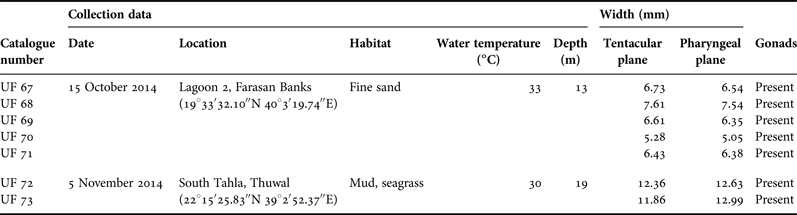
All specimens were collected by SCUBA divers in the coastal waters of the Red Sea, Saudi Arabia. Specimens (Table 1) were collected on mud and fine sand. After sampling, specimens were photographed alive and fixed in 95% ethanol, RNAlater™ RNA stabilization reagent (Qiagen Inc., Valencia, CA) or 4% seawater formalin. Morphological measurements below are in millimetres and are given as ranges, followed by means and standard deviations in parentheses. Specimens are deposited at the Florida Museum of Natural History (FLMNH), Division of Marine Invertebrates, USA.
Specimen data of Lobatolampea tetragona Horita, Reference Horita2000 collected from the Saudi Arabian Red Sea.

RESULTS
SYSTEMATICS
Family LOBATOLAMPEIDAE Horita, Reference Horita2000
Genus Lobatolampea Horita, Reference Horita2000
Lobatolampea tetragona Horita, Reference Horita2000
(Figures 1 & 2)
Lobatolampea tetragona Horita, Reference Horita2000, large mature specimen: UF 73 (A–D); smallest mature specimen: UF 70 (E). A, aboral view; B, aboral-lateral view along tentacular plane; C, close-up image of aboral-lateral view along tentacular plane; D, close-up image of aboral-lateral view along planepharyngeal plane; E, aboral view. g, gonad; stcr, subtentacular comb row; spmc, subpharyngeal meridional canal; e, egg; auc, auricular ctene; prc, perradial canal; pgc, paragastric canal; stmc, subtentacular meridional canal; ac, adradial canal. All scale bars: 1 mm.
In situ images of mature specimens of Lobatolampea tetragona Horita, Reference Horita2000 in the Red Sea. A, specimen (ca. 10 mm maximum width) on fine sand bottom; B, specimen (ca. 10 mm maximum width) attached on a leaf of seagrass, Halophila sp. (Hydrocharitaceae), by oral lobes. Both images from South Tahla, Thuwal, Saudi Arabia, 19 m depth.
Lobatolampea tetragona: Horita, Reference Horita2000.
Lobatolampea tetragona: Sasaki et al., Reference Sasaki, Ueno, Iwanaga, Oshiro and Kubota2001.
Lobatolampea tetragona: Kubota & Horita, Reference Kubota and Horita2009.
Lobatolampea tetragona: Kubota et al., Reference Kubota, Yamada, Chikuchishin, Minemizu, Taru and Okuda2013.
MATERIAL EXAMINED
Two mature specimens (UF 69 and UF 70), Lagoon 2 (19°33′32.10″N 40°3′19.74″E), Farasan Banks, 15 October 2014, leg. D. Uyeno, preserved in 95% ethanol; one mature specimen (UF 71), collection data same as those of UF 69 and UF 70, preserved in 4% buffered seawater formalin; two mature specimens (UF 67 and UF 68) collection data same as those of UF 67–70, preserved in RNAlater; two mature specimens (UF 72 and UF 73), South Tahla reef (22°15′25.83″N 39°2′52.37″E), near Thuwal, 5 November 2014, leg. D. Uyeno, preserved in 95% ethanol.
MEASUREMENTS
Tentacular plane length 5.28–12.36 mm (8.13 ± 2.81); pharyngeal plane width 5.05–12.99 mm (8.21 ± 3.22) (N = 7) (Table 1).
REMARKS
Specimens of ctenophores collected from the Red Sea bear the following characters shared by the type specimen of Lobatolampea tetragona Horita, Reference Horita2000 (see Horita, Reference Horita2000): body oval, medusa-shaped, compressed in oral-aboral axis (Figure 1A, E); paired oral lobes lacking visible auricles but bearing auricular ctenes (Figure 1C); short perradial canals present (Figure 1D); subpharyngeal meridional canals bearing aboral blind ends and c-shaped gonads with eggs (Figure 1A–C, E); neighbouring subtentacular meridional canals attached to each other on oral side (Figure 1C); oral end of paragastric canal (Figure 1D) blind; aboral ends of subpharyngeal and subtentacular meridional canals blind and attached to end of adradial canals (Figure 1D). Since noteworthy differences were not observed between the specimens examined here and those of the original description by Horita (Reference Horita2000), we conclude that all aforementioned specimens are conspecific.
DISCUSSION
Lobatolampea tetragona Horita, Reference Horita2000 was originally described based on two specimens collected from Ise Bay, North Pacific Ocean, Japan (Horita, Reference Horita2000). Subsequently, the species was reported from various localities limited to Japanese waters (Sasaki et al., Reference Sasaki, Ueno, Iwanaga, Oshiro and Kubota2001; Kubota & Horita, Reference Kubota and Horita2009; Kubota et al., Reference Kubota, Yamada, Chikuchishin, Minemizu, Taru and Okuda2013). The finding of L. tetragona in the present study represents the first record from the Red Sea and the first outside of the North Pacific. Although previously recorded in 10.5–23.4°C waters (Kubota et al., Reference Kubota, Yamada, Chikuchishin, Minemizu, Taru and Okuda2013), specimens for this study were collected at an ambient water temperature of 30–33°C.
Sasaki et al. (Reference Sasaki, Ueno, Iwanaga, Oshiro and Kubota2001) stated that the species is benthic rather than planktonic, based on observations made during his rearing experiment. During the field survey in the Red Sea, the first author (D. Uyeno) observed specimens of L. tetragona settled on mud or fine sand bottoms with their oral side down or attached to firm substrates, e.g. sea grasses, by their oral lobes (Figure 2). Despite the fact that Kubota & Horita (Reference Kubota and Horita2009) carried out 290 vertical hauls using a plankton net over the span of five days in coastal waters up to 7 m deep in the ferry port of Okinawa, Southern Japan, these surveys produced only nine individuals. During our surveys in the Red Sea, ctenophores were sometimes observed swimming after being disturbed, but they quickly settled back onto the substrate. Therefore, vertical hauls using a plankton net are likely to be an inefficient method for collecting L. tetragona due to their benthic behaviour. Additionally, it is difficult to locate L. tetragona in situ with the naked eye, as the bodies are transparent and flat (Figure 2). For these reasons, it is likely that these ctenophores have often been overlooked in previous field surveys. Sasaki et al. (Reference Sasaki, Ueno, Iwanaga, Oshiro and Kubota2001) estimated that the actual distribution of L. tetragona is much more widespread than previously thought, as it is eurythermal and has planktonic larvae. Our discovery of L. tetragona from the Red Sea confirms their guess, and L. tetragona is likely to be widely distributed in various areas of the Indo-West Pacific.
The maximum width of mature specimens of L. tetragona was 6.5 to approximately 50 mm in previous reports (Kubota et al., Reference Kubota, Yamada, Chikuchishin, Minemizu, Taru and Okuda2013). Kubota & Horita (Reference Kubota and Horita2009) reported immature specimens without gonads. Since the largest immature specimen recorded was 4.0 mm in maximum width, the species likely matures around this size range. In the present study, the smallest specimen recorded is 5.28 mm in maximum width, and it has c-shaped gonads (Figure 1E).
Studies on Red Sea invertebrates are underrepresented relative to other major reef systems (Berumen et al., Reference Berumen, Hoey, Bass, Bouwmeester, Catania, Cochran, Khalil, Miyake, Mughal, Spaet and Saenz-Agudelo2013) but continued work in this region will help resolve questions about its role in the global picture of biodiversity and biogeography (Bowen et al., Reference Bowen, Rocha, Toonen, Karl, Craig, DiBattista, Eble, Gaither, Skillings and Bird2013).
ACKNOWLEDGEMENTS
This research was supported by a KAUST Competitive Research Grant (URF/1/1389-01-01) and baseline research funds to M.L. Berumen. For logistic support, we thank Eric Mason at Dream Divers, the KAUST Coastal and Marine Resources Core Lab, A. Gusti, C. Nelson and the members of the Reef Ecology Lab.