

Introduction
Chick growth and development occurs at a high rate in the first week post-hatch. Maximum growth rate of broilers occurs in this short period of time, which represents about 20% of the broiler's total production cycle (Noy and Sklan, Reference Noy and Sklan2002). Therefore, a large amount of nutrients are required to secure and maintain the trend of this growth, because during those few days of adjustment, chicks make the metabolic and physiological transition from having their nutrients supplied from egg yolk to having nutrients supplied from compound feed (Sklan and Noy, Reference Sklan and Noy2000). Although the chicks are anatomically complete at hatch, they still have undeveloped digestive and immune systems (Maiorka et al., Reference Maiorka, Dahlke and Morgulis2006). Therefore, the use of high quality ingredients that have good nutritive value with readily digestible nutrients, especially protein and amino acids, is necessary for the efficient development of the gastrointestinal tract as well as maximising growth performance. A good start in the first week post hatch leads to a more uniform flock of chicks with good weight gain, which is positively correlated to the final weight of the birds (Kleyn and Chrystal, Reference Kleyn and Chrystal2008).
Adequate protein availability in the pre-starter phase is considered essential for increasing the bird's muscle development in later phases (Hargis and Creger, Reference Hargis and Creger1980). The major composition of diets, e.g. crude protein, amino acids and energy, are all factors that determine the bird's development in the earliest period of life.
Soybean meal (SBM) is the most widely used protein source in animal feeds. In general, SBM is considered the best plant protein source due to its amino acid profile. SBM is an excellent source of protein and energy for both poultry and swine. The high protein content with its well balanced and highly digestible amino acids makes SBM a valuable protein source for human and non-ruminant animal feeding (Kocher et al., Reference Kocher, Choct, Porter and Broz2002). However, SBM still has residual levels of anti-nutritional factors (ANF), which decrease its nutritive value (Marsman et al., Reference Marsman, Gruppen, Van der Poel, Kwakkel, Verstegen and Voragen1997; Mehri et al., Reference Mehri, Adibmoradi, Samie and Shivazad2010) and limit inclusion in broiler chicken diets, especially during the starter phase when the chicks gut is immature. Based on the fact that young animals are more susceptible to ANF that have a negative effect on digestion than older animals (Perez-Maldonado et al., Reference Perez-Maldonado, Mannion and Farrell2003), only the best quality ingredients with low levels of anti-nutrients should be used in starter diets to achieve good health and high growth rate.
It has been recognised for many years that thermal processing of soybeans is required to increase its nutritive value (Palacios et al., Reference Palacios, Easter, Soltwedel, Parsons, Douglas, Hymowitz and Pettigrew2004) as heat destroys ANF. Various processed soybean products have been used in animal and poultry feeding, including soybean protein concentrate (SPC), soybean protein isolate (SPI), whereby SBM is pre-treated with enzymes and/or microorganisms in order to eliminate the concentration of ANF. Replacement of SBM with these processed products in animal diets is believed to result in better growth performance.
Reducing ANF from the starter diets of broiler chickens, could have positive effects on the performance and subsequent physiology at an early age and throughout the broiler production life-cycle. Therefore, the objective of the present study was to investigate the impact of feeding of processed soy protein (Avistart™, Hamlet Protein Ltd., Horsens-Denmark) on performance, digestive physiology and morphology of the small intestine of broiler chickens.
Materials and methods
The experiment was approved by the Animal Ethics Committee of the University of New England (Approval No: AEC 12-054). Health and animal husbandry practices complied with the Code of Practice for the Use of Animals for Scientific Purposes issued by the Australian Bureau of Animal Health (National Animal Health and Medical Research Council, NHMRC, (1990).
Description of processed soy protein
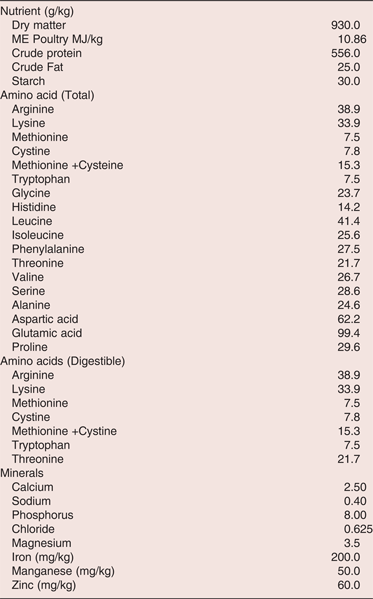
In nature, the soy bean contains a number of ANF, which – if not processed – significantly decrease the applicability in feed. The most important ANF are antigens, trypsin inhibitors, oligosaccharides and phytic acid. Processed soy protein (PSP, commercial name Avistart™) is a protein source made by co-processing soya and yeast. In a bioconversion process developed by Hamlet Protein Ltd., all anti-nutritional factors are reduced to a safe level for young animals – without compromising the protein quality. Table 1 shows the nutrient composition of PSP.
Nutrient composition of the processed soy protein Avistart™ used in the study

Hamlet Protein, Horsens-Denmark
Experimental design and bird management
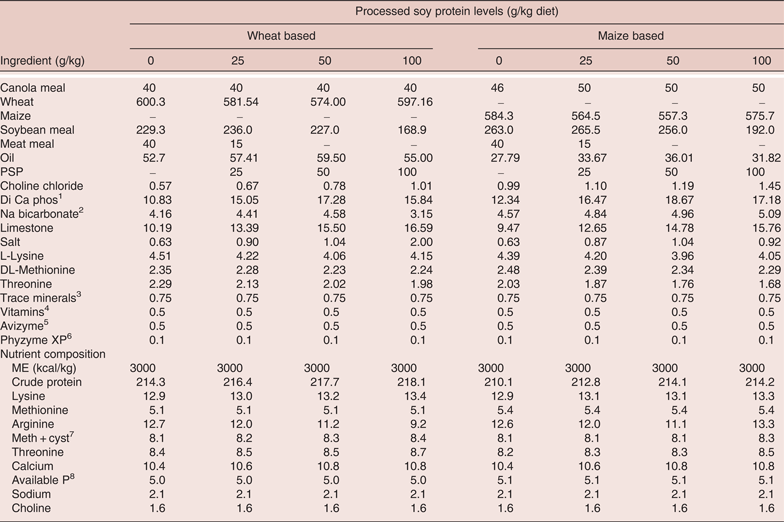
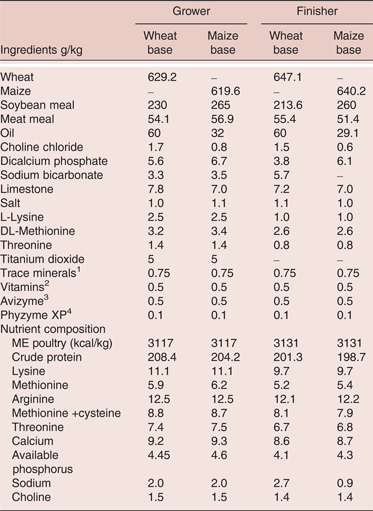
In a 4 × 2 factorial experiment, eight experimental diets were fed to investigate the effect of PSP on broiler performance and digestive physiology of broiler chickens. Four levels of PSP (0, 25, 50 or 100 g/kg) in two basal diets (either corn- or wheat-based) were included only in the starter diets which were fed from hatch to 10 d. The diets were identical in nutrient profiles and formulated to meet breeder specifications (Tables 2 and 3). After 10 d, the birds were transferred to commercial-type grower diets (11-24 d) and then a finisher diet (25-35 d). Titanium dioxide (TiO2), an indigestible marker, was incorporated into the grower diet at a rate of 5 g/kg diet for assessment of nutrient digestibility. Four hundred and eighty, one day-old male broilers (Ross 308) were randomly assigned to one of the eight treatments, giving six replicates of ten chickens. Chickens were reared in multi-tiered brooder cages (600 x 420 x 23 cm) placed in a climate-controlled room until 24 d, then the birds were transferred to a metabolic cage room to 35 d. Feed and water were provided ad libitum. The room temperature was gradually decreased from 33°C on d 1 to 24°C ± 1°C at 35 d. Eighteen hours of lighting were provided per day throughout the trial, excluding days one to seven, during which 23 hours of lighting were provided. Feed refusals and birds were weighed on d 10, 24 and 35 for calculation of average feed intake and weight gain. Mortality was recorded when it occurred and feed conversion ratio (FCR) was corrected for mortality. At 10 d and 24 d, two birds from each cage were randomly selected and killed by cervical dislocation. The abdominal cavity was opened and visceral organs removed, which were weighed. The relative organ weight was calculated as mass per unit of body weight (g/100g of body weight).
Ingredient and nutrient composition of the starter diets
1Dicalcium phosphate; 2sodium bicarbonate; 3Trace mineral concentrate supplied per kilogram of diet: Cu (sulphate), 16 mg; Fe (sulphate), 40 mg; I (iodide), 1.25 mg; Se (selenate), 0.3 mg; Mn (sulphate and oxide), 120 mg; Zn (sulphate and oxide), 100 mg; cereal-based carrier, 128 mg; mineral oil, 3.75 mg. 4Vitamin concentrate supplied per kilogram of diet: retinol, 12000 IU; cholecalciferol, 5000 IU; tocopheryl acetate, 75 mg, menadione, 3 mg; thiamine, 3 mg; riboflavin, 8 mg; niacin, 55 mg; pantothenate, 13 mg; pyridoxine, 5 mg; folate, 2 mg; cyanocobalamin, 16 µg; biotin, 200 µg; cereal-based carrier, 149 mg; mineral oil, 2.5 mg. 5xylanase + amylase + protease; 6phytase; 7methionine + cysteine; 8available phosphorous
Ingredient and nutrient composition of the grower and finisher diets
1,2,3,4 Composition as in Table 1
At 24 d, the pancreas and part of the proximal jejunum were taken for digestive enzyme assays. Ileal digesta were collected into plastic containers and immediately frozen. After freeze-drying (Martin Christ Gerfriertocknungsanlagen, GmbH, Germany) the ileal digesta samples were ground in a small coffee grinder and stored at 4°C in airtight containers for analysis of TiO2, gross energy, protein and dry matter. The weights of the whole carcass, breast meat (boneless), thighs and drumsticks were recorded at 35 d. The relative weights were calculated as an indication of mass per unit of body weight (g/100 body weight).
To evaluate the activity of digestive enzymes and protein concentration, the jejunal tissue was processed according to the method described by Shirazi-Beechey et al. (Reference Shirazi-Beechey, Smith, Wang and James1991). The pancreas was processed in a similar way to the jejunum except that Milli-Q water (Millipore Australia, North Ryde, Australia) was used in place of buffer and the entire tissue was homogenised. The homogenised tissue was centrifuged at high speed (30,000 g) for 20 min at 5°C. Aliquots of supernatant were collected and used for various enzyme assays and total protein content according to (Nitsan et al., Reference Nitsan, Dror, Nir and Shapira1974). The activities of jejunal and pancreatic enzymes were measured by incubation with fixed substrate concentrations according to the methods previously described for other species (Holdsworth, Reference Holdsworth1970; Serviere-Zaragoza et al., Reference Serviere-Zaragoza, del Toro and Garcia-Carreno1997) and standardised for poultry by Iji et al. (Reference Iji, Saki and Tivey2001). Tissue protein concentration in both jejunum and pancreas was measured using the Coomassie dye-binding procedure described by Bradford (Reference Bradford1976).
The TiO2 content of the diet and the ileal digesta was measured according to the method described by Short et al. (Reference Short, Gorton, Wiseman and Boorman1996). The digestibility of crude protein (CP), gross energy (GE) and dry matter (DM) of feed and freeze-dried ileal digesta samples were analysed along with the indigestible titanium dioxide marker. The nitrogen content of ileal digesta and diet samples was determined according to the Dumas combustion technique following the method described by Sweeney (Reference Sweeney1989). The GE value of the samples was obtained as MJ/kg directly with a digital type bomb calorimeter (IKA®- WERKE, C7000, GMBH & CO., Staufen, Germany)
The digestibility coefficient of nutrients was calculated using the following equation:
 $$\eqalign{& \hbox{Digestibility coefficient} = \cr & \quad 1 - \displaystyle{{Digesta \;nutrient {\displaystyle{{\displaystyle{9 \over kg} DM} \over Digesta}} TiO^2 \left({\displaystyle{9 \over kg} DM}\right)} \over {Diet \;nutrient {\displaystyle{{\displaystyle{9 \over kg} DM} \over Diet}} TiO^2 \left({\displaystyle{9 \over kg} DM}\right)}}}$$
Tissue samples were collected from the proximal jejunum and flushed with buffered saline and fixed in 10% neutral buffered formalin for histomorphological analysis. Samples were embedded in paraffin wax, sectioned and stained with haematoxylin and eosin. Sample sections were captured at 10x magnification using a Leica DM LB microscope (Leica Microscope GmbH, Wetzlar, Germany) and morphometric indices were determined as described by Iji et al. (Reference Iji, Saki and Tivey2001). Images were digitised and the villus height (from the tip of the villus to the villus crypt junction) and crypt depth (from the villus crypt junction to the muscular mucosa) were measured in 7-10 well orientated villi for each jejunal section. The basal and apical widths of the villi were measured in order to calculate the apparent surface area, as described by Iji et al. (Reference Iji, Saki and Tivey2001).
All data were analysed using the General Linear Models (GLM) procedure of Minitab version 16 for the main effect of PSP level, grain type, along with their interactions. Differences between mean values were determined using Fisher multiple range test.
Results
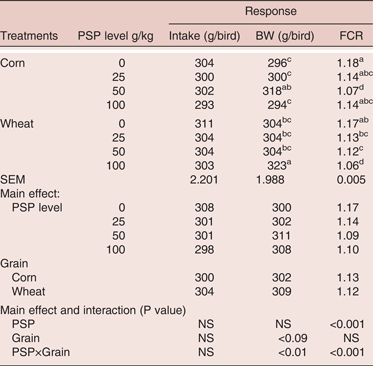
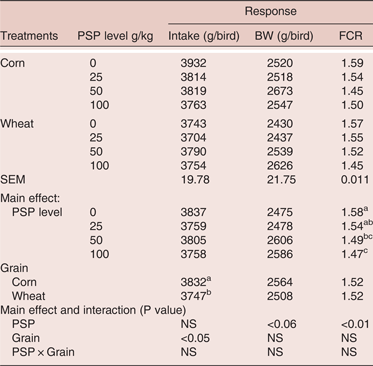
Feed intake up to 10 d of age was not affected by any main effects or interactions (Table 4). The PSP level had no significant effects on the body weight. In regards to the effect of the grain, body weight tended to be higher (P = 0.09) in birds fed wheat based diets than in those fed corn based diets. An interaction was detected (P < 0.01) between the two factors, revealing the highest body weight in birds fed the wheat based diets contained the higher PSP level. PSP level had significant effect (P < 0.001) on FCR, with a significant (P < 0.001) interaction between PSP level and the grain, with the best FCR recorded for birds that received higher and medium levels of PSP on wheat- and corn-based diets respectively.
Feed intake, body weight and FCR of birds between hatch and 10 days of age after placement on starter diets containing different levels of PSP
Each value represents the mean of six replicates for each treatment group; a,b.c – Mean values on the same column not sharing a superscript are significantly different at the P level shown for the main effect; SEM = Standard error of mean; NS = not significant.
Up to 35 d of age, feed intake was reduced (P < 0.05) in birds fed on wheat compared to corn based diet (Table 5). Body weight tended to be higher (P < 0.06) and FCR significantly improved (P < 0.01) in birds receiving PSP in their starter diets compared to the control. There was no interaction between main effects for feed intake, BW and FCR of broiler chickens.
Feed intake, body weight and FCR of birds between hatch and 35d after placement on starter diets containing different levels of processed soy protein
Each value represents the mean of six replicates for each treatment group; a,b.c – Mean values on the same column not sharing a superscript are significantly different at the P level shown for the main effect; SEM = Standard error of mean; NS = not significant.
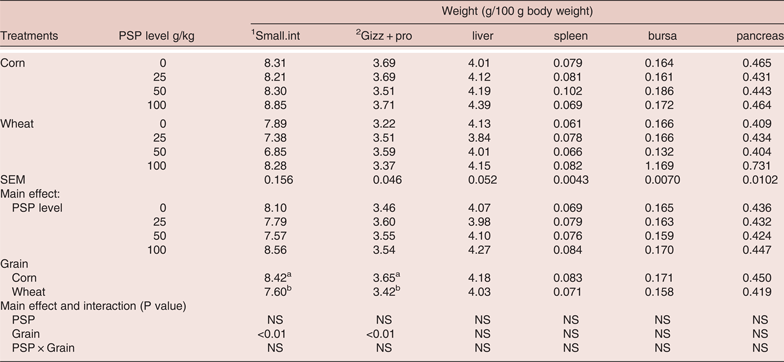
No interaction was observed between main factors in term of the relative weight of the visceral organs of broiler chicks up to 10 days of age (Table 6). However, grain type had significant effect on the relative weights of small intestine and gizzard + proventriculus which were higher (P < 0.01) in chickens fed the corn based diet than in those fed wheat.
Relative weight of visceral organs of broiler chickens at day 10 fed different processed soy protein levels in either maize- or wheat-based diet.
Each value represents the mean of six replicates for each treatment group; a,b.c – Mean values on the same column not sharing a superscript are significantly different at the P level shown for the main effect; 1small intestine with digesta; 2Gizzard and Proventriculus; SEM = Standard error of mean; NS = not significant.
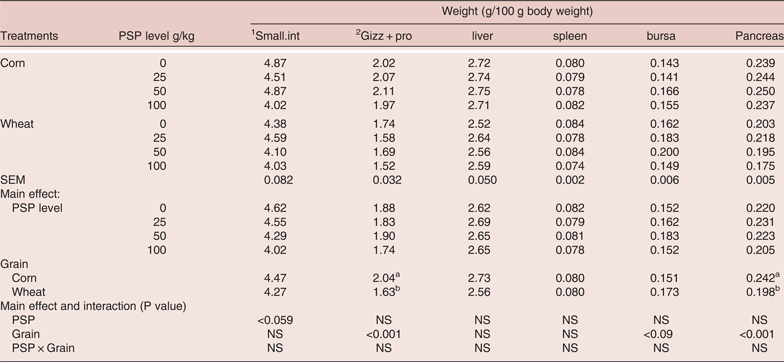
Up to 24 d, the relative weight of the small intestine tended to be higher (P < 0.06) in the birds fed diets contained PSP (Table 7). The relative weight of bursa tended to be higher (P = 0.09) and the relative weight of gizzard + proventriculas and pancreas were higher (P < 0.001) in birds fed corn based diets than in those fed wheat.
Relative weight of visceral organs of broiler chickens at day 24 fed various processed soy protein levels in either maize- or wheat-based diet.
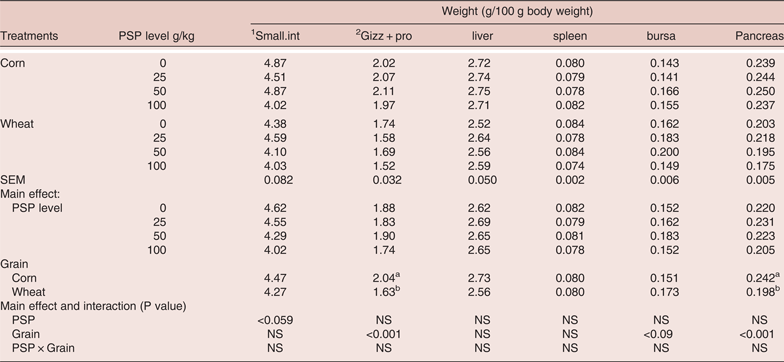
Each value represents the mean of six replicates for each treatment group; a,b.c – Mean values on the same column not sharing a superscript are significantly different at the P level shown for the main effect; 1small intestine with digesta; 2Gizzard and Proventriculus; SEM = Standard error of mean; NS = not significant.
There were no significant effects or interactions from PSP or gain type on the dressing percentage and the relative weight of carcass parts of broiler chickens at 35 d of age. However the relative weight of breast meat tended to be higher (P = 0.06) in birds fed diets containing PSP compared to the control. Overall, the dressing percentage and the relative weight of carcass parts were numerically higher in broiler chickens fed on starter diets contained PSP than those in control groups.
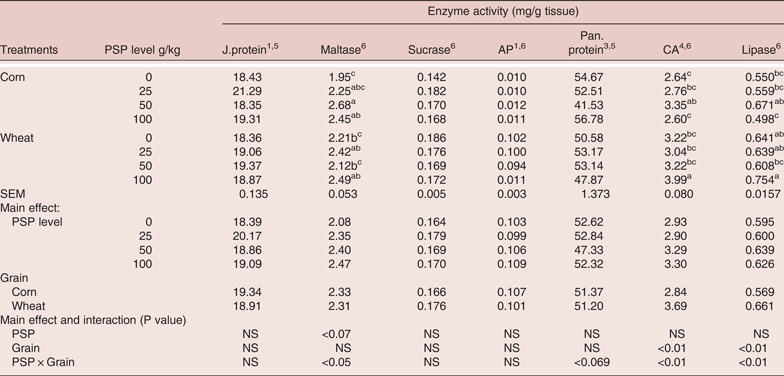
The activity of maltase tended to be higher (P = 0.07) in birds received PSP in their starter diets than those on control diets (Table 8). A significant (P < 0.05) interaction between grain type and PSP was found for the activity of maltase, whereby the lowest value was recorded in birds that received control diets in both types of grain based diets. The interaction between main effects tended to have an effect (P < 0.069) on the pancreatic tissue protein content. As a separate factor, grain type significantly affected the activity of chymotrypsin amidase (CA) and alkaline phosphatase (AP) when the highest (P < 0.01) CA and AP activities were recorded for birds fed on wheat based diets than in those fed on corn based diets. A significant (P < 0.01) interaction was seen whereby the highest CA and AP activities were found in birds fed the highest PSP level in their starter diets.
Effect of feeding different levels of processed soy protein in maize- and wheat-based starter diets on tissue protein content and digestive enzyme activities in the jejunum and pancreas of broiler chickens at 24 days of age
Each value represents the mean of six replicates for each treatment group; a,b.c – Mean values on the same column not sharing a superscript are significantly different at the P level shown for the main effect; 1J.protein= Jejunum tissue protein; 2AP, Alkaline phosphatase; 3Pan.protein= Pancrease tissue protein; 4CA, Chymotrypsin amidase; 5Protein (mg/g tissue); 6Enzymes (ηmol/mg protein/min) SEM = Standard error of mean; NS = not significant.
In general, ileal digestibility of protein, gross energy and dry matter of broiler chickens at 24 d were not affected by grain type, PSP or their interaction.
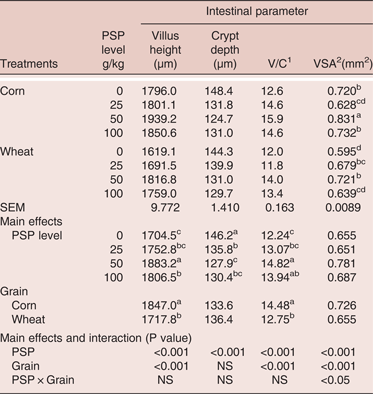
The histomorphology results from the jejunum are shown in Table 9. PSP level had significant effects on jejunum histomorphology of broiler chickens, whereby villus height and villus to crypt ratio (V/C) were higher in bird groups fed PSP diets, but this was only significant (P < 0.001) in those receiving medium and high PSP levels. Crypt depth was highest (P < 0.001) in the control group. Apparent villi surface area (VSA) was lower (P < 0.001) in the birds fed the highest level of PSP compared to other experimental groups. Villi height, V/C and VSA were higher (P < 0.001) in birds fed wheat based diets than in those fed on corn based diets. An interaction (P < 0.05) was observed between grain type and PSP for VSA, with the highest seen for chickens fed the corn based diet contained medium level of PSP.
Jejunal villus height, crypt depth, villus height/crypt depth ratio and villus surface area of chickens that received different processed soy product levels in starter diets in both maize- and wheat-based diets
Each value represents the mean of 6 replicates for each treatment group; a,b.c – Mean values on the same column not sharing a superscript are significantly different at the P level shown for the main effect; 1V/C = Villus to crypt ratio; 2VSA = Villus surface area; SEM = Standard error of mean; NS = not significant.
Discussion
The results of this experiment demonstrated that growth performance of broilers can be affected by the inclusion of PSP in the starter diet. Addition of PSP improved body weight and FCR in broiler chickens up to 10 or 35 d on both grain-based diets. This could be due to the reduction of ANF which affect digestion, and further concentrating the highly digestible protein in the processed product (Batal and Parsons, Reference Batal and Parsons2003). Specific processing for soy protein appears to increase the availability and utilisation of essential nutrients such as amino acids and energy, which, in turn, have a positive effect on the growth performance of the birds, especially in early life. This is supported by the findings of Jiang et al. (Reference Jiang, Gong, Ma, He, Li and Zhai2006), who found that substitution of corn Hamlet Protein (HP300) for SBM resulted in better growth performance of broiler chickens. In addition, Šiugždaité et al. (Reference Šiugždaité, Jerešiúnas, Stankevičius and Kulpys2008) observed the same positive effect on weaned pigs with the substitution of HP soy concentrate for fish meal.
In the present study the relative weight of visceral organs was not affected by the inclusion of PSP in the starter diets of young chicks. The results were similar to those of Tousi-Mojarrad et al., (Reference Tousi-Mojarrad, Seidavi and Dadashbeiki2012) who tested SBM that was processed by a technique used by Hamlet Protein. The essence of feeding high quality ingredients in the starter period is to improve the development of digestive function. The PSP tested in this study did not appear to have an impact on the weight of organs, although there was an impact from the type of the grain on the relative weight of visceral organs. In particular, there was an increase in the relative weight of the small intestine and gizzard + proventriculas at an early age for bids fed the corn based diets, while the relative weight of pancreas was positively influenced by corn based diets at the grower stage. Significant enlargement of the small intestine, gizzard + proventriculas and pancreas seen in chickens fed the corn based diet may be partly attributed to the influence of grain texture and composition, resulting in stimulation of the development of digestive organs. Inclusion of PSP in the starter diets of broiler chickens had no significant effects on the ileal digestibility of protein, gross energy and dry matter at 24 d of age. A similar effect was observed on the dressing percentage and carcass parts weight at 35 d.
There was a dose-dependent improvement in the maltase activity with increasing levels of PSP. This was converse with the findings of Jankowski et al. (Reference Jankowski, Juskiewicz, Gulewicz, Lecewicz, Slominski and Zdunczyk2009) who reported that the activity of mucosal maltase was not affected by dietary inclusion of PSP in diets for turkey. The most important observation was the interaction between grain type and PSP on the activities of pancreatic CA and lipase, whereby the highest values were seen in birds fed wheat-based diets containing the highest level of PSP. This may be due to the presence of readily digestible protein (PSP) in the intestinal lumen. Although the SBM used as the main source of protein was processed, protease inhibitors and other ANF are not always completely eliminated from such meals. PSP has lower levels of protease inhibitors and oligosaccharides compared to regular SBM, which have the ability to impair the digestive enzymes (Peisker, Reference Peisker2001). The activities of pancreatic CA and lipase were higher in birds fed wheat-based diet than those on corn-based diets. Variation in the activities of certain digestive enzymes between the two grain-based diets could be due to the differences in the chemical composition between the grain types, including ANF such as higher levels of soluble non-starch polysaccharides (NSP) in wheat. The activity of pancreatic and intestinal mucosal enzymes are well correlated to the body weight of birds (Uni et al., Reference Uni, Noy and Sklan1999; Sklan and Noy, Reference Sklan and Noy2000). The activity of digestive enzymes can be influenced by the form (Gabriel et al., Reference Gabriel, Mallet and Leconte2003) and type of cereal grains (Almirall et al., Reference Almirall, Francesch, Perez-Vendrell, Brufau and Esteve-Garcia1995) used in poultry formulations. This response can be complemented by rapid growth and increased development of the intestinal mucosa.
Diet constituents can influence the morphology of the intestinal mucosa by altering villus height and crypt depth, thereby modifying the surface area available for digestion and absorption (Sharma and Schumacher, Reference Sharma and Schumacher2001). Inclusion of PSP in the starter diet improved the histomorphology of the small intestine mucosa in terms of villi height, crypt depth villus:crypt ratio and villi surface area as measured at the jejunum at 24 d. The results were in accordance with the findings of Xu et al. (Reference Xu, Li, Liu, Zhan, Qian, Wu and Ding2012) who found that the villus height and villus:crypt ratio were increased in the duodenum and jejunum of egg-laying hens on diets supplemented with processed (fermented) soybean meal compared with those receiving plain SBM. Feng et al. (Reference Feng, Liu, Xu, Wang and Liu2007) observed an improvement in the intestinal morphology of broiler chicks as a result of replacement of untreated SBM with fermented SBM in the starter diet. The improvement in the morphology of intestinal mucosa of chickens fed on PSP-supplemented starter diets may be primarily due to the stimulatory effect of the product. This could be the key factor which explains the effect of PSP on growth performance thereby increasing the absorption of available nutrients necessary for body growth. This needs to be confirmed through further studies on cellular dynamics in the mucosa. The increased villus height to crypt depth ratio and VSA of the chickens that were fed on the starter diets containing PSP would improve the absorption of nutrients. Digestion and absorption are believed to improve as the ratio between villus height to crypt depth increases (Pluske et al., Reference Pluske, Thompson, Atwood, Bird, Williams and Hartmann1996). Although raw SBM has not been used in this study, residual ANF including lectins, have been shown to cause morphological changes in the intestine by attaching to specific receptors on the epithelial surface in the small intestine, destroying the brush- border membrane structure of the intestine (Qin, Reference Qin2003).
Histomorphological results revealed that villi height, villus:crypt ratio and VSA were increased in chickens fed the corn based diet, leading to improved absorption activity. This could be because wheat contains a considerable amount of NSP which impede the digestion and absorption of nutrients (Choct et al., Reference Choct, Hughes and Bedford1999).
Conclusions
The results showed that inclusion of PSP to the starter diets of chickens can improve broiler performance. Moreover, there were significant positive physiological responses of chickens to PSP in the starter diets of both corn- and wheat-based diets. The activities of digestive enzymes, such as jejunal maltase, sucrase, and pancreatic chymotrypsin amidase, were increased with PSP to the starter diets. The changes in mucosal morphometry equate to those that could have an impact on nutrient digestion and absorption. It can be concluded that using PSP into broiler starter diet can have beneficial effects on broiler productivity by its impact on digestive functions at an early age, and this may extend to the subsequent stages of the broiler life cycle. The PSP product was effective in both wheat- and maize-based diets.
Acknowledgments
We acknowledge the financial support of the University of New England. This research was conducted within the Poultry CRC, established and supported under the Australian Government's Cooperative Research Centres Program.
Declaration of interest
None