Introduction
Windstorms and wildfires can strongly damage forest ecosystems and influence the physical, chemical and biological properties of the soil. In particular, organic matter is reduced, soil structure and porosity can be changed, and the water and temperature regimes are altered. Moreover, soil erosion can be increased, leading to changes in the species composition of plants, soil microflora and the invertebrate community (Certini, Reference Certini2005). More than 80% of the multicellular animals in the world are nematodes (Bongers, Reference Bongers1988; Bloemers et al., Reference Bloemers, Hodda, Lambshead, Lawton and Wanless1997). Nematodes colonize all types of habitat and include a large number of genera and species with different body shapes and sizes. Nematode communities include all trophic groups, and they may feed on bacteria or fungi, or parasitize host plants or animals, according to their feeding habit (Yeates et al., Reference Yeates, Bongers, De Goede, Freckman and Georgieva1993). Nematode species also show different levels of sensitivity to environmental changes. All chemical and physical changes in the soil are rapidly reflected in changes to the richness and composition of nematode species (Bloemers et al., Reference Bloemers, Hodda, Lambshead, Lawton and Wanless1997). So, nematodes can be used with other soil biota as bioindicators of the quality, stability and changes in the soil.
In 2004, spruce forests in the High Tatras National Park were affected by a large windstorm. An area of 12,000 ha comprising a wood volume of 2.3 million m3 was heavily damaged by winds. Part of this area (220 ha) was damaged by wildfire 1 year later (Fleischer, Reference Fleischer2008). Following this natural disaster, the Forest Service tried successfully to salvage the timber in a large area of the affected forest. In other areas, affected by fire, the timber was not recovered. The aim of this study was to describe the short-term effects of various disturbances and forest management practices after windstorm and wildfire on the community structure of nematodes in the soil. The present study is an extension of that of Čerevková & Renčo (Reference Čerevková and Renčo2009) and describes the short-term effects of forest disturbances on nematodes in the soil and also the responses of nematode communities to spruce forest.
Materials and methods
Investigations were carried out in the High Tatras National Park in the northern area of Slovakia. The soil in the region is cambisol podzolic with a general pH (H2O) of 4. The mean annual temperature ranges from − 1 to +5°C and the annual precipitation varies from 1000 to 1600 mm. The original woody vegetation was a Lariceto–Piceetum forest, and before the windstorm the age of the trees ranged from 80 to 120 years.
Characteristics of the localities
Forest unaffected by wind (REF, 49°07′N, 20°47′E)
The original plant formation was a Lariceto–Piceetum forest with herbaceous undergrowth represented primarily by the shrub Maianthemum bifolium, and plants and herbs such as Oxalis acetosella, Vaccinium myrtillus, Calamagrostis villosa and Avenella flexuosa. The soil was characterized by organic carbon (Cox) 2.8 g/kg soil; total nitrogen (Ntot) 0.2 g/kg soil; and a carbon/nitrogen ratio (C/N) of 14.0.
Extracted forest (EXT, 49°07′N, 20°09′E)
This locality was completely destroyed by a windstorm and fallen trees were cleared out. Dense grass and various herbs had covered the land, with the dominant vegetation represented by C. villosa and A. flexuosa. In 2008, growth of Luzula luzulides and Veronica officinalis were also observed. Young trees were represented by Pinus silvestris and Betula pubescens. The main soil chemical characteristics were Cox 2.6 g/kg soil; Ntot 0.3 g/kg soil; C/N 8.7.
Burnt forest (FIR, 49°07′N, 20°11′E)
This locality was affected by fire, and fallen trees were partially recovered. The area was covered by an ash layer and sparse vegetation with dominance of C. villosa, A. flexuosa, and Chamerion angustifolium. Young trees were represented by Sorbus aucuparia and Populus tremula. The main chemical characteristics of the soil were Cox 4.2 g/kg soil; Ntot 0.44 g/kg soil; C/N 9.54.
Unmanaged forest (NEX, 49°09′N, 20°15′E)
In this locality, fallen trees were left to their natural succession. Composition of the dominant species consisted of Juncus effuses, Luzula multiflora, Agrostis stoloniferum and the trees Acer pseudoplatanus, A. platanoides and Abies alba. The main soil chemical characteristics were Cox 5.3 g/kg soil; Ntot 0.4 g/kg soil; and C/N 13.2.
The composition of plant communities and pedochemical characteristics of the area were investigated by Šimonovičová et al. (Reference Šimonovičová, Hanajík, Lancuch, Mičuda, Hloško, Dlapa, Ferianc, Haydenová, Fleischer and Matejka2007) and Šoltés et al. (Reference Šoltés, Školek, Kyselová, Fleischer and Matejka2008).
Data analysis
In each of the sites, five stands (100 m2) were selected to investigate the composition of the nematode communities. Sampling was carried out in June and October of 2006, 2007 and 2008. At each stand and sampling date five sub-samples were taken down to a depth of 10 cm. Five sub-samples were bulked and nematodes were isolated from 100 g of mixed soil samples using the Baermann method (Baermann, Reference Baermann1917), fixed in formalin–acetic acid–alcohol (FAA) solution (Southey, Reference Southey1986) and evaluated on permanent glycerine slides. Nematode species were assigned to trophic groups according to their feeding habits (Yeates et al., Reference Yeates, Bongers, De Goede, Freckman and Georgieva1993). Community indices were calculated for each stand and sampling date as follows: the diversity index for species (H'spp) (Shannon & Weaver, Reference Shannon and Weaver1949), the Maturity Index (MI) and Plant Parasite Index (PPI) proposed by Bongers (Reference Bongers1990). The indexes MI and PPI, based on nematode families, assume that all species within a family respond similarly to disturbance, defined by a score from c-p 1 (rapidly colonizing r-strategists) to c-p 5 (‘persisters’ in Bongers's terminology, with long life-cycles and low colonizing ability). Other calculated indexes were PPI/MI (Bongers & Korthals, Reference Bongers and Korthals1995); bacterial feeders/fungal feeders (B/F) (Wasilewska, Reference Wasilewska1997); the Enrichment Index (EI) and the Structure Index (SI) (Ferris et al., Reference Ferris, Bongers and De Goede2001). Weighting of nematode taxa was performed as suggested by the different authors. Weighting of the taxa that were not included in the paper of Ferris et al. (Reference Ferris, Bongers and De Goede2001) was derived from c-p values proposed by Bongers (Reference Bongers1990). Values of nematode abundance and indices obtained for each stand were then used for the calculation of their mean values in individual localities. Data were analysed by analysis of variance (ANOVA) and then subjected to cluster analysis, and means were compared using the Least Significant Difference (LSD) test. Cluster analysis was used to distinguish communities of nematodes in four heterogeneous environments (localities) during the 3-year period. A diagram to show linkage distance for 12 cases of population densities was developed. In order to distinguish the nematode fauna, a cluster analysis (Euclidean distances; Ward's method) was performed, using ln(x+1) transformed nematode population densities (where x represents species population density in 10 samples). Statistica (StatSoft Inc., 2001) software package was used for this analysis.
Results
During the study period (2006–2008), the effects of windstorm and wildfire on the structure of soil nematode communities in the High Tatras spruce forests (EXT, FIR and NEXT) were compared to nematode communities in the unaffected forest (REF). The number of species, abundance, trophic groups, values of ecological and diversity indices were also evaluated.
Species composition, abundance and diversity of nematode fauna
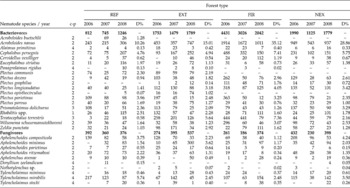
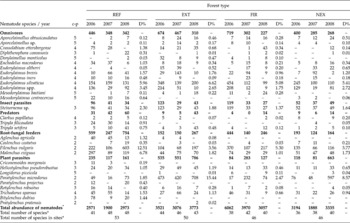
Comparisons between nematode communities in the four sites over 3 years showed variable results. A total of 57 nematode species were identified. Fifty-three were found in the REF, 50 were identified in the EXT, and 46 were recorded in the FIR and NEX sites (tables 1 and 2). In REF the dominant species were Acrobeloides nanus, Filenchus vulgaris, Malenchus exiguus, Eudorylaimus silvaticus and Tylencholaimus mirabilis. In the EXT site, the dominant species included Paratylenchus microdorus, A. nanus, E. silvaticus and Teratocephalus terrestris. In the FIR site, A. nanus, Cephalobus persegnis, T. terrestris, F. vulgaris and E. silvaticus were the most abundant species found, whereas the NEX site was characterized by a significant presence of A. nanus, P. microdorus, C. persegnis and E. silvaticus (tables 1 and 2).
Total abundance (n=10) and dominance (D%) of nematode species – bacteriovores and fungivores – in four sites during 2006–2008; REF, forest unaffected by wind – reference; EXT, extracted forest; FIR, burnt forest; NEX, unmanaged forest. c-p, c-p scores as given by Bongers (Reference Bongers1990).

Total abundance (n=10) and dominance (D%) of nematode species – omnivores, insect parasites, predators, root-fungal feeders and plant parasites – in four sites during 2006–2008; REF, forest unaffected by wind – reference; EXT, extracted forest; FIR, burnt forest; NEX, unmanaged forest. c-p, c-p scores as given by Bongers (Reference Bongers1990).

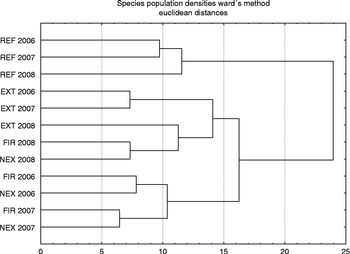
Of the total number of identified nematode species, nine were plant parasites. The following plant parasite species were identified in all forest types: Helicotylenchus pseudorobustus, P. microdorus, Rotylenchus robustus and Trichodorus sparsus. Paratylenchus microdorus was dominant in the EXT (15.4%) and the NEX (8.6%) sites (table 2). Cluster analyses were used to compare species composition and nematode population densities in the four sites (fig. 1). Results showed that there was a significant impact of the disturbance factor on the damaged forest. This is evidenced by the fact that samples from the REF forest that created a first separate cluster (fig. 1). The third cluster consisted of the NEX and FIR forests in 2006 and 2007. The central cluster consisted of a combination of EXT site and a sub-cluster of the FIR and NEX sites in 2008.
Cluster analysis of the population density of nematode species in four sites in the High Tatras from 2006 to 2008. REF, reference; EXT, extracted forest; FIR, burnt forest; NEX, unmanaged forest.

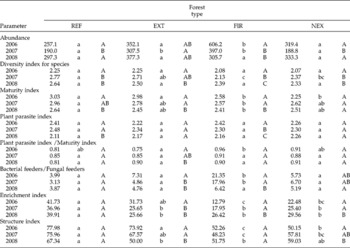
The abundance of nematodes was different for all sites and sampling dates. A significantly higher nematode abundance was recorded in the first year after the disturbance in the FIR site compared to the second and third years, while a significantly lower abundance was recorded in the second year in REF and NEX sites (P= 0.05) (table 3). In the first year the higher abundance of nematodes observed in the FIR site was due to the high abundance of the bacterial feeder A. nanus (table 1). In the third year following the forest disturbance, the abundance of nematodes was similar in all four sites and no significant differences were observed between REF and the other sites. Values of diversity index for species (H'spp) indicated that there were more differences in species structure of nematode communities in the FIR site. In this forest, the H'spp gradually increased from 2.08 to 2.39 during the 3 years. In the other three sites, in the second and third years the H'spp was higher than in the first year, although in the EXT site no significant difference was observed between the first and the second year (table 3). Comparison among the four sites showed no differences in species diversity index in 2006 and 2008 (table 3).
A comparison of mean values of nematode abundance and particular ecological and diversity indices in the four sites during 2006–2008. REF, forest unaffected by wind – reference; EXT, extracted forest; FIR, burnt forest; NEX, unmanaged forest.

Mean values in rows followed by the same small letters (a, b, etc.) and mean values in columns followed by the same capital letters (A, B, etc.) are not statistically different according to the Least Significant Difference test (P= 0.05) (n= 10).
Trophic groups and ecological indices
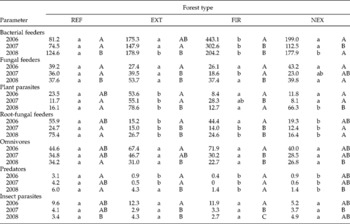
In the forests the most abundant nematodes were the bacterial feeders (table 4). A total of 18 bacterial feeder species were identified at all localities. The most abundant species from the bacterial feeder group at all localities were A. nanus and C. persegnis. A high abundance of Plectus spp. and T. terrestris in both EXT and FIR sites and Wilsonema schuurmansstekhoveni in FIR forest were observed in the first year after the windstorm and wildfire, and their abundance gradually decreased in the following years. No significant differences among the different forest sites were found in fungal-feeder nematodes in the first and third year of investigation. A significant lower abundance of fungal feeders was observed in the FIR site in the second year in comparison to the other sites (table 4). The most relevant species were Aphelenchoides composticola and T. mirabilis. Plant parasites were the second most abundant trophic group in the EXT forest. In this site a high abundance of P. microdorus was observed. During the third year in the NEX forest an increased abundance of plant parasite nematodes was recorded and it was due to a high abundance of P. microdorus (table 4). Root-fungal feeders in all of the affected forests (EXT, FIR, NEX) during the period were represented by a lower nematode abundance in comparison to that of REF forest, with the exception of 2006 in the FIR site. Omnivores were represented at a relatively high abundance in all sites, mostly due to the presence of E. silvaticus. For this trophic group no significant differences were observed during the period. A significantly lower abundance of predators was confirmed in all affected forests (EXT, FIR, NEX) in comparison to the reference site (P= 0.05) (table 4). Insect parasites for each year of investigation did not differ among all sites. Only in the REF site were no significant differences observed among the different years (table 4).
A comparison of mean values of number of nematodes in each trophic group in the four sites during 2006–2008. REF, forest unaffected by wind – reference; EXT, extracted forest; FIR, burnt forest; NEX, unmanaged forest.

Mean values in rows followed by the same small letters (a, b, etc.) and mean values in columns followed by the same capital letters (A, B, etc.) are not statistically different according to the Least Significant Difference test (P= 0.05) (n= 10).
The Maturity Index (MI) values were significantly higher in the REF compared to the FIR in all the 3 years (P= 0.05) (table 3). The lower MI in the FIR sites relates to a high abundance of bacterial feeders with low c-p values and the near absence of predators. The Plant Parasitic Index (PPI) values were similar within the investigated sites, but significantly different in the FIR over the years of investigation. Significant changes in the PPI in the FIR site was caused by changes in the abundance of T. sparsus with high c-p values.
The B/F ratio did not demonstrate significant differences in the REF and NEX forests during the different years. In the EXT and FIR sites, the B/F ratio decreased during the course of the study. This trend was due to an increase of abundance of fungal feeders in the EXT site and to a decrease in bacterial feeders in the FIR site. Significantly lower EI values were observed in all affected forests over all 3 years in comparison to the REF site. Similarly, significant differences in the SI were observed between the reference and damaged forests.
Factorial analysis of variance
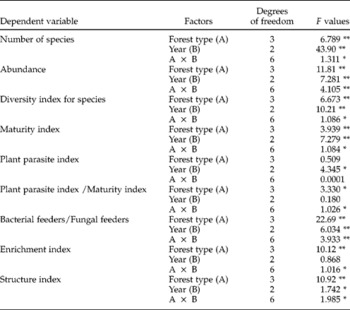
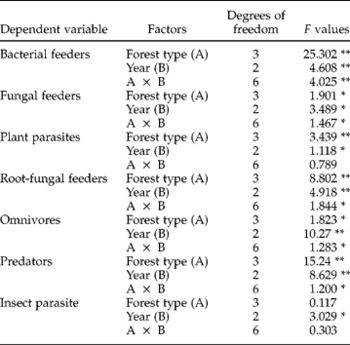
Both the main effects (forest type and year of investigation) upon the number of species, abundance, H'(spp), MI, B/F and SI were statistically significant and they also showed significant interactions. Forest type had significant effect on EI and PPI/MI while year of investigation had significant effect on PPI (table 5). Forest type and year of investigation had significant effects on bacterial feeders, fungal feeders, plant parasites, root-fungal feeders, omnivores and predators. There were also significant interactions between the two factors except for their effects on plant parasites (table 6).
Factorial analysis of variance to show the effects of forest site (factor A) and year of investigation (factor B) on ecological and diversity indices, number of species and nematode abundance.

F values significant at **P < 0.01 and *P < 0.05.
Factorial analysis of variance to show the effects of forest site (factor A) and year of investigation (factor B) on the abundance of nematodes in each trophic group.

F values significant at **P < 0.01 and *P < 0.05.
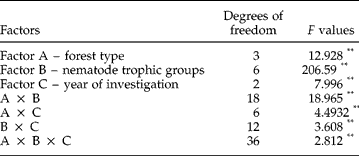
Factorial analysis of variance showed significant main interaction among forest type (four types), nematode trophic group (six groups) and years of investigation (table 7). In particular, significant interactions were found between nematode trophic groups and the other factors (forest type and year of investigation) (P= 0.01). The interaction between the type of forest and year of investigation was also significant. So, all factors involved interacted significantly with each other (A × B × C) (table 7).
Factorial analysis of variance. Interactions among forest site (factor A), nematode trophic group (factor B) and year of investigation (factor C).
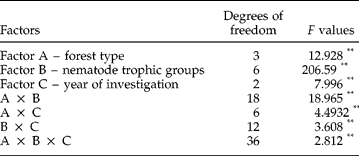
** F values significant at P < 0.01.
Discussion
According to our results, significant changes were observed mainly in the first year in the site affected by a windstorm and a subsequent wildfire. Burning removes plant litter, allowing more sunlight to reach and dry out the soil surface (Fenster et al., Reference Fenster, Ferrick and Scott2004). In the FIR site, soil microorganisms were the most abundant (Gömöryová et al., Reference Gömöryová, Strělcová, Škvarenina, Bebej and Gömöry2008), and bacteria are important food sources for nematodes. This is probably the reason for the increase in abundance of bacterial-feeder nematodes in the FIR site, which was caused mostly by a large increase in the abundance of A. nanus. McSorley (Reference McSorley1993) observed that 6 weeks after a controlled fire in a pine forest, the abundance of Acrobeloides increased, while the fungal-feeder nematode genus Aphelenchoides decreased. Fenster et al. (Reference Fenster, Ferrick and Scott2004) found no significant differences in the abundance of nematodes in burned and unburned forest, and Matlack (Reference Matlack2001) concluded that, over the long term, fire did not have a significant impact on the abundance or diversity of nematode communities. In the first year after a fire, Yeates & Lee (Reference Yeates and Lee1997) recorded a 100-fold increase in the abundance of Paratylenchus in the soil of burned forests compared to unburned areas. We observed an increased abundance of Paratylenchus in burned areas only during the second year. Yeates (Reference Yeates2007) noticed that extreme disturbances in the forest, such as slash-and-burn management, significantly reduced nematode abundance and diversity. In contrast, management that enhances growth of the understorey or herb layer can stimulate nematode populations.
Although a significant increase in the abundance of P. microdorus has been recorded in extracted and non-extracted forest plots, total abundance of nematodes during the period was similar to that of the reference forest. The situation in the EXT site with salvaged timber is similar to that of grassland ecosystems, and Paratylenchus has often been observed in association with grass (Soloveva, Reference Soloveva1972; Čerevková, Reference Čerevková2006). Gömöryová et al. (Reference Gömöryová, Strělcová, Fleischer and Gömöry2011) compared the microbial characteristics of soil in the same research plots and found no significant differences between EXT and NEX plots. Forge & Simard (Reference Forge and Simard2001) noticed a greater diversity in nematode communities in clear-cut areas than in the forest. This is in contrast with our data, as we found only slight differences in the diversity index when sites were compared. An increase in H'spp in the second and third years in all sites was due to seasonal changes rather than to damage or forest management practices.
Comparing the reference and destroyed forest sites, greater differences were found in the abundance of nematodes in the different trophic groups. The most conspicuous effects of forest disturbance on the trophic structure of the nematode community were the reduced abundance of predators and an increase in bacterial feeders. There was a high abundance of bacterial feeders in all disturbed forest sites. Root-fungal feeders were most abundant in REF. The majority of root-fungal feeders in REF belonged to the genera Filenchus and Malenchus and they declined in damaged sites. A similar situation was found in spruce forests in the Czech Republic (Háněl, Reference Háněl2004). Sohlenius (Reference Sohlenius2002) compared clear-cut and mature forests, recording a greater abundance of bacterial feeders during the period without trees, but the importance of fungi and fungal feeders increased during forest development. On the contrary, Donegan et al. (Reference Donegan, Watrud, Seidler, Maggard, Shiroyama, Porteous and DiGiovanni2001) found a significantly higher bacterial and fungal population in the forest than in clear-cut areas. Forge & Simard (Reference Forge and Simard2001) found a lower diversity of omnivores and predators, and a greater diversity of bacterial feeders and fungal feeders, in clear-cut areas compared to the mature forest. In our study, the abundance of omnivores did not differ too much between treatments and a similar situation was found in the spruce forest in the Czech Republic (Háněl, Reference Háněl2004). Previous studies (Freckman & Ettema, Reference Freckman and Ettema1993; Sohlenius, Reference Sohlenius1996, Reference Sohlenius1997) regarded omnivores as very sensitive to disturbances in ecosystems, reporting that they reacted by rapidly reducing their abundance. Forge & Simard (Reference Forge and Simard2001) found Aporcelaimellus to be more abundant in clear-cuts than in forest areas on one sampling date, while the diversity and abundance of omnivores and predators were reduced as a whole.
The Maturity Index (MI) is used to describe characteristics of the soil environment. A lower value of MI is represented in nematode fauna by more adaptable nematode species with a high reproductive activity, short life cycle and high tolerance to changes in the soil (e.g. Rhabditidae, Panagrolaimidae). Intensive damage to, and management practices involving, the soil environment have a strong impact on nematode communities. The majority of previous studies showed a lower Maturity Index in clear-cut (Forge & Simard, Reference Forge and Simard2001) or managed forests (Bjørlund et al., Reference Bjørlund, Vesterrgård, Johansson, Nyborg, Steffensen and Christensen2002). However, Bloemers et al. (Reference Bloemers, Hodda, Lambshead, Lawton and Wanless1997) found that the MI did not decline with the increase of disturbances in a disturbed tropical forest. In our investigation we found that the MI was lower in all disturbed sites in comparison to the REF site. A higher MI and higher abundance of predators and omnivores in the reference area characterized this ecosystem as stable.
Decomposition of organic matter in the soil is performed by bacterial and fungal feeders. To determine the decomposition of organic matter in affected areas, the ratio of bacterial to fungal feeders (B/F) was used. Our results showed a high abundance of bacterial feeders in the FIR site during the first and second years, but the third year showed no significant differences among the sites. The greatest values of EI were found in REF, which could indicate faster nutrient cycling via the detritus food web in undisturbed than in disturbed habitats.
In conclusion, forest disturbances and different management practices can cause changes in the composition and richness of nematode species. Forest disturbances have direct impacts on nematode diversity in all trophic groups. Short-term effects showed that the reference forest was significantly different from all of the disturbed sites. Moreover, during the years that were investigated most significant changes were observed in the FIR forest.
Acknowledgements
The authors acknowledge the support of the scientific grant agency (VEGA; Grant No. 2/0136/10 and Grant No. 1/0894/11) (0.5) and the project ‘Application Centre to protect humans, animals and plants against parasites’ (Code ITMS: 26,22022,0018) based on the support of the Operational Programme ‘Research and Development funded from the European Regional Development Fund’ (0.5).