Introduction
Waste from agriculture and the food industry include excreta from livestock, poultry and fish, unused materials from processing livestock, poultry and fish, milk and egg production and their further processing, production of plant derived foods, preparation and processing of fruits, vegetables, sugar, plant oils and tobacco, baked foods, candy/confection, production of beverages, restaurants and other food service entities and from consumers (Jayathilakan et al., Reference JAYATHILAKAN, SULTANA, RADHAKRISHNA and BAWA2012). Table 1 provides a comparison between production of poultry meat and eggs with other livestock products. Poultry meat production has increased globally and is now greater than either pig or cattle/buffalo meat. Livestock and poultry production is associated with considerable greenhouse gas (GHG) emissions (Table 1), with emissions from poultry production being markedly lower than pigs and much lower than either small or large ruminants. Thus, the poultry production is considerably more efficient than other aspects of animal agriculture for GHG emissions.
Comparison of livestock and poultry products (data from FAOStat) and emissions of greenhouse gases (GHG) from animal agriculture (Based on Steinfeld et al., Reference STEINFELD, GERBER, WASSENAAR, CASTEL, ROSALES and DE HAAN2006 updated using FAOStat 2016 production data and inventory numbers*).

NA not applicable
*Assumes no changes in GHG emissions with animal inventory (for respiratory CO2) or products produced (other GHG parameters)
#Assuming CH4 has 25 times and N2O has 298 times the greenhouse potential as CO2 (IPCC, 2007)
There are large amounts of excreta produced during the production of broiler chickens, laying hens, pullets, broiler breeders and other poultry. For the purpose of this review, faeces and urine will be considered as excreta as, in birds, they are released together from the cloaca. The present review examines the impact and utilisation of poultry waste. Specifically, the total nitrogen in poultry excreta is estimated globally from the production of both poultry meat and eggs. The environmental impact is considered including ammonia (NH3) loss from poultry facilities. Present and alternative uses of poultry excreta are considered.
Quantification of excreta produced
There is a relative dearth of quantitative information on manure from poultry or other livestock for a given country, region or globally. Total nitrogen and phosphorus in manure from the aggregate of livestock and poultry in the USA was reported by the U.S. Geological Survey as follows: 6.17 million metric tons of nitrogen and 1.85 million metric tons of phosphorus (as phosphate; Ruddy et al., Reference RUDDY, LORENZ and and MUELLER2006). In contrast, Pimentel et al. (Reference PIMENTEL, WILLIAMSON, ALEXANDER, GONZALEZ-PAGAN, KONTAK and MULKEY2008) estimated nitrogen in poultry and livestock excreta as 1.63 million metric tons of nitrogen; the basis of their estimate being somewhat unclear.
Nitrogen excretion in broiler (meat type) chickens
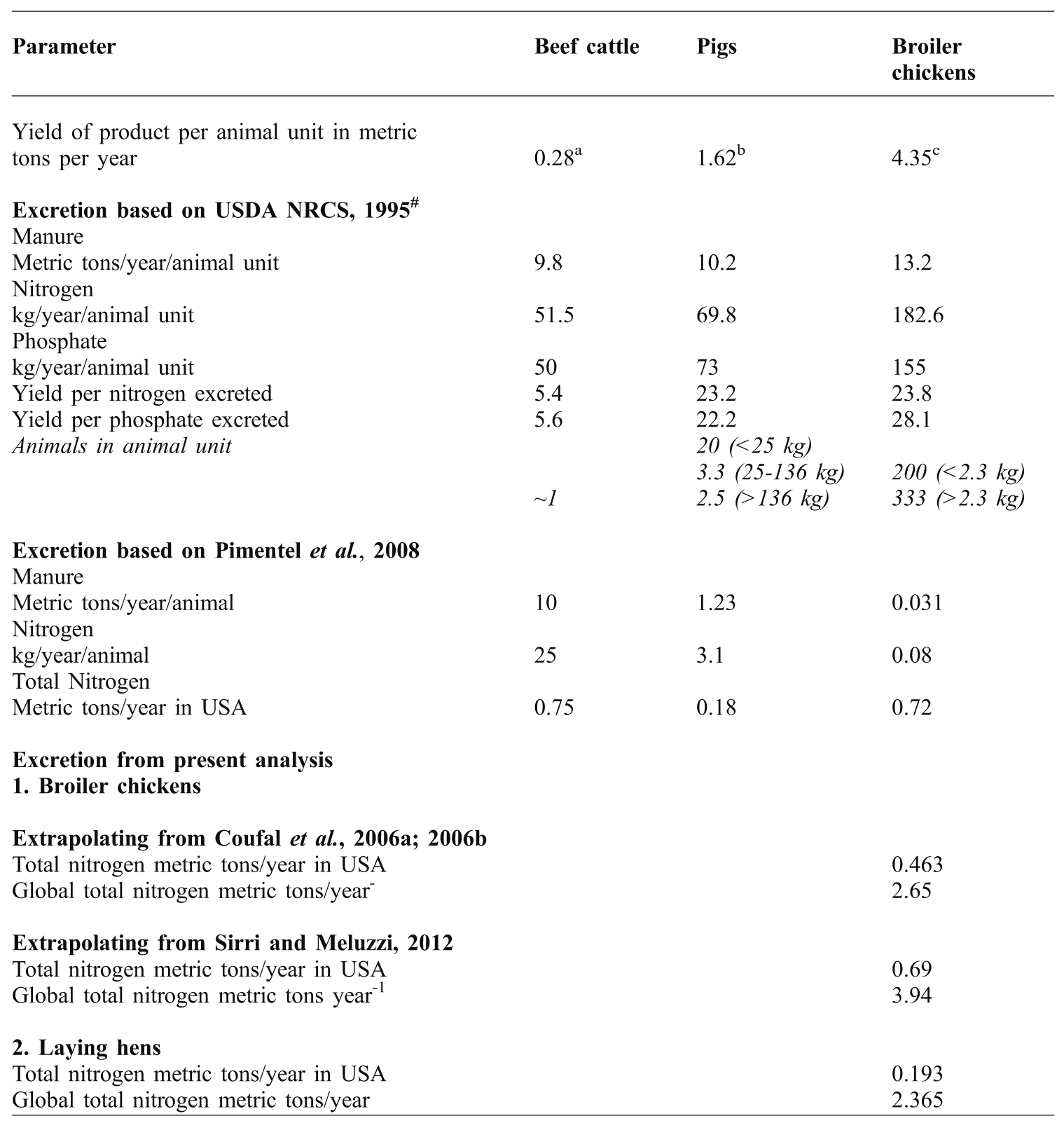
Nitrogen excretion from broiler chickens was estimated from whole house nitrogen balance studies (Table 2). Specifically, nitrogen excretion was considered as the sum the proportion of nitrogen in feed partitioned to litter and lost as gas (Coufal et al., Reference COUFAL, CHAVEZ, NIEMEYER and CAREY2006a; b); this value being 17.4 g N per kg live-weight. This estimate was employed to extrapolate excretion of nitrogen in the USA and globally.
Total nitrogen excreta (as NH3 and in litter as urate and other nitrogenous compounds) from broiler chickens in the USA in 2016 was estimated at 26.6 million metric tons live-weight (26.6 million kg live-weight) x 17.4 g N per kg live-weight. This equals 0.463 million metric tons (Table 2). Global total nitrogen in broiler chicken excreta was similarly estimated as 2.65 million metric tons based on 107.1 million metric tons of chicken meat (FAOSTAT) and 152.3 million metric tons of live weight chickens (Table 2).
This figure of 0.463 million metric tons is broadly consistent with the estimate of Pimentel et al. (Reference PIMENTEL, WILLIAMSON, ALEXANDER, GONZALEZ-PAGAN, KONTAK and MULKEY2008), but markedly lower than other estimates of nitrogen in excreta from broiler chickens. i.e. 0.72 million metric tons (Pimentel et al., Reference PIMENTEL, WILLIAMSON, ALEXANDER, GONZALEZ-PAGAN, KONTAK and MULKEY2008), 2.67 million metric tons (calculated from USDA NRCS, 1995) and less than 2.0 million metric tons (estimated from Ruddy et al., Reference RUDDY, LORENZ and and MUELLER2006, assuming that poultry constitute less than a third of the total for livestock and poultry excreta). Another published estimate of nitrogen excretion by broiler chickens was 25.9 g/kg (Sirri and Meluzzi, Reference SIRRI and MELUZZI2012). This would extrapolate to levels of nitrogen in excreta in the USA - 0.69 million metric tons and globally - 3.94 million metric tons (or 4.43 million metric tons for all poultry).
The relatively low figures for nitrogen in poultry excreta alone suggest that the issues related to loading (following land application) are of a markedly smaller magnitude than previously envisioned. However, levels of nitrogen in used litter are much lower than the estimated nitrogen excretion because of gas losses such as NH3. Total nitrogen excreta left in used litter by broiler chickens in the USA can be calculated based on the studies of Coufal et al. (Reference COUFAL, CHAVEZ, NIEMEYER and CAREY2006a; Reference COUFAL, CHAVEZ, NIEMEYER and CAREY2006b) as 23.3 billion metric tons live-weight x 6.348 g N per kg live-weight. This equals 168.9 billion g (or Gg) or 0.169 million metric tons of nitrogen.
Many meat-type chickens are raised on bedding composed of wood shavings, sawdust, peanut hulls, rice hulls or other shredded plant material. The bedding provides a soft surface for bird comfort. Excreta containing nitrogenous compounds builds up in the litter during bird growth, along with spilled feed and water together with shed feathers. In the following review, the term ‘used litter’ refers to litter after at least one flock production cycle. Composting used litter will not only reduce nitrogen but also decrease other problems such as odour and flies. Loss of NH3 during composting can be reduced by addition of magnesium and phosphate salts to allow formation of struvite, which improves nitrogen retention (Zhang and Lau, Reference ZHANG and LAU2007).
Comparison of yield and excreta produced by major meat animals.

# Calculated from data in USDA NRCS, 1995; Assumes marketing at 1250 lb (568 kg) 2 years from conception (accounting for cow in cow calf system); b Assumes 6.3 pigs per an animal unit (estimated based on linear growth rate and accounting for time in utero in the sow divided by number of piglets per gestation), 2 herds per year (calculated from FAOStat) and mean pig live-weight at marketing 128.2 kg (calculated from National Pork Board) (yield = 6.3 X 2 X 128.2/1000 metric tons); c Assumes 266 birds per an animal unit, live-weight at marketing 2.73 kg (National Chicken Council) and 6 flocks per year (yield = 266 X 2.73 X 6/1000 metric ton).
Nitrogen excretion in laying hens
The published data has been used to estimate nitrogen excretion in laying hens for this review. This was based on the assumptions of, firstly, there being 6 g protein present in a 50 g egg or 0.96g nitrogen in a 50 g egg (19.2 g nitrogen per kg eggs) and, secondly, there being a ratio of 1:1.665 egg nitrogen: excreta nitrogen (Latshaw and Zhao, Reference LATSHAW and ZHAO2011; de Carvalho et al., Reference DE CARVALHO, STRINGHINI, MATOS, FILHO, CAFÉ, LEANDRO and ANDRADE2012). Thus, excreta nitrogen was calculated as 32.0 g nitrogen per kg eggs or 32 kg nitrogen per metric ton of eggs. Given that global production of chicken eggs is 73.9 million metric tons (FAOSTAT), global production of nitrogen in excreta by laying hens (excluding pullets) was calculated to be 2.365 million metric tons (or 2.585 million metric tons for laying chickens, ducks and geese). Similarly, USA production of eggs is 6.04 million metric tons in 2016 (FAOSTAT). Therefore, production of nitrogen in excreta by laying hens (excluding pullets) can be estimated at 0.193 million kg or 0.193 million metric tons in the USA.
Ammonia
Globally, emissions of NH3 from animal agriculture, and specifically from manure, were estimated as 30 million metric tons; representing 64% of anthropomorphic NH3 emissions (Bouwman et al., Reference BOUWMAN, LEE, ASMAN, DENTENER, VAN DER HOEK and OLIVIER1997; Steinfeld et al., Reference STEINFELD, GERBER, WASSENAAR, CASTEL, ROSALES and DE HAAN2006). Ammonia reacts with atmospheric sulphur dioxide and nitric oxide in the atmosphere to form PM2.5 aerosols containing ammonium sulphate or ammonium nitrate. These aerosols result in reduced air quality and visibility (Wang et al., Reference WANG, NAN, SHI, FU, GAO, WANG, CUI, SAIZ-LOPEZ and ZHOU2015). Most of the NH3 will be deposited within 1 km from the site (e.g. poultry and livestock buildings (Fowler et al., Reference FOWLER, PITCAIRN, SUTTON, FLECHARD, LOUBET, COYLE and MUNRO1998; Shen et al., Reference SHEN, CHEN, BAI, SUN, COATES, LAM and LI2016). Thus, NH3 emissions can result in eutrophication of waterways and odour issues for close neighbours (Steinfeld et al., Reference STEINFELD, GERBER, WASSENAAR, CASTEL, ROSALES and DE HAAN2006).
Questions to be addressed
There are a series of questions which have not been fully addressed. Firstly, to what extent is nitrogen lost from excreta in used litter in the forms of NH3, gaseous nitrogen or nitrous oxide (N2O)? The assumption is that NH3 predominates. Secondly, do emissions of another GHG, methane, parallel those of NH3? Thirdly, does the rate of NH3 release vary through the growth of broiler chickens or with season or with increasing temperature? Fourthly, to what extent do the calculated nitrogen losses from a single, albeit outstanding, study reflect the overall situation in the USA and globally? And finally, do the reduced estimates of nitrogen excreted reflect improved broiler genetics and/or nutrition?
There is an important caveat to be stated before addressing these questions. The global estimates for quantities of nitrogen in poultry are likely to be under-estimates as there is markedly greater nitrogen excretion per unit weight of product with less intensive systems. This is due to poorer nutrition (including inadequately formulated diets) causing lower rates of production and higher rates of parasite infestation and pathogenic diseases (Wonga et al., Reference WONGA, DE BRUYNA, BAGNOLA, GRIEVED, M.LIE, PYM and and ALDERSA2017). Thus, there is considerable scope to reduce both excreta nitrogen and GHG emitted relative to meat and eggs produced.
Pathogens from poultry litter
There are high and diverse microbial populations (1010 CFU per g) in used litter (Chen and Jiang, Reference CHEN and JIANG2014) with greater diversity in wet litter, including the presence of the emerging human pathogen, Arcobacter spp. (Dumas et al., Reference DUMAS, POLSON, RITTER, RAVEL, GELB, MORGAN and WOMMACK2011). Other pathogens such as Clostridia and Staphylococcus spp. were not observed in used litter (Dumas et al., Reference DUMAS, POLSON, RITTER, RAVEL, GELB, MORGAN and WOMMACK2011). However, in other studies, the presence of E. coli, Campylobacter, Clostridium, Listeria, Salmonella, Staphylococcus and Streptococcus spp. were reported in used litter (Chen and Jiang, Reference CHEN and JIANG2014). In simulation studies of land application of used litter, Salmonella spp. were still detectable in the soil after two weeks (Molina et al., Reference MOLINA, WHELAN, FITZGERALD and STEVENS2013). Composting prior to land application reduces pathogens in used litter (reviewed: Chen and Jiang, Reference CHEN and JIANG2014). Pathogens from poultry manure have been shown to result in food-borne diseases in people (Atidégla et al., Reference ATIDÉGLA, HUAT, AGBOSSOU, SAINT-MACARY and KAKAI2016).
Land application of used litter and layer waste
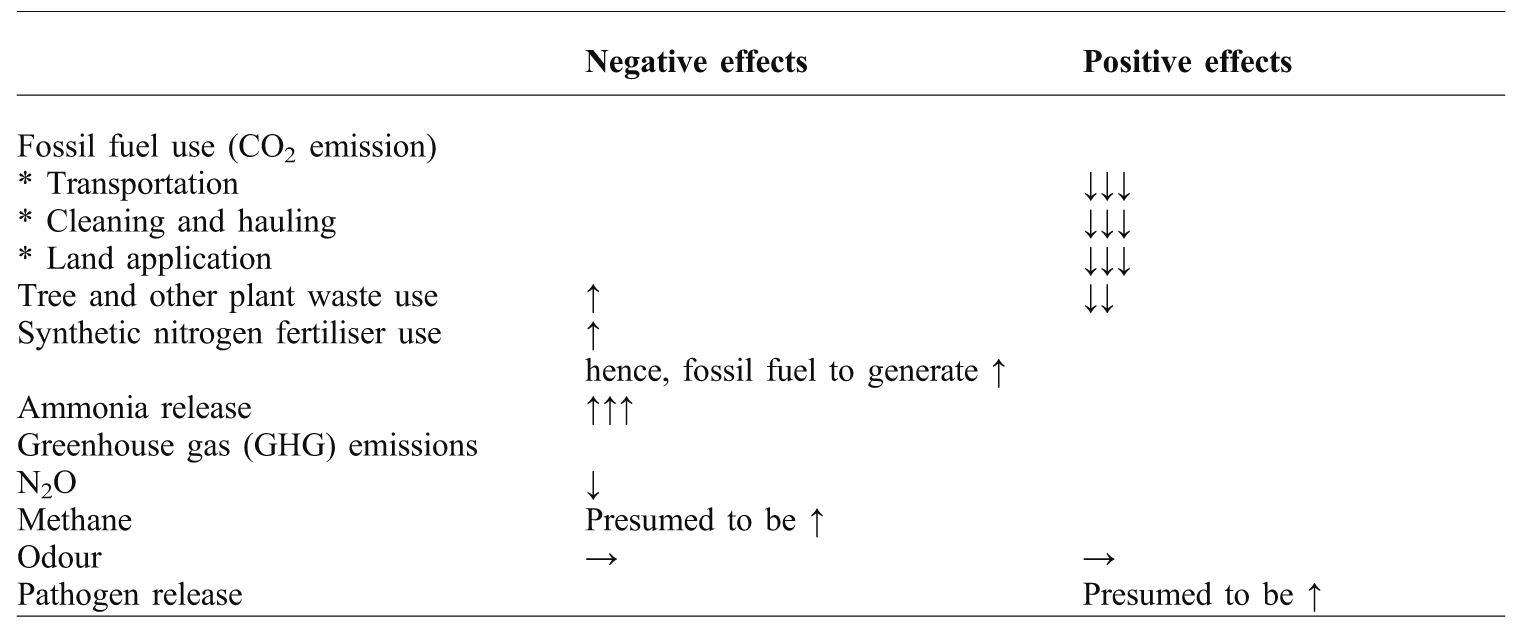
The effects of litter reuse on the environment is shown in Table 3. Land application of used poultry litter is the preferred method of disposal of waste (Williams, Reference WILLIAMS2010). Used litter can be a valuable resource providing plant nutrients, specifically nitrogen, phosphate and potassium. Poultry manure can be a relatively low-cost fertiliser, increasing soil nitrogen, phosphate and potassium and, thereby improving crop production or pasture growth (e.g. sorghum yield in Nigeria - Agbede and Ojeniyi, Reference AGBEDE and OJENIYI2009; corn and soybeans in USA - Watts et al., Reference WATTS, TORBERT, PRIOR and HULUKA2010; pasture - He et al., Reference HE, HONEYCUTT, TAZISONG, SENWO and ZHANG2009).
Effect of re-use of litter on the environment.

It has been estimated that livestock and poultry manure is applied to 0.3 million hectares of land in the USA, with corn production on 0.15 million hectares (McDonald et al., Reference MCDONALD, RIBAUDO, LIVINGSTON, BECKMAN and WANG2009; Bolan et al., Reference BOLAN, SZOGI, CHUASAVATHI, SESHADRI, ROTHROCK and PANNEERELVAM2010). It has been reported that the amount of used litter produced in 1998 was 1.46 kg per bird amounting 12 million metric tons per year in the USA in 1998 (Sharpe et al., Reference SHARPE, SCHOMBERG, HARPER, ENDALE, JENKINS and FRANZLUEBBERS2004) and 14 million metric tons in the late 2000s (Chen and Jiang, Reference CHEN and JIANG2014). However, with re-use of litter, it is likely that use of bedding materials has already or will markedly decrease in the near future and that the total amount of used litter needing to be removed from broiler chicken houses will be radically reduced. In developing countries, excreta is used effectively as fertiliser in some small-scale poultry production systems; these being either semi-intensive (50-200 birds) or small-scale intensive poultry production (>200 broilers or >100 layers; Wonga et al., Reference WONGA, DE BRUYNA, BAGNOLA, GRIEVED, M.LIE, PYM and and ALDERSA2017).
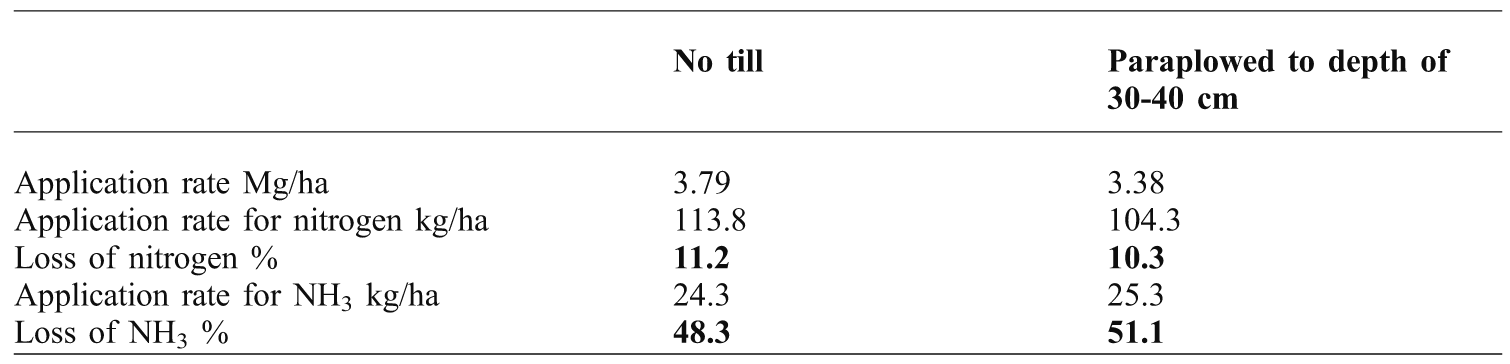
The value of used litter and other poultry excreta is supported from the report of no differences in corn yield after land application comparing poultry manure with ammonium nitrate synthetic fertiliser (Bitzer and Sims, Reference BITZER and SIMS1988). Moreover, soil levels of nitrogen after harvesting were somewhat higher for ammonium nitrate (Bitzer and Sims, Reference BITZER and SIMS1988). It is not clear whether soil quality is improved by the application of used poultry litter. Other questions that might be posed are the following; to what extent is land applied litter effective in sequestering carbon? In one study, soil organic carbon was not increased following application of chicken manure in a two crops per year system of growing tomatoes over a four-year period (Ren et al., 2014). Are there environmental issues with land application of used poultry litter? The European Commission-Directorate-General for Environment (2001) concluded that “emissions from land spreading of the two greenhouse gases nitrous oxide (N2O) and methane (CH4) are relatively small compared with emissions from manure stores, fertilised land, housing and outdoor livestock”. However, some N2O is released from manure as it is from synthetic fertilisers (Baggott et al., Reference BAGGOTT, CARDENAS, GARNETT, HOBSON, JACKSON, MOBBS, MURRELLS, PASSANT, THOMSON and WATTERSON2007). About a tenth of the nitrogen in used litter is lost after land application irrespective of whether in a no-till system or para-ploughed (Table 4; Sharpe et al., Reference SHARPE, SCHOMBERG, HARPER, ENDALE, JENKINS and FRANZLUEBBERS2004). The loss is due to nitrogen being lost in gases or dissolved in ground water and/or surface water. There is a higher rate of loss, about 50%, for NH3 (Sharpe et al., Reference SHARPE, SCHOMBERG, HARPER, ENDALE, JENKINS and FRANZLUEBBERS2004). It is estimated that 2% of nitrogen in manure is released as the GHG, N2O (Davidson, Reference DAVIDSON2009). The global warming potential of N2O is considered as 298 CO2 equivalents per unit as a GHG (IPCC, 2007).
Application of used litter and losses (data from Sharpe et al., Reference SHARPE, SCHOMBERG, HARPER, ENDALE, JENKINS and FRANZLUEBBERS2004).

There is considerable run-off of nitrogen and phosphate from both synthetic fertilisers and manure into surface water (rivers, lakes and streams). Kelleher et al. (Reference KELLEHER, LEAHY, HENIHAN, O'DWYER, SUTTON and LEAHY2002) concluded that nitrate contamination of ground water is seen with high rates of land application of used litter. The magnitude of the problem of run can be gleaned from the concentrations of nitrogen and phosphorus present in waters of rivers and streams in the USA which are the following, according to US government data: USA: <1 mg/l nitrogen; 1.2 mg/l phosphorus but US Corn Belt: 8 mg/l nitrogen; 3.5 mg/l phosphorus (USEPA, 1975 and USGS, 2017). In comparison, the maximal acceptable levels are 10 mg/l for nitrogen and 0.1 mg/l phosphorus (Barnhart et al., Reference BARNHART, BOSTIAN, FARE, GROSSKOPF, WHITTAKER, SINHA, MICHALAK and PAPENFUS2016; Mueller and Helsel, Reference MUELLER and HELSEL2017; USGS, 2017). A particular example of a significant problem was the run-off from poultry manure applied to agricultural land in the Delmarva Peninsula in the USA. Estimates of plant nutrients from run off entering the Chesapeake Bay were annually 26.3 million kilograms of nitrogen and 2.0 million kilograms of phosphorus (as phosphate) (Schroeder et al., Reference SCHROEDER, RADCLIFFE and CABRERA2004). This led to deterioration of water quality (Schroeder et al., Reference SCHROEDER, RADCLIFFE and CABRERA2004). Phosphate in surface water can lead to eutrophication of waters due to proliferation and a bloom of phytoplankton including cyanobacteria while nitrate is associated with ‘dead zones’ in marine environments (Diaz and Rosenberg, Reference DIAZ and ROSENBERG2008; Chislock et al., Reference CHISLOCK, DOSTER, ZITOMER and WILSON2013).
Re-use of litter
There is less used litter being applied as a fertiliser and for soil conditioning. Increasingly, at least in the USA and Brazil, litter is re-used in broiler houses from sequential flocks for 15 or more flocks (Wiedemann, Reference WIEDEMANN2015). However, caked litter is removed between flocks. At the end of each flock, the house can be effectively sealed in the absence of ventilation. Microbial fermentation of the used litter is characterised by rising temperatures and a build-up of NH3 in the house. This composting may be performed with the used litter piled into windrows (Coufal et al., Reference COUFAL, HARMEL and GENTRY2014). When litter is re-used for series of flocks, nitrogen levels in the litter reach a steady state, but levels of phosphate and potassium increase progressively (Chamblee and Todd, Reference CHAMBLEE and TODD2002; Coufal et al., Reference COUFAL, CHAVEZ, NIEMEYER and CAREY2006b). The obvious corollary is that the vast majority of nitrogen lost by each flock in their excreta is as gas, presumably predominantly NH3. Nitrogen loss as NH3 has been estimated as 11.07 g of N/kg liveweight (Coufal et al., Reference COUFAL, CHAVEZ, NIEMEYER and CAREY2006a). In addition, there may be shifts in methane emissions from litter fermentation, with methane being a GHG with an equivalency of 25 times that of carbon dioxide (CO2). There is little or no difference in the odour emissions with litter re-use (Wiedemann, Reference WIEDEMANN2015). However, there is greater emission of NH3 (Wiedemann, Reference WIEDEMANN2015) particularly with increased litter moisture (Martins et al., Reference MARTINS, HÖTZEL and POLETTO2013).
In the presence of both NH3 and elevated temperatures between flocks, pathogen numbers are reduced. This is supported by the decreased percentages of litter samples testing positive for Salmonella spp. with repeated re-use of litter for consecutive flocks (Roll et al., Reference ROLL, DAI PRÁ and ROLL2011).
This practice is in contrast with the Gothenburg Protocol, which established a series of measures to reduce NH3 emissions from poultry and livestock production (UNECE, 2012). The targets for reductions in NH3 emissions from poultry were 20% for poultry in existing housing and 20-90% for new poultry houses including removal of excreta frequently. Moreover, the European Union Commission (2017) promulgated a series of “best available techniques” (BAT) for livestock and poultry production. These included, for broiler chickens, the need to reduce NH3 release from poultry houses to below 0.01-0.08 kg NH3/animal/year, forced air drying of litter using indoor air, calculation of mass balance for nitrogen (based on feed intake, feed nitrogen content and nitrogen in the marketed product) and the determination of NH3 released.
What are the advantages of re-using litter?
The obvious advantages include elimination of both the costs of fresh litter and labour costs of removal of the used litter from the house and for land application (Cressman et al., Reference CRESSMAN, YU, NELSON, MOELLER, LILBURN and ZERBY2010). What are the environmental effects? The effect of litter reuse on the environment have not been quantified but involve countervailing, perhaps balancing, effects (Table 3). Another question that might be posed is to what extent is re-use of litter (where litter is being used) being practiced in different countries and, in aggregate, globally?
It has been argued that advances in poultry production will further reduce the utility of used litter. It is anticipated that amounts of nitrogen, phosphate and potassium in the excreta will be reduced due to the application of such approaches as superior diet formulation, addition of enzymes to the diet and improved digestibility and absorption of amino-acids, phosphate and potassium. Examples of this include the reduced nitrogen excretion by optimising dietary protein (Ferguson et al., Reference FERGUSON, GATES, TARABA, CANTOR, PESCATORE, STRAW, FORD and BURNHAM1998) and lower amounts of phosphate in the excreta with phytase incorporation into the feed (Powell et al., Reference POWELL, JOHNSTON, GASTON and SOUTHERN2008).
Alternative applications of used litter and other poultry excreta
feeding used litter and other poultry excreta to livestock
According to the FAO (2004), feeding poultry litter to cattle and sheep is practiced in many countries. The European Union does not permit feeding poultry litter to livestock and this matter is a controversial issue (McDougal, Reference MCDOUGAL2018). In South Africa, trading of poultry litter as an animal feed is not legal but “a farmer can feed poultry litter that is available on his farm or buy litter as a fertiliser and feed it to his livestock” (van Ryssen, Reference VAN RYSSEN2001).
Dried layer excreta can be used for ruminant feed as it provides sufficient levels of digestible energy, crude fibre, crude protein (nitrogen), crude fat, cobalt and iodine (Ghaly and MacDonald, Reference GHALY and MACDONALD2012). Dried laying hen excreta was reported to have digestible energy value of 1.36 Mcal/kg and contained 42% ash and 27% crude protein (Zinn et al., Reference ZINN, BARAJAS, MONTANO and SHEN1996). There was high degradation of nitrogen in the rumen but low degradability of bypass nitrogen after the rumen (Zinn et al., Reference ZINN, BARAJAS, MONTANO and SHEN1996). However, there is a need to supplement dried layer excreta with calcium, chloride, magnesium, phosphorus, potassium, sodium, copper, iron, manganese, selenium, sulphur or zinc (Ghaly and MacDonald, Reference GHALY and MACDONALD2012).
Dried layer excreta have been employed effectively in supplements for growing bull calves (Alam et al., Reference ALAM, KHAN, AKBER and KAMRUZZAMAN2008), growing sheep, fed a cassava peel-based diet (Okeudo and Adegbola, Reference OKEUDO and ADEGBOLA1993), supporting milk production in cattle (Thomas et al., Reference THOMAS, YU, TINNIMITT and ZINDEL1972; Odhuba, Reference ODHUBA2009) and, following ensiling whole corn, improved crude protein, and total digestible nutrients when fed to sheep (Kim et al., Reference KIM, KIM, KIM, LEE and KO2000). In contrast, dried layer excreta was either not effective or there were negative effects with depressed performance in broiler chickens (Blair and Herron, Reference BLAIR and HERRON1982) and limited utility in fattening sheep (Thomas et al., Reference THOMAS, YU, TINNIMITT and ZINDEL1972).
The evidence for the applicability of used broiler litter as a feed supplement is equivocal. Used broiler litter have been employed effectively in supplements for growing bull calves (Alam et al., Reference ALAM, KHAN, AKBER and KAMRUZZAMAN2008). Studies of a fermented product of poultry excreta and offal incorporated into poultry feed showed it to be effective (Dafwang et al., Reference DAFWANG, COOK, PRINGLE and SUNDE1986). There are studies reporting a lack of positive effects of feeding poultry waste. Autoclaved used peanut-hull broiler litter was inferior to soybean protein in growing sheep (Bhattacharya and Fontenot, Reference BHATTACHARYA and FONTENOT1965). There was little effect of feeding broiler litter diets on growth in growing sheep (Obeidat et al., Reference OBEIDAT, AWAWDEH, ABDULLA, MUWULLA, ABU ISHMAIS, TELFAH, AYROUT, MATARNEH, SUBIH and OSAILI2011).
In the USA, used poultry litter can make up 50% of the feed for beef, 65% for lactating cows and 80% of dry brood cows in cattle systems (Rankins et al., Reference RANKINS, RUFFIN and VAN DYKE2000). It is important to ensure that pathogens are greatly reduced from the used poultry litter, as “All litter, regardless of its source, should be processed to eliminate pathogenic organisms… A temperature of 55°C or higher will occur in the stack within 5 days” (Rankins et al., Reference RANKINS, RUFFIN and VAN DYKE2000). There are systems that are effective in reducing pathogens. For instance, used litter can be ensiled with chopped whole corn/maize or another suitable cereal, acidified by spraying with either propionic or acetic acid or pelleted by extrusion (Daniel and Olson, Reference DANIEL and OLSON2005). Alternatively, used litter can be deep stacked such that the fermentation temperature reaches 60°C to kill pathogens (Rankins et al., Reference RANKINS, RUFFIN and VAN DYKE2000; Daniel and Olson, Reference DANIEL and OLSON2005).
Used litter for fuel or biomass
There is considerable potential for employing used poultry litter as an energy source or for biomass (Dagnall, Reference DAGNALL1993). Approaches include direct combustion or burning following gasification or microbial fermentation. On farm combustion can be useful, including in Europe, with “poultry manure on farm …having … the same thermal efficiency (over 86%) as the combustion of biomass (e.g. wet wood chips)” (Dimache et al., Reference DIMACHE, O'CONNER and KEARNEY2013). The net energy of used litter (10.3 MJ wet/kg) is slightly less than wood chips (12.1 MJ wet/kg); and are assumed to be the same as new bedding materials. Used litter has less energy than lignite (14.0 MJ/kg) and bituminous coal 29.1 MJ/kg (Chastain et al., Reference CHASTAIN, COLOMA-DEL VALLE and MOORE2012). There are decreases in energy with increasing water content (Dávalos et al., Reference DÁVALOS, ROUX and JIMÉNEZ2002). It might be argued that large scale use of litter to generate electricity may be not be commercially viable due to its low energy content compared to coal or natural gas; the high costs of labour, equipment and fuels in transporting to a central location; difficulties in automated movement of the used litter; lack of continuity of availability; and issues of disposal of the ash with the high concentration of potash, phosphate and calcium (Chastain et al., Reference CHASTAIN, COLOMA-DEL VALLE and MOORE2012). Chicken litter is being used following gasification in the Netherlands as a biofuel from green electricity (Bolhar-Nordenkamp et al., Reference BOLHAR-NORDENKAMP, GARTNAR, TSCHANUN and KAISER2009). Another possibility is on farm combustion of used litter to generate heat for brooding instead of using propane or natural gas. Concerns have been expressed regarding hazardous emissions from the incineration of used poultry litter including particulates, dioxins, arsenic and bioaerosols (Stingone and Wing, Reference STINGONE and WING2011). There is potential for gasification of litter and then using it to generate heat and electricity. Small scale reactors using poultry excreta as the energy source are being used; for instance, in India and China (Bond and Templeton, Reference BOND and TEMPLETON2011). It can be concluded that, while there is considerable potential to utilise used litter, there are both labour and capital costs.
Conclusions and projections
The nitrogen in poultry excreta has been estimated at 2.65 million metric tons globally. This represents a valuable fertiliser. It might be argued that the nitrogen in poultry excreta is inconsequential compared to the global use of nitrogen fertilisers. The total global use of nitrogen fertiliser in 2012 was estimated as 103 million metric tons and is projected to increase to 110 million metric tons by 2020 (Good and Beatty, Reference GOOD and BEATTY2011). Thus, poultry excreta represent less than 3% of nitrogen in synthetic fertiliser used globally. Irrespective of whether the excreta in used litter comes from large commercial or small-scale production systems, it is produced in concentrated loci but it can, after land application, has strong positive effects on crop production.
There are negative environmental consequences of poultry production due to release of the NH3 and the greenhouse gas, nitrous oxide, together with contamination of surface and ground water. At least in the USA, there is a trend for re-use of litter with consequent probable increased release of NH3. With increasing production of poultry meat and eggs globally, there needs to be continued and, indeed greater, attention to sustainability issues of production.
Acknowledgements
Financial support by Rasht Branch, Islamic Azad University, grant number 17.16.4.8774 is gratefully acknowledged.