China has recently emerged as one of the world’s largest consumers of meat. In 2016, Chinese meat consumption was around 50 kg per capita, just over half the 97.1 kg average in the meat-loving USA, and enough to account for 28 percent of the world’s total (Milman and Leavenworth Reference Milman and Leavenworth2016; OECD 2021; Zhongguo jumin shanshi zhinan 2016). China’s new appetite for meat has attracted global attention, both from producers who hope to find a place in the vast Chinese market and from advocates who fear the health, food safety, and ecological implications of the country’s growing meat imports and domestic livestock production (DuBois and Gao Reference DuBois and Gao2017; Schneider Reference Schneider2014).Footnote 1
At first glance, China’s new prominence among the world’s carnivores neatly coincides with the country’s larger economic transformation. Observations of the stunning growth of China’s food industries generally begin with the market reforms of the early 1980s, a time when total per capita meat consumption was a mere 13.62 kg per year (Zhang et al. Reference Zhang, Wang and Martin2018). But that starting point may be artificially low, as it followed decades of austere consumption—including the severe famine of the late 1950s and early 1960s (Bramall Reference Bramall2011; Dikötter Reference Dikötter2010). Or it may not. While we can measure with some reliability such aggregated markers of progress as GDP or national grain production (Maddison Reference Maddison2007; Perkins Reference Perkins1969), there remains a great deal of disagreement about how the seismic transitions of the planned economy affected actual living standards, in part because such conditions varied so intensely. (Bramall Reference Bramall2011 highlights the value of county-by-county analysis.) For the decades that preceded the Communist Revolution of 1949, understanding the scale and patterns of how and when people consumed animal protein can provide insight into material well-being, as well as the state of animal husbandry, interregional trade, and the cultural impact of diet.
Understanding meat in Chinese historical diets: Three seats at the table
There is little agreement on the place of meat in China’s historical diets. A long-standing perception views the country as largely vegetarian, either by moral conviction or as a function of poverty. Certainly, Buddhist vegetarianism was widely practiced or at least admired. In addition, Vincent Goossaert (Reference Goossaert2005) has shown that a Confucian-derived sense of gratitude for the labor of work cattle (yi niu) fed what one late-nineteenth century missionary described as “a strong and almost universal prejudice against eating beef” (Nevis Reference Nevis1882: 246). Travel accounts often claimed that Chinese people ate little or no meat. A French missionary in eighteenth-century Beijing explained that the displacement of husbandry by intensive farming left “no manure for the fields, no meat on the tables, no horses for battle” (Braudel Reference Braudel1981: 200). A similar depiction from 1934 described meat as “a rare treat” (Cressey Reference Cressey1934: 173), and subsequent investigations by twentieth-century agronomist John Lossing Buck (Reference Buck1937) depict Chinese farming families raising pigs and barnyard poultry but selling the animals to buy grain rather than consuming the meat themselves. Based on livestock estimates similar to the ones used in this article, Dwight Perkins (Reference Perkins1969: 15) concludes that “China has never been a major producer and consumer of meat.” In two separate studies of Chinese agriculture, Francesca Bray (Reference Bray1984: 5) and Frederick J. Simoons (Reference Simoons1991: 293) each concluded that “the Chinese diet is largely/was overwhelmingly vegetarian,” while Fernand Braudel confidently proclaimed of China that “meat was rare. There were hardly animals for slaughter” (Reference Braudel1981: 1999). In many cases, a simple lack of data amplified received knowledge. A detailed 1912 study of the global meat trade rejected the possibility of exporting meat to Asia, based on the sweeping claim that the inhabitants, “where they are not entirely vegetarian, are too poor to buy imported meat.” A similar League of Nations report from 1939 dismissed China’s entire meat trade as either unknowable or too insignificant to measure (Critchell and Raymond Reference Critchell and Raymond1912: 236; Taussig and Moskovits Reference Taussig and Moskovits1939: 12).
Other evidence suggests that Chinese people consumed meat regularly. Meat figures prominently in Chinese travel literature, such as the depiction of Kaifeng street foods in the twelfth-century Dream Journey Through the Eastern Hua Capital (Meng Reference Meng2019 [1187]), in epicurean tracts like the eighteenth-century Gastronomy of the Sui Garden (Yuan 2015 [1792]), and medical ones like the Suixiju Book of Food and Drink (Wang Reference Wang2022 [1861]). Kuo Chung-hao (Reference Kuo2013) and Wu Jen-shu (Reference Wu2018) have used this sort of literature to show that meat eating was considered an integral part of health and culinary culture. Although unable to speak to actual consumption, pioneering work on living standards and food consumption in China (as part of the larger literature on the “great divergence” between China and Britain) has surmised that the cost of a comfortable lifestyle, including a meat-rich Northern European diet, would have been comparable in mid-eighteenth-century London and Beijing (Allen, et al. Reference Allen, Bassino, Ma, Moll-Murata and Zanden2011: 23–5). A travel writer from 1894 estimated that southern Chinese diets consisted of about five parts vegetable and one part animal, while northern ones were about half and half (Clark Reference Clark1894: 123). Contrary to the perception that meat was only for the well-off, the Gastronomy of the Sui Garden prefaces its section on vegetable dishes by noting that “the privileged and wealthy are fonder of vegetarian (su) dishes than they are of meat-based (hun) ones” (Yuan 1792).
Both of these depictions, those of Chinese as vegetarians and those of Chinese as enthusiastic meat eaters, may be correct without being representative. Since animal husbandry is highly regional, seasonal, and dependent on year-to-year change, it is hazardous to use ethnographic snapshots of any one place and time to build cultural assumptions about diets thousands of miles away. This is especially true for a nation as large and complex as China. The distance—both physical and culinary – from Chengdu to Beijing is at least as great as that between Rome and London.
Possibilities for understanding China’s food history become much wider for the twentieth century. Using ephemera like restaurant menus, scholars have examined the changing meanings of food, including regional and urban tastes, political necessity, and national strength (Lee Reference Lee2011; Swislocki Reference Swislocki2008, Reference Swislocki2011). Especially important for this period is the new availability of quantitative data. During the early twentieth century, Chinese and foreign researchers conducted surveys on all manner of topics, notably on questions of economic livelihood and trade (Faure Reference Faure, Kiely and DuBois2019; Grove Reference Grove, Kiely and DuBois2019). It requires some care to make this “tsunami” (to use Faure’s phrase) of statistics speak to the question of diet. Reports are often incomplete or methodologically careless, and even when reliable, they are bound both by the reach and aims of the scholars that produced them. Studies that examine food from a political, commercial, or nutritional perspective will each reveal unique facets of the same phenomenon.
This study uses three different sorts of data to present three distinct perspectives on Chinese meat consumption during the early twentieth century, moving beyond the simple question of how much meat people ate to show what kind of meat they ate and how often they did so, as well as where meat consumption figured in relation to household budgets, commercial trends, and animal husbandry practices. The first is Japanese price surveys from the 1920s, which show the relative cost of meat in different regional markets and suggest that for most people a small amount of meat would have been a minor luxury. The second is industry statistics collected during the mid-1930s. Slaughterhouse statistics reveal that urban access to meat was highly seasonal, while sales of animal products like hides and pig bristles attest to the massive scale of animal husbandry in the countryside, where most people lived. Finally, nutrition and dietary surveys conducted from 1920 to the late 1940s give the first insight into actual diets, confirming the high degree of individuation by income, location, and family life circumstances.
Taken together, the three perspectives agree that Chinese people in the first half of the twentieth century consumed a small but not insignificant amount of animal protein. (The nature of our sources prevents us from including in this study any manner of sea life, despite the nutritional, economic, and cultural importance of fresh and dried fish and shellfish in China, including the integration of aquaculture with animal husbandry; Ruddle and Zhong Reference Ruddle and Zhong1988.) But equally striking is how juxtaposing these different approaches highlights the blind spots inherent in each one. On its own, each of our sources is not only incomplete but potentially misleading. Prices and production statistics show possibilities but not choices, while dietary surveys demonstrate above all that no region or household should be regarded as typical. Comparing these different depictions brings into view the complexity of historical diets, as well as the hazard of relying solely on any one type.
Source 1: Price surveys, 1915–1925
The first of the three sources is a series of price surveys carried out by Japanese consular authorities during and immediately after the Great War, an event that created conditions of food insecurity and scarcity on a global scale. The European continent was the most directly afflicted, both by the destruction of crop land and productive capacity and by the disruption of a highly interdependent system of global food trade. Reliant on imports for many of its basic food items, Britain responded to the crisis by prioritizing domestic production, fixing prices for important commodities, and levying harsh punishments on hoarders (Gazeley and Newell Reference Gazeley and Newell2013). Further from most of the fighting, food trade in Asia was still deeply affected, with merchant shipping scarcity and wartime requisitioning creating shortages of rice, meat, tinned milk, sugar, and palm oil (Doeppers Reference Doeppers2016; DuBois Reference DuBois2019b). Markets for important food commodities would remain unsettled well into the 1920s.
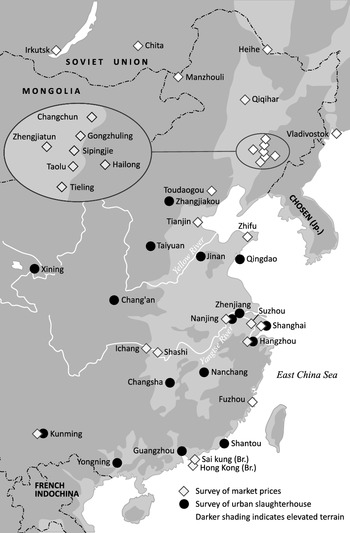
Fearing local effects of these disruptions, Japan kept a close eye on the production and prices of food across the region. Formerly a rice exporter, Japan had begun in the 1890s to rely on food imports, producing sophisticated industry intelligence on the regional production and trade of such key commodities as soybeans. By 1910, the year that the Japanese Ministry of Agriculture and Commerce (Nōshōmushō) first instructed its overseas consulates to begin collecting local data on food prices, the country was already heavily dependent on the continent for food security. The file of reports collected as “Investigations of Prices of Daily Use Items” (JACAR 1910–1920; see “Appendix: Chronology of Japanese price surveys” in supplementary materials) shows that responses to this request began trickling in early in the decade, with most of the surveys carried out toward the end of the war, urged on by fears of grain hoarding and the 1918 outbreak of rice riots in Japan. Concentrated in northern China, Siberia, and especially Manchuria (see Figure 1), the cities surveyed were at once potential sources and competitors for supply, as well as markets for Japanese food and non-food exports (Institute of Pacific Relations 1933; concerning Shanghai, see JACAR 1920–1921: 62–6).
Survey sites in China and Siberia.

Many factors complicate direct comparison of price data collected from different sites. Consulates carried out their work independent of each other, with no common methodology and, it seems, varying degrees of care. Commodities were not always of similar quality, and standard items like sugar and flour were often priced differently according to their place of origin. Surveys make reference to a wide range of standard and non-standard weights and currencies, including Russian rubles (which were used in Chinese border towns like Manzhouli and Heihe), and obsolete currencies like guantie (China Bureau of Foreign Trade 1927a). Beyond these technical problems, the years covered span a rapid spike in commodity prices, which accelerated after 1916, especially in those cities that traded frequently with Russia. Even without the problem of inflation, the natural cyclicality of food prices, such as those shown in Table 1, adds to the difficulty of making meaningful comparison between any two snapshots taken at different times of year (see also China Bureau of Foreign Trade 1927b, 1927c).
Seasonal variation in Jilin rice prices, 1920

Note: Prices in yuan per three dou of rice (first grade).
Source: Report of Consulate of Japan in Jilin, September 2, 1920 (JACAR 1910, 1920). The full set of price measurements is available at DuBois (Reference DuBois2021b). Averages calculated from the full data differ from the smaller sample of cities presented in the table.
Their limitations all having been noted, what can these surveys tell us? Price data speak to a number of issues, the first of which is preference. A “price-of-subsistence” analysis of the sort that has been employed by economists and nutritionists (including those discussed in the third part of this article) might approach food consumption strictly in terms of nutritional needs, arranging aggregate data into different permutations by which a household budget could be made to reach the most basic requirements for calories and protein (Allen, et al. Reference Allen, Bassino, Ma, Moll-Murata and Zanden2011: 21–3).Footnote 2 Yet while certainly useful, this perspective hardly represents how people actually live. Food consumption, even among the poor, is still a matter of enjoyment, taste, prestige, and custom. Among the more comfortable, it is even more conspicuously so.
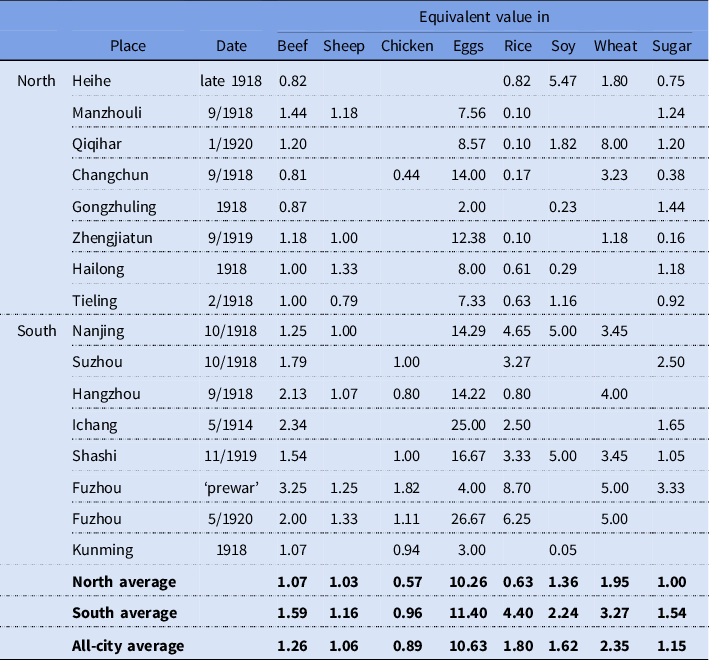
Preference for one type of meat over another is a product of time and place. The long-term rise of pork as China’s overall protein of choice was brought about by a population shift from the dry north to warmer and more moist and densely urbanized Jiangnan, all features that favored pig raising over sheep herding (Kuo Reference Kuo2013). Price data from the twentieth century show that such preferences remained highly local. Table 2 presents a snapshot of comparative value by showing the price value of one jin Footnote 3 of pork measured against an equal measure of other commodities: meat, rice, soybeans, wheat, and sugar (eggs are measured by the piece rather than by weight) in a cross-section of cities, arranged from north to south. At a national level, these prices suggest a slight preference for pork over beef and a comparable preference for chicken over pork. That is, for the price of one jin of pork, one could buy a slightly greater amount of beef or a slightly smaller amount of chicken. Sheep and pork were at rough parity. There is also a discernible regional tendency for northern markets to favor beef and sheep. On average, one jin of pork bought 1.07 jin of beef in markets north of the Yellow River, while farther north in such markets as Heihe, Changchun, and Gongzhuling, beef was significantly more costly than pork. (Qiqihar and Manzhouli are both adjacent to cattle-producing areas, which brought down their price of beef.) South of the Yellow River, pork was more expensive, worth an average of 1.59 jin of beef. In the southern city of Fuzhou, the price ratio of pork to beef was at one point greater than three to one.
Price equivalent of one jin of pork in selected markets

Source: (JACAR 1910–1920). The full set of price measurements is available at “China price data, 1910–1920” doi.org/10.7910/DVN/XSRAY9. Averages calculated from the full data differ from the smaller sample of cities presented in the table.
Trends in the price of meat in relation to other food staples are less pronounced. Measured against rice, meat was costly in such southern cities as Shashi and Fuzhou but cheap in the north. Geographic patterns are less pronounced when measured against wheat flour, though prices are very sensitive to time when measured against soybeans and sugar, which spiked in price in 1919 and 1920. Clearly the key factor here was less the availability of meat than the rapidly changing local value of what it was being measured against.
The local context of relative value is especially important when measuring food against wages. Rather than a real measure of household income, reported wages are best thought of as a notional figure. They would not include the labor of other family members, nor income from sideline activities, and would fluctuate depending on the season. Yet they can serve as a benchmark of what commodity prices might have meant to workers in different places. A day’s wage for a skilled craftsman such as a carpenter could buy about 1.5 jin of pork in densely populated Hangzhou or slightly more in Shashi. But wages went much further in less populated northern cities, where meat was more available: A similar day’s wage bought over two jin of pork in Changchun, three in Tieling, and as much as eight in Sipingjie. The higher figures might reflect temporary conditions of labor shortage, but even then they might not be so exceptional. The normal agrarian cycle produced regular periods of labor scarcity, most intensely at harvest, which is also a prime season for the sale and slaughter of fattened animals.
Finally, the price surveys reveal something about how meat was made and brought to market, since prices will converge as commodities move more freely. Price convergence is best demonstrated by such durable and highly standard commodities as grain. In late-nineteenth-century Japan, the introduction of telegraph and rail service standardized rice prices by giving traders the ability to appraise local inventory and quickly move stocks from where they were cheap to where they were dear (Ito et al. Reference Ito, Maeda and Noda2017). As Lillian Li (Reference Li2000) and others (Cheung Reference Cheung2008, Chuan and Kraus Reference Chuan and Kraus1975) have shown, price convergence in Chinese grain markets was neither permanent nor unidirectional; political disunity or the emergence of competing markets could disintegrate the network of grain shipments that had once allowed Beijing consumers to eat at Hangzhou prices.
Unlike grain, though, trade in live animals or fresh meat was constrained by specific logistic parameters. Density of stockbreeding depended on climate and natural resources. Grazing animals like cattle and sheep were raised in areas of pasture or mixed-use agriculture, and driven live to market; most of the sheep consumed in Beijing were brought in live from the grasslands of Mongolia (Meng and Gamble Reference Meng and Gamble1926: 36). Pigs were easier to raise in moist southern climates but were far more difficult than grazing animals to transport. New railways created meat-packing centers in cities like Harbin and Qingdao, but even with railroads, the shipping of live animals was restricted to a few well-traveled corridors and lacked the flexibility or efficiency to respond quickly to fluctuation in prices created by such unpredictable and localized events as good or bad harvests (Du Reference Du2021; DuBois Reference DuBois2019a).
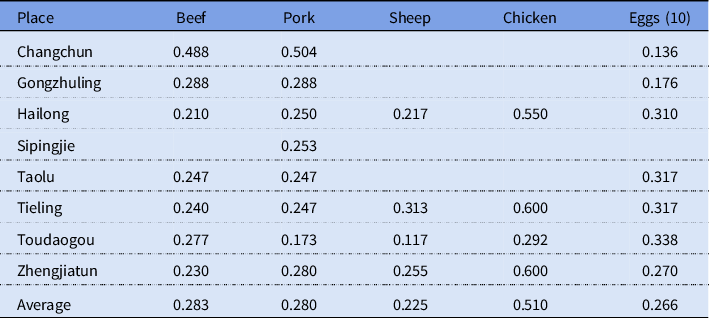
Table 3 shows prices for meat in markets near the city of Changchun (Figure 1, inset). The degree of variation even within this relatively small (roughly 200 km radius) area suggests that the movement of animals was hardly free. Of the different prices, beef was the most stable, ranging between 2.1 and 2.9 yuan per jin within smaller towns. Pork was slightly less so at 1.7–2.9, and chicken the least from 0.29 to 0.60. The city of Changchun paid roughly double the prices of smaller markets, despite sharing a rail line with Tieling, Sipingjie, and the meat-processing center of Harbin. The high price disparity between locations, combined with the fact that each of the smaller towns had its own slaughtering grounds (Changchun had four modern slaughterhouses), suggests that meat was primarily a local product: raised, slaughtered, and consumed all within a small area. Still, we must be careful not to read too much into the data at hand. Prices are drawn from snapshots taken at different times over successive years, including contradictory figures taken from the same time and place. We cannot know for certain how much of the difference between locations is actually a matter of poor sampling, seasonal fluctuation, inflation, or a mixture of all three.
Price of meat within Changchun area

Note: Except for eggs, all prices are per jin. Chicken prices given as whole bird are excluded.
Source: DuBois (Reference DuBois2021b).
In sum, the price surveys are best used as a guide to relative value within a single location, and that image becomes less reliable when comparing across months or years of dramatic upheaval. Ultimately, reported prices are able to only hint at answers to our other questions. Beyond the problems of comparing data that were collected using different currencies and without a common method, the real limitation is that prices show only possibilities, not actual choices. We may surmise that meat would for many have been an affordable luxury, something that might have made its way into the diets of both the comfortable and the laboring classes. But such supposition is purely hypothetical. If any factual lesson is to be drawn from prices, it is the danger of using limited data to generalize about food habits even within a small area. Indeed, if price surveys teach any one lesson it is that the availability, preference, and relative value of meat were all extremely local and quickly changing phenomena, even more so when measured relative to equally unstable factors like wages.
Source 2: Industry surveys, 1933–35
Chinese governments had long-regulated animal slaughter. Millennia-old laws designed to prevent overuse of animal stocks reemerged in the twentieth century as restrictions on the slaughter of beef cattle (Zhang Reference Zhang2021) – or of kid goats – whose skin had become fashionable for making gloves (Chen 1939). At the same time, new sanitary regulations channeled animal slaughter into municipal abattoirs, both for hygienic reasons (Gamsa Reference Gamsa2006; Hu Reference Hu2010; JACAR 1923) and to ensure the collection of the slaughtering tax (Meng and Gamble Reference Meng and Gamble1926: 36–7).
In 1933, the newly established Guomindang government commissioned investigations of urban animal slaughter. Fifteen cities responded with detailed month-by-month statistics on how many animals were slaughtered, how much meat was produced, and the per-head amount paid for live animals (DuBois Reference DuBois2021a). Like the Japanese price data, these reports demand a certain amount of caution. A survey aimed at increasing tax revenue would have encouraged underreporting. Methodological discrepancies remained; some cities omitted figures on fowl, which even many urban buyers would have purchased live and slaughtered at home. Nor do the surveys include smaller, unregulated slaughtering grounds, the likes of which would have been the norm in city suburbs throughout the countryside.
Nevertheless, the surveys present a useful complement to the price data collected 15 years earlier. The first difference is geographic. Manchuria, having been carved off by Japan in 1931, was not included, but many new parts of the country were (see Figure 1). The new sampling of locations confirms the importance of understanding the individuated chains that supplied cities with food. Among the locations newly surveyed, the northern city of Zhangjiakou was a major terminus of the overland trade from Mongolia and a receiving point for cattle and sheep driven in from northern grasslands. In contrast, Yongning (Nanning), in Guangxi, was a producer of live animals, especially cattle that were raised on the hilly terrain and driven in to neighboring Guangdong to be consumed locally or transshipped to Hong Kong and Southeast Asia. The coastal city of Qingdao was a major slaughtering center that sold pork locally and exported massive amounts of chilled beef to Japan (DuBois Reference DuBois2019a). In the far northwest, the small city of Xining was a center of trade for local pastoralists, who exported live animals to Gansu and Xi’an (Zhou Reference Zhou1968 [1920]). Entirely outside of the question of local tastes and customs, each of the cities surveyed occupied a very specific position on longer or shorter production and supply chains.
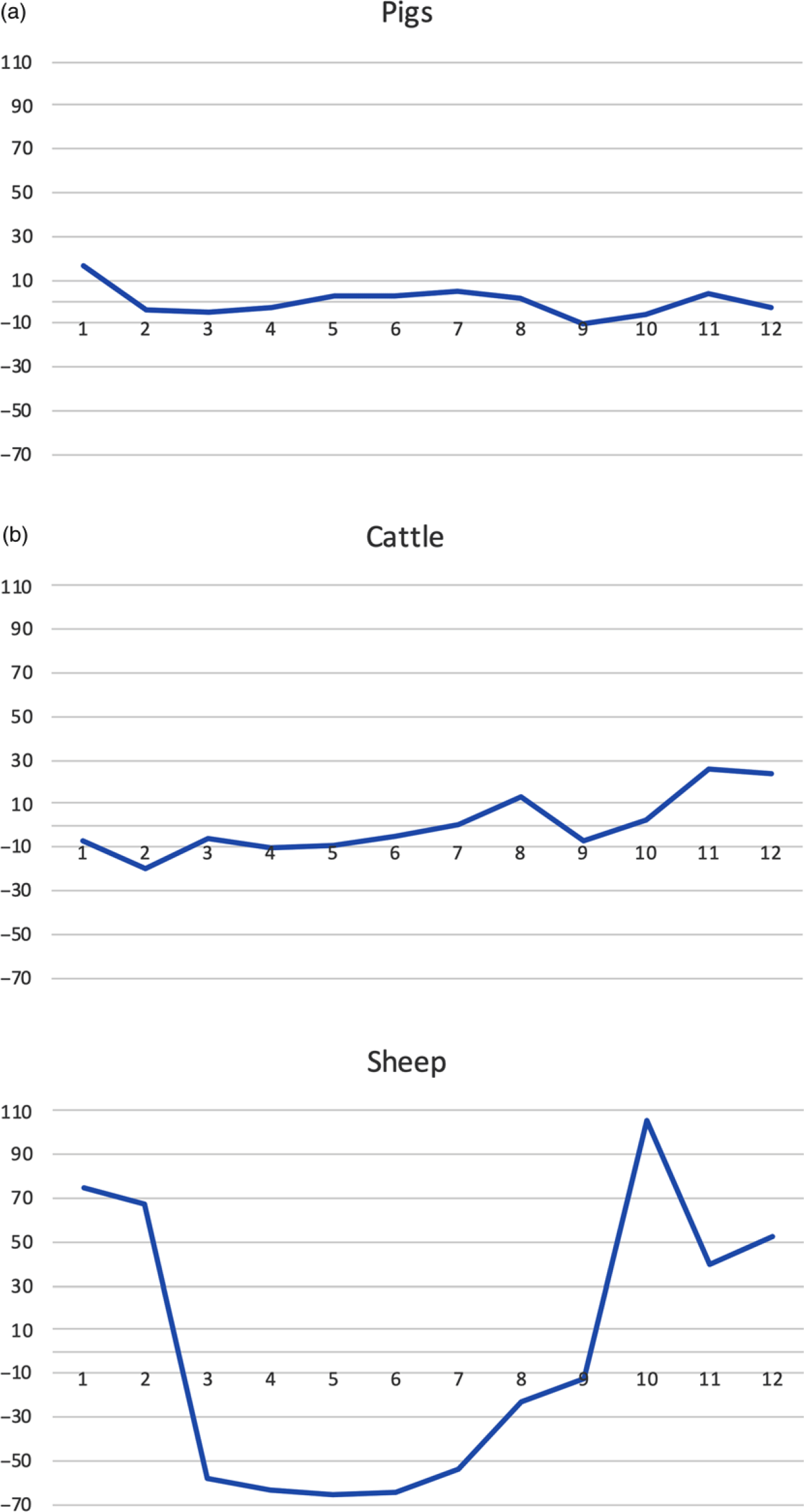
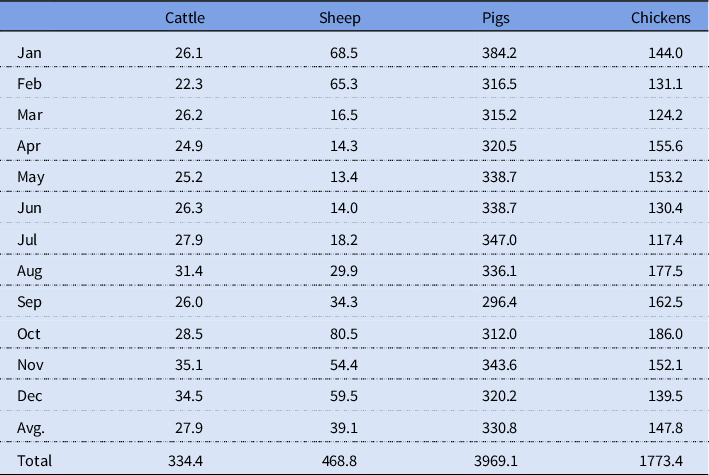
Unlike the annual snapshots presented in the Japanese price data, monthly slaughterhouse tallies reveal the complex seasonality of animal production. The three line graphs in Figure 2 show the cycle of meat production for pork, beef, and sheep meat in an aggregate of 15 cities (including cities that provided data from more than 1 year), as measured in the percent by which each month’s production deviated from its annual average. In all cities, cattle and sheep slaughter was highest in winter: falling off in spring, reaching a low point in April and May, rising sharply in September, and peaking in December and January. As shown in Table 4, these trends were consistent across locations and are evident as a composite of national data. Other month-to-month changes were tied to different cycles. Pig and chicken slaughter evinced a degree of seasonality in individual markets, but defy any other clear patterns, other than a tendency for pork production to drop off slightly in March. In both Guangzhou and Nanjing, consumption of goose meat was clearly seasonal, though the seasons were different for each city. The seasonality of meat production adds a new dimension to the relationship between price and preference. While price surveys alone allow only the simple assumption that more costly was more prized, charting prices against seasonal peaks and troughs of production shows the influence of overlapping yet independent cycles of demand and supply.
Seasonality in meat production.
Note: Meat production in composite of 15 cities as a monthly deviation (percent) from the annual average.
Source: DuBois (Reference DuBois2021a).

Monthly slaughterhouse tallies from 15 cities, in thousands of animals

Source: DuBois (Reference DuBois2021a).
Here again, using aggregated data risks blinding us to individuation. Across China, sheep slaughter increased in fall and winter. At one level, this rise was driven by seasonal variation in demand. Because Chinese medical theory considers sheep to be a “warming” meat, southern markets like Jiangxi and Nanchang consumed sheep exclusively in winter months.Footnote 4 Even now, the consumer popularity of sheep meat in the southern city of Guangzhou is a distant fourth place behind pork, beef, and chicken (Zhang et al. Reference Zhang, Wang and Martin2018). In central cities like Shanghai and Nanjing, the significant seasonal increase in sheep slaughter was accompanied by an increase in price, specifically from 4.95 to 8.75 yuan per animal in Hangzhou (Levine Reference Levine1920: 117–25). Northern cities show the same cyclicality of slaughtering trends, but for a very different reason. In northern cities such as Taiyuan, slaughter peaked in the autumn months, but prices per animal stayed the same or even fell. In the gateway city of Zhangjiakou, the price of sheep fell by half between October and December of 1934, just as the number of sheep slaughtered more than tripled. While winter demand for sheep meat on the border with frigid Mongolia was undoubtedly strong, the key factor was a glut of supply, as herders sought to dispose of their excess animals before the winter months when grazing was not possible and keeping livestock meant paying for feed. Some concerns were very specific to certain sites: Qingdao beef prices peaked in winter in part because meat bound for markets in Japan and Vladivostok during that season could be shipped unrefrigerated on the decks of ships.
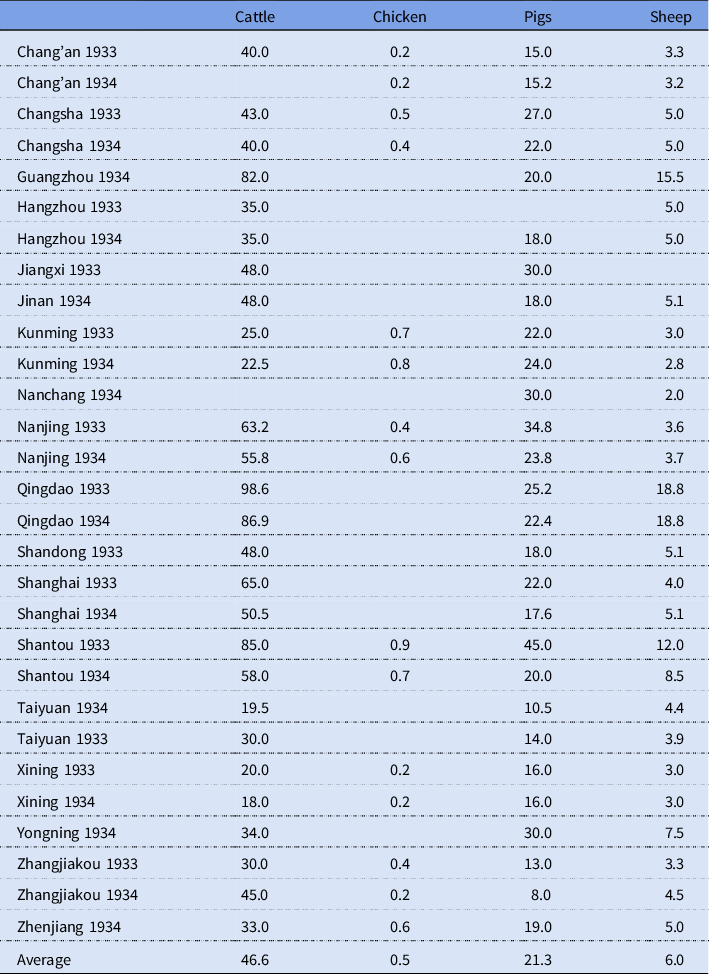
Finally, because slaughterhouse data express prices in a single currency, it becomes possible to see a wider picture of price convergence within animal industries. The results, shown in Table 5, reveal a far greater price diversity than had been evident within the regional cluster of towns around Changchun. The coastal city of Qingdao, a major center of beef slaughtering and export, paid the highest prices by far for live cattle. Not surprisingly, the lowest price for beef and sheep was paid in Xining, Kunming, and Taiyuan, inland cities that were poorer, adjacent to pasture, and removed from major consumption centers. As for hogs, they were cheap in northern cities like Zhangjiakou and Taiyuan and more expensive in Nanjing, Nanchang, and Guangxi. But more than these patterns, what is striking is the level of difference between cities. Cattle in pastoral Xining sold for one-fifth of what they did in export-oriented Qingdao. Cattle and hog prices nearly doubled between Jinan and Qingdao, cities that were physically close and connected by rail. Though the Qingdao slaughtering industry was fed by a constant supply of animals brought in from western Shandong, the mark-up on animals brought in to the city emphasizes the physical limitations of the live animal trade, as well as the addition of value to the fattened cattle.Footnote 5
January slaughterhouse prices in 18 locations

Note: Prices paid per head for live animals. All prices are given in yuan. Jiangxi and Shandong are provinces, containing the cities of Nanchang and Jinan, respectively.
Source: DuBois (Reference DuBois2021a).
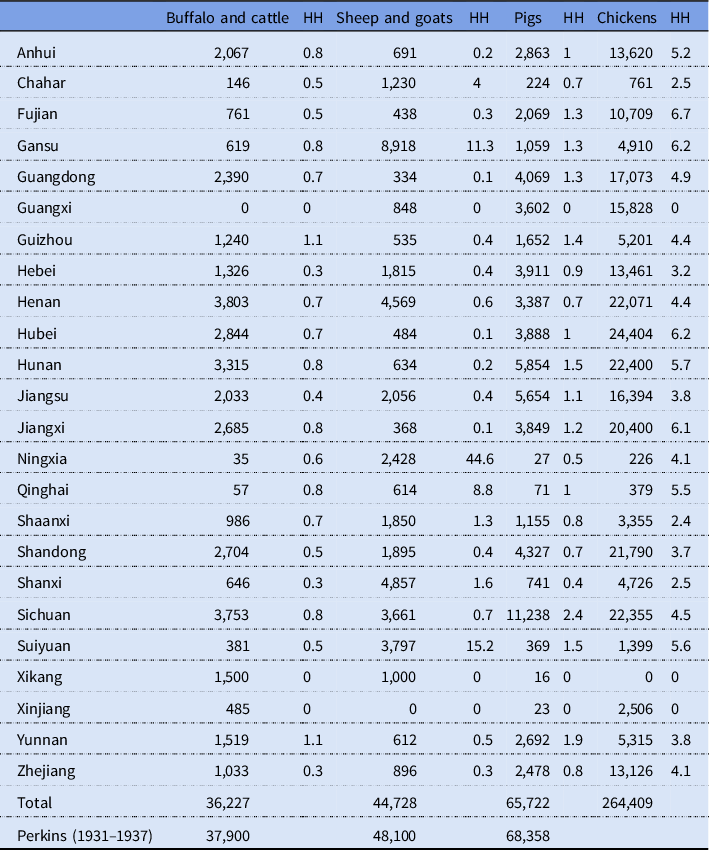
A second set of industry surveys, also from the early 1930s, traces the output of animal products, specifically hides and pig bristles (Ikeda Reference Ikeda1940). These surveys, summarized in Table 6, capture the geography of animal husbandry with what I believe to be the first provincial estimates of animal populations. (These correspond roughly to the national baseline figures used by Perkins Reference Perkins1969, 287.) They confirm some of the tendencies already discussed. The north-south divide between wheat and rice cultivation was replicated in the distribution of cattle, which thrived in drier farms, hills and pastures, and water buffalo, which were preferred for work in flooded rice fields. Pigs were common everywhere but more effectively raised in the verdant south. (Note the striking density of pig raising in Sichuan, with each rural family holding an average of 2.4 animals.) Keeping in mind that the northeast was no longer included in the data, fully one quarter of the national cattle herd was held in the two agrarian provinces of Henan and Shandong, at a density of one head for every 1.4–2 rural households, respectively. In pastoral Gansu and Qinghai, that number was even higher, with four head for every five households. Sheep far outnumbered people in the sparsely populated Suiyuan, where an average rural household held more than 12 sheep, and in Ningxia, where each household had more than 35.
Provincial animal populations total (thousand) and per household (HH)

Note: Some categories combined for space. Full data set available at DuBois (Reference DuBois2021c).
Source: Ikeda (Reference Ikeda1940); Perkins (Reference Perkins1969: 287).
Industry surveys also offer insight into the geography of animal slaughter. While the surveys of modern slaughterhouses showed only a thin slice of urban centers, the dispersal of markets for hides and bristles within each province hints at the national geography of the actual killing and processing of animals. For items like hides, the distance from slaughter to market would not have been great. Curing is a low-cost and low-technology process, and it made most sense to cure hides near where the animals were slaughtered, if only because cured hides are easier to prepare for long-distance shipping. The geography of pig bristles is less clear: Other than boiling the skin of a freshly slaughtered animal, pig bristles (about 0.9 kg per animal) require no further processing at all and could be collected and resold multiple times before reaching a final exporter, though the existence of numerous bristle markets within provinces also suggests that the primary consideration was proximity to slaughter.
We may be certain that animals killed for hides or bristles were eaten. A description of the sheep and cattle market in eighteenth-century Beijing indicates a meticulous economy of animal slaughter, with specialized tradespersons converging to “collect the blood, collect the skin, sell the meat, peel off the membranes, gather up the fur, [and] others who pick over the small pieces, cut through the chest and the stomach, and extract oil from the bones” (Zhao Reference Zhao1991 [1721]: 34). A social survey of meat prices in Beijing mentions the customary division of slaughtered animals: The head and most organs went to the customer who bought a whole animal, whereas the blood and intestines were always given to the shop workers (Meng and Gamble: 43). Intestines and stomachs were dried and sold abroad as sausage casings; in 1936, Shanghai alone exported nearly two million kilograms of pig intestines, at a value of 7.2 million dollars (China, Haiguan zongshuiwu sishu 1937: 341–2, DuBois Reference DuBois2019a). Street stalls cooked large bones into soup, and the leftovers were crushed and sold as fertilizer. Clearly, no part of a slaughtered animal went to waste.
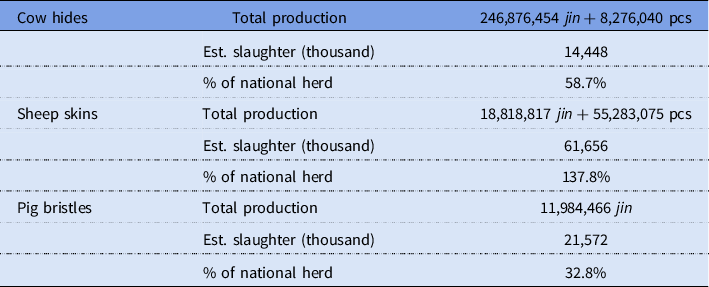
Data on animal by-products are the first to capture the scale of slaughtering that was carried out in more primitive and dispersed conditions, since a pig raised by a farmer, slaughtered in the village, and consumed locally would leave only the sale of bristles as evidence. Shown in Table 7, these figures attest to the truly massive scale of China’s animal industries: an annual slaughter of over 14 million cattle, 21 million pigs, and 61 million sheep, figures far exceeding those reported by the thin cross-section of urban centers accounted for by slaughterhouse surveys. They also suggest the efficiency of Chinese animal husbandry. Just under 60 percent of the cattle herd was slaughtered each year, meaning that animals were raised for an average of 621 days, a very high rate of turnover given that many animals were kept for labor. Even more striking is the slaughter of sheep, as an annual turnover of 137.8 percent of the national herd indicates that they were being slaughtered as fast as they could be replaced.
Annual slaughter estimate based on animal products

Note: Figures for hides were given in a combination of weights and pieces. Total figures were calculated by dividing weights by an average of 20 kg/40 jin per salted cowhide, and 1.5 kg/3 jin per salted sheepskin. Pigs are calculated at 1.8 jin/.9 kg of bristles per animal. Figure for the national sheep herd combines sheep and goats.
Source: Ikeda (Reference Ikeda1940: 92, 118, 140).
The scale and geography of animal slaughter indicate that meat was locally available throughout China. Animals of the time were significantly smaller than those today, and slaughterhouse statistics estimate roughly 150–250 jin of meat per head of cattle, 20 per sheep, and 80 per slaughtered pig.Footnote 6 But while live animals and cured hides could be transported for sale, meat generally had to be consumed or processed on the spot. Freezing was only available to a small portion of the modern slaughtering industry, and the meat that was stored and transported was generally salted and dried (such as salted ducks, Jinhua ham, or the dried ganba beef made in Sichuan and Yunnan) (Kuo Reference Kuo2013). Export industries accounted for only a small portion of production. Foreign exports of dried hams increased significantly during the Great War but fell off again soon after. New beef exports from Qingdao accounted for only a small fraction of meat produced and represented a separate production chain that did not include meat from older work animals, the most common source of beef (DuBois Reference DuBois2019a; Ninomiya Reference Ninomiya1932: 52). Of the massive amount of meat being produced, the great majority was consumed near to where the animal was slaughtered.
Together, the two industry surveys provide unique insight into the question of China’s meat production, establishing both the scale of animal slaughter and the details of its geography and seasonality. They complement earlier price surveys, confirming that meat in China was not only affordable but available in prodigious amounts. But the industry profiles also have their limitations. As much as they say about supply, these sources are completely silent about demand, specifically how or by whom meat was being consumed. For this, we turn to our final source.
Source 3: Nutrition surveys, 1920s–1940s
A final picture comes from food-intake surveys, which were carried out over two decades as part of what Jia-Chen Fu (Reference Fu2012) calls the progressive “scientization” of nutrition research and policy in China. The first of these surveys was conducted in 1922 by William Henry Adolph of Shandong Christian University. As northern China emerged from 2 years of famine, Adolph set out to quantify the ordinary diet of what he called the region’s “middle-class,” which in practice meant comfortable cultivators. Adapting methods that were already in use elsewhere, Adolph (Reference Adolph1925) instructed students returning home for the summer to record family diets, which they did using a variety of more or less careful methods, most commonly by weighing uncooked ingredients as they were brought home from market. The resulting record of summer diets of 340 adults and 144 children chosen effectively at random from all across the north of China could hardly be called scientific, but it initiated a trend of localized surveys based on an evolving set of common techniques: equalizing per-capita food intake with set coefficients for women, children, and the elderly, using these figures to equalize across a number of “adult days,” and moving from undifferentiated cataloguing of food consumed to a more detailed accounting of calories and fat, and ultimately to a focus on maximizing intake of protein (Jing and Ho Reference Jing and Hou1941, Fu and Chen Reference Fu and Shangqiu1946). Later surveys included such policy recommendations as a national campaign to increase intake of plant proteins, or banning the thriving egg export industry in order to lower costs for Chinese consumers (Zheng Reference Zheng1940).
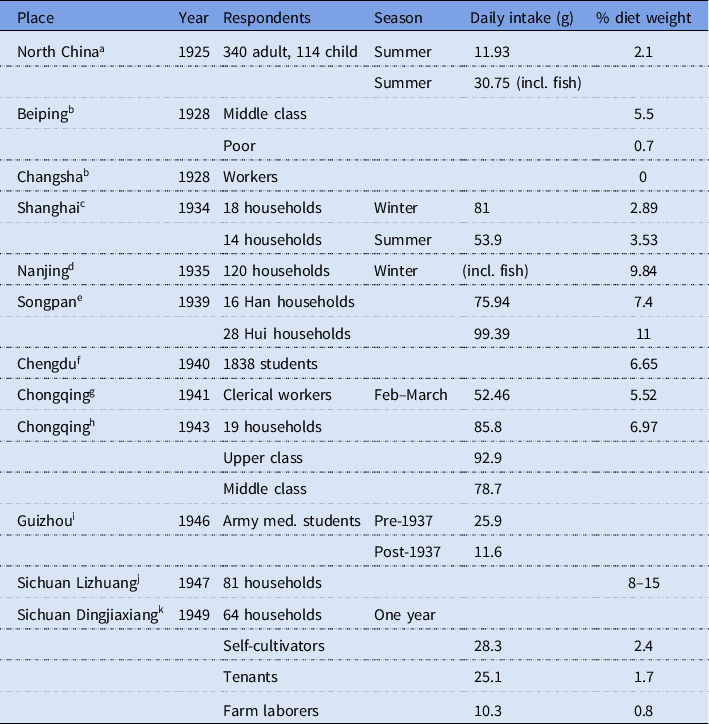
Taken together, these surveys suggest that individual meat consumption was low but not inconsequential. The 1922 survey reported that the “middle-class” consumed meat as a mere 2 percent of their diet by weight, compared to 18 percent for American contemporaries (7 and 33 percent of total food expenses, respectively). But the respondents were far from vegetarian. An average of the 1922 data is roughly 22 g of animal protein per “adult day” or about the size of one piece of uncooked bacon. This was far more than the amount consumed by contemporary poor Japanese households (Ogasawara et al. Reference Ogasawara, Inoue and Nagaya2016), and about a quarter of that (88.12 g) consumed by skilled British workers at the height of the Great War (which exceeded that in peacetime, Gazeley and Newell, Reference Gazeley and Newell2013). The range of figures from subsequent surveys is considerable: Workers in Changsha reportedly ate no meat at all, while meat consumption was high in urban Shanghai. In pastoral Songpan, and the wartime capital of Chongqing, it exceeded even the British figure. The range of survey results is summarized in Table 8.
Localized estimates of meat consumption in China

Sources: aAdolph (Reference Adolph1925), bShen (Reference Shen1937), cZhu (Reference Zhu1934), dZheng et al. (Reference Zheng, Tao and Zhu1935), eZheng and Gu (Reference Zheng and Gu1940), fZheng (Reference Zheng1940), gWang et al. (Reference Wang, Lin and Jin1943), hWang and Sun (Reference Wang and Sun1944), iWang and Chen (Reference Wang and Chen1946), jWang Youzhu (Reference Wang1947), kJin and Wang (Reference Jin and Wang1949).
These figures roughly corroborate the stunning slaughter estimates produced in the previous section, which if taken to a hypothetical average would come to a daily intake about 16.3 g of meat for each of 1930 China’s 489 million consumers.
Total annual slaughter * jin meat per animal (500 g/jin)/365 days per year/489 million population
Cattle: 14,448,000*200*500/365/489,000,000=8.0 g beef
Sheep: 61,656,000*20*500/365/489,000,000=3.5 g sheep
Pigs: 21,572,000*80*500/365/489,000,000=4.8 g pork
But more than these conjectural averages, the significance of the nutrition surveys is what they reveal about actual household consumption. Some of the surveys examined institutional diets: Two were conducted in schools (Wang et al. Reference Wang, Liao and Huang1948; Zheng Reference Zheng1940), and one included observations taken over 1 year in a local restaurant (Shen Reference Shen1937). But most measured households, revealing striking diversity even among neighbors. In all our data, these are the first real glimpse of household consumption, and they reveal another sort of cyclicality in Chinese diets: variation over the lifecycle of the family. In 1925, Soviet economist A.V. Chayanov (Chayanov et al. Reference Chayanov, Thorner, Kerblay and Smith1986) first described the fortunes of rural households in terms of the ever-changing ratio of producers to consumers. Thus, a farming household consisting of two generations of four working adults was wealthy relative to its available labor, while one with two aged grandparents and two young children (two partial producers supporting four consumers) would be forced to live much more frugally. With few mechanisms, or incentives, for saving wealth, families would live well while they could, and tighten belts when it was needed. Such changes would be reflected in household budgets and eventually in family diet. In addition to overall fortune, Chinese families altered their food consumption according to specific needs. Holidays and lifecycle events like funerals were marked by lavish feasts. Whenever possible, the elderly were fed meat, especially beef. Pregnant or nursing women were given meat and eggs.
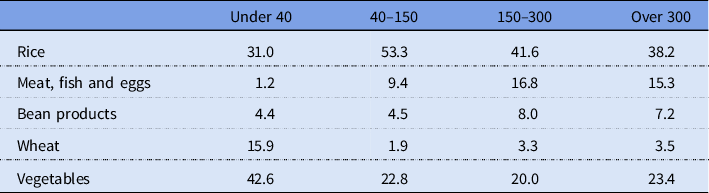
Household surveys confirm the importance of dietary diversity and hint at some of the reasons behind it. In the Shanghai surveys, the average household consumed 2.9 percent of its diet as meat, but even within the small sample of 18 households, two families consumed meat as 13.3 and 14.7 percent of their diet, while another family was essentially vegetarian. Income was clearly a factor. As was the case with households surveyed in Tokyo, the very poor ate little meat. As shown in Table 9, the wealthiest households in Nanjing consumed only marginally more of their diet as rice than the poorest but over 10 times the percentage of fish, meat, and eggs. Custom also played a role, even at the level of individual families. Muslim Hui households in Songpan, located in the mountainous far west of Sichuan, ate meat as 11 percent of their diet, significantly more than the 7.3 percent consumed by their Han neighbors (Ogasawara et al. Reference Ogasawara, Inoue and Nagaya2016; Zheng et al. Reference Zheng, Tao and Zhu1935; Zheng and Gu Reference Zheng and Gu1940; Zhu Reference Zhu1934). More individuated family circumstances, such as the illness, death, or malfeasance of a parent, are of course beyond the ability of our data to reveal but would have played a decisive role in the actual lived experience of any household.
Per cent components of Nanjing diets, divided by monthly household income (yuan)

Source: Zheng et al. (Reference Zheng, Tao and Zhu1935: 1753–8).
Conclusions
From a seemingly simple starting question – who ate meat in early twentieth-century China? – this inquiry has by necessity strayed in and out of new territory. We were led on this course by our data, which was in turn shaped by the needs of the people who collected it: the Japanese agricultural ministries that sought out commodity prices out of concerns over hoarding and market disruptions; the Chinese Guomindang government that collected industry data to ensure proper regulation and taxation of slaughter houses; and the generation of nutritionists who collected data on household diets because their new scientific understanding of malnourishment told them that they key to national health lay in dietary reform. But these specific needs also shaped what the survey collectors found: the particular perspectives of price and supply, and the highly episodic ethnographic perspective of spot dietary surveys. On its own, no single source provides a satisfactory understanding of how meat was produced, sold, and consumed. This is not because the figures themselves are unreliable but rather, as Griffin (Reference Griffin2018) has eloquently argued, because overreliance on any one sort of statistical data has the potential to mislead. In contrast to the sort of comparative cliometrics that adapts historical statistics of different sorts and eras to contemporary questions and categories, this article emphasizes how a focus on the original intent behind different sorts of data creates an opportunity for historians to reframe their understanding of the questions themselves.
The ramifications of this more expansive understanding of how meat was produced and consumed in China are at least as diverse as the motivations that drove our data. In addition to historical issues of food trade and security, economic growth, and public health, a clearer understanding of diets provides an important corrective to the image of rural life in the first half of the century as having been one of dire and unrelenting poverty. Captured in R.H. Tawney’s often-quoted likening of the precarity of peasant cultivators to “a man standing permanently up to the neck in water” (Tawney Reference Tawney1966: 77), such images in turn shape retrospective assessment of material change in the first few decades of the socialist planned economy (raising again the earlier problem of establishing a historical baseline to assess subsequent progress). A more precise picture of regional stockbreeding also shapes our understanding of the diverse roles that animals played in China’s agriculture and ecology. The specific details of how meat was slaughtered, processed, and distributed within communities and the changing prominence of meat in household diets affect understanding of the social and symbolic functions of meat within ritual and family life. Looking again to the second half of the twentieth century, this perspective suggests that images of a meatless past, such as the Hong Kong villagers who bewailed the experience of “going for months without even smelling lard” (Watson Reference Watson, Klein and Murcott2014: 29), may have been based on a period of particular scarcity, perhaps a very localized one (these villagers were, e.g., eating fish). Finally, understanding practices of meat consumption in the early twentieth century lends some insight into why newly wealthy China does not consume more meat than it does, and specifically why the rarely questioned industry assumption that, if given the chance, Chinese consumers would gorge on as much meat as possible (Schneider and Sharma Reference Schneider and Sharma2014) has in fact failed to materialize.
Supplementary material
To view supplementary material for this article, please visit https://doi.org/10.1017/ssh.2022.17