Introduction
Although antipsychotic medication is seen as the first line of treatment for schizophrenia and clinical guidelines suggest that there are clear benefits in terms of symptom reduction (NICE, 2009), there is also evidence that many service users choose to refuse or discontinue their pharmacological treatment. The largest trial (Lieberman et al. Reference Lieberman, Stroup, McEvoy, Swartz, Rosenheck, Perkins, Keefe, Davis, Davis, Lebowitz, Severe and Hsiao2005) to compare atypical antipsychotics found that 74% of patients with a diagnosis of schizophrenia chose to discontinue their medication over 18 months and it is estimated that rates of medication non-compliance in schizophrenia can be as high as 40% to 50% (Lacro et al. Reference Lacro, Dunn and Dolder2002). It is well known that service users with psychosis are often opposed to taking medication (Moncrieff et al. Reference Moncrieff, Cohen and Mason2009), which may be due to several factors, including lack of insight, stigma and concerns about side-effects [including extrapyramidal side-effects, weight gain, sexual dysfunction, metabolic and cardiovascular problems (Tandon et al. Reference Tandon, Belmaker, Gattaz, Lopez-Ibor, Okasha, Singh, Stein, Olie, Fleischhacker and Moeller2008) and an increased dose-related risk of sudden cardiac death (Ray et al. Reference Ray, Chung, Murray, Hall and Stein2009)]. There is also emerging evidence to suggest that antipsychotic medications may cause some of the cerebral abnormalities that were commonly assumed to be part of the schizophrenia syndrome (Moncrieff & Leo, Reference Moncrieff and Leo2010; Ho et al. Reference Ho, Andreasen, Ziebell, Pierson and Magnotta2011). Many have a poor response to antipsychotics, which will also affect decisions regarding medication; for example, a meta-analysis by Leucht et al. (Reference Leucht, Corves, Arbter, Engel, Li and Davis2009) found that atypical antipsychotics had, on average, only a 10-point superiority over placebo on the Positive and Negative Syndromes Scale (PANSS), equivalent to less than minimal improvement on the Clinical Global Impressions (CGI) Scale. Best practice guidelines have suggested that, in some circumstances, stopping medications may be indicated (Tam & Law, Reference Tam and Law2007). The consequences of poor adherence to treatment often include greater likelihood of hospital admission, and longer hospitalizations (Perkins, Reference Perkins2002), although this may be because no effective alternative treatment options are available. However, it is clear that many people hospitalized with psychosis retain treatment decision-making capacity (Owens et al. Reference Owens, Richardson, David, Szmukler, Hayward and Hotopf2008). A literature review regarding choice and decision making in people using mental health and social care services concluded that ‘the literature makes it abundantly clear that service users want to be offered more than just medication’ (Warner et al. Reference Warner, Mariathasan, Lawton-Smith and Samele2006), a finding supported by a recent meta-analysis demonstrating very low drop-out rates (average 13%) from long-term trials of psychosocial treatments in schizophrenia (Villeneuve et al. Reference Villeneuve, Potvin, Lesage and Nicole2010).
Cognitive therapy (CT) has been shown to be effective when delivered in combination with antipsychotic medication, with several meta-analyses showing robust support for this approach (e.g. Pilling et al. Reference Pilling, Bebbington, Kuipers, Garety, Geddes, Orbach and Morgan2002; Wykes et al. Reference Wykes, Steel, Everitt and Tarrier2008), although there is not complete consensus regarding such conclusions (Lynch et al. Reference Lynch, Laws and McKenna2010). However, it has yet to be formally evaluated in the absence of such medication, although there have been a few case studies (e.g. Morrison, Reference Morrison1994) that have demonstrated acceptability and provided some support. More recently, two case series have demonstrated some benefits, with four patients with auditory hallucinations showing some gains in terms of reduced symptoms, distress and disability (Morrison, Reference Morrison2001a) and three patients with a diagnosis of schizophrenia showing improvements in positive and negative symptoms (Christodoulides et al. Reference Christodoulides, Dudley, Brown, Turkington and Beck2008). We have shown that CT for people at risk of developing psychosis can prevent or delay onset of psychosis without the use of antipsychotic medication (Morrison et al. Reference Morrison, French, Walford, Lewis, Kilcommons, Green, Parker and Bentall2004a). As the benefits of CT for people not taking antipsychotics are unknown, although preliminary evidence is encouraging, guidance regarding the development and evaluation of complex interventions such as psychological treatments suggests that it is appropriate to conduct a phase II or exploratory study (MRC, 2000). This will inform the design of subsequent definitive trials regarding expected treatment effects, identification of appropriate outcome measures and follow-up periods, estimates of recruitment and attrition for a main trial, and acceptability and feasibility of the intervention. This exploratory study, therefore, aimed to conduct a preliminary examination of the feasibility and effectiveness of CT for people with psychosis who have decided not to take antipsychotic medication for at least 6 months.
Method
Trial design
We carried out a two-site exploratory or phase II study (MRC, 2000) of CT to assess the feasibility and effectiveness of CT for people not taking antipsychotics. Our protocol was approved by the National Research Ethics Service of the UK's National Health Service (NHS) and also by local NHS ethics committees at the trial sites.
Participants
Entry criteria for the trial included being in contact with mental health services and either meeting ICD-10 criteria for schizophrenia, schizo-affective disorder or delusional disorder or meeting entry criteria for an early intervention in psychosis (EIP) service (operationally defined using PANSS scores of at least 4 on hallucinations or delusions or at least 5 on conceptual disorganization, grandiosity or suspiciousness, in the context of initial presentation to services with psychotic experiences). Participants had to either have discontinued antipsychotic medication for at least 6 months while experiencing continuing symptoms or to have never taken antipsychotics and be currently refusing to do so. All participants had to score at least 4 on PANSS delusions or hallucinations or at least 5 on grandiosity or suspiciousness and be aged 16–65 years. Exclusion criteria included current in-patient admission, current receipt of antipsychotic medication, moderate to severe learning disability, organic impairment, primary diagnosis of drug or alcohol misuse, previous cognitive behavioural therapy (CBT) for psychosis and being non-English speaking (as this would prevent the use of standardized assessment instruments). Diagnosis was established using case-notes and a standardized checklist (ICD-10); all diagnoses were reviewed by a consultant psychiatrist (D.T.). All participants were identified by psychiatrists, care coordinators and other relevant mental health staff within participating mental health trusts at our two sites (Manchester and Newcastle/North East).
Outcomes
Our primary outcome measure was the PANSS (Kay et al. Reference Kay, Fiszbein and Opler1987), which is a clinician administered 30-item semi-structured interview consisting of seven items assessing positive symptomatology (e.g. hallucinations, delusions, conceptual disorganization), seven items assessing negative symptomatology (e.g. blunted affect, passive/apathetic social avoidance) and 16 items assessing general psychopathology (e.g. depression, anxiety, lack of insight, guilt). All items are scored between 1 (not present) and 7 (severe). Several studies have demonstrated the reliability and validity of the PANSS (Kay et al. Reference Kay, Opler and Fiszbein1988).
Secondary outcomes included dimensions of psychotic experiences such as severity, distress and disability, measured using the Psychotic Symptoms Rating Scales (PSYRATS; Haddock et al. Reference Haddock, McCarron, Tarrier and Faragher1999), which is a clinician-administered semi-structured interview consisting of 11 items assessing dimensions of auditory hallucinations and six items assessing dimensions of delusional beliefs. All items are scored from 0 to 4, with higher scores indicating more severe phenomena. The items assess frequency, preoccupation, location, loudness, conviction, amount of unpleasant content, severity of unpleasant content, amount of distress, intensity of distress, degree of impairment and control. We also included a user-defined measure of recovery, the Questionnaire about the Process of Recovery (QPR; Neil et al. Reference Neil, Kilbride, Pitt, Welford, Nothard, Sellwood and Morrison2009), which is a 22-item questionnaire developed collaboratively with service users, measuring subjective recovery in two domains: intrapersonal functioning and interpersonal functioning. Participants rate their agreement with statements on a five-point Likert scale rating from ‘strongly disagree’ to ‘strongly agree’. The subscales have good internal consistency and test–retest reliability over short periods. Social functioning was assessed using the Personal and Social Performance Scale (PSP; Morosini et al. Reference Morosini, Magliano, Brambilla, Ugolini and Pioli2000), which is a 100-point single-item rating scale based on the assessment of patient's functioning in four areas (socially useful activities, personal and social relationships, self-care and disturbing and aggressive behaviour). Informed by accepted thresholds of clinically significant change in PANSS total scores (Leucht et al. Reference Leucht, Kane, Etschel, Kissling, Hamann and Engel2006, Reference Leucht, Kissling and Davis2010), a good clinical outcome was defined a priori as a ⩾50% improvement; a moderate outcome was defined as a 25% improvement; and a poor clinical outcome as a 25% deterioration. Initiation of antipsychotic medication was also monitored using self-report at each assessment interview.
The participants were assessed at 3-monthly intervals for a period of 9 months (end of treatment), and then again at 15 months (follow-up); PANSS was only conducted at baseline, end of treatment and follow-up so as to reduce participant burden. Assessments were conducted by research assistants (M.W., H.S., S.B.), and good inter-rater reliability was established using ratings of videotapes of PANSS ratings (initially and mid-way through the trial); this was examined using intraclass correlations (ICCs) for ratings of recorded interviews and was shown to be good (ICC=0.83).
Intervention
The CT intervention was limited to a maximum of 26 sessions over 9 months and followed the principles developed by Beck (Reference Beck1976) . It was problem orientated, time limited, and encouraged collaborative empiricism, guided discovery and homework tasks, and was based on a written manual. It was based on an integrative cognitive model of hallucinations and delusions (Morrison, Reference Morrison2001b), which emphasizes the culturally unacceptable interpretations that people with psychosis make for events, in addition to their responses to such events and their beliefs about themselves, other people and control strategies. The central features of our approach to treatment of psychosis involves normalizing the interpretations that people make, helping them to generate and evaluate alternative explanations, decatastrophizing their fears, helping them test out such appraisals using behavioural experiments and helping them to identify and modify unhelpful cognitive and behavioural responses. It also incorporated metacognitive change strategies, including postponement of perseverative processing, evaluation of positive and negative metacognitive beliefs and modification of thought control strategies. A more detailed analysis of the treatment strategies can be found in our treatment manuals (Morrison et al. Reference Morrison, Renton, Dunn, Williams and Bentall2004b; Kingdon & Turkington, Reference Kingdon and Turkington2005), and our approach is consistent with a recent consensus exercise regarding essential elements of CBT for psychosis (Morrison & Barratt, Reference Morrison and Barratt2010).
In total, eight therapists contributed to the delivery of CT within the trial. The number of participants treated by each therapist ranged between one and 10. Sites varied as follows: Manchester (three therapists); North East (five therapists). Five of the therapists were clinical psychologists, two were nurses with an additional specialist cognitive therapy qualification and one was a psychiatrist. All received additional training associated with the trial manual and received weekly individual supervision and bimonthly peer supervision with all other trial therapists.
Data analysis
Distributions of the data were inspected for normality using visual inspection and analysis of skewness and kurtosis; all data were normally distributed except PANSS positive and negative subscales and the PSYRATS auditory hallucinations subscale. Dependent t tests were used to analyse changes in outcome measures for the normally distributed variables; non-parametric analyses using Wilcoxon's signed ranks test were used for skewed data. Tests of significance were two-tailed, but no correction was made for multiple comparisons given that this was a feasibility study in which we were less concerned about type 1 error. Treatment effect sizes for changes in symptom scores between pre- and post-treatment and between pretreatment and follow-up were estimated using Cohen's d statistic, which was calculated as (mean1−mean2)/(s.d.)pooled (Cohen, Reference Cohen1988). Clinically significant change was examined using thresholds of 25% and 50% improvement on adjusted PANSS total scores (Leucht et al. Reference Leucht, Kane, Etschel, Kissling, Hamann and Engel2006, Reference Leucht, Kissling and Davis2010). Missing data were replaced by using the last observation carried forward (LOCF) approach; although this assumption of stability is likely to bias results when comparing two or more treatments (Hamer & Simpson, Reference Hamer and Simpson2009), it is arguably a conservative assumption in an uncontrolled study.
Results
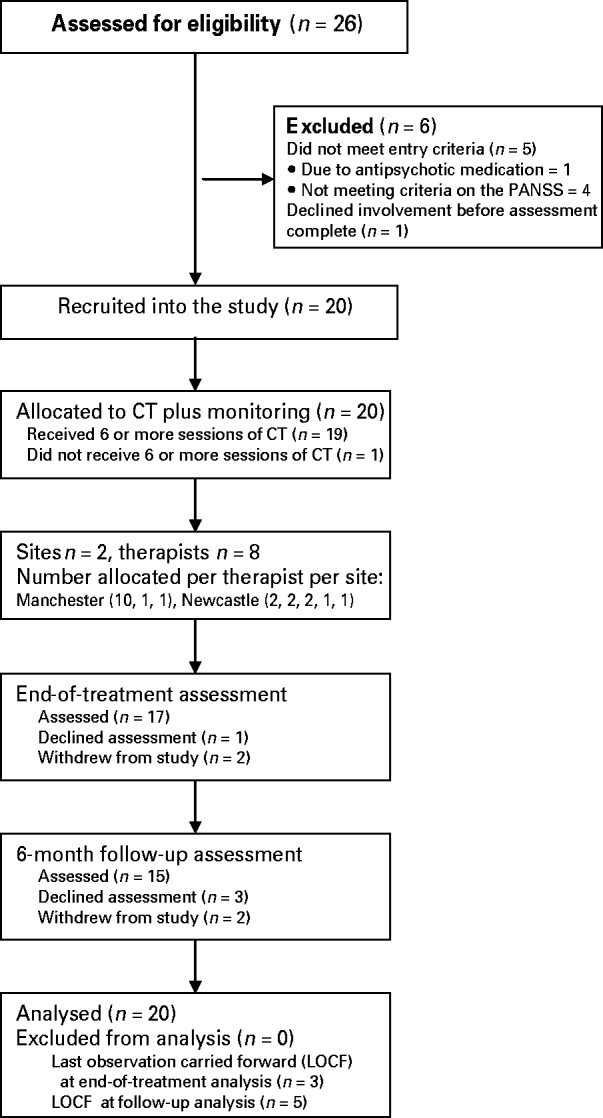
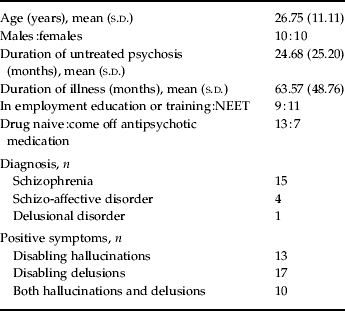
We finished recruiting for the trial in October 2009 and had a final sample size of 20 (Manchester n=12, Newcastle/North East n=8). The characteristics of the sample are presented in Table 1. The CONSORT (Consolidated Standards Of Reporting Trials) diagram for the study is provided in Fig. 1. The participants received a mean of 16.7 sessions (s.d.=7.26, range 1–26), each session lasting approximately 1 h. Adherence to CT was acceptable, with no participant not attending any sessions, and 19/20 receiving at least six sessions. No adverse events were reported.
CONSORT diagram for participant flow. CT, Cognitive therapy; PANSS, Positive and Negative Syndromes Scale.

Participant characteristics

s.d., Standard deviation; NEET, not in education, employment or training.
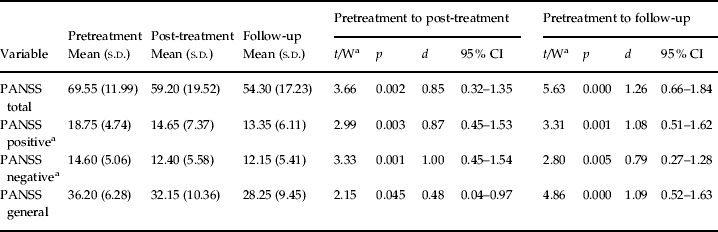
Analyses of the effects of CT on our primary outcome (PANSS), including both total score and subscales, at both end of treatment and follow-up, are shown in Table 2; both tests of significance (t tests) and effect sizes (Cohen's d) are reported. It is clear that the dimensions of our primary outcome all demonstrated a significant reduction at both end of treatment and follow-up.
Primary outcome data, statistical analyses and Cohen's d effect sizes (with 95% CIs)

PANSS, Positive and Negative Syndromes Scale; s.d., standard deviation; CI, confidence interval.
a For normally distributed data, parametric tests were used. For skewed distributions non-parametric Wilcoxon tests were used.
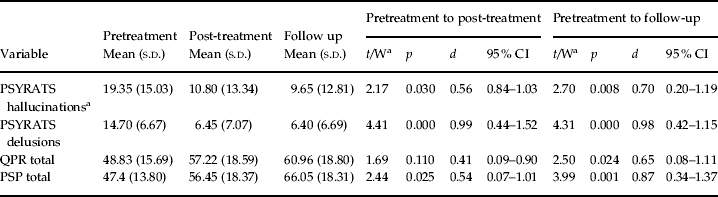
Table 3 shows the results of our secondary outcomes at the end-of-treatment and follow-up end-points; again, both tests of significance (t tests) and effect sizes (Cohen's d) are reported. These analyses show that dimensions of hallucinations and delusional beliefs significantly reduced at both end of treatment and follow-up. They also show a significant improvement in functioning at both end of treatment and follow-up, with a significant increase in self-rated recovery at follow-up but not at end of treatment.
Secondary outcome data, analyses and Cohen's d effect sizes (with 95% CIs)

PSYRATS, Psychotic Symptoms Rating Scales; QPR, Questionnaire about the Process of Recovery; PSP, Personal and Social Performance Scale; s.d., standard deviation; CI, confidence interval.
a For normally distributed data, parametric tests were used. For skewed distributions non-parametric Wilcoxon tests were used.
An analysis of levels of clinically significant change by consideration of percentage change in our primary outcome of PANSS total scores (adjusted) (Leucht et al. Reference Leucht, Kissling and Davis2010) is shown in Table 4. This shows that few participants showed no change or deteriorated, whereas a sizable number reported levels of change consistent with good and very good clinical outcomes (Leucht et al. Reference Leucht, Kane, Etschel, Kissling, Hamann and Engel2006). Throughout the 9-month treatment period, one of 20 participants commenced antipsychotic medication (this participant had a 29% decrease at end of treatment and a 60% decrease on PANSS total score at follow-up). Additionally, a further two of 20 participants commenced antipsychotic medication throughout the 9–15-month follow-up period (they had, respectively, a 4% increase and a 0.4% decrease at end of treatment, and a 2% decrease and 0.13% decrease on PANSS total scores at follow-up).
Percentage change in PANSS total scores

PANSS, Positive and Negative Syndromes Scale.
Discussion
Our study has demonstrated that CT for psychosis, in the absence of antipsychotic medication, is an acceptable treatment and is associated with a clinically significant reduction in psychiatric symptoms at both end of treatment and follow-up, in a group that are assumed to deteriorate without total adherence to medication (Subotnik et al. Reference Subotnik, Nuechterlein, Ventura, Gitlin, Marder, Mintz, Hellemann, Thornton and Singh2011). We also demonstrated that CT is associated with a meaningful reduction in dimensions of hallucinations and delusional beliefs over a similar time frame. CT is also associated with improved functioning and self-rated recovery, with significant increases shown at follow-up for both, and a significant improvement in functioning also demonstrated at end of treatment. Only one participant started antipsychotic medication throughout the treatment window, with an additional two commencing during the follow-up phase, which suggests that the observed effects were not attributable to instigation of antipsychotic medication; whether CT may facilitate the acceptance of antipsychotic medication in people who were previously unwilling to do so remains unclear without a control group comparison. The low drop-out rate that was observed, with only two withdrawals from the trial and all but one participant receiving at least six sessions, suggests that CT is an acceptable intervention for people who choose not to take antipsychotics. Our effect sizes and response rates suggest that the magnitude of change associated with the treatment can be considered good, although as an exploratory study these findings clearly need to be evaluated further within a definitive trial.
Given the poor compliance with antipsychotic medications and also their adverse side-effects profiles, it is encouraging that CT seemed to be both acceptable and of benefit to patients who refuse or discontinue such medication. These findings, together with the extensive evidence base supporting CT's effectiveness for treating co-morbid disorders such as anxiety and depression, suggest that patients refusing antipsychotics should be offered CT. If replicated in a definitive trial, such evidence may support the promotion of informed choices for clinicians, service users and carers, in which they are entitled to choose from a range of evidence-based treatments on the basis of likely benefits being weighed against likely adverse effects. It is worth noting that although many participants made clinically significant reductions, none experienced a clinically significant deterioration in symptoms as based on their PANSS scores.
This study has numerous methodological limitations, as is likely to be the case for a phase II exploratory trial (MRC, 2000). The small sample size, which was a convenience sample, clearly limits statistical power; nonetheless, we found significant effects on all outcome measures. The sample was also diagnostically heterogeneous (schizophrenia spectrum disorders), which could be viewed as a methodological weakness; however, given the development of services for psychosis and the emphasis on diagnostic uncertainty that exists within EIP services, it should ensure that our findings are generalizable to such real-world settings such as the NHS. The use of LOCF to deal with missing data is open to criticism (Hamer & Simpson, Reference Hamer and Simpson2009); however, we had a low proportion of such missing data and given that this was an open trial with a single arm, it represents a conservative approach to the analysis of treatment effects. Alternative approaches to handling missing data, such as mixed models, which estimate parameters and test hypotheses about them but do not impute missing values, are viewed as preferable when sample sizes are large because they allow the use of sensitivity analysis to investigate different assumptions (Hamer & Simpson, Reference Hamer and Simpson2009). However, as they rely on theory that only applies to large samples, they would be inappropriate for this study. Treatment fidelity was not formally assessed, but the supervision and training of therapists should have ensured a consistent approach to delivery of CT within the study, given that both sites have established expertise in this approach and include the authors of our published treatment manuals; the initial training included establishing consensus regarding a list of permitted intervention strategies and some agreed milestones (such as early establishment of problem/goals lists and a maintenance formulation). It is also possible that there may be therapist or site effects; however, given the small sample size and early phase of the trial, such analyses would not be appropriate here. Perhaps most significantly, the fact that this was an open trial clearly suggests the possibility of bias resulting from allegiance effects and non-blind ratings. Similarly, the lack of a control condition is problematic. All of these methodological limitations are likely to lead to inflated estimates of treatment effects, as CBT for psychosis trials that attempt masking were reported to be associated with a reduction of effect sizes of nearly 60% (Wykes et al. Reference Wykes, Steel, Everitt and Tarrier2008). Therefore, a randomized controlled trial (RCT) evaluating CT for people with psychosis not taking antipsychotics is required to examine the effectiveness using more robust methodology. Based on the findings from this exploratory trial, we are currently conducting a two-site RCT (the ACTION trial, ISRCTN 29607432) that uses independent, random allocation, a control condition, masking and examination of the sensitivities of treatment effect estimates to missing outcome data arising from patient drop-out in addition to site or therapist effects.
Acknowledgements
We thank R. Byrne for his consultancy regarding service user issues.
Declaration of Interest
None.