

1. Introduction
Distributive issues, namely agency problems, are to a great extent related to the institutional framework of an economic system (Bowie and Freeman Reference Bowie and Freeman1992; Jensen and Meckling Reference Jensen and Meckling1976; Pratt and Zeckhauser Reference Pratt and Zeckhauser1985; Ross Reference Ross1973). Institutions – meaning either systems of law and governance or informal rules that underlie the ethos of social groups – can encourage trust when they enforce property rights and compliance with contracts and thus make social punishment effective. Otherwise, trust is unlikely to occur. The contribution of any arrangement to promoting trust may be labelled as social capital (Coleman 1990, Reference Coleman, Calhoun, Meyer and Scott1991, Reference Coleman1994). By contrast, widespread opportunistic behaviour reflects the inability of institutions to prevent agency problems and leads to an increase in transaction costs.
In line with these propositions, historical scholarship concerning early modern Europe has emphasized the significance of institutional constraints for economic performance in the long run. The different paths followed by regions, dynastic states or cultural-religious communities in the enlargement of international transactions has been under scrutiny since Douglass North highlighted the importance of state-based systems in the allocation of resources and economic growth (North and Thomas Reference North and Thomas1973; North Reference North1990, Reference North and Tracy1991). Exploring a similar agenda, Avner Greif's writings on cultural beliefs and their impact on market transactions have called attention to the contribution of institutional approaches, arguing that either public or private means of coercion could cope with the challenges of long-distance trade. Focusing on the case of the Maghrebi Jews, this author valued integrated networks as effective informal institutions for penalizing opportunistic behaviour and selecting trustworthy partners (Greif 1988). Research in the same vein as Greif's has enlarged the discussion about mechanisms that build up reputation. Networks are still deemed cohesive systems, mainly because they are supposed to be effective providers of information, but what has been added is that the economic performance of organizations depended on the way in which networks or other private-order, reputation-based institutions were assisted by formal arrangements. The state or other third parties must have played a role in the selection of reputable individuals (González de Lara Reference González de Lara2008; Trivellato Reference Trivellato2003). If not, networks might fail as informal enforcement institutions by causing as many ‘troubles’ as they solved (Hancock Reference Hancock2005).
Therefore, historical analyses have taken social capital as a condition for market growth and have overlooked the fact that an increase in transactions may challenge any previous equilibrium between formal and informal systems of regulation. Other economic insights have stressed that social capital shapes a U-curve when it is plotted against development, the downward trend being the period of transition (Stiglitz Reference Stiglitz and Dasgupta2000; Grootaert Reference Grootaert2004). The growing number and heterogeneity of participants involved in a market boom may be accompanied by opportunistic behaviour. Therefore, distrust and agency problems may be more critical in particular periods than in others; this assumption has received little attention in historical approaches which tend to be concerned with other elements of change.
This article presents a case study that broadens the discussion on the institutional framework that could have supported the expansion of colonial markets as a part of the internationalization of the European economies. Eighteenth-century Portuguese colonial trade affords a good example due to the opening up of new mining areas in Brazil, a circumstance that pushed the frontier of the colony westward and boosted the number of transactions over a short period of time. A delay in installing a judicial and administrative framework across the whole territory, thus limiting the geographical reach of the legal system, prevented the state from being an effective third-party enforcement institution. Due to the state's inability to assure information and sanctions, the selection of reputable agents had to rely on private-order devices.
This article examines which mechanisms were effective in a private-order system based on reputation in a context in which networks were prone to loss of cohesiveness. Our hypothesis is that in such a context, social capital depletion may lead to an uneven distribution of information and limited access to honest individuals who might afford a premium to particular forms of management. Testing this hypothesis should enable us to identify the business strategy which could minimize agency problems while increasing business scale.
The mechanisms that respond to an adverse environment can be established through network analysis. As used here, this is a methodology that assesses the probability of the risk inherent in the social intercourses in which market transactions are embedded (Granovetter Reference Granovetter1973). It does not assume that network is an institution that ‘generates a particularized and differential trust to solve market failures’ (Ogilvie Reference Ogilvie2004), or a synonym of social cohesion (Greif 1988). Rather, it is an evaluation of the configuration of ties which allows us to test whether networks could provide symmetric information and checks the factors for their success or failure in creating trust. Therefore, the use of network analysis in this case study differs from the concept of network as it is widely used in the historical literature.
Our argument is that the geographical mobility of agents became a necessary mechanism to deal with agency problems. Itinerancy has a value that has previously been overlooked, particularly regarding its emergence in a context of social capital depletion. We will demonstrate that mobility could work to form the positive reputation of a few agents who provided a premium to those who established business contacts with them. This approach will highlight an example of a private-order reputation-based institutional framework that adapted to a situation in which a third-party did not provide assistance in a time of market growth. It enlarges the scope of earlier historical studies which have focused on similar topics (Hancock Reference Hancock1997; Mathias Reference Mathias, McCusker and Morgan2000; Pedreira Reference Pedreira1995), but also suggests that a similarly formalized network analysis for further comparative studies on the role of trust in organizational performance is necessary.
The first section of the article describes the growth of transactions between Portugal and Brazil in the eighteenth century and considers documented cases of merchant organizations confronted with agency problems. The second uses network analysis to assess the representativeness of the aforementioned documented cases, giving a measure of the level of social cohesion within the system and identifying the mechanisms that selected reputable agents. The third sets out the results of a statistical model designed to test the efficiency of different strategies and the premium of itinerancy, by computing amounts of gold received in Lisbon as a proxy of business scale and organizational performance. The conclusion summarizes what this analysis adds to the discussion of private-order, reputation-based institutions in periods of social change.
2. Portuguese–Brazilian trade and gold shipments
The first news of the discovery of gold in the Portuguese colony of Brazil in the 1690s dramatically changed the role of the south Atlantic area as far as the economic choices of Portuguese agents were concerned. The previous stage of occupation of the Brazilian territory had been led by an economy of plantation and exports of native commodities such as dyewood. Although Brazil had become one of the main suppliers of sugar to European markets in the seventeenth century, production was confined to a tiny area along the coast, and immigration did not reach proportions that jeopardized the population growth of the mother country.
The gold rush radically altered this colonial pattern. It put the state under the pressure of migratory flows from Portugal that were thought of as having negative effects on the supply of labour at home, while waves of immigrants in the mining regions of the colony pushed the frontiers westward. About 6,000 emigrants a year left Portugal with a view to making their fortunes in a region with promising business opportunities. Meanwhile, an estimated 600,000 slaves were sent from Africa, most of them to work in the extraction of gold (Simonsen Reference Simonsen1937, p. 135). During the eighteenth century these migratory flows shaped population growth in Brazil, which went from 237,000 to about 2,198,000 inhabitants (Bacci Reference Bacci2002; Jancsó Reference Jancsó and Jancsó2005, p. 23; Magalhães Reference Magalhães, Lains and Silva2004, p. 303; Schwartz and Lockhart Reference Schwartz and Lockhart2002, pp. 438–9, 454–9).
The state's main concern was with fiscal revenues, which involved (i) collecting ‘the fifth’, a long-established tax in Portugal on mineral production; (ii) the defence of the colonial monopoly enjoyed by Portuguese nationals; and (iii) the creation of a new tax levied on the transportation of gold from Brazil to Portugal in protective convoys. This priority meant that the setting up of effective administrative and judicial frameworks was postponed, and a large number of settlements were formed before the state was able to make the public domain of the territory effective. The image of ‘disorder’, a common feature of the expansion of frontiers, stands out in descriptions of daily life in the colony, reflecting the difficulties of implanting a state-based system of law (Furtado Reference Furtado2008). The Court of Appeals in Bahia was the only one in the colony until 1752, when another court in Rio de Janeiro was established. Justice depended on officials (ouvidores) whose jurisdiction extended over large areas, and who had overlapping judicial and fiscal duties (Russell-Wood Reference Russell-Wood and Bethell2004; Schwartz Reference Schwartz1973).
Meanwhile, mining activities increased colonial demand, which was met largely by foodstuffs and manufactured commodities, imported mainly from Europe and paid for by a range of colonial products, such as sugar, leather, tobacco and gold. Shipments of gold to Lisbon clearly reflected the growth of the colonial market in Brazil. While it is not possible to determine to what extent trade boosted the gold shipments, historical literature considers that most of the gold shipments derived from commerce (Morineau Reference Morineau1985; Boxer Reference Boxer1962, Reference Boxer1969; Fisher Reference Fisher1984). Taking the Spanish Atlantic routes as an example, 80 per cent of the silver that reached Seville or Cadiz was payment for goods received (Oliva Melgar Reference Oliva Melgar, Shaw and Oliva2005, p. 31). There is no evidence that the Portuguese case was different: the gold received by private agents can be explained primarily by the colony's negative balance of trade. The remaining share of the gold was also the outcome of other business activities performed by merchants. Some of them gained the right to collect taxes by participating in auctions of royal fiscal rights (Sampaio Reference Sampaio2003). Emigrant remittances might also have represented a small share of these flows. All in all, there is no sign that entrepreneurs arose who dealt exclusively in gold and silver.Footnote 1
Trends in the colonial market can thus be traced in fiscal documents.Footnote 2 All the gold sent to Portugal was taxed at a rate of 1 per cent of its value (according to a decree of 21 February 1720). The Crown justified this levy because it provided protection in the form of armed ships that escorted the annual fleets. Each shipment of gold from Brazil had to be recorded in registers especially created for this purpose (Livros de Manifestos do Ouro – Ships’ Gold Manifests) and placed in safes on board the warships. In these registers, ship's captains recorded the name(s) of sender(s), receiver(s), and the value and characteristics of the gold (bar, dust or coin). In 99.2 per cent of the cases the receivers/owners of the gold took on the risk of transporting the commodity. The other 0.8 per cent refers to cases in which a middleman took on the transportation risk. This distinction is explicitly stated in the registers. Delivery in Lisbon was exclusively controlled by officials of the Casa da Moeda (Royal Mint), who verified the value of the shipment, checked the amount to be delivered to the receiver against the ship's register and registered the immediate tax payment of 1 per cent of the shipment's value.Footnote 3 Hence, for private purposes, these official records constituted proof of cargo shipped from Brazil.
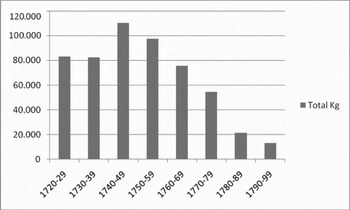
Brazilian gold arriving in Lisbon, 1720–1799

Under this scheme, a total of about 537 tonnes of gold arrived in Portugal between 1720 and the end of the eighteenth century, with the largest amounts delivered in the 1740s and 1750s. Of this total, 22 per cent went to the Crown as a result of taxation on production in mining areas, and 78 per cent to private agents. The totals reckoned by these records differ from other previously published estimates, which rely on unofficial sources and do not make a distinction between shipments for the state and those made on behalf of private agents (Morineau Reference Morineau1985; Pinto Reference Pinto1979). Notwithstanding these differences, all the available sources are unanimous in confirming the expansion of mining activities and the subsequent increase in the amounts of gold arriving in Lisbon in the first half of the eighteenth century.
The overwhelming share of the precious metal was then transferred to other parts of Europe. The structure of Portuguese foreign trade makes clear Lisbon's role as a trans-shipment port. A great part of Portuguese exportation to Brazil consisted of re-exportation of European commodities. In turn, goods from elsewhere in Europe were paid for with colonial goods, including gold (Pedreira Reference Pedreira1995, Reference Pedreira and da Cunha2001). It is estimated that no less than 60 per cent of the gold was re-exported.Footnote 4
The ‘colonial pact’ reserved the monopoly of the trade with Brazil to Portuguese merchants. It did not, however, create a barrier to the entry of any national agents, even those with limited knowledge of mercantile practices (Macedo Reference Macedo1982). Such an increase in opportunities for Portuguese middlemen meant that business organizations could face setbacks owing to the enlargement and increased professional heterogeneity of all those who were involved in this trade. This was reported in mercantile correspondence. The personal records of a merchant named Francisco Pinheiro, living in Lisbon, whose business activity is documented from the early eighteenth century to 1749 (Lisanti Reference Lisanti1974) shows that neither public nor private-order institutions protected him from breaches of contract by his agents. When he began his trading activities with Rio de Janeiro, he chose a ship's captain and a merchant living in the colony as his commissioners. In the event, both of them caused him problems. The former fled with his capital; the latter forced Pinheiro to send his brother to the colony in order to collect information. The reports that his brother sent back about frauds committed by the agent in Rio led Francisco Pinheiro to sever all ties with his former representative. The brother, in turn, also proved to be a bad choice. In a long letter, Francisco Pinheiro details a number of frauds to explain his loss of trust in his brother: the misdeeds include the reception of goods the brother fallaciously claimed to be in a deteriorated condition, the sale of merchandise without notification to Pinheiro, and the charging of excessively high commissions. Pinheiro replaced his brother with other agents, who were in turn replaced, as further setbacks emerged (Donovan Reference Donovan1990).
Pinheiro's history provides evidence of the constant severing and re-establishing of relations. Courts of law in Bahia were unable to assist him, an incapacity that increased the costs of agency Pinheiro was forced to incur if he wished to continue his activities. It may be presumed that profits compensated for the setbacks, given his endurance in the business, which is also well documented in the registers of gold remittances. However, it should be questioned whether he withstood costs higher than peers who adapted better to an environment that facilitated the opportunistic behaviour of agents based in Brazil, a risk which no insurance was able to cover.
Pinheiro's agency problems also disclose that kinship did not always provide a firm guarantee. This challenges the notion that it was kinship that could cope with long-distance demands, as has frequently been stressed in the literature.Footnote 5 Earlier writing has assumed that families created business networks with high levels of cohesion, and that this provided an informal means of social control. But available methods for testing this assertion have seldom been used. Network analysis renders statements about the effectiveness of social ties more accurate. This methodology can shed light on how representative the setbacks of Francisco Pinheiro might have been, drawing attention to distrust as a common handicap, even among siblings. Otherwise, any consideration of the role of personal relations in systems of trust is mere intuition.
3. Social capital and mobility
A discussion of agency problems involves an in-depth analysis of trust issues, considering that any relationship of trust carries a risk which varies according to the social actors’ perception of the costs and benefits of breaching a tie (Ensminger Reference Ensminger and Cook2003). Trust may be increased or capitalized by repeated relations. The positive reputation of the trustee is thus enhanced and the breaking of the tie entails a loss both to the trustor and the trustee. Frequently trust is undermined if the trustee sees an opportunity for a gain higher than what he would receive by honouring the existing ties; that is, he may foresee the establishment of a similar relationship with someone else who has not been informed about his opportunistic behaviour (Coleman Reference Coleman1994). The same assumption is at the core of Greif's explanation about the reputation-based system that characterized the Maghrebi Jewish traders, where a coalition of traders formed a thick network that provided the information and the incentives that hindered embezzlement, even though none of the parameters usually applied to a formalized network analysis is made explicit in his studies.
Network analysis is the appropriate methodology to appraise systems of trust and their impact on agency problems because the configuration of ties predicts the probability that information about dishonest agents will be shared (Cook Reference Cook, Calhoun, Meyer and Scott1990; Burt Reference Burt2000). To measure this probability in the Portuguese–Brazilian transactions under study, the configuration of networks that supported colonial flows must be known.
Since customs duties records were lost in the Lisbon earthquake of 1755, the sole documental source that accounts for the participants in the colonial market and their relationships are the fiscal records of gold shipments referred to above (Livros de Manifestos). This source was analysed in order to describe the structure of ties. The receivers and senders of the gold are represented by the dots (nodes) and the remittances by lines (edges). The data used in this analysis were obtained from samples taken at 10-year intervals beginning in 1721 and ending in 1761, corresponding to the period in which there were the greatest number of transactions.Footnote 6
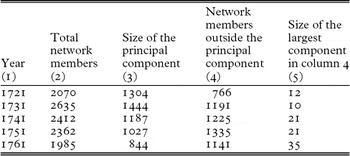
The total sample involves 11,464 actors who were active in the five sample years in question (Table 1). Connections between a number of actors (from a minimum of 844 to a maximum of 1,444) emerged in each year constituting the largest sub-graph (principal component – column 3, Table 1).Footnote 7 The other dots in networks (population out of the principal component – column 4, Table 1) involve small connected sub-graphs – dyads, triads or components ranging from 10 to 35 actors (column 5, Table 1) – and isolated dots.

These networks reveal the existence of individuals who were both senders and receivers. We infer that they travelled with the fleets, as suggested by Russell-Wood (Reference Russell-Wood2000) in his analysis of the social ranks involved in the Brazilian mining rush. In our case, this situation is represented by isolated dots or dots integrated in connected sub-graphs. It ranges from 19.7 to 24.2 per cent of the whole population in the networks and confirms the role of travelling merchant-commissioners in colonial trade (Macedo Reference Macedo1982; Maxwell Reference Maxwell1973; Flory Reference Flory1978; Costa and Rocha Reference Costa, Rocha and Macedo2009). Further evidence for the frequent occurrence of these merchant-commissioners is found in a set of applications to the knighthood of military orders or to the staff of the Inquisition. These positions were symbolic rewards distributed by the state and the church which ensured the individual's reputation with regard to religious and social background.Footnote 8
A much more important contribution which network analysis can make to our understanding of this trade, however, is found in the configuration of relations. This corresponds to the sociometric concept of the ‘star’ which points to an uneven distribution of information in this system of relations (Moreno Reference Moreno1934). A ‘star’ represents a nucleus of relations organized around central individuals in which dots are indirectly connected through mutual ties to the centre of the ‘star’. It is also the configuration used to describe relations in the credit market of medieval Genoa (Van Doosselaere Reference Van Doosselaere2009, pp. 104–10). This configuration ensures that those at the centre of the ‘star’ possessed information about all the other individuals involved, who, in turn, may not have shared information about the centre of the star. In the case of Genoa, such a network structure changed from 1154 to 1315, becoming more decentralized. Such a long-term change led Van Doosselaere to infer that this involved the loosening of a previous feudal structure. In the Portuguese–Brazilian trade, the ‘stars’ remained the predominant configuration, showing no evolution in networks’ structures over time. The central actors were mostly senders, suggesting that within the system asymmetric information favours them. Potentially, this had a negative impact on agency. However, the analysis of the group's cohesion allows for further understanding of agency problems.
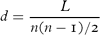
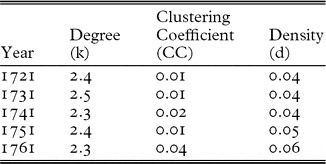
Cohesion is a feature of a social group which derives from direct, frequent and intense ties among sub-groups (Wasserman and Faust Reference Wassermann and Faust1994). It is discerned in this exercise by means of three indicators.Footnote 9 One is average degree (k), that is, the average number of relations each individual has in the network. Another is density (d), the number of connections in the network calculated as a ratio between the actual number of connections verified and the maximum number of connections that would exist if all the individuals in the network had relations with each other, varying between 0 (empty graph) and 1 (complete graph). A third is clustering coefficient (CC), the average probability that two individuals who have common relations with a third individual are themselves connected, also varying between 0 and 1. This last parameter discloses triangular relations pointing to a structure that could grant symmetric information, making the network an effective institution of social control.Footnote 10 Results are presented in Table 2.
Network structure: results of the computation of standard parameters

Source: Same as for Figure 1.
Each individual had between 2.3 and 2.5 connections on average. This is similar to another case study that applies this methodology to matrimonial ties in renaissance Florence (Padgett and Ansell Reference Padgett and Ansell1993) and shows networks whose connectivity is dependent on a low number of ties per actor. Moreover, the clustering coefficient (CC) has a value lower than density, which shows the scarce number of triangular relations and enforces the low probability of information being shared between two traders who had a common agent. This reinforces the inferences from the dominant ‘star’ configuration.
Altogether, networks exhibit a non-cohesive social environment and asymmetric information, both factors ensuring low levels of social capital. Assuming a correlation between levels of cohesion and the effectiveness of personal ties in penalizing morally hazardous behaviour, it is likely that high transaction costs affected the Portuguese–Brazilian market. It is worth noting that network structures such as these are consistent with the openness of the group of participants in the market and contradicts the most common perception of networks as effective informal institutions.Footnote 11
The example of Francisco Pinheiro can now be contextualized. The analysis of the broad structure in which he was inserted tells us that many of his peers, who did not leave behind commercial correspondence, must have suffered similar setbacks in managing their business over long distances. Market growth without formal barriers to the entry of newcomers promotes structures that tend to lose cohesiveness. If a third party who supplies incentives for obligations and expectations has not yet become effective, it is likely that private resources must have been diverted to protect individuals ‘from unlawful violations of their property rights’ (Knack and Keefer Reference Knack and Keefer1997; Jutting Reference Jutting2003).
A look at the dots that polarize above-average ties discloses what those resources were. Hancock has shown, with regard to the North Atlantic economic space, that the number of connections polarized by a merchant indicates that he had a positive reputation (Hancock Reference Hancock2000a). If hubs may signal positive reputation, one should note that in the case under study they correspond to individuals who were travelling in the fleets. This suggests that itinerancy mitigated the drawbacks that might have come from asymmetric information within the system. It may be inferred that paying an agent to go on the voyage was like allocating resources to protect individuals from being cheated by correspondents rooted in Brazil. Itinerancy must have functioned to reinforce the power of the network, and thus was a mechanism developed to adapt to an adverse environment.
Recent historical studies have paid attention to the role of mobility in the North Atlantic economy. Travelling was more frequent than the historical literature would have led us to believe some decades ago. Nowadays, it is seen to have promoted sales, introduced new marketing techniques and strengthened contacts, particularly during periods troubled by outbreaks of military conflict (Morgan Reference Morgan, McCusker and Morgan2000; Hancock Reference Hancock2000a, Reference Hancock, McCusker and Morgan2000b; Marzagalli Reference Marzagalli2005). In other words, in the North Atlantic context, mobility has been taken as a means to build up a network. In contrast, this same itinerancy has been interpreted in historical studies on the Iberian Atlantic as a negative device connected with smuggling. This was the view expressed in contemporary political speeches and legislation. Travelling agents (called peruleros in Spain and comissários volantes in Portugal) were associated with strategies which helped to circumvent the law that prevented foreigners from entering this economic space (Macedo Reference Macedo1982; Flory Reference Flory1978; Garcia-Baquero González Reference Garcia-Baquero González1988; McFarlane Reference McFarlane1993; Garavaglia and Marchena Reference Garavaglia and Marchena2005). Suspicion that smuggling was taking place forced the state to prohibit travelling agents in the Portuguese–Brazilian fleets in 1755.Footnote 12 This political decision raised objections within the merchant group, which pressed for alterations of the law to allow some exceptions. The tension between the state's aim of controlling fiscal duties and the actual role that itinerancy played in business organizations makes this case study quite different from that of Venice, where the state was not only a third-party institution for enforcement but also a provider of information about reputable individuals. A range of institutional frameworks enabled the Venetian state to assist private-order arrangements (González de Lara Reference González de Lara2008). In the Portuguese colonial market, the political misinterpretation of the role of travellers underlines the state's inability to cope with private-order devices.
The eighteenth-century view of this form of agency has been uncritically assimilated into Portuguese historical studies, which have taken the misconception for granted (Boxer Reference Boxer1962, Reference Boxer1969; Maxwell Reference Maxwell1973; Macedo Reference Macedo1982). The notion that itinerancy was at the service of foreigners is at odds with an analysis of gold shipments that arrived in Lisbon between 1721 and 1761. Travellers on the fleets between Portugal and Brazil show no particular connections with foreigners (Costa and Rocha Reference Costa, Rocha and Macedo2009).
If mobility had a specific function in the management of distance by becoming a form of agency and an effective means of selecting reputable individuals, it should have had a positive effect on the performance of organizations that adopted it. The next section tests this hypothesis.
4. The management of distance
A group of receivers as heterogeneous as possible with regards to organizational strategies was selected. This sub-group includes receivers of gold who show up in three or more of the five samples taken at 10-year intervals. This requirement aims at selecting individuals who continued in business for a considerable period of time (a minimum of 20 years) and therefore were not random participants. It is thus possible to test the economic results of any form of agency they might have implemented. Studying this group introduces a longitudinal perspective that makes it possible to check reiterated relations. Accordingly, 115 receivers who had relations with 350 senders through 320 gold shipments were identified. Each of them received an average of 15.4 kg of gold, an amount that was definitely higher than the 3.3 kg which was the average for the whole population (11,464 actors) under analysis. The data show a volume of activity that is therefore significant.
Receivers obtained remittances in four different ways:
(1) They would sail to Brazil and return with the gold; these are the isolated dots (nodes) in the network;
(2) They would have representatives in Brazil, who shipped the gold;
(3) They would have one or more agents who would travel with the gold in the fleets; or
(4) They would adopt a more complex solution that involved both the use of agents based in Brazil and travelling agents.
Each of these different methods had advantages and disadvantages. The first method listed above had several drawbacks. It implied the opportunity cost inherent in a long and dangerous voyage. In addition, transactions were made when the supply of goods was at its highest, that is, at the moment the fleets arrived in Brazil. This decreased the prices that could be charged and, consequently, placed a limit on profit margins. However, this method had one obvious advantage: it provided for independent decision-making that freed the trader from any type of agency risk. The second method inverts these costs and benefits. It dispensed with travel costs and enabled goods to be sold at any time during the year between the fleets’ arrivals from Portugal, but it also implied placing trust in traders based in distant markets, a situation in which the risk of moral hazard might be higher. The third option, based on the exclusive use of travelling agents, minimizes that risk insofar as regular contacts increased the flow of information between receivers and senders. This method, however, precluded the receivers from benefiting from the services of those based permanently in Brazil, when the latter could extend the range of investments in the colony. The fourth method involved the costs and the benefits of the previous two, but also presented a unique advantage. The agents who returned to Portugal could provide regular information about the Brazilian market and the activities of those who were permanently based there. It is assumed that travellers could perform a monitoring service.
The longitudinal study of the 115 receivers’ personal relations shows different combinations of the four methods over the period during which each trader was active. An analysis of these combinations identifies patterns among the strategies adopted, which distinguish three categories considered in the model. The first category applies to receivers who used strategies 1, 2 or 3, but never concomitantly. The particular feature of this group is having had agents resident in Brazil who were unmonitored at least in one sample year (category A). The second category refers to receivers who had senders monitored by travellers or by travelling themselves (category B). This differs from category A because there is no evidence to suggest that receivers ever relied on unmonitored agents in Brazil. The third category covers those who relied exclusively on itinerancy to resolve problems of agency. This category combines the first and the third strategies detailed above, corresponding to receivers who opted for mobility as their single strategy (category C).
The key issue is to find which category contributed most to reducing the costs of agency, assuming that social capital erosion provided a premium on management strategies. The model created to test the hypothesis considers the amount of gold received by each of the 115 receivers as the dependent variable. The independent variables include characteristics of the receivers as determined by an examination of the category of agency created and of the networks to which they belonged. This process resulted in seven independent variables:
(1) Number of years of activity (a continuous variable ranging from 3 to 5 depending on the number of samples in which each receiver appears).
(2) Category of management strategy (shown above as categories A, B and C).
(3) Number of observations for which each of the four agency methods was adopted. The aim is to assess the possible impact of the types of agency adopted throughout the years of activity of each receiver (continuous variable, ranging from 1 to 5 for each type of agency).
(4) Position in the structure of relations, that is, whether the receiver belongs to the largest sub-graph of the network or is outside it. This is used as a means of gauging his access to (or exclusion from) individuals with the largest number of relationships. This is a dummy variable (1 for belonging to the largest sub-graph, 0 otherwise).
(5) Distance from the central actors, measured in terms of connection or lack of connection to hubs in the network. Connection to individuals with a central position, who, as we have seen, were travellers, indicates proximity to the most trustworthy individuals. This adds to and refines the information obtained from the previous variable. This is also a dummy variable (1 for a connection to a central actor, 0 otherwise).
(6) Number of contacts – the ego-networks of the receivers. A variable determined by the number of relations found.
(7) Number of reiterated relations (the number of times that each receiver contracts the same sender), an indication of strong ties. As the number of reiterated relations was found never to exceed four, this variable ranges from a minimum of 1 to a maximum of 4.
Given that the dependent variable – the amount of gold received – does not have a normal distribution (it has a Gamma distribution)Footnote 13 and is therefore not amenable to the construction of a linear regression model, the following general linear model was formulated:

where μi = expected amount of gold, and ηi = the model linear component derived from the design matrix Zi (to identify the relevant explanatory variables). β is the vector of parameters.Footnote 14 Because there is a significant correlation between the independent variables, successive regression tests had to be made to determine which of the variables had the greatest influence on the scale of business but were not correlated with each other.
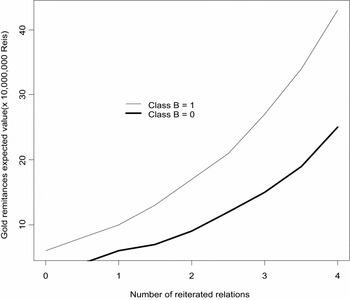
The results in Figure 2 show that the amounts of gold received by each of the selected traders were most sensitive to two variables: the number of reiterated relations and category B (the category including receivers who relied on monitored agents in Brazil).Footnote 15
‘Strong ties’, agency and gold receipts
Source: Same as for Figure 1.
Note: Class B = 1; when agency included in ‘category B’ (resident agents assisted by travellers); Class B = 0; any other form of agency.

The first characteristic serves as an indication of the positive impact of trust on business scale. A simple scrutiny of the surnames within the receivers’ ego-network does not lead to the recognition of familial ties. Nevertheless, the model highlights the importance of strong ties – whatever their nature – whenever information is not widely shared. The significance of strong ties in market performance has driven relevant work on economic sociology since Granovetter's assertion about the ‘strength of weak ties’ (Granovetter Reference Granovetter1973). We do not intend to pursue this discussion regarding markets in early modern times, where close, strong ties were necessarily reckoned as an asset. The model does not contradict these common assertions, but we wish to stress that it provides new insights into problems of exchange with regard to the second variable, i.e. maintaining agents in Brazil who were monitored by travellers.
The second characteristic shows that the effective means of reducing the risk of distrust was to have Brazilian correspondents monitored by traders who travelled with the fleets and had a central position in the network. A diachronic analysis of the connections among these 115 receivers reveals that the importance assigned to these hubs in the network changed throughout the first half of the eighteenth century.
The ratio between senders with a high number of ties (degree) and those with a low number of ties increased (Table 3) and gets close to one. This means that the former became vital in business organization. Travelling regularly reduced these agents’ chances of operating in a market that they visited only fleetingly, thus reducing their possibility of exploiting local opportunities for embezzlement. Travelling, therefore, was both a factor for building a positive reputation and the mechanism that afforded their centrality in the networks.

The fact that category B is one of the significant explanatory variables warrants a more detailed analysis of the role of residents in Brazil. It is clear that relying on individuals based in the colony could affect the scale of business. These agents ensured that the goods arriving in the fleets from Portugal were sold over the following year, at times when supply was at its lowest and prices were therefore higher. A business which was reliant on a chain of local traders to supply a growing market in the mining regions required the concession of credit. Those who were permanently based in the local market were better placed to control it.Footnote 16 Moreover, trade in the frontier regions of the two Iberian empires conferred further advantages to agents based in Brazil. Contraband was rife in the colony of Sacramento, close to the River Plate, where the administration was handed over to Spain under the Treaty of Madrid in 1750. Goods shipped by the Portuguese to this area reached the Spanish empire through Buenos Aires. The high profits obtained and access to Spanish silver called for representatives based in the local area, who were linked to others in port cities such as Rio de Janeiro, who in turn operated in connection with the traders who shipped the products from Lisbon. These interconnections are well known, and the letters sent by the merchant Francisco Pinheiro again serve to document the transactions made in this region (Canabrava Reference Canabrava1944; Possamai Reference Possamai2006).
In addition to these advantages, the merchants who resided in Brazil frequently combined their trading activities with posts in the colonial administration, intertwining political capital with agency issues. This promiscuity between commerce and local administration may even have had an indirect effect on commercial activity by reducing the costs of agency by means of lowering rates of commission. Francisco Pinheiro's correspondence also serves to describe this process. One of his agents residing in Minas Gerais asked him to apply pressure in Lisbon so that the agent might be granted a post in the local judicial administration. He argued that by securing another source of income, he could lower the commission he charged Pinheiro, offering this as a benefit in exchange for the personal favour he was asking of the Lisbon merchant (Furtado Reference Furtado1999).
Indeed, personal favours became part of business accounting. This subject has been thoroughly discussed in the historical literature. The debate has been dominated by the fiscal consequences of such promiscuity, focusing on the acquiescence of crown officials, who turned contraband into an informal institution (Pijning Reference Pijning1997; Moutokias Reference Moutokias1988, Reference Moutokias, Carmagnani and Romano1999). However, the impact that a local administrative framework entangled with merchant affairs came to have on social capital of the system is seldom mentioned. As far as merchants were concerned, it reduced the costs of agency, but delayed the creation of a skilled group of traders, which would have promoted an occupational ethos. As for the state, it delayed the development of a specialized bureaucracy of the kind that would normally be at the service of a modern state organization that enforces contracts and the law.
Relying on local agents had advantages denied to individuals found in category C, which is based exclusively on the use of travelling agents. However, as the results of the model show, the characteristics of Category A, which involved having residents who were not monitored, also failed to increase the scale of business. It will be noted that the correlation between this category and the variable ‘Strong ties’ – number of reiterated relations – indicates a high probability of ties being breached (a value of –.305 (.001)). This reinforces the argument that there was a high probability that agents residing in Brazil would engage in morally hazardous behaviour if freed from monitoring mechanisms. The additional costs incurred by paying for the voyages were certainly lower than the rate by which commissions in Brazil would have had to be increased to cover the risk of distrust. In this sense, travelling agents contributed to reduce transaction costs in the whole system. Assuming that merchants with a good reputation performed this function (hubs in the network), category B becomes the pattern that ensured the best economic performance.
It thus emerges that in this set of circumstances ‘good institutions’ centred on non-rooted people. This supports Acemoglu's findings on the role of demographic variables in shaping the institutional framework of economic performance. In this view, high mortality rates and exploitative colonial systems combined to prevent European institutions from being successfully transferred to colonial settings (Acemoglu et al. Reference Acemoglu2001). In the case of eighteenth-century Brazil, it was flows of people rather than high mortality rates which characterized colonial demography and determined institutional arrangements. The frequent return of settlers to Portugal and the ‘structural’ mobility of agents with a good reputation may have created barriers to the building of social capital in the colonized territory. A Governor-General and Viceroy observed this in a report dated from 1779. He stressed that most of those referred to as ‘merchants’ were simply commissioners whose lack of ‘good correspondence [accounts] with businessmen in Lisbon and Oporto . . . forced the latter to come to this capital [Rio do Janeiro] to monitor their accounts’ (Alden Reference Alden1968; Carnaxide Reference Carnaxide1940).
The case of Francisco Pinheiro – the only example known thus far – can now be located in a broader context and compared with the other examples modelled here. The model confirms that the forms of agency he used (category A) would not produce the best results, since he allowed his correspondents in Brazil, one of them being his brother, to operate unmonitored. The case of João de Castro Guimarães, who figures in all the sample years analysed, provides a clear counterpoint to Pinheiro, despite the fact that their backgrounds were similar. They were both newcomers in the colonial market when they started their activity. Both had parents who were farmers in northern Portugal, a situation which accords with many other examples of how the mercantile class was successively renewed by migratory flows from rural to urban areas (Pedreira Reference Pedreira1995). He moved to Lisbon, where he set up shop and began shipping goods to Brazil. His business prospered, and he advanced in the economic hierarchy, which allowed him to bequeath his commercial operation to his descendents.Footnote 17 In fact, one of his sons, Manuel Eleutério de Castro, would become one of the 100 leading merchants in Lisbon at the time of the Marquis of Pombal (Pedreira Reference Pedreira1995). From the gold shipment registers, we can see that during his trading activities Castro Guimarães established contact with 45 correspondents during the five years selected, 22 of whom were resident in Brazil, the other 23 being travelling agents. João de Castro Guimarães, unlike Pinheiro, achieved positive results by regularly monitoring his agents in local Brazilian markets (category B).
These two merchants’ activities provide micro-data that corroborate the underlying assumptions of the statistical model. An analysis based strictly on biographies would be unlikely to disclose the reasons for the different personal outcomes that emerged in our study. This type of analysis brings to light the relation between business strategies and economic performance.
5. Conclusion
This article has observed a historical case in which weakness in formal institutional arrangements coincided with the expansion of the number of participants in transactions. The combination of these circumstances delayed the creation of a group ethos and hindered the cohesiveness of networks. These constraints gave rise to an adverse environment in which a negative expectation prevailed with regard to the behaviour of agents. This case study highlights the fact that social capital depletion (distrust) may coexist with the growth of markets. This conclusion is at odds with propositions advanced in the economic history literature that take the effectiveness of both formal and informal institutional arrangements (trust) as a prerequisite of economic expansion.
Since flows of gold, one of the main commodities transacted, did not show any downward trend throughout the period of enlargement of the group of traders, this article has tried to establish the mechanism which enabled organizations to cope with distrust and hypothesized that social capital depletion rewarded traders who could manage it.
The methodology used demonstrates that networks are not necessarily synonymous with high levels of social capital, owing to the lack of cohesion and signs of asymmetric information exhibited by the ties’ configurations. It discloses the mechanism that selected reputable individuals by observing the actors who centralized connections in the system. Such a concentration of relations indicates a scarcity of individuals with appropriate attributes for this trade. Those who have them are frequently observed travelling back and forth and are major players in this field. We conclude therefore that mobility became a means of reinforcing a reputation-based system. According to the hypothesis, this would provide a reward to organizations which exploited these connections with travellers.
Testing this hypothesis proved that organizations that used travellers who monitored resident agents in the colony were able to obtain a comparative advantage. The cost of paying for voyages would have been lower than the expenditure needed to raise commissions in order to mitigate the risk of distrust of those who remained in the colony.
This conclusion alters the received view of networks as systems with an even distribution of trust and information, and it broadens previous assumptions about the role of voyages in long-distance trade. Until now the use of travellers has been seen as either a strategy at the service of contraband, a way to rebuild connections after a period of war or to broaden business investments. This case study proves that mobility was a response to markets with low levels of social capital.
Hence, agency problems were not mitigated through kinship, barriers to entry, or through the assistance of a third-party enforcement institution, as commonly observed in historical case studies. Problems of exchange in the Portuguese–Brazilian market were better solved by overcoming the physical barriers of distance and its temporal impact on information flows, which were factors for increased risk of embezzlement. The service of travellers resulted in a reduction of the time gap between decision-making and economic results. It acted as a means to monitoring the agents residing in Brazil, as well as a mechanism that would select the reputable agents throughout the period under analysis. This tells us how a private-order institutional arrangement was able to cope with distrust.
The lack of comparable studies at the present time prevents us from making any statement about whether the costs of transactions in this case were significantly different than elsewhere in Atlantic. All in all, the Portuguese–Brazilian case may inspire further research that uses network analysis to examine long-held impressions about North Atlantic areas.
Acknowledgements
We gratefully acknowledge the comments and criticism of two anonymous referees who contributed to improve this article. Special thanks are due to Paula Figueiredo for discussion on statistical issues and to David Hancock, José Luis Cardoso, Raphael Wittek, Álvaro Ferreira da Silva and Rita Martins de Sousa for their suggestions. The article benefited from subsidies provided by Fundação para a Ciência e Tecnologia (POCI-2010).
Statistical appendix
The response variable – Y – measures the total amount of gold received per agent. Its histogram shows that it is not normally distributed.

Two further tests were carried out. One is a Kolmogorov-Smirnov test. The other is the Q-Q Plot. In both cases the null hypothesis (Y normally distributed) was rejected. The same occurs when a particular outlier (gold receipt > 60,000,000 réis) is removed.
A linear regression model could not be used in this case. However, if the sample proves to be well adjusted by some distribution in the exponential family, we should be able to specify a generalized linear model to fit the data. In this case the response variable is continuous and only defined for positive values and fits a Gamma distribution. This hypothesis was not rejected by the Kolmogorov-Smirnov test (run for Exponential Distribution, which is a particular case of a Gamma distribution).

The Q-Q Plots representations support this hypothesis:

We thus assume that Y has an approximate Gamma distribution, which belongs to the exponential family, as imposed for the formulation of a generalized linear model.