Introduction
Huntington's disease (HD) is a neurodegenerative disease, caused by a CAG repeat expansion leading to an abnormal huntingtin protein. Damage is particularly found in the striatum, although other regions of the brain are affected as well, including cortical areas. The most characteristic symptoms of HD are motor deficits, including chorea, rigidity, and abnormal posturing. In addition to motor symptoms, cognitive and behavioral changes are generally also found, such as memory and executive dysfunctions, depression, apathy and other psychiatric manifestations. Clinical diagnosis is based on motor symptoms. However, since HD is a disorder with a known genetic etiology, (Huntington's Disease Collaborative Research Group, 1993), people that are at risk of having the disease can be identified before onset of the first symptoms, allowing for directed search of preclinical deficits. This has indicated that subtle cognitive impairments can be found in prodromal HD gene carriers, in particular affecting memory, executive functioning and psychomotor speed (e.g., Farrow et al., Reference Farrow, Churchyard, Chua, Bradshaw, Chiu and Georgiou-Karistianis2007; Kirkwood et al., Reference Kirkwood, Siemers, Hodes, Conneally, Christian and Foroud1999, Reference Kirkwood, Siemers, Stout, Hodes, Conneally, Christian and Foroud2000; Lawrence et al., Reference Lawrence, Hodge, Rosser, Kershaw, French-Constant, Rubinsztein and Sahakian1998; Lemier, Decruyenaere, Evers-Kieboms, Vandenbussche, & Dom, Reference Lemiere, Decruyenaere, Evers-Kieboms, Vandenbussche and Dom2004; Robins Wahlin, Lundin, & Dear, Reference Robins Wahlin, Lundin and Dear2007; Snowden, Craufurd, Thompson, & Neary, Reference Snowden, Craufurd, Thompson and Neary2002; Stout et al., Reference Stout, Paulsen, Queller, Solomon, Whitlock, Campbell and Aylward2011; Tabrizi et al., Reference Tabrizi, Langbehn, Leavitt, Roos, Durr, Craufurd and Stout2009, Reference Tabrizi, Scahill, Durr, Roos, Leavitt, Jones and Stout2011). Furthermore, on a neural level, damage to the striatum is already found in prodromal HD gene carriers and some studies have reported subtle cortical abnormalities as well (e.g., Gómez-Ansón et al., Reference Gómez-Ansón, Alegret, Muñoz, Monté, Alayrach and Tolosa2009; Harris et al., Reference Harris, Codori, Lewis, Schmidt, Bedi and Brandt1999; Nopoulos et al., Reference Nopoulos, Aylward, Ross, Johnson, Magnotta, Juhl and Paulsen2010; Paulsen et al., Reference Paulsen, Nopoulos, Aylward, Ross, Johnson, Magnotta and Nance2010; Tabrizi et al., Reference Tabrizi, Langbehn, Leavitt, Roos, Durr, Craufurd and Stout2009, Reference Tabrizi, Scahill, Durr, Roos, Leavitt, Jones and Stout2011; Thieben et al., Reference Thieben, Duggins, Good, Gomes, Mahant, Richards and Frackowiak2002). The striatum (including the caudate nucleus and putamen) is a part of the basal ganglia, which are a group of subcortical nuclei that are important for executive and motor functions, but are also involved in learning mechanisms. Prodromal HD patients have been found to be impaired on tasks that are dependent on the striatum, in particular implicit learning tasks, such as motor pursuit (Heindel, Salmon, Shults, Walicke, & Butters, Reference Heindel, Salmon, Shults, Walicke and Butters1989), rotary pursuit (Gabrieli, Stebbins, Singh, Willingham, & Goetz, Reference Gabrieli, Stebbins, Singh, Willingham and Goetz1997), mirror reading, and implicit sequence learning (Ghilardi et al., Reference Ghilardi, Silvestri, Feigin, Mattis, Zgaljardic, Moisello and Eidelberg2008; Kim et al., Reference Kim, Reading, Brashers-Krug, Calhoun, Ross and Pearlson2004).
Implicit contextual learning is a type of implicit learning that has received much attention over the past decade. It is based on the notion that our environment contains a large amount of contextual information that characterizes specific environments. By memorizing this contextual information we can facilitate a visual search through our environment, which underlies a top-down attention guiding mechanism (e.g., Chun & Jiang, Reference Chun and Jiang1998; Chun, Reference Chun2000). Interestingly, this mechanism does not require conscious attention, and, therefore, is an implicit learning process. Furthermore, although the task requires a motor response to measure response times, the learning mechanism is purely based on the association between visual information.
It was repeatedly shown that the medial temporal lobes are involved in implicit contextual learning (Chun & Phelps, Reference Chun and Phelps1999; Greene, Gross, Elsinger, & Rao, Reference Greene, Gross, Elsinger and Rao2007; Manns & Squire, Reference Manns and Squire2001; Preston & Gabrieli, Reference Preston and Gabrieli2008). The medial temporal lobes, in particular the hippocampus, are important for a range of memory processes, such as explicit memory and binding of features in memory. Although the importance of the MTL in implicit contextual learning is supported by several studies, we showed in a recent study that patients with Parkinson's disease were unable to learn contextual information during an implicit contextual cueing task (Van Asselen et al., Reference Van Asselen, Almeida, André, Januário, Freire Gonçalves and Castelo-Branco2009). Parkinson's disease is a neurodegenerative disease in which dopamine cells in the substantia nigra degenerate. Since the substantia nigra is the main source of dopamine to the striatum, the latter is also affected. Importantly, in the study of Van Asselen et al. (Reference Van Asselen, Almeida, André, Januário, Freire Gonçalves and Castelo-Branco2009) patients were tested in an early stage of the disease to ensure damage was largely limited to the basal ganglia. This is because, although Parkinson's disease affects the basal ganglia early on, the frontal cortex is also affected in later stages of the disease. Together, this suggests a critical network underlying implicit contextual learning, including both the medial temporal lobes and the basal ganglia.
In the current study, we aimed to investigate implicit contextual learning in Huntington's disease. To define whether an impairment can already be found before onset of the first clinical features, we included both prodromal and symptomatic HD participants. If the basal ganglia are indeed involved in implicit contextual learning, we expect to find no learning effect in the symptomatic HD patients, in contrast to the healthy control subjects. Considering the fact that damage to the basal ganglia is already found in prodromal HD patients, impairment is also expected in this group.
Methods
Participants
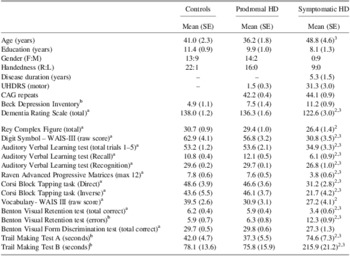
Two patient groups were included in this study: 16 prodromal Huntington's disease participants and 9 symptomatic Huntington's disease participants. All patients were seen by an experienced neurologist (C.J.), who used the motor scale of the Unified Huntington Disease Rating Scale (UHDRS) for clinical diagnosis. Genetic testing was used in all patients to define the number of CAG repeats (see Table 1). Furthermore, we tested 22 healthy control subjects. Participants were excluded from the study if they had fewer than 4 years of education or when they had neurological or psychiatric disorders that were not related to HD. The three groups were matched for education level [F(2,44) = 2.1; p = .13]. One-way analysis of variance (ANOVA) demonstrated an overall difference between the ages of the three groups of participants [F(2,44) = 4.3; p < .05]. However, post-hoc analyses indicated no age difference between the controls and prodromal HD participants and the controls and symptomatic HD participants. A significant difference was found, as expected, between the prodromal and symptomatic HD participants. Considering the progressive nature of the disease, this difference was unavoidable. Characteristics of these groups are presented in Table 1.
Characteristics of the prodromal and symptomatic HD participants and the control group

Note. UHDRS = Unified Huntington Disease Rating Scale; WAIS-III = Wechsler Adult Intelligence Scale-Third edition. 1 = Significant difference (p < .05) between the controls and prodromal HD group; 2 = Significant difference (p < .05) between the controls and symptomatic HD group; 3 = Significant difference (p < .05) between the prodromal HD group and symptomatic HD group. a = tests on which higher score is better; b = test on which lower score is better.
Neuropsychological Testing
All participants were tested with an extensive neuropsychological test battery to define whether prodromal and symptomatic HD participants had other cognitive deficits. We used the 12-item short form of the Raven Advanced Progressive Matrices (Raven, Raven, & Court, Reference Raven, Raven and Court1993) and the Vocabulary subtest of the WAIS-III (Wechsler, Reference Wechsler1997, Reference Wechsler2008) as an indication of intelligence. Visual perception was tested with the Rey Complex Figure Test (Rey, 1941; Osterrieth, Reference Osterrieth1944), the Benton Visual Retention test (Benton, Reference Benton1974) and the Benton Visual Form Discrimination test (Benton, Hamsher, Varney, & Spreen, Reference Benton, Hamsher, Varney and Spreen1983). Verbal memory was tested using a Portuguese version of the Rey Auditory Verbal Learning Test (Cavaco et al., Reference Cavaco, Pinto, Gonçalves, Gomes, Pereira and Malaquias2008; Rey, Reference Rey1964). To assess working memory and executive functioning we used the Trail Making test and Digit Symbol subtest of the WAIS-III and the Corsi Block-Tapping task (Berch, Krikorian, & Huha, Reference Berch, Krikorian and Huha1998; Kessels, Van Zandvoort, Postma, Kappelle, & De Haan, Reference Kessels, Van Zandvoort, Postma, Kappelle and De Haan2000). For the latter task, the product of the total number of correct trials and the length of the largest sequence was calculated (Kessels et al., Reference Kessels, Van Zandvoort, Postma, Kappelle and De Haan2000). The Dementia Rating Scale-2 (Mattis, Jurica, & Leitten, Reference Mattis, Jurica and Leitten2002) and the Beck Depression Inventory (Beck, Ward, Mendelson, Mock, & Erbaugh, Reference Beck, Ward, Mendelson, Mock and Erbaugh1961; Portuguese adaptation: Vaz Serra & Pio Abreu, Reference Vaz Serra and Pio Abreu1973a, Reference Vaz Serra and Pio Abreu1973b) were used to test for dementia and depression subsequently. Handedness was defined by using a translated version of the Edinburgh Handedness Inventory (Oldfield, Reference Oldfield1971). Informed consent was obtained according to the Declaration of Helsinki and all procedures were approved by our local ethics committee.
Implicit Contextual Cueing Task
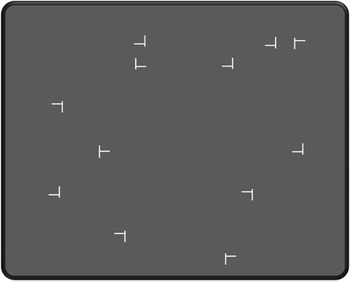
Subjects were tested with an implicit contextual cueing task in which spatial information was used as a contextual cue (Van Asselen et al., Reference Van Asselen, Almeida, André, Januário, Freire Gonçalves and Castelo-Branco2009). This task was programmed using the Presentation software (Neurobehavioral systems) and displayed on a computer screen. The implicit contextual cueing task (Figure 1) is a visual search task in which subjects need to locate a target (T) among 10 distractor stimuli (L). The target stimulus was rotated either 90° or 270° and the distractor stimuli were rotated either 0°, 90°, 180°, 270°. The stimulus size was 0.81° × 0.81°. After instructions were given, subjects were asked to place their chin in a chinrest that was positioned 50 cm from the computer screen. Subjects were instructed to locate the target and indicate the direction of rotation of the target as quickly as possible by pressing one of two buttons of a response box. The experiment contained 16 blocks of 24 trials, resulting in 384 trials in total. In half of these trials, the spatial configuration (i.e., the positions) of the distractor and target stimuli were repeated. These trials are called “Repeated trials”. Importantly, the direction of rotation of the targets in these trials was always randomly defined to prevent motor learning. In the other half of the trials, the positions of the stimuli and their direction of rotation were always randomly defined. These trials are called “New trials”. Each block contained 12 Repeated trials and 12 New trials. Each of the 12 Repeated trials contained a different spatial configuration that was repeated once per block. Therefore, each Repeated spatial configuration was shown once during each of the 16 blocks and thus repeated 16 times during the entire experiment. Before the start of the experiment 24 practice trials were given that did not contain any repeated contextual information.
A sample display of the contextual cueing task.

Recognition Memory Task
To define whether subjects had noticed the repeated contextual information, three questions were asked immediately after finishing the experiment, namely: (1) “Did you notice anything during the experiment?” (2) “Did you notice that some of the configurations were repeated?” (3) “Did you try to remember the repeated configurations?”. Subsequently, a recognition memory task was performed to define whether subjects had any conscious knowledge of the repeated spatial configuration. This recognition memory task contained 24 trials. During each trial, a spatial configuration was presented and subjects were instructed to indicate which of the trials had been repeated during the experiment by pressing one of two buttons on a response box. No time limit was used. Half of the trials contained repeated spatial configurations and half of the trials contained new spatial configurations.
Statistical Analyses
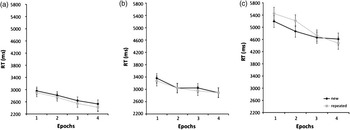
For statistical analysis, the 16 blocks were collapsed into 4 epochs of 4 blocks each (Figure 2). Trials in which an error (i.e., indicating the incorrect rotation of the target) was made were excluded (Controls: 1.1%; prodromal HD participants: 0.8%; symptomatic HD participants: 4.6%) from analyses as well as trials with a response time that took longer than 2 SD above the individual mean (Controls: 4.5%; prodromal HD participants: 4.2%; symptomatic HD participants: 4.4%). A one-way ANOVA demonstrated an overall difference between the three groups for the number of errors [F(2,44) = 13.9; p < .01; η2 = 0.39], indicating that the symptomatic HD participants made more errors than the controls, but not the prodromal HD participants (p < .001). No group differences were found for the number of trials in which subjects responded too slow [F(2,44) = 0.2; p = .81].
Mean reaction times and standard errors for the Repeated and New trials separately as a function of Epoch (1–4). The three figures refer to the (a) control group; (b) prodromal HD group; (c) symptomatic HD group.

Implicit learning is reflected by the difference in response times between the Repeated and New trials. This difference is called the contextual cueing effect. To define whether the contextual cueing effect was the same for the three groups, we performed a three-way repeated measures analyses, in which we included the between-subject variable Group (symptomatic HD participants, prodromal HD participants, controls) and the within-subject variables Configuration (repeated and new trials) and Epoch (1–4). As an index of the magnitude of the effects, the effect size η2 was computed. Age, education level, and gender were included as covariates in the repeated measures analyses. For further interpretation of the results, it is important to realize that no significant age difference was found between the patient groups and the control group. Furthermore, previous research has shown that age does not affect implicit contextual learning (Howard, Dennis, Howard, Yankovich, & Vaidya, Reference Howard, Dennis, Howard, Yankovich and Vaidya2004).
Since HD is a rare disease, the groups of participants that were included in this study were relatively small. A sample size analyses using the equation given by Rosner (Reference Rosner2006), indicated that for the implicit contextual cueing task a sample size of 14 participants is needed to have sufficient power (α = 0.05 and β = 0.8). This means that the control and prodromal HD group have sufficient participants, but that the symptomatic HD group should have a few more. However, considering HD is an extremely rare disease and the fact that patients in an early stage have several symptoms that complicate participation, we were unable to increase the sample size. However, we have repeated the same analyses, now using only two groups, namely the control and HD group. The latter included both prodromal and symptomatic HD participants. Since these groups were now matched for age, education level, and gender, we did not include any covariates.
Results
Neuropsychological Tests
To define whether the prodromal and symptomatic HD participants had cognitive impairments we applied an extensive battery of neuropsychological tasks. The results of these tests are reported in Table 1. Separate one-way ANOVAs were used to analyze the results of the different neuropsychological tests, comparing the symptomatic and prodromal HD group with the control subjects. When necessary we performed Dunnett post-hoc tests to compare the prodromal HD participants with the controls and the symptomatic HD participants with the controls. We found a significant Group effect for all tasks (ps < .05), except for the Benton Visual Form Discrimination Test [F(2,44) = 2.8; p = .07]. Post-hoc analyses indicated that the symptomatic HD participants performed significantly worse than the control subjects on all tasks (p < .05), whereas no significant difference was found between the prodromal HD participants and the control groups on any of the tasks. Symptomatic HD participants performed worse than prodromal HD participants on all tasks (p < .05), except the Rey Auditory Verbal Learning Test and the Vocabulary subtest of the WAIS III.
Implicit Contextual Learning Task
The repeated measures analyses with the three groups (prodromal HD, symptomatic HD and controls) demonstrated a significant main effect for Group [F(2,41) = 41.7; p < .001; η2 = 0.67], indicating a difference in overall response times between the three groups. Contrast analyses indicated that HD participants (p < .001) as well as the prodromal HD (p < .05) participants responded significantly slower than the control subjects. Symptomatic HD participants are also slower than the prodromal HD participants (p < .001). A significant main effect was also found for Epoch [F(3,123) = 2.9; p < .05; η2 = 0.06], indicating that participants responded faster at the end of the experiment than at the beginning, reflecting visuomotor learning. The extent of learning was the same for the three groups of subjects, as was reflected by the nonsignificant interaction for Group × Epoch [F(6,123) = 2.1; p = .058]. Importantly, a significant Group × Configuration effect was found [F(2,41) = 3.8; p < .05; η2 = 0.16], demonstrating a difference in the extent of learning for the three groups. No three-way interaction was found [F(6,123) = 0.8; p = .61].
To understand which of the groups showed a significant contextual cueing effect, we performed separate repeated measures analyses for each Group, including the within-subject variable Configuration. For the control subjects, a contextual cueing effect was found that was reflected by a significant main effect for Configuration [F(1,21) = 9.3; p < .01; η2 = 0.31]. This demonstrates that within the control group response times were faster for the Repeated trials than for the New trials. When the same repeated measures analyses were performed for the prodromal [F(1,15) = 0.7; p = .72] and early-stage Huntington's disease participants [F(1,8) = 2.4; p = .16], no significant effect of Configuration was found, indicating that there was no difference in response times between the Repeated and New trials within the clinical groups.
Considering the small sample sizes of the patient groups, in particular the symptomatic HD group, we have repeated the previous analyses including only two groups, namely HD participants (including both prodromal and symptomatic participants) and the controls. We found a significant interaction effect for Group × Configuration [F(1,45) = 4.2; p < .05; η2 = 0.09], indicating a difference in contextual learning between the HD participants and the control subjects. Subsequently, we performed the two-way repeated measures analyses separately for the HD participants, including the within-subject variable Configuration. We did not find a significant effect for Configuration [F(1,24) = 0.2]. This confirms previous results indicating that HD participants are impaired on the implicit contextual cueing task.
Recognition Memory Task
To define whether subjects were aware of the repeated contextual information, we asked three questions after finishing the implicit contextual cueing task. Only one prodromal HD participant and one control subject indicated to have noticed the repeated contextual information (Question 1). Five prodromal HD participants and three control subjects indicated to have noted the repetitions when specifically asked about the contextual information (Question 2). Only one control subject indicated to have tried to memorize the repeated contextual information. For two control subjects, responses were missing.
To further define whether subjects had any conscious awareness of the repeated information, we tested all subjects with a recognition memory task. We found no significant difference between the number of correct responses on the recognition memory task and chance level for the controls, prodromal HD group, and HD participants (t < 2.1). This indicates that subjects did not have any explicit knowledge of the repeated contextual information, thereby confirming the implicit nature of the contextual cueing task.
Discussion
In the current study we tested participants with prodromal and symptomatic Huntington's disease using an implicit contextual cueing task using visuospatial information. The ability to learn contextual information and use this information to guide attention to a target is reflected in the reduction in response times for the trials with repeated contextual information in comparison to those trials with new contextual information. In our study, such a contextual cueing effect was found for the healthy control subjects, but not for the symptomatic or prodromal HD participants. This indicates that both prodromal and symptomatic HD patients are impaired on a spatial-based implicit contextual cueing task. These results are in line with previous studies that have shown deficits for different types of implicit learning in prodromal HD participants (Gabrieli et al., Reference Gabrieli, Stebbins, Singh, Willingham and Goetz1997; Ghilardi et al., Reference Ghilardi, Silvestri, Feigin, Mattis, Zgaljardic, Moisello and Eidelberg2008; Heindel et al., Reference Heindel, Salmon, Shults, Walicke and Butters1989; Kim et al., Reference Kim, Reading, Brashers-Krug, Calhoun, Ross and Pearlson2004).
Furthermore, the results of the current study are similar to previous findings in Parkinson's disease, another neurodegenerative disease affecting the basal ganglia, where we also observed an implicit learning deficit (Van Asselen et al., Reference Van Asselen, Almeida, André, Januário, Freire Gonçalves and Castelo-Branco2009). Together, these results suggest that the basal ganglia might play a role in implicit contextual learning. We cannot rule out, however, that abnormal function or connectivity of other brain regions affected by HD underlie this specific impairment. That is, in both Parkinson's and Huntington's disease, cortical areas such as the frontal lobes are also affected (Wolf, Vasic, Schönfeldt-Lecuona, Landwehrmeyer, & Ecker, Reference Wolf, Vasic, Schönfeldt-Lecuona, Landwehrmeyer and Ecker2007). However, in our previous study, we tested Parkinson's disease patients in an early stage of the disease, in which the damage is largely confined to the basal ganglia. In the current study, we tested both prodromal HD patients and HD patients in an early stage of the disease. The finding that both patient groups were impaired strengthens the idea that damage to the basal ganglia might have caused the learning impairments. Furthermore, the medial temporal lobes, which also have an important role in implicit contextual learning (Chun & Phelps, Reference Chun and Phelps1999; Greene et al., Reference Greene, Gross, Elsinger and Rao2007; Manns & Squire, Reference Manns and Squire2001; Preston & Gabrieli, Reference Preston and Gabrieli2008), are not affected in HD patients (Halliday et al., Reference Halliday, McRitchie, Macdonald, Double, Trent and McCusker1998). Finally, it should be noted that whereas patients with Huntington's disease and Parkinson's disease are impaired on an implicit contextual cueing task, patients with corticobasal syndrome are not (Negash et al., Reference Negash, Boeve, Geda, Smith, Knopman, Ivnik and Petersen2007), even though this is also a neurodegenerative disease that affects the basal ganglia. Subtle differences in disease pathology in Parkinson's disease, Huntington's disease, and corticobasal syndrome might explain the differences in impairment. Future studies should use neuroimaging techniques to define the exact subcortical areas that are involved.
To test overall cognitive functioning we have included a large battery of neuropsychological tests in the current study. Results of these tests indicated that the symptomatic HD participants were impaired on a wide range of tasks that were aimed at testing memory, executive functioning and visual perception. In contrast, prodromal HD participants were not impaired on any of these tasks. Although previous studies have found some cognitive functions to decline before onset of the disease, others indicated no impairments or suggested that the standard neuropsychological tests were not sensitive (Witjes-Ané et al., Reference Witjes-Ané, Mertens, van Vugt, Bachoud-Lévi, van Ommen and Roos2007). Indeed, in the current study we found that the prodromal HD participants were not impaired on any of the standard neuropsychological tasks, but were impaired on the implicit contextual cueing task. This suggests that the deficit in implicit learning is independent from general cognitive decline. In contrast, our findings that the symptomatic HD participants demonstrate a more general cognitive impairment affecting a wide variety of functions, thereby confirming previous studies (Lemiere et al., Reference Lemiere, Decruyenaere, Evers-Kieboms, Vandenbussche and Dom2004). This is in line with the fact that they have more extensive damage to other cortical and subcortical brain areas.
It should be noted that Huntington's disease is a rare disorder, making it difficult to include a large group of patients, in particular when strict inclusion criteria are used and a distinction is being made between prodromal HD patients and symptomatic HD patients in an early stage of the disease. Analysis of sample size determined that the prodromal HD group is large enough, however, it could still be argued that the nonsignificant effect for the symptomatic HD participants is due to the small number of subjects that were included. For that reason, we have analyzed the data using only two groups, namely the HD participants (prodromal and symptomatic participants) and the control subjects. In this case, the HD participant group is even larger than the control group. The results of these analyses confirmed no implicit contextual learning in HD participants. Considering the small sample sizes of the patient groups, it is important to emphasize the need for replication to confirm our conclusions on implicit contextual learning deficits in HD.
In conclusion, we found that not only symptomatic HD participants, but also prodromal HD participants are impaired on a spatial based implicit contextual learning task. These results suggest that the basal ganglia might be involved in implicit contextual learning.
Acknowledgments
The authors declare that the research described in this manuscript was conducted in the absence of any commercial or financial relationships that could be construed as a potential conflict of interest. The information in this manuscript and the manuscript itself has never been published either electronically or in print. This research was supported by a grant from the BIAL Foundation (n°73/06) and the Portuguese Foundation for Science and Technology/COMPETE/FEDER (project PTDC/PSI-PCO/108208/2008 to MVA and PTDC/PSI/67381/2006 to MCB).