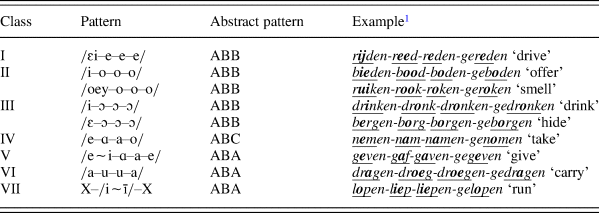
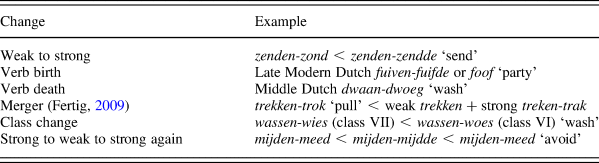
In the Germanic languages, two strategies to form preterites and past participles exist. “Weak” verbs form their preterite and past participle by adding a dental suffix to the stem (e.g., Dutch spelen-speelde-gespeeld ‘play-played-played’). “Strong” verbs on the other hand use ablaut in the preterite, and, in Dutch, they add a nasal suffix to the stem in the past participle, while often also using ablaut (cf., zingen-zong-gezongen ‘sing-sang-sung’ or raden-ried-geraden ‘guess-guessed-guessed’). Among the strong verbs, historically seven ablaut classes can be discerned (cf., Table 1), while for the weak inflection in Dutch, there is only one class left. Through the centuries, many strong verbs have become weak. However, the strong-to-weak evolution is not the only change that has taken place in the course of history. Other changes that have occurred can be found in Table 2.
Present day representation of the historical ablaut classes in Dutch

Changes in the strong and weak verbal system in Dutch

The strong-to-weak evolution has been studied the most on a range of Germanic languages (Bybee [Reference Bybee1985:120], Cuskley, Pugliese, Castellano, Colaiori, Loreto, & Tria [Reference Cuskley, Pugliese, Castellano, Colaiori, Loreto and Tria2014], Lieberman, Michel, Jackson, Tang, & Nowak [Reference Lieberman, Jean-Baptiste, Jackson, Tang and Nowak2007] for English; Carroll, Svare, & Salmons [Reference Carroll, Svare and Salmons2012] and Nowak [Reference Nowak2015] for German, Dutch, and Luxembourgish; Dammel, Nowak, & Schmuck [Reference Dammel, Nowak and Schmuck2010] for German, Dutch, English, and Swedish; Strik [Reference Strik2015] for Frisian and Swedish; Dammel & Nowak [Reference Dammel and Nowak2015] for Frisian; and De Smet & Van de Velde [Reference De Smet and Van de Velde2019], Pijpops, Beuls, & Van de Velde [Reference Pijpops, Beuls and Van de Velde2015], Van Santen [Reference Van Santen, Santen and van der Wal1997], and Vosters [Reference Vosters, Vogelaer and Seiler2012] for Dutch, inter alia). However, most studies suffer from one of four shortcomings: (i) The studies are confined to a specific period in time, for example, by only taking into account younger data or synchronic slices; and (ii) They focus on one or two specific factors at a time and study them in isolation from each other. A first step toward a multifactorial approach was taken by De Smet and Van de Velde (Reference De Smet and Van de Velde2019), who replicated the often-cited studies of Lieberman et al. (Reference Lieberman, Jean-Baptiste, Jackson, Tang and Nowak2007) and Carroll et al. (Reference Carroll, Svare and Salmons2012) for Dutch. However, (iii) these studies were carried out using reference grammars to define whether a verb was weak or strong in a given period, which is a reasonable but linguistically quite a crude measurement, given that verbs are often not consistently strong or weak, especially when they are in transition to entirely weakening. Furthermore, (iv) in these studies, only preterites have been taken into account, though past participles also show weakening.
In order to really capture the different factors that play a role and to have a representative image of the weakening, we need a lot of verbs where this weakening occurred. Because only low-frequency verbs tend to weaken and at different stages in time, we needed a very wide timespan to capture as many observations of strong verbs becoming weak. In this paper, we undertake a corpus study on diachronic Dutch material from the ninth to the twentieth century. We will investigate which factors play a role in the strong-to-weakFootnote 2 evolution and see whether these factors have a different effect on preterites and participles and how they interact with time. Although we do not want to deny the effects of external factors like regional differences (De Vriendt, Reference De Vriendt1965) or demography (Dale & Lupyan, Reference Dale and Lupyan2012), we think these are better left to smaller-scale “ideographic” studies. We will carry out a “nomothetic” study here, though with an eye for the philological complexities that haunt the evolution of verb morphology in Dutch.
We will start by describing the factors that can be hypothesized to contribute to the weakening of strong verbs, in particular the well-known effects of frequency, the difference between preterites and participles, which also ties in with the effects of frequency, and the effects of analogy and how similarity can either cause an analogical pull to, or a push away from, a certain form. We will next describe how we gathered the data and how the data were coded. In the following sections we elucidate the procedure of the statistical analysis, present our results, then discuss them and draw conclusions.
A WIDE RANGE OF FACTORS
Frequency
Among the multitude of factors that have been reported to play a role in the evolution of preterite morphology, the best known is token frequency: high-frequency verbs tend to weaken less than low-frequency verbs. Bybee (Reference Bybee2006:715) explained this “Conserving effect”: “High-frequency sequences become more entrenched in their morphosyntactic structure and resist restructuring on the basis of productive patterns that might otherwise occur.” This factor has been empirically verified for many Germanic languages, using different methods and on both synchronic and diachronic data (cf., Carroll et al., Reference Carroll, Svare and Salmons2012; Cuskley et al., Reference Cuskley, Pugliese, Castellano, Colaiori, Loreto and Tria2014; De Smet & Van de Velde, Reference De Smet and Van de Velde2019; Lieberman et al., Reference Lieberman, Jean-Baptiste, Jackson, Tang and Nowak2007; Nowak, Reference Nowak2015:166–73; Pijpops et al., Reference Pijpops, Beuls and Van de Velde2015; Strik, Reference Strik2015; Van Santen, Reference Van Santen, Santen and van der Wal1997; Vosters, Reference Vosters, Vogelaer and Seiler2012; inter alia).
A second frequency measure that plays an important role is type frequency, that is, the number of different verbs belonging to a particular ablaut class. A higher type frequency means, again, a lower chance of weakening: the higher the number of verbs in a particular ablaut pattern, the more the pattern is entrenched in memory, so that it is readily available in memory when language users have to form preterites of verbs that fit the pattern, preempting the need to resort to the default weak inflection. This effect, too, is well established in the literature concerning strong and weak verb morphology (e.g., Bybee, Reference Bybee1995; Carroll et al., Reference Carroll, Svare and Salmons2012; Hare & Elman, Reference Hare and Elman1995; Knooihuizen & Strik, Reference Knooihuizen and Strik2014; Nowak, Reference Nowak2015:166–73).
The protective effect of type frequency is basically an analogical effect: a verb is connected with its ablaut neighbors. It has been hypothesized that this effect will, however, be counterbalanced by an analogic pull to other verbs that are phonetically similar but belong to the weak inflection class (Köpcke, Reference Köpcke, Butt and Fuhrhop1999:57). The phonetic similarity may range from full homophony (e.g., scheppen ‘create’–scheppen ‘dig’) to partial resemblance (e.g., scheppen–meppen ‘slap,’ deppen ‘dab,’ reppen ‘mention’).
Another variable related to frequency is the regularity of the verb. While strong verbs are often said to be irregular (Haeseryn, Romijn, Geerts, de Rooij, & van den Toorn, Reference Haeseryn, Romijn, Geerts, de Rooij and van den Toorn1997:84–93; Lieberman et al., Reference Lieberman, Jean-Baptiste, Jackson, Tang and Nowak2007), they show productive regularity, which is evidenced by production experiments with fake verb forms (Knooihuizen & Strik, Reference Knooihuizen and Strik2014; Van de Velde & Kestemont, Reference Van de Velde and Kestemont2015), and by the emergence of strong ablaut patterns in erstwhile weak verbs (cf., Köpcke, Reference Köpcke, Butt and Fuhrhop1999; Nowak, Reference Nowak2015). Moreover, the historical ablaut patterns are systematically related to the consonant skeleton of the root. A number of verbs are, however, genuinely irregular. These change not only their stem vowel when forming the preterite or the past participle. Two examples are houden-hield ‘hold’ and gedijen-gedeeg (now gedijde) ‘flourish.’ The reasons are, once more, the influence of sound laws, ripping up morphological regularity. In houden-hield, the absence of the liquid in the present is due to the sound law that turns it into a glide when it occurs before a back vowel, but not before a front vowel. As neatly fitting an ablaut class makes the verb easier to memorize, these irregularities might be a disadvantage for the strong verbs. However, most irregular forms tend to be very high-frequency forms (low-frequency irregular forms are likely to regularize by analogy) that tend to become autonomous from derivationally related forms (they do not need to be regularly formed on the basis of the present stem [Bybee, Reference Bybee2006:715]) and “often constitute unanalyzed frozen phrases, and so do not contribute to analogical generalization at all” (Ambridge, Kidd, Rowland, & Theakston, Reference Ambridge, Kidd, Rowland and Theakston2015:247). Because, in order to form the weak inflection, we need to know the present tense, it may be the case that weakening is less straightforward for these autonomous irregular verbs than for regular verbs (cf., Köpcke, Reference Köpcke, Butt and Fuhrhop1999:49).
Differences in weakening between preterites and past participles
A second important observation is that preterites and past participles do not weaken together. Many verbs in contemporary Dutch sport strong participles, but weak preterites (stoten-stootte-gestoten ‘push,’ vouwen-vouwde-gevouwen ‘fold,’ bakken-bakte-gebakken ‘bake,’ malen-maalde-gemalen ‘grind,’ inter alia). Contributing to this asymmetry is Präteritumschwund “preterite loss.” In Germanic, past participles have been grammaticalized into the analytic perfect (ik heb gezongen ‘I sang’), which is in the process of replacing the preterite as a way to express past tense in, among others, (South-)German, Afrikaans, and Dutch (e.g., Abraham & Conradie, Reference Abraham and Conradie2001; Coussé, Reference Coussé2013; Dammel et al., Reference Dammel, Nowak and Schmuck2010; Drinka, Reference Drinka2013). This diachronic trade-off leads to a decrease in the frequency of the preterite and an increase in the frequency of the past participle. Because token frequency is an important determinant in whether a verb weakens or not, we expect that, through time, the ever more frequent past participle is increasingly protected against weakening, while the dwindling preterite is more vulnerable to weakening (as Dammel et al. [Reference Dammel, Nowak and Schmuck2010] showed for synchronic data).Footnote 3
Also contributing to the asymmetry between preterite and past participle weakening is the vowel pattern. Not only do preterite and past participle share semantics (Dammel et al., Reference Dammel, Nowak and Schmuck2010), for some verbs they also share the morphological markers. For the Dutch strong verbs, three different vowel patterns can be discerned (cf., Table 1): an ABA-pattern, where the present and the past participle show a different vowel than the preterite (e.g., lopen-liep-gelopen ‘run’), an ABB-pattern, where the preterite and past participle share a vowel that differs from the vowel in the present (zingen-zong-gezongen ‘sing’), and an ABC-pattern where every vowel change stands on its own (breken-brak-gebroken ‘break’). Different behaviors for these different patterns noticed by Van Haeringen (Reference Van Haeringen1940) have been empirically verified on synchronic (Van de Velde & Kestemont, Reference Van de Velde and Kestemont2015), diachronic (De Smet & Van de Velde, Reference De Smet and Van de Velde2019; Nowak [Reference Nowak2015:168; Reference Nowak, Dammel, Eitelmann and Schmuck2018] for German) and dialect data (Taeldeman, Reference Taeldeman2011). Two main trends can be distinguished: (i) for preterites, verbs showing the same vowel in the preterite and participle (ABB-verbs, e.g., zingen-zong-gezongen ‘sing’) tend to preserve the strong inflection better, while preterites not showing the same vowel in the preterite and participle tend to lose the strong inflection (ABC- and ABA-verbs), especially when the past participle does not show ablaut (in case of an ABA-pattern, for example, the participle gelopen ‘ran’); and (ii) for participles, verbs that share the same vowel for the present and participle (the ABA-pattern) tend to retain the strong inflection.
For the ABB-verbs, the vowel pattern clearly reflects the semantic distinction between the present on the one hand and the past tense (expressed either by preterite or analytic perfect) on the other hand (Nowak, Reference Nowak, Dammel, Eitelmann and Schmuck2018:154). This regular pattern is dominant for both the contemporary strong verbs in Dutch (class I, II, III and some class IV-verbs sport an ABB-pattern) and for the weak verbs (one marker, a dental suffix, is used for both the preterite and past participle), and offers mutual protection for both the preterite and participle. Though preterites might have become less frequent as a result of Präteritumschwund, the vowel of ABB-preterites is still well known, because it is shared with the past participle.
This is not the case for ABA- and ABC-verbs. When preterites of ABA- or ABC-verbs decrease in frequency, the language user cannot fall back on the vowel of the past participle, though it does happen that ABC-preterites take the vowel of the ABC-past participle, turning these verbs into ABB-verbs, for example, breken-brook-gebroken < breken-brak-gebroken ‘break’ or stelen-stool-gestolen < stelen-stal-gestolen ‘steal’Footnote 4 (see also Nowak [Reference Nowak, Dammel, Eitelmann and Schmuck2018] for German). This makes ABA- and (to a lesser degree) ABC-preterites more prone to weakening.
Not only are ABA-preterites more susceptible to change, ABA-participles also seem to be overall more conservative. We hypothesize that this scenario might work on the observation that ABA-verb participles are midway between strong and weak. Regarding ablaut vowel, their participles are weak, and it is only their nasal suffix that testifies to their allegiance to the strong strategy. As ablaut is the most salient indicator of Germanic past tenses, language users may be under the impression that the participle is weak already, seeing no need to level the form further. Support for this second scenario can be found in the less common weak-to-strong evolution. Weak verbs that have become strong by analogy of a class with an ABA-pattern, namely jagen-joeg-gejaagd ‘hunt’ or vragen-vroeg-gevraagd ‘ask,’ kept their original dental suffixes in their participles: the vowel pattern already fits, so the suffix does not need to change. However, one could argue that, if the participle is conceived of as weak already, language users might as well shift to the weak inflection entirely. Indeed, in German, precisely these past participles of ABA-verbs tend to weaken more (Nowak, Reference Nowak2015:167). A second explanation could be that the strong participles are protected by the supporting rhyme in present plural and infinitive forms. This explanation fits better with the observation that German ABA-past participles tend to weaken more: though these could also receive protection from present plural and infinitive, in German, only the first and third person present plural are formed with -en (the second person plural is formed with -t, for example, ihr lest ‘you read’) and the infinitive is used almost 7% less often than in Dutch.Footnote 5
The effect of ambiguous forms
As mentioned, similar forms might influence the strong-to-weak evolution. If a strong verb is homophonous with a weak verb (cf., Nowak [Reference Nowak, Schmid and Ziegler2011] for German examples), this could cause confusion for language users who might use weak forms for the originally strong verb (cf., [a]) and strong forms for the weak verb (cf., [b]), as in the case of the originally strong verb scheppen-schiep-geschapen ‘create,’ which is homophonous with the originally weak verb scheppen-schepte-geschept ‘dig, draw from.’
-
(a) want die looze Feeks wist de St. Huiberts Heeren zo aardig te betoveren, dat de Leeuwen, in Bokken, de Tygers, in Zwynen, en de Luipaarts, in Bandrekels, herschept wierden (Van Olmen [Reference Van Olmen2019]: observation from 1724)
‘because the false Witch managed to bewitch the Gentlemen of St. Huibert so well, that the Lions were recreated into Bucks, the Tigers into Swines, the Leopards into Chain Dogs.’
-
(b) zoo grooten behagen schiep zy in haar kuisch voornemen. (Van Olmen [Reference Van Olmen2019]: observation from 1659)
‘so much delight did she draw from her chaste intention.’
Homophony is not only found between the present forms of two verbs but can also be seen at work in the preterite. In some cases the strong preterite plural can be homophonous with the present of another verb, for example, roken (smell-pret.pl or smoke-pres.pl) or the stem of the preterite can be homophonous with a noun or adjective, for example, rook (smell-pret.pl or smoke-noun). Previous research suggests that homophones can strengthen the memory trace of a word (Jescheniak & Levelt [Reference Jescheniak and Levelt1994], though other studies contradict these results, e.g., Gahl [Reference Gahl2008]) and we also see cases where superficial resemblance can generate contamination effects in semantics, morphology, and syntax (see Dauzat, [Reference Dauzat1927], Pijpops, De Smet, & Van de Velde [Reference Pijpops, De Smet and Van de Velde2018], and Van de Velde, De Smet, & Ghesquière [Reference Van de Velde, De Smet and Ghesquière2013] on paronymic attraction).
Nouns can influence the inflection of the strong verbs in yet another way (Fertig, Reference Fertig2009). In some cases, a strong verb can be reanalyzed as a zero derivation of a noun. As derivations almost always take the weak inflection (Bailey, Reference Bailey1997:6–29; Pinker & Ullman, Reference Pinker and Ullman2002:459; though see Ramscar, Reference Ramscar2002), this might cause the verb to weaken. For example, it might have been the case that schellen-schal-geschollen ‘sound’ became weak, because it was reanalyzed as a derivation of the noun schel ‘bell.’
Although we just adduced reasons to hypothesize that homophonous forms can attract a verb to the weak inflection by an analogical pull at the formal level, in other cases language users avoid homonymy (Gilliéron & Roques, Reference Gilliéron and Roques1912). Though homonymy avoidance has met skepticism in historical linguistic literature (e.g., Lass, Reference Lass1997:355–61), its effects are supported by several observations in the history of Dutch verbal morphology and elsewhere (Baerman, Reference Baerman2011; De Clerck & Vanopstal, Reference De Clerck, Vanopstal and Collins2015:364; De Vogelaer & Coussé, Reference De Vogelaer and Coussé2011). When presents and preterites might formally merge due to sound change, language users appear to maintain the distinction. For example, by the end of the Middle Ages, central Dutch dialect areas and the burgeoning standard language underwent a massive apocope of the schwa in the Auslaut “word final position.” However, the apocope was suspended in weak preterites where the dental preterite (either in its voiceless allomorph environment or by Auslautverhärtung “final obstruent devoicing”) would have merged with the third person singular ending -t of the present (Van Loon, Reference Van Loon2014:261): werk-t (work-prs.3sg) would be indistinguishable from werk-t(e) (work-pret.sg) with apocope. It is revealing that the schwa apocope did take place in verbs where there is no risk of confusion, as in the irregular weak forms like koch-t(e) (buy-pret.sg) versus koop-t (buy-pret.3sg). Another example is the rise of the /i:/-preterite in many originally class III verbs. In some Middle Dutch dialects /ɑ/ before liquids changed to /ɛ/, which led to a temporary merger of the first person singular of the present and preterite (e.g., help: help:pres.1sg or help:pret.sg). To sidestep this ambiguity, these verbs adopted the /i:/-preterite of ablaut class VII (Van Bree, Reference Van Bree1987:212). Ambiguity avoidance might also play a role in the strong-to-weak evolution. In case the stem of a verb ends in a dental, the weak preterite will be homophonous with the present plural (e.g., zitten sit:pres.pl or sit:pret.pl).
Finally, two phonologically similar verbs can come to be seen as one lexical item by language users. In case one of the verbs was strong and the other one weak, the inflection of the resulting verb can be either strong or weak (see Fertig [Reference Fertig2009], who shows that this is by no means a rare phenomenon; see Nowak [Reference Nowak, Schmid and Ziegler2011] for German). For instance, in Dutch, a weak verb dwalon ‘wander’ has merged with a strong verb dwelan ‘wander.’ The resulting verb dwalen took the weak inflection. These mergers can skew our results, so they have to be taken into account.
DATA EXTRACTION
For this study, we wanted to prioritize temporal coverage, so we collected all preterites and past participles of all verbs that were originally strong, from the earliest sources we have in Dutch up until now, in the corpus data we have at our disposal. In a first step, we made a list of all known verbs that were strong at one point in time. For this, we used the historical dictionaries of the Geïntegreerde Taalbank, Footnote 6 Hempen (Reference Hempen1988), and more recent lists (Onze Taal).Footnote 7 We excluded some hyperfrequent verbs, which are known to almost categorically resist weakening, and often show some irregularity in their forms that suggest they are verbs sui generis, rather than members of an analogically connected model of strong verbs. These were all verbs of the two highest frequency bins in De Smet and Van de Velde (Reference De Smet and Van de Velde2019) in which no verbs had weakened in over a 1000 years’ time, though only if their frequencies had remained stable throughout time (also based on De Smet & Van de Velde [Reference De Smet and Van de Velde2019:147]). Following those criteria, attestations of zijn ‘be,’ doen ‘do,’ see ‘zien,’ staan ‘stand,’ gaan ‘go,’ worden ‘become,’ and komen ‘come’ were not included.Footnote 8 By virtue of their token frequency, they are likely to exert an undue influence on the statistical model.
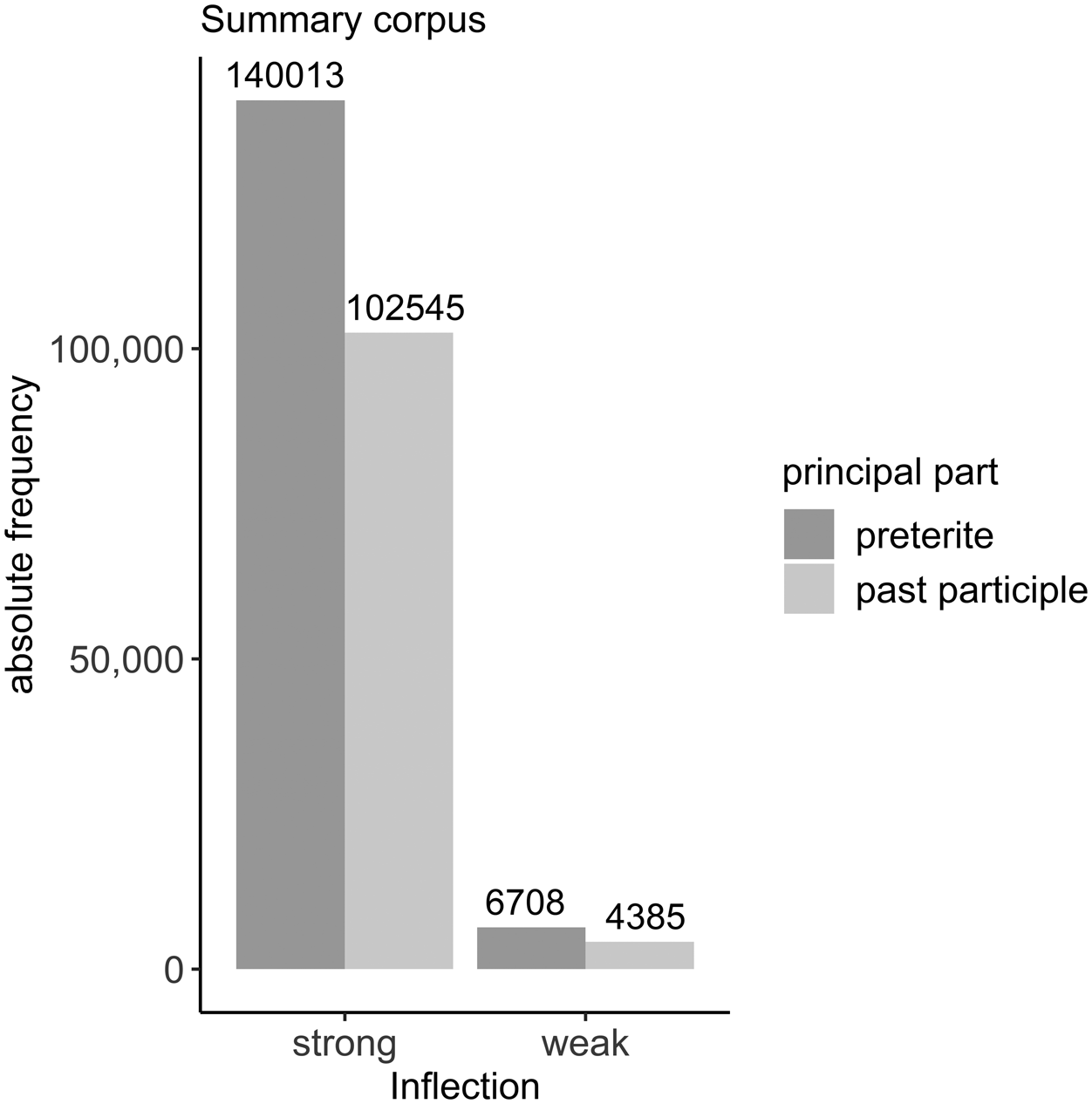
In a second step, all remaining verbs were searched for in a collection of historical corpora, listed in Appendix 1. We looked for all preterites and past participles of the verbs on our list, taking into account rampant spelling variation. The results of the non-annotated corpora were cleaned manually. To reduce noise, we only looked for strong preterite and participle forms that could be expected, considering what is known about ablaut changes and for complex forms that were attested in the historical dictionaries. Inflected forms of past participles were not included. We did not differentiate between past participles that were used as a verb or as an adjective either, because this distinction is very hard to make, especially in older data (see Coussé, Reference Coussé2011). We did control for the possibility of verbs showing up as adjectives in our corpus. Verbs that never showed up as strong (e.g., breien ‘knit’) in our entire dataset were excluded. This brought the total to 253,651 observations of which 242,558 were strong and 11,093 were weak, with the earliest observation in the ninth and the latest observation in the twentieth century. Of these, 146,721 attestations were preterites and 106,930 were past participles. This can be seen in Figure 1. Together they comprise 237 historically strong verb stems and 1,961 lemmas.
Summary of the corpus (n = 253,651).

DATA ANNOTATION
As a cautionary note, it should be mentioned that these historical, (mostly) non-annotated corpora have their limitations. The annotation of many of our variables of interest required the detailed information provided in the dictionaries of the Geïntegreerde Taalbank. Because many articles of the Woordenboek der Nederlandsche Taal “Dictionary of the Dutch Language” (WNT) were written already at the end of the nineteenth century, we added Van Dale Groot Woordenboek der Nederlandse Taal (Reference Boon, Hendrickx and Fifteenth edition2015) (an authoritative contemporary dictionary spanning from 1880 until now) to cover the twentieth century.
A distinction was made between (i) variables at the level of the verb, and (ii) variables at the level of the individual observation. Variables of type (i) have the same value for all observations of the same verb, whereas variables of type (ii) will have to be assessed observation by observation. There are, however, a number of complications here. First, the variables of type (i) (at the level of the verb) do not remain constant through time. Verbs may experience a change in frequency over time or may shift to new ablaut patterns. Another complication is that some variables pertain to the verb stem, while others pertain to the lemma level.
Response variable
Every attestation was coded as strong or weak.
Fixed effects
– Century. Century was coded as a scaled and centered numerical variable.
– Token frequency. To calculate the token frequency, we split our data into two subperiods (800–1500 and 1500–2000).Footnote 9 Every preterite received a value of how often its verb stem was attested in the preterite in this period, divided by the sum total of all observations (both preterites and participles) in that period. The calculation was also applied to the past participles. This relative frequency was subsequently log-transformed.Footnote 10
– Type frequency. For the type frequency, each verb stem was assigned an ablaut class on the basis of its attestations in the dataset, though in case the class could not be deduced from our dataset (e.g., because only the preterite or only the participle appears), the class was assigned based on reference grammars. When a verb shows forms belonging to more than one ablaut class, the most frequent ablaut pattern was chosen. When the verb shows only weak forms in a specific century, it was assigned to the class it last belonged to before it weakened. This variable was coded on a century level (in order to be able to take into account verbs that change ablaut class, e.g., wasschen-woesch ‘wash’ used to belong to class VI until the thirteenth century when it changed to class VII, wiesch), although the ninth through thirteenth century were aggregated, because of the data sparsity in the first four centuries. We then counted the number of verb stems (of which at least one attestation was strong) in each class in each century. This value was divided by the total number of verb stems in that century. The end result was log-transformed.
– Weak type frequency. To test whether the phonological similarity with weak verbs plays a role, the reference dictionaries were used (because the originally weak verbs are not included in our dataset). For each verb stem in our dataset, the number of weak verb stems with the same rhyme was counted. Different weak homonyms were not taken into account (i.e., the weak homonyms were counted as one type). This value was log-transformed.Footnote 11
– Regularity. Regularity was coded for each verb stem per period in the dictionaries.
– Principal part. Each token was coded as a preterite or past participle.
– Vowel pattern. The coding for the vowel pattern was largely done the same way as the coding for ablaut class, that is, based on our own data, or when necessary, based on reference grammars, for each verb stem and for each century. Usually singular and plural share the same vowel, which makes the generalization to an ABA, ABB, or ABC pattern rather straightforward. However, in some cases, this is not true. Class I and II still show a different vowel in preterite singular and preterite plural more or less until the Middle Ages (/ê/ versus /ē/ for class I and /ô/ versus /ō/ for class II). This difference was leveled by regular sound changes (now reed-reden ‘drove’ and boog-bogen ‘bent’). Class III shows a different vowel in singular and plural largely until the sixteenth century (e.g., drank-dronken ‘drank’). This difference disappeared through analogical leveling in the direction of the plural (Van Bree, Reference Van Bree1987:210). Class IV and V still show a different vowel, i.a. /ɑ–a/ (e.g., nam-namen ‘took’ and gaf-gaven ‘gave’); however, these vowels are morphologically connected for language users, as they are vowel pairs that occur in lengthening in open syllables in Dutch nouns, for example, dak ‘roof’ and plural daken (Van Bree, Reference Van Bree1987:232). When there is an actual difference between singular and plural, as for class I, II, and III in certain centuries, this cannot be summarized in a simple three-letter combination. Therefore, the more frequent singular was chosen to represent the second letter, for example, drinken-drank-dronken-gedronken is summarized as ABC with the preterite singular drank representing the second letter (cf., De Smet & Van de Velde, Reference De Smet and Van de Velde2019).
– Homophony preterite noun, homophony preterite verb, homophony weak verb. For all the verb stems in the dataset, the dictionaries were checked to see whether a homophone existed for each period. Because there are obviously fewer words attested in the earlier dictionaries than actually existed, material from the later dictionaries was extrapolated, except when it was mentioned specifically that the word only entered the Dutch language later. For each verb stem, it was checked whether its stem was homophonous with a weak verb (e.g., scheppen strong ‘create’ or weak ‘dig’), whether its preterite plural was homophonous with another verb (either strong or weak, e.g., roken smell:pret.pl or smoke:pres.pl) and whether its preterite (singular or plural) was homophonous with an adjective or noun (e.g., rook smoke:pret.sg or smoke:noun). Hapaxes were ignored.
– Possible reanalysis. To account for possible reanalysis, we checked for each period whether a semantically related noun with the same present stem as the verb stem existed (e.g., verdriet ‘grief’–verdrieten ‘to have grief’).
– Merger. The difference between the merger variable and the homophony with a weak verb variable is that, in the case of merger, the two verbs will be conceived of as the same lexeme by language users. Because this is hard to measure, we could not code for actual cases of merger, but only for plausible cases of merger. This variable partly consists of the homophony with a weak verb variable but also captures other plausible scenarios for merger. We consider merger a plausible scenario for verbs that are homonymous with a weak verb, verbs that have a causative derivation (cf., Fertig, Reference Fertig2009), verbs that have a homophone and verbs that only differ in the length of their vowel (e.g., frequentatives, drupen-druppen ‘drip’) or show e instead of a or i instead of e (these vowels behave as allophones or are orthographically interchangeable between regions and time periods in earlier stages of Dutch, for example, strong schellen – weak schallen ‘sound’), or vice versa. For the fully homophonous verbs, no extra semantic constraints were applied, and we assumed that the exact formal resemblance was already enough for language users to regard both verbs as one lexical item. In the cases without full homophony, as in the causative or frequentative derivations, or in the case of small vowel differences, we added the constraint that there needs to be a plausible semantic connection. We did not differentiate on the level of this lexical merger variable: we treated it as a binary distinction ‘possible merger’ versus ‘no merger,’ and kept this distinction constant for all periods and all different verbs (because it is hard to see when a verb has actually merged and because its consequences can be long-term).
– Dental stem. This was coded for each verb stem per period in the dictionaries.
Control variables
– Adjectival participle. To control for adjectival use of past participles in our dataset, we added for each lemma whether its strong participle was lexicalized as an adjective, again according to the historical dictionaries.
– Rhyme. We added whether the text in which the observations occur has end rhyme or not, as the strong form may be preserved longer to fit the rhyme.Footnote 12 Note that the rhyme variable is not measured at the level of the individual observations but at the level of the text. This means that observations from rhyming texts that do not occur in rhyme position are nevertheless also considered as undergoing a conservation effect due to rhyme. The reason is that it was not feasible to manually check each individual observation. At the same time, this variable also controls for the genre of the text, as poetry often contains more archaic language than prose.
– Contemporary Dutch. In order to control for the unwanted effect that verbs that have ceased to exist would show much less weakening than expected by the model, because they did not have the chance to weaken before they disappeared (e.g., dwaan-dwoeg ‘wash’), we added a variable indicating whether the verb still exists in contemporary Dutch. This was determined by a search in a reference corpus for contemporary Dutch (SoNaR, Oostdijk, Reynaert, Hoste, & van den Heuvel [Reference Oostdijk, Reynaert, Hoste and van den Heuvel2013]).
– Earlier weakening. Our dataset suffers from an autocorrelation problem: the different observations in our dataset are not fully independent from each other. If a verb was weak in the previous centuries (e.g., geschieden ‘happen’ weakened quite early on), it should not come as a surprise that it will be weak in consecutive centuries. Nonindependence increases the risk of type I errors. Statistical models accounting for autocorrelation have not been fully integrated in historical linguistics yet (see Van de Velde & Petré, Reference Van de Velde, Petré, Knight and Adolphs2020), and full independence is rare in statistical studies (Salsburg, Reference Salsburg2001:144). We followed a practical solution to manage this problem (see also Baayen & Milin, Reference Baayen and Milin2010) by adding a variable that represents the amount of weakening in the previous century, separately for participles and preterites. In case the participle or preterite was not attested, we resorted to the nearest previous century where the participle or preterite was attested. If the verb was not attested before, we added a default value of 0% weakening. This solution ensures that the model will fit the probability of the weak form of an observation under multivariate control, which now includes a measurement of overall rate of weakening. If it is indeed the case that the fitted probability is largely determined by the verb's prior weakening, the model will promote the new variable in the overall regression model, leaving less room for the other factors to enhance the goodness-of-fit. In other words, with this extra control variable, the model will incur a penalty for the variables of interest in periods with high weakening.
ANALYSIS
We applied mixed-effects logistic regression, using the lme4 package (Bates, Maechler, Bolker, & Walker, Reference Bates, Maechler, Bolker and Walker2015) in R (R Core Team, 2017).Footnote 13 Our binary response variable is the inflection of the attestation, which is coded as strong (0) or weak (1). Apart from the fixed effects in the previous section, a complex random structure was modeled.
Random effects
– Source. First, it was important to add a random effect for the source in which the attestation was found; as there were many short text files, we merged all files with five or fewer observations in one level. This random effect has 1434 levels.
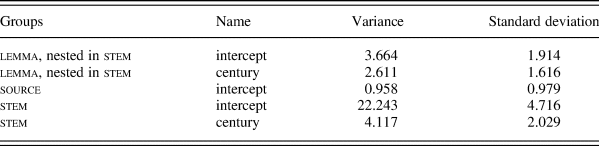
– Verb stem – verb lemma. Second, a random effect was added for each verb. This is not straightforward: it is not immediately clear whether we should distinguish verbs on the basis of their stem or on the basis of their lemma. We decided to consider both by nesting the verb lemma in the verb stem. Verb lemma consists of 1961 and verb stem of 237 levels. A random slope was added for the verb stem and lemma with century, because the effect of century may differ for each verb. Some verbs never weaken through time, while others weaken quite early and still other verbs only sport weak forms in the twentieth century. This random slope can either be correlated with the random effect for the verb stem and verb lemma or not. We set out by including the correlation and tested whether this enhanced the model quality.
Interaction effects
As to interaction effects, Century was entered in an interaction with Vowel pattern. Principal part was entered in a two-way interaction with (allowing for the effect of the variables of interest to play out differently for preterites or past participles)Footnote 14:
– Vowel pattern (especially for ABA-verbs, as we expect different results for preterites and participles here)
– Dental stem (weak forms with a dental in the stem will mainly cause ambiguity in the preterite)
– Adjectival participle
– Century
If the interactions are significant, this is an indication that preterites and participles are not acting in unison, whereas nonsignificant effects could be an indication to the contrary, implying a paradigmatic connection between the two principal parts, if the main effects are significant at least. However, absence of significance should not be promoted to significance of absence.
Model selection
For our model selection, we first checked whether our random structure was necessary by using likelihood ratio tests to compare nested models and by using the AIC (Aikaike Information Criterion), which imposes a penalty for model complexity (Gries, Reference Gries2015:112–15; Zuur, Ieno, Walker, Saveliev, & Smith, Reference Zuur, Ieno, Walker, Saveliev and M. Smith2009:121–2). All random effects made our model significantly better, although the random slope did not need to be correlated with the random effect for verb lemma nested in verb stem. Then, we checked whether our interactions were necessary, by deleting them one by one from our model and comparing against the previous model. Finally, we checked whether the main effects that were not part of an interaction could be added to make the model significantly better by again using the same method.Footnote 15 We checked our final model for multicollinearity and found reassuringly low VIF-scores. Our final model attained a C-value (area under the ROC curve) of 0.999 (indicating a very good fit), a marginal R2 of 0.246, and a conditional R2 of 0.933, though of course this very good fit is partly due to our control variable Earlier weakening.
RESULTS
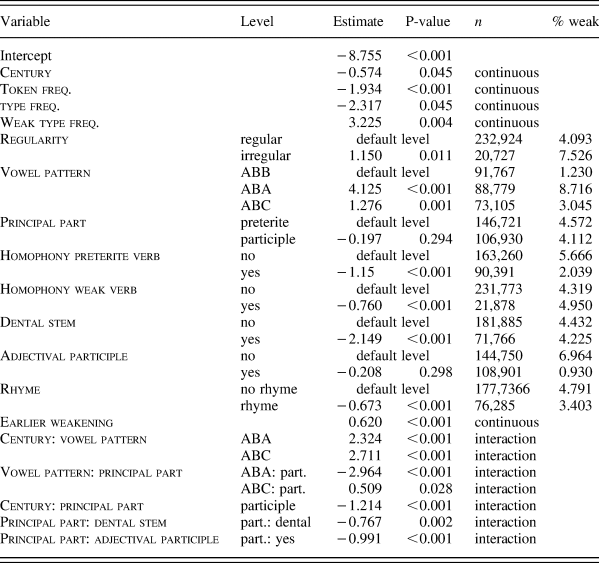
Tables 3 and 4 show the output of our model. The main effects of Homophony preterite noun, Possible merger, Possible reanalysis, and Contemporary Dutch did not make the model significantly better (i.e., they did not yield a meaningfully lower AIC value).
Output regression: fixed effects (with ‘strong’ as reference value for response variable)

Output regression: random effects

DISCUSSION
Century
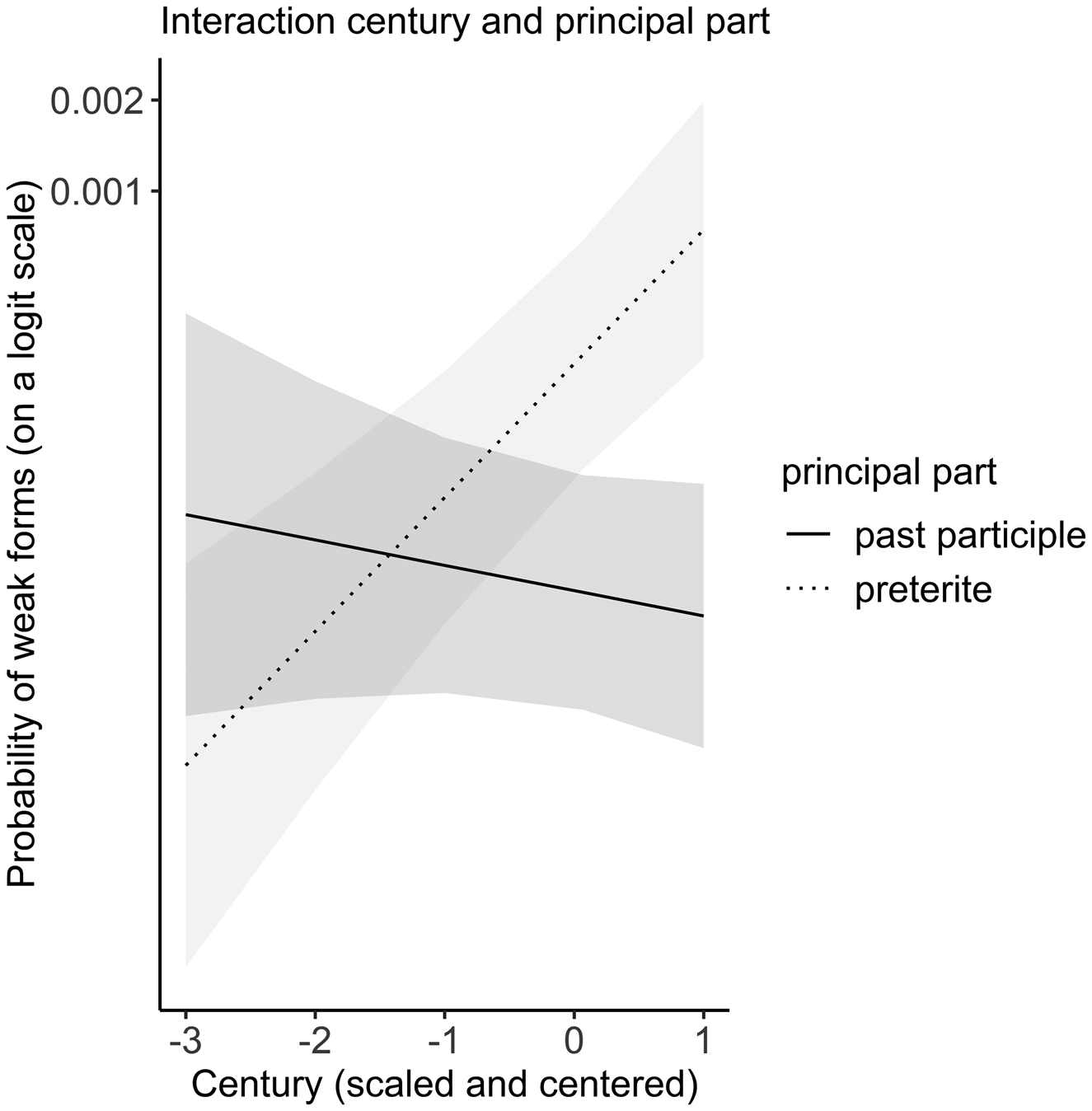
At first sight, it might seem strange that the main effect for Century suggests that, through the centuries, the probability of weak verbs decreased. However, this can be explained by the interaction effects with Principal part and Vowel pattern that we will discuss below.
Frequency
The well-known inverse correlation between Token frequency and probability of occurring in the weak form was confirmed, as was the inverse correlation between Type frequency and probability of occurring in the weak form. However, the type frequency of the strong verbs is not the only variable of importance exerting an analogical influence. The results also show that weak verbs can pull similar strong verbs away from the strong inflection. The more weak verbs with the same rhyme exist, the stronger the analogical pull. Finally, we see that irregular strong verbs are more likely to undergo weakening than regular strong verbs, contrary to what we expected on the basis of the literature.
Vowel pattern and Präteritumschwund
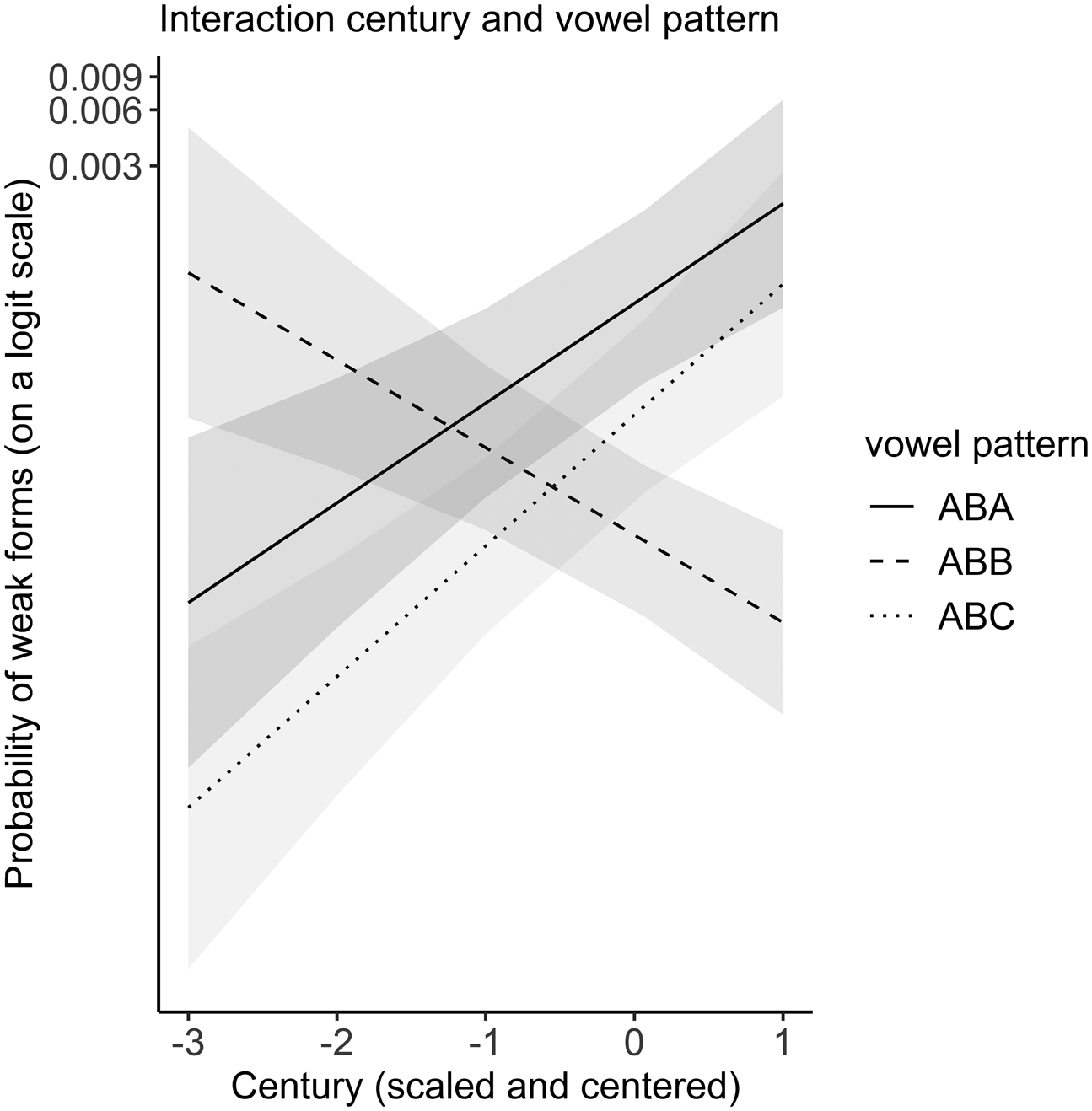
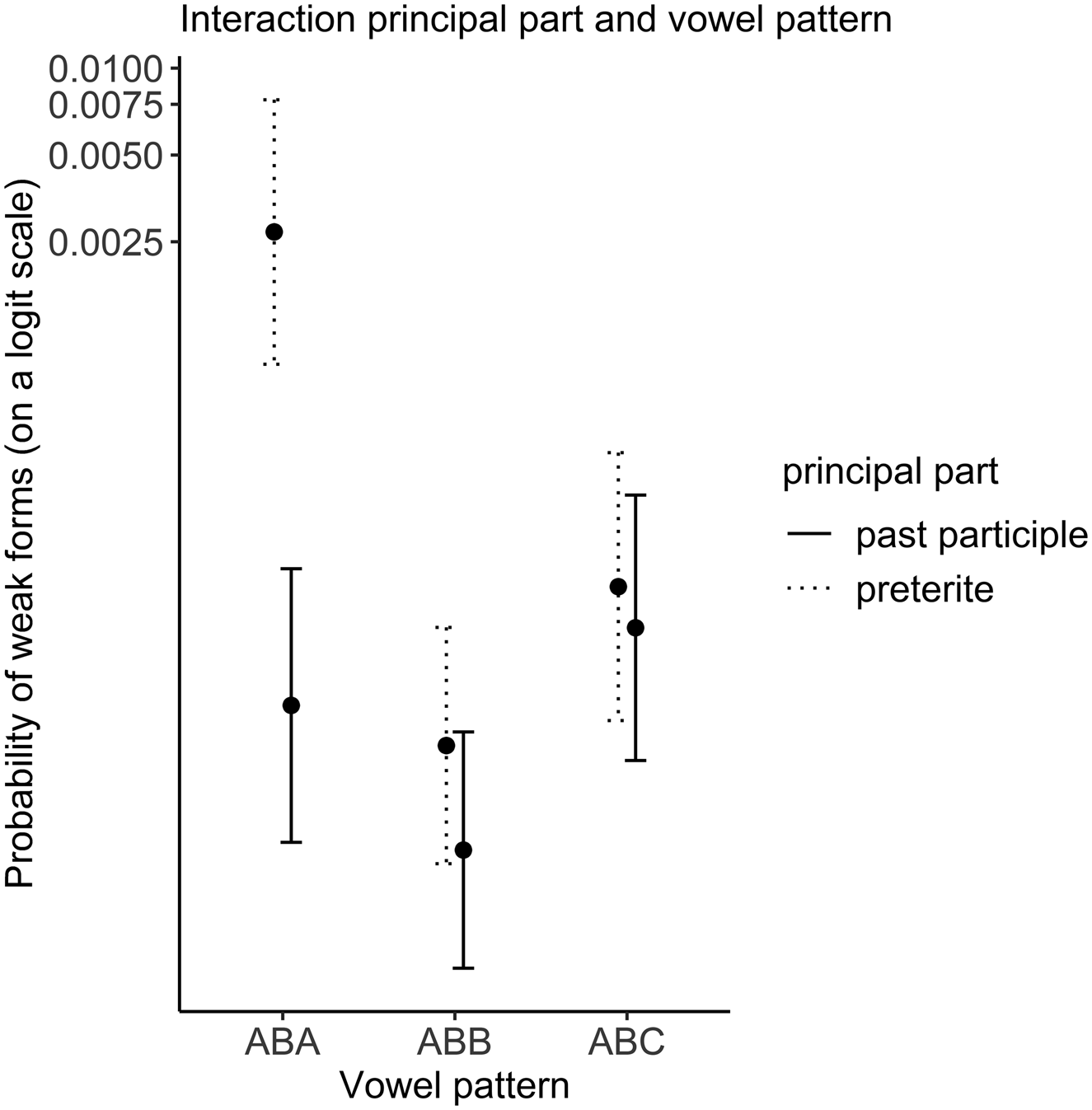
Figures 2 and 3 show the effect of Präteritumschwund: Figure 2 makes clear that the weakening only affects the preterites, not the past participles. In fact, the participles get slightly stronger through time. The reason for this opposite trend in preterites and participles is to be sought in the gradual replacement of preterites by analytic perfects (i.e., Präteritumschwund): as the analytic perfects become more frequent, the past participle gets protection against weakening. Figure 3 gives further corroboration for the Präteritumschwund hypothesis: through time, the probability for ABA- and ABC-verbs to become weak increases, while the probability for ABB-verbs decreases. This could be a sign that, in the earlier centuries, the preterite and past participle were not yet as closely connected by shared semantics, because the past participle was not regularly used to express past tense. As a result, only through time, when the past participle started expressing past tense, did the shared vowel begin to offer protection. There is, however, another reason why participles tend to weaken less, as pointed out above: some participles share a vowel with the present (the so-called ABA-verbs). This may offer protection to weakening for a number of reasons. First, the shared rhyme with infinitives and present plural may offer support. Alternatively, sharing a vowel with the present may make these participles more akin to the weak inflection already, so that there is a lower pressure toward regularization. In the interaction between principal part and vowel pattern in Figure 4, we see very clearly that past participles of ABA-verbs tend to weaken less and preterites of ABA-verbs tend to weaken more.
Interaction century and principal part.

Interaction vowel pattern and century.

Interaction principal part and vowel pattern.

The effect of ambiguous forms
Of the homophony-related variables investigated, Homophony preterite noun did not turn out to be significant, which is not so surprising given that the nouns never appear in the same context as the verbs they are homophonous with. The starkly disambiguating syntactic contexts of nouns and verbs reduces the contamination effect. Possible reanalysis did not reveal a significant effect either (though the suspected effect of Possible reanalysis was ill-understood to begin with, according to Ramscar [Reference Ramscar2002]).
On the other hand, Homophony weak verb and Homophony preterite verb were retained in the model. However, unlike what we expected, we see that verbs showing homophony with a weak verb are better protected against weakening. Even though we encounter cases where the ambiguity causes weakening, the strong preterites and past participles do seem to survive, which might be some form of homonymy avoidance. This phenomenon, where homonymous terms are only disambiguated in their marked principal parts, can also be found for homonymous nouns that are only disambiguated in their plural forms (e.g., brother-brothers/brethren or Dutch wortel-wortelen ‘carrots’/wortels ‘roots,’ Van Loon [Reference Van Loon2005:32–3], cf., also Hare & Elman [Reference Hempen1995:90]). Homophony preterite verb did display the expected effect: verbs of which the preterites show homophony with another verb are indeed better protected.
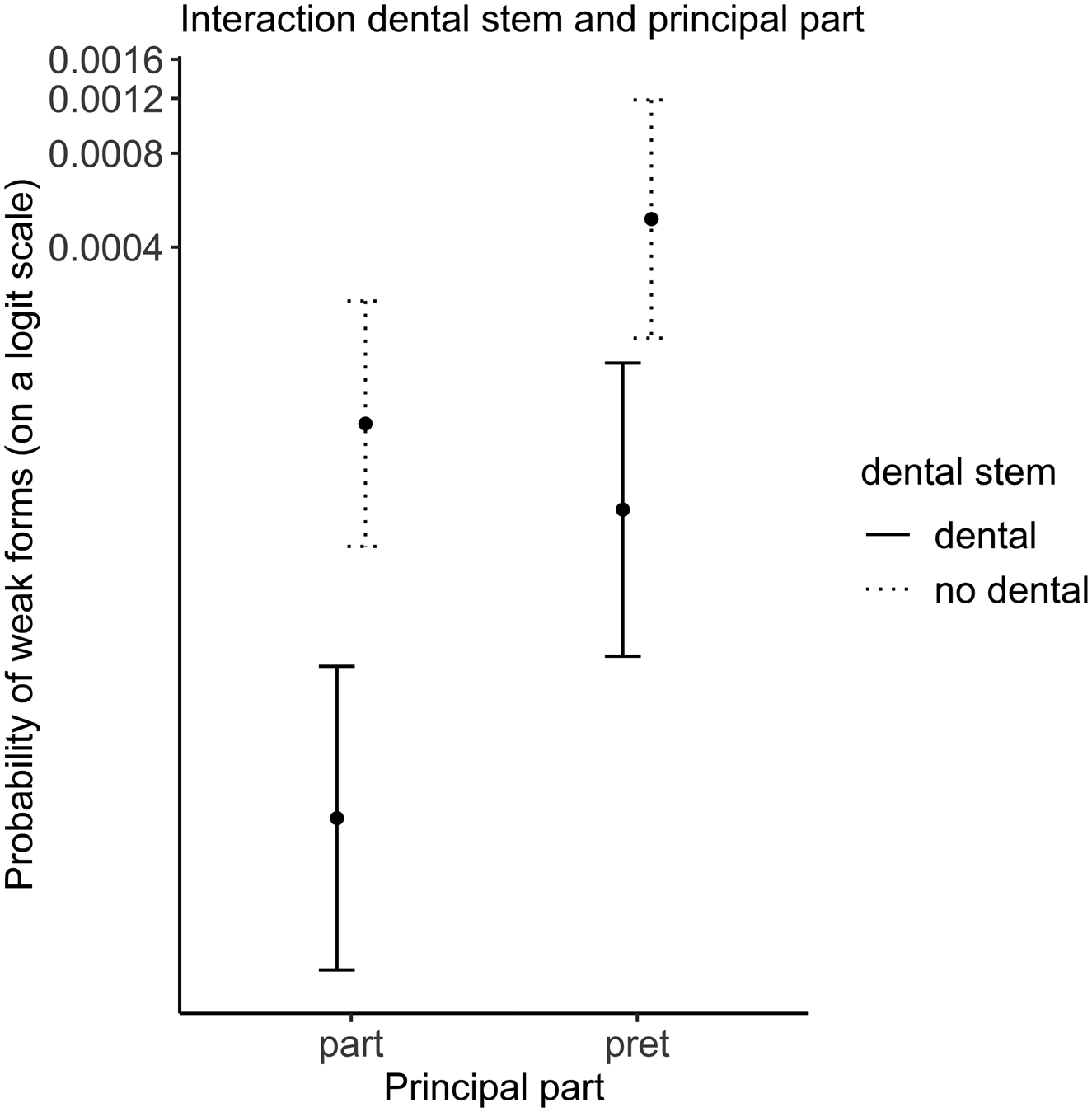
Finally, we also looked at the influence of Dental stem. Verbs with a dental in the stem weaken less than verbs without a dental, again probably to avoid homophony (e.g., zitten: sit:pres.pl or sit:pret.pl). The role of the dental stems was entered as an interaction effect with the Principal part as a moderator variable. The effect is plotted in Figure 5. We see the effect for both the preterites and the past participles, which suggests that both principal parts must be connected for the language user, as a dental stem is unlikely to cause ambiguity that has to be avoided in the case of weakened past participles.
Interaction Principal part and Dental stem.

Control variables
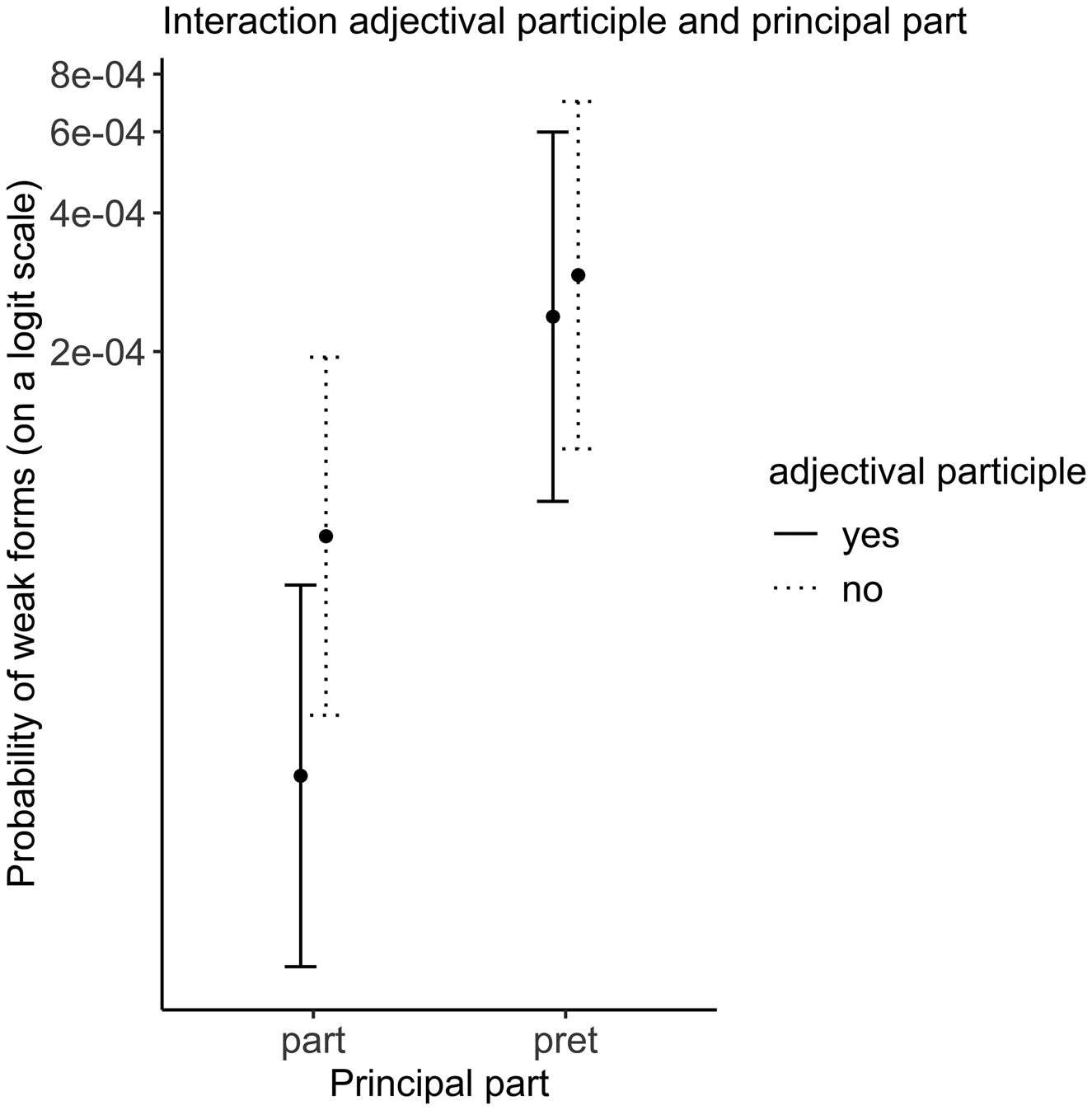
Although they primarily function as control variables in the overall model, some of the remaining factors merit consideration as well. First, Figure 6 shows that the past participle tends to weaken less when it is also lexicalized as an adjective, but the same happens, though to a lesser degree, with the preterites. This shows firstly that when a past participle has lexicalized as an adjective, it becomes, to language users, isolated from the verb, and it becomes a separate lexical item, fossilized in its strong inflection (e.g., verbolgen ‘incensed’) (cf., Bybee, Reference Bybee1985:91) and secondly that there is a spillover effect from the past participle to the preterite, which seems to imply again that they are connected in the minds of language users.
Interaction principal part and adjectival participle.

Secondly, we can also note that rhyming texts tend to contain more strong forms (probably to fit the rhyme or because these texts are more conservative) and that, of course, a verb tends to weaken more when it had already weakened in the previous centuries.
CONCLUSION
While the evolution of preterite morphology in the Germanic languages has been intensively investigated, and a number of factors have been suggested to play a role, their precise impact has rarely been tested in a multifactorially controlled research design. In this paper, we have cast our nets wide and gauged the differential impact and interplay of a substantial set of language-internal factors. Our results show a number of trends. First of all, the well-known effects of token frequency and type frequency are once more confirmed, this time for historical Dutch. Secondly, preterites and past participles seem to be (or have grown) closely connected to each other, which can be deduced from the mutual protective effect of the ABB preterite and past participle vowel (which increases over time) and the spillover effect of the influence of the dental stem to the past participles and the effect of lexicalization of the past participles to the preterites. This close connection is probably an effect of the Präteritumschwund in Dutch, though this phenomenon at the same time causes an asymmetry in weakening due to the decreasing frequency of the preterites, especially when they do not share a vowel with the participle. Thirdly, analogical effects do not only come forth from the weak class as a whole or strong verbs within the same ablaut class but also, more specifically, from weak verbs with the same rhyme or homophonous verbs. Still, this effect is a delicate balance, as there is a lurking danger of confusing homonymy: too much similarity appears to curb the change.
This is the first study, to our knowledge, to take a corpus-based long-term perspective on the weakening trend, from the earliest attested stages of a West-Germanic language all the way up to the present, and to gauge the effects under multifactorial control, including an elaborate random structure. Still, the results have to be approached with due caution. Because of the lack of annotated corpora and frequency lists for diachronic Dutch data, we sometimes had to use relatively crude measures. It could very well be that using more precise measures (e.g., ratios for how often the homophone appears to how often the verb appears, how often the participle appears as an adjective, or how many times the present stem appears in a noun as opposed to in a verb), the estimators of the model would alter to a smaller or larger degree. Furthermore, we have ignored regional differences and other sociolinguistic factors, as this kind of metadata is very hard to come by or is simply absent for older texts. Still, by its unprecedented size and temporal scope, we maintain that this study significantly advances our knowledge of the relative strength of the different factors that determine which verbs weaken and which verbs stay strong. We now have a better idea not only which factors outrank other factors in their strength on the change at issue, but also how they enter into complex interactions.
SUPPLEMENTARY MATERIAL
To view supplementary material for this article, please visit https://doi.org/10.1017/S0954394520000101.