I knew a very wise man … that … believed if a man were permitted to make all the Ballads, he need not care who should make the Laws of a Nation.Footnote 1
Andrew Fletcher of Saltoun, 1704The Edinburgh wig-maker, poet, bookseller, publisher and librarian Allan Ramsay (c1684–1758) may not have been his country's best bard or most judicious editor, but it would be difficult to overestimate his role in creating the idea of ‘Scottish song’ in the first place – and, as I will argue, the idea of ‘Scottish music’ in a broader sense. For centuries the notion of grouping European music according to ethnic origin had been nebulous at best, but in the eighteenth century a new wave of cultural nationalists worked hard to fashion ideas of ‘national music’ and tradition in Europe, and Ramsay was at the forefront of this wave. There has been a great deal of work on ‘invented tradition’ and nationalism, but much less specifically on the early formulations of the idea of national music.Footnote 2 Here I aim to explore questions about why music first began to be considered a part of modern cultural identity at a certain moment in history. In this context, Ramsay's efforts should be of interest not only in the specific field of Scottish studies. Rather, since he carefully articulated and forged an implied narrative of national music, Ramsay also stands as a parallel and (most often) a predecessor to those in other countries around Europe who gathered the strands and invented their own countries' claims to unified ethnic-national musical styles.
The 1707 Act of Union that joined England and Scotland under one government was incredibly contentious. It quelled for the Scots a long political clash with England, but ironically brought a new threat of cultural hegemony from the south. There were various ways of dealing with this situation. Many educated Scots chose to downplay the local aspects of Scottish culture, and to assimilate to English-based culture as a norm.Footnote 3 Later in the century David Hume was a famous example of a Scot who sought to ‘better’ Scotland's position by assimilation rather than difference. Among other things, he compiled a list of linguistic ‘Scotticisms’ to avoid (he saw these as markers of uneducated provinciality).Footnote 4 On the other hand, there were many patriotic middle-class citizens who sought to create and promote a distinctively Scottish culture as national, turning the provincial into an asset by showing its potential achievement in its own right.Footnote 5 It was this attitude, adopted by Ramsay and his followers such as Walter Scott – rather than the outlook of a David Hume – that appealed to future generations of Scots as more heroic and became the more influential position around Europe as well.
In forging a Scottish musical tradition, the problem was not lack of material but just the opposite: songs and music were copiously abundant in Scotland, but with so many diverse and even opposing texts and contexts to choose from, selecting and assembling them to represent a single symbolic nation was a political endeavour, and a gamble that took work to sell, both literally and figuratively. As we shall see, before the framing of a national musical style could gain its own momentum, musical Scottishness rode on the coat-tails of conceptions of Scottishness that focused on poetry, language and even clothing. This seems to be the reason why it took a literary man such as Ramsay to first help pave the way to ‘Scottish music’. Through his interest in song, which naturally links words to music, but also through his connections with Edinburgh's musical literati, his projects touched on music in different ways. Ramsay's small but meaningfully placed gestures on behalf of musical goals seem like pulses added at the right time to a kinetic sculpture. They found a sympathetic vibration and set something much larger in motion: a restructuring of the musical culture of Scotland.
I will consider three strands of Ramsay's work. First: he provided the impetus to change the organizing principle for Scottish music collections. The contents of such collections had previously been determined with a more functional than ideological thrust. Ramsay started the process of organizing collections around national origins and national – even nationalist – symbolism. Although this transformation was the result of his editing and authoring of poetic texts, it nevertheless had an immediate and lasting effect on how the music to which he harnessed the texts was conceptualized as well. Second: Ramsay came upon a musical culture in his home country that was based almost entirely on manuscripts and oral traditions. In the course of working with his most famous song text collection, he also kick-started the music-printing industry in Scotland, an essential ingredient of the future promotion of ‘national music’. Third: Ramsay's approach to the political and ethnic divisions within Scotland, his active desire to unite the Lowland and Highland Scottish cultures into a common image, although at first unique, was soon adapted as the norm. It, too, transferred smoothly from his literary style and subject matter to paradigms for music.
Besides Ramsay's own work, I will also consider briefly the double aspect of his influence: many musicians and compilers followed him directly, reinforcing his ideas, but many others built on his work in a negative, reactionary way. Ramsay was one of the first to understand the potential of literary and musical material, and especially material shared at least partly by the lower classes, for rallying people around a common identity. This was an idea that was just becoming current in his lifetime, and one what was pithily articulated in 1704 by Ramsay's fellow Scottish patriot Andrew Fletcher of Saltoun in the epigraph above this article.Footnote 6 Beginning around 1718, Ramsay began to lead by example in harnessing this power, forging a link between popular song and national identity. When Ramsay came upon the scene, there was no such idea yet as ‘folk music’.Footnote 7 ‘Popular’ culture such as broadsides and songs remained at the time, especially in Scotland, something that, rather than separating the upper classes from the lower, was shared by all of them. What set the classes apart in this paradigm was not whether the rich and poor had access to the same pooled cultural props, but the way they inflected and used this material differently in various social contexts.Footnote 8 This helps explain why, as Peter Zenzinger, Steve Newman and others have noted, Ramsay's attitude towards the idea of the ‘popular’ and its links to the ‘national’ were ambivalent and also changed a few times over the course of his life.Footnote 9 His attention to the cultural origins of music and other artistic products would grow with later generations into an obsession with ‘pure’ national tradition, folklore and ‘authenticity’. In this respect, Ramsay inadvertently began to create a monster that would later destroy his own reputation, but by the same token his work and ideas remained central even as they became the basis for counter-reactions.
Ramsay's Musical Environment and Source Materials
The musical environment at the turn of the eighteenth century in Edinburgh was largely a world of oral traditions, supplemented by and interacting with a body of music manuscripts that were in circulation. There was practically no local music-printing industry, especially for secular music, with only a couple of publications since John Forbes's Aberdeen music-school songbook of 1662.Footnote 10 These facts are well known in Scottish music studies. But it is worth considering here something that becomes evident from the many extant Lowland manuscripts from the seventeenth and eighteenth centuries: this was a culture in which the practical uses of music outweighed other concerns. Since the material in these manuscript collections was truly ‘popular’ in the older sense described above (a commonly shared body of melody), their contents and their organization were overwhelmingly determined not by concerns about whence or from whom the melodies originated, but rather by their suitability for, and adaptation to, particular purposes.Footnote 11
Consider one of the main types of manuscript circulating in Scotland at the time: the collection of music for ‘country dancing’. Much ‘country dance’ music has been characterized as folk music, or as a mix of folk and art melodies. But this labelling is at best futile. Since the very categories of ‘folk’ and ‘art’ presuppose a concern with origins,Footnote 12 using these terms anachronistically distorts the emphasis on adaptation rather than provenance that characterizes these collections and their musical culture. Single collections for country dancing – both printed compilations and manuscripts – freely combined music originally written for English theatre pieces by the likes of Farmer, Purcell and later Handel with anonymous tunes handed down through a long line of printed broadsides, and with other melodies most likely taken down from oral tradition. Sometimes even individual tunes were patched together from a combination of sources. An example is the country dance ‘Excuse me’, which was well known throughout BritainFootnote 13 and represents the work of a hack-writer upon John Dowland's much older lute song ‘Can she excuse my wrongs?’ – itself a reworking of one of his own instrumental pieces.Footnote 14 What unites the country-dance repertoire was not its sources but its social function: dancing masters served the nobility; they educated the children of society's highest echelon in what had become a pastime necessary for acceptance in polite society.Footnote 15 Tailoring the material to the character demanded by the use at hand was the primary concern. We can see this in the Scottish manuscripts assembled for country dancing. For instance the ‘Agnes Hume manuscript’, compiled from around 1704, at one point contains four consecutive pages with identical copies of the tune ‘John Anderson My Jo’ (the last copy featuring dancing instructions); the others must have been for accompanying musicians playing along.Footnote 16
Further contemporary manuscripts represent a wide variety of specialized functions besides country dancing: some are compendia for educating the children of wealthy landowners, others are the souvenirs from these same wealthy amateurs of the music they encountered on their travels. Others use invented, near-illiterate tablature, lacking notated rhythm. These probably served as memory aids for dance musicians on the job.Footnote 17 Yet the actual origins of the tunes – and even many of the tunes themselves – were shared between these different collections, even as the arrangement and presentation were adapted for different uses. When a manuscript was compiled over a long period and in several hands, its utility continued to dictate its contents and often must have affected the way it passed from owner to owner as well. The Agnes Hume manuscript can again serve as an example. As reconstructed by Evelyn Stell, it seems to have begun as a young girl's instruction book, possibly for cittern or even keyboard or guitar, before being taken over by a professional violinist around 1708; only at this point did it come to be used for country dancing. However, the early parts of the manuscript are easily adapted to the violin (of course, or such a transfer would not have been possible).Footnote 18 Another Scottish manuscript from the time, the ‘Thomson manuscript’,Footnote 19 seems to have gone through several owners who played different instruments, but again most of the tunes were interchangeable between the instruments played by successive compilers, and Stell has speculated that the book may have been used by military band members through more than one phase of its assemblage. This history would explain both the repertoire and the presence or absence of certain instruments.Footnote 20
This world of manuscripts and oral tradition, mixing what we now consider to be the ‘national’ music of different countries, and also tunes of ‘high’ and ‘low’ origin, is the background for Ramsay's work. If this musical culture seems foreign to us, it is all the more remarkable how quickly Ramsay introduced a new element when he oriented his song collections, with a single-mindedness of purpose, around national origin, and when he spurred the wide dissemination of this musical cultural capital through printing. Suddenly tunes were being called upon less for immediate practical use, or to represent individual patrons or celebrate local occasions, and more to represent, and later characterize, a nation – to be a body of national music.
Conceptions of ‘National Styles’ and ‘Scottish Music’ before the 1720s
It would be strange if there had not been at least scattered earlier characterizations of ‘Scottish music’ as a whole over the many centuries leading up to the Union in 1707. And indeed there were a few. One of the best known comes from the twelfth-century Welsh-Norman monk Giraldus Cambrensis. Giraldus had chronicled and differentiated the practices of the various British peoples (gentis/nationis) and written that the Irish were distinguished from the mainland British by possessing faster, more brilliant music, especially harp music, and that the Scots followed and even excelled the Irish in this regard.Footnote 21
But such characterizations are undeveloped, and they are few and far between. This is true in general of various descriptions of ‘national’ types of music until the eighteenth century.Footnote 22 Ideas and characterizations of national music depended on a sizeable proportion of the population having a sense of national identity or consciousness centred around cultural concerns.Footnote 23 Prior to the eighteenth century, European conceptions of national groupings had formed around what Susan Reynolds has called a ‘regnal’ sense of community – that is, allegiance to a king or other leader, generally designated through divine right – or around the belief in endogamous racial nations.Footnote 24 Such regnal and endogamous communities had sometimes also come to be associated with specific land areas and occasionally with cultural elements such as laws, languages and the like; but we should resist investing these associations with the weight they later took on. In this earlier period shared culture remained dependent upon and much less important than kinship and feudal concerns. Thus the earlier writings of a small group of well-travelled and erudite clerics, scholars or traders who mentioned musical styles associated with different nations do not demonstrate that national consciousness had permeated downward to the point where it could be an effective mass movement (or middle-class movement) in culture and politics.Footnote 25 Before that could happen, the different strata in society had to feel themselves to hold, at least on some level, more in common with each other than with those in the same social positions in other lands.
That shift would occur just around Ramsay's lifetime. There is a consensus among scholars that from the end of the seventeenth century and through the eighteenth, growing mercantile trade, the increasing spread of literacy and print culture, the increasing use of vernacular languages among the governing and trading classes and the dissolution of local feudal governments brought a sense of identity and cultural friction that finally shifted the emphasis towards a reliance on shared culture to define the nation, and a need to frame these supposedly shared experiences as a construct for social control.Footnote 26 Such questions would come to dominate the political discourse leading up to the French Revolution, gradually outbalancing ideas of divine right, endogamy and landscape. Rousseau's notion of a collective will, for example, compelled him to delineate governable groupings culturally, without resorting to bloodlines or divine right at all.Footnote 27
Such consciousness, arising as it did within the space of a century in different countries around Europe, would de facto result in the possibility of a more meaningful association between national or ethnic groups and musical styles. It ushered in debates such as those in France between François Raguenet and Jean-Laurent Le Cerf de la Viéville, who, in major treatises around the turn of the eighteenth century, championed Italian music and French music respectively.Footnote 28 By the time Bach and Handel were writing, they understood they could draw on a common understanding of ‘the French style’, ‘the German style’ and so forth – and these ideas were bolstered by the writings of Scheibe, Mattheson, Heinichen and others.
Many of these musical characterizations came from outside the countries being stereotyped – and this was certainly true for the Scots, whose musical sense of self was ironically dependent on England at first. Scottish cultural identity in general developed well after English identity, despite the claims of some Scottish nationalist historians who have cited much earlier popular participation in the wars against English invaders – alongside lines from the Declaration of Arbroath (1320), with its striking calls to fight for liberty from English domination – as evidence of a unique and already-growing Scottish national consciousness.Footnote 29 What these contentions for an unbroken tradition of national identity in Scotland have tended to downplay or even ignore is that medieval ‘Scottishness’ was built on concerns radically different from modern national identities: the same divine right of kings, political convenience and ancestral mythologies that supported other medieval identities.Footnote 30 There is no denying that Scotland had a strong history as a ‘nation’ in the older senses defined above, but what appears in the Scottish Wars of Independence is not nationalism in the modern sense. The Scots had little image of themselves as a cultural people at this time. Scotland remained a fragmented feudal society where a host of competing regional and local identities sat side by side.Footnote 31
On the other hand, it was in England where modern cultural-national identities appeared earliest in Europe.Footnote 32 The English Civil War – one of the first seismic tremors to jolt the foundation of divine right – provided a historical backdrop even to philosophical writing such as Locke's and Rousseau's, and England's advanced trading and colonial conquests also brought its relatively large middle class into frequent contact with outsiders. Thus, even before 1700, national musical characterizations and delineations became truly commonplace in England, buoyed by terminology stressing the unique ‘genius’ (spirit, guiding traits) of each ethnic group.Footnote 33 The Scots of course were a particularly close and present group to the English: after the Civil War and through the turn of the eighteenth century there was an ever-increasing and popular body of music in England characterized as ‘Scotch songs’ and ‘Scotch tunes’, in collections such as John Playford's English Dancing Master (1651) and on the London stage.Footnote 34
To explain why there would be no similar characterizations of ‘Scottish music’ from within Scotland until well into the eighteenth century, we should note another factor besides the general disparity in middle-class ethnic consciousness between England and Scotland in the late seventeenth century. Scotland was also dealing with a major internal fissure. While the Gaelic identity of medieval Scotland had been largely an Irish identity, dynastically and culturally,Footnote 35 in the fourteenth century there emerged a growing linguistic and cultural rift between the Gaelic-speaking Highlands and the Scots-speaking Lowlands.Footnote 36 An oft-quoted passage written by the chronicler John of Fordun only sixty years after the Declaration of Arbroath asserted that Lowanders were ‘docile and civilized, trustworthy, long-suffering and courteous’, while the Highlanders were ‘fierce and untameable, uncouth and unpleasant, much given to theft, fond of doing nothing’ and hard to govern because they were ‘hostile and savage not only towards the people and language of England, but also towards their fellow Scots [proprie nacioni] because of the difference in language’. What might hold things together was dynastic rather than cultural: Highlanders, too, were ‘loyal and obedient to the king and the kingdom’.Footnote 37
By the sixteenth and seventeenth centuries the Highland–Lowland division only grew wider,Footnote 38 and as the Reformation spread it was compounded, reinforced and cross-cut by religious division as well.Footnote 39 Things reached a boiling point during Ramsay's lifetime. Ever since the Stuarts had been deposed from the British throne in 1688, support for the exiled royals had been particularly strong in their native Scotland. Yet Jacobitism was far from unanimous there. After assurances from London that the Kirk would be tolerated in the Union, many Presbyterian preachers and their congregations saw more danger from Episcopalian and Catholic Scots with Jacobite sympathies than they saw from the English.Footnote 40 Because the Episcopal and Catholic strongholds tended to be in the Highlands, where Calvinist reformers had penetrated least, Whig (that is, unionist, anti-Jacobite and generally Presbyterian) propagandists in the Lowlands tended to conflate Jacobitism with Highland culture in general. The situation was exacerbated by the two abortive Jacobite uprisings in 1715 and 1745 – the latter (‘the forty-five’) led by the exiled Stuart heir ‘Bonnie Prince Charlie’.Footnote 41 The forty-five was a particularly bitter affair: Whig Lowlanders became even more polarized from the Highlands – their propaganda reiterating images of thieving and barbarous northern heathens, even comparing Bonnie Prince Charlie to the Antichrist.Footnote 42 One Lowland broadside song contemporary with the uprising called Charles's army ‘A bare-ars'd nasty Lousy Pack’ and another warned of ‘these Highland Rogues, / Most part whereof seemed like Swine or like Stirks [cattle], / Polluting our Lodgings, defiling our Kirks’.Footnote 43 For Fordun, Highland ‘savagery’ had been culturally (racially?) ‘inferior’ but manageable because of loyalty to the same king. Now, with a dynastic dispute in place, even that mitigating factor was erased as a way of forging a group identity.
For these reasons the modern Scottish cultural idea of musical nationhood was dependent on and reactive to the developing English sense of selfhood and Other. For my purposes here, I would like to accentuate the issue of exoticism in English views of Scottish music, and its role, for outsiders, in obscuring the Highland–Lowland split. Samuel Pepys had noted a ‘strange’ foreign quality to Scottish music in 1666.Footnote 44 Another English commentator wrote on a trip to Scotland: ‘Music they have, but not the harmony of the sphears [sic], but loud terrene noises, like the bellowing of beasts’.Footnote 45 It was perhaps this general belief that all Scottish music was slightly exotic or even barbaric that meant that, for the English, the Highland–Lowland divide was unimportant or quaint. Lowland and Gaelic cultures might be conflated or even switched in order to capitalize on the exoticism of Scotland in general and to sell music. In 1700 John Playford's son Henry published his own Collection of Original Scots Tunes (Full of the Highland Humours) for the Violin: Being the First of this Kind yet Printed.Footnote 46 The so-called ‘Highland Humours’ were a gimmick; the tunes in this book were of the same Anglo- and Lowland-Scottish stock as those circulating in many Lowland-Scottish manuscripts. But other publishers soon followed suit.Footnote 47 This, then, was the first modern characterization of ‘Scottish music’ to ignore Scotland's internal rifts and present a whole.
Scotland Responds: Obscuring the Highland–Lowland Divide from Within
By the early eighteenth century the time was finally ripe for Scotland to forge some response to the outside idea that there was such a thing as cultural ‘Scottishness’.Footnote 48 The 1707 Act of Union presented a classic example of the kind of cultural threat around which modern nationalisms form. In the years around the Act (including the long negotiations as it approached, and the fallout for generations afterwards) Scottish patriotism began to shape itself as an assertion of – and often a rediscovery or invention of – cultural traits.Footnote 49 The haggling over the provisions for Scottish institutional independence in a United Kingdom was one important way in which this occurred: from being side-effects of a particular government, the Scottish church, legal and education systems were recast into representations of essential Scottishness.Footnote 50 But soon nationalists began to embrace other types of cultural capital to represent their identity as well.
One might think that Scottish music, given its already high profile in England, would have played a large role in the very earliest of the Scottish nationalist projects at the time. But it actually came a bit late to the game. There are several probable reasons for this. One is that, despite their high profile, the so-called ‘Scotch tunes’ in England had nearly no clear-cut definition in musical-technical terms.Footnote 51 Anything that claimed to be a ‘Scotch tune’ was taken as such. This would naturally make it harder to market counterclaims about what was really Scottish. Another reason for music's late appearance in native assertions of cultural Scottishness is the fact that music continued to be viewed as more ephemeral than literature or other expressive arts at the time.Footnote 52 (This was also the primary reason why factors such as occasion and function governed the way music had been written down when it was.) Music was obviously linked to the ‘ballads’ that Fletcher of Saltoun recognized as something that might create and steer national culture and mores, but in this vision music's role was to adorn and carry words. Although music was generally perceived as fleeting in most European traditions at the time, in many circles in Scotland this belief was exaggerated into full-blown suspicion, because, despite the wealth of home-grown musical traditions, the Kirk was particularly censorious of music – especially secular music. Indeed, religious resistance is a factor that also helps explain the lack of a developed music-printing industry in Scotland, and the small number of professional musicians there in general.
For a combination of reasons, then, musicians did not immediately take up the mantle of leadership in asserting Scottishness through music. Rather, such an undertaking was left to the likes of Ramsay, a literary promoter interested in harnessing music to his larger project. Music was almost smuggled into early Scottish nationalist ventures, at first a hanger-on, an appendage to other cultural domains used to fashion group consciousness. It would later come to stand on its own, but in order to see how Ramsay's cultural nationalism and approach to the Highland–Lowland divide rubbed off on the musical world of Lowland Scotland, let us first briefly consider his more concerted framing of the same dynamic in non-musical work.
One of the most important elements that enabled music to become a focus of national identity was language, and one of the first people to promote the Scots (that is, Lowland) language and literature as a cultural possession was the indefatigable printer James Watson, who published A Choice Collection of Comic and Serious Scots Poems: Both Ancient and Modern, by Several Hands as the Act of Union loomed in 1706. Watson was a Jacobite devoted to the idea of divine right, and additionally the collection included plenty of classical and old English and even Latin alongside the broader Scots. Nevertheless, reading poems that celebrate things such as ‘Tartan’ and ‘Haggize’ specifically in juxtaposition with the claim that the collection was ‘the first published … in our own Native Scots Dialect’ transfers the emphasis away from regnal constructs of identity, and towards culture.Footnote 53 Watson would follow up his 1706 collection with two later volumes in 1709 and 1711.
Ramsay was important in this promotion of Scots culture through emphasis on language and literature. In 1712 he and some other young men had formed a convivial ‘easy club’, which by 1713 was taking a nationalist turn – the members decided it was an ‘affront’ to their nation to use the names of Englishmen as their alter egos and vowed to call themselves after Scottish literary figures from then on.Footnote 54 Ramsay wrote and adapted several poems for the club as it developed, and this must have spurred his activity when he went into publishing himself. In 1718 he published in the vernacular a book of Scots Songs, and then in 1724 The Ever Green, based on a manuscript of old Scottish poems. In the prefatory material to this collection Ramsay went further than Watson had, explicitly treating language as a mark of cultural leverage and pride. In his Introduction he wrote: ‘When these good old Bards wrote, we had not yet made Use of imported Trimming upon our Cloaths, nor of foreign Embroidery in our Writings. Their Poetry is the Product of their own Country, not pilfered and spoiled in the Transportation from abroad.’Footnote 55 Indeed, in books such as The Ever Green, Ramsay engaged in a practice that would become a common element in the creation of ‘national’ culture across Europe: he chose one version of the vernacular (in this case the Edinburgh Scots dialect), and by disentangling it from the taint of the vulgar, made it a national symbol.Footnote 56
As Ramsay's overt identification of linguistic with sartorial purity suggests, clothes, too, were becoming national cultural symbols. Increasingly, Scottish dress was celebrated in song and story, both in the Lowlands and in the Highlands. An example from the latter demonstrates the shift, across just half a century, towards a cultural view of nationhood. When the Jacobite poet Iain Lom wrote a series of anti-Union songs, such as ‘Oran an agaidh an aonaidh’ (A Song Against the Union), just around the turn of the eighteenth century, these (despite being quite bloody) are primarily about regnal solidarity and specific heroes and villains.Footnote 57 Conversely, after the forty-five, the government in Westminster responded by banning, among other things, Highland dress. In several Jacobite Gaelic songs dealing with the punitive Act of Proscription, songs written during and just after the forty-five by Alasdair MacMhaighstir Alasdair and others, the banned garments are mourned almost as if they were themselves martyred heroes.Footnote 58 It is clear that cultural elements have not only become representations of injustice and political rights denied; they have in fact become symbols of national and cultural identity.Footnote 59 Such use of cultural elements as nodes of identity was now, notably, permeating through the class structure far beyond those who were privileged enough to be well travelled and educated. Many poems and songs about these clothes were by people who were illiterate in their own language, and they bring us as close as it is possible to come, from our current standpoint, to the thoughts typical of the Highland population at the time.Footnote 60 Ramsay was ahead of the Highland songwriters in his desire to link cultural elements such as clothes (and other commonplaces: he would publish a collection of Scottish proverbs, in 1737) to Scottishness. Already by 1718 he had written, in literary English, his poem-pamphlet Tartana: Or, The Plaid, urging Scottish women to endorse the Highland garment. He attacked those who would forsake the plaid, saying: ‘You're no more Scots, and cease to be my Muse.’Footnote 61
What is for our purposes at least as striking in Ramsay's Tartana as the general links between culture and nationhood is that Ramsay is historically early in his desire to suppress or ignore the Highland–Lowland rift in his vision of Scottishness. The imperative to forge a united nation in the face of English dominance was fraught. We should keep in mind that the country was more divided than ever at precisely this moment. This was a time when many or even most Lowlanders with aspirations to be accepted by the English establishment set about disassociating themselves from Highland culture as much as they could, choosing instead to incorporate elements of English or French culture.Footnote 62 Ramsay was evidently aware that he was writing something odd and controversial in advocating for a garment that was already associated with Highland backwardness – a part of Scottish culture that was consciously rejected as part of many Lowland ‘Scottish’ identities – because he continued: ‘THUS far young Cosmel read, then stared and curst, / And ask me very gravely how I durst / Advance such Praises for a Thing despis'd, / He, smiling, swore I had been ill advis'd.’Footnote 63 Ramsay responds that though he may be in the minority, he has a right to express his opinion.Footnote 64
One of Ramsay's surprising insights was to realize earlier than many of his fellow patriots that the single idea of Scottishness thrown around with ease south of the border was used to stereotype and characterize all Scots regardless of whether or not they themselves sought to distance themselves from Highland associations, so it might as well be embraced. In fact, an image of a united cultural ‘Scotland’ could be an asset in forging a strong national identity at home. Of course, since the English saw all Scots as a bit wild, uncultured and unruly, and thus identified them all with the Highlanders, the group that was supposedly most unruly of all, it was unlikely to be a stereotype picked up unproblematically by the Scottish themselves. It would have to be tweaked into something more acceptable, and this undertaking lay at the centre of Ramsay's approach.
Alongside the mediation between Highland and Lowland in Ramsay's work was a blending of high and low register, and of old and new material. The material in The Ever Green, while emphasizing the link between language and nationhood, reinforced an image of courtly middle-Scots poets. But taking his cue from the new thinking manifest in Fletcher of Saltoun's famous quotation, Ramsay quickly recognized that modern, up-to-date, popular culture could also galvanize national pride. Indeed, it could both celebrate cultural capital (clothes, shared traits), and become it as well, and this recognition lies at the heart of his song projects especially. His first collection of Scots Songs (the words only, with tunes named), published in Edinburgh in 1718,Footnote 65 had been a low-key affair. But in 1723 to 1724 he published the first edition of The Tea-Table Miscellany, his extremely successful collection of Scottish song texts old and fully or partially new. It would expand and continue through numerous editions.Footnote 66 As we have seen, there was as yet no conception of a ‘pure’, uncorrupted ‘folk’ that could reconnect humanity with nature. Rather, Ramsay's concern with the popular flowed from the fact that song texts and tunes were shared across classes, but adapted to very different ends. Of course, in his own tailoring of this material toward the promotion of a respectable Scottish culture at home and in England as well, he happily rewrote or reworked song texts whenever he felt it was necessary to make them appropriate for ‘ilka [every] British Lass’, to whom he dedicated the book – with the tacit emphasis on every polite, middle-class British woman.
Ramsay and melodies, programming and Music Printing: Three Influential Gestures
All of the attitudes Ramsay exhibited in his text collections transferred directly to his efforts to define and advocate for a pan-Scottish music. Although he printed no tunes in The Tea-Table Miscellany, this certainly did not signal a lack of interest in music. The lack of printed tunes was partly practical, since there wasn't a music-printing infrastructure. But by indicating that his collections were not just poems (as Watson's collection stood) but ‘songs’, and by following the typical ‘popular’ practice from broadside tradition of naming the melodies to which printed words ought to be sung, Ramsay showed that tunes were essential and thus made music inseparable from his project to peddle a new Scottish culture based on a shared foundation. Furthermore, he clearly assumed that the tunes would have been known to his target audiences.Footnote 67 Thus music may have made its entry by a side door, supporting the reorganization of texts around nationalist ends; nevertheless, by the very nature of Ramsay's collections as songbooks, the tunes he used would be reinterpreted as lasting national capital rather than ephemeral creations constantly changing in accordance with different occasional and practical ends. Put in the simplest terms, tunes became symbols rather than tools.
Ramsay did more than just include music in a text project, however. He also laid the groundwork for the specific paradigms by which musical specimens might be reorganized and reconceived. I want to zoom in on three of Ramsay's pioneering musical gestures – manipulation of repertoire, melodic citation and finally music publishing – that helped transform the musical world of Edinburgh, and by extension much of Scotland. Each of these gestures was quite isolated, a one-off. If with song texts (an important part of Scottish music themselves) Ramsay felt at home professionally and was thus closely involved in creating the material that helped shift contemporary thought, when it came to the melodies and other musical concerns, he hit and ran. Not being a trained musician, he did not write melodies as he did poems, and he did not, to my knowledge, participate in musical performances. But his high profile among the literati who also made up Edinburgh's musical elite, and their familiarity with the literary aspects of his unifying project, were factors that allowed Ramsay's few small musical contributions to resonate, and to galvanize those who would take over the formation of the idea of Scottish music.
The first of Ramsay's musically influential gestures came in the medium of poetry, but as a blatantly musical call to arms. The thirty years from 1690 to 1720 had seen the first real development in Edinburgh of English- and Continental-influenced music institutions such as private and public concerts and musical societies.Footnote 68 In Scotland's respectable circles, the Edinburgh Musical Society would come to play a very large role. The Musical Society was officially inaugurated only in 1728, but had existed slightly less formally for many years as the ‘music club’, which met regularly in a tavern.Footnote 69 By 1721 Ramsay had penned his epistle ‘To the Musick Club’, published that year in his collection of Poems, which circulated to a massive list of subscribers.Footnote 70 Ramsay, while not actually a member of The Musical Society, was closely linked to many of its members. The society would mix professional musicians on the payroll with gentlemen amateurs, many of whom played with the hired musicians in the early years of the society,Footnote 71 and many of whom were the same literati who gathered at Ramsay's house and subscribed to his publications.Footnote 72 As unofficial poet laureate of the group, then, when Ramsay addressed their musical activities, his words were bound to be taken seriously.
‘To the Musick Club’ reflects his specific concerns within the ‘cultivated’ Scottish music scene of 1721. Foreign presence as such had not scared people like Ramsay. There had always been a strong French influence on Scottish culture,Footnote 73 and Corelli, too, had been widely accepted. But the newest invasion of Italian opera must have seemed too much for Ramsay. In London, the Royal Academy of Music was established in 1720 with Handel as director, and the arrival on the scene of Bononcini that same year raised even further the profile of Italian music in the British capital. Ramsay must have been particularly galled to find that many of the Scottish nobility were heavily attuned to these latest Italian trends filtered through London fashion. When Bononcini's Cantate e Duetti dedicati alla Sacra Maestà di Giorgio Rè della Gran Bretagna was published 1721 in London, for example, the list of subscribers included a sizeable number of the Scottish upper class, especially those who were most Anglicized and Whiggish.Footnote 74 So Ramsay must have seen the newest influx not only as an Italian incursion, but also potentially as English ‘foppery’. It is notable that in ‘To the Musick Club’ the strategy proposed by Ramsay was not to establish British music as a whole as a counterweight to Italian (which was the English reaction, in such works as the Beggar's Opera), but instead to cling specifically to Scottishness, urging the development of a refined and united Scottish music that could stand alongside Italian cultivation.
This is the background for the following lines in the poem, which show a powerful, conscious effort to breach cultural barriers that would hitherto have been forbidding:
We see here a musical extension of Ramsay's literary projects that reconciled elements of Highland with Lowland in order to establish Scottish cultural nationalism by encouraging bourgeois Scots to ‘own and refine’ a united native culture. Ramsay invokes here two famous exemplars of Anglo-Lowland tune stock (‘The Broom of Cowdenknowes’ and ‘Winter Nights are Long’) as metonyms for Lowland musical culture, and then in the same breath the ‘Martial’ pibroch genre as a metonym for the musical culture of the Highlands, and he joins them all under the same banner.
Ramsay's demand is bold. To juxtapose these two musical worlds as a specifically indigenous ‘Scottish’ response and counterpart to foreign (in this case Italian) musical culture, as he here suggests, would have been a ridiculous idea only a few years earlier. The highly stylized pibroch especially, far from being a representative of Scotland as a whole, would have been very foreign to a Lowlander before 1720. None of the Lowland manuscripts that have come to light dating from before this time even contains a Gaelic song title, let alone a tune specifically referencing the specialized pibroch genre.Footnote 77 (No Gaelic music manuscripts are known from the seventeenth century or early eighteenth century; Gaelic-speakers who were musically literate at this time would have been discouraged from using their native language, a fact that only strengthened the stereotype of the illiterate, ‘wild’ Highlander.) Yet the pibroch served Ramsay perfectly here. Cultivated by trained clan pipers who even ran their own piping colleges, the pibroch was a refined courtly tradition of lengthy, rule-bound works featuring an increasingly complex variation on an opening ground, and it thus countered stereotypes of Highland barbarism. Such a tradition fitted well with Ramsay's view of a unified and culturally developed Scotland. Ramsay's well-chosen combination of representative styles in the poem was highly suggestive and would be followed up, as we shall see.
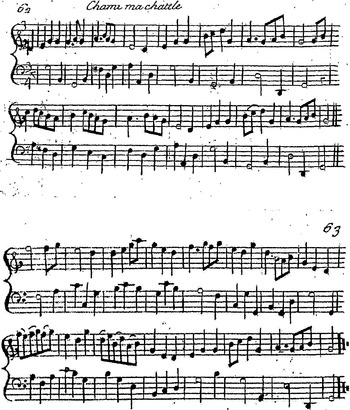
Ramsay was, however, not just a cheerleader encouraging others to bridge the Highland–Lowland divide. Two years after urging musicians to integrate Highland and Lowland in ‘To the Musick Club’ he made another important gesture, which, if less immediately striking, nevertheless showed that he himself was attempting the type of integration that he urged on others. His Tea-Table Miscellany, for the first time in print or in a known manuscript, treats a tune with a Gaelic title as part of a ‘Scottish’ collection. Indeed, it pairs the tune with a Lowland text. ‘Love inviting Reason’ is listed as ‘A SONG to the Tune of, – Chami ma chattle, ne duce skar mi’.Footnote 78 This is an obvious bastardization of the Scottish Gaelic ‘Tha mi 'nam chadal; na dùisgibh mi’ (I am sleeping; don't wake me up). The tune had recently appeared in a published collection of Irish music as ‘Ta me ma Chulla's na doushe me’ (from the Irish Gaelic, again meaning ‘I am sleeping and don't wake me up’).Footnote 79 Of course, if Ramsay cited the tune, it must have been known to much of his audience in the Scottish Lowlands. And indeed, the melody had already surfaced in an earlier Lowland manuscript, known as the Sinkler MS (written in 1710 by the Glasgow music teacher Andrew Adam, probably for one of his students).Footnote 80 Notably, however, there it is called only ‘An Irish tune’ (f. 3v). This would suggest that in 1710 at least some Gaelic music was present and influential in Lowland Scotland, but was still considered culturally foreign (Irish). It would take a figure such as Ramsay to reclaim this ‘Irish’ tune with a Gaelic title – and by extension the broader Highland culture – as ‘Scottish’. From the influence of Ramsay's own collection, the air would soon become a stalwart of the ‘Scotch tune’ repertoire, now known as ‘Cold Frosty Morning’.Footnote 81
In other words: to assert the novelty of Ramsay's suggestion that Highland and Lowland music ought to be representative parts of the same culture is not to deny earlier cross-influences between the neighbouring traditions. The Sinkler manuscript provides one example of how a few Highland tunes and genres had already made their way into early Lowland collections, and the entire genre of the ‘port’ alone is enough evidence that Lowland music was permeated by genres and tunes with Highland and Irish elements.Footnote 82 The point is rather that while there were various diverse influences on Lowland music before 1720 (English, French, Irish, Highland, Italian and so forth), their geographic origins had often been unimportant; and when such origins were first given attention, Highland tunes were treated as culturally ‘foreign’ alongside the French and others. (The Scots Gaelic language, which evolved and separated from Irish Gaelic, was still called ‘Irish’ or ‘Erse’ throughout much of the eighteenth century; and in the early part of the century Highland and Irish music were conceptually grouped together rather than Highland and Lowland.) From Ramsay's work onward, this was no longer the case.
Perhaps Ramsay had this idea of reorientation in mind when he wrote the specific text to which he paired ‘Chami ma chattle’. The poem, in English with just a trace of Scots vocabulary, is itself a story of transplantation and origins. Like a gender-reversed Rake's Progress, ‘Love inviting Reason’ is a tale of Annie, who has gone from the ‘green meadow’ to the big town. Her faithful and uncorrupted Jamie, left behind, begs her not to forsake him for a lap dog, French dancer or other foppish affectation. We do not discover the outcome, but the counterpoint between maintaining one's ‘roots’ and broadening one's identity thus echoes through both Ramsay's use of the Highland tune and the poem that it sets.
The gesture of using ‘Chami ma chattle’ could not be repeated by Ramsay himself, as there were not yet other tunes that were both known by Gaelic names and also sufficiently familiar to Lowlanders. Thus, although there are pairings of texts and tunes with a similar thrust elsewhere in the Miscellany, especially from the 1729 edition onwards, no others are as explicit in their weaving-together of elements from opposite sides of the Highland–Lowland line, almost pretending it did not exist. Some songs in the collection are just extensions of the trope of the sexualized ‘Highland Laddie’ stereotype present in the Lowlands (which does little to make it less ‘foreign’).Footnote 83 Others, such as Ramsay's song beginning ‘Farewell to Lochaber’, refer to Highland settings. This song is set to a tune named as ‘Lochaber no more’, whose origins are not clearly Highland or Lowland: versions seem to have passed around in a wide geographical swathe.Footnote 84 The closest Ramsay himself came to repeating his gesture of employing a tune with a Gaelic title was his use of the tune ‘Killiecrankie’, which I will address below. In any case, while Ramsay in the 1720s could not yet exactly replicate his inclusion of a tune with a Gaelic title in a ‘Scottish’ collection published in the Lowlands, only a little more than a decade later the mixture of tunes with Scots and Gaelic titles would be a practice ready to be exploited by musicians, a few of whom knew both repertoires. Furthermore, because these later collections would print melodies rather than just naming them, they no longer needed to rely on their audiences' knowledge of a tune in support of printed text; they could take the opportunity to present, in music notation, new material from the Highlands alongside Lowland melodies in Scottish collections.
Finally, in a third crucial gesture, Ramsay would take further action in his capacity as a publisher and bookseller. In 1725 the expatriate Scot William Thomson published down in London Orpheus Caledonius: Or, a Collection of the Best Scots Songs – taking many of Ramsay's words from the Tea-Table Miscellany wholesale and without acknowledgment, but now printing and harmonizing the tunes that Ramsay had only named in his collection. Thomson's shameless capitalization on Ramsay's project seems to have inspired Ramsay himself to get briefly involved in the music-publishing business. Given the lack of infrastructure for music printing in Scotland at the time, responding to Thomson's London publication was not a trivial matter. Ramsay enlisted the singer and violinist Alexander Stuart (also often spelled ‘Stewart’) to help him provide bass lines for the melodies used in his texts, and within a year had published his own tiny 16° Musick for Allan Ramsay's Collection of Scots Songs,Footnote 85 more or less the beginning of music publishing in Edinburgh. While this local response to the London publication was hasty and of low quality both in its harmonizations and as a print object (Figure 1 shows its printing of the tune with the Gaelic title discussed above), the competitive atmosphere and links between Ramsay and the musicians in the Edinburgh Musical Society set the ball suddenly rolling towards the creation of a print-based secular musical culture in Scotland. Furthermore, the title Ramsay chose for his diminutive music collection did not even reiterate the words Tea-Table Miscellany, instead describing it only as a ‘collection of Scots songs’ and accordingly stressing the national element. The little publication thus pushed further towards the recognition of both tunes (as sound) and music books (as objects) as shared and uniting cultural property.Footnote 86
‘Chami ma chattle’, from Musick for Allan Ramsay's Collection of Scots Songs, set by Alexr Stuart & Engraved by R. Cooper, vol first (Edinburgh: Printed and sold by Allan Ramsay[, 1725–1726]). National Library of Scotland (Ing.38). Used by permission. With thanks to the Trustees of the National Library of Scotland

Sympathetic Vibrations
Through his role as a central fixture in Edinburgh's cultural life, Ramsay's gestures on behalf of music, however isolated, reverberated quickly. They seemed to give just the prod necessary to spur musicians and intellectuals into tying music to cultural-national projects.
A group of Scottish musicians took up his 1721 musical call to ‘own and refine’ native Scottish music almost immediately. To the stock of well-known tunes that had been circulating orally and in manuscript they added simple figured bass lines and other contemporary galant features. David Johnson has called their published collections of these settings for a bourgeois audience the ‘Scots Drawing Room Style’.Footnote 87 It was a musical parallel to Ramsay's national poetry. We have already seen the earliest representatives of this style: Thomson's Ramsay-based Orpheus Caledonius, published in London, followed by Ramsay's and Stuart's own response later that year. From this point onwards the Edinburgh Musical Society, the erstwhile ‘Musick Club’ addressed by Ramsay, seemed always close to the work of carrying out the wishes he had expressed in the poem. Stuart was himself one of the longest-serving musicians on the rolls of The Musical Society, paid from the first records of its official founding in 1728 until late in the century, and from 1731 he was the society's librarian.Footnote 88 As for Thomson's collection, by 1733 it had gone into an expanded two-volume edition, of which The Musical Society quickly bought not one but ten copies.Footnote 89 (Incidentally, Ramsay himself sold the Society music on occasion.Footnote 90)
If Stuart's native answer to Thomson's London-published work was small and hastily produced, other Edinburgh-based musicians soon responded more robustly. About a year after the Stuart/Ramsay book, another musician on the rolls of the Musical Society, Adam Craig, published the first instrumentally oriented collection.Footnote 91 (Stuart's collection had been a supplement to Ramsay's texts.) As soon as the most prominent Scottish composers of the day, James Oswald and William McGibbon (the latter also played with The Musical Society), became involved around 1740, published collections of specifically Scottish music proliferated.Footnote 92 Most of these collections could be played on transverse flute or violin and had bass lines printed underneath.Footnote 93 Together, these publications – and the activities of the music clubs that were springing up in other Scottish cities – helped to elevate Scots culture along the lines recommended by Ramsay, and to convert Scotland's educated music scene into a print-oriented milieu.
As part of the project of ‘owning and refining’ Scottish tunes alongside Italian and other music, these musicians were able to take up the integration of Highland elements into the idea of ‘Scottish’ music – a process that Ramsay had potently suggested in ‘To the Musick Club’, but had been able to do in only a limited way himself, most notably with ‘Chami ma chattle’. There were two separate but intertwined types of importation into the Lowland-defined body of ‘Scottish’ melody that could take place. The first involved songs with Jacobite connotations. Here the problem was explicitly political. The second was the introduction of Highland melodies in general, including especially those known only or primarily by Gaelic titles. These airs, though occasionally carrying political symbolism, would have been difficult to integrate more because of their unfamiliarity or occasional stylistic ‘foreignness’ than for any other reason. In both cases music was in many ways the ideal medium for integrating Highland and Lowland culture. Concerning Jacobitisim: if music's ambiguity of meaning had been one reason that it was initially considered ephemeral and less able to function as lasting cultural capital, the very same ambiguity made melodies less politically volatile even when they were associated with charged words. And concerning ‘foreignness’: at least nominally, music offered no language barrier between Highland and Lowland akin to the differences between Gaelic and English.
In reality the advantages of music over words in crossing cultural and geographical boundaries quickly became more pronounced when it came to the question of political implications rather than differences of language, style and repertoire. The lyrics of Jacobite songs could be fully integrated into mainstream Scottish culture only after the threat of political Jacobitism was neutralized later in the century. William Donaldson singles out a collection as late as 1769 (David Herd's Ancient and Modern Scottish Songs, expanded in 1776) as the first to include Jacobite songs in the same figurative breath as ‘ancient’ Scottish material, and also as the first to group Highland and Lowland Scottish material together while excluding English and Irish.Footnote 94 The case was different with melodies. Some Lowlanders conflated the Highlands in general with Jacobitism, but melodies alone could not generally confirm such connotations. Indeed, there was a long tradition, continuing from the earliest broadside culture, of reusing tunes for (often ironic) parodies of their original texts and for completely new words. Thus melodies linked to Jacobite songs or events could spread much further and more quickly than Jacobite song lyrics.
Ramsay's naming of ‘Gillikranky’ as the tune to be used for his verses ‘Virtue and Wit’ from the 1729 edition of the Miscellany is a case in point. Killiecrankie was the site of a Jacobite triumph in the first, 1689, resistance to the Stuart deposition, and in the early eighteenth century there were in fact two well-known tunes using this name to which Ramsay may have been referring, at least one apparently of Irish origin.Footnote 95 But as melodies carrying only the name of a place, their connotations remained slippery. Indeed, although by the end of the eighteenth century one ‘Killiecrankie’ tune would be adorned with famous Jacobite words (first in a broadside after the forty-five and then in a version written at least partially by Robert Burns), in Ramsay's time it is unclear what, if any, text was associated with either of the tunes. The extant versions of both tunes from before Ramsay are untexted; Ramsay's neoclassical love song is the earliest text that I know of to be attached to a tune of this name. So the tune title Ramsay used would have passed with reasonably little friction among an audience with wide geographical and political spread. And this was not an isolated case. Because it was relatively easy to invoke tunes with politically charged names at this early stage, precisely because melodies had a history of being seen as ephemeral and unfixed in meaning, analogues to Ramsay's use of ‘Killiecrankie’ could proliferate easily. Around and after the forty-five, several other melodies overtly linked to Jacobite songs entered explicitly ‘Scottish’ collections – with new words, though often with preserved titles – all well before Jacobite lyrics could safely be printed as Scottish emblems.Footnote 96
Thus while the volatility of Jacobitism might initially make Ramsay's use of ‘Killiecrankie’ seem more radical than his use of ‘Chami ma chattle’, it is actually the Gaelic title applied to a Scottish collection that was more novel in terms of his new vision of ‘Scotland’. For all its political ambiguity, music still depended on familiarity to spread, and tunes with titles that were unpronounceable or meaningless, or that were not stylistically suited to common Lowland dances, actually took more work to import into Lowland collections than anything else. Even in these cases, however, tunes spread more easily than words. By the 1730s untexted tunes designated in English or Scots as ‘Highland’ (now instead of ‘Irish’, with its foreign implications) appear in a few manuscripts alongside the Lowland Scottish airs; and the reel even became recognized as a dance type and resultant tune type that was both generally ‘Scottish’ and specifically associated with the Highlands.Footnote 97 The Duke of Perth, a member of the Edinburgh Musical Society himself, had the scribe David Young write out a lavish manuscript of reel tunes for him in 1734.Footnote 98
Not until around 1740 did more tunes appear that carried actual titles in Gaelic, latching on to the isolated example of ‘Chami ma chattle’ in the Tea-Table Miscellany. The so-called McFarlan manuscript of 1740, also in Young's hand and copied for a member of the Edinburgh Musical Society, is one of the first to feature Gaelic titles alongside Scots in the same place.Footnote 99 Only a few years later, such mixes had become common.Footnote 100 And published collections followed the same course as these manuscripts: James Oswald's Curious Collection of Scots Songs was the first since the small Stuart/Ramsay book to include Gaelic titles, also in 1740. Oswald soon went on to publish his important Caledonian Pocket Companion, which from the 40s to the 60s would run to twelve volumes, circulating widely and embracing many ‘Highland’ tune types and Gaelic tune titles in its ‘Caledonian’ scope. It was this collection that ultimately realized Ramsay's advice to the music club to ‘own and refine’ the ‘martial pibroch’ alongside Lowland music: the volumes include some pieces based on repetitive instrumental figuration and labelled as pibrochs, placed next to well-known Lowland vocal melodies.Footnote 101
Within a few years of Culloden, the idea of a pan-Scottish ethnic nation was finally exploited in print by a Highland author as well. The most famous contemporary poet of the Highlands, Alasdair MacMhaighstir Alasdair (sometimes anglicized as Alexander MacDonald), published in 1751 his Ais-Eiridh na Sean Chánoin Albannaich: no, An nuadh Orainaich Gaidhealach (Resurrection of the Old Scottish Tongue: Or, The New Gaelic Songs). In it he included a poem reclaiming Gaelic as the ancient language of all of ScotlandFootnote 102 – and in his English-language Preface, he wanted to invite Lowlanders to participate in their ancient arts, suggesting they had strayed from their true linguistic and cultural roots.Footnote 103 (The book was itself an attempt to trace the national ‘genius’ of the ‘Celtic Nation’.Footnote 104) Towards this goal of national reintegration, perhaps, MacMhaighstir Alasdair listed Lowland tunes to be used for much of the Gaelic poetry in the book (the same mixing that Ramsay had pioneered, but with the terms now reversed). Coming as it did just in the wake of the forty-five, the book was considered incendiary, and many copies were burned by the authorities. But when not accompanied by open propaganda, music's ambiguity had allowed for an integration of Highland and Lowland melodic material towards new nationalist ends decades before Highland, and especially Jacobite, lyrics could be integrated into ‘Scottish’ collections.
A Double Influence: Ramsay and his Followers as Positive and Negative Models
It would take the crushing defeat of the Jacobite rebellion at Culloden Moor in 1745 to declaw Jacobitism and turn it from a political into a cultural movement and a part of mainstream Scottish identity.Footnote 105 As English attitudes toward the Scots after the rebellion edged towards more blatant jingoism and abuse, and as the harsh proscription laws applied even to the clans who had been loyal to the Hanoverians, it is no wonder that more and more Scots sought a unified identity based on resisting Englishness, thus sweeping internal friction under the carpet. But Ramsay had already taken this position after the 1715 rebellion, assuming that all Scots would be grouped together by outsiders anyway, and capitalized on that conflation to internalize a stronger united image. He, like his cohorts in the ‘easy club’, but more influentially, had even anticipated the later, pervasive movement to turn Stuart symbolism from a political quest into a cultural ‘sentimental Jacobitism’.Footnote 106 The aftermath of the forty-five, tragic as it was, thus helped fulfil Ramsay's vision of Scots' owning and refining a pan-Scottish national music. Such vicissitudes of history in counterpoint with various influential personalities were mirrored in broader trends across eighteenth- and nineteenth-century Europe, as other nations also began to discover and invent national musical traditions.Footnote 107
I would like to conclude by considering one last aspect of Ramsay's influence: his use by future generations paradoxically as both an indispensable source and a negative model. Although Ramsay, in Tartana, had decried the use of ‘imported trimming’ on native cloth, overall he promoted Scottish culture alongside Continental and other traditions – just as, in ‘To the Musick Club’, he had suggested that music ought to be cultivated everywhere equally, and called for the performance of both Scottish music and Corelli. Indeed, the 1729 edition of the Tea-Table Miscellany even noted in its subtitle that it included songs in English and Scots alike.
But currents changed after the middle of the century, ushering in a new quest for cultural purity and isolation. In musical circles, part of the catalyst seems to have been the sheer number of foreigners, particularly Italians, plying their musical trade in Edinburgh, and the increasing perception of a divide in aesthetic goals between Italian and Scottish music. By the early 1770s there were virulent and outright xenophobic attacks against Italian music in Scotland.Footnote 108 Closely attached to the growing emphasis on purity was an even more influential new idea: authenticity. As the eighteenth century progressed, Enlightenment thinkers became increasingly obsessed with charting the stages of civilization in a move away from a pure state of nature. Their sense of rupture with the past, which has been explored by Regina Bendix, Susan Stewart and others, led them to hold cultural artefacts and styles presumed to be ancient up against the standard of a notionally pure origin whose essence needed to be carefully guarded.Footnote 109 The publication of James MacPherson's supposed translations of complete epics by the third-century Celtic bard Ossian around 1760 led to a series of debates that provided the foundation for the modern idea of folk song and folk music in Europe – that is, ‘national music’, not in the sense of a popular culture shared across classes, but rather as a relic from the past, something representing an ancient and untainted stage of society, a domain in which ‘authenticity’ was thus central.Footnote 110 As the ‘uncorrupted’ peasantry came to be seen as the true bearers of this ancient folk culture, the quest for a ‘pure’ and ‘authentic’ folk opened up a gulf between ‘high’ and ‘low’ culture that was new.
An ironic result of such thinking from the 1760s onward was that Ramsay's easy conflation of material with Highland and Lowland origins and symbolism became the standard model for Scottish music at the same time that his equally easy conflation of material with ‘high’ and ‘low’, or with new and old, origins came to be seen as a betrayal of authenticity. Ramsay himself had catalysed the obsession with origins in Scottish music by calling on tunes to stand for the nations that produced them, but that obsession soon led to a pervasive focus on both temporal origins (authentic ‘antiquity’) and perceived differences between origins in ‘the people’ and origins in educated, high culture.Footnote 111 This new value system meant that what to anyone in Ramsay's generation seemed a perfectly normal urge to refine and improve – using and rewriting pan-national material to its best advantage – was now viewed as unforgivable carelessness with ancient, communal cultural icons. For example, in 1794 the irascible antiquary Joseph Ritson accused Ramsay of being a ‘reprehensible’ editor because he rewrote material rather than preserving the ‘ancient and original words’, which are now ‘irretrievable’.Footnote 112 Almost identical attacks continued in the canonical work on Scottish song and music as long as the romantic conception of a pure and authentic folk music held sway, until late in the twentieth century.Footnote 113
However anachronistic these attacks on Ramsay were, since he could not have acted on principles that were only formulated half a century after he worked, they none the less show a second side to Ramsay's influence. All the writers who attacked Ramsay drew on his collections because they were the first to collect and shape music along Scottish national lines – and to use music to represent its origins as a source of cultural esteem – but at the same time these later scholars used their differences from him to establish their own credentials.
Something similar happened to the Scottish composers of the 1740s to 1770s who had taken up Ramsay's call, mixing and matching international genres and styles, including the Scottish. To a certain extent, as the ideal of purity spread in the middle of the century, these composers took different paths. Thomas Erskine, the Earl of Kellie, chose increasingly to define himself as a German-trained composer working in a Mannheim-influenced style. McGibbon conveniently died. Oswald, who had moved to London, was less decisive, and most akin to Ramsay himself. Like Ramsay, he approached his source materials with refining and combinative – composerly rather than preservationist – ends. He also continued to treat Scottish music as part of a larger picture, drawing on different national styles. Consider Oswald's approach to Highland music. The tunes with Gaelic titles he published from 1740 do indeed show an interest in embracing this repertoire as ‘Scottish’ – but the extent of his familiarity with it is hard to determine (Oswald's versions of Gaelic titles are sometimes mangled almost beyond sonic recognitionFootnote 114); and certainly he was no more purist in his approach to repertoire.
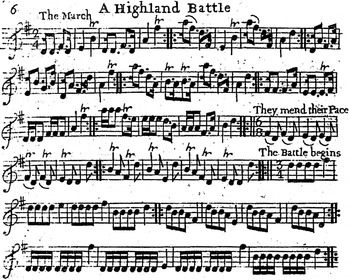
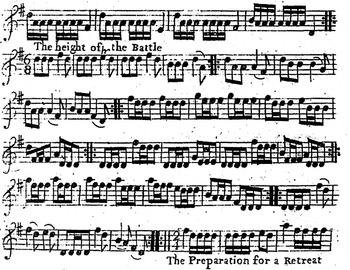
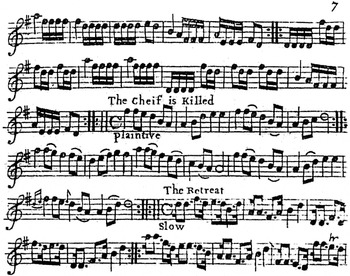
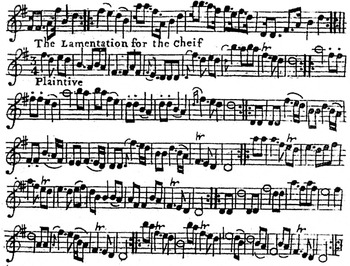
His piece ‘A Highland Battle’ (see Figure 2) as much represents his imagined use of pibroch as it invokes a true pibroch in form and function, and it seems to be infused with an Italian programmatic and narrative flair (which he had also explored in his ‘Airs for the Seasons’) – more specific than would ever appear in a typical pibroch.
James Oswald, ‘A Highland Battle’, from The Caledonian Pocket Companion, in Ten Volumes, volume 9, 6–7 (London, c1760). © The British Library Board (e.1290.a). Used by permission

continued

continued

continued

As he shared Ramsay's approach, Oswald had the same type of double influence as Ramsay, but within a more purely musical domain. On the one hand, his collection The Caledonian Pocket Companion was a bread-and-butter source of airs for the likes of Robert Burns. On the other hand, he was attacked because he never abandoned his cosmopolitanism in search of Scottish ‘authenticity’ and ‘folkishness’, because he attempted to continue sounding Scottish, English and Italian all at the same time.Footnote 115 In the later purist environment even McGibbon's earlier work came in for criticism: the early nineteenth-century collector Alexander Campbell would write that every melody that passed through his hands had picked up ‘pedantic garnish’, thus implying it was no longer truly ‘folk music’.Footnote 116
All this happened from the 1770s onwards, at the same time as the publication of new collections by a group of musicians who showed a real familiarity with and creative integration of Highland and Lowland practices as well as a familiarity with (and desire to conform to) the idea of authenticity and folk purity. The most notable of this new group were Daniel Dow, Neil and Nathaniel Gow, Robert Mackintosh and Isaac Cooper.Footnote 117 So it was that Ramsay's vision of a Scottish music that truly (and sometimes seamlessly) integrated Highland and Lowland sources and styles into a ‘national’ whole was fulfilled just as his methods were coming under fire from a new value system.
Recently scholarly views have finally shifted toward recognizing Ramsay's creative role rather than measuring him with an anachronistic yardstick based on a concept of folk music and authenticity that he could not have known. But even the generations of scholars and musicians who attacked Ramsay while relying on his collections testify to the ways in which his early work shaped the discourse on Scottish music and the concept of national music in a constant process from the eighteenth century to the present. Ramsay and the networks around him are thus a powerful example, in a country that was culturally divided and politically subordinated, of the working practice of inventing and embedding ‘national’ musical culture – of the nation as Homi Bhabha has described it: a constant state of narration.Footnote 118