Introduction
The verbal fluency test (VFT) is a widely used instrument to assess both the verbal and executive functions for which both inferior temporal and frontal lobe are considered to be responsible (Lezak et al., Reference Lezak2004; Baldo et al., Reference Baldo, Schwartz, Wilkins and Dronkers2006). The test is brief and simple, usually taking 1 minute to administer. The examinees are required to name as many words as possible within the time given. Words can either belong to a certain semantic category (category or semantic fluency task) or begin with a certain letter (letter or phonemic fluency task).
A number of studies have demonstrated that verbal fluency tasks are sensitive measures of cognitive dysfunction in Alzheimer's disease (AD). The VFT-related early neuropsychological deficits in AD are characterized by a breakdown in the structure of semantic knowledge as well as impairments in executive functions, particularly cognitive flexibility (Lafleche et al., Reference Lafleche and Albert1995; Ruff et al., Reference Ruff, Light, Parker and Levin1997). Similar declines in fluency performance have been noted in cases with amnestic type of mild cognitive impairment (MCI) (Murphy et al., Reference Murphy, Rich and Troyer2006; Nutter-Upham et al., Reference Nutter-Upham2008). The VFT therefore is considered to be an appropriate screening tool for the early detection of AD (Mok et al., Reference Mok, Lam and Chiu2004; Murphy et al., Reference Murphy, Rich and Troyer2006).
In a meta-analysis of verbal fluency performance in patients with AD, it was speculated that category fluency performance might be more impaired than letter fluency performance in the early stages of AD (Henry et al., Reference Henry, Crawford and Phillips2004). Patients with AD exhibit greater impairment on category fluency than on letter fluency performance, relative to healthy controls (Barr and Brandt, Reference Barr and Brandt1996; Crossley et al., Reference Crossley, D'Arcy and Rawson1997; Henry et al., Reference Henry, Crawford and Phillips2004). Therefore, a category-letter fluency discrepancy measure is often reported as an important distinguishing characteristic of AD patients. However, it should be noted that healthy elderly persons have more difficulty in generating words by letter than by category (Rosen, Reference Rosen1980). Another recent meta-analysis regarding verbal fluency performance in patients with AD indicated that the category-letter discrepancy did not differ between AD patients and controls (Laws et al., Reference Laws, Duncan and Gale2010). Lows and coworkers implied that the category-letter fluency discrepancy measure may be an exaggerated normal tendency. The issue of whether this finding also holds true for cases of amnestic MCI remains controversial. Murphy et al. (Reference Murphy, Rich and Troyer2006) found that people with amnestic MCI exhibited greater impairment in category fluency than in letter fluency performance, relative to healthy controls, whereas Nutter-Upham et al. (Reference Nutter-Upham2008) found that both the phonemic and category fluency were significantly impaired in amnestic MCI cases relative to cognitively intact older adults. Taking all these together, the performance of the category fluency test appears to be useful for the early detection of AD.
Some community-based studies have found a significant effect of educational background on verbal fluency performances, with particularly robust effects on category fluency task performance (Ruff et al., 1996; Ratcliff et al., Reference Ratcliff1998; Acevedo et al., 2000; Troyer, Reference Troyer2000), although several studies suggest that age moderates this effect of education (Tombaugh et al., Reference Tombaugh, Kozak and Rees1999; Benito-Cuadrado et al., Reference Benito-Cuadrado, Estaba-Castillo, Böhm, Cejudo-Bolívar and Peña-Casanova2002). For example, although age does influence category fluency task performance (Troyer, Reference Troyer2000), Benito-Cuadrado and coworkers (Reference Benito-Cuadrado, Estaba-Castillo, Böhm, Cejudo-Bolívar and Peña-Casanova2002) insisted that category fluency performance is more sensitive to the effect of education than that of age. Consequently, in order to examine the utility of the category fluency test as a tool for screening AD, it is necessary to study the effect of education not only in a cognitively intact population but also in a population of patients with early AD.
The precise nature of a possible effect of educational background on the VFT scores of AD patients remains to be clarified. The present study examined the possible effect of educational profiles on the performance of the VFT in adults over 50 years old with amnestic MCI and mild AD.
Methods
Selection of participants
A total of 801 older patients who visited the geriatric outpatient unit of the Nagoya University Hospital from January 2000 to April 2009 were initially included in the study. All the participants were subjected to detailed assessment of cognitive function. Of these patients, 716 individuals actually participated in this study (i.e. completed the relevant tasks and for whom demographic information was available). Tasks/measures included the Mini-mental State Examination (MMSE; Folstein et al., Reference Folstein, Folstein and McHugh1975), Clinical Dementia Ratings (CDR; Morris, Reference Morris1993), memory measures, and the VFT. Each participant or a caregiver signed a consent form after the outline of the study having been sufficiently informed by the principal investigator.
Out of the 716 individuals, 345 patients with AD and 123 individuals with amnestic MCI were included in the analyses. To exclude individuals with other diagnoses, medical histories obtained by the geriatricians were carefully reviewed, and information of neuropsychological assessment, brain imaging by MRI or CT scan, and biological tests were also used. All AD patients met the diagnostic criteria of both dementia according to the Diagnostic and Statistical Manual of Mental Disorders, third revised edition (DSM-III-TR; American Psychiatric Association, 1985) and probable AD according to the criteria of the National Institute of Neurological and Communicative Disorders and Stroke and Alzheimer's Disease and Related Disorders Association (NINCDS-ADRDA; McKhann et al., Reference McKhann, Drachman, Folstein, Katzman, Price and Stadlan1984). Finally, we selected 335 patients with mild or moderate AD whose MMSE score exceeded 15.
The Mayo criteria were used to define amnestic MCI in the present study (Petersen et al., Reference Petersen, Smith, Waring, Ivnik, Tangalos and Kokmen1999). The criteria include the presence of a memory complaint, impaired memory function for age, preserved general cognitive functioning, intact activities of daily living (ADL), and the absence of dementia. As the operational definition, the preserved general cognitive function was confirmed by MMSE, and the intact ADL was confirmed by CDR. We defined the amnestic MCI group based on the following eligibility criteria: scoring 24 or more points on MMSE and scoring 0.5 points on CDR. For the assessment of mnemonic function, we used a story recall task, and those who scored >1.5 of the standard deviation (SD) below the normal mean for older adults were defined as subjects with amnestic MCI. Normal older volunteers with no cognitive dysfunction, no history of neuropsychiatric illness, with CDR 0, were recruited in the city's healthcare centers.
Tasks
Verbal fluency test
Each participant was asked to generate as many words as possible either belonging to a category “animal” (category fluency) and beginning with “か [ka]” in syllabic Japanese script “kana,” excluding proper names, numbers and words stated previously (letter fluency). This task was essentially the verbal fluency test standardized for the Japanese language by Ito and Hatta (Reference Ito and Hatta2002). Measurements were started once it was clear that each participant understood the task instructions. Fluency task scores were the total number of words recalled for the category and the letter.
Extra tasks
The Story Delayed-Recall Test was used to assess memory functioning. In this auditory task, participants were asked to recall a whole story half an hour after the story had been read to them by an examiner. The story consisted of 15 segments. The Wechsler Adult Intelligence Scale-Revised (WAIS-R; Wechsler, Reference Wechsler1981) Digit Symbol subtest was used to assess the processing speed and the Color-Word Stroop Test was used to assess executive functioning.
Data analysis
All statistical analyses were performed using SPSS 17.0 J. for Windows.
Results
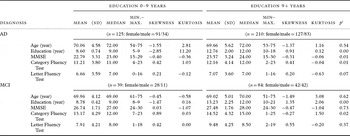
Because performance on the VFT was affected by the years of education, the scores of the VFT were stratified by this variable. For each group (AD or amnestic MCI), the scores were divided into two education levels (0–9 years and 9+ years). Table 1 shows the means, standard deviations (SDs), medians, minimum-maximum values, skewness, and kurtosis for age, education, gender, MMSE and scores on the category and the letter fluency tests for each of the group. Mann-Whitney tests were performed to determine intergroup differences with respect to education for each of the group. Within AD patients, MMSE scores, the category fluency scores, and education years were significantly lower in the group with 0–9 years education level than in those with 9+ years’ education (p < 0.05). In those participants with MCI, the category fluency scores and education years were significantly lower in the group with 0–9 years’ education than in those with 9+ years’ education (p < 0.05). These results show that category fluency scores tended to increase with increasing years of education, whereas on the letter fluency there is no difference between the two education levels.
Means, standard deviations (SDs), medians, minimum–maximum values, skewness, and kurtosis for age, education, gender, MMSE, and category/letter fluency test scores for each of the groups

† Mann-Whitney tests were performed to determine intergroup differences with respect to education for each of the groups.
MMSE = Mini-mental State Examination.
To make a detailed analysis of the education effect observed in the category and the letter fluency test, the scores were divided into five education levels (0–6, 7–9, 9–12, 12–15, and 15+ years). Figure 1 shows the performance on the category fluency test for each patient group in two age classes and five education levels. Missing points in the graph mean lack of numbers (n > 7) eligible for comparison in the cluster. This Figure demonstrates that a similar trend was observed in both AD and MCI groups regarding the robust effect of education on the performance of the category fluency task, but was not observed on the performance of the letter fluency task.
Performance on the category [A]/letter [B] fluency tests in two groups (AD and MCI) and five education levels (indicated below horizontal axis).
Note. Missing points in the graph mean lack of numbers (n > 7) eligible for comparison in the cluster. AD = Alzheimer's disease; MCI = mild cognitive impairment.

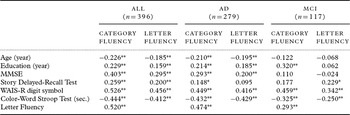
Table 2 shows correlation (Spearman's rank correlation coefficient) between each neuropsychological marker and category/letter fluency test for each group. The analysis included all 396 individuals for whom no variable scores were missing. In AD patients (n = 279), category fluency scores were positively correlated with education (year: ρ = 0.214), MMSE scores (ρ = 0.293), Story Delayed-Recall Test scores (ρ = 0.148), and WAIS-R digit symbol scores (ρ = 0.449), and were negatively correlated with age (year: ρ = −0.210), and Color-Word Stroop Test scores (ρ = −0.432). In the patients (n = 279), letter fluency scores were positively correlated with education (year: ρ = 0.185), MMSE score (ρ = 0.200), and WAIS-R digit symbol score (ρ = 0.416), and were negatively correlated with age (year: ρ = −0.195), and Color-Word Stroop Test scores (ρ = −0.429). In amnestic MCI participants (n = 117), category fluency scores were positively correlated with education (year: ρ = 0.320), and WAIS-R digit symbol scores (ρ = 0.459), and were negatively correlated with Color-Word Stroop Test scores (ρ = −0.325). In these participants (n = 117), letter fluency scores were positively correlated with Story Delayed-Recall Test scores (ρ = 0.229), and WAIS-R digit symbol score (ρ = 0.342), and were negatively correlated with Color-Word Stroop Test scores (ρ = −0.250). Additionally, In both AD patients and amnestic MCI participants, category and letter fluency task scores were positively correlated (ρ = 0.474; ρ = 0.293).
Correlation between each neuropsychological marker and the total number of words produced during category/letter fluency test for each of the group: Spearman's rank correlation coefficient

MMSE = Mini-mental State Examination; WAIS-R = Wechsler Adult Intelligence Scale – Revised.
** p < 0.01, * p < 0.05.
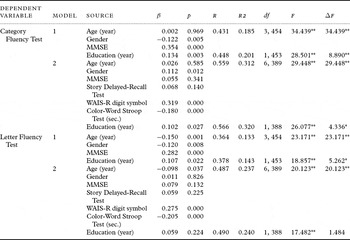
Table 3 summarizes a multiple regression analysis that included all individuals for whom no variable scores were missing. A multiple regression analysis was performed to determine the effects of adjusted age, gender, and general cognitive state on category and letter fluency performance during the early stages of AD. These variables were reported to influence fluency in previous studies (Laws et al., Reference Laws, Duncan and Gale2010). Gender was dummy coded, such that l = male and 0 = female. The variable of age, gender, and severity of general cognitive decline as measured by the MMSE were entered first as covariates in the model 1. After controlling for these covariates, years of education was entered at the last step. The three variables in neuropsychological assessments associated with the degree of cognitive declines in early AD (memory as measured by the Story Delayed-Recall Test, psychomotor-speed as measured by the WAIS-R digit symbol subtest, and executive functioning as measured by the Stroop color-word test) were added as covariates in the model 2. After controlling for these covariates, years of education were entered at the last step. The results for all participants (n = 396) revealed that education was significantly related to category fluency test scores in model 1 and 2 (β = 0.134, p < 0.01; β = 0.102, p < 0.05), as confirmed by a significant increment in R2 when years of education were entered in model 2 adjusted by more variables (R2 changed from 0.312 to 0.320, p < 0.05). On the other hand, education was significantly related to letter fluency test scores in the model 1 (β = 0.107, p < 0.05) but education was not significantly related to letter fluency test scores in the model 2 (β = 0.059, not significant), as confirmed by a non-significant increment in R2 when years of education were entered as the predictor (R2 change from 0.237 to 0.240, not significant).
Summary of the multiple regression analysis (n = 396)

MMSE = Mini-mental State Examination; WAIS-R = Wechsler Adult Intelligence Scale – Revised.
** p < 0.01, * p <0.05.
Discussion
The current study demonstrated that category fluency performance reflects not only AD specific changes but also the effects of education. Impaired performance of the category fluency test has already been observed in subjects with amnestic MCI (Murphy et al., Reference Murphy, Rich and Troyer2006; Nutter-Upham et al., Reference Nutter-Upham2008), which may suggest that the impairment of category fluency is a neuropsychological hallmark prior to the onset of dementia. Although the category fluency performance related to the severity of AD slightly better than the letter fluency performance, the effect of education level, after adjusting for age, gender, and cognitive state, was observed in the category fluency performance, but not the letter fluency performance. Similar results were obtained in subjects with amnestic MCI. These results suggest that the effect of education has more influence on the performance of the category fluency task in an aged population. The present results agree with findings from many community-based studies which indicate a significant effect of educational background on verbal fluency performance (Ruff et al., 1996; Acevedo et al., 2000; Troyer, Reference Troyer2000). In particular, our results agreed with the finding of a recent meta-analysis in terms of showing a selective effect of education on semantic but not phonemic fluency (Laws et al., Reference Laws, Duncan and Gale2010). We confirmed that such an effect was preserved at least in the early stages of AD including MCI.
We also examined the association between the VFT score and related cognitive functions. With regard to the category fluency task, a mild correlation with the MMSE score was observed in AD, and moderate correlations with the Color-Word Stroop Test score and the WAIS-R digit symbol score were observed in both AD and MCI. As for the letter fluency task, a weak correlation with the MMSE score was observed in AD, and mild to moderate correlations with the Color-Word Stroop Test score and the WAIS-R digit symbol score were observed in both AD and MCI. Observed correlation of the VFT performance with the MMSE score supports a notion that the impairment can reflect general cognitive decline in the clinical stage of AD. Further analyses showed that the VFT performance was associated with the cognitive domains of psychomotor speed and executive functioning. It is well known that executive deficits occur in the very early stage of AD (Baudic et al., Reference Baudic, Barba, Thibaudet, Smagghe, Remy and Traykov2006). Perret (Reference Perret1974) discussed the association between efficiency of word generation and executive functioning, particularly cognitive flexibility, and demonstrated that executive and frontal lobe based dysfunction negatively influence word fluency performance. According to Gruen et al. (Reference Gruen, Frankle and Schwartz1990), problems in executive functioning were caused by the fluidity and flexibility of choosing the strategy. They identified three cognitive sets, including same initial consonant–vowel syllable (see–seed), semantic association (ship–sail), or same initial consonant blend (tree–trick).
Both verbal fluency task scores were only weakly correlated with Story Delayed-Recall Test scores in the present study. Ruff et al. (Reference Ruff, Light, Parker and Levin1997) reported similarly low correlations between letter fluency scores and the measures of verbal memory performance in healthy volunteers whose ages ranged from 16 to 70 years. Baudic et al. (Reference Baudic, Barba, Thibaudet, Smagghe, Remy and Traykov2006) also demonstrated a lack of correlation between VFT scores and scores on an episodic memory task in cases with very mild and mild AD. Taken together, it is suggested that the VFT performance has little association with impaired recent memory in the early stages of AD at least.
In order to determine the education effect after adjusting for age and cognitive state on the VFT performance in early stage AD, we performed the multiple regression analysis on 396 individuals including both amnestic MCI and AD. The result of model 2 indicated a significant increment in R2 when education year was entered on category fluency task, but not on the letter fluency task. This result suggests a significant effect of education on the category fluency performance after adjusting for disease-specific changes in early AD population, and the effect cannot be overlooked in interpreting the results of the VFT. In view of weighing the contribution of the confounders to the category fluency task results, it is impossible to determine AD risk based on an absolute cut-off point when not taking into account patients’ educational attainments. By contrast, such education effect after adjusting for age, gender, and cognitive state on the letter fluency performance was not observed. Hence the letter fluency task may, in comparison with the category fluency task, be resistant to the variable of education.
In asking why the educational background influences the category fluency performance, several explanations can be made, which include motivational problems, and the influence of test anxiety and test familiarity. Another explanation for the observed phenomenon may rely on the cognitive reserve hypothesis. The hypothesis would explain the delayed onset of clinically diagnosable dementia and the accelerated cognitive decline in individuals with extensive education (Hall et al., Reference Hall, Derby, LeValley, Katz, Verghese and Lipton2007; Wilson et al., Reference Wilson, Hebert, Scherr, Barnes, Mendes de Leon and Evans2009). The present results, showing that categorical processing was relatively preserved in the earlier stages of dementing disorders, may favor this hypothesis. The key to adequate neuropsychological assessment, including the use of the VFT, requires the use of reliable norms stratified by age, gender, and educational level (de Koning, Reference de Koning2009).
The present sample was Japanese-speaking, and caution must be paid when attempting to generalize to non-Japanese-speaking individuals or individuals for whom Japanese is a second language. The VFT is commonly used across the world (Lezak, Reference Lezak2004). Hatta and coworkers have provided normative data for both category and letter fluency tasks in the Japanese population (Ito and Hatta, Reference Ito and Hatta2006). Ito and Hatta (Reference Ito and Hatta2002) suggested that Japanese speakers did not necessarily use the same strategy in the VFT as native English speakers proposed by Troyer (Reference Troyer2000). In view of the distinctive linguistic properties of the Japanese language, the results of the present study provide useful knowledge regarding the use of the VFT in Japanese elderly populations.
In conclusion, we examined the effects of educational background on the category and letter fluency performance in older adults with AD and amnestic MCI, and found that the score of the VFT, especially the category fluency performance, reflects not only AD specific changes but also education effect. Such effect was observed in the early stage of AD including amnestic MCI. In the earlier stages of dementing disorders, the effect of education cannot be overlooked in interpreting the results of the VFT.
Conflict of interest
None.
Description of authors' roles
N. Kawano and H. Umegaki designed the study, analyzed the data, and wrote the paper. Y. Suzuki collaborated during discussions and the writing process. All three authors participated in data collection.
Acknowledgments
The authors thank everyone who helped with the data collection and coordination of this study.