Introduction
Following seminal works by Bentall and others (Bentall et al. Reference Bentall, Jackson and Pilgrim1988; van Os et al. Reference van Os, Gilvarry, Bale, van Horn, Tattan, White and Murray1999; Boyle, Reference Boyle2002), there has been a shift from research into schizophrenia as a heterogeneous diagnostic category toward the study of individual psychotic symptoms. A number of cognitive models have emerged, ranging from general models of positive symptoms of psychosis (Garety et al. Reference Garety, Kuipers, Fowler, Freeman and Bebbington2001, Reference Garety, Bebbington, Fowler, Freeman and Kuipers2007; Morrison, Reference Morrison2001; Bentall et al. Reference Bentall, Fernyhough, Morrison, Lewis and Corcoran2007), to more specific models of hallucinations (Bentall, Reference Bentall1990; Chadwick & Birchwood, Reference Chadwick and Birchwood1994; Morrison, Reference Morrison1998) and delusions (Garety & Hemsley, Reference Garety and Hemsley1994; Bentall et al. Reference Bentall, Corcoran, Howard, Blackwood and Kinderman2001; Freeman et al. Reference Freeman, Garety, Kuipers, Fowler and Bebbington2002).
Psychological models of individual symptoms of psychosis emphasize that they are multi-dimensional constructs. For delusions specifically, the view that they are fixed, all-or-nothing beliefs held with 100% conviction has been challenged by findings that about half of those with delusions entertain the possibility that they may be mistaken (Garety et al. Reference Garety, Freeman, Jolley, Dunn, Bebbington, Fowler, Kuipers and Dudley2005) and that delusional conviction is not static (Sharp et al. Reference Sharp, Fear, Williams, Healy, Lowe, Yeadon and Holden1996). Factor-analytic studies of delusions typically report three or four dimensions, namely, conviction, preoccupation, distress and disruption to behaviour (Garety & Hemsley, Reference Garety and Hemsley1987; Harrow et al. Reference Harrow, Rattenbury, Stoll, Oltmanns and Maher1988). Contemporary assessments using these dimensions [e.g. Peters et al. Delusions Inventory, Peters et al. Reference Peters, Joseph, Day and Garety2004; Psychotic Symptoms Rating Scales (PSYRATS), Haddock et al. Reference Haddock, McCarron, Tarrier and Faragher1999] have proved more helpful than dichotomous measures of delusions (present/absent) in differentiating clinical cases from non-need for care individuals (Peters et al. Reference Peters, Day, McKenna and Orbach1999; Smith et al. Reference Smith, Riley and Peters2009). There is emerging evidence that different factors may contribute to each dimension; for instance, reasoning processes such as jumping to conclusions and belief flexibility appear to be most strongly related to conviction (Garety et al. Reference Garety, Freeman, Jolley, Dunn, Bebbington, Fowler, Kuipers and Dudley2005), while emotional processes such as meta-worry are associated with distress and preoccupation (Freeman et al. Reference Freeman, Garety and Kuipers2001). Research indicates a lack of covariance over time between separate dimensions of delusions (Brett-Jones et al. Reference Brett-Jones, Garety and Hemsley1987). Recently, it has been suggested that the immediate therapeutic effects of medication may operate through a reduction in preoccupation and distress, with conviction changes lagging behind (Mizrahi et al. Reference Mizrahi, Kiang, Mamo, Arenovich, Bagby, Zipursky and Kapur2006).
Models and assessments of hallucinations also emphasize their multiple dimensions, such as emotional valence and impact on behaviour (Haddock et al. Reference Haddock, McCarron, Tarrier and Faragher1999). These aspects are more predictive than intensity and frequency of the experience in differentiating voice-hearers with and without a need for care (Romme & Escher, Reference Romme and Escher1989; Daalman et al. Reference Daalman, Boks, Diederen, de Weijer, Blom, Kahn and Sommer2011). Beliefs about voices play a fundamental role in determining their emotional and behavioural impact (Chadwick & Birchwood, Reference Chadwick and Birchwood1994; Birchwood et al. Reference Birchwood, Meaden, Trower, Gilbert and Plaistow2000), with the principal themes consisting of individuals' beliefs about control and power (‘omnipotence’) in relation to their voices. Psychological therapies, such as cognitive behaviour therapy for psychosis (CBTp), have accordingly shifted their focus from helping individuals to moderate the frequency and intensity of their hallucinations by teaching coping strategies (Tarrier et al. Reference Tarrier, Sharpe, Beckett, Harwood, Baker and Yusupoff1993), to modifying their beliefs about their voices in order to reduce distress and change behaviour (Trower et al. Reference Trower, Birchwood, Meaden, Byrne, Nelson and Ross2004).
Cognitive models of psychosis (Garety et al. Reference Garety, Kuipers, Fowler, Freeman and Bebbington2001; Morrison, Reference Morrison2001) emphasize the central role of appraisals about psychotic experiences, which differentiates them from more generic stress-vulnerability models (Zubin & Spring, Reference Zubin and Spring1977). Garety and her colleagues suggest that a psychotic outcome will only occur if individuals appraise their anomalous experiences as externally caused and personally significant, while Morrison proposes that beliefs about cultural acceptability of intrusive experiences are key to determining psychosis. In support of cognitive models, both Brett et al. (Reference Brett, Peters, Johns, Tabraham, Valmaggia and McGuire2007) and Lovatt et al. (Reference Lovatt, Mason, Brett and Peters2010) found that a group of non-need for care individuals reporting similar anomalous experiences to a psychotic group were differentiated from their clinical counterparts by their appraisals, which were more likely to consist of psychological or normalizing explanations.
Contemporary psychological conceptualizations of psychosis therefore concur in their view that psychotic symptoms as multi-dimensional phenomena are shaped by appraisals. However, progress in our understanding of the relationships amongst different symptom dimensions and appraisals has been hampered by limitations in measurement tools. Participant responses obtained retrospectively in laboratory settings are prone to recall and social desirability biases and cannot capture the subtle variability and interactions of psychological processes, such as shifts in conviction in pathological beliefs depending on the presence of abnormal experiences at any one moment.
The Experience Sampling Method [(ESM); Csikszentmihalyi & Larson, Reference Csikszentmihalyi and Larson1987; Myin-Germeys et al. Reference Myin-Germeys, Oorschot, Collip, Lataster, Delespaul and van Os2009) is a research strategy that provides ‘online’ assessment of individuals' subjective experience in their daily life. Participants are signalled by a bleeping wrist watch to complete a self-report assessment in real time, multiple times per day, within their own environment. Previous research confirms the validity of such an approach in psychotic patients (Delespaul & deVries, Reference Delespaul and deVries1987; Myin-Germeys et al. Reference Myin-Germeys, Delespaul and deVries2000, Reference Myin-Germeys, van Os, Schwartz, Stone and Delespaul2001b, Reference Myin-Germeys, Delespaul and van Os2005, Reference Myin-Germeys, Oorschot, Collip, Lataster, Delespaul and van Os2009; Oorschot et al. Reference Oorschot, Kwapil, Delespaul and Myin-Germeys2009) and it is particularly well suited to the study of psychological models, since it allows analysis of symptom dimensions and dynamic relationships between variables within individuals. ESM methodology has previously demonstrated that symptom intensity fluctuates over time (Myin-Germeys et al. Reference Myin-Germeys, Nicolson and Delespaul2001a; Thewissen et al. Reference Thewissen, Bentall, Lecomte, van Os and Myin-Germeys2008, Reference Thewissen, Bentall, Campo, van Lierop, van Os and Myin-Germeys2011) and has shown a specific association between delusions and negative affect (Ben-Zeev et al. Reference Ben-Zeev, Ellington, Swendsen and Granholm2010; Thewissen et al. Reference Thewissen, Bentall, Campo, van Lierop, van Os and Myin-Germeys2011). These studies have provided strong support for some of the hypothesized causal links between emotional processes and psychotic symptoms (Freeman et al. Reference Freeman, Garety, Kuipers, Fowler and Bebbington2002). For example, Thewissen et al. (Reference Thewissen, Bentall, Campo, van Lierop, van Os and Myin-Germeys2011) found that paranoia was driven by an increase in anxiety and a decrease in self-esteem, while Ben-Zeev et al. (Reference Ben-Zeev, Ellington, Swendsen and Granholm2010) further reported that these causal links were specific to delusions and not to hallucinations. Ben-Zeev and colleagues also showed that these relationships were different for specific dimensions, with anxiety predicting belief conviction and sadness predicting associated distress.
The aims of the current study were to examine the interrelationships between key variables identified in contemporary cognitive models of psychotic symptoms and to compare ESM and retrospective report methodologies in the assessment of dimensions and appraisals of delusions and hallucinations. Specifically, the following research questions were posed:
(1) What is the frequency of psychopathological thought content in daily life?
(2) Are symptom dimensions interrelated?
(3) Are symptom appraisals and delusional conviction constant?
(4) Is affect related to presence and intensity of psychotic symptoms?
(5) Are appraisals associated with distress and disruption to functioning?
(6) For voices specifically, are beliefs about voices stronger predictors of distress than symptom intensity?
(7) Do ESM ratings correlate with traditional psychotic symptom measures?
Methods
Participants
Participants were recruited from consecutive referrals over an 18-month period to the Psychological Interventions Clinic for Outpatients with Psychosis (PICuP), a specialist out-patients service offering CBTp in the South London and Maudsley National Health Service Foundation Trust in the UK. Referrals to PICuP tend to consist of individuals with ‘medication-refractory’ symptoms. Individuals were asked to participate in a study involving the completion of an ESM diary over five time periods during therapy over a 12-month period. Only the baseline data (completed at referral) are reported here.
Only 12 out of 82 individuals agreed to participate [five men and seven women; mean age 36.4 (s.d.=5.6) years]. A total of 25% were married/co-habiting and 42% were white British. Nine reported hallucinations [mean score (on PSYRATS-hallucinations; Haddock et al. Reference Haddock, McCarron, Tarrier and Faragher1999)=32.3; s.d.=2.6] and nine reported delusions [mean score (on PSYRATS-delusions)=16.7; s.d.=4.1]. They had a mean score of 21.7 (s.d.=10.2) on the Beck Depression Inventory [(BDI-II); Beck et al. Reference Beck, Steer and Brown1996], 22.8 (s.d.=8.7) on the Beck Anxiety Inventory [(BAI); Beck et al. Reference Beck, Epstein, Brown and Steer1988], 47.5 (s.d.=8.1) on the Manchester Short Assessment of Quality of Life [(MANSA); Priebe et al. Reference Priebe, Huxley, Knight and Evans1999] and 4.1 (s.d.=1.9) on the Subjective Experience of Negative Symptoms (SENS) scale (Selten et al. Reference Selten, Sibjen, van sen Bosch, Omloo-Visser and Warmerdam1993).
The low recruitment rate was likely to be due to the high demands of the study (five repeated 1-week long ESM assessments over the course of 1 year). Participants did not differ from the 70 people who did not participate in age, gender, ethnicity or marital status, but they were less likely to drop out of therapy [Fisher's exact test=4.5, degrees of freedom (d.f.)=1, p=0.048]. There were no differences in presenting symptoms (delusions, depression, anxiety, quality of life and negative symptoms) except that participants scored significantly higher on PSYRATS-hallucinations than non-participants (t=2.2, d.f.=43Footnote 1 Footnote †, p<0.001).
Measures and materials
Standardized interviews and questionnaires
PSYRATS (Haddock et al. Reference Haddock, McCarron, Tarrier and Faragher1999)
The PSYRATS is a semi-structured interview measuring psychological dimensions of delusions and hallucinations. The auditory hallucinations subscale has 11 items (including frequency, intensity, duration, disruption and beliefs about origin and control) and the delusion subscale has six items (including conviction, preoccupation, disruption to functioning and distress). All items are rated by the interviewer on a 5-point ordinal scale, with a potential range of scores for the hallucinations subscale of 0–44 and of 0–24 for the delusions subscale. Higher scores indicate greater pathology.
BDI-II; (Beck et al. Reference Beck, Steer and Brown1996)
The BDI-II is a widely used 21-item self-report questionnaire, which measures the severity of depression in clinical populations. Items are rated on a 4-point scale, with a potential range of total scores of 0–63. Higher scores indicate greater depression.
BAI (Beck et al. Reference Beck, Epstein, Brown and Steer1988)
The BAI is a widely used 21-item self-report measure of the severity of anxiety in adults. Items are rated on a 4-point scale, with a potential range of total scores of 0–63. Higher scores indicate greater anxiety.
MANSA (Priebe et al. Reference Priebe, Huxley, Knight and Evans1999)
The MANSA is a 16-item measure assessing satisfaction with life across 12 subjective and four objective areas, such as employment, finances, leisure, friendships, relationships, personal safety, accommodation, physical and mental health. Each item is rated on a 7-point scale with extremes labelled ‘couldn't be worse’ and ‘couldn't be better’, with a potential range of total scores of 12–84. Higher scores indicate better quality of life.
SENS (Selten et al. Reference Selten, Sibjen, van sen Bosch, Omloo-Visser and Warmerdam1993)
The SENS is an interview-based self-rating scale derived from the Scale for the Assessment of Negative Symptoms (Andreasen, Reference Andreasen1989). An abbreviated version was used where respondents were asked to rate themselves on seven dimensions assessing ‘lack of motivation’, ‘lack of energy’, ‘physical anergia’, ‘asociality’, ‘relationships with friends and peers’, ‘recreational interests and activities’ and ‘anhedonia’. Scores ranged from 0–7, with higher scores representing higher levels of negative symptoms.
ESM booklets
A set of 10 self-assessment forms or diary entries were collated in a pocket-sized booklet, one per beep (see Myin-Germeys et al. 2001 a, b, Reference Myin-Germeys, Delespaul and van Os2005). The assessment forms consisted of the following variables:
Thought content
Spontaneous thoughts were assessed by the question ‘What was I thinking just before the beep went off?’ and were coded for presence of pathology, subject and valence of thought, using the coding manual shown in Appendix 1.
Affect
Both positive and negative affect were assessed by nine items rated on 7-point Likert scales (1=not at all to 7=very), prefaced by the words ‘I feel …’. Positive affect items consisted of ‘happy’, ‘in a good mood’ and ‘relaxed’ and negative affect items consisted of ‘low’, ‘guilty’, ‘ashamed’, ‘anxious’, ‘annoyed’ and ‘scared’. A greater number of negative than positive mood states items were included because our research questions pertained to distress particularly.
Psychotic symptom dimensions
The specific presenting symptoms of each individual were elicited at the initial assessment and were transcribed in the person's own words on the front page of the booklet and on each self-assessment form as ‘My first problem is …’ (hallucinations) and ‘My second problem is …’ (delusions). Each ‘problem’ was then assessed in separate sections in the self-assessment form. Intensity (‘my first/second problem is present’), distress (‘my first/second problem is upsetting me’) and interference (‘my first/second problem is interfering with what I'm doing’) dimensions were included for both delusions and hallucinations. Conviction (‘my second problem is true’) and preoccupation (‘my second problem is going round and round in my mind’) were included for delusions only. All items were rated on 7-point Likert scales (1=not at all to 7=very).
Appraisals of symptoms
Appraisals for each symptom were assessed by prefacing individual items by ‘Right now I believe this problem is to do with …’. Appraisals relating to ‘insight’ (‘an illness’) and ‘decentring’ (‘the way my mind is working right now’) were included for both hallucinations and delusions. Appraisals of control (‘my first problem is out of my control’) and power (‘my first problem is powerful’) were included for hallucinations only. All items were rated on 7-point Likert scales (1=not at all to 7=very).
Procedures
All participants completed an assessment comprising the standardized interviews and questionnaires, as part of PICuP's routine assessment procedures. The specific wording of the individual's presenting difficulties (‘first’ and ‘second’ problem) were elicited during this interview and subsequently inserted in the booklets.
A 30-min training session was scheduled to orient the person to the meaning of all booklet items and response choices. One self-assessment form was completed during the training session as a practice and feedback given. Six individualized booklets (one for each of the six consecutive days) and a bleeping wrist watch were provided per participant. Participants were instructed to complete one self-assessment form immediately following each bleep and to register the time of completion. The watch was pre-programmed to emit 10 beeps per day between 09:00 and 23:00 hours at semi-random times of the day; bleeps were never closer to each other than 15 min and never longer than 180 min, with an average gap of 90 min. The timing sequence was fixed across participants, but differed within individuals on each day to avoid building up expectancies of the timing of the beeps. Each participant could therefore provide a maximum of 60 data points for each variable (i.e. 10 diary entries per day for 6 days). Any self-assessment form completed >15 min after the beep was deleted and any individual providing <20 completed self-assessment forms was excluded. Participants were contacted once by telephone on the second or third day to remind them of the procedures and resolve any difficulties and could phone the experimenter at any time during the week. They received an honorarium for their time.
To assess inter-rater reliability for coding of spontaneous thoughts recorded in the ESM booklet, two researchers (E.P. and S.W.) independently coded a random sub-sample (112) of diary entries. Altogether, 94% agreement was obtained for content of thought, 80% for pathology of thought, 83% for subject of thought and 74% for valence of thought.
Overview of statistical analyses
Multi-level or hierarchical linear modelling techniques are ideally suited to the analysis of ESM data as the multiple observations in one person create two levels of analysis (ESM-beep level and participant level). Data were analysed with the multi-level xtreg module in Stata 11.0 (StataCorp LP, USA). The B is the fixed regression coefficient of the predictor in the multi-level model and can be interpreted in the same way as the estimate in unilevel regression analysis. All multi-level regression analyses were conducted with standardized dependent and independent variables using the STD command in Stata yielding standardized values for each specified variable with mean (0) and s.d. (1). The standardized B is therefore equivalent to Cohen's (Reference Cohen1988) effect size.
Results
All participants completed >20 diary entries, with an average of 44.5 out of 60 (s.d.=6.9; range=33–57) observations (total data points=534).
What is the frequency of psychopathological thought content in the flow of daily life?
Three participants did not report hallucinations and three did not report delusions. Hallucinations (with intensity score >2) were present on 73% of the beeps for hallucinators and delusions on 67% for individuals with delusions.
The mean percentage of codable thoughts was 83% (range=18–100%). The proportion of pathological thoughts was low (16%), with psychotic thoughts representing 3.6% (range=0–18%) of codable entries and anxiety and depression thoughts 4.7% (range=0–26%).
The predominant ‘valence’ of codable thoughts (36% could not be coded) was neutral (neutral: 30%; negative: 20%; positive: 14%), while the main ‘subject’ of thought related to the world/environment (world/environment: 43%; self: 22%; other people: 15%; self-referential: 4%). However, the valence of psychotic-related thoughts, self-related thoughts and thoughts about other people were predominantly negative (46.5%, 41% and 31.7%, respectively).
Are symptom dimensions related to each other?
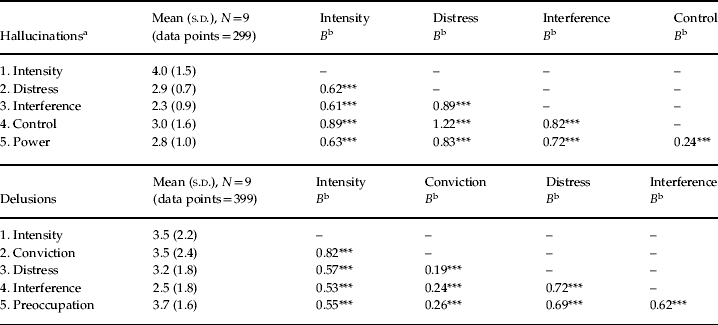
Mean scores (calculated for each participant and then averaged) and associations for all hallucination and delusions dimensions are displayed in Table 1. Overall hallucinations, when presentFootnote 2, were of moderate intensity (rating=4) and rated as slightly below moderate for distress, interference, control and power. All dimensions were significantly associated with intensity and with each other.
Symptom dimensions (standardized effect sizes)

a Includes only hallucination intensity scores >1, all other ratings 1–7 ; see text for details.
b The B is the fixed regression coefficient of the predictor in the multi-level model. All multi-level regression analyses were conducted with standardized dependent and independent variables with mean (0) and s.d. (1).
*** p<0.001.
Delusions were also of moderate intensity and were rated as moderate for conviction, distress and preoccupation, and slightly lower for interference. Again, all dimensions were significantly associated with intensity, and with each other, although the associations with conviction ratings were the weakest (all <0.3).
Are symptom appraisals and delusional conviction constant?
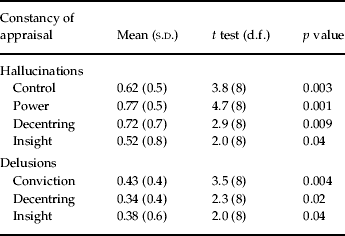
Constancy was assessed by exploring differences between two subsequent observations. The average difference score for all observations per person was then calculated, with any deviation from zero regarded as indicative of significant changes over time. Results are displayed in Table 2. Appraisals (decentring and insight) were not constant for either hallucinations or delusions, nor were appraisals about power and control for voices nor delusional conviction. The average moment-to-moment variations were the equivalents of between 5–11% change in the scale range. Appraisals about voices tended to be more variable than for delusions, as indicated by the magnitude of the mean difference scores.
Constancy of symptom appraisals (calculated as the difference between two subsequent observations)

d.f., degrees of freedom.
Is affect related to presence and intensity of psychotic symptoms?
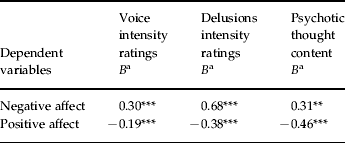
Negative mood items were aggregated to form a ‘negative affect’ score and positive mood items formed a ‘positive affect’ score (see Table 3).
Relationships between affect, symptom presence and intensity (standardized effect sizesFootnote a)

a The B is the fixed regression coefficient of the predictor in the multi-level model. All multi-level regression analyses were conducted with standardized dependent and independent variables with mean (0) and s.d. (1).
** p<0.01, *** p<0.001.
Separate regressions were done for intensity ratings for hallucinations and for delusions, and presence of psychotic thoughts (in spontaneous thought recordings). Intensity ratings of hallucinations and delusions, and the presence of psychotic thoughts were all highly related to negative affect and, inversely, to positive affect.
Are appraisals associated with distress and disruption to functioning?
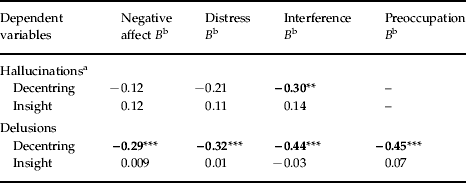
Decentring appraisals for delusions were associated with less distress and disruption to functioning, whichever way they were measured (negative affect; symptom-related distress; interference; preoccupation). Decentring appraisals were related to less interference from hallucinations2, but not negative affect or symptom-related distress. Insight was not related to distress or functioning for either hallucinations or delusions (see Table 4).
Relationships between appraisals, distress and functioning (standardized effect sizesFootnote b)

a Includes only hallucination intensity scores >1, all other ratings 1–7 ; see text for details.
b The B is the fixed regression coefficient of the predictor in the multi-level model. All multi-level regression analyses were conducted with standardized dependent, and independent variables with mean (0) and s.d. (1).
** p<0.01, *** p<0.001 (significant findings are shown in bold).
Are beliefs about voices stronger predictors of distress than symptom intensity?
Intensity (rated >2), control and power appraisals of voices were entered simultaneously into a regression analysis to determine their relative independence.
Power appraisals were the only significant predictor of negative affect (standardized B=0.22, p<0.001). Intensity (standardized B=0.62, p<0.001), control (standardized B=0.35, p<0.001) and power appraisals (standardized B=0.36, p<0.001) were all independently significantly associated with symptom related distress.
Are ESM self-report measures associated with interview-rated psychotic symptom measures?
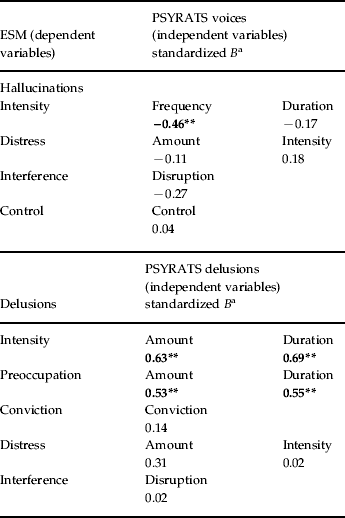
Results from multi-level linear regression analyses with: (1) voice frequency; (2) distress (amount and intensity); (3) disruption to life; (4) controllability ratings from the PSYRATS-hallucinations and (1) preoccupation (amount and duration); (2) distress (amount and intensity); (3) disruption to life; (4) conviction ratings from the PSYRATS-delusions as independent variables, and their equivalent ESM dimensions as dependent variables, are shown in Table 5.
Associations between PSYRATS and corresponding ESM measures (standardized effect sizesFootnote a)

PSYRATS, Psychotic Symptoms Rating Scales; ESM, Experience Sampling Method.
a The B is the fixed regression coefficient of the predictor in the multi-level model. All multi-level regression analyses were conducted with standardized dependent, and independent variables with mean (0) and s.d. (1).
** p<0.01 (significant findings are shown in bold).
For hallucinations, PSYRATS and ESM ratings were significantly associated for only one out of six analyses (ESM intensity ratings and PSYRATS frequency). For delusions, ESM intensity and preoccupation ratings were significantly related to their PSYRATS counterparts, but distress, disruption to life and conviction were not.
Discussion
This study set out to assess appraisals and key dimensions of symptoms, spontaneous thoughts, current mood and the relationship between them, extending previous ESM studies. Although recruitment rates were low, our participants were able to contribute acceptable levels of diary entries (74% of maximum) and codable thoughts (83%), providing further evidence for the reliability and acceptability of this method in some patients with psychosis. Also, the large amount of data collected (534 data points) allowed well-powered analyses to be conducted.
Although key symptoms were rated as present on the majority of occasions, they were rated as moderate or below moderate severity on intensity and other dimensions. Furthermore, spontaneous thought content was mostly non-pathological and concerned with the world/environment rather than the self. Only one in 12 (8.3%) of recorded spontaneous thoughts was depression, anxiety or psychosis related. The low rate of pathological thoughts cannot be explained by the participants being a recovered group, since they were all sufficiently distressed by their symptoms to be seeking psychological help. These findings suggest that despite psychotic experiences being a persistent problem, our participants were not constantly engulfed by their symptoms in their daily lives, concurring with previous ESM studies. For instance, Delespaul et al. (Reference Delespaul, deVries and van Os2002) demonstrated that hallucinations were present around 30% of the time in a sample of hallucinators, with their presence being related to a number of contextual influences. Similarly, Myin-Germeys et al. (Reference Myin-Germeys, Nicolson and Delespaul2001a) found that delusions were present slightly less than a third of the time, whilst Thewissen et al. (Reference Thewissen, Bentall, Lecomte, van Os and Myin-Germeys2008, Reference Thewissen, Bentall, Campo, van Lierop, van Os and Myin-Germeys2011) showed marked daily fluctuations in paranoia, with low ratings for extended periods during the day. These findings also agree with testimonies from service-users, who comment that their symptoms are not necessarily central to their lives and recovery stories (May, Reference May2000; Pitt et al. Reference Pitt, Kilbride, Nothard, Welford and Morrison2007).
Nevertheless, the valence of psychotic thoughts and thoughts about the self and others were predominantly negative. Furthermore, the presence of psychosis-related thoughts and the intensity of symptoms were both related to more negative and less positive affect, especially so for delusions. These findings replicate those of Myin-Germeys et al. (Reference Myin-Germeys, Nicolson and Delespaul2001a) and Thewissen et al.'s (Reference Thewissen, Bentall, Campo, van Lierop, van Os and Myin-Germeys2011) report that paranoia was associated with high levels of all negative emotions. The intensity of hallucinations was strongly associated with distress and interference, while intensity of delusions was associated with conviction, distress, interference and preoccupation. It thus appears that, when present, psychotic experiences are associated with distress and disrupt functioning; associations that psychological therapies attempt to change by separating the symptoms from their emotional and behavioural consequences (CBTp, Fowler et al. Reference Fowler, Garety and Kuipers1995; Acceptance and Commitment Therapy, Bach & Hayes, Reference Bach and Hayes2002; mindfulness, Chadwick et al. Reference Chadwick, Hughes, Russell, Russell and Dagnan2009).
An interesting finding was the weak associations between delusional conviction and other delusional dimensions (effect sizes all <0.3), providing further support for the suggestion that delusional conviction and distress/preoccupation represent separate factors (Peters et al. Reference Peters, Day, McKenna and Orbach1999; Garety et al. Reference Garety, Freeman, Jolley, Dunn, Bebbington, Fowler, Kuipers and Dudley2005). However, it is not the case that conviction is static while distress and preoccupation show variability, since conviction was found to be highly variable. While this presents a challenge to traditional diagnostic criteria for delusions that define them as ‘fixed’ beliefs held with ‘absolute’ conviction, it is in line with contemporary models of delusions as dynamic phenomena reactive to day-to-day environmental and internal stimuli.
Other appraisals were also highly variable, such as ‘insight’ (i.e. illness attributions) and ‘decentring’ (i.e. psychological explanations). This challenges traditional models of insight, where individuals are judged to either have insight or not, or to have awareness of one dimension (e.g. recognition that one has an illness or requires medication), but not another (e.g. attribution of symptoms to illness) (David, Reference David1990). The present findings suggest that a person's understanding of their experiences, as with delusional conviction, fluctuates over brief periods of time depending on environmental context and internal states. It is noteworthy that greater endorsement of a psychological explanation of delusions and, to a lesser degree, hallucinations, was related to less disruption to functioning, less distress and less negative affect. In contrast, insight ratings for either delusions or hallucinations were not associated with distress or functioning levels, lending support to the emerging body of work showing that ‘good insight’ is not necessarily advantageous to all areas of functioning (Mintz et al. Reference Mintz, Dobson and Romney2003; Cooke et al. Reference Cooke, Peters, Greenwood, Fisher, Kumari and Kuipers2007; Wiffen et al. Reference Wiffen, Rabinowitz, Lex and David2010).
Appraisals about hallucinations, including about power and control, were even more variable than those about delusions. These findings contrast with those of Csipke & Kinderman (Reference Csipke and Kinderman2006), who reported that hallucinators' beliefs about their voices are stable. This discrepancy may reflect differences in type and length of measurement; Csipke & Kinderman (Reference Csipke and Kinderman2006) examined change over a 6-month period, while we assessed moment-by-moment fluctuations, with a more sensitive instrument. Indeed, a number of ESM studies have demonstrated that psychological factors such as self-esteem, often assumed to be static and durable when assessed using questionnaires, fluctuate on a daily or even hourly basis (Thewissen et al. Reference Thewissen, Bentall, Lecomte, van Os and Myin-Germeys2008, Reference Thewissen, Bentall, Campo, van Lierop, van Os and Myin-Germeys2011).
The importance of ‘omnipotence’ beliefs about voices in determining distress and behaviour is increasingly recognized (Hacker et al. Reference Hacker, Birchwood, Tudway, Meaden and Amphlett2008). We also found that power appraisals were a stronger predictor of negative affect than intensity of voices. Both power and control appraisals were independently associated with symptom-related distress specifically, although voice intensity also made a significant contribution. These findings support the recent adaptations to CBTp for voices that focus on modifying power beliefs rather than reducing the frequency of voices (Trower et al. Reference Trower, Birchwood, Meaden, Byrne, Nelson and Ross2004).
The data obtained with this methodology were not completely comparable to retrospective, interview-rated symptoms using the PSYRATS (Haddock et al. Reference Haddock, McCarron, Tarrier and Faragher1999), with slightly more rapprochement between the two assessment measures being found for delusions than for hallucinations. Discrepancies between ESM and retrospective reports of coping were also reported by Stone et al. (Reference Stone, Schwartz, Neale, Shiffman, Marco, Hickcox, Paty, Porter and Cruise1998), who concluded that the retrospective data did not capture moment-by-moment coping efforts adequately. We would also argue that ESM ratings offer greater sensitivity and have more ecological validity than interview-based assessments, due to its ability to report psychological functioning as it unfolds in its natural environment. Furthermore, ESM may be particularly useful for clinical practice, not only for assessments but also to complement (or even replace) thought records and other cognitive behaviour therapy tools employed to identify links between thoughts, feelings and behaviour.
Limitations
This study has a number of limitations. The intensive nature of the study (with ratings to be completed for 5 weeks over a 12-month period) meant that participant uptake was low. The small number of participants may have led to insufficient power to detect potentially meaningful associations with smaller effect sizes. Nevertheless, we had more than double the number of observations per participant than is required according to Hox rule, suggesting that the study was adequately powered for a multi-level design. While many of our effects sizes were moderate or large, some of our findings were significant despite small effect sizes, suggesting that non-significant findings were not due to a lack of power, although of course this cannot be ruled out completely. The low sample size does, however, call into question the representativeness of the sample. The findings of this study cannot be generalized to many other individuals with psychosis, not only because they were selected from a CBTp clinic, but also because only 15% of those approached agreed to participate. Although comparable with those who declined on most clinical and demographic parameters, participants were less likely to drop out of therapy, suggesting they may have been a somewhat higher functioning or more adherent group. It may be that the use of more sophisticated technology (e.g. personal digital assistants; Granholm et al. Reference Granholm, Loh and Swendsen2008; Ben-Zeev et al. Reference Ben-Zeev, Ellington, Swendsen and Granholm2010) may facilitate greater uptake and acceptance of intensive methodologies by more representative groups. Reducing the number of beeps per day, and/or the number of days over which the study is conducted, may also be helpful (e.g. Kimhy et al. Reference Kimhy, Delespaul, Corcoran, Ahn, Yale and Malaspina2006), although this might jeopardize the richness of the data obtained. Paradoxically, reducing the number of beeps may increase burden on participants because the procedures are less part of their daily routines. However, some of these modifications may enable this potentially powerful methodology to be transferred to more routine outcome measurement.
Conclusions
This study demonstrated that psychotic experiences, present at a moderate level of intensity for a majority of the time, did not ‘engulf’ the individuals in this sample. Nonetheless, the presence and intensity of psychosis-related thoughts led to general distress and interfered with functioning. Conviction was less strongly associated with delusional dimensions of distress, pre-occupation and interference, than they were associated with each other. Delusional conviction was not stable, nor were appraisals about symptoms. Power appraisals were central to negative affect and distress about voices. The ability to ‘decentre’ from delusions, but not insight, was a key predictor of lower levels of distress. Overall, these findings are in line with cognitive models of psychosis; they provide support for the hypotheses that psychotic symptoms are multi-dimensional constructs and appraisals are central to determining distress and functioning.
Acknowledgements
This work was supported by the Department of Health, UK (Research and Development grant allocated from the South London and Maudsley (SLaM) National Health Service Foundation Trust). E.P., E.K. and P.G. acknowledge support for some clinical sessions from the National Institute of Mental Health (NIHR) Biomedical Research Centre for Mental Health, King's Health Partners.
Declaration of Interest
None.
Appendix 1: Coding manual for spontaneous thoughts
Variable 1: Content
(1) Uncodable (e.g. not a thought, activity, incomplete entry; anything about beep, watch or booklet).
(2) Codable (either factual or non-factual).
Variable 2: Pathology
(1) Problem-related (problem 1 – voices).
(2) Problem-related (problem 2 – delusions).
(3) Other (psychotic, delusions and voices only, unrelated to problems 1 and 2).
(4) Anxiety-related (e.g. worries).
(5) Depression related.
(6) Non-pathological.
Variable 3: Subject of thought
(1) Related to self.
(2) Related to world/environment (situational).
(3) Related to other people.
(4) Self-referential (when the thought is about other people or external things, but relate to the self, e.g. ‘people are talking about me’).
Variable 4: Valence
(1) Positive.
(2) Negative.
(3) Neutral [if unclear, do not use neutral category but use uncodable (88)].
Each variable included an additional ‘uncodable’ category.