Introduction
Crabeater seals, Lobodon carcinophaga (Hombron & Jacquinot), are the most frequent species that become stranded inland and mummify around Antarctica (see Péwé et al. Reference Péwé, Rivard and Llano1959, Barwick & Balham Reference Barwick and Balham1967, Dort Reference Dort1975, Reference Dort1981, Gordon & Harkness Reference Gordon and Harkness1992, Nelson et al. Reference Nelson, Smellie, Williams and Moreton2008, Negrete et al. Reference Negrete, Soibelzon, Tonni, Carlini, Soibelzon and Poljak2011, Reference Negrete, Soibelzon, Soibelzon, Márquez, Loza and Acosta2015). This is probably related to the estimated higher numbers and densities of crabeater seals compared with other Antarctic pack-ice seals (Flores et al. Reference Flores, Haas, van Franeker and Meesters2008, Bengtson et al. Reference Bengtson, Laake, Boveng, Cameron, Hanson and Stewart2011, Forcada et al. Reference Forcada, Trathan, Boveng, Boyd, Burns and Costa2012, Southwell et al. Reference Southwell, Bengtson, Bester, Schytte, Bornemann and Boveng2012, Gurarie et al. Reference Gurarie, Bengtson, Bester, Blix, Cameron and Bornemann2017). This species is more common at marginal or peripheral pack ice (Siniff et al. Reference Siniff, Cline, Erickson and Holdgate1970, Bornemann & Plötz Reference Bornemann and Plötz1999) and is known to move in numerous pods, probably to optimize their feeding in cooperative behaviour (Gales et al Reference Gales, Fraser, Costa and Southwell2004, Gottfried Reference Gottfried2014)
In particular for the western Weddell Sea (Fig. 1) the occurrence of mummified crabeater seals has been recently reported (Nelson et al. Reference Nelson, Smellie, Williams and Moreton2008, Negrete et al. Reference Negrete, Soibelzon, Tonni, Carlini, Soibelzon and Poljak2011, Reference Negrete, Soibelzon, Soibelzon, Márquez, Loza and Acosta2015, Nývlt et al. Reference Nývlt, Fišáková, Barták, Stachoň, Pavel, Mlčoch and Láska2016). The cause for these stranding events has been extensively discussed (Barwick & Balham Reference Barwick and Balham1967, Stirling & Kooyman Reference Stirling and Kooyman1971, Nelson et al. Reference Nelson, Smellie, Williams and Moreton2008, Negrete et al. Reference Negrete, Soibelzon, Soibelzon, Márquez, Loza and Acosta2015, Nývlt, et al. Reference Nývlt, Fišáková, Barták, Stachoň, Pavel, Mlčoch and Láska2016). For the study area, Negrete et al. (Reference Negrete, Soibelzon, Soibelzon, Márquez, Loza and Acosta2015) presented spatial distribution, taphonomy, age and sex structure of a large part of the group of mummified crabeater seals (MCS) at Bodman Point, Seymour Island (Isla Marambio) and performed necropsies and virology analyses. The authors stated, based on the high incidence of pregnant seals, that the MCS at Bodman Point were likely to have been stranded during the breeding season.
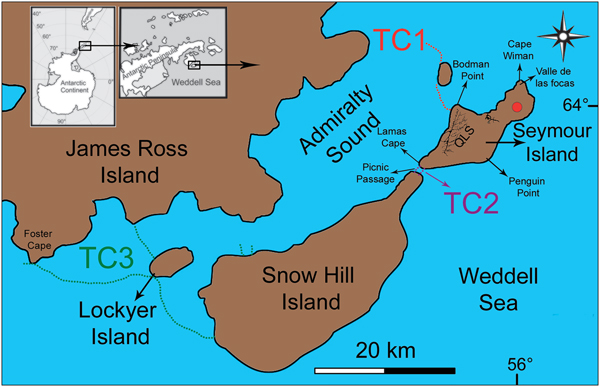
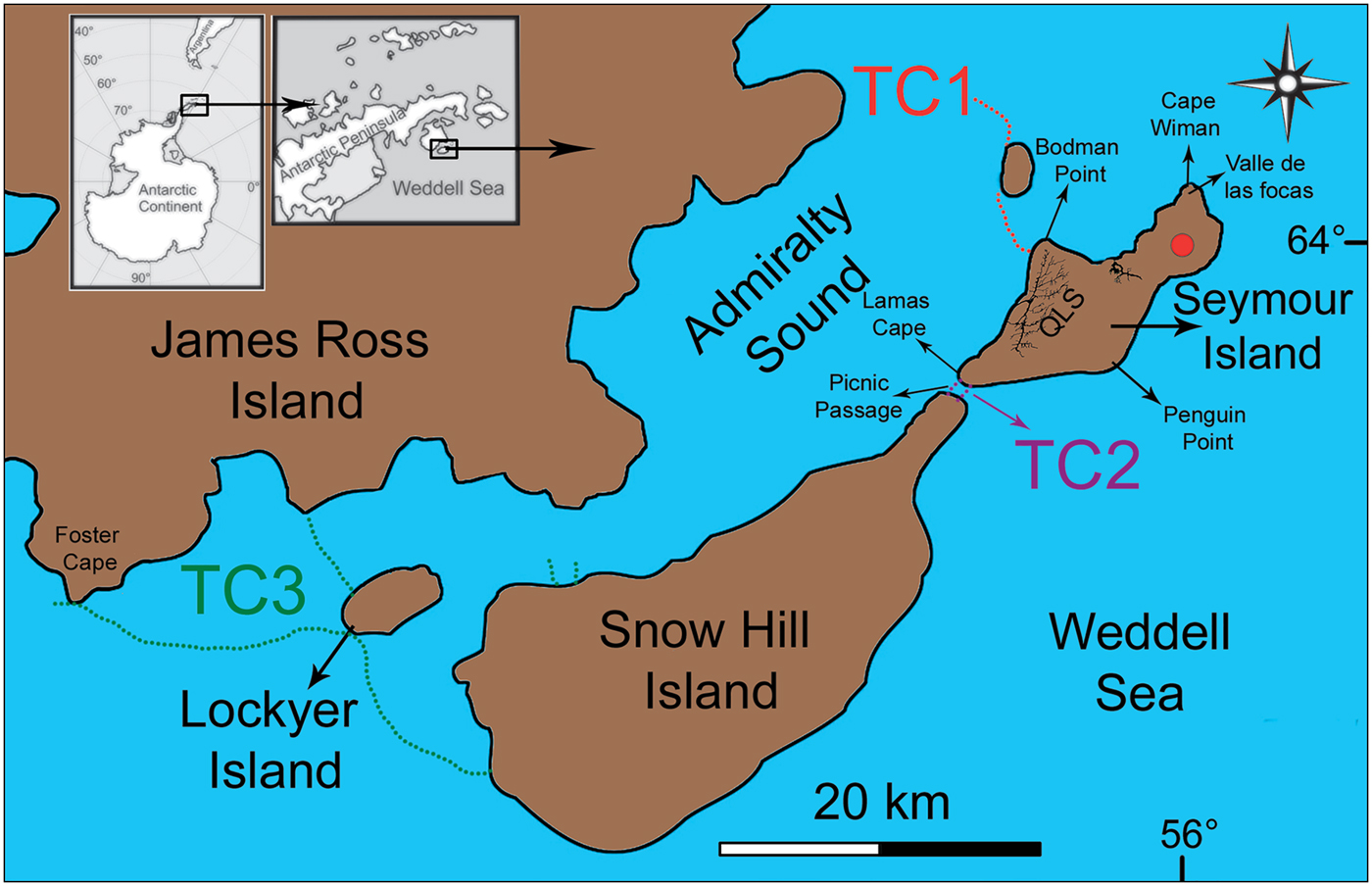
Map of the study area (after Montes et al. Reference Montes, Nozal, Santillana, Marenssi and Olivero2013) showing the tide cracks (TC 1–3) and the new sites where MCS were recorded. Red dot = Marambio Station.
Crabeater seals breed during spring on the pack ice, where males gather with pregnant females or even with those that have recently given birth (Siniff & Reichle Reference Siniff and Reichle1976, Siniff et al. Reference Siniff, Stirling, Bengston and Reichle1979, Laws Reference Laws1981). Several authors reported that the peak of pupping for crabeaters seals is around late October (Siniff et al. Reference Siniff, Stirling, Bengston and Reichle1979, Laws et al. Reference Laws, Baird and Bryden2003, Southwell et al. Reference Southwell, Kerry, Ensor, Woehler and Rogers2003). To date and to the knowledge of the present authors (see below), there is no information about breeding events of this species in the study area. Thus, is not clear yet in which time of the year the pregnant mummified seals reported by Negrete et al. (Reference Negrete, Soibelzon, Soibelzon, Márquez, Loza and Acosta2015) were stranded. And even more importantly, why do females that are about to deliver a pup wander inland instead of remaining in the pack ice; resort to an area where there are no previous reports of pupping?
In order to explore these questions, the present study set out to evaluate whether crabeater seals are usual residents that breed in the area or use Admiralty Sound (Estrecho Bouchard) as passage. Thus, data on abundance and distribution of crabeater seals were obtained during aerial surveys conducted in the study area during three consecutive austral springs. Additionally, new evidence that strandings are still taking place, new records of MCS in the study area and new sites along Seymour Island with mummified seals are presented here. Finally, the taphonomic states and the spatial dispositions of all the mummified seals (those reported by Negrete et al. Reference Negrete, Soibelzon, Soibelzon, Márquez, Loza and Acosta2015 and the ones reported here) were established.
Study Area
Seymour Island presents low temperatures and precipitation with a prevalence of strong and cold winds (mostly from the SW). Its climate is similar to an arid sub-polar region with less than 400–550 mm of annual precipitation (National Meteorological Service, SMN (www.smn.gob.ar), Argentina, Marambio Station), the mean annual temperatures range from −15.1°C in June to −1.7°C in December (SMN, www.smn.gob.ar) and the island surface is mostly free of snow. All these topographic and climatic characteristics contribute to the mummifying process of the dead seals occurring inland at Seymour Island.
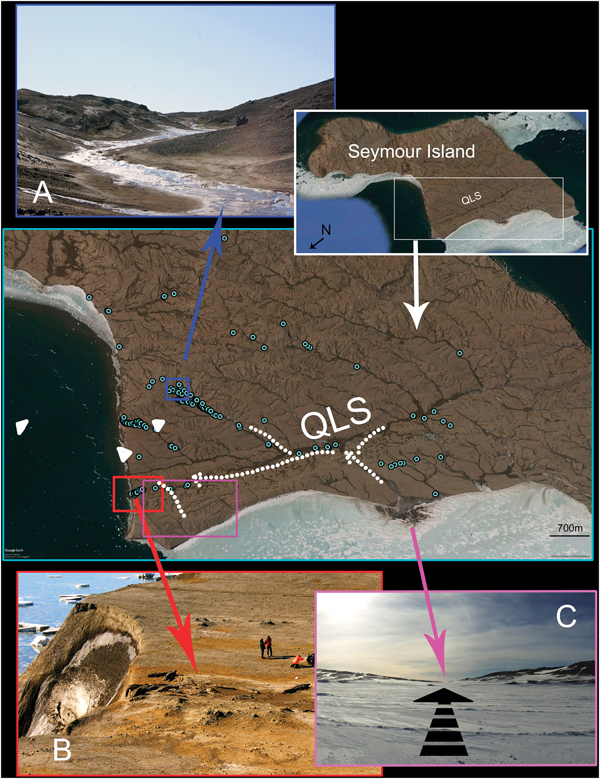
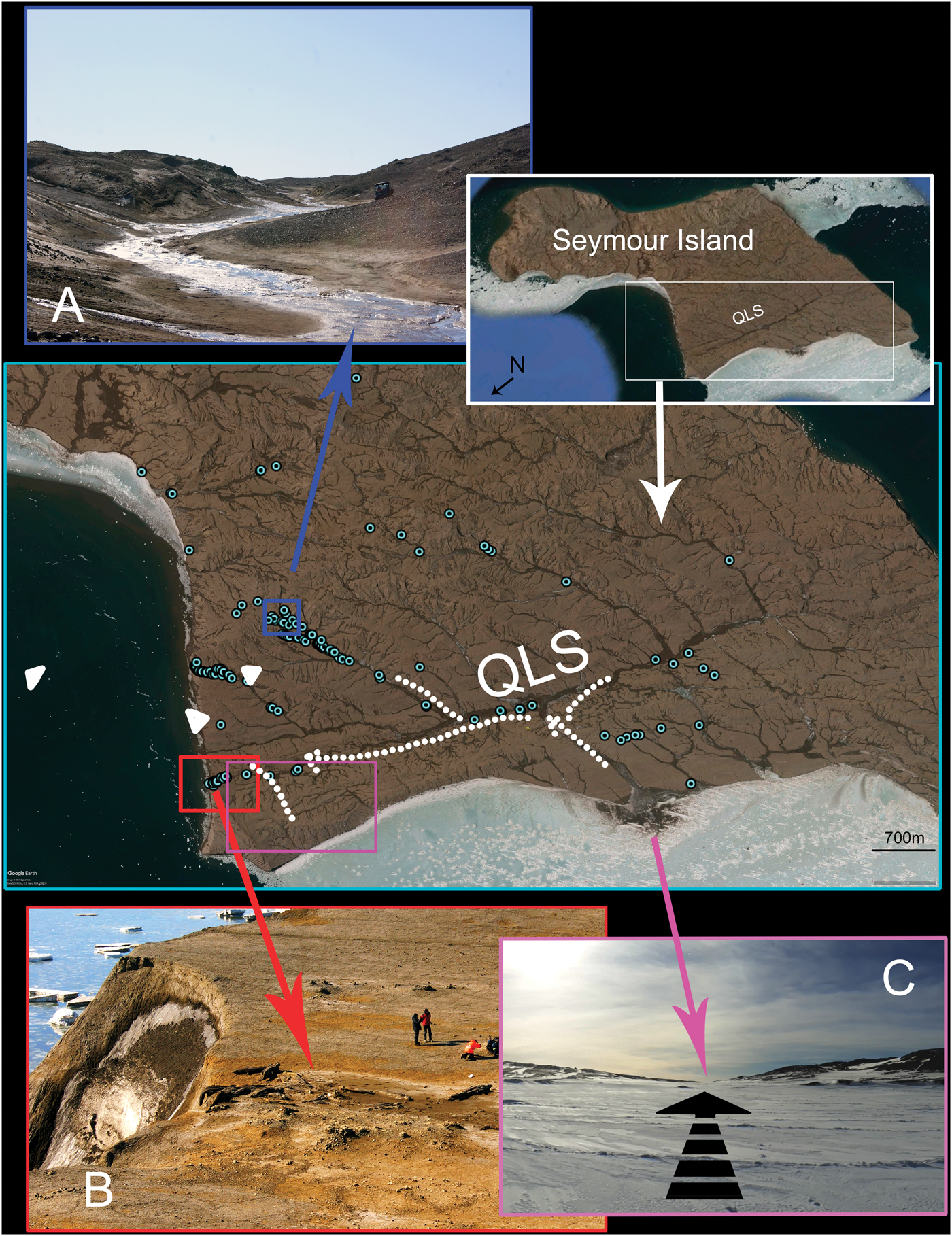
The largest group of mummified crabeater seals is located at the Larga Valley (Quebrada Larga) stream, near Bodman Point while other small groups of MCS were found near Cape Wiman, Penguin Point and Cape Lamas (Fig. 1). The Larga Valley stream is c. 8 km long, flanked at both sides (west and east) by hills interrupted by minor ephemeral streams. It drains during summer southwest into Fossil Bay at the eastern coast of Admiralty Sound that separates Seymour Island and James Ross Island (see Fig. 1). The Larga Valley stream begins in a 30 m a.s.l cliff and decreases SW to less than 3 m a.s.l. at Fossil Bay where the land is hardly distinguishable from the sea ice pack (Fig. 3) when the sea surface of the Admiralty Sound is frozen (May to November).
Materials and methods
Mummified crabeater seal data
Seymour Island was prospected from all-terrain vehicles and snowmobiles during three field trips (2014, 2015 and 2016) recording the presence of mummified seals.
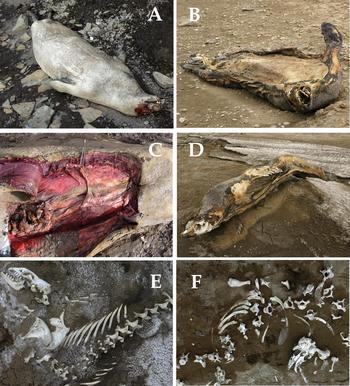
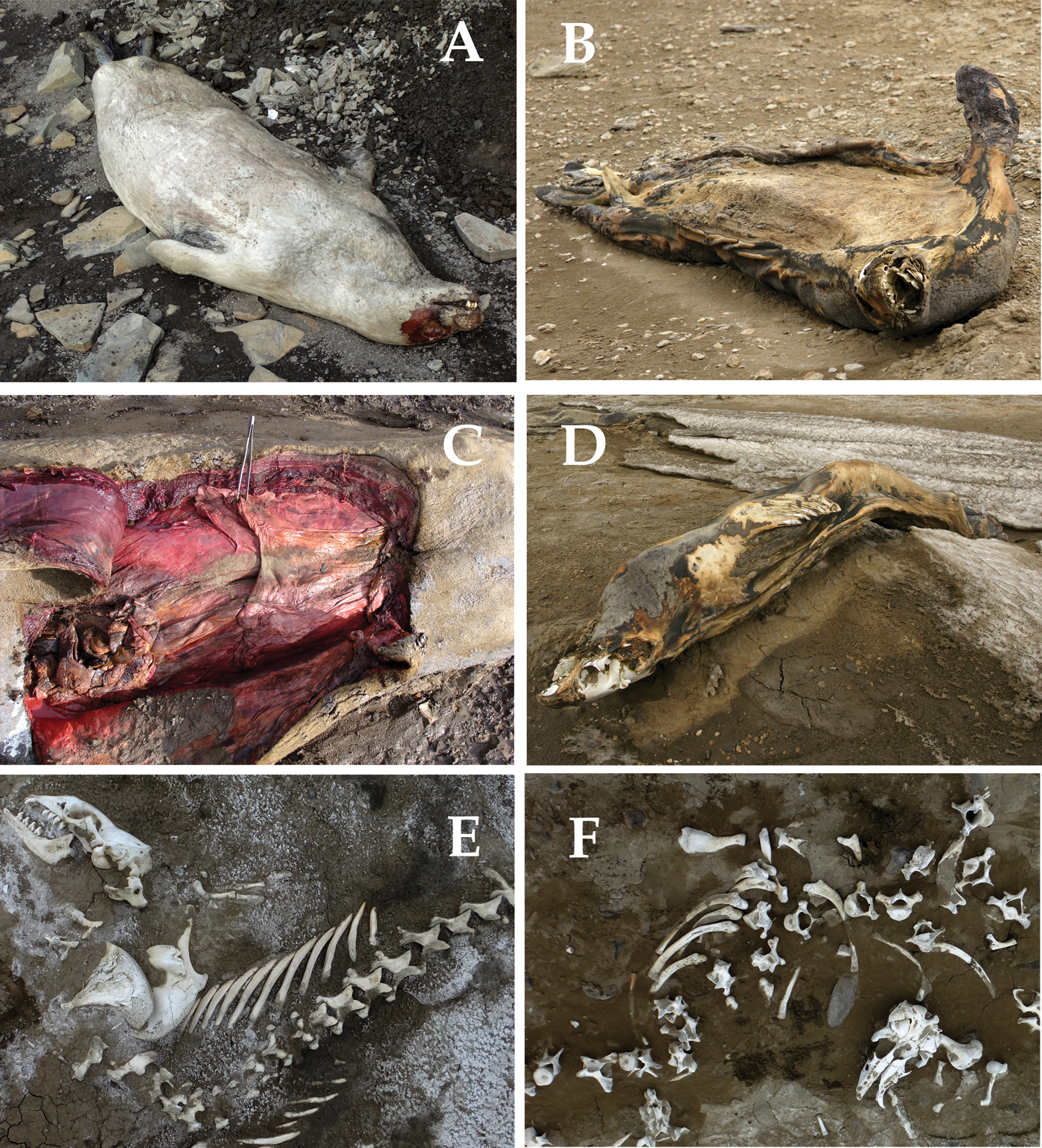
All the carcasses, i.e. the group reported in this study along with those reported by Negrete et al. (Reference Negrete, Soibelzon, Soibelzon, Márquez, Loza and Acosta2015), were georeferenced, photographed and assigned to one of the following five categories of taphonomic states (similar to those of Nývlt et al. Reference Nývlt, Fišáková, Barták, Stachoň, Pavel, Mlčoch and Láska2016) (Fig. 2):
T1: Entire and fresh specimens without signs of weather deterioration (Fig. 2a).
T2: Specimens with signs of weather alteration or partially preserved, covered by skin and with soft tissues (fat, muscles) and/or internal organs preserved (e.g. lungs, stomach, intestines, etc.) (Fig. 2b & c).
T3: Articulated skeletons partially covered by skin, but without internal organs (Fig. 2d).
T4: Articulated skeletons without skin (Fig. 2e).
T5: Disarticulated skeletons (Fig. 2f).
Different categories of taphonomic states of mummified crabeater seals (T1–T5. See text).
Crabeater seal surveys
The first flight was performed on September 2014 over the general area of Admiralty Sound, to check for the presence of crabeater seals that may breed in the area. Given that most seals were observed along major tide cracks, in the following flights (September 2015, 2016, 2017) the cracks were considered as transects (see above). Every flight was performed at constant speed (100 km h−1) and altitude (200 m above the pack ice) from a DHC-6 Twin Otter airplane during the peak haul-out time of the species (10h00 and 14h00, local time). The seals were vertically photographed by a single observer with digital camera (Canon EOS 7D, 100 mm focal length) through a floor hatch (c. 50 cm diameter) of the aircraft resulting in an 80 m wide transect. The number of seals, the preferred habitat (tide cracks, water, pack ice edge, etc.) and the spacing (solitary, couples and groups) were recorded. Spacing of seals was calculated by mean distance, measured in “standard seal lengths” from aerial photographs (one “standard seal length” equals about 2.4 m), of a seal to its nearest neighbour on the sea ice. A group was defined as three or more individuals within three standard lengths of distances between them. The extent of pack ice in the area of the Admiralty Sound was also registered in each flight. Three major tide cracks were defined (TC1-3) from north to south (Fig. 1)
Results
New records of mummified crabeater seals
A total of 96 mummified crabeater seals were registered during the study period at Seymour Island. All the specimens were adult seals and most of them were distributed along various ephemeral streams and valleys of the Larga Valley stream system (Fig. 3). The exception was a group of four seals registered in a valley close to Cape Wiman, in the north-east section of Seymour Island, informally called “Valle de las Focas” and two other groups of three and two adult MCS found at Penguin Point and Cape Lamas respectively. The taphonomic states of these new records and of those 80 MCS presented by Negrete et al. (Reference Negrete, Soibelzon, Soibelzon, Márquez, Loza and Acosta2015) range from disarticulated bones to highly preserved bodies with almost fresh soft tissues and without signs of mummification. The number of specimens classified in the taphonomic states T1, T2, T3, T4 and T5 were 11, 50, 44, 24 and 47 respectively. The spacing was heterogeneous since the animals were found even as solitary individuals, pairs, or aggregations of more than ten specimens. The aggregation of seals should not be interpreted as groups of individuals that stranded in the same event since they do not present, in all cases, the same state of preservation.
Spatial distribution of MCS along Larga Valley stream (Quebrada Larga stream (QLS)) area. Coloured boxes show different specimens and topographical features. White dotted arrows show the route followed by seals once inland. Black dotted arrow in box c shows the entrance from the pack ice to the Larga Valley stream (picture was taken from the pack ice).
Current presence of crabeater seals in the study area
During the aerial surveys carried out between the last week of September and the first week of October of the years 2015, 2016 and 2017, hundreds of crabeater seals were counted. Nevertheless, the number of seals observed later in the season (last week of October) decreased in all the years analysed. For example, in 2015, 624 seals were observed at the end of September, while in the aerial survey performed on the same transect at the end of October, only 42 were counted. In turn, for the 2016 and 2017 seasons the seals counted changed from 115 to 78 and from 361 to 236 respectively.
The spacing also changes among surveys since the occurrence of pairs of individuals, presumably male–female couples, was more abundant during the second half of October. Only one crabeater seal pup (10 October 2015; near Lockyer Island) was registered in the study area.
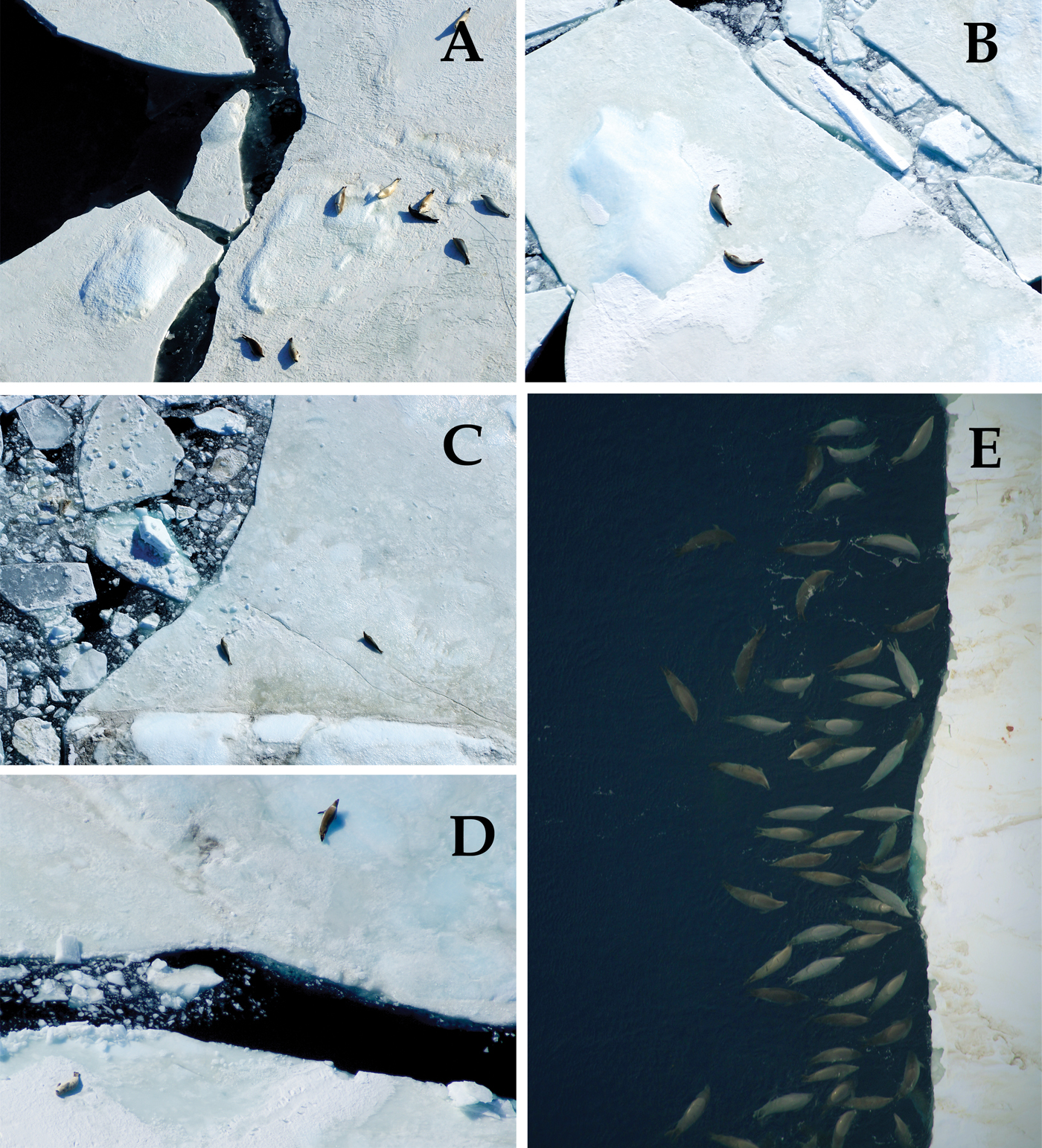
Most of the crabeater seals were observed along tide cracks; nevertheless, a number were also observed at the pack-ice edge (boundary of the pack ice and the open water), or on the ice floes that were clumped at the pack edge and even in the water along the edge (Fig. 4).
Preferred habitats of crabeater seals observed during aerial surveys. a–c. Crabeater seals observed at the edge of the pack ice and/or at ice floes. d. Crabeater seals along tide cracks. e. part of a large group of seals observed in the water next to the border of the pack ice, at the middle section of Admiralty Sound.
Ice conditions in Admiralty Sound
For the last 30 years the area was prospected by one of us (J.L.) and, between September and October, well-consolidated pack ice (more than 0.8 m thick) always covered the entire strait. The presence of three tide cracks that usually appear in the same place of the strait each year was also noticed (J.L. personal observation) (Fig. 1). Finally, during the aerial surveys surprisingly, it was observed that sea ice break-up in Admiralty Sound occurred exceptionally early during 2016 and 2017, when open water in the southern and middle areas of the strait was recorded.
Discussion
The occurrence of MCS in the study area was first reported by Negrete et al. (Reference Negrete, Soibelzon, Tonni, Carlini, Soibelzon and Poljak2011). They concluded that, at least for the MCS in taphonomic state T3 (as defined here), the deaths could have occurred in the last 100 yr. More recently, for the same group of MCS several necropsies and anatomical, virological and taphonomic analyses showed that most of the carcasses correspond to adult seals that died during the breeding season, mainly due to starvation (Negrete et al. Reference Negrete, Soibelzon, Soibelzon, Márquez, Loza and Acosta2015). These authors also proposed that the seals get stranded in a natural trap by mistaking the ice-covered stream opening for marine pack ice. The fact that the specimens of MCS could be included into the different categories of taphonomic states (T1–T5) reinforces the hypothesis that the stranding was not a single event (Negrete et al. Reference Negrete, Soibelzon, Soibelzon, Márquez, Loza and Acosta2015). Moreover, during each year of the present study, with the exception of 2016 and 2017, new seals preserved in states T1 or even T2 (i.e. not yet mummified) were found. This is interpreted here as strong evidence of seals getting stranded in the area in present times.
Negrete et al. (Reference Negrete, Soibelzon, Soibelzon, Márquez, Loza and Acosta2015) speculated, based on the records of pregnant mummified seals and even a mother with a pup, that the crabeater seals get stranded while wandering inland searching for shelter from the icy southwestern winds during storms, probably around the breeding season, which occurs during October. Southwell et al. (Reference Southwell, Kerry, Ensor, Woehler and Rogers2003) estimated that in eastern Antarctica the peak of pupping is between 21–31 October. Siniff et al. (Reference Siniff, Stirling, Bengston and Reichle1979) reported pupping between 23–26 October at Gerlache Strait, while Laws et al. (Reference Laws, Baird and Bryden2003) suggested that pupping at Prince Gustav Channel (near the study area) did not occur until mid-October (see table 1 in Laws et al. Reference Laws, Baird and Bryden2003). Nevertheless, during the aerial surveys (September and October) only one pup was recorded (10 October 2015; near Lockyer Island) among the hundreds of crabeater seals observed. An alternative explanation could be that the species does not usually breed in Admiralty Sound but probably uses it as a route to more northerly breeding grounds and, depending on ice conditions, they could get stranded in the strait. Records of crabeater seals travelling in large groups (more than 100 individuals) were reported probably in relation to cooperative feeding or predator avoidance behaviours (Gales et al. Reference Gales, Fraser, Costa and Southwell2004, Gottfried Reference Gottfried2014). During the aerial survey conducted in September of 2015 large groups of seals were observed clumped in the pack ice close to the Lockyer Island tide crack (TC3); during the flights of September 2016 and 2017 the larger groups were in the water or at the border of the pack ice at the middle section of Admiralty Sound near Picnic Passage (Estrecho Arguindeguy) (TC2) (Fig. 4d). No specimens were observed in the TC1 area. It is reasonable to speculate that the species passes through, in large groups, from the south to the north of Admiralty Sound, probably using the tide cracks to haul out and to return to the sea. The most permanent tide cracks are at the southern (TC3) and at the northern (TC1) boundaries of the strait. Since the rest of the area is usually covered by thick pack ice during September and October, the seals are likely to get stranded in the middle section of the strait particularly under heavy ice conditions. As crabeater seals are not able to open holes in the ice by themselves, like Weddell seals do, they have to look for open water areas. In this scenario, the opening of a huge stream, such as the Larga Valley stream, with a frozen surface or even draining water into the pack ice could be confused by seals as a part of the pack ice, leading them to wander inland. In the vicinity of the study area (James Ross Island) Nývlt et al. (Reference Nývlt, Fišáková, Barták, Stachoň, Pavel, Mlčoch and Láska2016) also proposed that seals might be trapped by a freeze-up and follow a stream and wander inland in an attempt to locate open waters.
Although it is possible that the species breeds in the area later in the season (i.e. during November), the decrease in the number of seals observed between the surveys of September and October of each year reinforces the idea that the majority of crabeater seals use Admiralty Sound as a passage instead of a breeding site, at least under normal sea ice conditions (i.e. well-consolidated pack ice covering the entire strait). However, during the years 2016 and 2017, the ice pack broke down very early in the season (in comparison with the records of the last 30 years). This situation would be beneficial for the seals given that they would find a habitat similar to the one they usually use during the reproductive season (pack-ice floes surrounded by open water). This could explain why around 80% of the seals observed during September were present at the end of October. Moreover, the early breakup of the pack ice would reduce the chance of seals getting stranded and wandering inland, which explains the lack of seals recently stranded inland (taphonomic state T1 or T2) during those years. More aerial surveys, especially at the end of October and during November are needed to verify this.
Conclusions
In the present contribution, new records of mummified crabeater seals are reported in the Larga Valley stream at Seymour Island. Additionally, the work enhances the knowledge of this aggregation detailing their taphonomic state and spatial distribution. In addition, two new sites at Seymour Island (Penguin Point and Cape Wiman) were prospected and a few more carcasses were discovered.
The occurrence of crabeater seals during the breeding season in Admiralty Sound is reported here for the first time. Even though these are preliminary reports and more censuses later in the season are needed, this is believed to be the first information regarding the abundance of this species of seals in this area.
It is proposed that the majority of crabeater seals use Admiralty Sound as a passage to the northern breeding area when the strait is entirely covered by thick pack ice. Finally, the unusual early breakup of the pack ice in the strait may prompt the species to use this area to breed under these circumstances. This should be monitored especially in the context of the climate change that the Antarctica Peninsula is experiencing.
Author contribution
Dr Javier Negrete, Dr Leopoldo H. Soibelzon, Jorge Lusky and Dr Esteban Soibelzon all participated in the field trips and wrote the article.
Acknowledgments
This work was carried out thanks to the logistics provided by the Instituto Antártico Argentino and the Dirección Nacional del Antártico. Many thanks to “Pica” Pedreira, J.C. Della Cha, Pablo Moscoso, Gustavo Daneri, Ricardo Montiel and Marcos Rios for their assistance with logistics on the ground. To the Twin Otter crew of the Fuerza Aérea Argentina, especially to captain Luis Edgardo Calfin and First lieutenant Federico Ayerdi for their professionalism and enthusiasm.
The authors are especially grateful to Dr Marthan Bester and Dr Daniel Nývlt for their comments that clearly improved this manuscript. This contribution was funded by the PICTA 2010-01 IAA and UNLP (PI 11/N816).