The severe acute respiratory syndrome (SARS) outbreak from November 2002 until July 2003 resulted in over 8000 cases and 748 deaths worldwide, 1 with the vast majority occurring in China (87% of cases; 84% of all deaths): The aftermath heralded the need for the rethinking of public health emergency response capacity building in China, especially as until April 2003 the then public health experts had underestimated the impact.Reference Kamps and Hoffmann 2 The National Government allocated significant resources to establish and strengthen a coordinated and consolidated disaster response capacity, encompassing early detection and warning wherever possible, responsive and reliable laboratory testing, health service emergency response and on-site management, as well as the capacity of frontline medical response services.Reference Yang 3 , Reference Lee 4 After a decade of rapid development, the general disaster response capacity has improved, especially with the establishment of a coordinated medical management system that is able to respond to national disasters and other emergencies.Reference Zhang, Liu and Li 5 , Reference Tian, Wang and Ye 6
Prior to 2003, disaster response mechanisms in China were largely decentralized and independent in action, relying on hospital accident and emergency departments, most of which usually manage routine hospital emergency demand, rather than respond to natural disasters, catastrophic accidents, or incidents involving social unrest or arising from terrorist acts.Reference Li, Huang and Zhang 7 , Reference Wang, Wei and Xiang 8 To cope with larger public emergencies more efficiently, regional disaster coordination centers were established nationwide, which became the backbone of the coordinated disaster response system. Both central and various local governments provided financial support of up to 1.868 billion RMB resulting in the establishment of 22 national disaster response teams to address major emergencies. 9 Capacity building of these national teams was intensified by focusing on personnel selection and capacity enhancement, supplemented by the provision of equipment such as vehicles and other related hardware.Reference Hui, Jian-Shi and Xiong 10 , Reference Ouyang 11 After a decade, it is timely to examine whether this investment has achieved the intentions of the Government.
Despite China’s continuous progress on the construction of disaster response systems after experiencing the H1N1 influenza epidemic, especially after the disastrous Wenchuan and Yushu earthquakes, previous disasters exposed a number of issues regarding the capacity of hospital emergency departments as a contributory component of disaster relief. Despite the intensive disaster management capacity planning at national and provincial levels, the majority of community level or frontline response capacity remained weak and vulnerable due to a scarcity of purpose-trained medical disaster response personnel, often accompanied by a lack of supplies to readily cope with the sudden influx of demand that arises as a consequence of any disaster. These are compounded by (dis)organizational factors: both local and systematic.Reference Wang, Wei and Xiang 12 - Reference Farley and Weisfuse 14
That organizations such as hospitals should be ready and able to cope with disasters, hospitals represent places of safety and refuge in the minds of people who are sick and injured. Yet, the SARS epidemic demonstrated that hospital staffs were by no means in any privileged position of safety or protection. Indeed, a natural disaster does not discriminate and the very staff we expect to be ready willing and able to provide succor and assistance may be the very people needing medical care themselves. Understandably, research on hospital disaster preparedness is a relatively new area and in-depth studies are scant in China.Reference Chen 15
Despite the requirements of the Chinese national disaster response plan, vulnerabilities remain. Our research sought to identify whether there were any major deficiencies in the current proposals for disaster preparedness, including the capacity of hospital and health systems, training and scenario testing (mock exercises to test preparedness and reactions), resource availability (in terms of equipment and consumables), and personnel responsiveness. We note the distinctions between disasters that are heralded and not heralded as described by Hanfling, Altevogt,Reference Hanfling, Altevogt and Gostin 16 in that there are significant differences in expected preparatory behaviors by health services in disasters that may occur without any warning (such as earthquakes and tsunami), as opposed to calamities such as pandemics, which may have a window of opportunity for health authorities to set preventative actions in place. We also concur with their view that there are degrees of disaster: The existing health resources might have sufficient “surge capacity” to cope with a calamity such as a major plane accident, riot, or aftermath of a terrorist attack, but a truly catastrophic disaster may leave health services completely unable to provide any form of assistance without rapid external assistance—regardless of the most perfect plan or quantities of stockpiled resources.
Notwithstanding, our intention was to investigate the extent to which hospitals in Heilongjiang province have achieved preparations to address disasters and to identify vulnerabilities and causative factors and therefore propose actions for those responsible to consider further improvement.
METHODS
Data Source and Sampling Method
We used a multistage, stratified cluster sampling method considering the socioeconomic, educational, demographic, and health indicators of Heilongjiang province to rank localities into 5 groups. From each group, 39 sample county-level areas and districts were selected at random, which yielded 65 hospitals (22 tertiary and 43 secondary hospitals). From these sites, we achieved a final sample of 1328 staff members involved in the frontline provision of medical disaster relief across Heilongjiang province.
Data Collection and Quality Control
Originally we planned to seek information using questionnaires, structured in 2 parts so that an institutional response was gained, in addition to the perspectives of frontline providers. Draft questionnaires were devised for both cohorts, both of which sought baseline descriptive information regarding the institution or individual. The institutional questionnaire sought to understand the extent of organizational preparedness in terms of presence of documented policies and procedures, how often these were reviewed and tested, and the extent to which the recommended emergency equipment and consumables reserves had been achieved. We also sought information from the perspective of frontline personnel in terms of their experience in providing disaster relief, their perspectives on the response of management when disaster occurred, as well as a reflection on their own response to disasters (or disaster scenario simulations). This was not produced in isolation: After several rounds of focus group discussions, each questionnaire was carefully revised, subjected to a pilot trial, and further revised. In addition to the questionnaire, face-to-face interviews were conducted by suitably prepared medical students. Quality control was achieved using independent secondary data collection: 5% of the sampled participants were revisited to check the accuracy of the data, which was found to be greater than 95%.
Statistical Analysis
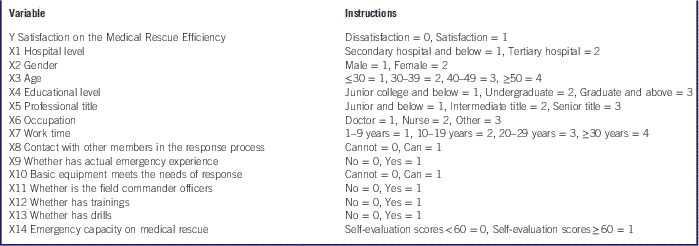
After the data cleaning process, samples with incomplete or anomalous data (n=71) were excluded, leaving a final sample of 1257 eligible participants, which were entered into a database for analysis using SPSS 19.0 (IBM Corp, Armonk, NY). Logistic regression was undertaken to predict the determinants of the confidence regarding disaster response capacity: The independent variables were shown in Table 1. A description of the emergency preparedness and management situation of the hospital, emergency experience and response ability of the personnel, training, and drill situation was achieved using thematic analysis.
Variable Assignment Note

RESULTS
Baseline Demographic Information
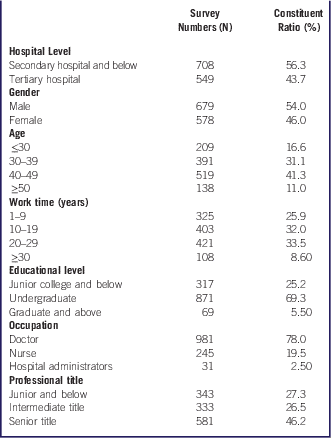
Of the 1257 eligible participants, 54% were male and 46% female; 549 worked in tertiary hospitals, and the remainder (n=708) in secondary hospitals. The sampled population was predominantly aged from 40 to 49 years old (41.3%) and most had worked in their professional capacity from 20 to 29 years; 46.2% held a senior professional title with relevant experience in disaster response. In general, the education level was predominantly at the baccalaureate level. The sampled population predominantly comprised medical practitioners (78.0%) or nurses (19.5%), leaving 2.5% to other categories of staff (Table 2).
Basic Information of the Sample

Emergency Preparedness of the Hospitals
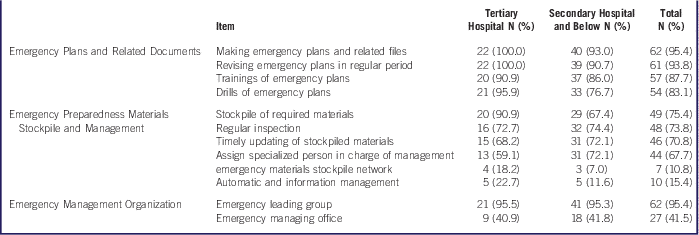
All tertiary hospitals had disaster management plans in place with regular documented revisions; 95.9% engaged in simulation training exercises (drills) and 90.9% engaged in specific disaster management training. Secondary hospitals were less prepared; only 93.0% had disaster management plans in place, and where such plans existed, revisions were more infrequent, as were disaster management training and simulation exercises (drills) at 76.7% (Table 3).
Emergency Preparedness of the Hospitals

The management of reserve supplies in terms of equipment and consumables is a critical factor in any disaster management response. As shown in Table 3, 70.8% of the sampled hospitals regularly reviewed and maintained the recommended standard onsite consumable reserves; however, only 10.8% of all hospitals had established a network of extrinsic access to disaster response supplies. A total of 90.9% and 68.2% of the sampled tertiary hospitals achieved the stockpile of required materials and the timely updating of stockpiled materials, compared with secondary hospitals, which fared 67.4% and 72.1%, respectively. Conversely, secondary hospitals were more likely to assign disaster management responsibility to a particular position within the organization (72.1%) than were tertiary hospitals (59.1%).
Overall, 95.4% of the sampled hospitals had established a disaster response team to address emergencies, but only 41.5% had created a disaster response officer responsible for routine implementation of disaster response planning.
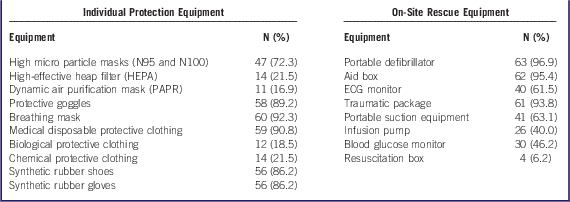
In terms of disaster response consumables and other equipment, more than 80% of the sampled hospitals had sufficient supplies of individual protective gear, such as eyewear, high-efficiency breathing masks, and disposable protective clothing, including disposable shoes and gloves. Despite this, fewer than 20% of the sampled hospitals provided or held dynamic air purification masks and biological disposable protective suits. In terms of disaster response equipment, more than 90% of the sampled hospitals had portable defibrillators, whereas only 61.5% had portable electrocardiography monitors and 63.1% had portable suction equipment. More than 50% of the hospitals had an inadequate supply of infusion pumps and blood glucose monitors; only 6.2% of the sampled hospitals reserved an additional supply of this equipment specifically for resuscitation purposes (Table 4).
Individual Protection Equipment and Site Rescue Equipment

Emergency Response of the Personnel
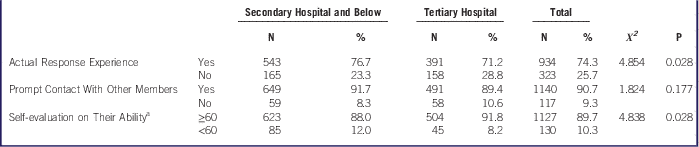
The average time of initiating an emergency response by individual teams was 8.61 minutes overall; but the response time at secondary hospitals was 1.64 times that of tertiary hospitals. During emergency response scenario training, most personnel (90.8%) reported efficient verbal or visual communication with those charged with coordinating the response. Most personnel (74.3%) reported previous actual emergency response experience: Paradoxically, the rate reported in the secondary hospitals (76.2%) was slightly higher than that of tertiary hospitals (71.2%; Table 5).
Emergency Response Experience and Self-Rated Ability

a Hundred mark system
Determinants Influencing the Results of Medical Rescue Efficiency
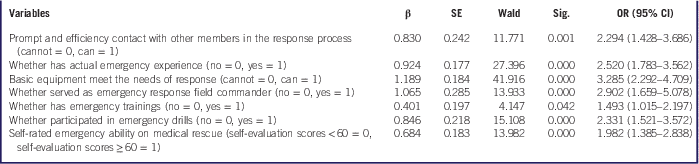
Logistic regression yielded a wide range of determinants associated with the confidence regarding the efficiency of disaster response (Table 6). Prompt and efficient communication with other members in the emergency response process, and prior emergency response experience were more likely to coincide with satisfactory and efficient medical rescue results. The ready availability of “basic equipment to meet the needs of the emergency response” was identified as the single most important factor contributing to efficient medical rescue outcomes (OR=3.285). Personnel who had prior experience of directing disaster responses or previous emergency medical rescue training and or simulation experience generally played a more significant role in promoting disaster response efficiency than those who had not experienced this before. We found that personnel who had higher self-evaluation scores on disaster response capacity were more likely to demonstrate correspondingly higher medical rescue efficiency outcomes.
Determinants Affecting the Results of Medical Rescue Efficiency

DISCUSSION
Since the turn of the century, China has experienced a range of natural disasters, including a highly communicable airborne epidemic, which overall resulted in many casualties. Given the investments made by the national and provincial governments, it is only natural that there should be concern that the measures put in place are indeed effective in meeting future disasters. Hospitals are a frontline essential resource when disasters occur, and it is appropriate that their emergency response is examined, and any gaps identified.
Our research demonstrated that preparedness is an essential precondition for the achievement of highly functional and effective disaster response teams, and this in turn relies upon well-qualified and experienced people who have specific training including simulated scenario testing in the presence of well documented and communicated disaster response plans that receive periodic review and revision. This is consistent with the research findings of Spranger and Duncan.Reference Spranger, Villegas and Kazda 17 , Reference Duncan, Ginter and Rucks 18
Preparedness of Emergency Plans and Related Documents
To best ensure the likelihood of an effective and comprehensive disaster response, what is necessary is the establishment of well-designed hospital disaster management plans that receive periodic review and are congruent with overall national disaster relief strategies, as well as take into account local environmental factors.Reference Ouyang 11
Our survey found that all tertiary hospitals and 93% of the secondary hospitals sampled in Heilongjiang province have established disaster response plans that are regularly revised and updated, which is a higher rate that secondary hospitals in Guangxi province (84%). Although disaster response plan development in Heilongjiang Province was better than that in other western provinces of China, 9.3% of the secondary hospitals did not review and update them regularly.Reference Ling 19
In addition, simply having a documented plan in accordance with the regulation is certainly not enough: The quality of a disaster response plan is dependent upon staff, training, and scenario testing, with access to the required equipment and consumables. Xieping Dong shows that many emergency rescue plans currently developed by hospitals are either not practical or have deficiencies in terms of logistics or other relevant factors.Reference Xieping and Lufeng 20 We observed that there is often a disparity between tertiary and secondary hospitals: Specific disaster response training was not observed in 4.1% of tertiary hospitals compared with 23.7% of secondary hospitals, and similarly, 9.1% of tertiary hospitals omitted simulation scenario testing of disaster response plans compared with 14% of secondary hospitals, a trend in common with that observed in Guangdong Province.Reference Ying 21 Yet, medical staff from secondary or even primary care facilities are often the first point of response in a disaster. Whether they can meet the expectations of the national disaster response strategy in the absence of effective communication, access to resources, specific training, and simulation testing will impact their effective disaster response.Reference Ying 22
Management Organization of Emergency Preparedness
We found that all hospitals in the survey had established disaster response teams, and 95.4% of surveyed hospitals established regular leadership groups accountable for routine capacity building. Fewer than 41.5% hospitals had established a separate administrative internal bureaucracy responsible for the daily management of emergency preparedness. This leads one to question whether a separate “department” in each facility is necessary, or whether disaster preparedness should be integrated as part of each hospital’s overall strategic plan, with responsibilities shared across each division.
When disasters occur, hospitals respond by relying upon existing organizational structures to facilitate an immediate response, but when the immediate episode is over, most hospitals revert to their routine service delivery activities.Reference Rebmann 23 Often the valuable lessons that may be learned through reflective processes such as debriefing and deconstruction are lost due to a lack of either a mechanism for systematic operational review or an emergency office to separately take the responsibility of planning, implementing, monitoring, and supervising the disaster response capacity-building activities. It is arguable that a “one size approach” will not meet the needs of all facilities: Clearly, there is a cost implication not only of establishing a separate internal bureaucracy, the cost of which only larger facilities could absorb, but also the relative lack of power that often accompanies auxiliary structures such as a “disaster relief management office.” Hospitals have seen the transition from quality management officers to total quality management, where the organizational outcomes are the responsibility of management. Unless disaster management preparation becomes a mainstream responsibility of organizational management, we fear a continuation of hospitals failing to achieve specific training (12.3%) or simulation scenario testing and or drills (16.9%). In Guangdong Province, an even higher percentage (22.5%) of hospitals fails to conduct regular simulation scenario testing and or drills.Reference Guanming 24
Availability of Emergency Equipment and Supplies
Due to the often sudden and unpredictable onset associated with disasters, it would seem reasonable in the first instance that sufficient resources should be held in reserve, or be able to be readily mobilized to where it is needed to satisfy disaster response or recovery demands.Reference Chen and Huang 25 Although we noted that all hospitals established disaster response teams as required by the national disaster response strategy, public concerns persist concerning availability of necessary supplies and equipment should a disaster occur.Reference Barbera, Yeatts and Macintyre 26 In accordance with the national strategy, more than 70% of hospitals achieved the target of having sufficient emergency reserve supplies of materials as determined by the national government, and managed this stock in terms of rotation and replacement, with 67.7% hospitals assigning specific accountability within their staffing structure. Conversely, only some 10.8% of hospitals have established a coordinated network to cooperatively manage and maintain sufficient supplies through modern information techniques, including supplier-accelerated logistics using the supply chain. In terms of materials management, secondary hospitals are generally not as developed as tertiary hospitals, but the gap is more obvious in areas of information technology to assist in stock management, which is especially poor (7%) compared with that of tertiary hospitals (18.2%). This suggests significant work is required to reach the target of setting up a reliable nationwide information network that can coordinate essential supplies in times of disaster. The experience in countries such as Australia in response to the assistance given to countries affected by the 2004 Indian Ocean earthquake and tsunami highlighted the need for comprehensive and responsive materials management systems that rely on an agreed common catalogue using EAN catalogues and barcodes. In addition, to avoid excessive amounts of capital due to stockpiling within hospitals, effort was placed into ensuring the reliability of logistical communication and supply mechanisms, with supply contracts between customers (hospitals) and suppliers having capacity to respond to occasions of increased demand using a philosophy of “just in time” rather than “just in case.” The temptation to build a separate independent network for management of existing stockpiles must be avoided in China: Hospital consumables should be managed via the appropriate materials management information technology, and should be able to be mobilized at call.
Emergency Personal Protective Equipment
The most crucial resource in any disaster is the disaster relief personnel. Depending on the type of disaster, protective apparel appropriate to the associated risks are essential, and perhaps the most important strategy is to reduce physical exposure to high-risk factors during the disaster response.Reference Verbeek, Ijaz and Mischke 27 Personal protective equipment of response staff (medical, nursing, and others) should be sufficiently available and accessible for the rapid deployment of on-site medical responses. Our survey found that not all personal protective equipment are held in sufficient supply, and the availability of high-efficiency particulate air filters, dynamic air purification masks, biologically protective clothing, and chemically protective clothing were particularly problematic. In addition, portable emergency medical response equipment with independent internal rechargeable electrical supply capacity (as there are often failures with electrical supply during times of disaster), such as infusion pumps, blood glucometers, and cardiac defibrillators stored with the other resuscitation equipment is often insufficient for regular usage, let alone times of disaster. Our investigation reveals that basic rescue equipment remains in very short supply in many hospitals, and that attention should be given to addressing this shortfall.Reference Wang, Xiang and Xu 28
Emergency Experience and Self-Assessment of Personal Capacity
There is no greater teacher than experience, and no amount of simulated scenario drilling can replace actual field experience. Nevertheless, the development of critical and creative thinking by our emergency response personnel is to be encouraged. No disaster plan can comprehensively predict every type of calamity. Therefore the field experience of emergency personnel shared with other staff through both formal and informal mechanisms is to be encouraged to enhance the capacity and confidence of the medical staff who will, no doubt, face future disasters in their careers.Reference Hohenhaus, Hohenhaus and Saunders 29 , Reference Martel, Oteng and Mould-Millman 30 We found that 25.7% of medical staff lacked direct field disaster response experience.
We believe an honest self-assessment on emergency capacity by medical staff could help each hospital estimate their overall disaster response capacity, identify training and simulation exercise needs, and plan their strategies to improve emergency preparedness.Reference Tang, Fitzgerald and Hou 31 On a self-assessment scale out of 100 in terms of individual emergency medical response capacity, in tertiary hospitals 89.7% of staff graded their abilities higher than 60, 57.4% above 80 points, and 22.5% above 90 points. Only 8.2% regarded themselves lower than a baseline of 60 points. Comparatively in secondary hospitals, 12% of medical staff graded their abilities below the 60-point benchmark, which suggests a lower preparedness capacity.
Contributed Factors to the Satisfaction on Efficiency of Medical Rescue
Our multifactorial logistic regression analysis identified 7 important contributory factors that influence interviewees’ perception regarding the efficiency of disaster response activities. Among them, the capacity for hospitals to respond to immediate demand for essential basic equipment is identified as the most important issue (OR=3.285). Other factors that participants surveyed indicated as bearing an impact on the outcome of disaster response preparation include leadership and response staff having previous disaster management training or experience, effective and timely communication between responders with clear demarcation of responsibilities and relationships, and finally participation in specific scenario training and drills, and specific disaster management training.
Conclusions
Over the past decade the Chinese National Government, in partnership with provincial administrations, has done much to improve the national capacity to resist national disasters. In all national strategies, however, it is often the “grassroots level” that is subject to the greatest impact when disasters occur, and despite the best intentions, where the least preparatory changes are often achieved. This hinders the progress of disaster response capacity building in China. Our findings suggest that prioritized interventions should focus on the following aspects: first, all hospitals should have an effective disaster management plan in place that is congruent with the national strategy and is subject to regular revision; second, that specialized and functional disaster response mechanisms should be clearly delineated and established to foster and coordinate routine emergency preparedness at the hospital level.
In addition, we strongly recommend that emergency equipment availability should be reviewed to ensure that periods of peak demand may be accommodated, and that all electrical equipment function despite failure of the electrical supply grid. In addition, sufficient supplies of consumables including personal protective equipment should be held in reserve (stockpiling) and rotated to ensure it remains serviceable and up to date, and that additionally the supply chain management of medical consumables be strengthened on a national basis to ensure that periods of peak demand may be met, and interruptions to supply are kept to a minimum.
To further improve public confidence on disaster management capacity, we suggest that the initial priority should be to reduce the current gap between hospital demand and supply as a matter of urgency. This should be followed by capacity-building programs that target disaster response training and the use of scenario training to enhance prospective field experience in disaster response management. We believe that continuous emergency capacity building activities that improve individual emergency department staff capacities should be a documented responsibility of all hospital managements.
Funding
Ministry of Health Public Benefit Fund (201002028); National High Technology Research and Development Program of China (2006AA02Z460) National Natural Scientific Fund of China (71203051, 71173064, 71473065).