





Fruit and vegetables (F&V) form the basis of healthy diets, with a broad range of plant foods and nutrients necessary for health and well-being(1). The WHO recommends that adults consume at least 400 g of F&V daily(2). However, consumption is insufficient among the majority of the global population(Reference Harris, de Steenhuijsen Piters and McMullin3). Low fruit and vegetable consumption is one of the major risk factors for poor health, accounting for about 2 million deaths and 65 million disability-adjusted life years annually worldwide, particularly in low- and middle-income countries(Reference Afshin, Sur and Fay4). A 2012 survey showed that nearly all of the adult Tanzanian population had consumed less than the recommended five servings of F&V in a typical week(Reference Mayige and Kagaruki5). The 2022 Demographic and Health Survey revealed that only 55 % of women aged 15–49 years consume dark green leafy vegetables, 18 % consume vitamin A-rich F&V, 33 % consume other vegetables and 28 % consume fruit(6).
Fruit and vegetable consumption has declined globally in the context of the nutrition transition, in which populations shift from traditional foods to processed and ultra-processed foods(Reference Popkin, Corvalan and Grummer-Strawn7). There is a need for improved dietary diversity, including consumption of more fresh F&V(Reference Scott8). There is an issue of equity between and among populations as far as access to F&V is concerned(Reference Harris, Tan and Mitchell9), with particularly low consumption in urban areas(Reference Hall, Moore and Harper10–Reference Mayen, Marques-Vidal and Paccaud12) and among populations with lower levels of education and income(Reference Frank, Webster and McKenzie13).
Increasing fruit and vegetable consumption will require an end-to-end, food systems approach that considers both supply- and demand-side factors (Reference Mayen, Marques-Vidal and Paccaud12). Policy changes at each point of the value chain can enable fruit and vegetable availability and consumption(Reference Gillespie and van den Bold14,Reference Gelli, Hawkes and Donovan15) . A challenge to making this a reality in Tanzania and elsewhere, however, is that different actor coalitions frame the problems and priorities for food systems in ways consistent with their values and interests, such that no single storyline exists for which to work towards a common goal(Reference Béné, Oosterveer and Lamotte16,Reference Harris17) .
In Tanzania, food and agricultural policies, laws, regulations and organisations have a strong focus on increased agricultural productivity, with F&V often marginalised, despite having significant potential to contribute to nutritional and economic outcomes(18). Analyses of public policy relevant to fruit and vegetable value chains in other Low- and Middle-Income Countries (LMIC) have identified fragmentation and incoherence(Reference McDermott and De Brauw19,Reference Thow, Verma and Soni20) . Historical policy decisions as well as political economic factors, including those related to the dynamics of public and private agricultural and market activity, shape current policy and sometimes mean that opportunities to improve policy coherence are overlooked. A coherent policy about diet and food systems will require policy sectors to work together in new ways(Reference Thow, Verma and Soni20).
However, policy relevant to F&V in Tanzania has not yet been analysed to identify potential leverage points. Policy analysis can provide insights into how choices of public and private decision-makers about the food system are made, how actors of the food system influence them and what the implications are for F&V across food systems(Reference Harris, de Steenhuijsen Piters and McMullin3). This evidence can in turn be used by policy actors to identify opportunities and strategies to increase the priority given to F&V in policy agendas addressing both supply and demand in Tanzania through analysing and drawing lessons from the policy process and associated political-economic dynamics.
The goal of this study was therefore to explore how F&V are framed, prioritised and addressed across the policy process in Tanzania – from agenda setting, through policy design, implementation and coordination – and identify pathways and mechanisms for strengthening attention for F&V in policies. Using political economy analysis (PEA) and Kingdon’s Multiple Streams Framework (MSF), we examine how agenda-setting dynamics in addition to institutional arrangement and power relations shape F&V policy trajectories within the Tanzanian food system.
Methods
Study design
We conducted a qualitative policy analysis specifically related to F&V in Tanzania. The research questions for this study were as follows: (1) What is the policy landscape regarding F&V across sectors (spanning production to consumption) in Tanzania, including strengths and challenges? (2) What influences policy priorities for F&V in Tanzania and who are key stakeholders? and (3) What leverage points exist, to increase policy priority for F&V, to contribute to sustainable healthy diets?
To inform the analysis, we used two existing frameworks – a PEA framework tailored to nutrition and Kingdon’s MSF(Reference Hall21–Reference Reich and Balarajan23). The PEA framework emphasises the impact of actors, interests, institutions and power relations on policy processes. The MSF studies how the streams – problem stream, policy stream and political stream – interact to open or close ‘windows’ for policy change. Over time and collectively, these frameworks allowed us to explore the way fruit and vegetable issues are framed, how policy options are constructed and why political and institutional factors shape policy attention.
These theoretical frameworks directly informed the study instruments and analysis. The interview guide was developed based on key concepts within these frameworks. Questions that focused on stakeholder roles, incentives and institutional arrangements and power dynamics reflected the PEA framework, while questions around how problems were framed, what policy alternatives existed and the political context of decision-making aligned with the MSF streams. It was also based on information from policy documents. Interview data were thematically analysed, with coding categories based on the PEA and MSF concepts as well as the research questions. The interviews subsequently provided insights that honed our application of the frameworks by identifying context‑specific dynamics pertinent to the Tanzanian F&V sector.
Data collection
We collected policy documents from relevant sectors – namely Agriculture, Health, Trade, Investment, Commerce, Rural Development, Finance, Water and Environment and from relevant sub-national jurisdictions. We identified relevant policies by searching Ministry websites and confirmed completeness with government agencies between September 2022 and March 2023.
Data were also collected through key-informant interviews with those knowledgeable about aspects of vegetable policy processes in Tanzania. The interviews aimed to complement the documentary data with insights from key stakeholders who are knowledgeable about policy-making and implementation related to F&V in Tanzania. We used a purposive sampling approach, to identify potential participants based within government departments (at national and sub-national levels), academia, non-governmental organisations/civil society, development partner organisations and the private sector.
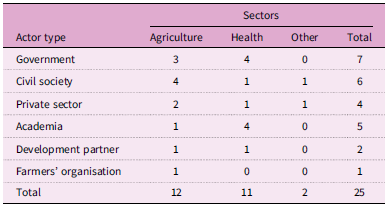
We invited potential interviewees to participate based on existing networks and active snowball sampling, which is recommended for policy research with elites due to the tight networks of actors and the professional nature of the study (i.e. we asked about their professional roles and opinions, so there was little risk of perceived coercion)(Reference Bell24). The lead author, who is based in Tanzania, conducted twenty-five interviews between July and December 2023 (Table 1) with a response rate of 83 %.
Data analysis
For the documentary analysis, the lead author extracted text relevant to fruit and vegetable supply chains and consumer food environments, drawing on the High-Level Panel of Experts on Food Security and Nutrition (HLPE-FSN) framework to guide initial categorisation. Relevant material included both background and framing content as well as specific policy initiatives. Extracted material was coded in an Excel matrix and reviewed with the senior author.
We developed the coding framework through a combination of deductive and inductive approaches. Deductively, we drew on key concepts from the PEA framework – actors, interests, incentives, institutional arrangements and power dynamics – and from Kingdon’s MSF, including problem framing, policy alternatives and political context. These theoretical constructs were distilled into operational codes (i.e. ‘Problem framings,’ ‘Policy situation,’ ‘Implementation situation,’ ‘Actors and interests,’ ‘Institutional arrangements’, ‘Power’ and ‘Context’). Emerging from the data, further inductively generated codes were developed to encapsulate themes. The draft coding framework was pre-tested and subsequently refined in a workshop of the study team in December 2022 to ensure conceptual coherence and clarity. Emerging codes were added after team discussion as new themes arose during analysis.
The coding was conducted using the Quirkos software by the first author, with constant interdisciplinary discussions to clarify ambiguous points and ensure consistency in the application of the theoretical constructs. An initial thematic analysis phase focused on the policy change opportunities and explored the themes related to problem framing, the policy and implementation environment, trade-offs, stakeholder interests and the political/economic factors.
Results
The results are structured according to the integrated analytical framework combining multiple streams theory and PEA. Findings are presented across four interrelated domains: (1) agenda-setting dynamics (problem, policy and politics streams), (2) actor interests and institutional mandates, (3) governance and implementation constraints and (4) power and resource allocation patterns shaping F&V policy prioritisation.
Agenda setting and problem recognition
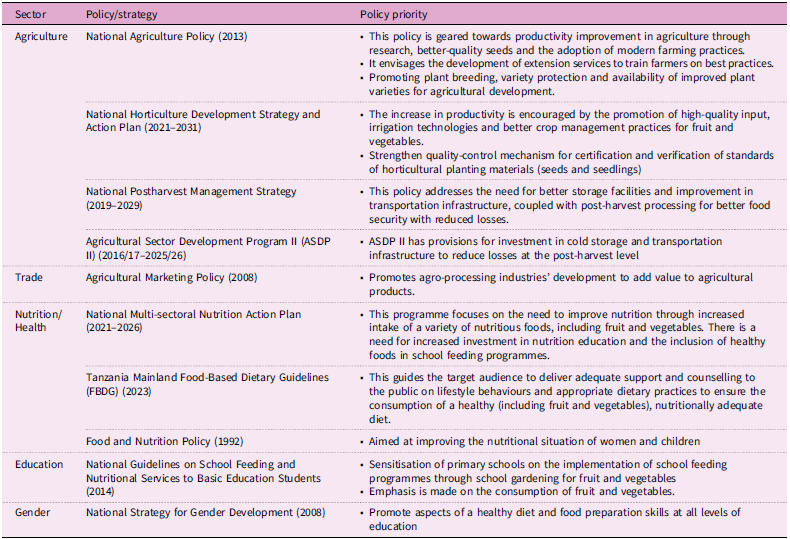
Based on the problem stream of the MSF, as well as the PEA framework of ideas and institutional framing, the findings suggest that despite the formal recognition of F&V in various sectoral policies, their recognition remains limited and conditional upon the dominant concept of food security as a matter of staples. The analysis of policy content indicated relatively high formal recognition of F&V within agriculture, health, education and gender and less in trade and finance sector policies (Table 2). In all these sectors, it was identified that F&V were contributing towards the achievement of three key objectives: improvements in nutrition outcomes, diversification of agricultural outputs and economic growth. Specific policy interventions that were favourable to F&V were identified in National Multisectoral Nutrition Action Plan (NMNAP) II, the National Agricultural Policy and the Food-Based Dietary Guidelines (FBDG). Interviewees stated that F&V are now considered in the FBDG which demonstrates greater recognition of the role of F&V in combating malnutrition and non-communicable disease (NCD).
However, it did not come out clearly for all sectors, particularly trade and finance policies. Neither the Agricultural Marketing Policy (2008) nor the National Trade Policy (2003, edition 2023) explicitly mentioned F&V in their policy statements or action areas. Although these policies create an environment that is supportive of agro-processing and the expansion of trade, the failure to mention F&V might affect their integration into trade facilitation and capacity-building in exports. Interviewees suggested that this omission weakens the sector’s visibility in national trade strategies and may constrain investment in domestic market stabilisation and value chain development.
A further gap identified in the policy analysis was the limited consideration of F&V within taxation policies. Respondents from farmers’ organisations and civil society highlighted overlapping local government levies – such as produce cess, council levies, market fees, and transport checkpoint charges – that increase compliance costs for agricultural producers and traders. Although such levies apply broadly to agricultural commodities, interviewees noted that their cumulative burden particularly affects smallholder F&V producers operating within fragmented value chains. As one civil society respondent explained:
‘Crop cess and levies are a problem; the law clearly states that farmers should only pay once, but the reality is that farmers incur charges for their produce at each gate they pass, regardless of whether they are in the same region. So, this double taxation is also an issue for farmers’. 18_agriculture_civil society
These structural features of the trade and taxation environment show how institutional arrangements may indirectly constrain the integration of F&V into broader economic policy frameworks.
In addition to the specific content of policies, all interviewees emphasised the importance of narratives that place great value on staple foods like maize, rice and cassava in relation to F&V. At the level of policy discourse, food security was often equated with cereal self-sufficiency, reflecting long-standing national strategies that sought to ensure economic stability. One government nutrition stakeholder observed:
‘It’s very rare to find that policymakers are talking issues of F&V when talking about food security. When calculating food security in Tanzania, we are not including F&V, it just cereal. This is an area that we have to intervene because we are not given it a priority in our policies’ (1_Nutrition_Government).
This is reflected in how problems are defined in the agenda-setting process. While there is an increasing body of evidence on NCD and micronutrient deficiencies, F&V tend to be seen as secondary, as opposed to primary, aspects of food security. The respondents’ views suggested that this influenced budgetary support, subsidies and monitoring, all of which tend to be focused around staple crops.
Institutional and implementation constraints
Despite the formal recognition of F&V in various policies, the interviewees pointed a difficulty in the translation of the commitment into practice. In all sectors, limited implementation capacity was noted as the major challenge. In their views, limited underfunding and lack of technical know-how were noted as major contributors to poor policy implementation. Despite the existence of national policies on horticulture production, reducing post-harvest loss and nutrition-sensitive agriculture, these policies were noted to be underfunded.
Farmers were widely described as the primary group affected by poor policy implementation. Respondents reported limited access to extension services, improved seeds, fertilisers, pesticides and irrigation infrastructure – constraints that reduce both production volumes and product quality. Five interviewees (#2, #3, #13, #18, #21) indicated that such limitations restrict smallholder farmers’ ability to participate in higher-value markets and formal value chains, particularly where modern production standards are required. These findings suggest that although policy alternatives for promoting F&V exist on paper, the policy stream remains weak in operational terms due to insufficient investment and technical support mechanisms.
Interviewees further described long-standing structural investment patterns that favour staple and cash crops over horticultural production. Tanzania’s agricultural infrastructure, extension systems and subsidy programmes were perceived as historically oriented towards maize, rice, cassava and selected export commodities. Several respondents (#2, #3, #13, #18, #21) reported that extension officers are more numerous and better trained in staple crop production, while technical support for F&V is comparatively limited.
Export-oriented agriculture was also described as a priority investment area, shaping both production incentives and policy attention. In some contexts, fruit such as avocado were promoted primarily as high-value export crops rather than as components of domestic dietary improvement. One agriculture sector respondent noted:
‘In the area where I currently reside, they are actively promoting avocado cultivation. As a result, people are using avocado as a commercial crop and exporting it to other nations’ (20_agriculture_civil society).
While such investments may contribute to economic growth, interviewees suggested that they do not necessarily translate into improved domestic availability or affordability of diverse F&V. This reflects how institutional mandates and economic development strategies shape the viability of F&V policy alternatives within the policy stream.
Poor implementation was also attributed to governance challenges, particularly the disconnect between national policy design and local-level realities. Several interviewees described agricultural and nutrition policies as predominantly top-down, with limited participation from smallholder farmers during formulation. One farmers’ organisation representative stated:
‘Most policy in Tanzania is top-down and not directly influenced by the farmer; therefore, it tends to be less sensitive to local farming conditions and economic realities’ (15_Agriculture_farmers organisation).
Respondents emphasised that government strategies promoting agricultural modernisation do not always address context-specific constraints such as unreliable irrigation, limited storage infrastructure, weak market linkages and insufficient farmer training. As a result, policy objectives related to F&V production and value chain development may not align with on-the-ground capacities.
These governance processes illustrate the significant effect that institutions and processes have on the implementation of policies. Although the issue of F&V has been prioritised in the country, the fragmented coordination, limited capacity at the sub-national level and limited responsiveness to the needs of the farmers have affected the implementation of the policies.
Beliefs, framing and economic perceptions shaping F&V policy prioritisation
Beyond formal policy recognition, deeply embedded beliefs and economic narratives influenced how F&V are valued relative to staple and export crops. The respondents in the study recognised the nutritional importance of F&V in addressing micronutrient deficiencies. However, this recognition did not translate into equivalent political urgency. F&V were frequently discussed as complementary foods, as opposed to strategic staples, in comparison to cereals like maize or rice, which are deeply embedded in issues of food security, national stability and electoral accountability. Several respondents (#1, #2, #3, #4, #7, #8, #9, #12, #15) referred to F&V as ‘household crops’ or ‘garden produce’, supporting the idea of F&V as non-strategic goods.
‘Home gardening is the best approach to be adopted, at least every community or household should have a home garden for F&V. There are also institutions such as prisons and schools. Those areas, I think we need to advocate more’ (4_Health and nutrition_ government).
Although unhealthy diets and rising NCD were increasingly acknowledged, F&V were not consistently constructed as central policy solutions. Instead, food security remains narrowly defined in caloric terms. This narrative framing contributes to a weaker coupling between the problem (malnutrition and NCD) and the policy solution (F&V system transformation), thereby limiting agenda advancement.
Economic narratives played a critical role in the analysis. Even though F&V were identified as high-value crops in terms of their ability to contribute to the economy and export earnings, the interviewees observed that they are not commonly considered a macro-economic commodity of significant importance when compared with export crops like tobacco or other cash crops with well-defined value chains (#6, #8, #9).
Some of the interviewees observed that F&V are not considered a ‘safe’ commodity due to the associated risks of perishability, high post-harvest losses, fragmented markets and lack of adequate cold storage facilities. Thus, they are not considered for public investments in comparison with ‘safer’ or more ‘stable’ commodities:
‘To effectively increase production, we must also identify markets for our produce. It’s essential to establish a mechanism that allows vegetables and fruit grown in one region to reach other areas. Given that these products are perishable, we need to consider policies that facilitate their timely distribution’ (7_Nutrition_Academia).
The interviewees also noted that the institutionalised belief systems of the sectors were another critical issue in the analysis of the problem. For example, several participants from the agriculture sector pointed to the assumption that improving the production of staple foods is a prerequisite for improving food security. This assumption embodies a logic that sequences the policy process and limits direct investment in the food system related to dietary quality that includes F&V. This logic leads to policy inertia, meaning that people work within a system that is slow to change unless there is strong leadership pushing for new policies.
While the interviewees pointed to the increasing awareness of the evidence that supports the relationship between F&V consumption and health and economic outcomes, they also pointed to the fact that such evidence is not necessarily translated into legislative actions. Data gaps identified related to the size of the domestic F&V market, the contribution to employment and the economic benefits were pointed to as undermining the advocacy for F&V systems. The interviewees pointed to the fact that the policy debate is often driven by the need to achieve immediate production targets and programme cycles that are donor-driven rather than long-term objectives for dietary transformation (#2, #7). This suggests that while policy learning is evident in the policy discourse, the institutionalisation of new policy beliefs into the policy process is limited.
Actor interests and power relations
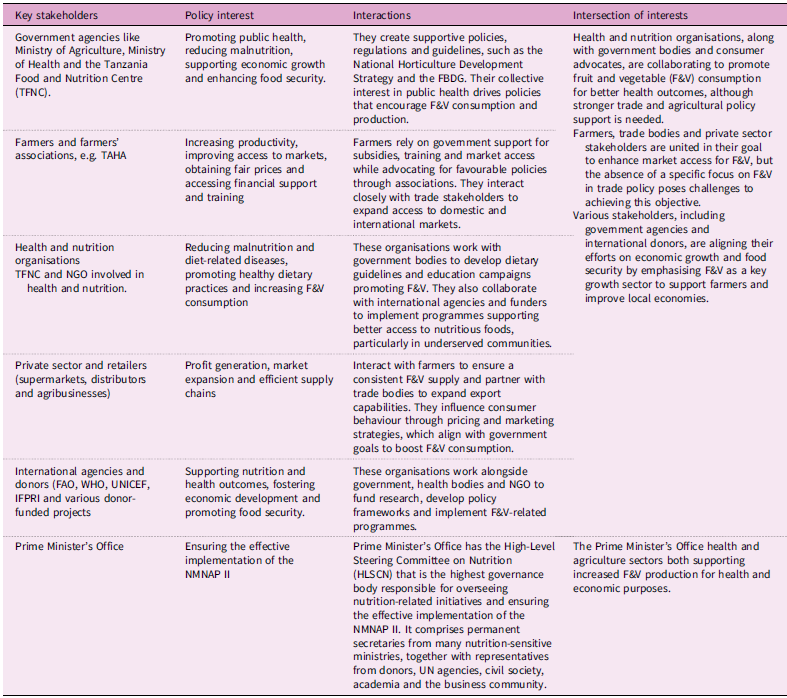
The overall political stream is shaped by the balance of forces between government ministries, development partners, private sector actors and civil society working to promote their own interests within the F&V policy ecosystem (Table 3). Government and international organisations, as well as private sector actors, impacted fruit and vegetable policy through key interests along with activities related to both the development stage of the policies and implementation (three Ministry of Agriculture and local government authorities’ interviewees). They also claimed that they are central to input supply, production standards and market facilitation throughout the value chain (#1 #11 #17).
The Ministry of Health was noted by three public health stakeholders as essential in integrating dietary considerations into agricultural policy (#4 #12 #13). Development partners and international organisations, including the FAO, were frequently referenced by both government and Non-Governmental Organisation (NGO) respondents for their technical and financial contributions to policy processes and implementation. An international organisation (#19) representative mentioned existing support for the climate-resilient agriculture project, and a government official (#11), elaborated on their involvement in assisting to develop guidelines for F&V access to markets and standards of safe consumption.
Private sectors – particularly large processors and export-oriented agribusiness firms – were described by interviewees from farmers’ organisation (#15) and government (#1 #17) as vocal advocates for investment-friendly policies, infrastructure development and value chain upgrading. At the same time, smallholder farmers, who dominate primary production, were portrayed by NGO respondents (#19) and a farmers’ group representative (#15) as seeking improved access to quality inputs, affordable credit and more secure and predictable market channels. Three interviewees (#9 #18 #19) from private sector, exporters and producers recognised their role as leaders in driving policies to facilitate entry into the market and ensure business profitability. One interview from private sector explained,
‘We work closely with the government to remove trade bottlenecks… efficiency in exports is our biggest concern’ (9_Agriculture_private sector).
These policy priorities often favour the routine use of pesticides, but regulatory gaps remain. For example:
‘In our local markets, you often find F&V displayed directly on the ground. With some vegetables, you can even smell the pesticide residues, which clearly indicates they don’t meet safety standards.’ (17_Agriculture_Government).
Health and nutrition interviewees (#1 #4 #12 #16) expressed concern that ‘many farmers do not receive proper training on pesticide handling’ and ‘there is almost no enforcement in rural areas, especially for products not destined for export’ (#19).
Interviewees from civil society organisations and public health experts were consistently described as key actors in advocating for food security, nutrition and policy reform. One (#24) civil society respondent stressed the importance of integrating F&V policy into broader dietary health agendas, while a public health academician (#6 #13) underscored the role of civil society organisations in pushing for accountability and pro-nutrition regulatory frameworks. Civil society organisations and development partners (#20 #23) are vocal proponents of nutrition-sensitive and environmentally sustainable agriculture. One civil society organisation representative remarked,
‘We’ve pushed for more integration of nutrition goals into health and agricultural policies, but we’re often sidelined in policy dialogues dominated by economic and trade ministries’ (2_Nutrition_civil society).
While two interviewees (#14 #19) agreed that while these actors are effective at piloting innovative models, ‘they lack the political leverage to change mainstream policy priorities’.
Opportunities for policy change and stream coupling
Despite these constraints, the analysis identified converging interests and strategic entry points that may facilitate further coupling of problem, policy and politics streams. Recognising and building upon existing positive beliefs and stakeholder interests is critical for creating momentum around F&V in Tanzania. Various stakeholders, such as the government, civil society and the private sector, shared a common conviction about the nutritional, economic and environmental advantages of F&V and the opportunity to take the F&V agenda forward in Tanzania. Some of the interviewees from the Ministry of Health and Academia (#12 #13) considered advocating for F&V as a required approach to deal with the increasing burden of NCD and undernutrition. Agricultural policymakers (#11 #17) shared this positive framing, acknowledging the potential of F&V to contribute to increased income diversification, especially for rural smallholders, and to climate-resilient food systems. Such prevalent opinions form a strategic foundation for building coalitions to push for improved F&V policies.
The analysis also indicated that there were points of converging interests that could be utilised to gain traction for reform. Private sector actors (#9 #14) were strongly interested in the opening of the F&V market – both domestically and for export – highlighting value addition and agro-processing potential. Their focus on cold chain infrastructure, clarity in regulations and investment incentives has an intersecting point with governmental priorities of economic development and job creation. As development partners (#18) anticipated, it was confirmed that technical support would augment private sector demand, boosting production, establishing standards for quality and facilitating ease of entry into regional markets. The initiative encourages a win-win scenario for health, trade and rural development.
Strategically, stakeholders pointed to several policy and programmatic entry points. One (#1) interviewee from local government emphasised mainstreaming F&V promotion into District Nutrition Action Plans and leveraging multisectoral nutrition platforms that already exist. Representatives of civil society (#20) suggested placing F&V within the broader right-to-food and food systems story to take root at the national policy levels. Others (#7 #18) suggested aligning F&V goals with national development plans like the Agricultural Sector Development Programme and the Health Sector Strategic Plan. These opportunities hold real promises of elevating F&V in Tanzania’s policy agenda – if only stakeholders will continue to coordinate and synchronise.
Discussion
This study found that F&V are widely recognised in many national policies across Tanzania’s food system. Key strengths include the integration of F&V in national development agendas – agriculture, health and education policies – and stakeholders’ understanding that F&V contribute both to improved health and to economic growth. However, notable gaps remain, especially as economic sectors like trade and finance afford limited attention to F&V, and challenges in cross-sectoral implementation constrain progress. As a result, much of the policy landscape prioritises more on livelihoods and economic development and healthy diets is not well integrated beyond the health sector. Without a more coherent, system-wide approach, opportunities to improve population diets may continue to be overlooked. The analysis identified four areas where policy action could strengthen F&V integration across Tanzania’s food system. These findings are consistent with other studies in LMIC, where nutrition goals are often separate from agricultural and economic interests(Reference Kadiyala, Harris and Headey25).
Firstly, there is a need to strengthen the alignment of cross-sectoral policies. The emphasis on F&V as an integral component of a healthy diet has so far been largely limited to the health and nutrition sectors, as depicted by the NMNAP II and the Food and Nutrition Policy. The agriculture, trade and education sectors provide only limited support to the promotion of F&V. The implementation of the existing policies is impeded by the failure to coordinate with the economic sectors. This is a globally observed phenomenon, which has been evidenced by the failure to align the nutrition sector with the trade and economic sectors(Reference Baker, Kay and Walls26,Reference Thow27) . Tanzania has the potential to use the existing mechanisms, such as the High-Level Steering Committee for Nutrition, to promote the F&V sector. The international experience has depicted the importance of trust, informal cooperation and capacity-building between the health and economic sectors, as observed in the case of Thailand(Reference Thaiprayoon and Smith28).
Second, strengthening consumer awareness through public campaigns and behaviour-change communication could increase demand for F&V and raise their visibility on the policy agenda(Reference Braga-Pontes, Simões-Dias and Lages29–Reference Rekhy and McConchie32). Stakeholders – particularly those in health – identified limited consumer awareness as a constraint. Evidence from other settings shows that public education, nutrition communication and targeted campaigns can shift perceptions and stimulate consumption, especially in urban populations(Reference Rekhy and McConchie32).
Third, there are important opportunities to stimulate investment in F&V value chains. Although horticulture is recognised as a priority sector in policy documents such as the Agriculture Sector Development Programme II and the National Horticulture Development Strategy, staple crops continue to dominate policy focus(Reference Olney, Singh and Schreinemachers33–Reference Khandelwal, Verma and Shaikh35). Cultural attitudes linking food security to staple foods, like maize and cassava, will also support the focus on these crops. To achieve a viable F&V sector, the development of an enabling environment is critical. The current challenges, such as district-level levies, inadequate storage and transportation facilities and insufficient public investment(18), hinder the expansion of local producers and Tanzania’s potential to meet local and export markets(Reference Dube, Paremoer and Jahari36,Reference Mashindano, Kazi and Mashauri37) .
Fourth, fiscal and market incentives may promote the development of F&V sector. Key supports identified by interviewees included tax incentives, subsidies, grants and improved infrastructure; these are particularly important given the relative lack of budgetary focus on F&V compared with staple crops(Reference Rais, Kushwaha and Rohan38). International examples are illustrating what’s possible: India’s National Horticulture Mission introduced fiscal incentives that expanded engagement in the sector by private enterprises(Reference Jagran39,Reference Gulati, Ganguly and Landes40) and Kenya’s horticulture sector experienced a boom from smallholder subsidies and investments in post-harvest systems(41). Interventions of this nature exemplify how effective targeted incentives can be to improve competitiveness, drive productivity and further diversify outputs.
Although Tanzania has a policy framework that recognises the importance of F&V, there are still significant opportunities to improve the alignment of policies, demand creation and investments. It will be crucial to overcome the barriers in the policy process to promote F&V in the overall food and nutrition agenda in Tanzania.
Conclusion
This study underscores the pivotal, but under-utilised, nature of fruit and vegetable policies in promoting sustainable healthy diets in Tanzania. Although there is increasing awareness in policy circles regarding their role in enhancing nutrition and the prevention of NCD, the F&V subsector continues to be marginalised within overarching agricultural and food system strategies. The dominance of investment in staple foods, along with fragmented institutional mandates and weak multisectoral coordination – especially in trade and finance – remains obstacles to effective policy implementation. However, the establishment of the High-Level Steering Committee for Nutrition and the existence of the National Multisectoral Nutrition Action Plan provide a possible avenue for harmonising national and local policy initiatives. To unlock the complete potential of the F&V sector, there is an urgency to have integrated policy coherence, improve governance structures and provide fiscal and market through stakeholder engagement that prioritises F&V as strategic components of the country’s pathway to a sustainable healthy diet.
Acknowledgements
The authors are grateful to the people who participated during the study, including government and non-government officials, for their invaluable time during the interview and who contributed to confirming the reviewed policy documents, sharing published policy documents for review and making this work possible.
Authorship
M. S. V.: Conceptualisation, Methodology, Data curation, Formal analysis, Investigation, Validation, Writing – original draft, Writing – review and editing. N. A.: Conceptualisation, Data curation, Formal analysis, Validation, Writing – review and editing. A. M. T.: Conceptualisation, Formal analysis, Funding acquisition, Investigation, Methodology, Project administration, Resources, Supervision, Validation, Writing – original draft, Writing – review and editing.
Financial support
The research that led to these findings was funded by One CGIAR (Consultative Group on International Agricultural Research) led by the International Food Policy Research Institute (IFPRI).
Competing interests
There are no conflicts of interest.
Ethics of human subject participation
This study was conducted according to the guidelines laid down in the Declaration of Helsinki, and all procedures involving research study participants were approved by the Tanzania Commission for Science and Technology (approval no. 2023-827-NA-2023-852). Verbal consent was witnessed and formally recorded.
Appendix
Interviewee characteristics

Table 1 Long description
A table summarizing interviewee characteristics across different sectors and actor types. The table has six rows and five columns. The columns are labeled Actor type, Agriculture, Health, Other, and Total. The rows are labeled Government, Civil society, Private sector, Academia, Development partner, and Farmersʼ organisation. Row 1: Government, Agriculture, 3; Health, 4; Other, 0; Total, 7. Row 2: Civil society, Agriculture, 4; Health, 1; Other, 1; Total, 6. Row 3: Private sector, Agriculture, 2; Health, 1; Other, 1; Total, 4. Row 4: Academia, Agriculture, 1; Health, 4; Other, 0; Total, 5. Row 5: Development partner, Agriculture, 1; Health, 1; Other, 0; Total, 2. Row 6: Farmersʼ organisation, Agriculture, 1; Health, 0; Other, 0; Total, 1. Row 7: Total, Agriculture, 12; Health, 11; Other, 2; Total, 25.
Sources: Authors.
Key: Other = Gender, Trade and Finance.
Highlights from policy documents aimed at the promotion of F&V and health in Tanzania

Table 2 Long description
A table summarizing policy strategies and priorities for promoting fruits and vegetables and health in Tanzania. The table has six columns and multiple rows. The columns are labeled Sector, Policy/strategy, and Policy priority. The table includes the following data: Row 1: Sector: Agriculture, Policy/strategy: National Agriculture Policy (2013), Policy priority: This policy is geared towards productivity improvement in agriculture through research, better-quality seeds and the adoption of modern farming practices. It envisages the development of extension services to train farmers on best practices. Promoting plant breeding, variety protection and availability of improved plant varieties for agricultural development. Row 2: Sector: Agriculture, Policy/strategy: National Horticulture Development Strategy and Action Plan (2021-2031), Policy priority: The increase in productivity is encouraged by the promotion of high-quality input, irrigation technologies and better crop management practices for fruit and vegetables. Strengthen quality-control mechanism for certification and verification of standards of horticultural planting materials (seeds and seedlings). Row 3: Sector: Agriculture, Policy/strategy: National Postharvest Management Strategy (2019-2029), Policy priority: This policy addresses the need for better storage facilities and improvement in transportation infrastructure, coupled with post-harvest processing for better food security with reduced losses. Row 4: Sector: Agriculture, Policy/strategy: Agricultural Sector Development Program II (ASDP II) (2016/17-2025/26), Policy priority: ASDP II has provisions for investment in cold storage and transportation infrastructure to reduce losses at the post-harvest level. Row 5: Sector: Trade, Policy/strategy: Agricultural Marketing Policy (2008), Policy priority: Promotes agro-processing industriesʼ development to add value to agricultural products. Row 6: Sector: Nutrition/Health, Policy/strategy: National Multi-sectoral Nutrition Action Plan (2021-2026), Policy priority: This programme focuses on the need to improve nutrition through increased intake of a variety of nutritious foods, including fruit and vegetables. There is a need for increased investment in nutrition education and the inclusion of healthy foods in school feeding programmes. Row 7: Sector: Nutrition/Health, Policy/strategy: Tanzania Mainland Food-Based Dietary Guidelines (FBDG) (2023), Policy priority: This guides the target audience to deliver adequate support and counselling to the public on lifestyle behaviours and appropriate dietary practices to ensure the consumption of a healthy (including fruit and vegetables), nutritionally adequate diet. Row 8: Sector: Nutrition/Health, Policy/strategy: Food and Nutrition Policy (1992), Policy priority: Aimed at improving the nutritional situation of women and children. Row 9: Sector: Education, Policy/strategy: National Guidelines on School Feeding and Nutritional Services to Basic Education Students (2014), Policy priority: Sensitisation of primary schools on the implementation of school feeding programmes through school gardening for fruit and vegetables. Emphasis is made on the consumption of fruit and vegetables. Row 10: Sector: Gender, Policy/strategy: National Strategy for Gender Development (2008), Policy priority: Promote aspects of a healthy diet and food preparation skills at all levels of education.
Sources: Authors.
Actor interests and influence in the current policy context in Tanzania

Table 3 Long description
A table comparing the interests and influence of various stakeholders in Tanzaniaʼs policy context related to fruit and vegetable consumption. The table has four columns: Key stakeholders, Policy interest, Interactions, and Intersection of interests. It contains seven rows, each representing a different stakeholder group. Row 1: Government agencies like Ministry of Agriculture, Ministry of Health and the Tanzania Food and Nutrition Centre (TFNC). Promoting public health, reducing malnutrition, supporting economic growth and enhancing food security. They create supportive policies, regulations and guidelines, such as the National Horticulture Development Strategy and the FBDG. Their collective interest in public health drives policies that encourage FV consumption and production. Health and nutrition organisations, along with government bodies and consumer advocates, are collaborating to promote fruit and vegetable (FV) consumption for better health outcomes, although stronger trade and agricultural policy support is needed. Row 2: Farmers and farmers associations, e.g. TAHA. Increasing productivity, improving access to markets, obtaining fair prices and accessing financial support and training. Farmers rely on government support for subsidies, training and market access while advocating for favourable policies through associations. They interact closely with trade stakeholders to expand access to domestic and international markets. Farmers, trade bodies and private sector stakeholders are united in their goal to enhance market access for FV, but the absence of a specific focus on FV in trade policy poses challenges to achieving this objective. Various stakeholders, including government agencies and international donors, are aligning their efforts on economic growth and food security by emphasising FV as a key growth sector to support farmers and improve local economies. Row 3: Health and nutrition organisations. TFNC and NGO involved in health and nutrition. Reducing malnutrition and diet-related diseases, promoting healthy dietary practices and increasing FV consumption. These organisations work with government bodies to develop dietary guidelines and education campaigns promoting FV. They also collaborate with international agencies and funders to implement programmes supporting better access to nutritious foods, particularly in underserved communities. Row 4: Private sector and retailers (supermarkets, distributors and agribusinesses). Profit generation, market expansion and efficient supply chains. Interact with farmers to ensure a consistent FV supply and partner with trade bodies to expand export capabilities. They influence consumer behaviour through pricing and marketing strategies, which align with government goals to boost FV consumption. Row 5: International agencies and donors (FAO, WHO, UNICEF, IFPRI and various donor-funded projects). Supporting nutrition and health outcomes, fostering economic development and promoting food security. These organisations work alongside government, health bodies and NGO to fund research, develop policy frameworks and implement FV-related programmes. Row 6: Prime Ministerʼs Office. Ensuring the effective implementation of the NMNAP II. Prime Ministerʼs Office has the High-Level Steering Committee on Nutrition (HLSCN) that is the highest governance body responsible for overseeing nutrition-related initiatives and ensuring the effective implementation of the NMNAP II. It comprises permanent secretaries from many nutrition-sensitive ministries, together with representatives from donors, UN agencies, civil society, academia and the business community. The Prime Ministerʼs Office health and agriculture sectors both supporting increased FV production for health and economic purposes.
Sources: Authors.

 Open access

