INTRODUCTION
Due to its three-dimensional structure, the brine channel system of sea ice is a comparable environment to sandy interstitial habitats (Weissenberger et al., 2002). These two systems share a range of meiofaunal taxa (i.e. nematodes, turbellarians and harpacticoid copepods) with specific adaptations to burrowing and creeping behaviours (Pfannkuche & Thiel, Reference Pfannkuche and Thiel1987; Schewe, Reference Schewe2001; Gradinger et al., Reference Gradinger, Meiners, Plumley, Zhang and Bluhm2005; Schuenemann & Werner, Reference Schuenemann and Werner2005). Recently, the occurrence of a sympagic hydrozoan taxon has been reported for the first time (Bluhm et al., Reference Bluhm, Gradinger and Piraino2007), showing a close morphological convergence with soft bottom interstitial hydrozoan taxa. To date, less than 50 interstitial cnidarian species are known from shallow and deep sediments around the world; they are typically minute (often smaller than 1 mm), characterized by a reduction of diagnostic features, and in some aspects atypical of the phylum (Thiel, Reference Thiel, Higgins and Thiel1988; Bozhenova et al., Reference Bozhenova, Stepanjants and Sheremetevski1989; Giere, Reference Giere1993; Bouillon & Grohmann, Reference Bouillon and Grohmann1994).
The family Protohydridae Allman 1888 is a hydroid taxon widely distributed in temperate waters of the northern hemisphere (see Schuchert, Reference Schuchert2006 for references), and it includes one genus with two species of small solitary interstitial polyps, Protohydra leuckarti Greeff, 1869 and P. psamathe Omer-Cooper, 1963, recorded from shallow interstitial sediments. The family characters include the absence of tentacles and gonophores, gametes bulging in the gastric cavity, and a pedal disc formed by epidermal tissue only, which is used to move the hydroid in a caterpillar larva-like manner. Here we report a new interstitial hydroid from the Arctic sea ice brine channel system, possessing the typical epidermal pedal disc and simple morphology of Protohydridae, but with some new, additional features. Therefore, it is described herein as a new species, Sympagohydra tuuli, and the new genus Sympagohydra is proposed to accommodate the new species within the Protohydridae, for which we provide an emended diagnosis.
MATERIALS AND METHODS
Study area
Samples were collected at Barrow, Alaska (Figure 1), in 2003–2006, at different locations and months less than 1 km offshore in the Chukchi Sea (Basc and Hanger sites), in the Beaufort Sea, and in the shallow Elson Lagoon. At all sites water depth ranged from 2.0–6.3 m. Sampling was carried out throughout the seasonal cycle of ice formation, from December to June. At these sites, ice core bottom sections (0–10 cm, i.e. the closest section to sea water–ice interface) were collected with a Kovacs-type ice auger (9 cm diameter). Sample processing was carried out as described elsewhere (Bluhm et al., Reference Bluhm, Gradinger and Piraino2007). Hydroids and other sea ice interstitial fauna were counted alive with Wild MZ3 and Leica MZ12 dissecting scopes at 10–100× magnification before fixation with 1% buffered formaldehyde–seawater solution (final concentration). Morphological studies were then carried out at the Laboratories of the University of Salento. Hydroid size measurements (N = 40) were done with Image-J software from digital images taken with a Canon Rebel camera attached to a Zeiss inverted compound microscope using 10×–40× objective lenses. Cnidocyst measurements were carried out by a Zeiss Axioscope microscope using a 100× objective lens.
Map of the study area near Barrow, Alaska, with marked sampling sites.

Holotype and paratypes are deposited in the hydrozoan collection at the Laboratory of Zoology and Marine Biology of the University of Salento, Lecce, Italy.
RESULTS
MATERIAL EXAMINED
Basc C5 16-3-6 (0-10), holotype (from Chukchi Sea: BASC 71º 19′N 156º 41′W). Paratypes: Hanger C4 11-31-6 (0-10) (71º 20′N 156º 39′W), Beaufort (71°22′N 156°24′W), Elson Lagoon (71º 21′N 156º 28′W).
DIAGNOSIS
Solitary naked hydroids, with one whorl of solid filiform tentacles at the base of a short hypostome, and a tubular, extensible foot-like projection made by epidermal tissue only.
TYPE SPECIES
Sympagohydra tuuli sp. nov.
ETYMOLOGY
The genus name Sympagohydra indicates its membership of the ice-associated (=sympagic) fauna, a widely used term deriving from the composite word συν (together) and παγo see bottom of this page for guidance on this (ice). According to the ICZN Code of Zoological Nomenclature (article 30.1.1.), the gender of the new genus name is feminine.
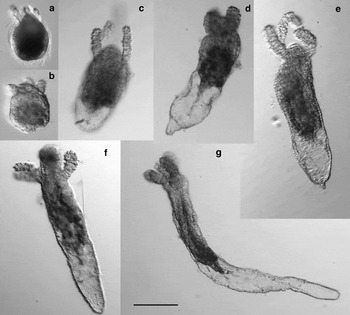
General morphology of Sympagohydra tuuli gen. nov. and sp. nov. at various stages of extension of the ectodermal foot. (a) Contracted polyp, showing a concentration of flagellated cells around most of the aboral part of the body; (b) contracted polyp: endoderm cells are brownishly coloured; (c–g) various degrees of unfolding of the ectodermal foot. The shape of hypostome and the tentacle length vary accordingly. Scale bar (a–g): 200 µm.

DIAGNOSIS
Small solitary polyps, with spindle-shaped hydranths when relaxed (maximum length 1.1 mm), almost spherical when contracted (0.2 mm length). Three to four oral solid (chordal) tentacles, thick and filiform, slightly extensible, surrounding a small hypostome of variable shape, from dome-shaped to conical to tubular, depending on the degree of extension. Aboral side highly extensible, as a foot-like projection made by epidermal tissue, with several flagellated cells. Nematocysts of three types: stenoteles on the hypostome, microbasic mastigophores and desmonemes on tentacles, few mastigophores scattered along the body column.
ETYMOLOGY
The specific name is dedicated to the newborn daughter of Bodil Bluhm and Rolf Gradinger, Tuuli, whose name is derived from a Finnish word meaning wind. The specific name follows the apposition rule, article 31.1 of the ICZN Code of Zoological Nomenclature (4th edition, 1999).
DESCRIPTION
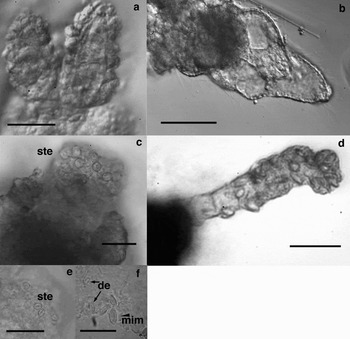
This delicate and naked hydroid (Figure 2a–g) varies in length from near 200 µm (Figure 2a–b) up to 1000 at complete extension (Figure 2c–g). It bears three or usually four thick and short filiform tentacles (Figure 2c, e & f) at the base of a short but slightly extensible hypostome (Figure 2f). The endoderm of the tentacles is chordal (Figure 3a). The aboral side of the hydroid can be extended considerably, by unfolding a foot-like ectodermal projection, always without perisarc (Figures 2c–g & 3b). A coordinated contraction–relaxation cycle of myoepithelial cells allows modification of the internal fluid pressure, leading to extrusion of the ectodermal foot. The diploblastic condition (ectoderm and endoderm layers) is restricted to the top half of the body column; a single layer of ectoderm cells of the foot projection form the lower half of the extended polyp (Figure 2e–g). The tip of the ectodermal foot shows no comparable structure to adhesive pedal disc (Figure 3b). There is no secretion of mucous or gelatinous sheath. Instead, the outer layer contains several flagellated cells along the basal two-thirds of the hydranth body (Figure 1a & Figure 3b). The hydroid may apparently move within the sea ice channel system by a combination of caterpillar-like peristalsis and by the spiral beating of the long flagella. The unfolding mechanism of the ectodermal foot seems comparable to the extension of a bivalve foot, by increasing the internal fluid pressure at the hydranth base. The cnidome is characterized by three types of cnidocysts: a small number of stenoteles (length = 11–14 µm) (Figure 3c, e) on the hypostome, and microbasic mastigophores (length = 9–12 µm, width = 6–8 µm) and desmonemes (length = 7–10 µm, width = 5–7 µm) (Figure 3d, f) distributed along the tentacles, more concentrated at the tentacle tip (Figure 3d). Few mastigophores can be rarely found on the hydranth column, but nematocyst clusters (like those of Boreohydra) were never recorded. Sexually mature specimens were not observed.
Features of Sympagohydra tuuli. (a) The chordal organization of endoderm cells in tentacles; (b) ectodermal foot-like projection, with flagellated cells; (c) hypostome with stenotele cnidocysts (ste); (d) extended tentacle with distribution of cnidocysts with higher concentration in the distal two-thirds of the tentacle; (e) stenotele cnidocysts (ste); (f) microbasic mastigophore (mim) and desmoneme (de) cnidocysts from tentacles. Scale bars (a–e): 50 µm; (f): 25 µm.

ECOLOGY AND DISTRIBUTION
Sympagohydra tuuli was recorded only in the bottom section of sea ice cores, i.e. in the first 10 cm of the brine channel and pocket system of sea ice near to the water column interface. Bluhm et al. (Reference Bluhm, Gradinger and Piraino2007) found a strong positive relationship between hydroid densities and their potential prey, namely copepod nauplii and polychaete juveniles, suggesting for S. tuuli a potential keystone role in the ecology of sympagic communities, as proposed for Protohydra leuckarti within the temperate shallow mesopsammic communities of the northern hemisphere (Heip, Reference Heip1971; Heip & Smol, Reference Heip, Smol, Persoone and Jaspers1976; Piraino et al., Reference Piraino, Fanelli and Boero2002). However, identifiable food items were not recognized in the gastric cavity.
REMARKS
As already pointed out (Schuchert, Reference Schuchert2006), the systematic placement of Protohydridae is difficult, due to their reduced morphology. Petersen (Reference Petersen1990) considered the family as an incertae sedis group, but close to the Hydridae, as also suggested by Bouillon (Reference Bouillon1985) and more recently re-established by Bouillon et al. (Reference Bouillon, Gravili, Pages, Gili and Boero2006), including the two families in the suborder Moerisiida.
Differently, Stepanjants et al. (Reference Stepanjants, Anokhin and Kuznetsova2000) suggested that Protohydridae should be regarded separately from the Hydridae, because of different cnidome composition/distribution and the absence of tentacles, envisaging also that Hydridae might have derived from aberrant Corymorphidae, being not related to Moerisidae. Recent molecular data based on mitochondrial markers (16S; Collins et al., Reference Collins, Winkelmann and Schierwater2005) and nuclear markers (18 S, 28S; Collins et al., Reference Collins, Schuchert, Marques, Jankowski, Medina and Schierwater2006) strongly corroborate the phylogenetic hypothesis on the close relationship between Hydridae and Corymorphidae (both included in the Aplanulata group; see Collins et al., Reference Collins, Winkelmann and Schierwater2005 for its definition). These data also clearly contradict the supposed affinity between Moerisidae and Hydridae.
The family Protohydridae Allman 1888 included hitherto a single genus, Protohydra, with two or three paedomorphic species with solitary hydranths, without tentacles, but with an epidermal pedal disc, and sexual products differentiated in the endoderm (Bouillon et al., Reference Bouillon, Gravili, Pages, Gili and Boero2006; Schuchert, Reference Schuchert2006). Transverse fission is also a common mode of asexual reproduction for Protohydridae. Besides Protohydra leuckarti Greeff, 1869, the validity of additional Protohydra spp. is still a matter of debate. Bouillon et al. (Reference Bouillon, Gravili, Pages, Gili and Boero2006) listed P. caulleryi Dawydoff, 1930, but not P. psamathe Omer-Cooper, 1963. Anokhin (Reference Anokhin2001) also questioned the validity of P. psamathe. On the other hand, Schuchert (Reference Schuchert2006) supported the validity of P. psamathe, but not of P. caulleryi, as a likely representative of the Olindiidae family. According to older observations (cited in Schuchert, Reference Schuchert2006), the cnidome of the genus Protohydra includes stenoteles and basitrichous isorhizas but recent observations on living material allowed the identification of a third cnidocyst type, macrobasic mastigophores, in P. leuckarti (Stepanjants et al., Reference Stepanjants, Anokhin and Kuznetsova2000; Anokhin Reference Anokhin2001). The lack of desmonemes, as Schuchert (Reference Schuchert2006) pointed out, should be linked to the secondary loss of tentacles.
Bouillon (Reference Bouillon1985) included Protohydra in Boreohydridae, but later Bouillon et al. (Reference Bouillon, Gravili, Pages, Gili and Boero2006) included it in Protohydridae, even though they implied an alliance with Boreohydridae by placing both in the Moerisiida suborder. According to Schuchert (Reference Schuchert2006), the discovery of Cryptohydra, family Acaulidae, filled the gap between Boreohydridae and Protohydridae. However, Sympagohydra shows characters that are considered of diagnostic relevance for different families. In fact, the cnidome of Sympagohydra parallels that of Acaulidae and the morphology of the tentacles closely resembles the aboral tentacles of Cryptohydra. Three to four oral tentacles are found both in Sympagohydra and in Boreohydra (but are clearly capitate in the latter). Sympagohydra and Psammohydra show a comparable number and morphology of tentacles. Finally, Sympagohydra comes close to the genus Protohydra for its comparable interstitial behaviour, small size, and the occurrence of an extensible epidermal foot projection, but it bears a distinctive feature in possessing oral tentacles, justifying our proposal of a new genus. Based on these combined characteristics, we accommodate Sympagohydra within the Protohydridae family, for which we propose the following emended diagnosis.
DIAGNOSIS
Small solitary hydroids, with spindle-shaped hydranths, usually living in interstitial habitats (coastal sediments, pack ice), with or without three–four thick and filiform solid tentacles. Extensible pedal disc, formed by epidermal cells only. Gonophores absent, gametes bulging into gastric cavity. Nematocysts: stenoteles and isorhizas, microbasic mastigophores on hypostome and hydranth body, desmonemes on tentacles.
CONCLUSION
In conclusion, given the current limited knowledge on Protohydridae life cycles, we agree with Schuchert (Reference Schuchert2006), who recognized that ‘… any subdivision now appears entirely arbitrary’. A thorough revision based on molecular and morphological analyses of these interstial families is required to shed light on the phylogenetic relationships of these highly derived polyps.
ACKNOWLEDGEMENTS
We thank Allen Collins (Washington) and Sofia Stepanjants (St Petersburg) for suggestions and criticisms, which improved the original manuscript. The field sampling and sample analyses by B.B. and R.G. was supported by the National Science Foundation (grant number OPP 0520566) and the Coastal Marine Institute (Task Order 85242). Results were presented by S.P. at the Sixth Workshop of The Hydrozoan Society, held at the Marine Biological Association Laboratory, Plymouth, UK, 18–30 June 2007. The Italian Ministry for University and Research, the MarBEF network, and the Province Administration of Lecce support investigations on hydroid biodiversity by two authors (S.P. and F.B.). We thank the Barrow Arctic Science Consortium for continuous logistical support during field operations. We are grateful to S. Story-Manes and M. Nielson-Kaufman for their support while in Barrow. This article contributes to the Arctic Ocean Diversity Census of Marine Life project.