Introduction
The importance of early childhood has been recognised by Australian Commonwealth and state and territory governments in the Investing in the Early Years—A National Early Childhood Development Strategy (COAG, 2009). The strategy is a national commitment to strengthening and sustaining the early years of a child's life and is a response to evidence that all children have a right to experience a positive early childhood experience to create an improved future for themselves and for the nation (COAG, 2009). A key mechanism for achieving the strategy includes the implementation of Australia's first national curriculum, the Early Years Learning Framework (EYLF) (Department of Education, Employment and Workplace Relations, 2009). The EYLF is a framework of principles, practices and outcomes designed to improve professional judgements and pedagogical practices within the early years of education with the intent of improving professional knowledge and confidence (DEEWR, 2010, p. 8).
A key aim of the EYLF is for educators to develop cultural competence. The EYLF acknowledges that cultural competence for Aboriginal and Torres Strait Islander peoples is ‘distinctly different from the broad idea of respecting all cultures’ (DEEWR, 2010, p. 24). However, there is a degree of ambiguity that surrounds the term ‘cultural competence’ despite its frequent use by writers and researchers (Moule and Diller, Reference Moule and Diller2012; Rose, Reference Rose2013; Bainbridge et al., Reference Bainbridge, McCalman, Clifford and Tsey2015). It is acknowledged in the EYLF that cultural competence is an ‘evolving concept and our engagement with it will contribute to its evolution’ (DEEWR, 2010, p. 21). Therefore, exploring educators’ understandings of cultural competence and its associated discourse is important. Language and discourse is an important issue to investigate because they are mechanisms or systems that have power to influence representations that advantage some and disadvantages others.
Foucault (Reference Foucault1980) draws our attention to how knowledge works through selective discourse and discursive practices in specific institutional settings to normalise actions and practices. Foucault (Reference Foucault1980) focussed on the association between knowledge and power and how power functioned within what he called an ‘institutional apparatus’. I argue the education system is an institutional apparatus that controls and excludes in several ways through practice, statements, actions and choices. For example, Foucault's work draws our attention to regimes of truth that ‘sometimes work against social justice by excluding, rather than including, different ways of understanding and living in the world’ (Campbell and Page, Reference Campbell, Page and Mac Naughton2003, p. 290). Discourse has real perceived power that affects those who it has been designed for. By way of an example, take the emergence of the discourse that led to the establishment of the ‘closing the gap’ regime as a measure to improve outcomes for Aboriginal children. This did little but reinforce the image of the ‘disadvantaged child’. These ‘regimes of truth’ create an authoritative consensus about what needs to be done and how it should be done. Using a poststructuralist and Foucauldian lens, one could explore the effects of positioning ‘others’ and challenge the ways in which they produce binary discourses and reproduce meanings that constrain possibilities.
The discourse of cultural competence
A review of the literature reveals a significant amount of scholarship in relation to cultural competence within the health field, but less in the education field. Beginning with earlier definitions of cultural competence, Cross et al. (Reference Cross, Bazron, Dennis and Isaacs1989, p. 189) define cultural competence as:
a set of congruent behaviours, attitudes, and policies that come together in a system, agency or among professionals and enable that system, agency or those professionals to work effectively in cross-cultural situations. (Cross et al., Reference Cross, Bazron, Dennis and Isaacs1989, p. 189)
Primarily used within the health care field, Cross et al. (Reference Cross, Bazron, Dennis and Isaacs1989) advocate for cultural competence as the fifth component in a six-component developmental process with cultural proficiency at the highest level of development. The continuum begins with cultural destructiveness, which ‘refers to attitudes, practice and policies that promote the superiority of the dominant culture and attempts to eradicate the inferior and different culture’ (Lum, Reference Lum2011, p. 25). At the other end of the Cross et al. (Reference Cross, Bazron, Dennis and Isaacs1989) continuum of cultural competence is cultural proficiency. This is characterised as ‘holding culture in high esteem’ (Cross et al., Reference Cross, Bazron, Dennis and Isaacs1989, p. 17). Although the definition provided by Cross et al. (Reference Cross, Bazron, Dennis and Isaacs1989, p. xi) acknowledges the ‘important role which culture plays in the lives of all human beings’, the focus appears to be on the achievement of goals by the individual, system or organisation. Morris critiques the cultural competence continuum that is presented by Cross et al. (Reference Cross, Bazron, Dennis and Isaacs1989). Morris (Reference Morris2010, p. 321) states that the six-stage continuum ‘resembles a linear and sequential actualization of higher states of competency’ that leaves culture open to interpretation.
A review of cultural competence in the early year's literature (DEEWR, 2009; DEEWR, 2010; SNAICC, 2012) claims that cultural competence is not only an important element in early childhood education but is essential to ensuring the appropriateness and accessibility of early childhood education services to children from ‘diverse communities’ (DEEWR, 2010, p. 27). The EYLF further describes cultural competence as ‘being aware of one's own world view; developing positive attitudes towards cultural differences; gaining knowledge of cultural practices and world views; and developing skills for communication and interaction across cultures’ (DEEWR, 2009, p. 16). While there is reference made to ‘being aware of one's own world view’, it does very little to provide insight into the complexity of individuals interacting with cultures other than their own. Nor does it refer to individuals and institutions, including early childhood services, to investigate and challenge existing racialised structures and racialised practices that continually position Aboriginal people as the ‘other’. It provides an idea that the ‘culturally competent’ person is an ideal to strive for while also reinforcing existing stereotypes about the ‘other’.
Several writers (Dean, Reference Dean2001; Kumagai and Lypson, Reference Kumagai and Lypson2009; Morris, Reference Morris2010; Lum, Reference Lum2011) are critical of cultural competence, particularly about the methodology and operationalisation of it. Dean (Reference Dean2001) is critical about the construct of cultural competence and maintains that cultural competence ‘is consistent with the belief that knowledge brings control and effectiveness, and that this is an ideal to be achieved above all else’ (Dean, Reference Dean2001, p. 624). This is reminiscent of the various acts and policies that aimed to ‘protect’, ‘exclude’ and ‘control’. For example, the provisions of the Aborigines Act 1911 (SA) was designed to enact strict control over the mobility of Aboriginal populations. Later policies and initiatives aimed at improving outcomes for Aboriginal people can be viewed as mechanisms to shape actions and to govern, to exercise power and to control behaviour. The intent here is to highlight how power, knowledge and discourse are all related and continue to exhibit in policies that focus on what the governing body can do for Aboriginal people. Furthermore, these initiatives involve a ‘judging’ of some sort. Foucault (Reference Foucault1979, p. 304) argued that ‘the judges of normality are present everywhere. We are in the society of the ‘teacher-judge, the doctor-judge, the educator-judge’. These ‘judges of normality’ can be argued to be prevalent in contemporary Aboriginal policies in general and Aboriginal education in particular.
Spillman (Reference Spillman2017, p. 138) has proposed that the language of disadvantage has become synonymous with Aboriginal education. Against this backdrop, an examination of the discourse that is prevalent in definitions of cultural competence leads to the necessity of an approach that ‘leaves us pondering with a sense of unknowingness’ (Seamann et al., Reference Seamann, Proud, Martin, Fleet, Patterson and Robertson2012, p. 253). This critical approach directs educators to think critically, to challenge inequitable discourse and ‘to begin to disrupt the regimes of truth that govern the field of early childhood by … learning to read for equity’ (Mac Naughton, Reference Mac Naughton2005, p. 117). This requires that we work to the principles of ‘curiosity and from a point of ‘informed not knowing’’ (Furlong and Wight, Reference Furlong and Wight2011, p. 39). Therefore, the intention of this research was to investigate educators’ understandings of and perspectives about cultural competence.
Methods of data collection and analysis
I approach this research from the perspective that there are diverse multiple understandings of any phenomenon (Berger and Luckmann, Reference Berger and Luckmann1966). A mixed methods approach was chosen to allow a deeper insight into educators’ understandings and perspectives of cultural competence. The study had two main components; (1) Q methodology and (2) an Indigenous methodology of yarning. The data for this paper were drawn from the second part of the study.
Yarning as a research method
Qualitative research is primarily about understanding. Merriam (Reference Merriam and Merriam2002, p. 4) affirms that ‘researchers strive to understand the meaning people have constructed about their world and their experiences; that is, how do people make sense of their experience?’ Narrative approaches such as conversational methods and yarning allows understanding of participants’ perspectives and viewpoints via stories and recollections and supports the journey of making meaning (Kovach, Reference Kovach2010). Using a yarning approach allows for a contextualised and cohesive appreciation of educators’ understandings, knowledge and prior experiences by enabling ‘participants to discuss their interpretations of the world in which they live and to express how they regard situations from their own point of view’ (Cohen et al., Reference Cohen, Manion and Morrison2000, p. 267). There is growing acknowledgement of the importance of yarning as a research method and has been recommended as an appropriate and respectful way of engaging with Aboriginal people (Bessarab and Ng'andu, Reference Bessarab and Ng'andu2010; Bowes et al., Reference Bowes, Kitson and Burns2010; Kovach, Reference Kovach2010).
Many early childhood researchers have responded to the call for culturally appropriate methodologies and have used yarning in their approaches. By way of example, Bowes et al. (Reference Bowes, Kitson and Burns2010) utilised a yarning methodology with Aboriginal families who talked about their experiences of early childhood education. They advocated for the use of a research method that was appropriate and would engage families so that ‘their voices could be heard authentically’ (Bowes et al., Reference Bowes, Kitson and Burns2010, p. 2) and that privileged Indigenous knowledges. Facilitated by Aboriginal field researchers, Bowes et al. (Reference Bowes, Kitson and Burns2010, p. 9) argued that the ‘richness and authenticity of the families’ contributions in this project were linked to the accessible and non-threatening use of yarning as a methodology.
Fluckiger et al. (Reference Fluckiger, Diamond and Jones2012) research was based in a remote preschool setting in Australia and focussed on the links between effective partnerships between parents, teacher and the community and young Aboriginal children's literacy development. Data were collected using a variety of methods including direct observation, field notes and interviews. To gather parents’ and communities’ understandings on effective partnerships, yarning was used. Yarning allowed the participants to express their perspectives and contribute to the research in their own way and voices (Dean, Reference Dean2010, p. 5). The narrative approach of yarning in this research demonstrates that using a method of yarning can create a culturally appropriate way for the researcher to listen to the voices of Aboriginal participants and has the potential to bring non-Aboriginal people into an intercultural space that is respectful and reciprocal.
Participants
The nine participants in this study identified as current preschool directors (four), preschool teachers (two) and those who worked previously as early childhood teachers and/or directors. Of these nine participants, three identified as Aboriginal and all participants were female and had been employed in early years education for over 10+ years. Procedures throughout the study were guided by protocols as outlined in ethics applications to both the University of South Australia Human Research Ethics Committee and the Department for Education and Children's Services Ethical Conduct Unit. Although the number of participants is small, the methodological approach allowed for close examination of educators’ understandings of cultural competence. The results cannot make broad generalisations; however, they can locate the available discourse of cultural competence in the early years of education at the current time.
Procedures
Once ethics approval was gained, the researcher contacted potential participants via email to begin developing our ‘research’ relationship. Participants were informed of the study where I briefly outlined the nature of the research and the purpose of it. Consequently, emails were exchanged back and forth between researcher and each participant to confirm participation and organise a suitable and mutually agreeable time and place to meet. The yarns occurred over several weeks at various locations. All interviews were digitally recorded using a voice recorder and transcribed and reviewed by the researcher for accuracy and content. This provided opportunity for the researcher to examine the raw data in detail and to be immersed in the data to gain a deeper insight into each participant's understandings. Once yarns were transcribed, all identifying information was removed from the transcripts. Pseudonyms were assigned to protect identities and other identifying information to secure confidentiality. Additionally, the transcript of each yarn was sent back to each participant for checking and approval and to ensure it was representative of their voice, understandings and perspectives.
The data were analysed using an inductive qualitative method consisting of several stages. I drew on the work of Saldaña (Reference Saldaña2009) to assist in the coding process. Saldaña (Reference Saldaña2009, p. 8) explains coding as ‘primarily an interpretive act … an exploratory problem-solving technique without specific formulas to follow’ (Saldaña, Reference Saldaña2009, pp. 4–8). The first step involved reading and rereading the data and noting keywords and phrases to identify preliminary codes. This open initial coding generated over 80 codes. Second-level coding generated eight categories. Third-level analysis involved the refining of categories into themes. Rigorous examination of codes and categories to inform the development of themes was based on portraying ‘something important about the data in relation to the research questions’ that ‘represents some level of patterned response or meaning with the data set’ (Braun and Clarke, Reference Braun and Clarke2006, p. 10). The entire analysis process was reiterative and cyclic as meticulous care was paid to language, patterns, consistencies and inconsistences for emergent themes to develop.
Analysis of the data revealed several main themes emerging from the perspectives of educators and which correlated with the research question. These themes are presented as:
(1) Ways of knowing: the normalisation of cultural competence
(2) Ways of being: policy as paradox
(3) Ways of doing: being open to possibilities
I drew inspiration from Aboriginal scholar Karen Martin (Reference Martin2003) and her points on ways of knowing, being and doing as metaphors to frame the discussion. Martin (Reference Martin2003) argues that our ways of knowing and being are inseparable from our ways of doing and each informs the other, thus, emphasising relatedness. I have taken the stance that educators’ ways of knowing, being and doing are enmeshed in personal meaning, values and practices. Martin's (Reference Martin2003) framework provides a structure to articulate the participants’ ways of knowing, being and doing in relation to their understandings of and perspectives about cultural competence.
Discussion and findings
Ways of knowing: the normalisation of cultural competence
This research was based on the understandings that no one person knows it all and all knowledge is socially constructed. It was also acknowledged that there are different types of knowledges at different levels of operation that are contextual and dependant on some form of relationship. The intention in this research was to not place judgement on participants’ perceived understandings or quantify their understandings. It was more about enabling participants to grapple, reflect upon and critique their understandings and perspectives related to the concept of cultural competence. Fisher (Reference Fisher2005, p. 61) highlights that: ‘we are always in a state of incomplete knowledge, of coming to know, of building on our partial understandings’. Participant Joan explains:
My understanding of cultural competence has changed a lot in the last few years and while I would probably say I don't have an in depth understanding of it, what I feel like is that it is based around relationships. (Joan)
Similarly, Ruth emphasised cultural competence as being about understanding. Ruth described cultural competence:
I think it goes deeper, I absolutely agree with growing educators’ competence … maybe it should be understanding, because understanding embraces a whole lot more than just competence. (Ruth)
The term ‘understanding’ entails more than ‘knowing’. It requires delving deep within and questioning and disrupting the normalised narrative and problematising assumptions around the meanings of powerful concepts. Taking time to critically examine concepts enlightens our perspectives of issues that are of relevance to the communities we work with. Sally reflected that for an educator to be culturally competent they must:
have an understanding of Aboriginal & Torres Strait Islander ways of being. There must be an understanding and awareness of family structures, relationships, practices, language and accept difference is ok. (Sally)
For Sally, cultural competence was knowing about Aboriginal culture and acknowledging diversity within Aboriginal cultures. It is important that educators explore their own understandings of ‘difference’ to foster critical thinking about how concepts are used in everyday policies and practices with children and families (Robinson and Jones, Reference Robinson and Jones2006, p. 2). For example, ‘difference’ can be taken to be an effective code word that normalises an ‘us and them’ approach (Castagno, Reference Castagno2014, p. 81). It is important to situate knowledge within larger contexts of how power, institutions and our everyday pedagogical practices work to not only create but to also maintain ‘difference’ (Castagno, Reference Castagno2014, p. 119). The concern here is that the display of well-intended efforts to address ‘diversity’ and ‘difference’ has resulted in a manifestation of ‘saviours’ who can ‘fix’ students (Castagno, Reference Castagno2014, p. 112). There is a concern that without critiquing and questioning such normalised perspectives and knowledge a tendency to perpetuate a stance; a way of knowing, producing knowledge that benefits the status quo. I argue that cultural competence in the EYLF is a type of discourse that generates an ‘authoritative consensus about what needs to be done …and how it should be done’, as a representation of a regime of truth (Gore, Reference Gore1993 cited in Mac Naughton, Reference Mac Naughton2005, p. 30). Primarily a social construct operates predominantly from Eurocentric worldviews and theories deeply influenced by philosophies and assumptions that position the ‘other’ as different. The concept works to position the ‘culturally competent’ person as in a position of power, as the ‘expert’, while also reinforcing existing stereotypes about the ‘other’. Contradictory to this, Joan explained cultural competence as:
not about I want to learn about others so I can take that knowledge and go teach somebody else it. It's about authentic connecting with other people which may support my understanding and learning. It's not meant to be ‘I want to learn from you so I become an expert or anything’. What I came to realise was how little I knew of Aboriginal people and culture and the same for a variety of other cultures. (Joan)
Joan's perspective is informative and follows the argument that there is a need to move away from a dominant regime of truth to ways of knowing that are informed through reciprocity, relationships and learning from and with Aboriginal families and communities. Aboriginal early childhood educator June suggested:
I am very aware that cultural competence is approached with either a closed or open mind. The challenge is to continually try to address and change negative attitudes by responding to questions openly, honestly and to the best of your ability. (June)
Another main category identified in this theme was of educators developing a reflective culture. Mary explains:
To have cultural competence I recognise I need to have the ability to understand, respect and open the channels to develop effective communication with people across all cultures. This understanding of my own identity and the identity of others has influenced my approach and the decisions I make as a practitioner. (Mary)
Engaging in critical reflection is an ongoing process and supports educators to question what informs their beliefs and how this shapes their practices. Joan and Mary shared their beliefs about reflective practice:
One of the things that supported a change in thinking and development of thinking for me was about saying ‘we just can't keep on going and saying, ‘oh we must do something about that one day’. (Joan)
The opportunity to … challenge thinking, share learning and explore possibilities was a very valuable experience. (Mary)
I contend that Joan makes an important point in that there is potential to grow and develop from exploring not just the unknown but also discovering what we know and questioning how we know. However, most participants described cultural competence as a way of knowing but failed to mention the deeper reflection on the systemic ways of being and doing, including that of privilege. Such privilege influences their thinking and perspectives. Instead of seeing their lack of understanding and knowledge as a means to reflect and learn there appeared to be a form of silent resistance amongst some of the participants. In the absence of a clear way of conceptualising cultural competence it becomes nothing more than a metaphor that perpetuates dominant practices. For this reason, it is important for educators to continually examine and problematise assumptions around the meanings of powerful concepts to better inform understandings and perspectives of issues that are relevant to the children, families and communities we work with.
Although just a snapshot, this section focussed on the research participants’ ways of knowing in relation to their understandings of and perspectives about cultural competence. It was demonstrated that through sharing understandings and perspectives meaning can be reconceptualised through critical reflection to develop new perspectives. Sims (Reference Sims1999, p. 3) eloquently explains, ‘there no longer needs to be a pretence that we are experts. It is appropriate to ask questions; to not know but be willing to find out’. Clearly, there needs to be support in place to enable this to occur.
Ways of being: policy as paradox
The overarching theme of this section is on policy being a paradox that influences educators’ ways of being culturally competent. Ways of being culturally competent are reconstructed through sharing knowledge and consolidating what is known in relationship with other people. Aboriginal early childhood educator, Jenny, raises the issue of respecting and acknowledging children's cultural backgrounds as core to being culturally competent:
In the past people try to box us in, [that] we have always sort of felt like the fringe dwellers, always being on the outer. But I think it's really important as part of this cultural competence is to recognise the children's culture, recognise and value our cultures as First Nation peoples. (Jenny)
Jenny makes an important point about the significance of recognising a child's culture. As framed by various writers (Burgess and Berwick, Reference Burgess and Berwick2009; Sims, Reference Sims2011), services that are responsive to the cultural needs of Aboriginal children contribute to improving learning outcomes. Although, Jenny alludes to cultural competence as a means to acknowledge children's culture, there is lack of substance as to how cultural competence is operationalised. What is important is questioning how we know what we know and concede that cultural competence is complex, contextual and intensely personal and cannot be applied universally. Sally, an Aboriginal early childhood educator contextualised cultural competence to her setting and local language groups, stating that:
Cultural competence is very important in an educational setting because not every culture is the same, there are different beliefs, values and ways of doing that must be understood and acknowledged by all educators when working with Aboriginal and Torres Strait Islander children. An understanding must be evident because just with the Aboriginal culture there are different language groups that have different ways of doing so knowledge and awareness must be a part of any educational setting. (Sally)
Sally pointed to the importance of not only respecting and acknowledging diversity but also deconstructing knowledge and contextualising it within the relevant education context. Paula talks about systemic constraints and normalised institutional practices that inhibit her work towards developing cultural competence:
I do think that we have a headset and an education system that's based on language and it's based on us, it shouldn't be, but all too often it becomes ‘I'm the holder of information and I'll give it to you’ and the implications of that is that is there is only one way of information or learning. (Paula)
Paula highlights her perspective of a Eurocentric education system that functions through language to privilege dominant cultures and perpetuates the historical legacies and assumptions underlying Aboriginal education. This demonstrates that there needs to be a commitment that individuals question their own standpoints and position themselves in a way that works to increase their knowledge base around Aboriginal peoples and communities. This requires passion, humility and a willingness to engage and be aware of their own values, beliefs and practices—both as an educator and as a learner. This is a good starting point. Joan expressed her concern some individuals think that because they don't know enough they will do nothing. Joan stated that:
Ok I'm no expert which is fine, but doing nothing is a poor way out, so the constraints I also think are probably similar to the ways other educators think. That you have to be an expert in cultural competence to be talking about cultural competence… One of the things that supported a change in thinking and development of thinking for me was about saying ‘we just can't keep on going and saying oh we must do something about that one day’. Possibly the same for other educators… I reckon it's about saying, ‘let's make an attempt and if we fail it won't be because its deliberate it will be because we are learning along the way’, so there is no right or wrong. (Joan)
Joan brings into question issues of being respectful and open in learning encounters of different cultural perspectives. Being ethical and responding with respect is fundamental in response to acknowledging a diversity of cultural knowledge's. Developing new learning often occurs within professional learning opportunities. This requires exercising caution, critiquing the purpose, delivery format and time factors of any cultural competence professional learning. By way of an example, Joan insisted that:
Cultural competence is not the sort of thing I've learnt that you can do a workshop on and then educators go off and voila – they're culturally competent! (Joan)
Other research participants provided a variety of views on the relevance and usefulness of professional learning opportunities to developing cultural competence. For example, Ruth asked the question:
I can attend all types of manner of professional development and tick off that I have participated but does that necessarily mean I am culturally competent? (Ruth)
Ruth echoes the sentiments held by Tervalon and Murray-Garcia (Reference Tervalon and Murray-Garcia1998, p. 119) who affirm that the, ‘equating of cultural competence with simply having completed a past series of training sessions is an inadequate and potentially harmful model of professional development’. Ruth raises a pertinent question here about the usefulness of such professional development opportunities that do not contribute to transformation in pedagogy.
Another constraint identified by participants was time. By way of an example, Laura shared that:
The system asks us to be tasky and fast thinkers, where in fact cultural competence requires deep slow thinking, and honouring time to yarn about it, we do not honour that, we say we do but then we give it 5 min. (Laura)
Time poses a challenge for some but it seems to be located within pre-established objectives as mentioned by Laura. Time is also an essential factor for Joan, who stated that:
The fact that we place time restrictions on it, which is about a lack of understanding, we place time restrictions on our work and our understandings, when it's actually a long-term approach and process. (Joan)
Joan associated the concept of time to lack of understanding. Ruth also refers to time in developing cultural competence. She maintains that it takes time and cannot be limited to professional development opportunities:
I am wondering whether some people are passive in their approach to cultural competency—as if they may pick it up by osmosis. Time has to be inclusive of understanding cultural competency. (Ruth)
The participants have revealed that lack of time potentially sets boundaries on what educators think, question and practice. Everything within these boundaries therefore becomes normalised and taken for granted. Everything outside is disregarded and dismissed (Dahlberg et al., Reference Dahlberg, Moss and Pence2007, p. xiv). This places restriction on developing relationships and forming partnerships.
Several constraints that impinge on educators developing cultural competence have been identified. Some of these constraints include systemic limitations related to professional development and other organisational features including lack of time. These ways of ‘being’ culturally competent have important implications for educator's in terms of how they approach operationalising cultural competence. Participants also felt the need for a more coordinated systemic approach to the delivery of professional learning in this area. This would require a concerted effort to contextualise cultural competence professional learning by engaging with the knowledge of local Aboriginal communities and ensuring their voices and perspectives are primary.
Ways of doing: being open to possibilities
It has been highlighted that participants’ conceptualisations of ‘cultural competence’ is located within a complexity of discourses and their ways of knowing about and ways of being culturally competent requires educators to reconstruct and reconceptualise their understandings. The issues covered in the previous sections focussed primarily on some of the constraints expressed by the educators in being culturally competent. This section has a future-orientated approach that shares the narratives of participants continuing the journey of being open to possibilities of exploring, critiquing and questioning the concept of cultural competence.
A commonality between most participants’ perspectives was of undertaking a learning journey. There is already a significant body of literature that foregrounds cultural competence as a learning journey (Bennett, Reference Bennett and Paige1993; Wells, Reference Wells2000; Campinha-Bacote, Reference Campinha-Bacote2002). In thinking about her learning journey, Ruth shares a thought:
Sometimes I think I look at things that are presented to people around checklists, and it might be a good starting point as a reference point because if you've only got small numbers of children in your site and no Aboriginal staff. (Ruth)
Ruth mentions the use of checklists as a starting point. This is problematic as this does little more than perpetuate stereotypes and essentialises culture. Checklists tend to portray the so-called fixed characteristics of a diverse culture. What is required is challenging the purpose of such checklists and troubling essentialised constructions of culture within such checklists. Checklists not only perpetuate stereotypes but portray ‘binaries that ‘other’ Aboriginal people in relation to the dominant society’ (Hollinsworth, Reference Hollinsworth2015, p. 44). Essentialising cultures potentially encourages non-Aboriginal peoples to ignore the great diversity within Aboriginal and Torres Strait Islander cultures (Hollinsworth, Reference Hollinsworth2015, p. 44). There is a need to recognise the persuasive nature of the cultural competence paradigm in essentialising cultures. It is also about seeking new potentials and questioning ‘what haven't I considered’ and ‘who else should I be talking too?’. This is the point of undertaking a journey, of continually seeking to undertake continuous self-reflection on one's own assumptions and practices and being comfortable in a space of ‘not knowing’. A ‘not knowing’ attitude in place of ‘expert’ is more appropriate. It has been established that there is no possibility of becoming culturally competent or reaching a ‘level’ as such but instead one enters a lifelong journey. The exciting part of learning is reconceptualising our ways of knowing through a learning journey to offer new perspectives. By way of an example Kate states that:
For me it's been much more of a journey in the last 18 months, because more specifically I have had time to talk to people, to work with people which its part of the work that I do, whereas it wasn't necessarily a prime focus before. (Kate)
Kate emphasised that her journey has offered her new perspectives on the importance of engaging in dialogue with people. Undertaking a journey has also offered new perspectives to other participants. For instance, Mary commented:
My journey so far has opened my eyes and deepened my commitment to learning, respecting, recognising, and challenging myself. (Mary)
Similarly, Kate also symbolised cultural competence as a work in progress and a journey:
I think it's a work in progress I don't think it's anything that you say, ‘Well I'm there’. It's an ongoing sort of journey. I guess that's what I'm trying to describe from my beginning of working in education in preschools and schools, it's been a work in progress of how it is I have developed an understanding of ‘cultural competence’. (Kate)
Overall, participants recognised cultural competence as a journey, not a destination. Kate points to context as influencing her ways of doing and her understanding of cultural competence is a work in progress and evolving.
Thus far, it has been maintained that this research was not intended to seek ‘truth’ nor categorise cultural competence but more to communicate what educators are saying and doing at present in relationship to the concept of cultural competence. What has been emphasised is the importance of deconstructing understandings related to authoritative constructions of cultural competence. There has been emphasis on continuing the journey and ‘doing’ in a way that is collaborative to inspire exploration and co-construction of the concept of cultural competence. Participant Laura affirms that:
I can say that in the current space and in the current time which I am at, I am open to the possibilities. (Laura)
Laura is pointing to the importance of undertaking a journey: a quest to interrogate how particular claims or concepts are normalised, that is how they come to be treated as if it were true knowledge (Dahlberg et al., Reference Dahlberg, Moss and Pence1999, p. 30). Dahlberg et al. (Reference Dahlberg, Moss and Pence1999, p. 116) encourage interrogation of concepts and frameworks when they state:
By all means let there be frameworks of normalisations, if these are wanted. But equally let us not fool ourselves about what they are or what they can do. Let us recognise their limitations and dangers, their assumptions and values. Let them not be at the expense of ignoring other ways of thinking. (Dahlberg et al., Reference Dahlberg, Moss and Pence1999, p. 116)
Joan demonstrates her change in thinking and challenged her own assumptions that cultural competence was about ‘other people’. Her journey was one of rethinking cultural competence, reflecting critically and challenging assumptions. Underlying this is the knowledge that we are never finished or reach an end-point. Laura states:
If you don't sit in doubt how are you ever going to be culturally competent, because you can't be certain, if you think you're certain, you're not. (Laura)
We can never arrive at a point where we are done learning, therefore, taking time to critically reflect and engage in dialogue is vital in all our work. This is a journey where we critique and examine our personal lenses. By way of an example, Robertson (Reference Robertson, Fleet, Patterson and Robertson2006, p. 160) states that ‘in the ethics of encounters, we are obliged to be cautious and questioning in our gaze [lense] and in our subsequent use of it’. Educators who gaze upon themselves and take on a role as an ‘inquisitive philosopher and critically reflective practitioner’, potentially position themselves to be open to new ways of knowing, being and doing (Jovanovic and Roder, Reference Jovanovic and Roder2008, p. 140). This research offers a framework of positioning self in relationship to ways of knowing, being and doing cultural competence.
A framework of positioning self in relationship to ways of knowing, being and doing cultural competence
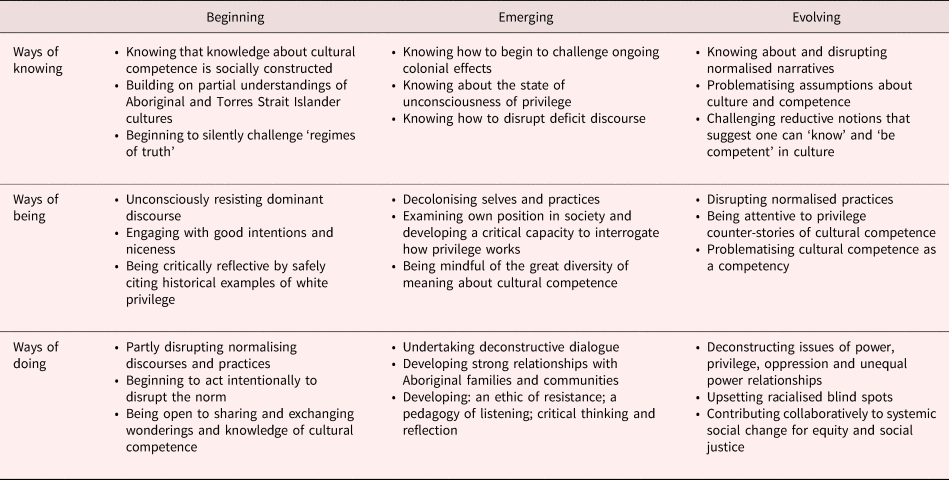
This research is an illustration of enacting Martin's (Reference Martin2003) ways of knowing, ways of being and ways of doing to deconstruct how we demonstrate cultural competence (Do), respectfully and rightfully be culturally competent (Being) through what we know about cultural competence (Knowing). Within the realm of ways of knowing, Martin (Reference Martin2003, p. 209) accentuates ‘no one person or Entity knows all’ which is congruent with the stance taken in this research that educators begin from a place of not knowing to question, reflect and extend their understandings of cultural competence. In this research, ways of knowing incorporates an element of challenging one's unconscious resistance to disrupting normalised views of cultural competence.
Martin (Reference Martin2003) articulates ways of being as about ‘the rights we earn by fulfilling relations to Entities of country and self’ (Martin, Reference Martin2003, p. 209). In this research, ways of being is about acknowledging that there are different types of knowledges at different levels of operation informed by one's stance on critical reflection. Ways of being incorporate reconceptualising the purpose of cultural competence through a decolonising lens and responding appropriately to move towards equity and social justice. Our ways of being culturally competent evolve as contexts change so we are in an ongoing, shifting state of constantly problematising cultural competence as a competency (Martin, Reference Martin2003, p. 210).
Finally, Martin (Reference Martin2003) affirms that ways of doing become a combination and expression of our ways of knowing and ways of being. Ways of doing in this research were represented as acting intentionally to disrupt normalising discourses and practices of cultural competence and developing an ethic of resistance to enable critical reflection; working collaboratively with Aboriginal families and communities to effect systemic social change for equity and social justice. These three ways of discovering have important implications for educator's in terms of how they approach operationalising cultural competence.
Table 1 accentuates a framework of learning from a place of not knowing about cultural competence to a position of challenging reductive notions that suggest one can ‘know’ and ‘be competent’ in culture. It merges diverse understandings of cultural competence as socially constructed, complex and subjective. The framework of positioning self in relationship to ways of knowing, being and doing cultural competence seeks to provide opportunities for individuals to question cultural competence in ethical encounters that disrupt dominant discourses related to the concept. The table also emphasises that we are always in a constant state of beginning the journey and continuing the journey of developing our cultural understanding
Framework of positioning self in relationship to ways of knowing, being and doing ‘cultural competence’

Conclusion
It has been demonstrated that we are often faced with common sense concepts similar to that of ‘cultural competence’ that really do nothing but ‘normalize and naturalize the existing social system, values and standards … and stunt our imaginations and prevent us from envisioning alternate possibilities’ (Keating, Reference Keating2007, p. 123). It is suggested that we start from a place of not knowing; be open to possibilities; incorporate principles of respect, reciprocity, trust and understanding; all of which underpin Indigenous epistemologies and ways of doing, to navigate discourses of cultural competence. This research advocates a position of constantly questioning, reflecting and deepening our understandings about cultural competence. Therefore, the framework of positioning self in relationship to ways of knowing, being and doing ‘cultural competence’ is valuable as a point of discussion and reflection. There is a reluctance to ‘orchestrate representations’ of where the research participants are positioned within this framework (Murdock cited in Mackay and O'Sullivan, Reference Murdock, Mackay and O'Sullivan1999, p. 28). However, the research participants could be positioned as between emerging and evolving their understandings of cultural competence. This is based on the idea that there are ‘degrees of agreement about what counts as truth’ in relation to the concept of cultural competence (Barker and Galasinski, Reference Barker and Galasinski2001, p. 66).
This research has illustrated in part the significant journey some of the educators have undertaken to interrogate and disrupt regimes of truth about cultural competence (Foucault, Reference Foucault1980). Using an Indigenous research method of yarning provided a holistic context for individuals to reflect and reconstruct their personal experiences, understandings and perspectives of cultural competence. Ways of knowing and being culturally competent requires that educators critically reflect on their understandings through sharing knowledge and consolidating what is known through reciprocity and engagement with others. This means taking time to critically analyse our ways of being and doing, that is, question what we know and how we know and how our beliefs and behaviours manifest itself in all that we do (or don't do) (Lampert, Reference Lampert, Phillips and Lampert2005, p. 89). This also requires that we move away from thinking that cultural competence equates to intervention within specific populations and move towards further developing our understandings by questioning the epistemological foundations of common sense concepts.
Conflicts of interest
None.
Karen Sinclair is a Ngarrindjeri educator who currently teaches undergraduate and postgraduate courses in Indigenous Studies within the School of Creative Industries at the University of South Australia. Her PhD focus is on educators’ understandings and perspectives of cultural competence. Research interests focus on Indigenous Knowledges in curriculum; Indigenous Research Methodologies; Critical Race Theory and Transformative Pedagogies. Karen is also the Deputy Presiding Officer of the South Australian Aboriginal Lands Trust.