

Introduction
There are several factors including genetics, time of feeding, diet, age, stress, chilling rate and ageing of the product that influence the tenderness of beef. With such a variety of factors affecting tenderness, improvement and prediction of this trait is not easy. Moreover, no rapid and non-destructive measurement of tenderness is currently available. The main methods currently employed to predict beef tenderness are consumer taste panel assessment and the Warner–Bratzler shear force (WBSF) method. Sensory panel analysis is a direct evaluation method, but it is time-consuming and has less repeatability. The WBSF method can be used to objectively determine mechanical beef tenderness. Despite the objectiveness and accuracy of the method, it is difficult to routinely apply it in the meat industry. Therefore, it is necessary to develop a non-destructive, efficient and rapid assessment method for beef quality. The major benefit of imaging-based approaches is that they provide non-destructive and non-invasive measurements. Research progress in this area suggests that the prospect of being able to estimate eating and nutritional qualities of meat may not be too far away (Maltin and Craigie, Reference Maltin and Craigie2012). X-ray computed tomography (CT) is a non-invasive, diagnostic tool, initially developed for use in human medicine. It has also been adopted for use in animal science as it can non-invasively measure fat, muscle and bone in vivo in farm animals (up to 150 kg of live weight) (Scholz et al., Reference Scholz, Bünger, Kongsro, Baulain and Mitchell2015). In Hungary, CT has been applied – mainly for research purposes – in cattle breeding, too. Computed tomographic examination of rib samples was used for the meat yield estimation of different breeds. On the other hand, slaughter value estimation of carcasses can be achieved more objectively by using CT data combined with EU carcass classification (Holló et al., Reference Holló, Szűcs, Tőzsér, Holló and Repa2007). Computed tomographic imaging is based on the attenuation of photons from an X-ray beam transmitted through the examined object. Differentiation of various materials using conventional single-energy CT is based on their X-ray attenuation expressed as CT numbers in Hounsfield units. Developments of new protocols or dual-energy scans (kV) aim to collect better data on soft tissue composition and meat quality (Kongsro, Reference Kongsro2014).
Our objective was to compare the collagen/hydroxyprolin content and CT connective tissue proportion in the longissimus thoracis (LT) muscle of Hungarian Simmental (HS) bulls and cows.
Material and methods
Altogether, carcasses from 12 bulls and 12 cows of HS cattle were randomly collected at a commercial slaughterhouse. Recorded slaughter weight was 530.6±44.7 kg for bulls and 527.33±53.54 kg for cows. Average age of bulls and cows were 696.1±566.5 days and 3042±945.3 days, respectively. Carcasses were assessed by trained operator for conformation on an 18-point scale (from 1 (the poorest) to 18 (the best)). Carcasses were also assessed for fatness on a 15-point scale (from 1 (the leanest) to 15 (the fattest)) according to the EU beef carcass classification scheme with the use of subclasses. Carcasses were chilled conventionally for 24 hours at 4°C. After 24-h chilling, samples were taken from the right half carcass LT muscle cut at the 12th rib. All rib cuts from each carcass were vacuum packed in polyethylene bags and transported to Kaposvár University for X-ray CT analysis.
Computed tomographic examination of rib samples was performed 3 days postmortem at the Institute of Diagnostic Imaging and Radiation Oncology of Kaposvár University. Two consecutive helical scans at low- and high-energy settings (80 and 140 kV) were realised by using a 16-slice CT system (Siemens Somatom Sensation Cardiac, slice thickness: 5 mm, Siemens, Erlangen, Germany). Images from samples scanned at two different energy levels were inspected by image analysis. Images from the two energy levels were added (80+140 kV). Computed tomographic value at LT muscle area of each mixed scan (80 kV+140 kV) was determined. Volumetric connective tissue content was determined (above 200 CT value) with the usage of MANGO (3.8, 2016) software.
After CT examination, samples were transported to the Analytical Laboratory of the University. After removing surface fat, intramuscular fat (IMF) content was determined gravimetrically by the Soxhlet method, using petroleum ether as solvent. Hydroxyproline measurement was used to determine connective tissue (collagen) content in meat according to the method described by Reddy and Enwemeka (Reference Reddy and Enwemeka1996). Briefly, hydroxyproline content was determined by acidhydrolysis, first, the oxidized form was reacted with 4-dimethylamino-benzaldehyde and the absorbance was measured at 560 nm. As a standard, an aqueous solution of l-hydroxyproline was used. The amount of hydroxyproline was determined from a standard curve. Total collagen was calculated as hydroxyproline ×7.25 and expressed as gram of collagen per 100 g of muscle.
Statistical analysis was performed by using IBM SPSS 20.0 software package. Bivariate correlations procedure was used for the measurement of linear association among CT data and laboratory results, and Pearson’s correlation coefficient was determined as well. Through one-way ANOVA procedure, effect of sex and slaughter age were analysed, separately. Differences among groups were analysed using LSD test (P<0.05).
Results
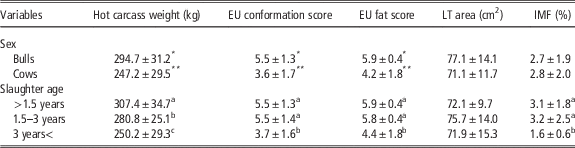
Cows had a lower carcass weight (247 kg v. 295 kg), EU conformation score (3.6 v. 5.5) and fatness score (4.2 v. 5.9) than bulls (P<0.01) in agreement with other studies comparing carcass traits in bulls and cows (Table 1). For bulls, the majority of carcasses were placed to conformation score O+(equivalent to score 15), whereas in cows the most common conformation class was P0 (equivalent to score 1). These values, due to lighter carcass weight, were lower than previously reported data. Bulls had higher LT area than cows, however, differences were not significant. Longissimus thoracis area of bulls were similar to the values registered in crossbred Simmental bulls slaughtered at the age of 18 months (Bures and Bartoň, Reference Bureš and Bartoň2012). Intramuscular fat content was the same for bulls (2.8±1.9) and for cows (2.7±1.9), and slightly lower than the minimum amount (3%) of IMF to achieve acceptable consumer satisfaction (Hocquette et al., Reference Hocquette, Gondret, Baéza, Médale, Jurie and Pethick2010).
Summary statistics of slaughter and carcass data

LT=longissimus thoracis; IMF=intramuscular fat.
*, **Means significant differences between sex.
a,b,cMeans significant differences between slaughter age.
Conformation and fatness scores of carcasses according the EUROP grid are expressed on a 18 point scale (from 1 (the poorest) to 18 (the best)) and on a 15 point scale (from 1 (the leanest) to 15 (the fattest)), respectively.
Higher slaughter age significantly decreased hot carcass weight in both sexes. EU conformation and fat scores were significantly lower in the oldest animals compared with the two other age groups regardless of sex. Older animals produced carcasses with smaller LT area and lower level of IMF (P<0.001).
Intramuscular connective tissue (IMCT) plays a significant role in determining meat tenderness. The main component of IMCT is collagen, which determines the basal toughness of meat. The ability to differentiate soft tissue structures within muscle is limited, because soft structures mainly contain small atomic components, which show similar X-ray attenuation values. According to our hypothesis, this material differentiation is with the usage of dual energy more feasible. Mean collagen content was 0.56±0.19 mg/100 g, higher than in a previous study conducted by Christensen et al. (Reference Christensen, Ertbjerg, Failla, Sañudo, Richardson, Nute, Olleta, Panea, Albertí, Juárez, Hocquette and Williams2011), but similar to the findings of Bartoň and Bureš (Reference Bureš and Bartoň2012).
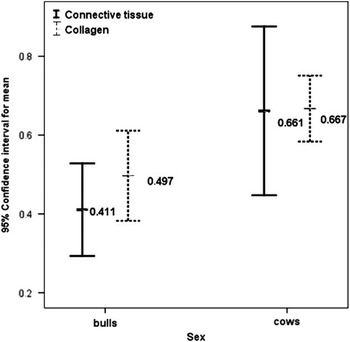
Mean collagen content of cows was significantly higher (0.7%), than that of bulls (0.5%) (Figure 1). The same tendency could be observed for the CT connective tissue content (0.4% v. 0.7% P<0.05, Figure 1). In literature, total collagen content in muscle was affected by degree of animal maturity (Blanco et al., Reference Blanco, Jurie, Micol, Agabriel, Picard and Garcia-Launay2013). It is worthy of note, that in our study, cows were significantly older than bulls. Computed tomographic connective tissue proportion of LT correlated positively with the collagen content r=0.81. A weak relationship was found between IMF content and collagen content as well as with CT connective tissue proportion (r=−0.30, r=−0.32).
Computed tomography determined connective tissue proportion (in %, solid lines) and collagen content (in mg/100 g, dash lines) according to sex (mean with 95% confidence interval).

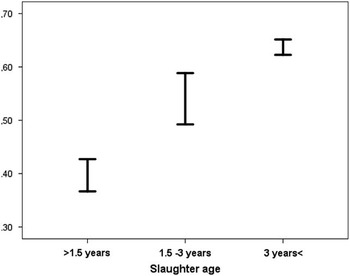
Age of animals had an impact on meat tenderness, which decreases, as animals get older. Collagen content was lower in young animals (Figure 2). The highest collagen content was observed in the oldest age group (0.65±0.11 mg/100 g), which was followed by the intermediate age group (0.59±0.09 mg/100 g). The lowest collagen content was obtained in the youngest slaughter age group (<1.5 years). Similar tendency was observed for CT connective tissue proportion (>1.5 years: 0.37±0.25%, 1.5 to 3 years: 0.49±0.15%, 3 years<:0.62±0.29%). There was a weak positive correlation between slaughter age and CT connective tissue as well as collagen content of LT (r=0.3 to 0.4).
Collagen content (in mg/100 g) according to age group (mean with 95% confidence interval).

Conclusion
Proportion of IMCT in LT increased with slaughter age and older cows had higher collagen and connective tissue proportion than bulls. Mixed CT scans can be used for the analysis of IMCT content. Further research is needed on this topic.
Acknowledgements
The authors gratefully acknowledge support from the Hungarian Scientific Research Fund (Project 111645).