Implications
This experiment has shown that, irrespective of stocking density, transporting goats for 3 h under the hot, humid tropical conditions may induce heat shock protein (hsp) 70 reaction. Elicitation of hsp 70 response suggests that the protein density may be used as a biological index of stress attributed to handling and transportation in ruminants. Further studies are warranted to investigate whether the increase in hsp 70 actually protects the goats against the adverse effects of road transportation.
Introduction
Animals during transportation may be exposed to an array of adverse physical and psychological stimuli including extreme weather conditions, noise, vibration, motion, food and water deprivation and mixing of unfamiliar animals. The procedures of loading and unloading animals into and out of transport vehicles may also result in severe distress. High ambient temperature is a major factor in the elicitation of physiological stress reactions during road transportation in livestock and poultry (Broom, Reference Broom2000). Studies on cattle (Tarrant et al., Reference Tarrant, Kenny, Harrington and Murphy1992) and sheep (Knowles, Reference Knowles1998) have shown that stocking density is crucial for animal welfare during transportation and becomes critical at high stocking densities. High stocking densities on transport vehicles have been closely associated with greater physiological stress reactions and poorer meat quality, when compared with medium and low stocking densities (Broom, Reference Broom2000).
When living organisms are exposed to thermal stresses, the synthesis of most proteins is retarded, but a group of highly conserved proteins known as heat shock proteins (hsp) are rapidly synthesized. Heat shock proteins have been proven to play a key role in protecting stressed cell and organisms, and preventing or reversing disorders caused by stress (Barbe et al., Reference Barbe, Tytell, Gower and Welch1988). The protein acts as a molecular chaperone by binding to other cellular proteins, assisting intracellular transport, and folding into the proper secondary structures and thus, preventing aggregation of protein during stress (Chirico et al., Reference Chirico, Waters and Blobel1988). It has been documented that stressors other than thermal stressors, for example, feed restriction (Zulkifli et al., Reference Zulkifli, Che Norma, Chong and Loh2001) and confinement in crates (Zulkifli et al., Reference Zulkifli, Al-Aqil, Omar, Sazili and Rajion2009) may also elicit a hsp response. To the best of our knowledge, the effects of road transportation on hsp 70 expression have not been studied in ruminants. Yu et al. (Reference Yu, Bao, Zhao and 2007) reported that transportation for 2 h increased hsp 70 and hsp 70 mRNA expression in pigs. Al-Aqil and Zulkifli (Reference Al-Aqil and Zulkifli2009) noted an increase in hsp 70 expression with transit time and suggested that the proteins are involved in the stress caused by transportation in broiler chickens. The purpose of this study was to determine the changes in hsp 70 production in goats transported in a high- or low-density group under the hot, humid tropical climate.
Material and methods
Animal welfare
This study was undertaken following the guidelines of the Research Policy of the Universiti Putra Malaysia on animal ethics.
Animals and farm
A total of 60 healthy Boer does (4.5 months of age, mean BW = 20.50 kg) were obtained from a commercial farm in Janda Baik, Pahang, Malaysia (3°31′N, 101°55′E). The climate was hot and humid with average day temperature at 35°C and night temperature at 25°C. The relative humidity fell within 70% to 90%. The goats were raised in raised slatted floor houses with zinc roofing. The dimensions of each pen of 20 animals were 8.8 m × 4.8 m. The animals were fed with Napier grass and a commercial concentrate.
Experimental design and treatments
All the 60 animals, irrespective of their home pens, were randomly assigned to three groups (control and two different transport densities) with 20 animals per treatment. The effects of two transport floor spaces (0.20 m2/animal, high density (HD); 0.40 m2/animal, low density (LD)) were investigated. The control animals remained in their home pens.
Transport vehicle, loading and journey time
An open truck with a maximum loading weight of 5000 kg was used for the study. The floor of the vehicle, measuring 5.3 m (L) × 3.1 m (W) × 2.25 m (H) was covered with wood shavings. The floor space in the truck was divided into two compartments using wooden panels. The front and rear compartments were designated for LD and HD treatment groups, respectively. On the day of the experiment (10:00 hours to 11:00 hours), each transport group animal was swiftly caught, loaded into the truck and transported for about 3 h to the Animal Research Unit, Universiti Putra Malaysia, Serdang Selangor. The animals were not restrained and the journey covered villages, highways, roads with heavy traffic and traffic lights over a total distance of about 250 km with an average speed of 76 km/h. Ambient temperature during loading was 30°C to 32°C. Food and water were withdrawn 12 h before the journey and throughout the journey.
Brain samples
After transportation, the animals were unloaded individually and five animals from each treatment group were chosen at random, anesthetized with pentobarbital sodium (30 mg/kg) by injection into the jugular vein and subsequently slaughtered according to the Halal method. The heart and kidney samples were removed and frozen in liquid nitrogen to enable the detection of hsp 70. The control animals that remained in the farm at Janda Baik were also subjected to organ sampling for hsp 70 detection.
SDS-PAGE and immunoblot analysis
Heart and kidney (0.5 g of each organ) tissues were homogenized in an Ultra-Turrax homogenizer, using 5 ml chilled Tris--HCl buffer (20 mM Tris pH 7.5, 0.75 M NaCl, 2 mM 2-mescaptoethanol) and centrifuged at 23 000 g for 30 min at 4°C. The protein concentration of the supernatants was quantified using the Bicinchoninic Acid Protein Assay Kit Procedure No. TRPO-562 (Sigma Chemical Co., St. Louis, MO, USA) with bovine serum albumin as the standard. Thirty micrograms of total protein were loaded and separated on 1.5 × 80 × 100 mm 12% polyacrylamide gels containing SDS (Laemmli, Reference Laemmli1970) using the Hoefer Mini Gel apparatus. The gels were electrophoresed at 150 V until the tracking dye reached the base of the gel. The fractionated proteins were visualized by Coomasie blue staining or transferred to polyvinyledine difluoride (PVDF) membranes (MSI, USA) (Towbin et al., Reference Towbin, Stachelin and Gordon1979). After electrophoretic transfer, the PVDF membranes were stained with 0.5 g/l Ponceau S in 10 g/l acetic acid solution to visualize and mark the positions of the proteins used as molecular weight standards. After washing the Ponceau S with distilled water, the non-specific binding sites were blocked using 10 ml of cold blocking buffer containing 10% non-fat milk and 0.05% sodium azide for 30 min. The membranes were incubated overnight (4°C) with 5 ml of blocking buffer containing antiserum (mouse anti-chicken hsp 70; Sigma Chemical Co.) against hsp 70 in a 1 : 1000 dilution. Following overnight incubation, the blots were washed four times (5 min each) with 10 ml of cold blocking buffer. The blots were then reacted with goat anti-mouse secondary antibody conjugated to alkaline phosphatase (Sigma Chemical Co.) for 1 h. After rinsing with cold phosphate buffered saline the color reaction on the PVDF membrane was developed using commercially prepared 5-bromo-4-chloro-3-indolyl phosphate/nitro blue tetrazolium (Sigma Chemical Co.). Relative density of the hsp 70 was determined using a densitometer (UVP, UK) with UVP Gel Base Pro program.
Statistical analysis
All analyses were performed using general linear models procedure of SAS (SAS Institute, 1991). A one-way ANOVA was used to analyze the data and means were separated by Duncan’s multiple range test. Results were considered statistically significant at P < 0.05.
Results
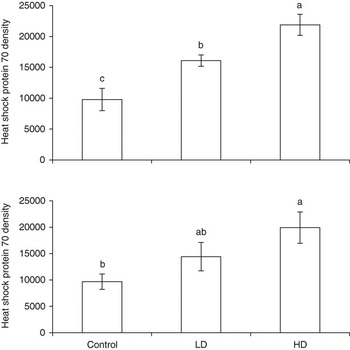
Densitometric readings of hsp 70 following transportation indicated variations according to organs (Figure 1). In the kidneys, the HD group showed the highest (P < 0.05) hsp 70 density followed by the LD and control. On the contrary, in the hearts, only the HD goats had significantly (P < 0.005) greater hsp 70 expressions compared with controls. The mean hsp 70 densities of LD goats were not significantly (P > 0.05) different from those of HD and controls.
The effect of transportation on heat shock protein 70 density of kidney (top) and liver (bottom) tissues. (a) to (c) Means with no common letters differ (P < 0.05). LD = transport floor space of 0.40 m2/animal; HD = transport floor space of 0.20 m2/animal.

Discussion
Stress-elicited hsp accumulation plays an important role in the ability to tolerate both physiological and psychological stress (Zulkifli et al., Reference Zulkifli, Che Norma, Chong and Loh2001 and Reference Zulkifli, Al-Aqil, Omar, Sazili and Rajion2009). Induction of hsp 70 expression following road transportation has been reported in pigs (Yu et al., Reference Yu, Bao, Zhao and 2007) and poultry (Al-Aqil and Zulkifli, Reference Al-Aqil and Zulkifli2009). We are unaware of prior reports on hsp expression and transport stress in both small and large ruminants. Results of this experiment clearly demonstrate that transport stress may evoke hsp 70 expression in goats. There is a question of whether the hsp 70 reaction to transportation is attributed to thermal stress per se or in combination with other noxious stimuli such as noise, acceleration and feed and water deprivation. Zulkifli et al. (Reference Zulkifli, Al-Aqil, Omar, Sazili and Rajion2009) reported that chickens subjected to crating and left stationary in a room with an ambient temperature of 24°C showed an increase in hsp 70 expressions. Thus, the hsp 70 response noted in this study could be attributed to the additive effects of various stressors associated with road transportation.
According to the Animal Welfare Guidelines of Tasmania (2008), the recommended stocking density for goats with an average BW of 20 kg is 0.17 m2/animal, which is larger than the space provided to the HD group in this study. However, the stocking density recommended by the Animal Welfare Guidelines of Tasmania (2008) may not be suitable for transported goats under the tropical hot and humid conditions. In this experiment, the HD goats had significantly greater hsp 70 density in the kidneys than their LD counterparts following transportation. There is considerable evidence that the synthesis of hsp 70 is temperature dependent (Zulkifli et al., Reference Zulkifli, Liew, Israf, Omar and Hair-Bejo2003), and thus hsp 70 response could be considered a cellular thermometer. Studies in Escherichia coli and cultured Drosophilia cells have shown that cells responded to temperature increase by increasing either the amount or the activity of a transcription factor that is specific for the heat shock gene (Etches et al., Reference Etches, John and Verrinder Gibbins1995). The differences in hsp 70 expression between LD and HD could be also attributed to non-thermal stressors. Blake et al. (Reference Blake, Udelsman, Feulner, Norton and Holbrook1991) reported that hypophysectomized rats did not exhibit hsp 70 response following restraint, and the administration of adrenocorticotrophin hormone to those rats that elicited hsp 70 expression in the adrenals. Thus, it can be concluded that hsp reaction is closely related to the hypothalamic-pituitary-adrenal axis.
Exposure to stressful stimuli may elicit hsp response in the cells of various organs. Cullen and Sarge (Reference Cullen and Sarge1997) reported that hypothermia elevated hsp 72 mRNA expression in the brain, heart, kidney, liver and lungs of mice. On the contrary, Matz et al. (Reference Matz, Blake, Tatelman, Lavoi and Holbrook1995) noted hsp induction in the brown adipose tissue of cold-stressed mice but not in the brain, heart and lungs. In this study, although transportation evoked hsp 70 expression in both heart and kidney tissues, the reaction was greater in the latter. The protective effects of hsp 70 on heart (Latchman, Reference Latchman2001) and kidney (Turman and Rosenfeld, Reference Turman and Rosenfeld1999) tissues have been documented. Yu et al. (Reference Yu, Bao, Zhao and 2007), however, indicated the converse in transported pigs. The discrepancies could be associated with the differences in the species of animals used and ambient temperatures between our study location and those of Yu et al. (Reference Yu, Bao, Zhao and 2007).
On the basis of hsp 70 density in the kidney tissues, our results suggest that hsp 70 expression increases with the magnitude of transport stress experienced by the animals. Working with pigs, Yu et al. (Reference Yu, Bao, Zhao and 2007) indicated that it was unclear whether the increase in hsp 70 reaction following transportation protects the skeletal muscle or it is an indicator of muscle damage. Koh (Reference Koh2002) reported that exercise-elicited increases in hsp may protect the skeletal muscle from injury in human beings.
In conclusion, this study demonstrated that, irrespective of stocking density, transporting goats for 3 h under the hot, humid tropical climate altered hsp 70 expression. Further studies are warranted to investigate whether the increase in hsp 70 actually protects the goats against the adverse effects of road transportation. Work in poultry showed that better ability to produce hsp 70 resulted in higher muscle glycogen content following 6 h of road transportation (Zulkifli et al., Reference Zulkifli, Al-Aqil, Omar, Sazili and Rajion2008). Hence, it is reasonable to hypothesize that hsp 70 expression may influence the meat quality of ruminants.
Acknowledgments
This work was supported by the Research University Grant of Universiti Putra Malaysia.