INTRODUCTION
Interspecific interactions are generally considered one of the important factors contributing to community structure of parasites (Poulin, Reference Poulin2001). Much of the evidence comes from gastrointestinal communities of helminths but research has also been directed to monogenean communities of fish, which represent good study systems with respect to habitat selection and niche segregation between species. In general, monogenean communities have been considered non-interactive regarding interspecific interactions (e.g. Rohde, Reference Rohde1977, Reference Rohde1979, Reference Rohde1991; Koskivaara et al. Reference Koskivaara, Valtonen and Vuori1992; Rohde et al. Reference Rohde, Hayward, Heap and Gosper1994; Geets et al. Reference Geets, Coene and Ollevier1997; Hayward et al. Reference Hayward, Lakshmi and Rohde1998; Morand et al. Reference Morand, Poulin, Rohde and Hayward1999, Reference Morand, Simková, Matejusova, Plaisance, Verneau and Desdevises2002; Simková et al. Reference Simková, Desdevises, Gelnar and Morand2000; Mouillot et al. Reference Mouillot, Šimková, Morand and Poulin2005). However, most of the previous studies have lacked the appropriate scale of investigation. First, studies have been conducted in systems with low parasite abundances (e.g. Rohde, Reference Rohde1979; Koskivaara et al. Reference Koskivaara, Valtonen and Vuori1992; Hayward et al. Reference Hayward, Lakshmi and Rohde1998; Simková et al. Reference Simková, Desdevises, Gelnar and Morand2000, Reference Simková, Gelnar and Sasal2001). In such cases, parasites have a relatively high number of vacant niches and between-species interactions are likely to be insignificant or do not occur at all. A second and more important aspect is that studies have been carried out at study scales where microhabitat-level interactions between species are easily overlooked. In many cases with small sized monogeneans, such as dactylogyrids, interactions have been analysed at the scale of gill arches or sections of the arches (Koskivaara et al. Reference Koskivaara, Valtonen and Vuori1992; Simková et al. Reference Simková, Desdevises, Gelnar and Morand2000; Bagge et al. Reference Bagge, Sasal, Valtonen and Karvonen2005; Mouillot et al. Reference Mouillot, Šimková, Morand and Poulin2005; see also Morand et al. Reference Morand, Simková, Matejusova, Plaisance, Verneau and Desdevises2002). Parasite microhabitat, however, may be highly sensitive to study scale as interspecific interactions and competitive exclusion between the small-sized individuals, if any, may take place even within individual filaments despite overlapping species distributions at a larger scale. Interactions at such study scales have remained largely unexplored, but could provide a new insight into competition between monogenean species (see also Geets et al. Reference Geets, Coene and Ollevier1997). Similarly, interactions within species may also take place at very small scales. For instance, aggregation of individual parasites in close proximity to each other within a narrow microhabitat could enhance their mate finding and reproductive success (e.g. Rohde, Reference Rohde1977, Reference Rohde1979; Morand et al. Reference Morand, Simková, Matejusova, Plaisance, Verneau and Desdevises2002). In this study, we examined interspecific and intraspecific interactions in 3 abundant Dactylogyrus species on the gills of the pond-type crucian carp (Carassius carassius).
Pond type crucian carp live in dense populations (Bagge et al. Reference Bagge, Poulin and Valtonen2004), where conditions are ideal for reproduction and transmission of directly transmitted parasites. Indeed, abundance of monogeneans of the genus Dactylogyrus on the gills of these fish is unusually high compared to many other monogenean-fish systems (e.g. Rohde, Reference Rohde1979; Koskivaara et al. Reference Koskivaara, Valtonen and Vuori1992; Hayward et al. Reference Hayward, Lakshmi and Rohde1998; Simková et al. Reference Simková, Desdevises, Gelnar and Morand2000, Reference Simková, Gelnar and Sasal2001) and all other parasite species are virtually absent because of the harsh environmental conditions in the ponds (Bagge et al. Reference Bagge, Poulin and Valtonen2004; Karvonen et al. Reference Karvonen, Bagge and Valtonen2005). Thus, these communities are ideal for studies on interspecific and intraspecific interactions. In our previous study on the community structure of dactylogyrids (Bagge et al. Reference Bagge, Sasal, Valtonen and Karvonen2005), we found no interactions between the species at the scale of gill arches. The aim in this study was to extend this analysis and explore the interactions by investigating parasite occurrence on individual gill filaments. We expected to find negative interspecific associations between the species which would be seen as occurrence of individual parasites on different filaments or parts of the filaments. We also expected to find aggregation of conspecific parasites within their microhabitats.
MATERIALS AND METHODS
Ten crucian carp [length=112·4±3·1 mm, weight=24·6±2·0 g (all figures indicate mean±s.e.)] were captured from a pond in Central Finland in August 1998 using fish traps, and were brought to the laboratory where they were freshly killed. The gills of each fish were then removed from the left side and the external and internal hemibranchs of each of the 4 gill arches (see Fernando and Hanek, Reference Fernando, Hanek and Kennedy1976; Geets et al. Reference Geets, Coene and Ollevier1997) were separated. This resulted in a total of 8 hemibranchs (referred to as A–H so that hemibranchs A and B represented those of the first gill arch, respectively, and so forth) studied from each fish. Individual filaments from each hemibranch were studied separately by first observing the parasites under a dissection microscope and then preparing a slide of each filament harbouring parasites. Furthermore, each filament was divided vertically to tip and basal parts. This set-up resulted in a total of 5273 filaments and 10 546 parts studied from the 10 fish. All adult dactylogyrids were identified to the species level with a compound microscope (100–400× magnification). Identification was based on the sclerified parts of the parasites (Gusev, Reference Gusev1985) and was performed on fresh slides. Juvenile forms, however, could not be identified to species level and they were considered as a single group. Prevalence and mean abundance (Bush et al. Reference Bush, Lafferty, Lotz and Shostak1997) were then calculated for each parasite species and juveniles.
For the statistical analysis, filaments, and their parts (tip and base), within the hemibranchs were treated as ‘independent’ samples. Although this is a simplification, e.g. because of possible interactions between the parasites, it represented a snapshot of the location of parasites on the gills at one particular time. First, to obtain a rough overview of parasite distribution, each hemibranch was divided into 10 sections, each representing 10% of the filaments. This proportional division was made because hemibranchs had different numbers of filaments (range 44–78) both between and within individual fish.
Second, to explore if negative interactions occurred between the 3 Dactylogyrus species, we calculated Spearman correlations for all species pairs (D. formosus–D. intermedius, D. formosus–D. wegeneri and D. intermedius–D. wegeneri), which is a common method for studying interspecific interactions in parasites (e.g. Simková et al. Reference Simková, Desdevises, Gelnar and Morand2000; Poulin and Valtonen, Reference Poulin and Valtonen2002; Vidal-Martínez and Poulin, Reference Vidal-Martínez and Poulin2003). The analysis was made at the scale of individual filaments and parts of the filaments (tip and basal part). First, parasite numbers on individual filaments of each fish were compared by excluding such filaments where both species were absent (i.e. double-zeros). Resulting one-tailed P-values for each species interaction (n=10) were then analysed using the inverse chi-square method by Fisher in which a combination P-value is calculated from multiple independent one-tailed tests (Hedges and Olkin, Reference Hedges and Olkin1985). Since the purpose of this analysis was to test for negative interactions, in a case of positive correlation between species, the P-value for negative interaction was calculated as 1−p. Since the result in this analysis may be affected by possible species-specific differences in parasite location on the gills (increases the proportion of filaments where only 1 of the species is present), we also conducted the analysis using only those filaments harbouring individuals of both parasite species. However, due to the low number of such filaments in individual fish, combination P-values could not be calculated, and correlation analyses (2-tailed) were conducted on data combined for all fish. Second, filaments harbouring individuals of both species were also used when analysing interspecific interactions within filaments i.e. whether individuals in a species-pair were located in different ends of the filament. This was done by analysing correlations (2-tailed) within the tip and basal parts of the filaments.
Finally, intraspecific parasite aggregation, i.e. if parasites were clumped to either end of a filament, was analysed. This was done by using data from filaments harbouring 2 or more parasite individuals of each species where aggregation of the individuals to either end could occur. Parasite numbers between the parts of such filaments were compared using Spearman correlation analysis (2-tailed) where negative correlations would indicate aggregation of parasites to either end of a filament.
RESULTS
Parasite occurrence
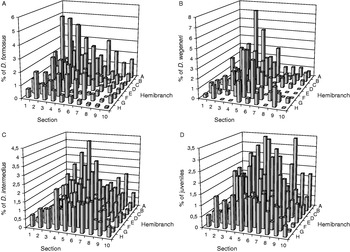
Prevalence of infection was 100% for all parasite species and juveniles. The most abundant species was D. intermedius whose mean abundance was 266·2±89·3. Abundances of D. formosus, D. wegeneri and juveniles were 129·0±28·5, 24·5±2·4 and 99·1±21·5, respectively. It should be noted that the gills were examined from the left side of each fish and therefore these values do not indicate total parasite abundances of the fish. All species as well as juveniles showed roughly equivalent distributions among the hemibranchs and horizontal sections of the hemibranchs so that the first 2 arches (i.e. hemibranchs A–D of this study) and the middle sections 3–7 of each hemibranch had the highest proportion of individuals (Fig. 1). On average, D. formosus, D. wegeneri, D. intermedius and juveniles infected 15·5% (±2·7), 4·0% (±0·2), 27·0% (±6·3) and 14·4% (±2·1) of the individual filaments of each fish, respectively. The overall mean percentage of infected filaments in the 10 fish was 46·2±5·0%. Furthermore, numbers of individuals of the 3 parasite species were not correlated in the fish [Spearman correlation analysis (n=10 for all species pairs): r=−0·337, P=0·340 (D. formosus–D. wegeneri), r=0·067, P=0·855 (D. formosus–D. intermedius), r=0·264, P=0·461 (D. wegeneri–D. intermedius)].
Distribution of Dactylogyrus formosus (A), D. wegeneri (B), D. intermedius (C) and Dactylogyrus juveniles (D) on the gills of 10 crucian carp (Carassius carassius) individuals. Gills of each fish were studied from the left side first by separating the hemibranchs of each gill arch so that hemibranchs A and B represented those of the first arch, respectively, and so forth. Each section presents 10% of the filaments of each hemibranch. Bars represent mean percentage of parasite individuals observed in one particular location on the gills of the 10 fish. Note differences in the Y-axis scales.

Interspecific interactions
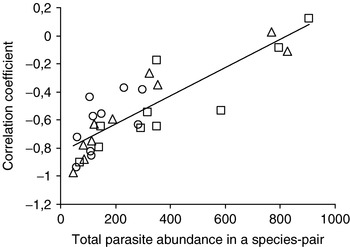
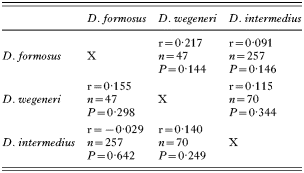
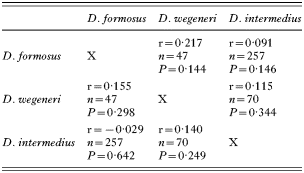
Interspecific interactions were analysed at the scale of individual filaments and parts of the filaments. At the scale of individual filaments, significant negative associations were observed in all species pairs [inverse chi-square analysis for negative interactions: P=116·08, d.f.=20, P<0·001; (D. formosus–D. wegeneri), P=91·22, d.f.=20, P<0·001 (D. formosus–D. intermedius), P=95·38, d.f.=20, P<0·001 (D. intermedius–D. wegeneri)]. However, the individual values of correlation coefficient (n=30) were strongly dependent on the total abundance of the parasite species on fish (linear regression analysis: R2=0·731, F=76·03, P<0·001; Fig. 2) so that the strongest negative associations were detected in fish harbouring fewest parasites. When interactions were analysed using those filaments harbouring individuals of both species in a species-pair, negative associations were no longer observed [Spearman correlation analysis (2-tailed): r=0·155, n=47, P=0·299 (D. formosus–D. wegeneri), r=0·118, n=257, P=0·059 (D. formosus–D. intermedius), r=0·056, n=70, P=0·646 (D. wegeneri–D. intermedius)]. Negative associations between the species were also not detected within the parts of filaments (Table 1).
Relationship between the intensity of interspecific interactions among the three Dactylogyrus parasite species (analysed using 2-tailed Spearman correlation analysis) and the abundance of parasites in each species-pair. Each marker (circles: D. formosus–D. wegeneri, squares: D. formosus–D. intermedius, triangles: D. wegeneri–D. intermedius) represents the value of correlation coefficient calculated for each species-pair on the filaments of each of the 10 crucian carp, and the corresponding total abundance of the two parasite species. The fitted line represents linear regression (R2=0·731, F=76·03, P<0·001).

Results of Spearman correlation analyses performed on the numbers of the three Dactylogyrus species on different parts of the filaments, tip (above diagonal) and basal part (below diagonal), of crucian carp (Carassius carassius)
(Only those filaments harbouring both species in a species-pair were used in the analyses.)
Intraspecific aggregation within the filaments
Parasite abundance did not differ between the parts of the filaments in any of the parasite species [paired samples t-tests on data, including filaments with 2 or more parasite individuals of each species: t256=1·337, P=0·183 (D. formosus), t21=0·276, P=0·785 (D. wegeneri), t585=0·056, P=0·955 (D. intermedius)] indicating that, on average, individuals of each species were equally distributed between the tip and basal parts. However, in juveniles, the abundance was higher in the basal part of the filaments (paired samples t-test: t168=3·811, P<0·001). Despite the equal mean distribution of adults between the parts, individuals of each species on the filaments were concentrated to one of the parts as indicated by significant negative correlations [Spearman correlation analysis on data including filaments with 2 or more parasite individuals of each species: r=−0·700, P<0·001 (D. formosus), r=−0·901, P<0·001 (D. wegeneri), r=−0·479, P<0·001 (D. intermedius)]. Further analysis indicated that the part of the filament harbouring higher numbers of worms had, on average, 85·23% (±1·29), 91·67% (±3·42) and 77·89% (±0·88) of the individuals of D. formosus, D. wegeneri and D. intermedius, respectively.
DISCUSSION
In the light of previous evidence, interspecific interactions in monogeneans are rare (e.g. Rohde, Reference Rohde1977, Reference Rohde1979, Reference Rohde1991; Koskivaara et al. Reference Koskivaara, Valtonen and Vuori1992; Geets et al. Reference Geets, Coene and Ollevier1997; Hayward et al. Reference Hayward, Lakshmi and Rohde1998; Simková et al. Reference Simková, Desdevises, Gelnar and Morand2000; Morand et al. Reference Morand, Simková, Matejusova, Plaisance, Verneau and Desdevises2002; Mouillot et al. Reference Mouillot, Šimková, Morand and Poulin2005). However, in many cases, studies have been conducted in systems with low parasite numbers or at relatively large study scales (see references in the Introduction section), which do not adequately test for such relationships. In the present study, interactions between 3 abundant Dactylogyrus species were investigated at the scale of individual gill filaments where interactions, if any, were expected to occur.
In general, the initial establishment of these parasites to skin and gills of fish (see Kearn, Reference Kearn1968) is likely to be random with respect to numbers or location of individuals of other species. This seems reasonable as parasites contacting a host fish should seek for immediate attachment to ensure the overall transmission. Some indication of this is given by our finding that the numbers of individuals of the 3 parasite species were not correlated within fish, which supports independent transmission. Parasite distribution on the gills was also roughly similar between the species; most parasites were found on the first gill arches, which probably represent the optimal area of the gills for these parasites (see also Geets et al. Reference Geets, Coene and Ollevier1997; Bagge et al. Reference Bagge, Sasal, Valtonen and Karvonen2005). Thus, it seems that there is considerable interspecific overlap in parasite occurrence on the gills. More specific site selection resulting, for example, from interspecific interactions, is therefore likely to take place after the initial establishment at a smaller scale (individual filaments) within the overall area of distribution (gills).
When the interactions between the species using data where at least 1 of the species was present on a filament were observed, significant negative associations were found between all species pairs. Interestingly, however, these associations were influenced by parasite abundance, i.e. significant negative interactions measured using conventional correlation analyses were more common in low parasite abundances and interactions became non-significant in higher abundances. This strongly suggests that the negative correlations were observed simply because the filaments harbouring only 1 of the species are more common in less saturated communities, which directly influences the result of the analysis. In more saturated communities, on the other hand, the proportion of filaments harbouring both parasite species as well as the number of individuals on the same filaments increases making the detection of negative associations more unlikely. However, negative associations were not observed either in any of the species-pairs when analysed using filaments where both species were present. Indeed, there were neither numerical (decrease in numbers of one species on a filament) nor functional (occurrence of species on different parts of the filaments) responses (sensuPoulin, Reference Poulin2001) between the species. To summarize, the above results indicate that the distributions of these parasite species overlap extensively and this also extends down to narrow-scale microhabitats, which again supports the conclusion that competitive interactions between the species are absent.
Intraspecific aggregation in monogeneans has usually been related to reproductive performance of the parasites i.e. concentration of individuals in one place could enhance mate finding and subsequent cross-fertilization (Rohde, Reference Rohde1977, Reference Rohde1979, Reference Rohde1991; Morand et al. Reference Morand, Simková, Matejusova, Plaisance, Verneau and Desdevises2002; Bagge et al. Reference Bagge, Sasal, Valtonen and Karvonen2005). It was observed that parasites were aggregated within the filaments as the majority of individuals infected one part of the filament (tip or base). This suggests that parasites are actively seeking close proximity with conspecifics and do so with high efficiency as indicated by the very high percentage of recovery of individuals from the same part (77–91%). It remains unclear, however, how this pattern initially arises. It may be that newly established parasites begin to seek for conspecifics when the site of preference could be determined by the first individual to colonize the filament. It should also be noted that although aggregation patches of adults were not consistently found in certain parts of the filaments, juveniles preferred the basal part. This may be related to factors such as lower detachment probability of juveniles with developing adhesive organs (see Kearn, Reference Kearn1968) if less pressure from the water current is directed to the basal part. However, more work is needed to verify this.
To conclude, the results suggest that negative associations do not exist in these monogenean communities even at high parasite abundances. Still, we do not know how close to saturation these communities really are. Although the overall mean percentage of infected filaments (46·2%) would suggest the presence of vacant niches, some areas of the gills may be unfeasible habitats for these parasites. On the other hand, increasingly detailed microhabitats (e.g. lamellae, secondary lamellae) could provide enough vacant niches to sustain even larger populations of worms with overlapping distributions. However, studies on interspecific interactions at such study scales may become laborious or otherwise unfeasible to perform. Nevertheless, the present study scale revealed very high intraspecific aggregation of parasites within the filaments, which is consistent with the idea of enhanced mating opportunities. This also supports the overall conclusion that intraspecific interactions in monogenean communities are likely to outweigh the importance of possible interspecific interactions (see also Morand et al. Reference Morand, Simková, Matejusova, Plaisance, Verneau and Desdevises2002).
We thank Tuula Sinisalo and Arto Tuomainen for assistance in the laboratory, and John Holmes for valuable comments on the manuscript. This study was supported by a rector's grant of the University of Jyväskylä, Kone Foundation and the Academy of Finland Centre of Excellence in Evolutionary Research.