Independence movements are today present in several stateless territorially concentrated nations, irrespective of their level of self-government. Among advanced industrial democracies, the stronger secessionist movements are found in Belgium, Canada, Italy, Spain, and the United Kingdom (Keating Reference Keating1996; Sorens Reference Sorens2005). In the absence of a secession clause in their respective constitutions, a broad array of political parties and civil society groups have mobilized to demand a self-determination referendum as a means to let the citizenry of their territories express their will (Muñoz and Guinjoan Reference Muñoz and Guinjoan2013). Canada held a referendum on the secession of Quebec in 1980 and 1995. The United Kingdom called a popular vote on Scotland's independence in September 2014. In the Spanish case, Catalonia convoked a consultation in November 2014, although the central government did not recognize its legality.
Once the date of the referendums has been established, media, political, and scholarly attention are focused not only on the evolution of the positive and negative votes, but also on disentangling the determinants of support and rejection for independence. Regarding the two referenda held in 2014 in Scotland and Catalonia, individuals’ national identity and their expectations about the economic consequences of independence were identified as the main factors underpinning support for secession (Kopasker Reference Kopasker2014; Muñoz and Tormos Reference Muñoz and Tormos2015). Although gender differences were nonexistent in regard to these variables, opinion polls showed a significant gender gap in support for constitutional change, which presents a puzzle for further research (Ormston Reference Ormston2013).
Scholarly research on political behavior has extensively explored gender differences in aspects such as voting patterns, political engagement, political ambition, ideology, party identification, and political knowledge. While the gender gap in attitudes toward institutional and constitutional change has been identified (Wenzel, Bowler, and Lanoue Reference Wenzel, Bowler and Lanoue2000), it has, nonetheless, been barely studied. This article examines gender differences in support for independence by focusing on the Catalan case. In doing so, we factor saliency of the debate on constitutional change and attitudes toward risk into the empirical analysis. Specifically, we delve into how female and male voters’ psychological dispositions toward risk-taking might affect their position toward independence and pay special attention to its potential heterogeneous effects across gender.
Whereas economics, social psychology, and behavioral medicine have long studied how attitudes toward risk-taking shape individuals’ economic and social behavior in fields such as investment, savings, gambling, consumption, health, or executive decision making, the effect of risk aversion on political behavior has received little scholarly attention (see Ansolabehere and Iyengar Reference Ansolabehere and Iyengar1995; Muñoz and Tormos Reference Muñoz and Tormos2015; Soroka Reference Soroka2014). Risk aversion is a “reasonable assumption” in the context of referendums (Hobolt Reference Hobolt2006, 627). Debates and referendums over sovereignty, as argued by Nadeau, Martin, and Blais (Reference Nadeau, Martin and Blais1999, 524), are an “ideal setting” for exploring how attitudes toward risk may influence voters’ decision making since they are “based in large part on hypothetical conjectures about the future and because the decision portend[s] potentially huge consequences.”
The remainder of the article is structured as follows. The first section introduces our theoretical arguments regarding the relationship between constitutional preferences, risk aversion, and gender. The second section describes the main factors leading to mobilization for independence in Catalonia. The third section outlines the data and research strategy followed in the empirical analysis, the results of which are presented in section four. The last section presents the main findings, discusses their implications, and suggests avenues for further research.
CONSTITUTIONAL CHANGE, RISK AVERSION, AND GENDER
The concept of risk is applied to those situations in which individuals must make decisions or choices between different alternatives with uncertain future consequences (Schubert Reference Schubert2006, 706). The recurring finding in the literature is that men tend to be less risk-averse than women (see, among others, Arch Reference Arch1993; Byrnes, Miller, and Schafer Reference Byrnes, Miller and Schafer1999; Jianakoplos and Bernasek Reference Jianakoplos and Bernasek1998). Explanations accounting for this phenomenon, though, remain somewhat underdeveloped. Some scholars have noted that women and men “may attach different meanings to what appear to be the ‘same’ risks” based on gendered practices and gendered ideologies with regard to social roles (Gustafson Reference Gustafsod1998, 810). As Booth, Cardona-Sosa, and Nolen (Reference Booth, Cardona-Sosa and Nolen2014, 128) argue, gender differences in behavior under uncertainty might stem from social learning rather than from inherent gender traits. Others have noted that the risks more commonly investigated chiefly reflect male experiences, such as investment decisions, which may bias the results. Those subjects more familiar with the risks will be more likely to perceive them as less frightening (Cutter, Tiefenbacher, and Solecki Reference Cutter, Tiefenbacher and Solecki1992, 18).
Risk aversion is a promising variable to study vote intention in sovereignty referendums since under these circumstances voters cannot draw upon past experience, and they are confronted with hypothetical conjunctures about the future that both sides of the political debate seek to shape to their advantage (cf. Nadeau, Martin, and Blais Reference Nadeau, Martin and Blais1999, 523). Although a No vote is not free of uncertainty and a simple continuation of the status quo cannot be assumed (for example, a new territorial accommodation agreement might be offered by the unionist camp), a Yes vote leading to constitutional change is usually perceived as being riskier (Dion Reference Dion2010, 120). In the context of the Scottish and Catalan referendums, when making a decision, voters might well have considered relationships with the European Union or the economic viability of the new independent state. Therefore, since the outcomes of independence processes are largely uncertain, risk disposition is likely to affect how citizens shape their preferences toward secession (Johns, Bennie, and Mitchell Reference Johns, Bennie and Mitchell2012, 595).
While some individuals may just vote expressively in these contexts, which might moderate the impact of risk aversion, the Scottish and Catalan cases suggest that the growth of proindependence support from levels below a fifth to about half of the population in just a few years is largely explained by instrumental and welfare-maximizing reasons (Muñoz and Tormos Reference Muñoz and Tormos2015). It is precisely on these premises that the Yes campaigns in both countries have been structured, making them subject to risk considerations. In fact, individuals’ risk aversion may be a rational reaction to the uncertainty underpinning constitutional change, especially where issues of legality and process are more prominent in the debates than discussions about the implications of the different constitutional options (Bell and Mackay Reference Bell and Mackay2013), as it happened in Scotland at the onset of the referendum campaign and in Catalonia until the very same day of the consultation. Given that women tend to be, on average, more risk-averse than men, that uncertain scenarios increase risk aversion (Dohmen et al. Reference Dohmen, Falk, Huffman, Sande, Schupp and Wagner2011), and that the low prominence of gender issues (and gender equality more broadly) in the debates on constitutional change may increase women's uncertainties about what independence would mean for their everyday lives (Kenny Reference Kenny2014), we present the following hypothesis:
H1:
Women are less supportive of independence than men.
Gender differences in risk attitudes, though, might not hold unconditionally. Risk in politics is largely a function of an issue's salience (Saalfeld Reference Saalfeld, Auel and Benz.2006, 69). As Hobolt (Reference Hobolt2006, 627) notes, “voters’ utility of voting for the proposal is reduced when they know little about the position.” Individuals are more or less risk-averse or risk-prone depending on the levels of information they feel they have when making a decision (Cutter, Tiefenbacher, and Solecki Reference Cutter, Tiefenbacher and Solecki1992). Indeed, information about risks alters the perception of the potential benefits (Finucane et al. Reference Finucane, Alhakami, Slovic and Johnson2000; Slovic Reference Slovic1999). In the specific case of sovereignty debates, public discourses on economic and political issues “involve areas that are relatively unfamiliar to the electorate” (Kopasker Reference Kopasker2014, 104), which might increase individuals’ uneasiness with the political process and the decision at stake (Ormston Reference Ormston2013, 5). That is, the lesser the available information, the more uncertain voters will be about the outcomes of constitutional change and the more supportive of the status quo they are likely to be.
As the salience of the political debate increases and more information is available, the level of uncertainty will be lower, thereby depressing the impact of risk aversion (Behrens et al. Reference Behrens, Woolrich, Walton and Rushworth2007; Van Schie and Van Der Pligt Reference Van Schie and Van Der Pligt1995). When uncertainty decreases, No votes might be largely explained by expressively negative positions toward constitutional change rather than by lack of information. Building on the finding that women are not particularly risk-averse when they feel properly informed (Schubert Reference Schubert2006, 710), we propose the following:
H2:
Gender differences in support for independence will gradually vanish as the debate on constitutional change becomes more salient.
This notwithstanding, we cannot rule out the following:
H3:
Risk aversion may have heterogeneous effects across gender.
Research on risk aversion has identified different responses to risk across gender, which may have important implications for behavior (Slovic Reference Slovic1999, 694). Men and women systematically differ in their responses to risk, with women making less individually oriented and more socially oriented choices than men (Eckel and Grossman Reference Eckel, Grossman, Plott and Smith2008, 518). Similarly, gender differences emerge in emotional experiences of risks (Croson and Gneezy Reference Croson and Gneezy2009, 452). One of the most consistent gender differences involves reactions to positive and negative stimuli (see Soroka Reference Soroka2014, 45–47). Women's uneasiness when anticipating negative outcomes is stronger than men's (Fujita, Diener, and Sandvik Reference Fujita, Diener and Sandvik1991). As pointed out by Schubert (Reference Schubert2006, 710), even “[when] the probability for a positive outcome increases, women are not necessarily more likely to choose the corresponding alternative.” Conversely, men's overconfidence may cancel out the impact of risk (Niederle and Vesterlund Reference Niederle and Vesterlung2007). Indeed, men's interpretation of risk is usually seen as a challenge needing response (Arch Reference Arch1993). While negatively framed messages tend to activate an “avoidance response” among women, men exhibit the highest arousal levels and comprehension scores for negatively valenced messages (Grabe and Kamhawi Reference Grabe and Kamhawi2006).
Framings of messages have been found to produce gendered outcomes in assessments of risk aversion (Booth and Nolen Reference Booth and Nolen2012, 520). Yet, while women are generally affected by framing, men are not (Fagley and Miller Reference Fagley and Miller1990). In sovereignty referendums, both unionist and proindependence actors struggle to impose their definition of risk to convince the electorate that their solution is the most cost-effective, welfare-maximizing, or safest, whereas their rivals’ option would bring about catastrophic outcomes. In particular, while we acknowledge that the impact of positive and negative visions depends on their credibility (Nadeau, Martin, and Blais Reference Nadeau, Martin and Blais1999, 537), in light of the literature discussed above, we expect that,
H4:
When confronted with negative scenarios, risk-averse women will show a lower support for independence than risk-averse men.
SUPPORT FOR INDEPENDENCE IN CATALONIA
Up until the mid-2000s, the debate on Catalonia's territorial accommodation within Spain revolved around whether decentralization could eventually develop into an asymmetrical federal state through which the so-called “historical nations” could enjoy a higher degree of regional competencies than the rest of the autonomous communities (Serrano Reference Serrano2013). However, this possibility has systematically faced the opposition of several regions whose autonomy was gradually enlarged out of competitive bargaining based on perceived comparative grievances (Guinjoan and Rodon Reference Guinjoan and Rodon2014; Muro Reference Muro2009). The two largest statewide political parties have also resisted moving away from the Spanish “coffee-for-all” model for electoral, territorial, and ideological logics (Verge Reference Verge2013).
In 2003, in a new attempt to increase the level of both self-rule and shared-rule, several Catalan political parties agreed to draft a new Statute of Autonomy (i.e., regional constitution), which stirred political strife in both Catalan and Spanish politics (Colino Reference Colino2009). The reformed Statute of Autonomy was eventually passed by the Catalan and the Spanish parliaments and, finally, voted on by Catalans through referendum in 2006. The main right-wing statewide party, the Popular Party, the Spanish Ombudsman, and several regional governments lodged an appeal before the Constitutional Court, which kept the issue of Catalan autonomy at the top of the political agenda and radicalized both the proindependence and unionist camps (Muñoz and Guinjoan Reference Muñoz and Guinjoan2013).
In 2010, the Spanish Constitutional Court ruled against several key articles of the new Statute. This ruling largely fostered a feeling of uneasiness in Catalonia with the existing territorial accommodation within Spain. The massive social mobilization in protest for this ruling decisively spurred the proindependence movement. When asked about constitutional preferences, the share of respondents supporting a Catalan independent state more than tripled, rising from 14% in 2006 to 45% in 2014.Footnote 1 Similarly, when asked about voting intention in a hypothetical sovereignty referendum, over the past few years support for independence skyrocketed, reaching 60% by late 2014.Footnote 2
As a result of steady social mobilization, in December 2013 the leaders of the six Catalan parties supporting self-determination agreed on the date and question of a sovereignty referendum. Although public opinion surveys consistently showed that around 70–80% of the Catalan population supported holding such a referendum, the various requests made by the Catalan parliament and government to allow this were voted down by the Spanish institutions and the largest statewide parties. In spite of this, the Catalan government, with the support of all parties defending the right to self-determination, organized a nonbinding consultation on November 9, 2014. More than 2.3 million Catalans turned out, with more than 80% of voters endorsing independence.Footnote 3
The proindependence movement in Catalonia presents important differences with the Quebecois and the Scottish ones. Firstly, the Yes platform is not monopolized by a single party but is integrated by parties throughout the ideological spectrum, from the radical Left to the center-Right (Serrano Reference Serrano2013). Secondly, the political process has been bottom-up, with civil society leading the demands for self-determination and pushing political parties to move forward through massive demonstrations and cyberactivism. Finally, while public events and media coverage of the Scottish referendum were largely male-dominated for most of the campaign (Kenny Reference Kenny2014), in Catalonia the Yes camp is much more feminized. Most of the social organizations supporting the referendum or specifically created to galvanize support for independence have gender-balanced memberships and are or have been led by women, although media coverage is also gender-biased.Footnote 4
DATA AND METHOD
The empirical analysis proceeds in two steps. Firstly, we use the various waves of the Political Opinion Barometer administered by the Centre d'Estudis d'Opinió (CEO) from 2011 to 2013, the only surveys with a direct question on intended referendum vote,Footnote 5 to trace from a longitudinal perspective the evolution of gender differences in support of independence. The series under exploration includes seven identical surveys, each one containing between 2,000 and 2,500 individuals interviewed by telephone (CATI). This makes a total of 16,500 respondents stratified by gender, age, and town size.
Secondly, we adopt a static perspective to examine the impact of risk aversion on support for independence and, more specifically, to tease out the potential heterogeneous effects of risk aversion across gender. In this case, we turn to a very useful piece of survey research, namely an online experimental survey also carried out by CEO in December 2013. In this survey, ten treatment subgroups had the question on intended vote in a secession referendum primed by a prior statement. Echoing public debates, the introductory statement presented five positive and five negative hypothetical conjunctures about negotiation scenarios with Spain or about the costs and benefits of independence. For example, the unionist camp typically flags the fear of Catalonia being expelled from the European Union and suffering from acute economic problems, whereas secessionists maintain that membership into the EU would be kept and that independence would boost economic growth in Catalonia. Thus, by manipulating framing operations, the heterogeneous effect of risk across gender can be empirically tackled.Footnote 6
The total number of individuals to whom a positive or a negative treatment was administered is 1,635, while 202 respondents received no treatment and thus constitute the control group. Respondents were selected from a commercial online pool among Catalan residents over 17 years old. Despite not being a probability sample of the population, the survey design applied gender, age, and area of residence (i.e., provinces, the subregional administrative divisions matching the electoral constituencies) quotas thereby granting sufficient variance in key demographics to prevent the results from being driven by the heterogeneous effects of the stimuli on a specific group of the population.Footnote 7
In order to explore the determinants of vote intention toward independence (in favor/against/undecided), our dependent variable in the two analyses, we use multinomial logistic models, taking voting against independence as the baseline category.Footnote 8 In the longitudinal analysis, the main independent variable is the salience of the territorial debate, which is captured through a question tapping what respondents consider to be the most important problem in Catalonia. This is an open question asked throughout the seven surveys under exploration that the CEO clusters into 18 categories, two of which directly tackle territorial politics and the accommodation of Catalonia within Spain. For each of the waves, we take the sum of the percentage of respondents in these two categories as a proxy for the salience of the territorial debate.
In the static model, the main independent variable is risk aversion. We rely on a direct question of subjective risk aversion that asks respondents to evaluate how comfortable they feel when taking risks. This is a continuous variable ranging from 1, “I feel very comfortable taking risks,” to 5, “I feel very uncomfortable taking risks,” so the higher the value, the more risk-averse an individual is. This variable takes after that which was used by Nadeau, Martin, and Blais (Reference Nadeau, Martin and Blais1999) in their study of the Quebec referendum. Along with self-reported risk, the experimental survey included an alternative measure. Respondents were required to decide how much of the money won in a lottery they would invest with an associated risk of either doubling or halving the prize. While the empirical analyses yield virtually the same results with the two measures, we have chosen the former for various reasons. Firstly, gambling or investment measures may fail to elicit typical decision-making behavior, and it is unclear whether such measures relate more generally to other choice contexts. Secondly, investment decisions, even after winning a lottery, are strongly conditioned by other factors, such as individuals’ social class and gender (see Mandrik and Bao Reference Mandrik and Bao2005). Investment decisions may predominantly reflect male experiences, as men are more familiar with financial risks and are thus more likely to perceive them as less frightening (Cutter, Tiefenbacher, and Solecki Reference Cutter, Tiefenbacher and Solecki1992). Additionally, women tend to perceive smaller probabilities for gains (Schubert Reference Schubert2006, 711).
Both the longitudinal and the static analyses include a variable identifying sex, which takes the value 1 for “women” and 0 for “men,” and control for several variables that have proved to be relevant when explaining Catalans’ support for independence: subjective national identification (1, “I feel only Spanish,” to 5, “I feel only Catalan”); left-right self-placement (0, “extreme left,” to 7—in the longitudinal analysis—or 10—in the survey experiment—“extreme right”); household income (12 categories ranging from less than 300€ a month to more than 6,000€); and age (continuous variable). Due to data availability, the effect of individuals’ educational level can be assessed only in the longitudinal analysis (from 1, “primary education,” to 6, “university education”). Both analyses also include the frequency of political discussion with friends and family as a proxy for political sophistication. The variable ranges from 1, “never,” to 4, “almost every day or every day,” in the static analysis, and from 1, “no frequency at all,” to 5, “very frequently,” in the longitudinal analysis.
EMPIRICAL RESULTS
While Catalans’ support for independence has tremendously increased in the past few years, some relevant gender differences have been observed when examining vote intention in a referendum, as Table 1 shows. Whereas gender differences were negligible with regard to the No vote, men were consistently more likely to vote Yes. Simultaneously, women were more inclined to abstain or to remain undecided with statistically significant differences sustained over time, thus confirming our first hypothesis. The gender gap, though, gradually shrank and eventually vanished. From June 2013 onward no statistical differences are found in support for independence between women and men. In what follows we seek to unveil the factors lying behind the evaporation of the gender gap and the extent to which the determinants of support for independence may vary across gender.
Gender differences in intended referendum vote

Source: Centre d'Estudis d'Opinió, Baròmetre d'Opinió Política.
Note: 2011 and 2012 waves include 2,500 respondents, and 2013 waves include 2,000 respondents. Negative values indicate women have a higher frequency in the corresponding response category.
+ p < .1, * p < .05, ** p < .01, *** p < .001.
The Vanishing of the Gender Gap in Support for Independence
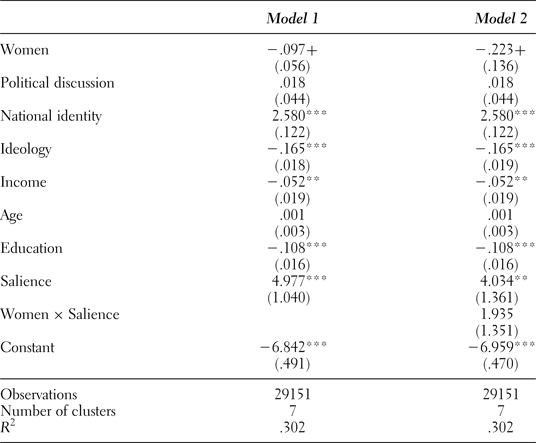
Model 1 in Table 2 presents the results of a multinomial logistic regression model on voting in favor of independence (using voting against secession as the baseline category), and data clustered by opinion poll (wave).Footnote 9 The results show that, on average, women have been consistently less supportive of independence than men, with the coefficient being statistically significant at the 10% level. Yet, as argued in the theoretical section, we expect that the growing salience of the debate over Catalonia's independence has made women more amenable to constitutional change. The salience variable, which taps the perceived most important problem in Catalonia, took its lowest value in June 2011 (4.2%), the first wave, and its highest value in June 2013 (11.1%). Except for a nonsignificant decrease in February 2012, the salience of the territorial debate steadily increased over consecutive waves. The growing importance of independence in the public sphere may have decreased the uncertainty associated with constitutional change, especially by providing information about the different plausible outcomes.
The determinants of voting in favor of independence: Longitudinal model

Note: Standard errors in parentheses.
+ p < .1, * p < .05, ** p < .01, *** p < .001.
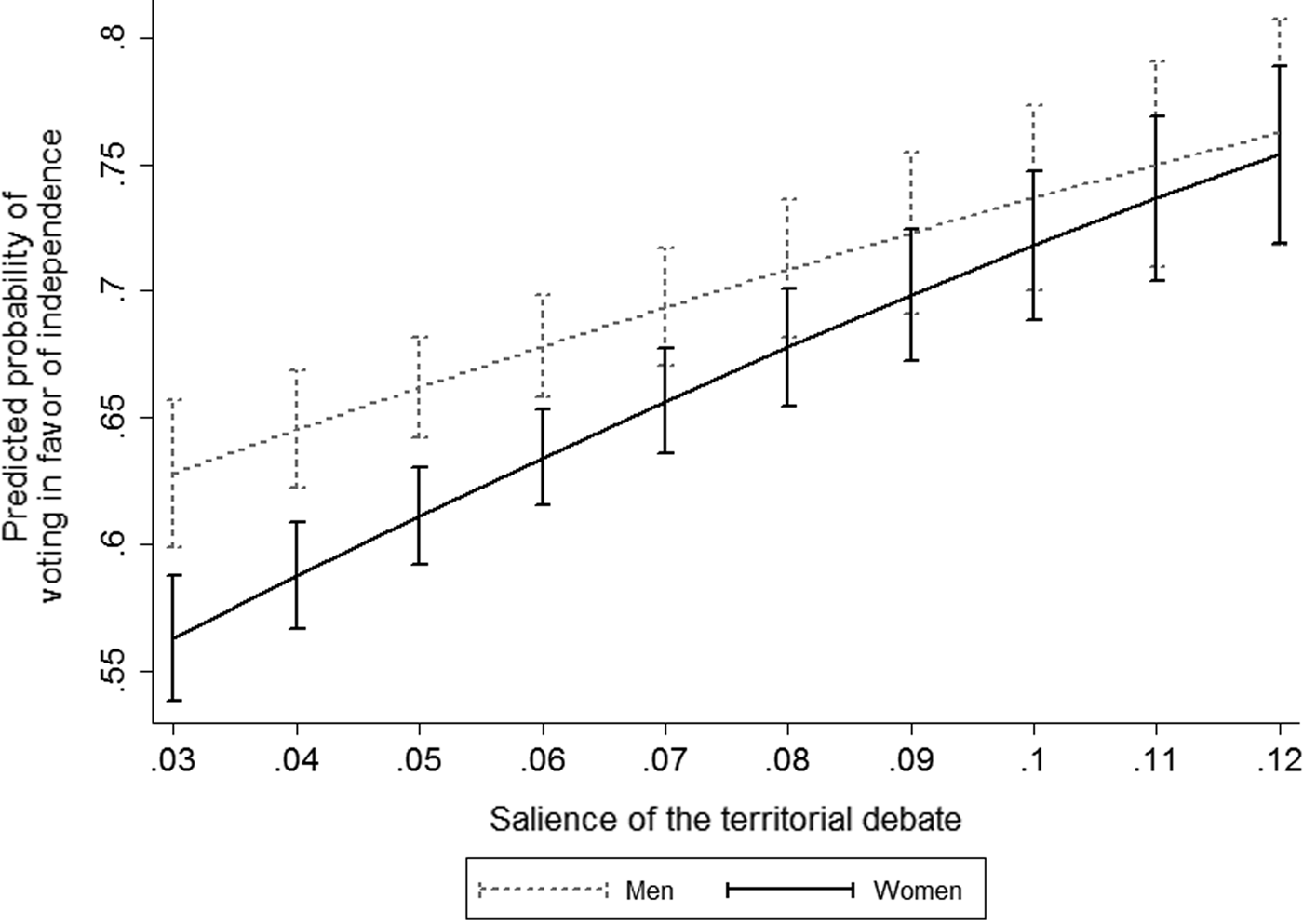
To identify whether increased salience has contributed to eliminating gender differences in support for independence, Model 2 in Table 2 introduces an interaction term between “women” and “salience” of the territorial debate—with data clustered by opinion poll.Footnote 10 The constitutive term for salience is, as expected, positive and statistically significant, indicating that as the debate became more salient, support for independence among men increased. The interaction of salience of the debate with women—which shows the marginal increase of salience of the debate among women as compared with men—is also positive, although it does not reach statistical significance. Nonetheless, when we plot the predicted values of support for independence as a function of the salience of the territorial debate, gender differences shrink. Figure 1 shows that, in line with our second hypothesis, as the salience of the territorial debate increased, gender differences in support for independence eventually vanished.
Predicted probabilities of voting in favor of independence across salience levels by gender.

Risk Aversion, Gender, and Support for Secession
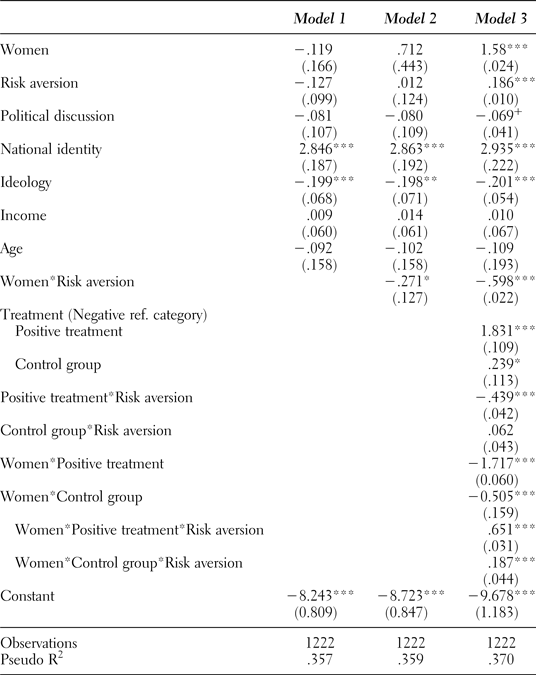
With a view to assessing the impact of risk aversion on support for secession, Table 3 shows the results of a multinomial logistic model, with voting against Catalan independence being again the baseline category. Model 1 in Table 3 shows that gender is not statistically significant. It is worth noting that the experimental survey was administered in December 2013, when the overall gender gap in intended referendum vote was already nonexistent (see Table 1). Women are thus equally likely to vote in favor of independence than men, when national identity, ideology, political discussion, income, and age are controlled for. Similarly, on its own, risk aversion does not reach statistical significance. The remaining variables show that national identity is the strongest predictor of voting in favor of independence. The more Catalan an individual feels, the more likely (s)he is to cast a favorable vote in the event of a referendum. Individuals placed in the Right of the ideological spectrum are less likely to support independence. These two findings align with previous studies (Muñoz and Tormos Reference Muñoz and Tormos2015). Lastly, the model shows that political discussion, income, and age have basically no impact on support for independence.
The determinants of voting in favor of independence: Static model

Note: DV: Intended referendum vote (baseline category: voting against independence).
Standard errors in parentheses.
+ p < .1, * p < .05, ** p < .01, *** p < .001.
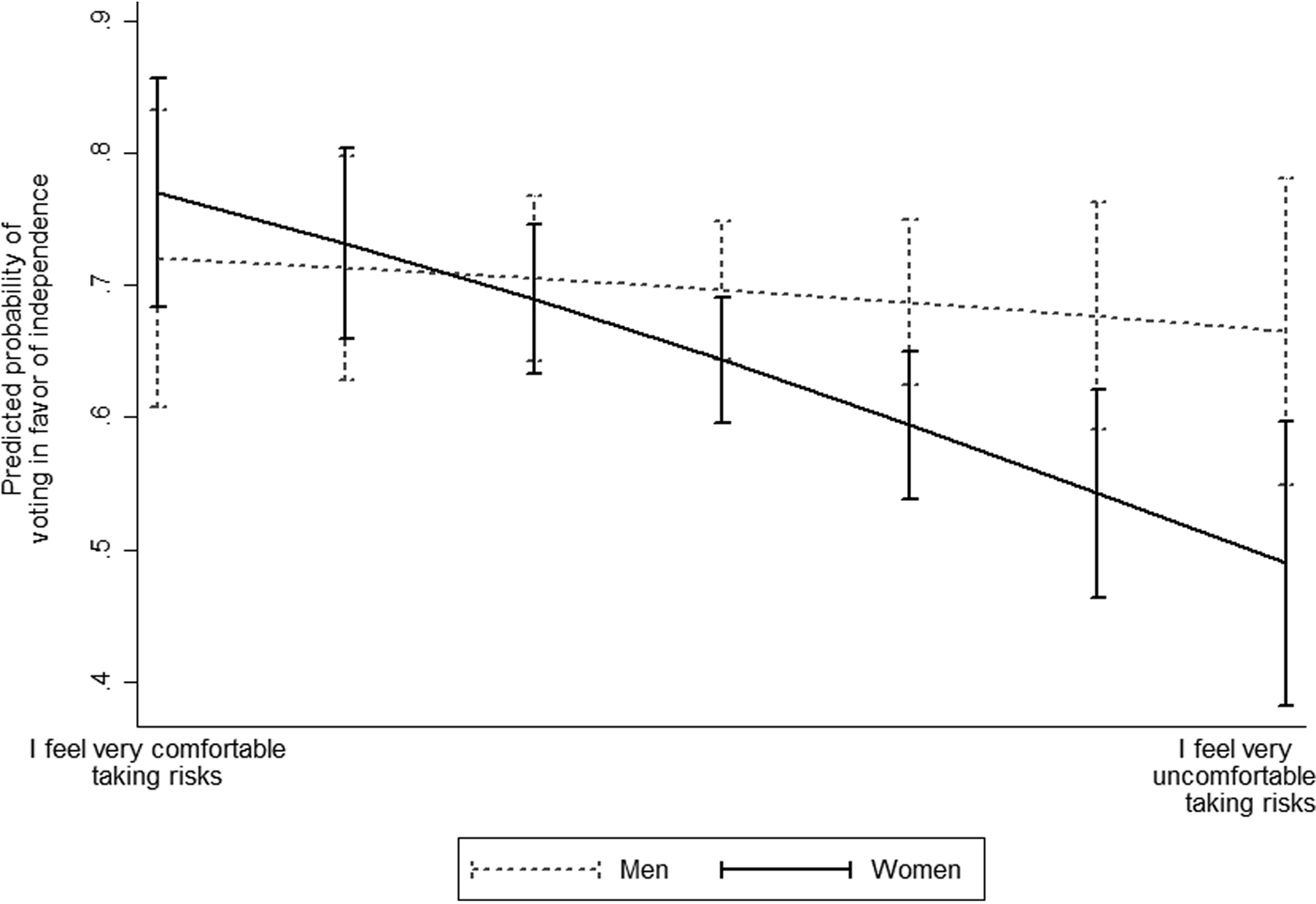
We do not expect, though, gender differences in support for independence to be additive, but rather conditional on the presence of risk attitudes. To test whether aversive attitudes toward risk-taking have heterogeneous effects among women and men, Model 2 in Table 3 includes an interaction term between individuals’ level of risk aversion and gender. The interaction term is significant and negative, indicating that risk-averse women are less likely to vote in favor of independence than men with similar psychological dispositions, thereby confirming our third hypothesis. Figure 2 plots the interaction and shows the predicted probabilities of voting in favor of independence across gender for different levels of risk aversion. Whereas for the male group predicted probabilities are very stable across varying degrees of subjective risk-taking attitudes, for the female group, the higher the uneasiness with assuming risks, the lower the support for independence. The remaining variables show considerable consistency with Model 1. National identity and ideology are still, in this order, the most relevant predictors of voting in favor of independence, whereas income, political discussion, and age are not statistically significant.
Predicted probabilities of voting in favor of independence across risk-aversion attitudes by gender.

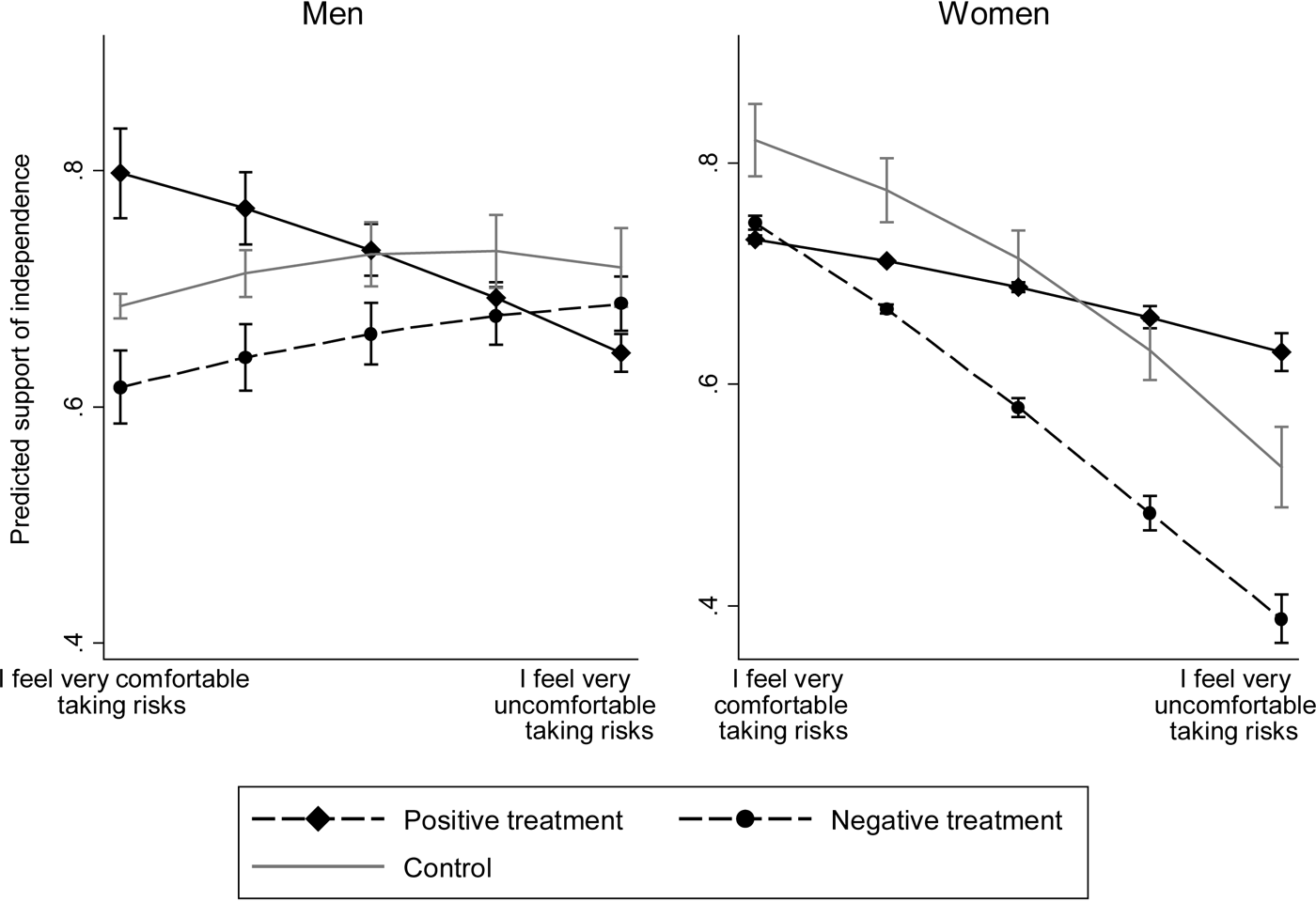
Having confirmed that risk aversion produces heterogeneous effects by gender, we then proceed to explore heterogeneity in greater detail by factoring into the empirical analysis the framing of hypothetical positive or negative scenarios surrounding the independence process or independence itself. Almost half of the respondents were primed with a positive treatment, about another half with a negative treatment, and the remaining group received no treatment (control group). Following our theoretical expectations, we test whether manipulating the framing—that is, administering a positive or a negative treatment—has a differential effect on the conditional relationship between gender and risk aversion. More concretely, we sustain that, when confronted with negative scenarios, risk-averse women will be less likely to support independence than men with a similar psychological disposition (H4).
This theoretical expectation requires modeling a triple interaction between gender, risk aversion, and treatment category (positive/negative/control group). Triple interactions mean that there is a two-way interaction that varies across the levels of a third variable.Footnote 11 In our case, we seek to find out whether the interaction between risk aversion and the (positive/negative) treatment differs across gender. Model 3 in Table 3 indicates that the triple interaction is statistically significant. In order to make the interpretation of the results easier, Figure 3 plots the impact of the negative and positive treatments among women and men as a function of their risk aversion. As can be seen, negative treatments drive support for independence downward dramatically. Likewise, women feeling very uncomfortable with taking risks but having received no treatment show a significantly lower probability to vote in favor of independence, as compared with less risk-averse women. Although the slope is shallower, the same trend is observed for women having received the positive treatment. These results indicate that risk aversion shapes women's position on independence, with negative treatment magnifying this pattern and positive treatment moderating (albeit not eliminating) it.
Predicted probabilities of voting in favor of independence across risk-aversion attitudes by gender and treatment group.

Positive and negative treatments impact men differently (see also Figure 3). Under positive treatments, like in the case of women, men with higher levels of risk aversion are less likely to vote in favor of independence than those with lower levels of risk aversion. Interestingly, negative treatments do not depress men's support for independence, regardless of their level of risk aversion, as it does for women. Indeed, as men's risk aversion climbs, negative priming slightly increases support for independence. Although the effect of positive and negative priming is also statistically significant for men, it is weaker than for women, thereby providing support for H4.
Overall, the findings from the experimental survey clearly corroborate our expectation of gendered heterogeneous effects of risk aversion on voting for independence when negative or positive treatments are administered.Footnote 12 As predicted, women are less likely to vote in favor of independence at higher levels of risk aversion and when primed with negative scenarios. Conversely, men's probability to vote in favor of independence is only slightly shaped by risk aversion, with positive treatments inducing a lower probability of supporting independence and negative treatments having the opposite effect.
CONCLUSIONS
This article has shown that the effects of the psychological dispositions toward risk can also be expanded to voters’ decisions, especially high-stake political decisions. Referendums, and especially consultations on the possibility to create a new state, provide excellent opportunities to study this relationship since independence entails a large amount of uncertainty. Precisely, political actors tend to structure the public debate around the positive or negative effects that independence might bring about, thereby seeking to shape voters’ attitudes toward risk. The Catalan case follows the same pattern as the Quebec and Scottish cases where the gender gap in support for change shrank in the final stages of the referendum campaigns. Our empirical analysis suggests that while the gender gap in constitutional preferences existed at the onset of the constitutional debate—with women being less supportive of independence—it progressively disappeared as the salience of the debate increased.
The empirical analysis also shows that risk aversion produces heterogeneous effects across gender in the case of sovereignty referendums. Our results indicate that women's likelihood of voting in favor of independence is depressed by uneasiness with risk-taking, even in contexts where vote intention no longer shows a significant gender gap, as in Catalonia. Yet, the effect of risk aversion on women's support for independence seems to be moderated by the priming of the risks at stake. The gendered impact of risk on support for independence is thus conditional upon the type of hypothetical conjunctures about the future of the independent state respondents are confronted with. Whereas positive scenarios do not produce significant differences across groups, negative scenarios generate heterogeneous effects. Under the latter, risk-averse women are significantly less likely to vote in favor of independence than men with similar risk-taking attitudes.
Bearing in mind that this heterogeneous response to risk is found in a no-stakes survey, where respondents may feel they can safely express opinions at a low-cost opportunity, larger gender differences in the event of an actual vote (i.e., a binding referendum) are likely to appear, with voters being then more apprehensive about the consequences of their decision. Indeed, the lower support for independence in the Scottish referendum among women over 55 and its impact on the overall results—the No camp gathered 55% of the vote—suggests that women may play a crucial role in determining the outcome of sovereignty referendums, specifically if catastrophic visions manage to dominate the public debate.
For this reason, in-depth qualitative research is much needed to tease out the gendered meanings of risk aversion for differently situated women and men and its consequences on political behavior. In particular, a qualitative approach could provide valuable insights to the moderating factors of risk aversion among women under uncertain scenarios. For example, in the case of sovereignty referendums, gender differences in risk aversion might well be overcome where political actors frame constitutional change as a means to address the policy issues of particular concern to women, including welfare, gender equality, gender-balanced political representation, and social justice more broadly. As seen in Scotland, the gender gap in support for independence was significantly reduced after the publication of the white paper by the government that instilled public debate among the population. Additionally, the mobilization and representation of women's views in the political process may be of paramount importance. Where women are visible in the independence campaign, either as leaders of proindependence political parties and civil society groups or as strong grassroots women's organizations (like the Scottish Women for Independence), female voters might not only feel more “present” in the political discussions and thus become more engaged, but they may also be incentivized to acquire more information, a crucial element for decreasing levels of risk aversion.
The methodology applied in this article may help other fields of study to shed more light on the heterogeneous impact of risk aversion across gender, especially when dealing with threatening social environments. These may include, for example, research on gender differences on authoritarianism or the acceptability of the use of military force. The analysis can also be expanded to other high-stake political decisions, such as the adoption of institutional reforms leading to uncertain consequences. Finally, although neither experimental nor regular surveys are usually rich enough to delve into the reasons behind the heterogeneous effects of risk aversion across gender, we suggest that the answer may lie in a combination of factors. As already noted by the extant literature, heterogeneity might be due to the fact that men tend to be aroused by negative scenarios or face them as challenges instead of deploying an avoidance reaction, as is more common among women. It might also be the case that men hold a stronger expressive position for independence, which may moderate the effects of risk aversion levels on this population group, whereas women's vote may be less expressively based and rely instead to a larger extent on instrumental reasons—especially on those that maximize the economic, social, or cultural well-being of the whole population. Several nuances are thus needed to avoid overemphasizing and essentializing gender differences in risk aversion and their impact on political behavior.