Introduction
Sorghum (Sorghum bicolor L. Moench) is among the major grain crops in many parts of the world. In Pakistan, it is mainly grown not only for fodder purposes but also for grain production in certain areas in semi-arid and arid regions (Ghani et al., Reference Ghani, Saeed, Hussain, Arshad, Shafique and Shah2015; Hussain et al., Reference Hussain, Baloch, Yousaf, Naeem, Khakwani and Begum2011). Sorghum is planted on an estimated area of 0.34 million ha with an average yield of only 0.62 t ha−1 (Habib et al., Reference Habib, Tahir and Ain2013). Sorghum grain is used as food but only on a small scale when compared to the main staple grains, such as wheat (Triticum aestivum L.) and rice (Oryza sativa L.). However, sorghum grain is extensively used as animal feed due to its high nutritional profile (Ghani et al., Reference Ghani, Saeed, Hussain, Arshad, Shafique and Shah2015), besides growing well in arid environments due to its tolerance to drought and heat stress (Ghani et al., Reference Ghani, Saeed, Hussain, Arshad, Shafique and Shah2015; Hussain et al., Reference Hussain, Baloch, Yousaf, Naeem, Khakwani and Begum2011).
Weeds are a significant problem to grain sorghum production as farmers do not often remove weeds manually or mechanically. Although sorghum is a crop with a relatively high suppressive ability due to its allelopathic potential, some weed species are less sensitive than others (Moore et al., Reference Moore, Murray and Westerman2004). Therefore, it is important to assess the competitive ability of dominant weeds in sorghum crops. Parthenium weed (Parthenium hysterophorus L.) is an invasive weed known to infest a large number of crops, including sorghum (Bajwa et al., Reference Bajwa, Chauhan, Farooq, Shabbir and Adkins2016, Reference Bajwa, Ullah, Farooq, Chauhan and Adkins2019b,c,d). It has been proposed that parthenium weed was introduced into Pakistan from neighbouring India potentially through trade of infested commodities and river system. In a recent large-scale survey, we reported that parthenium weed had spread across many districts in irrigated cropping systems of Punjab, Pakistan and found to infest all major crops and grazing lands costing the farming communities (Bajwa et al., Reference Bajwa, Farooq, Nawaz, Yadav, Chauhan and Adkins2019a).
Parthenium weed germinates, grows and reproduces under a wide range of environmental conditions (Bajwa et al., Reference Bajwa, Chauhan, Farooq, Shabbir and Adkins2016, Reference Bajwa, Chauhan and Adkins2018, Reference Bajwa, Wang, Chauhan and Adkins2019e) due to its vigorous growth habit, strong competitive ability, high nutrient and moisture uptake ability and an allelopathic competence (Bajwa et al., Reference Bajwa, Chauhan, Farooq, Shabbir and Adkins2016; Nguyen et al., 2017; Singh et al., Reference Nguyen, Bajwa, Navie, O’Donnell and Adkins2003). It has been reported to cause severe growth reduction and yield loss in important grain crops, such as maize (Zea mays L.) and sorghum (Safdar et al., Reference Safdar, Tanveer, Khaliq and Riaz2015; Tamado et al., Reference Tamado, Ohlander and Milberg2002). For instance, it caused up to 50% yield loss in maize in Pakistan (Safdar et al., Reference Safdar, Tanveer, Khaliq and Riaz2015, Reference Safdar, Tanveer, Khaliq and Maqbool2016) and almost total crop failure (97% yield loss) in a sorghum crop heavily infested by parthenium weed in Ethiopia (Tamado et al., Reference Tamado, Ohlander and Milberg2002). In another study, Tamado and Milberg (Reference Tamado and Milberg2000) reported that parthenium weed was the second most frequent weed across 240 arable crop fields in eastern Ethiopia.
The detrimental effects of parthenium weed on crop growth and yield depends on its density and competition duration with the crop, just like most weed species. At just 3 plants m-2, parthenium weed caused up to 70% grain yield loss in sorghum under rainfed conditions (Tamado et al., Reference Tamado, Ohlander and Milberg2002). There are only a few studies reporting the effect of parthenium weed on crop performance when it competed with crops for different durations. In Ethiopia, the critical competition duration of parthenium weed with grain sorghum was between 19 and 69 days after crop emergence (Tamado et al., Reference Tamado, Ohlander and Milberg2002). However, this critical period in maize crop was between 17 and 23 days under irrigated conditions in Pakistan (Safdar et al., Reference Safdar, Tanveer, Khaliq and Riaz2015). The competition dynamics of any weed species is likely to vary among crops and regions. Therefore, region-specific studies are needed to determine the actual density thresholds and critical competition duration of problematic weeds such as parthenium weed.
Parthenium weed is an emerging problem in grain sorghum production in Pakistan, which has the potential to significantly hit the subsistence farming in semi-arid and arid areas. Similar trend has also been observed in many south Asian and African countries. Therefore, this field study was conducted to determine the effect of parthenium weed on growth and yield of grain sorghum at varying weed densities and competition durations under arid conditions. The results of the present study will provide important information about the extent of losses caused by parthenium weed in grain sorghum and will help in determining the suitable time and density thresholds to manage this problematic weed.
Materials and Methods
Experimental site and weather
Two different field experiments were conducted at the Research Farm of Bahauddin Zakariya University, Layyah, Pakistan (30.96°N, 70.93°E and 143 m a.s.l.) in 2016 and were repeated in 2017 at the same site. The area has a desert climate with average annual rainfall of 195 mm. Total rainfall during the crop growing season (July to October) was 207 and 103 mm in 2016 and 2017, respectively (Adaptive Research Farm, Karor, Layyah). The average maximum and minimum air temperatures during growing season were 33 and 20°C, respectively during both years. The soil was a sandy loam with pH of 8.0, an organic matter content of 0.6%, electrical conductivity of 0.53 dS m-1, and nitrogen, phosphorus and potassium contents of 400, 6 and 159 ppm, respectively.
Experimental design and treatments
Both experiments were laid down in a randomised complete block design with three replications per treatment and a net plot size of 8.0 × 2.2 m. The field chosen for this work had been free of parthenium weed infestations in the past. Therefore, seeds of parthenium weed were uniformly broadcasted onto each experimental plot, except for the control treatments in both experiments where no parthenium weed plants were required. The weed species emerging, other than parthenium weed, were removed regularly from all the treatments by hand.
Experiment 1 (Effect of density): five different densities of parthenium weed (0, 5, 10, 15 and 20 plants m-2) were established as the experimental treatments. Parthenium weed plants in excess to the required density in a treatment were also removed by hand pulling. A control treatment (0 plants m-2) was kept free from parthenium throughout the crop season by manual weed control.
Experiment 2 (effect of competition duration): six different treatments were evaluated: a season-long weedy treatment; weed-free after 2, 4, 6 and 8 weeks of crop sowing; and a season-long weed-free treatment. A uniform parthenium weed density of 15 plants m-2 was maintained in all treatments and excess parthenium weed seedlings were removed just after emergence. The season-long weed-free treatment was kept free from parthenium weed throughout the crop season by manual weed control.
Crop husbandry
A soaking irrigation was applied to the field, which was then cultivated two times and levelled to prepare a uniform seed bed. Seeds of sorghum cultivar ‘Lajawab’ were obtained from Maize and Millets Research Institute, Sahiwal, Pakistan. Planting was undertaken at the seed rate of 10 kg ha-1 using 30-cm spaced rows. Sowing using a manual seed drill was completed in the second week of July during both years. The crop was flood irrigated at the critical growth stages of booting, panicle initiation and the start of grain formation. The N and P fertilisers were soil applied at the rate of 80 and 40 kg ha-1 as urea (46% N) and diammonium phosphate (46% P2O5), respectively. A full dose of P and a half dose of N were applied at the time of sowing. The remaining half dose of N was applied in two splits at 25 and 50 days after sowing. The experiments were harvested in mid-October during both years.
Evaluations
Parthenium weed biomass was recorded from two randomly selected locations within each treatment plot (each 1 m2) just before harvesting the crop in Experiment 1 and just before imposing the weed-free periods in Experiment 2. Parthenium weed plants were cut just above soil level and placed in paper bags. Dry biomass was recorded after oven drying at 70 °C for 72 hours. Five sorghum plants were randomly harvested by cutting just above the soil level from each treatment 60 days after sowing. Samples were weighed to record the average fresh weight per plant, then placed in paper bags and dried in oven at 70 °C for 72 hours to determine the dry biomass per plant. The number of leaves was also counted from 10 randomly selected sorghum plants from each treatment at the same growth stage. The height of 10 plants per treatment plot was recorded and averaged just before harvest. The crop was harvested separately for each treatment plot manually (with a sickle) when it had reached the maturity. The heads were removed and dried before threshing. The number of heads was also counted from two randomly selected locations within each treatment plot (each 1 m2) before harvesting the crop. After harvesting and threshing, a randomly selected subsample of 1000 grains was taken from each plot, weighed and the average 1000 grain weight was recorded.
Statistical analysis
Data from both years were subjected to an analysis of variance which revealed a significant effect of year (p < 0.05); therefore, data for both years were analysed separately using Statistix-8.1 software (Analytical Software, Tallahassee, FL, USA). However, the year effect on sorghum grain yield was non-significant in Experiment 2, so the yield data of both years were pooled to analyse the effect of parthenium weed competition durations. In Experiment 1, the data were analysed by regression analysis using SigmaPlot v.14 (Systat Software Inc., San Jose, CA, USA) as the experimental treatments were quantitative in nature. The coefficient of determination (R 2) values was presented to depict the strength of each relationship. The regression model was selected on the basis of fitness as detected by the software and by observing the data trend and R 2 values. The individual values of different replications of each treatment were used for the regression analysis as using the mean values did not substantially improve the R 2 values. In Experiment 2, we used the analysis of variance and the treatment means were separated using the least significant difference (LSD) test at p < 0.05. Sorghum grain yield losses were calculated by the following equation:
 ${\rm{Percentage\; yield \;losses}} = {Y_0 - Y_T \over Y_0} \times 100$
where Y 0 is grain yield at the parthenium weed density of 0 plants m-2 and Y T is yield in the respective treatment having a particular density of parthenium weed. The correlation between parthenium weed biomass and sorghum grain yield was plotted in SigmaPlot, and the strength of relationship was presented by correlation coefficient (r).
Results
Effect of density
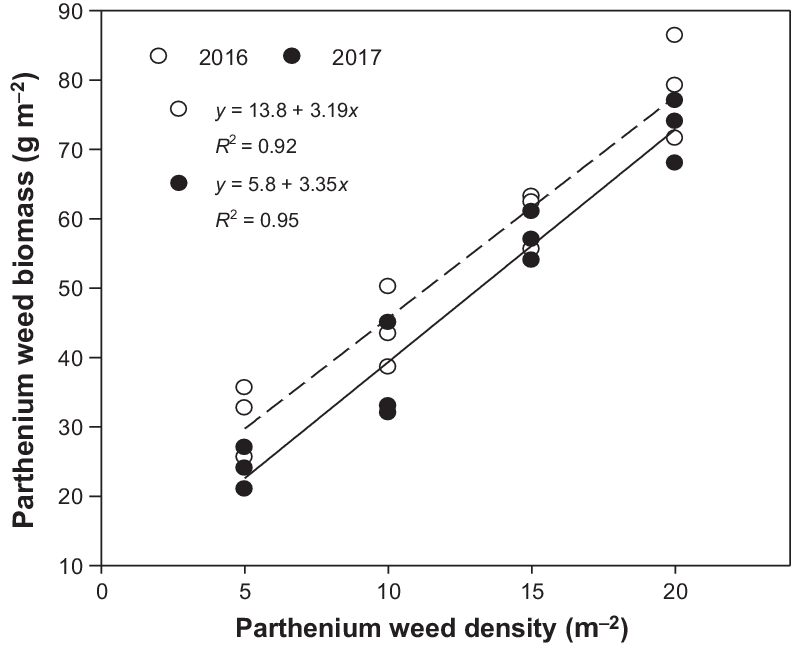
Parthenium weed dry biomass increased significantly (p < 0.001) with increasing parthenium weed density during both years (Figure 1). Parthenium weed densities of 5 and 20 plants m-2 produced the highest (79 and 73 g m-2) and the lowest (32 and 24 g m-2) dry biomass during 2016 and 2017, respectively (Figure 1).
Effect of different densities of parthenium weed on its biomass in a sorghum crop during the 2 years of study.

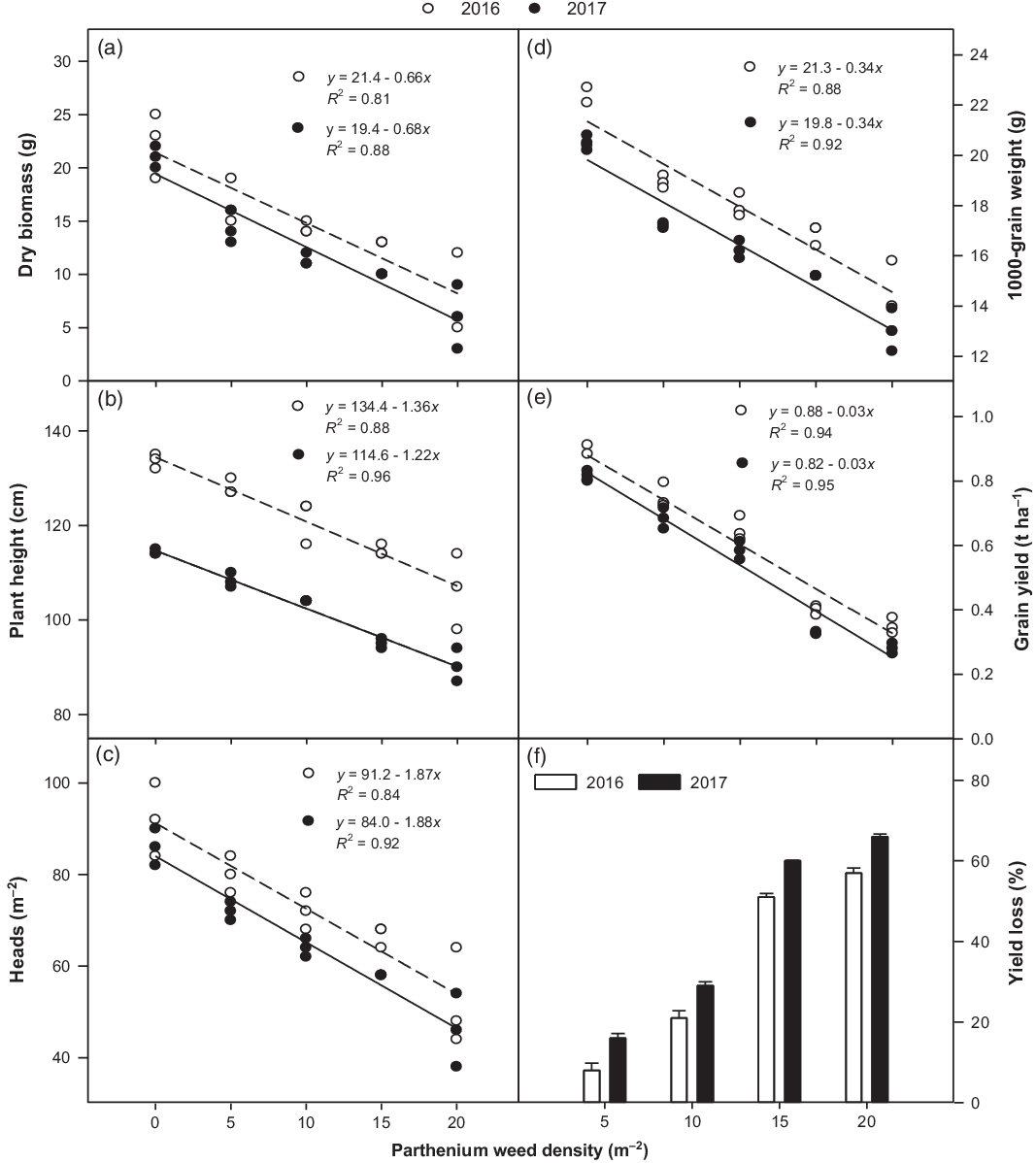
All the densities of parthenium weed had a significant (p < 0.001) effect upon sorghum biomass per plant during both years and the highest biomass (21 and 22 g) per plant was recorded in the plots free of parthenium weed (Figure 2a). It was reduced by 25–67% and 31–72% at parthenium weed densities of 5–20 plants m-2 during 2016 and 2017, respectively, as compared to the parthenium weed-free treatment. The tallest sorghum plants (133 and 114 cm) were observed in plots free of parthenium weed during 2016 and 2017, respectively (Figure 2b). Sorghum plants were 4–20% and 5–21% shorter at the parthenium weed densities of 5–20 plants m-2 during 2016 and 2017, respectively, as compared to the parthenium weed density of 0 plants m-2. The lowest number of heads (52 and 46), 1000-grain weight (14.3 and 13.0 g) and grain yield (0.35 and 0.28 t ha-1) were recorded at the highest parthenium weed density of 20 plants m-2 during 2016 and 2017, respectively (Figure 2c-e). Even parthenium weed densities of 5 plants m-2 caused significant reductions in the number of heads, 1000-grain weight, and grain yield of sorghum as compared to the parthenium weed density of 0 plants m-2 (Figure 2c-f). Parthenium weed densities of 16 and 13 plants m-2 were estimated to cause 50% losses in sorghum grain yield during 2016 and 2017, respectively (Figure 2e). Parthenium weed biomass and sorghum grain yield had strong negative correlation during 2016 (r = −0.95) and 2017 (r = −0.98).
Effect of different densities of parthenium weed on (a) dry biomass per plant, (b) plant height, (c) number of heads m-2, (d) 1000-grain weight, (e) grain yield and (f) yield loss of sorghum during the 2 years of study. Error bars represent ± standard errors of mean.

Effect of competition duration
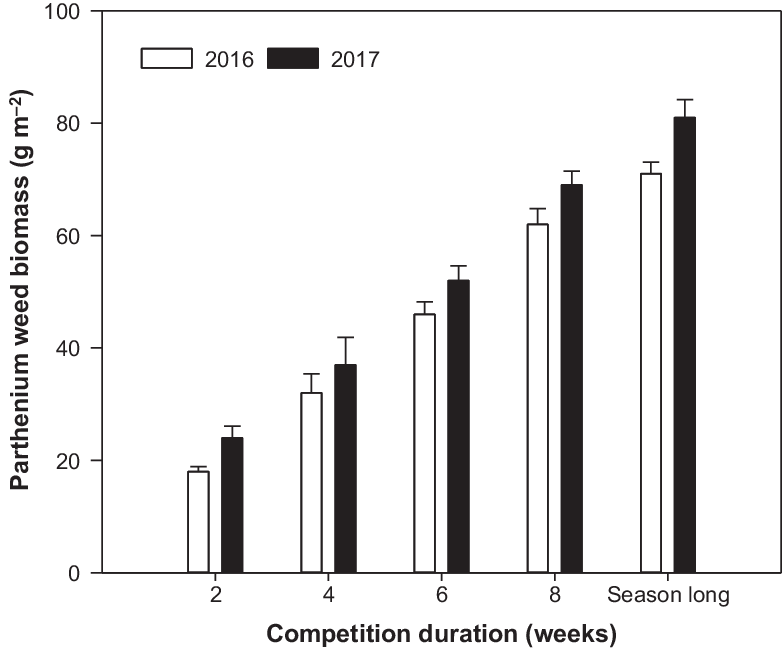
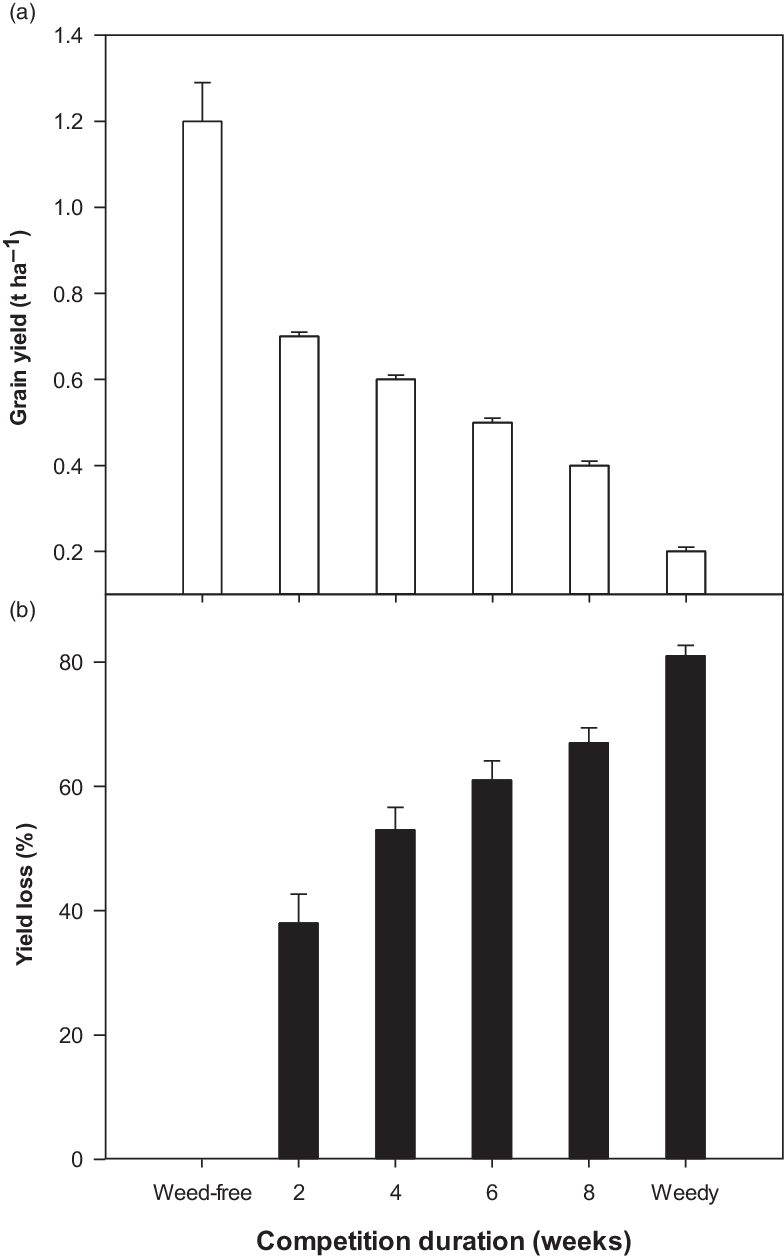
Parthenium weed dry biomass increased significantly (p < 0.05) with increasing competition duration between parthenium weed and sorghum during both years (Figure 3). Parthenium weed dry biomass was highest (70 and 81 g) and lowest (18 and 24 g) in the season-long weedy and weed-free after 2 weeks treatments during 2016 and 2017, respectively (Figure 3). The grain yield was significantly (p < 0.05) reduced by increasing parthenium weed competition duration and parthenium weed competition for 2, 4, 6, 8 weeks and full season caused 38, 53, 61, 67 and 81% loss in sorghum grain yield, respectively (Figure 4a,b). Parthenium weed biomass and sorghum grain yield had a strong negative correlation (r = −0.95).
Parthenium weed dry biomass at different competition durations in a sorghum crop during the 2 years of study. Error bars represent ± standard errors of mean. LSD values were 8.44 and 9.14 for 2016 and 2017, respectively, at p < 0.05.

Sorghum (a) grain yield and (b) yield loss as affected by parthenium weed at different competition durations. Error bars represent ± standard errors of mean. The data of grain yield for the 2 years were pooled as the year effect was non-significant (p = 0.91) for this parameter.

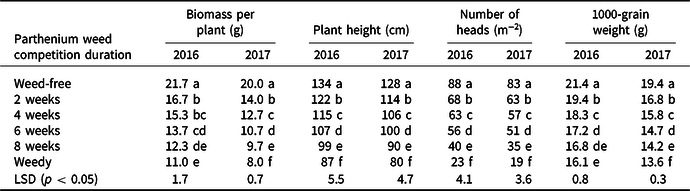
Sorghum dry biomass per plant was also significantly reduced with increasing duration of parthenium weed competition (Table 1). The season-long weedy treatment caused the highest reductions in sorghum dry biomass during both years of study and increasing competition duration also had a significant (p < 0.05) negative effect on plant height of sorghum as compared to the season-long weed-free treatment (Table 1). The sorghum plants were tallest in a season-long weed-free treatment, while the number of heads and 1000-grain weight of sorghum were lowest in season-long weedy treatments (Table 1).
Effect of parthenium weed competition duration on sorghum growth and yield-related traits during the 2 years of study

Treatment means sharing the same case letter in a column do not differ significantly (p < 0.05) by the LSD, Least Significant Difference test.
Discussion
Our results clearly demonstrate that parthenium weed can strongly interfere with the growth of sorghum, resulting in severe grain yield losses. Increasing densities and competition duration from the weed caused greater reductions in sorghum growth and yield. This, we suspect is mainly due to severe resource competition at the higher weed densities and longer competition durations. Previous studies on other cereal crops also showed that this weed caused substantial yield losses at relatively high densities and for longer competition durations (Asif et al., Reference Asif, Ayub, Tanveer and Akhtar2017; Bajwa et al., Reference Bajwa, Ullah, Farooq, Chauhan and Adkins2019c,d; Safdar et al., Reference Safdar, Tanveer, Khaliq and Riaz2015, Reference Safdar, Tanveer, Khaliq and Maqbool2016; Tamado et al., Reference Tamado, Ohlander and Milberg2002).
Most weed species at high densities often increase inter-specific competition which benefit them by physical dominance and better resources acquisition and crop suppression depends on weed density also differ among weed species. For example, Moore et al. (Reference Moore, Murray and Westerman2004) studied the effect 1–18 plants of Palmer amaranth (Amaranthus palmeri S. Wats.) in a 15-m-long row of grain sorghum. It was found that the grain yield reduced by 3.5% with weed density going up by one plant per row every time (Moore et al., Reference Moore, Murray and Westerman2004). Parthenium weed can compete strongly even at low densities; however, it causes greater yield losses at high densities. For example, 20 plants of parthenium weed m-2 in maize caused 50% yield loss compared to 20% yield losses at 5 weed plants m-2 (Safdar et al., Reference Safdar, Tanveer, Khaliq and Riaz2015). However, an earlier study on grain sorghum in the rainfed conditions of Ethiopia reported that parthenium weed had a pronounced impact on crop yields, where only three parthenium weed plants m-2 caused up to 70% sorghum grain yield losses (Tamado et al., Reference Tamado, Ohlander and Milberg2002). Contrastingly, the yield losses were in the order of 15% at low density of parthenium weed, that is, 5 plants m-2 in our study (Figure 2). This is probably due to the poor crop growth under the severe rainfed conditions of Ethiopia that intensified the weed-crop competition even at the very low densities of parthenium weed. In fact, the same study reported up to 97% loss in sorghum grain yield at a lowland rainfed site (Tamado et al., Reference Tamado, Ohlander and Milberg2002).
In our study, the highest density caused up to 66% yield loss (Figure 2f), which represents a significant increase in competition with increasing parthenium weed densities. This might be due to the higher weed biomass production at high densities. In another study on maize, dry biomass of parthenium weed increased over 400% as the weed density increased from 5 to 20 plants m-2 (Safdar et al., Reference Safdar, Tanveer, Khaliq and Riaz2015). Furthermore, parthenium weed is known to uptake more nutrients from root zone at higher densities (Asif et al., Reference Asif, Ayub, Tanveer and Akhtar2017; Safdar et al., Reference Safdar, Tanveer, Khaliq and Riaz2015), enabling the whole population to grow faster and affect the crop growth at these high densities.
Weed competition duration has a significant impact upon crop growth and yield and crops have different periods of time in which they are more sensitive to weed competition. Weed management during such critical durations of weed-crop competition is essential to prevent substantial yield losses (Knezevic et al., Reference Knezevic, Horak and Vanderlip1997). Burnside and Wicks (Reference Burnside and Wicks1967) reported that sorghum yield was not significantly reduced when weeds competed during the initial 3 weeks following crop emergence. However, significant yield losses occurred when weeds were not controlled between 4 and 8 weeks after crop emergence. Moreover, the effect of weed control at 1, 2 or 3 weeks following crop emergence did not differ (Burnside and Wicks, Reference Burnside and Wicks1967), suggesting that weed competition during that period had little impact on the final crop yield. In contrast, our study shows that parthenium weed competition for only 2 weeks after crop emergence decreased the sorghum grain yield by 38% (Figure 4b). This shows the strong competition ability of parthenium weed if it could emerge and establish at early stages of crop growth. The growth and yield reductions were significantly higher with increasing competition duration of parthenium weed, reaching up to 80% at 20 plants m-2 (Table 1; Figure 4b). Similar trend has been reported for this weed in earlier studies (Safdar et al., Reference Safdar, Tanveer, Khaliq and Maqbool2016; Tamado et al., Reference Tamado, Ohlander and Milberg2002) . With increasing competition duration, parthenium weed plants grew bigger, attained more biomass and used more nutrients that enabled them to suppress the crop growth. Poor crop growth due to parthenium weed interference had a significant detrimental effect on the reproductive development of sorghum by reducing the number of heads and the 1000-grain weight, which then translated into grain yield loss. Knezevic et al. (Reference Knezevic, Horak and Vanderlip1997) reported that redroot pigweed (Amaranthus retroflexus L.) competition with sorghum at different densities, even at early growth stages, reduced the seed number per head resulting in significant yield loss.
The early emergence, vigorous growth, high nutrient uptake capacity, ability to tolerate harsh conditions might have enabled parthenium weed to compete strongly with so-called competitive sorghum crop (Annapurna and Singh, Reference Annapurna and Singh2003; Bajwa et al., Reference Bajwa, Chauhan, Farooq, Shabbir and Adkins2016, Reference Bajwa, Chauhan and Adkins2017, Reference Bajwa, Chauhan and Adkins2018; Nguyen et al., Reference Nguyen, Bajwa, Navie, O’Donnell and Adkins2017). In addition, this weed produces and releases potent secondary metabolites/allelochemicals in its rhizosphere through which it inhibits the growth of neighbouring species (Belz et al., 2007; Singh et al., Reference Belz, Reinhardt, Foxcroft and Hurle2003). However, the role of parthenium weed allelopathic capacity in its interference potential cannot be established clearly under field conditions and especially, against a well-known allelopathic crop like sorghum. Parthenium weed has also demonstrated the potential to alter the soil physical and microbial properties in such a way that favours its growth while restricting the moisture and nutrients supply to other plant species (Timsina et al., Reference Timsina, Shrestha, Rokaya and Münzbergová2011).
Conclusion
Parthenium weed had a significant impact on sorghum growth and yield, with the negative effects increasing under high weed density and competition duration. Parthenium weed caused 8–66% grain yield loss at the weed densities of 5–20 plants m-2 as compared to weed-free treatment (0 plants m-2). Its competition with sorghum crop for 2 weeks to full growth season reduced the grain yield by 38–81% than the season-long weed-free treatment. This suggests that this problematic weed should be controlled below the density of 5 plants m-2 and throughout the crop growth season in grain sorghum to avoid substantial yield losses in arid conditions. These results have implications for other regions with similar climatic conditions in South Asia.
Acknowledgements
This study is part of the PhD project of Ali Ahsan Bajwa who is thankful to The University of Queensland, Australia for the provision of Research Training Program and UQ Centennial Scholarships. Authors are also thankful to the technical staff at the Research Farm of Bahauddin Zakariya University, Layyah, Pakistan for their support in conducting this study.