INTRODUCTION
Among the different oilseed crops, rapeseed oil, especially from Canola cultivars, is widely preferred because of its high contents of the major fatty acid oleic acid, followed by linoleic acid and linolenic acid. The development of oilseeds with altered lipid composition has been the subject of intensive research among oilseed breeders due to the industrial and nutritional importance of the oil. The quality and functionality of seed oil is primarily determined by the proportion of its constituent fatty acids, of which the relative proportions of C18 unsaturated fatty acids is of special importance. Seed oils rich in linoleic acid, e.g. sunflower and safflower, are suited for polyunsaturated oils and margarines, while those with high oleic acid content (OAC), e.g. peanuts and rapeseed, can be used as salad oils and for cooking purposes. A nutritionally balanced oil should contain low saturated fats such as palmitic (C16:0) and stearic acid (C18:0), combined with a high concentration of monounsaturated fat such as oleic acid, as this has reportedly been found to reduce low-density lipoproteins in human blood serum without influencing the level of desirable high-density lipoproteins (Dupont et al. Reference Dupont, White, Johnston, Heggtveit, McDonald, Grundy and Bonanome1989).
Improvements and increasing sophistication of plant breeding methods have in recent times resulted in the development of cultivars with high proportions of oleic and intermediate proportions of linoleic acid content (LAC) and reduced the proportion of linolenic acid in the oil (Auld et al. Reference Auld, Heikkinen, Erickson, Sernyk and Romero1992). Genetic studies for OAC have shown this trait to be controlled mainly by the nuclear genes of cells in the embryo, with partial dominant effects (Zhou & Liu Reference Zhou and Liu1987; Zhang et al. Reference Zhang, Shi, Wu, Ren, Li, Zhang and Zhang2004a). Experiments have indicated that OAC is controlled by one major gene and three or more polygenes (Möllers Reference Möllers2002). Zhang et al. (Reference Zhang, Qi, Pu, Chen, Chen, Gao, Chen, Gu and Fu2008) found two main effect quantitative trait loci (QTLs) linked to OAC in their sample. Additive effect was the main genetic effect for OAC, and the dominance effect was relatively small (Kondra & Tsunoda Reference Kondra and Tsunoda1975; Chen & Beversdorf Reference Chen and Beversdorf1990; Ecker & Yaniv Reference Ecker and Yaniv1993). Being a quantitative trait, OAC can be affected by both genetic main effects and genotype×environment (G×E) interaction effects. Small but significant environmental effects were found for OAC, indicating that environmental conditions might influence oleic acid variation in rapeseed (Schierholt & Becker Reference Schierholt and Becker2001; Möllers Reference Möllers2002; Zhang et al. Reference Zhang, Shi, Wu, Ren, Li, Zhang and Zhang2004a).
For LAC, the genetic control was also mainly by nuclear genes in embryo cells. High G×E interaction effects have been found for LAC (Zhang et al. Reference Zhang, Shi, Wu, Ren, Li, Zhang and Zhang2004b). Chen & Beversdorf (Reference Chen and Beversdorf1990), using a population free of erucic acid, suggested that the segregation pattern of C18:2 fits a model involving segregating alleles at two loci. However, Zhang et al. (Reference Zhang, Qi, Pu, Chen, Chen, Gao, Chen, Gu and Fu2008) found three QTLs linked to LAC. Additive effects were the main genetic effect, although a considerable dominant-genetic component was noted (Ecker & Yaniv Reference Ecker and Yaniv1993). The prevalence of additive effects over dominant effects for LAC variation in rapeseed was also supported by Zhang et al. (Reference Zhang, Shi, Wu, Ren, Li, Zhang and Zhang2004b).
Most of the available research reports on OAC and LAC variation in rapeseed were based on analysis of mature seeds and therefore could not show the dynamic variation for genetic effects at different seed developmental times. Presently, the focus is on the temporal expression of traits in order to identify lines with the most favourable combination of alleles for the desired trait, which could be utilized in further trait improvement. Genetic studies for dynamic variations of genetic main effects and G×E interaction effects at different seed developmental times/stages have been reported in rice (Shi et al. Reference Shi, Wu, Lou, Zhu and Wu2002, Reference Shi, Wu and Wu2005; Zhang et al. Reference Zhang, Shi, Yue, Wu and Bao2004, Reference Zhang, Shi, Wu, Ye and Qi2006), cotton (Ye et al. Reference Ye, Lu and Zhu2003) and sponge gourd (Zhang et al. Reference Zhang, Hu, Zhang, Guan and Zhang2007). However, such a study on OAC and LAC in rapeseed is still lacking. Furthermore, OAC and LAC are seed quality traits and, apart from the maternal and cytoplasmic genetic systems that supply the seed with nutrients during its development, these quality traits might also be affected by diploid embryo nuclear genes. The simultaneous control of these two important seed traits by the three genetic systems at seed maturity has already been well established (Zhang et al. Reference Zhang, Shi, Wu, Ren, Li, Zhang and Zhang2004a, Reference Zhang, Shi, Wu, Ren, Li, Zhang and Zhangb). However, the simultaneous influence of the three different genetic systems at different seed development times/stages on OAC and LAC in rapeseed has not yet been researched.
In the present study, an attempt was made to understand the dynamic behaviour of gene expression for OAC and LAC traits of rapeseed at different developmental times/stages in two environments. The genetic models for quantitative traits of seeds in diploid plants were used to evaluate unconditional and conditional genetic main effects and G×E interaction effects of three different genetic systems, and to estimate the heritability components and predict genetic values of parents for OAC and LAC of rapeseed.
MATERIALS AND METHODS
Plant material, field design and cultivation
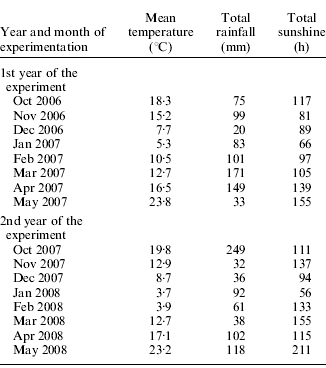
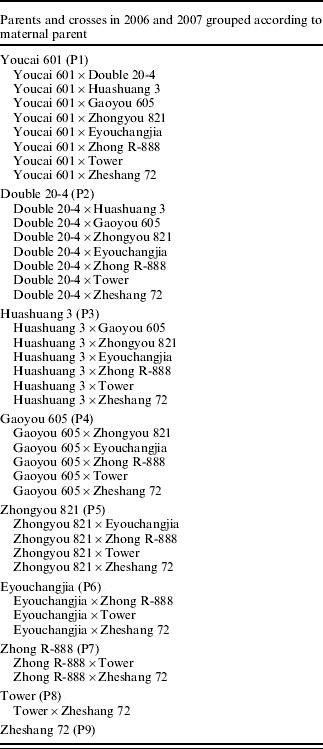
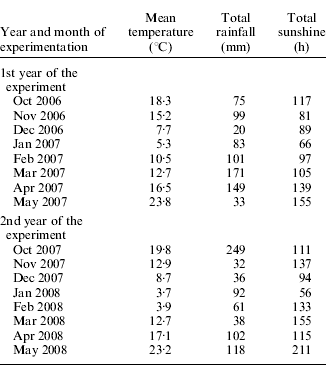
A complete diallel mating design (not including reciprocal crosses) was investigated in 2 years, 2006/07 and 2007/08. The environmental differences in the 2 years with regard to the amount of rainfall, temperature and sunny days during the whole developmental period of rapeseed are presented in Table 1. Similar culture management practices were followed in the 2 years, but slight differences with regard to the amount of manure or fertilizer applied to each plot may exist due to manual errors during application. For the experiment, nine cultivars (P1–P9) of Brassica napus L., with different cytoplasms and maternal plants, were used as parents: Youcai 601 (P1), Double 20-4 (P2), Huashuang 3 (P3), Gaoyou 605 (P4), Zhongyou 821 (P5), Eyouchangjia (P6), Zhong R-888 (P7), Tower (P8) and Zheshang 72 (P9). The parents and crosses used in the present experiment are shown in Table 2. These parents were randomly sampled from a reference population and some of them have been widely planted or used as parents of rapeseed breeding in China. The seeds of nine parents and their F1 progenies were sown on 9 October 2006 and 13 October 2007, respectively, at the experimental farm of Zhejiang University (120°11′27″E, 30°16′28″N, 40 m asl, average annual temperature 16–17°C, average annual rainfall 1300 mm, semitropical climate, silty loamy soil). The actual seasonal rainfall in 2006/2007 was 731 mm and that in 2007/08 was 728 mm. Thirty-six crosses for F1s or F2s were obtained. A randomized block design with two field replications was laid out, and 38 days after sowing the seedlings were individually transplanted at a spacing of 350×300 mm. There were 32 plants in each plot for parents and F1. Manure (c. 45 000 kg/ha) was applied manually to the experimental field and mixed thoroughly with the soil 1 week prior to transplanting in each year. A nitrogen–phosphorous–potassium compound fertilizer (Zhejiang Juhua Co. Ltd.) was applied, 1 month after transplanting: 19·5 kg N/ha, 11·13 kg P/ha and 18·67 kg K/ha were applied in the field. Insects and other pests were controlled by spraying three times with pesticides: twice at the seedling stage and once after transplanting into the field. The pesticide solution used was a mixture of dimethyl-dichloro-vinyl-phosphate (DDVP; Orichem International Ltd) and dimethoate (shanghai agro-chemical industry CO., Ltd.) and the application rates were 0·113 ml DDVP/m2 and 0·113 ml dimethoate/m2. No fungicides were applied during the experiment, and manual weeding was done during the seedling stage. Flowers that opened in the same day were counted and recorded. To prevent cross pollination, the selected inflorescence were covered with photic bags prior to anthesis. To minimize side effects, seed samples of both parents and of F2s on F1 plants were harvested from 12 plants in the middle part of each plot. Subsequent seed samples were categorized into five developmental times based on their harvesting date after fertilization (15, 22, 29, 36 and 43 days after flowering (DAF)). The F1 seed samples for each developmental time in both years were obtained by crossing females to males during the same growing season using hand emasculation. Sample sizes were as follows: the seed sample at 15 days comprised c. 50 inflorescences/plot, followed by 45 at 22 days, 30 at 29 days, 20 at 36 days and 15 at 45 days. Each inflorescence contained c. 2–7 freshly opened florets, which were recorded and bagged after removing the unopened florets, during each day of the flowering period.
Environmental conditions for 2006/07 and 2007/08 during the whole experimental period of rapeseed
Parents and their crosses used for the experiment in 2006 and 2007

Experimental analysis method for OAC and LAC
OAC and LAC (mg/g) at five different developmental times were analysed by near-infrared reflectance spectroscopy on NIRSystems model 5000 instrument (NIRSystems, Inc., Silver Spring, MD, USA), in which routine analysis and calibration development were carried out according to WinISI II manual (ISI FOSS NIRSystems/TECTOR, Infrasoft International, LLC). 3·2 g of each sample was scanned in a 36 mm internal-diameter ring cup. For developing the fatty acid calibration equation, an additional 210 samples from five developmental stages were included and the contents of individual fatty acid components were analysed by gas chromatography (Japan, Model GC-9A). The oven-dried rapeseeds (1 g), dried to a constant weight, were crushed and 0·25 g of the sample was transferred to centrifuge tubes in two replications. Thereafter, 1 ml of extracting agent (ether/benzene, 1:1 by volume) was added, vortexed to mix the contents and left overnight. Subsequently, 1 ml of 0·4 N KOH-CH3OH was added to the mixture and allowed to stand for another 30 min. A sample of c. 1 μl was then taken and injected into the gas chromatogram and flame ionization detector with operating conditions as follows: temperature (column/injector/detector), 200/270/270°C and carrier gas flow, H2=50 ml/min and N2=55 ml/min. Two replications were performed for each of the 210 samples used in the gas chromatography analysis and the average of the two replications was taken as the value of OAC and LAC for each sample analysed. The statistics of total fatty acid, i.e. the sum of concentrations of palmitic acid, oleic acid, linoleic acid, linolenic acid, erucic acid and eicosenoic acid, was estimated for each sample and OAC and LAC was expressed as mg/g fatty acid. Based on the study of Wu et al. (Reference Wu, Shi and Zhang2006b) on fatty acid calibration in matured rapeseed samples, the fatty acid equations were recalibrated. All procedures were carried out with ISI software. Original reflectance spectra were corrected, prior to calibration by applying a second derivative transformation, standard normal variate transformation, and de-trend scatter correction. The second derivative was calculated from the log (1/R) spectra at gaps of 8 nm and smoothing over segments 8 nm long. Calibration equations were developed by using the spectral information from 1100 to 2500 nm and modified partial least squares (MPLS) regression. Cross validation was used to avoid overfitting. When using such calibration parameters, the regression equations for OAC and LAC were developed with standard errors of calibration as low as 39·7 mg/g or 16·6 mg/g, respectively, and coefficients of determination (R 2) of c. 0·94 or 0·85, respectively. Samples from all five developmental times from each parent, F1 and F2 in both years were measured with two replications (i.e. 5×3×2×2).
Genetic analysis
The unconditional genetic model of Zhu & Weir (Reference Zhu and Weir1994) and conditional genetic model of Zhu (Reference Zhu1995) for diploid seed quantitative traits were used to estimate the variance parameters comprising genetic main effects and G×E interaction effects from embryo, cytoplasmic and maternal genetic systems at different seed development times/stages of rapeseed. For a diallel mating design from a set of inbred lines, the generation mean (yhijkl) of mating type k from maternal line i and paternal line j in block l of environment h was partitioned as

where μ is the population mean (fixed); Eh, environmental effect (fixed); Gijk, genetic main effect with components of embryo additive (Ao) and dominance (Do) effects, cytoplasmic effect (C), maternal additive (Am) and dominance (Dm) effects (random); GEhijk, G×E interaction effect with components of embryo additive interaction (AoE) and dominance interaction effects (DoE), cytoplasmic interaction effect (CE), maternal additive interaction (AmE) and dominance interaction (DmE) effects (random); Bl (h), the block effect, random; ehijkl, residual effect (random).
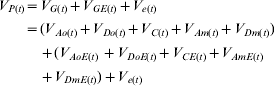
The MINQUE (0/1) method (Zhu & Weir Reference Zhu and Weir1994) was used to estimate the different variance components. The genetic effects from the unconditional analysis were comprised of the accumulated effects of genes (0→t) expressed from flowering (0) to a particular time (t) in the whole developmental period of rapeseed (Zhu & Weir Reference Zhu and Weir1994). The variance components at developmental time (t) for the unconditional analysis can be distinguished as: embryonic additive main variance (VAo (t)), embryonic dominance main variance (VDo (t)), cytoplasmic main variance (VC (t)), maternal additive main variance (VAm (t)), maternal dominance main variance (VDm (t)), embryonic additive interaction variance (VAoE (t)), embryonic dominance interaction variance (VDoE (t)), cytoplasmic interaction variance (VCE (t)), maternal additive interaction variance (VAmE (t)), maternal dominance interaction variance (VDmE (t)) and residual variance (Ve (t)). The partitioning for the unconditional phenotypic variance (VP (t)) is
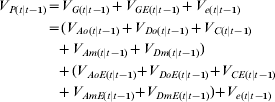
The genetic effects from the conditional analysis were comprised of the net effects of new expression of genes activated in the special period t–1 to time t (t−1→t) during different seed development stages and could be distinguished as: conditional embryonic additive main variance (VAo (t|t−1)), conditional embryonic dominance main variance (VDo (t|t−1)), conditional cytoplasmic main variance (VC (t|t−1)), conditional maternal additive main variance (VAm (t|t−1)), conditional maternal dominance main variance (VDm (t|t−1)), conditional embryonic additive interaction variance (VAoE (t|t−1 )), conditional embryonic dominance interaction variance (VDoE (t|t−1)), conditional cytoplasmic interaction variance (VCE (t|t−1)), conditional maternal additive interaction variance (VAmE (t|t−1)), conditional maternal dominance interaction variance (VDmE (t|t−1)) and conditional residual variance (Ve (t|t−1)). The partitioning for the conditional phenotypic variance (VP (t|t−1)) is
Since the performance of OAC or LAC might be simultaneously controlled by genetic main effects and G×E interaction effects from diploid embryo nuclear genes, cytoplasmic genes and diploid maternal nuclear genes, the estimated total narrow-sense heritability (h (t )2), which determines the heritability arising from the additive and cytoplasmic effects, at different developmental times was further differentiated into embryonic general heritability (hGo (t )2=VAo (t)/VP (t)), cytoplasmic general heritability (hC (t )2=VC (t)/VP (t)), maternal general heritability (hGm (t )2=VAm (t)/VP (t)), embryonic interaction heritability (hGoE (t )2=VAoE (t)/VP (t)), cytoplasmic interaction heritability (hCE (t )2=VCE (t)/VP (t)) and maternal interaction heritability (hGmE (t )2=VAmE (t)/VP (t)). The partitioning for the total narrow-sense heritability is

An adjusted unbiased prediction method (Zhu Reference Zhu1993; Zhu & Weir Reference Zhu and Weir1996) was used to predict components of genetic main effects and G×E interaction effects including embryonic additive effect (Ao), cytoplasmic effect (C), maternal additive effect (Am), embryonic additive interaction effect (AoE), cytoplasmic interaction effect (CE) and maternal additive interaction effect (AmE). The Jackknife resampling methods (Miller Reference Miller1974; Zhu & Weir Reference Zhu and Weir1996) were applied by sampling generation means of entries to derive the standard errors of estimated unconditional or conditional variances, heritabilities and predicted genetic merits of parents for OAC and LAC of rapeseed. The degree of freedom (d.f.) for estimated parameters was 135.
RESULTS
Phenotypic variant of the generations at different development times
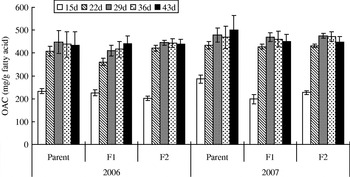
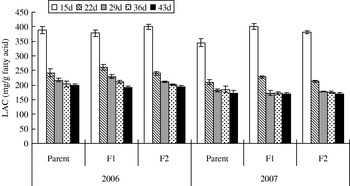
The phenotypic generation means for OAC and LAC at different developmental times across environments are illustrated in Figs 1 and 2.
Phenotypic means distribution for OAC across generations at different developmental times in 2006 and 2007. The bar on the figures represents standard error of mean (s.e.m.).

Phenotypic means distribution for LAC across generations at different developmental times in 2006 and 2007. The bar on the figures represents s.e.m.

For oleic acid, the results revealed that the mean OAC increased till 29 DAF, and by 36 and 43 DAF, either a slight increase or decrease was found, depending on generation and environment. However, a sharp rise in the means of generations was observed from 15 to 22 DAF. Higher generation means were observed for 2007 than in 2006. In 2007, the parents had higher means than the F1 and F2 for OAC at 15, 22, 29 and 43 DAF with values of 287, 434, 479 and 500 mg/g of fatty acid, respectively. In contrast, in 2006, the OAC variation at the five developmental times among parents, F1 and F2, was inconsistent. This suggests that the proportion of OAC in rapeseed could be influenced by environmental conditions (e.g. weather, soil, culture and management of field, etc.), in addition to genetic main effects.
The results for linoleic acid revealed that its content decreased with time, with the lowest content being observed at 43 DAF (Fig. 2). The means for LAC among generations were lower in 2007 than in 2006, indicating the influence of environmental factors for this trait. Among the three generations studied, the parents had higher means than either F1 or F2 at 29 and 36 DAF in 2007 and at 43 DAF in both years. The F1 generation means were higher than the parents or F2 at 22, 29 and 36 DAF in 2006 and at 15 and 22 DAF in 2007. For F2, the mean LAC was higher than parents at 15 or 22 DAF. These results, therefore, confirm that variations existed for LAC at different developmental times across generations and that both genetic main effects and G×E interaction effects are important.
Estimation of unconditional and conditional genetic main variance and G×E interaction variance components
Oleic acid
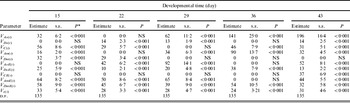
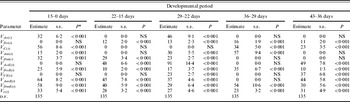
Unconditional variance analysis, comparing the effects of different genetic systems, showed that the performance of OAC was mainly affected by G×E interaction effects at 15, 22 and 29 DAF with the VGE (t) values being 0·52, 0·67 and 0·66 of the total genetic variation (VG (t)+VGE (t)), and by genetic main effects at 36 and 43 DAF with the VG (t) values being 0·75 and 0·60 of the total genetic variation, respectively (Table 3). However, the conditional analysis (which can reveal the stage-specific expression of genes) indicated that the new expression of genes at most developmental stages was more likely to be affected by G×E interaction effects, except for the period of 30–36 DAF where the genetic main effects (VG (t|t−1)) were larger (Table 4).
Estimates of unconditional variance components for OAC at five different developmental times in rapeseed

* P-value of one tail t test.
NS, not significant.
Estimates of conditional variance components for OAC at five different developmental periods in rapeseed

* P-value of one tail t test.
NS, not significant.
The embryonic main effects were most important for OAC particularly at 29, 36 and 43 DAF (VAo (t)+VDo (t)/VG (t)=0·69, 0·51 and 0·77, respectively), followed by the cytoplasmic main effects, especially at 15 and 22 DAF (VC (t)/VG (t)=0·41 and 0·41, respectively) and then by maternal main effects (VAm (t)+VDm (t)/VG (t)=0·12–0·40, respectively). However, the conditional variance implied that the net embryonic main effects were larger only for the specific period of 23–29 DAF (VAo (29d|22d)+VDo (29d|22d)/VG (29d|22d)=0·53). For the other developmental stages, the new expression of genes from the cytoplasm (VC (t|t−1)/VG (t|t−1)) was more important at 1–15 (0·41) and 37–43 DAF (0·66), while the net maternal effects (VAm (t|t−1)+VDm (t|t−1)/VG (t|t−1)) were prominent at 16–22 (0·70) and 30–36 DAF (0·53). Thus, depending on the seed developmental time/stage, the sequential expression of genes from embryo, cytoplasm and maternal plant can all be important for OAC variation among genotypes.
Among the G×E interaction components, the detected unconditional or conditional variance showed that the maternal interaction effects (VAmE (t)+VDmE (t)) or net maternal interaction effects (VAmE (t|t−1)+VDmE (t|t−1)) were larger than others at different developmental times/stages, except at 29 or 23–29 DAF, where the embryonic interaction components (0·52 or 0·55) were larger. These results confirmed that the expression of maternal plant genes was more easily influenced by the environmental conditions and that the expression of cytoplasmic genes was relatively stable across environments, because the significant cytoplasmic interaction effect or net cytoplasmic interaction effect for OAC at VCE (15d), VCE (22d), VCE (29d) and VCE (36d) or VCE (15d|0d), VCE (22d|15d) and VCE (36d|29d) were not detected in the experiment. Also, the conditional analysis indicated that expression of genes could be interrupted at the different developmental stages, such as expression of cytoplasmic genes at 16–22 or 23–29 DAF, respectively. VAo (36d|29d), VAo (43d|36d) and VAm (43d|36d) were not found in the conditional analysis, which was interpreted to mean that the significant unconditional genetic effects observed in Table 3 resulted from the continued expression of genes activated at the previous developmental stages.
Further, the larger cumulative or net additive and cytoplasmic effects (0·55–0·87 of (VG (t)+VGE (t)) or 0·46–0·75 of (VG (t|t−1)+VGE (t|t−1))) observed in the unconditional or conditional analysis revealed that dominance effects were not prominent for OAC variation, except for the stage 30–36 DAF in the conditional method. For the total embryonic or maternal effects, the embryonic effects accounted for 29, 36 and 43 DAF with 0·57, 0·48 and 0·61 of total genetic variance, while the total maternal effects with 0·60 and 0·56 were more prominent at 15 and 22 DAF, respectively. For the conditional analysis, the net maternal effects including maternal additive and dominance effects and their G×E interaction effects accounted for 0·60, 0·62, 0·56 and 0·36 of total genetic variance at 1–15, 16–22, 30–36 and 37–43 DAF, respectively.
Linoleic acid
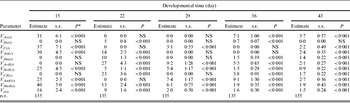
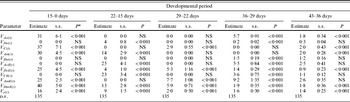
The genetic effects from unconditional variance analysis of different genetic systems in Table 5 showed that the performance of LAC was mainly affected by G×E interaction effects at 22, 29 and 36 DAF ((VGE (t)/(VG (t)+VGE (t)))=0·70, 0·90 and 0·70, respectively) and by genetic main effects ((VG (t)/(VG (t)+VGE (t)))=0·52 and 0·51) at 15 and 43 DAF, respectively. However, the conditional analysis, which can reveal the stage-specific expression of genes, indicated that the new expression of genes at most developmental stages was more likely to be affected by G×E interaction effects, except for the initial period of 15 DAF where the genetic main effects (VG (15d|0d)) were larger (Table 6).
Estimates of unconditional variance components for LAC at five different developmental times in rapeseed

* P-value of one tail t test.
NS, not significant.
Estimates of conditional variance components for LAC at five different developmental periods in rapeseed

* P-value of one tail t test.
NS, not significant.
Comparing the genetic main effects from different genetic systems, the analysed unconditional or conditional results showed that the total of cumulative or net maternal and cytoplasmic main effects were most important for LAC at different developmental times/stages (0·16–1·00 of VG (t) or 0·20–1·00 of VG (t|t−1)), with the exception of 36 or 30–36 DAF. Among the G×E interaction components, the detected unconditional or conditional variance showed that the maternal interaction effects (VAmE (t)+VDmE (t)) or net maternal interaction effects (VAmE (t|t−1)+VDmE (t|t−1)) were larger than others at different developmental times/stages, except at 22 and 29 or 16–22 DAF, where the embryonic interaction components (0·47 and 0·52 of VGE (t) or 0·45 of VGE (t|t−1), respectively) were larger. These results confirmed that the expression of maternal plant genes was more easily influenced by the environmental conditions followed by embryonic interaction effects and then by cytoplasmic interaction effects. Also, the conditional analysis indicated that expression of genes could be interrupted at the different developmental stages, such as expression of embryo genes at 23–29 DAF. VDm (22d|15d) and VAoE (29d|22d) were not found in the conditional analysis which was interpreted to mean that the significant unconditional genetic effects in Table 5 resulted from the continued expression of genes activated at the previous developmental stages. Further, VDo (43d) was not found when compared with the conditional results. This might be due to interference from genes expressed at the previous developmental times.
Also, the larger cumulative or net additive and cytoplasmic effects (0·63–0·82 of (VG (t)+VGE (t)) or 0·49–0·74 of (VG (t|t−1)+VGE (t|t−1))) observed in the unconditional and conditional analysis revealed that dominance effects were not prominent for LAC variation except for the stage 23–29 DAF in the conditional method. Among the embryonic and maternal variances, the total embryonic variances accounted for 0·47, and 0·48 of total genetic variance at 29 and 36 DAF, respectively, while the total maternal variances accounting for 0·50, 0·38 and 0·44 of the total genetic variance were more prominent at 15, 22 and 43 DAF, respectively. For the conditional analysis, the maternal variances from maternal additive and dominance variances and their G×E interaction variances accounted for 0·50, 0·62 and 0·46 of total genetic variance at 1–15, 23–29 and 37–43 DAF, respectively.
Although significant residual variances were found for all developmental times/stages for both OAC and LAC, it is suggested that both traits were mainly affected by genetic effects from different genetic systems because of the small value of estimated Ve (t) or Ve (t|t−1).
Estimation of components for general heritability and interaction heritability
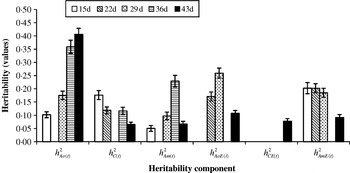
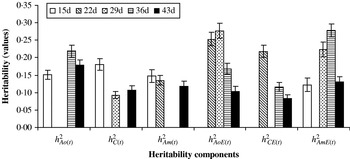
The estimates of heritability for OAC and LAC at five different developmental times in rapeseed are depicted in Figs 3 and 4.
Estimates of genetic main heritability and G×E interaction heritability for OAC at different rapeseed development times. The bar on the figures represents s.e.m.

Estimates of genetic main heritability and G×E interaction heritability for LAC at different rapeseed development times. The bar on the figures represents s.e.m.

Oleic acid
For OAC, the estimates of total narrow-sense heritability for the developmental times 15, 22, 29, 36 and 43 DAF were 0·53, 0·49, 0·71, 0·70 and 0·81, of which the general heritability contributed 0·33, 0·12, 0·27, 0·70 and 0·53, while those of interaction heritability components were 0·20, 0·37, 0·44, 0·00 and 0·28, respectively (Fig. 3). The higher general heritabilities indicated that selection efficiency for OAC was least likely to be influenced by the environment for the developmental times 15, 36 and 43 DAF. Also, the large heritability estimates confirmed that the inheritance for OAC was considerably stronger throughout generations, indicating that OAC could be improved through selection. The sum of embryonic general and interaction heritabilities was larger than others for the developmental times 29, 36 and 43 DAF, accounting for 0·43, 0·36 and 0·51, respectively of total heritability. Thus, to improve OAC in rapeseed, single seed selection might be more beneficial than maternal plant selection, especially at seed maturity. From the interaction heritabilities, it was found that the maternal heritabilities were more easily influenced by environmental conditions at 15 and 22 DAF, while the embryonic interaction heritabilities were larger at 29 and 43 DAF, respectively. Also, the cytoplasmic interaction heritability was more stable across environments when compared to embryonic and maternal interaction heritability, as it was not observed at most seed developmental times.
Linoleic acid
For LAC, the total narrow-sense heritability at 15, 22, 29, 36 and 43 DAF was 0·60, 0·61, 0·59, 0·78 and 0·72, respectively, which indicated that it is possible to improve LAC in seed oils of rape by selection in early generations. Among general and interaction heritabilities, while the general heritability contributions were higher at 15 and 43 DAF with 0·48 and 0·40, interaction heritability with values of 0·47, 0·50 and 0·56 appeared more important at 22, 29 and 36 DAF, respectively. For the different general and interaction heritability components, the sum of embryonic general and interaction heritabilities were visibly larger than either cytoplasmic or maternal heritabilities for the developmental times 22, 29, 36 and 43 DAF, accounting for 0·25, 0·28, 0·39 and 0·28 of total heritability. Thus, selection of seeds with higher LAC could be more beneficial than maternal plant selection in improving LAC of rapeseeds. Among the interaction heritability components, maternal interaction heritabilities were higher at 15, 36 and 43 DAF, while the embryo interaction heritabilities were important at 22 and 29 DAF, respectively.
Prediction of genetic effects for parents
In order to select the better parent(s) for breeding purpose to achieve desired improvements for seed quantitative traits, it is essential to know the breeding values of parents for the trait of interest, so that suitable parents can be crossed to achieve desired results.
The prediction for the breeding value of the parents for seed quantitative traits comprises embryonic additive effect (Ao), embryonic additive interaction effects in 1st (AoE 1) and 2nd (AoE 2) environments (years), cytoplasmic effect (C), cytoplasmic interaction effects in 1st (CE 1) and 2nd (CE 2) environments, maternal additive effect (Am), maternal additive interaction effects in 1st (AmE 1) and 2nd (AmE 2) environments. The total breeding values for the two environments (years) were predicted as GtI=Ao+AoE 1+C+CE 1+Am+AmE 1 in 2006 and GtII=Ao+AoE 2+C+CE 2+Am+AmE 2 in 2007, respectively.
Oleic acid
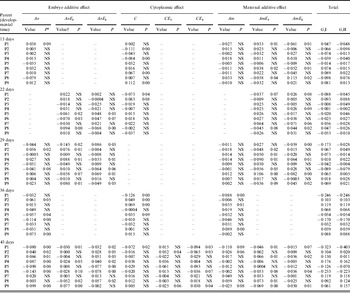
For OAC, the predicted breeding value of genetic main effects and G×E interaction effects in different environments, for parents at five different development times is shown in Table 7. Comparing the different development times, GtI and GtII of parents at 15 and 22 DAF, with the exception of P7 (Zhong R-888) and P9 (Zheshang 72) at 15 DAF and P2 (Double 20-4) at 22 DAF, could decrease OAC due to their higher prevalence of negative values in 2006 and 2007. The expression of cytoplasmic genes at 15, 22 and 36 DAF, embryonic additive genes at 15 and 36 DAF and maternal additive genes at 36 DAF for OAC was stable among environments. The genetic main effects at 36 DAF from embryonic, cytoplasm and maternal plant genetic systems were more important since there was no G×E interaction effect found in the present experiment, while for 43 DAF the impact from the G×E interaction effects was very important for OAC.
Estimates of predicted genetic main effects and G×E interaction effects of parents for OAC at five different developmental times of rapeseed

* P-value of two tail t test.
† – predicted effects not available because of the corresponding zero estimates of variance components in Table 3.
NS, not significant.
The predicted genetic effects in Table 7 indicate that the variations at different development times under different environments were significant in most parents. In general, the predicted genetic effects of parents P1 (Youcai 601) (values ranged from 0·047 to −0·323 for GtI and from −0·048 to −0·403 for GtII), P5 (Zhongyou 821) (values ranged from −0·014 to −0·126 for GtI and from 0·046 to −0·070 for GtII) and P6 (Eyouchangjia) (values ranged from 0·074 to −0·170 for GtI and from 0·027 to −0·170 for GtII) became more negative from 15 to 43 DAF, while some parents like P2, P3 (Huashuang 3), P4 (Gaoyou 605), P7, P8 (Tower) and P9 were negative at 15 or 22 DAF, but became positive thereafter for the subsequent developmental times. These parents could therefore be used in crossing programmes to improve OAC of rapeseed oil through breeding in diverse environments.
Linoleic acid
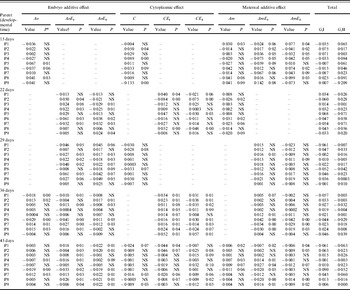
The results of estimated genetic values in Table 8 revealed that the genetic main effects as well as G×E interaction effects of parents could affect LAC of offspring and the detectable differences were found for the genetic main effects and G×E interaction effects among the parents analysed.
Estimates of predicted genetic main effects and G×E interaction effects of parents for LAC at five different developmental times of rapeseed

* P-value of two tail t test.
† – predicted effects not available because of the corresponding zero estimates of variance components in Table 5.
NS, not significant.
Since the gene expressions at different seed development times could be controlled by different loci of the polygene system, the predicted values of parents could also vary at different times. Comparing the different developmental times, the parents had opposite signs for GtI and GtII at 22 followed by 15 and then by 36 DAF. On the contrary, the performance among the parents for LAC was relatively stable at 29 and 43 DAF, indicating their ability was more suitable to varying environments near maturity. The expression of cytoplasmic genes at 15 and 29 DAF, embryo additive genes at 15 and maternal additive genes at 22 DAF was stable among environments. For the developmental times 36 and 43 DAF, the influence from the G×E interaction effects was important for LAC.
For parents, GtI and GtII of P2 (Double 20-4) (values being 0·075 and 0·017 at 15 DAF, 0·047 and 0·033 at 29 DAF, 0·063 and 0·023 at 43 DAF, respectively) could increase LAC of rapeseed in a stable fashion in both environments, and so could be used as a parent for improving LAC in rapeseed breeding programme. Also, P5 (Zhongyou 821) and P7 (Zhong R-888) can also be used because of their higher stable positive values at 36 DAF (values being 0·021 (GtI) and 0·001 (GtII) for P5 and 0·023 (GtI) and 0·018 (GtII) for P7) and 43 DAF (values being 0·010 (GtI) and 0·023 (GtII) for P5 and 0·045 (GtI) and 0·060 (GtII) for P7), respectively. The results further showed that the beneficial alleles for LAC were distributed among the parents, since the nine parents used in the study behaved differently to the environment at different seed development times.
DISCUSSION
Rapeseed is one of the major global oil crops. Rapeseed oils with high oleic and intermediate linoleic acid are widely preferred by consumers due to their health benefits. Natural or induced mutagenesis in association with classical plant breeding methods has been utilized to develop rapeseed cultivars with the oleic acid proportion as high as 0·80 of the total fatty acids in the seed oil (Auld et al. Reference Auld, Heikkinen, Erickson, Sernyk and Romero1992; Rücker & Röbbelen Reference Rücker and Röbbelen1996). The existence of wide variability for OAC or LAC among rapeseed genotypes provides the opportunity for further improving the quality of high yielding varieties through breeding. Both OAC and LAC are complex quantitative traits with three or more QTLs having been identified for each trait (Möllers Reference Möllers2002; Zhang et al. Reference Zhang, Qi, Pu, Chen, Chen, Gao, Chen, Gu and Fu2008). Also, different sets of QTL genes might be involved during different stages of seed development. The results from the present study indicate that gene expression for OAC or LAC occurred throughout the whole developmental period of rapeseed, and that different QTL genes with additive and/or dominance effects were activated during the different developmental stages. This was clearly represented by the differences in magnitude and significance of the different genetic variance components. One possible explanation for this variation could be that the polygene system of quantitative traits could have specific expression pattern(s) at different developmental periods. Dissimilar categories and activity of isozyme has been reported for the development of embryo and endosperm in maize (Yang & Zeng Reference Yang and Zeng1984). Details of the expression of 8095 genes that are activated during various periods of B. napus seed development have been obtained through cDNA microarray hybridization and are available in the RAPESEED database (Wu et al. Reference Wu, Shi, Niu, Xing and Xue2008).
Seed quality traits of rapeseed are complex characters due to the involvement of diploid embryonic, cytoplasmic and diploid maternal genetic systems. While the seed containing the embryo (cotyledons) is the progenitor of the next generation, seed development is based on the photosynthetic product supplied by the maternal plant. Chloroplast and/or mitochondrial DNA existing in cytoplasm could also affect the quality of rapeseed. Therefore, the quality traits of rapeseed might be simultaneously controlled by the genes from different genetic systems including diploid plant embryo nuclear genes, cytoplasmic genes and diploid maternal plant nuclear genes. The results of this experiment showed that OAC or LAC could be affected by different genetic systems, with embryonic and cytoplasmic effects being responsible for OAC and maternal effect in combination with cytoplasmic effect being more important for LAC at different development time/stages. A possible reason for this difference might be that, at the molecular level, the differential effects on OAC and LAC during seed development are manifested by different temporal and spatial patterns of gene expression which in turn could influence the genetic variances. Actions and interactions of genes and their products during the different seed developmental times/stages have primary effects on genetic variances, secondary effects on genetic co-variances through pleiotropic and epigenetic interactions, as well as differential effect on the genetic background in which individual genes are expressed (Atchley & Zhu Reference Atchley and Zhu1997). These might result in dynamic patterns of variability of complex traits during the different developmental periods. The pattern of conditional genetic variance in OAC and LAC suggested that when conditioned by the variation 15 days before for the first developmental stage followed by 7 days interval thereafter, there is still considerable new variation being introduced, especially from the maternal genes expression, as is evident from the estimates of variance components for conditional genetic analysis.
Rapeseed grown in different environments can be influenced by genetic effects and environmental conditions. This is because the expression of some quantitative genes depends on the prevailing external environment. Thus, understanding the magnitude of genetic main effects and G×E interaction effects can provide useful information for breeders with regard to selecting the better lines (or varieties) of rapeseed which are more adaptable under different environments. The results indicated that both genetic main effects and G×E interaction effects are important and the maternal effects are more easily influenced by the environment for both OAC and LAC in rapeseed.
For the improvement of seed quality traits, selection of the better maternal plant or single seeds could be useful in conventional plant breeding programmes. This is determined basically by the genetic nature of the trait concerned. For example, for improving oil content in rapeseed, it was reported that selection based on the holistic performance of the maternal plant would be more efficient than single seeds due to their higher maternal heritability (Wu et al. Reference Wu, Shi and Zhang2006a). However, the heritability analysis results for OAC or LAC revealed that the embryonic heritability was higher than maternal heritability at most developmental times and so selection for single seeds might be more efficient for these quality traits. Similar observations for OAC were also reported by Zhang et al. (Reference Zhang, Shi, Wu, Ren, Li, Zhang and Zhang2004a) for mature rapeseed. Thus, depending on the trait transferred to the next generation and the prominent genetic system involved, different selection strategies need to be devised for improvement of the concerned trait.
Some plants can produce high OAC or LAC in the initial stages but decrease in the later stages, while some others may exhibit a different pattern. Since the major aim in rapeseed quality breeding is to improve this trait, selection of the parent containing the most favourable combination of alleles at different developmental times and across environments can be useful for breeders to achieve a stable increase in OAC or LAC in rapeseed. For example, in the present experiment, several parents such as Double 20-4, Huashuang 3, Gaoyou 605, Zhong R-888, Tower and Zheshang 72 could be selected in high oleic breeding programmes for improving OAC, due to their stable positive values under varying environments and at different developmental times, while for improving LAC, Double 20-4 was found to be most suitable.
The present paper provides some new information on the dynamic changes of genetic effect components when conditioned on variability at earlier developmental times. This method could be useful in that the variance components can be corrected for variability at different developmental times so as to demonstrate when significant episodes in the generation of new variations might occur. Furthermore information can be obtained on the stages at which maximum genetic activity occurs for OAC or LAC trait, thereby providing further opportunities for improving the OAC or LAC in rapeseed through genetic manipulation or by crossing with varieties that indicate higher genetic activity for that specific developmental stage.
The project was financially supported from Technology Office of Zhejiang Province (No. 2008C22084), Foundation for University Key Teacher by the Ministry of Education of China and by the 151 Program for the Talents of Zhejiang Province. The first two authors, M. T. Variath and J. Wu, contributed equally to this work.