





Introduction
International organisations, including the United Nations, the World Bank, and the institutions of the European Union, play a vital role in addressing various global challenges, such as ecological, financial, and geopolitical risks. Given their differing and sometimes conflicting preferences and objectives, countries utilise diplomacy and other means to influence international politics and further their interests within these organisations, especially as the stakes continue to rise. Yet, international organisations are not only arenas of intergovernmental negotiation; they are constituted and sustained through the practices of individuals – nationals of different countries – who occupy distinct positions within those organisations and the international field. As the nature of diplomacy undergoes a broader transformation beyond formal state-to-state interaction, and as states increasingly view their citizens abroad as sources of soft power, a critical question emerges: how do such individuals relate to their countries of origin, and how are they implicated in the pursuit of national interests? The article addresses this question by exploring diaspora professionals working in international organisations and their involvement in diaspora diplomacy.
Contemporary diplomacy extends beyond professional diplomats and government officials, fitting into a broader framework known as new diplomacy. It signifies a shift from traditional state-centric negotiations to more inclusive and multifaceted approaches and emphasises the involvement of diverse actors, increased transparency, and direct engagement with foreign publics (Cooper, Heine and Thakur Reference Cooper, Heine and Thakur2013). Public diplomacy is one of the most prominent expressions of new diplomacy, premised on the idea that countries aim to shape the perceptions and preferences of foreign publics through listening, advocacy, cultural diplomacy, exchange, and international broadcasting (Cull Reference Cull and Kennedy2022). Both new diplomacy and public diplomacy reflect the increasing complexity and interconnectedness of global relations, where multiple stakeholders play significant roles in diplomatic efforts (Melissen Reference Melissen2005, Reference Melissen2011; Adler and Firestone Reference Adler and Firestone2018). Country nationals living abroad constitute one such group of actors in multilateral and global politics, and their engagement is increasingly conceptualised as ‘diaspora diplomacy’, highlighting the role of diasporas in fostering relationships with other nations and advancing the policy goals of their countries of origin across various domains (Rana Reference Rana, Zaharna, Arsenault and Fisher2014; Lartigue Reference Lartigue2021). While this emerging phenomenon is attracting growing scholarly attention, diaspora diplomacy remains a concept marked by definitional ambiguity and analytical inconsistency (Gilboa Reference Gilboa and Kennedy2022).
Diaspora networks are described as tools of soft power, capable of influencing foreign relations, enhancing national image, and driving economic growth (Stone and Douglass Reference Stone and Douglas2018; Kennedy Reference Kennedy, Snow and Cull2020). Considering this, governments are increasingly engaging diasporas to bolster their public diplomacy efforts, making the diaspora a key component of their international outreach strategies (Kingsley Reference Kingsley2018). Moreover, states are increasingly adopting tailored approaches to engage diasporic individuals for foreign policy purposes, considering their positions, interpersonal ties, and willingness to act (Silverman, Abramson and Grossman Reference Silverman, Abramson and Grossman2026). The political power that diaspora actors accumulate is rooted in their transnational networks across diverse global contexts (Koinova Reference Koinova2018). As Castells (Reference Castells2011) argues, we live in a networked society in which actors embedded in influential networks exercise considerable influence over global geopolitics. Slaughter (Reference Slaughter2017) reinforces this notion, arguing that informal networks often surpass formal structures in power and impact. In this context, individuals working in international organisations may play a crucial role.
Existing studies on diaspora diplomacy often provide limited or overly generalised accounts of who qualifies as an actor in this field or, more broadly, in international relations. Typically, the state is identified as the primary actor (e.g., Birka and Kļaviņš Reference Birka and Kļaviņš2020; Manor and Adiku Reference Manor and Adiku2021; Silverman, Abramson and Grossman Reference Silverman, Abramson and Grossman2026). The diaspora is often portrayed as a singular entity or represented collectively through diaspora organisations (e.g., Ho and McConnell Reference Ho and McConnell2017; Brinkerhoff Reference Brinkerhoff2019; Kennedy Reference Kennedy and Kennedy2022a; Moise Reference Moise2023). If the activities of individual actors are considered at all, they are typically discussed in the context of group mobilisation and leadership or framed as informal, everyday interactions with local communities (e.g., Stone and Douglass Reference Stone and Douglas2018; Brinkerhoff Reference Brinkerhoff2019; Zhu and Chen Reference Zhu and Chen2023). However, there is a growing body of literature on diaspora diplomacy, which re-orients attention from collective mobilisation to the role of interpersonal relations. So far, attention has been focused on how individual diaspora members are embedded in business, political, labour, cultural, sporting, and intellectual networks (see, for example, Brinkerhoff Reference Brinkerhoff2016; Silverman, Abramson, and Grossman Reference Silverman, Abramson and Grossman2026). Research on the strategic engagement of diaspora members within international organisations to advance their countries’ strategic interests – a practice adopted by many states – remains limited (Ho and McConnell Reference Ho and McConnell2017; Adler and Firestone Reference Adler and Firestone2018).
How these individuals engage in diaspora diplomacy, who their counterparts in their countries of origin are, and how they navigate multiple, sometimes competing, loyalties and affinities, is still insufficiently understood. This article addresses this gap by shedding new light on the complexity of actors involved in diaspora diplomacy, with a particular focus on diaspora professionals as citizen diplomats.
Focusing on Latvia as a case study, we tackle the following research questions: Who are the key actors in diaspora diplomacy? How is diaspora diplomacy enacted in practice by individuals working in international organisations? What factors contribute to or hinder the engagement of citizen diplomats in diaspora diplomacy? Our data come from a survey (N = 150), six focus group discussions (N = 18), and four in-depth interviews with Latvian diaspora professionals employed in international organisations. Latvia is an ideal case for exploration, as theory suggests that diaspora engagement in public diplomacy is particularly significant for small countries, which have limited resources and fewer avenues of influence.
The article begins with a literature review that addresses gaps in the existing literature and adopts a conceptual framework for empirical research. This is followed by a brief discussion of the context of Latvian diaspora diplomacy. The methodology section then outlines the research underpinning the study. The analysis is structured into three sections: the diversity of actors involved, the practice of diaspora diplomacy, and the factors that influence engagement in diaspora diplomacy. The article concludes with a summary of the findings and their implications for both the research and practice of diaspora diplomacy. Our central argument is that diaspora members working in international organisations may exercise considerable influence within multilateral politics and should be recognised as key actors within the networked practices of new diplomacy.
Diaspora diplomacy revisited: bridging conceptual gaps and actor complexity
This section addresses key gaps in the existing literature by adopting a conceptual approach, moving from definitions of diaspora diplomacy to its key roles and functions and, subsequently, to the range of actors involved – from collective actors to a more focused consideration of individuals as citizen diplomats – thereby establishing the analytical foundations for the actor-centred analysis that follows.
In this study, we define ‘diaspora’ as communities of migrants living in one or more host countries who maintain a memory of, and some connection to, their home state (Gilboa Reference Gilboa and Kennedy2022: 380). However, defining ‘diaspora diplomacy’ is a much more complex task. Although the term ‘diaspora diplomacy’ has been in use for nearly two decades, there are significant variations in how it is understood. Gilboa (Reference Gilboa and Kennedy2022) describes this variability as ‘conceptual anarchy’, highlighting the absence of consensus regarding terms, definitions, theoretical frameworks, and approaches both within and across academic disciplines. Here, we aim to clarify the definition of diaspora diplomacy and identify key aspects for empirical analysis by synthesising these differing approaches. To do that, we first need to situate it within its broader conceptual framework.
While diaspora diplomacy is most commonly positioned within the framework of public diplomacy, it is also closely related to the concept of new diplomacy (Melissen Reference Melissen2005; Cull Reference Cull and Kennedy2022), both of which are associated with soft power theory. Both new diplomacy and public diplomacy provide a useful framework for situating diaspora diplomacy within established perspectives in international relations. They reflect the growing complexity and interconnectedness of global relations, in which diverse stakeholders play increasingly significant roles in diplomatic efforts. Crucially, both also emphasise the use of soft power to influence and engage foreign audiences. The appeal of a nation’s values, culture, and policies fosters cooperation, reducing the need for coercive measures (Nye Reference Nye2004; Gilboa Reference Gilboa2008). Public diplomacy can be understood as the process that converts soft power resources into tangible diplomatic actions. In this context, new diplomacy serves as the overarching framework, public diplomacy represents one of its key modalities, and soft power constitutes the primary resource on which both new diplomacy and public diplomacy rely.
Building on the approaches of Stone and Douglas (Reference Stone and Douglas2018), Ho and McConnell (Reference Ho and McConnell2017), Brinkerhoff (Reference Brinkerhoff2019), and Cull (Reference Cull and Kennedy2022), we propose an integrated working definition of diaspora diplomacy as a multifaceted form of public diplomacy characterised by polylateral communication and representation conducted by and between diverse actors. In international relations, polylateral communication typically refers to interactions among multiple states. However, in the context of diaspora diplomacy, it encompasses communication among a broader range of actors, including various state institutions, intergovernmental and non-governmental organisations, and individuals. This communication may be initiated by a range of actors representing the country of origin or the country of residence, as well as by diaspora actors themselves. Diasporas act as unique intermediaries, leveraging their dual perspectives and insights gained from experiences in both their countries of origin and residence.
When analysing diaspora diplomacy through the role of diasporas, some studies define the concept narrowly as ‘diplomacy through diaspora’, viewing it primarily as a tool utilised by states of origin to advance their national objectives in host countries (Rana Reference Rana, Zaharna, Arsenault and Fisher2014). Defining diaspora diplomacy solely as a means for countries of origin to further their interests in countries of residence – such as ‘engaging a country’s overseas community to contribute to building relationships with foreign countries’ (Rana Reference Rana, Zaharna, Arsenault and Fisher2014: 70) – appears to be an overly narrow interpretation. Other studies focus on ‘diplomacy for diaspora’, defining diaspora diplomacy as a governmental strategy aimed at systematically building relationships with diaspora groups, acknowledging their value as assets for their home country development (Birka and Kļaviņš Reference Birka and Kļaviņš2020). While diaspora engagement has been widely examined outside the specific framework of diaspora diplomacy (see, for example, Cohen Reference Cohen2008; Kuznetsov Reference Kuznetsov2013; Brinkerhoff Reference Brinkerhoff2016), a growing body of scholarship considers such engagement to be a central component of diaspora diplomacy (see Kennedy Reference Kennedy, Snow and Cull2020; see also Routledge International Handbook of Diaspora Diplomacy (Kennedy Reference Kennedy2022b), Parts 2 and 3). Conversely, some research conceptualises diasporas as diplomatic agents in their own right, adopting the term ‘diplomacy by diaspora’ (Ho and McConnell Reference Ho and McConnell2017; Brinkerhoff Reference Brinkerhoff2019; Zhu and Chen Reference Zhu and Chen2023). Ho and McConnell (Reference Ho and McConnell2017) note that diasporas can act as independent political agents at various times and for different reasons. They argue that ‘diplomacy by diaspora’ operates outside strict state control, especially when traditional state actors are unable to represent the diaspora’s interests or when the diaspora challenges official state ideologies.
In our study, we recognise all three types of diaspora diplomacy – diplomacy through diaspora, diplomacy for diaspora, and diplomacy by diaspora – as significant and often interrelated, as the analysis demonstrates. Their distinct conceptual foci and how they can be integrated into a more holistic analysis of diaspora diplomacy are shown in Figure 1.
Types of diaspora diplomacy.

Diaspora diplomacy is increasingly integrated into the broader framework of public diplomacy (Kennedy Reference Kennedy, Snow and Cull2020), yet it remains uncertain whether their functions fully align. Public diplomacy literature identifies its key functions as listening, advocacy, nation branding, national broadcasting, cultural diplomacy, and exchange. In contrast, the core functions of diaspora diplomacy are often defined in more limited terms, such as communication and representation (Ho and McConnell Reference Ho and McConnell2017; Zhu and Chen Reference Zhu and Chen2023), sometimes including mediation (Brinkerhoff Reference Brinkerhoff2019) or merging them; for instance, listening is often encompassed within communication, while advocacy and nation branding are typically considered components of representation (Brinkerhoff Reference Brinkerhoff2019). We operationalise diaspora diplomacy by adopting Cull’s (Reference Cull and Kennedy2022) argument that diaspora efforts intersect with all aspects of public diplomacy. While existing literature mainly emphasises communication and representation as key functions of diaspora diplomacy, we broaden this framework to include traditional public diplomacy functions such as listening (to understand others’ perspectives, preferences, and concerns), advocacy (promoting key ideas and defending national interests abroad), and nation branding (enhancing the country’s reputation and appeal), and we interpret exchange as social capital (network) development. This broader framework enables a more nuanced examination of how diaspora diplomacy is enacted in practice. Within Cull’s (Reference Cull and Kennedy2022) typology of public diplomacy, this research focuses on the functions most directly relevant to individual-level engagement in diaspora diplomacy by professionals working in international organisations. International broadcasting and cultural diplomacy are not examined, as they are less directly reflected in the forms of engagement characteristic of this group.
Existing studies often offer a limited, superficial, or overly generalised understanding of who qualifies as an actor in diaspora diplomacy or, more broadly, in international relations. While the state is frequently recognised as the primary actor (e.g., Birka and Kļaviņš Reference Birka and Kļaviņš2020; Manor and Adiku Reference Manor and Adiku2021), there is a growing understanding in the field of international relations that the state is not a unitary actor. Specific institutions – such as ministries and governmental agencies – undertake distinct functions and embody ‘the state’ in both international and domestic contexts. These entities often operate autonomously within their respective domains. Also, rather than solely acting through state institutions when engaging with diasporas, outreach efforts often involve multiple actors, including political parties and non-governmental organisations, each driven by distinct interests and agendas (Koinova and Tsourapas Reference Koinova and Tsourapas2018). Moreover, the diaspora is also frequently perceived as a singular entity or represented through diaspora organisations (e.g., Ho and McConnell Reference Ho and McConnell2017; Brinkerhoff Reference Brinkerhoff2019; Kennedy Reference Kennedy and Kennedy2022a; Moise Reference Moise2023). However, in practice, only a small percentage of those living abroad are members of diaspora organisations (Mieriņa and Jansone Reference Mieriņa and Jansone2019). Diasporas are far from uniform and are significantly heterogenous (Góis and Marques Reference Gois and Marques2023; Zhu and Chen Reference Zhu and Chen2023). They consist of a diverse range of actors who may hold different statuses within host societies and possess varying levels of intercultural skills and access to resources (Kaša and Mieriņa Reference Kaša and Mieriņa2019; Bela and Mieriņa Reference Bela and Mieriņa2023; Zhu and Chen Reference Zhu and Chen2023). Thus, in our study, we recognise the different layers of actors involved in diaspora diplomacy, including states, non-state entities in countries of origin, international organisations, and the diverse agents of diasporas themselves (see Figure 2).
Diversity of the key actors in diaspora diplomacy.

With diaspora diplomacy typically seen as an exclusive domain of collectives (Ho and McConnell Reference Ho and McConnell2017; Stone and Douglass Reference Stone and Douglas2018), only a few scholars have so far highlighted the significance of individuals as independent actors in diaspora diplomacy (Brinkerhoff Reference Brinkerhoff2019; Zhu and Chen Reference Zhu and Chen2023). Even in these studies, individual contributions are often oversimplified by primarily focusing on interpersonal communication in everyday contexts. There is a lack of attention to individuals who engage independently in diaspora diplomacy through initiatives in their professional fields.
We address this gap by exploring the diversity of both diasporic and country-of-origin actors involved in diaspora diplomacy and examining how individuals engage in diaspora diplomacy, whether as part of their professional roles or beyond them. A limitation of this study is that the diversity of diaspora actors is not analysed systematically. Instead, it is reflected indirectly through variations in participants’ organisational affiliations and countries of residence.
The literature analysis reveals a nuanced terminological challenge in describing individuals who actively engage in diaspora diplomacy through advocacy, knowledge transfer, and other forms of engagement. In this article, the term ‘citizen diplomats’ is adopted, as it aligns with both new diplomacy and public diplomacy frameworks in conceptualising the involvement of non-state actors in diplomatic activities. In the context of diasporas, the term ‘citizen diplomat’ is not merely a reference to legal nationality; rather, it carries a predominantly metaphorical meaning. It emphasises the distinction between state-led diplomacy conducted by accredited diplomats and initiatives undertaken by individuals at the grassroots level.
This form of diplomacy – often described as people-to-people diplomacy – underscores the evolving role of individuals in international relations. It differs from state-centric public diplomacy and involves the participation of citizens in activities that promote dialogue, mutual understanding, and cross-border cooperation (Hanada Reference Hanada2022; Omidi and Roustaie Reference Omidi, Roustaie and Zreik2024). These individuals draw on their intercultural skills to make meaningful contributions to global diplomacy (Fulda Reference Fulda2019).
The literature suggests that the term ‘citizen diplomat’ is broad and inclusive, encompassing a wide range of actors. Citizen diplomacy is characterised by a high degree of flexibility and inclusivity and may involve participants ranging from volunteers and students to highly skilled professionals and global experts. On the one hand, it is often associated with laypersons engaging in cultural exchange, student exchange programmes, volunteering, and grassroots initiatives (Popkova Reference Popkova2022; Ober et al. Reference Ober, Matusevych and Konovalova2026). On the other, a growing body of literature highlights the role of professionals and experts in citizen diplomacy. Individuals working in fields such as human rights, climate change, academia, entrepreneurship, and NGO leadership have been shown to make significant contributions to international engagement and cross-border cooperation (Fulda Reference Fulda2019; Marklund and Hellenes Reference Marklund and Hellenes2023; McGowan Reference McGowan2026). This diversity is increasingly seen as a strength, enabling multiple forms of engagement and enhancing the capacity for dialogue, mutual understanding, and cooperation across borders (Popkova and Michaels Reference Popkova and Michaels2022; Holoborodko Reference Holoborodko2026).
Against this backdrop, we argue that professionals working in international organisations can also be conceptualised as citizen diplomats, given their intermediary position between formal diplomatic structures and non-state transnational engagement. Our central argument is that citizen diplomats have the potential to influence international relations in ways that extend beyond the reach of official state diplomats.
Previous efforts at diaspora engagement: diaspora diplomacy in action
Previous research showcases several notable instances of successful mobilisation by diaspora organisations and communities to the benefit of their home countries. These include the Asian and African student movements in Germany during the 1960s (Pojmann Reference Pojmann2008), the activities of Turkish Kurds in Europe (Baser and Böcü Reference Baser and Böcü2024), the Advance Australia global diaspora network (Stone and Douglass Reference Stone and Douglas2018), Ukrainian diaspora organisations in recent years (Carment, Nikolko, and MacIsaac Reference Carment, Nikolko and MacIsaac2021), and Baltic diaspora organisations, such as the World Federation of Free Latvians (PBLA), which raised awareness of the Soviet occupation of their homeland and actively supported the integration of the newly independent Baltic states into NATO and other international organisations (Bekere Reference Bekere2023). However, the academic literature contains only limited and narrowly framed references to individual involvement in a country’s public diplomacy efforts (e.g., Stone and Douglass Reference Stone and Douglas2018; Brinkerhoff Reference Brinkerhoff2019; Zhu and Chen Reference Zhu and Chen2023).
The role of professionals working in international organisations in advancing diaspora diplomacy for the benefit of their countries of origin remains a significantly underexplored area. Rana (Reference Rana2011) attributes this to unclear norms and a lack of well-established practices in this domain. Neutrality and equal treatment of member states are fundamental professional standards for public officials in European Union institutions. There are restrictions on disclosing certain information, with the interests and priorities of the EU taking precedence. Similar norms are also upheld in the United Nations, international banks, and other organisations. These standards mean that professionals are generally not permitted to advocate openly for or promote the interests of any specific country. Nonetheless, some reports clearly indicate that the reality is more complex and that individuals in international organisations can make significant contributions to advancing their country’s status, influence, and visibility in multilateral settings:
While the employees of EU institutions are formally mandated to serve the interests of the European Union as a whole and not their home countries, it would be myopic to assume that all states and employees abide by the given principle. Informally, member states use their nationals to influence EU positions and to gain access to agenda-setting and information (Hornát, Šlosarčík, Tomalová et al. Reference Hornát, Šlosarčík, Tomalová and Váška2022: 1634).
This is evident in the importance attached to the strategic placement of nationals in key roles within these organisations (Ingebritsen, Neumann, Gstöhl et al. Reference Ingebritsen, Neumann, Gstöhl and Beyer2006; Government of Ireland 2020; Hornát, Šlosarčík, Tomalová et al. Reference Hornát, Šlosarčík, Tomalová and Váška2022), a concern reflected in studies of small states’ engagement with European Union institutions. Several countries, including Denmark, Ireland, and the Czech Republic, have been transparent about their strategies for engaging professionals in international organisations as part of their diplomatic efforts. Information is also available regarding Estonia’s efforts in this area. However, many other countries, which, according to the participants of this study, actively involve their diaspora in diplomatic initiatives, choose to keep their strategies confidential. Regarding the benefits of these efforts, the Danish government has implemented strategic initiatives to enhance Danish engagement in EU institutions, aiming to strengthen the country’s long-term influence and gain important insider insights (Finansministeriet 2017). Similarly, the Irish government recognises that Irish officials working within the EU play a vital role in shaping and implementing EU policies that align with Ireland’s interests. These officials possess a deep understanding of Ireland’s culture, system, and priorities, making them valuable contacts for Irish government officials on EU-related matters. They can also provide early warning of significant upcoming policy or legislative decisions that could impact Ireland (Government of Ireland 2020: 6). Hornát, Šlosarčík, Tomalová et al. (Reference Hornát, Šlosarčík, Tomalová and Váška2022) highlight the Czech government’s commitment to supporting Czech nationals in international organisations as part of an effort to define and articulate to others key strategic national interests.
By contrast, international organisations are oriented towards building independent political orders that operate beyond national governments and serve the common interest. Hence, from their standpoint, it is concerning that states may seek to instrumentalise their nationals in pursuit of their foreign policy objectives (Trondal, Murdoch, and Geys Reference Trondal, Murdoch and Geys2015). Research by Trondal et al. on seconded nationals in the European Commission shows, however, that these actors tend to operate with a considerable degree of independence from their member state governments, despite initial expectations that they would be more strongly influenced by them (Trondal, Murdoch, and Geys Reference Trondal, Murdoch and Geys2015). Therefore, when examining the engagement of professionals working in international organisations in diaspora diplomacy, it is important to consider both the interests of the state in engaging these individuals and the individuals’ own commitment and willingness to become involved. This is particularly relevant given the potential for competing demands between commitment to the international organisation and commitment to the country of origin.
Previous research suggests that engagement in diaspora diplomacy, particularly by individuals operating outside the traditional diplomatic framework but leveraging their professional expertise or networks, often stems from emotional attachment and loyalty to their home country (Ok Reference Ok2018; Latrigue Reference Lartigue2021). Rather than being employed or financially compensated by their country of origin, these ‘citizen diplomats’ operate voluntarily, making the scope and depth of their contributions opaque and challenging to track. To strengthen connections and facilitate information exchange, targeted networking activities with diaspora professionals, such as forums and meetings with ambassadors, are sometimes organised. Countries rely on the goodwill of these individuals and must remain mindful of their capacity and willingness to engage in diaspora diplomacy (Rana Reference Rana, Zaharna, Arsenault and Fisher2014). Notably, some scholars argue – in line with the ‘diplomacy by diaspora’ approach – that diasporas are not simply subjects of state-led initiatives; they are active diplomatic agents in their own right. They have the potential to influence national policies and foreign relations based on their own views and values, thereby reshaping diplomatic practices by involving a broader range of actors (Ho and McConnell Reference Ho and McConnell2017; Brinkerhoff Reference Brinkerhoff2019; Kennedy Reference Kennedy, Snow and Cull2020, Reference Kennedy and Kennedy2022a).
Diaspora Diplomacy in Latvia
Latvia has introduced a series of policy initiatives to strengthen its connections with its diaspora – a form of ‘diplomacy for diaspora’. In 2012, the Ministry of Foreign Affairs appointed an Ambassador for Diaspora Affairs, tasked with the systematic coordination of relations with Latvian expatriates. The 2018 Diaspora Act further clarified the objectives and responsibilities of public institutions in relation to diaspora policy. While these efforts are often strongly oriented towards the preservation of language, culture, and identity, political and economic engagement also appears but is less systematically conceptualised within the broader framework of public diplomacy.
Latvian diaspora organisations have emerged as pivotal entities in bringing to light and harnessing the potential of diaspora diplomacy and fostering collaboration among diaspora professionals. Initiatives such as the non-governmental organisation ‘Economic Cooperation and Investment for Latvia’ (#esiLV network) exemplify this trend, facilitating cooperation among stakeholders in intergovernmental organisations, international non-governmental organisations, and foreign public administrations (#esiLV, n.d.Footnote 1). The proactive activities of professionals within these networks serve as an example of ‘diplomacy by diaspora’.
Recent efforts indicate a growing recognition of the value of engaging diaspora professionals, moving beyond traditional diaspora organisations. Hence, Latvia is in the process of developing a cohesive strategy to enhance its representation in international organisations (diplomacy through diaspora). With a threefold increase in development cooperation funding, the Ministry of Foreign Affairs aims to utilise diaspora expertise in regions lacking Latvian diplomatic presence. In 2024, the Ministry partnered with various agencies to hold the third Forum of Latvian Professionals in International Organisations, further underscoring the importance of diaspora expertise in shaping Latvia’s global representation.
A methodological approach to investigating diaspora diplomacy
Our research employed a parallel mixed-methods design, giving equal weight to both qualitative and quantitative approaches. The focus was on Latvian diaspora professionals working in intergovernmental organisations (such as the European Union, the United Nations, and NATO) and international non-governmental organisations outside of Latvia, excluding those whose roles directly involve representing their country of origin (e.g., members of the European Parliament and ambassadors). Following Gilboa’s (Reference Gilboa and Kennedy2022) definition, their belonging to the Latvian diaspora was not determined by strictly outlined external characteristics but by their own self-identification. Data collection took place in June and July 2022, following a pilot study conducted in April and May. A survey targeting Latvian diaspora professionals in international organisations received 150 responses. In addition to the survey, six focus group discussions (FGDs) were organised, involving 18 participants. Furthermore, the four highest-level professionals were invited to participate in one-on-one, in-depth interviews to provide unique insights.
Survey respondents were recruited through various channels due to the specific characteristics and limited size of the target group. Information about the study was shared via #esiLV, a grassroots network and cooperation platform that connects Latvian entrepreneurs, scientists, professionals from international organisations, and experts from the creative industries worldwide. To minimise potential selection bias from self-selection within a specific, very engaged and motivated diaspora network (such as #esiLV), a diverse array of other communication channels was also utilised. These included the Ministry of Foreign Affairs, the Investment and Development Agency of Latvia, diaspora organisations, and diaspora media. To further mitigate selection bias, we utilised a database of email addresses of Latvians living abroad who had participated in previous University of Latvia surveys and had agreed to be contacted for future research. This approach enabled the research team to reach 6,512 individuals, inviting them to participate in the study or share the information with others in the target group.
Of the 150 valid responses, 116 respondents (77%) are currently employed in international organisations, while the remaining participants have held positions in these organisations within the past decade. Most respondents work or have worked in European Union institutions (90%), usually within various Directorate-Generals (DGs) of the European Commission. Additionally, 24% have experience with different United Nations entities. Other organisations represented among respondents include the OECD, World Bank, OSCE, NATO, European Central Bank, Amnesty International, and Greenpeace (2–5%) (see Appendix B below for other characteristics).
Participant recruitment for the focus group discussions (FGDs) relied on a list prepared by the Ministry of Foreign Affairs, which drew on information from embassies, as well as a list submitted by #esiLV, each list containing approximately 35 individuals. When selecting participants, priority was given to individuals whose names appeared on both lists. We also sought to ensure broad geographical representation and institutional diversity. We invited 36 professionals to participate, and 18 responded positively. The FGDs were organised around specific thematic professional categories, including international justice professionals, governance experts working in international intergovernmental organisations (such as the UN, OSCE, WHO, and World Bank), professionals employed by EU institutions outside of the EU, those working in EU institutions within the EU, and experts from international non-governmental organisations. Given the global distribution of participants, discussions were held online via Zoom. While the FGDs arguably included some of the most active Latvian diaspora professionals, the discussions revealed the same trends as those identified in the survey results.
In accordance with best practices in research ethics and the national and EU legal frameworks on data protection, participants were informed about the purpose of data collection, how their data would be processed, stored, and used for analysis and publication, as well as how their identities would be protected. The project obtained voluntary informed consent from all research participants. FGDs and interviews were recorded, transcribed, and coded using a combination of theory-driven and inductive approaches. In the first stage of coding, we applied theoretically informed categories, including (1) perceived benefits to the country of origin from the engagement of diaspora professionals (to assess whether these align with benefits of diaspora diplomacy identified in the literature); (2) forms of engagement (to examine consistency with the functions of diaspora diplomacy identified in the literature and survey data); and (3) collaboration partners (to capture their diversity) as well as (4) factors facilitating and hindering engagement in diaspora diplomacy.
In the second stage, we employed an inductive coding approach, paying attention to salient themes emerging from the data that were not captured by the initial coding framework. The qualitative data were analysed using constant comparative analysis.
Key actors: diversity of diasporic and country of origin actors in diaspora diplomacy
Since Latvia joined the EU in 2004, the involvement of Latvian professionals in EU institutions has expanded and diversified. Furthermore, Latvia is a member of the UN, NATO, OECD, and various other international organisations. Our study shows that diaspora professionals recognise the significant potential for regular and purposeful collaboration with their country of origin (with state administration, the NGO sector, education, and the economic sector), and they see themselves as a valuable resource for Latvia. 23% believe there are many opportunities for collaboration, while 46% see some potential for collaboration. FGDs indicate that participants perceive collaboration as a valuable long-term strategic resource that can contribute to Latvia’s development and enhance its visibility and influence on the international stage, particularly within EU institutions. A majority (56%) of our respondents indicated that they have engaged, at least occasionally, in collaboration with various stakeholders in Latvia over the last five years. However, only 18% of them reported close cooperation; partnerships are typically sporadic (33%) or rare (49%). FGDs revealed that collaboration is often initiated by diaspora professionals themselves, highlighting their pivotal role in fostering transnational cooperation.
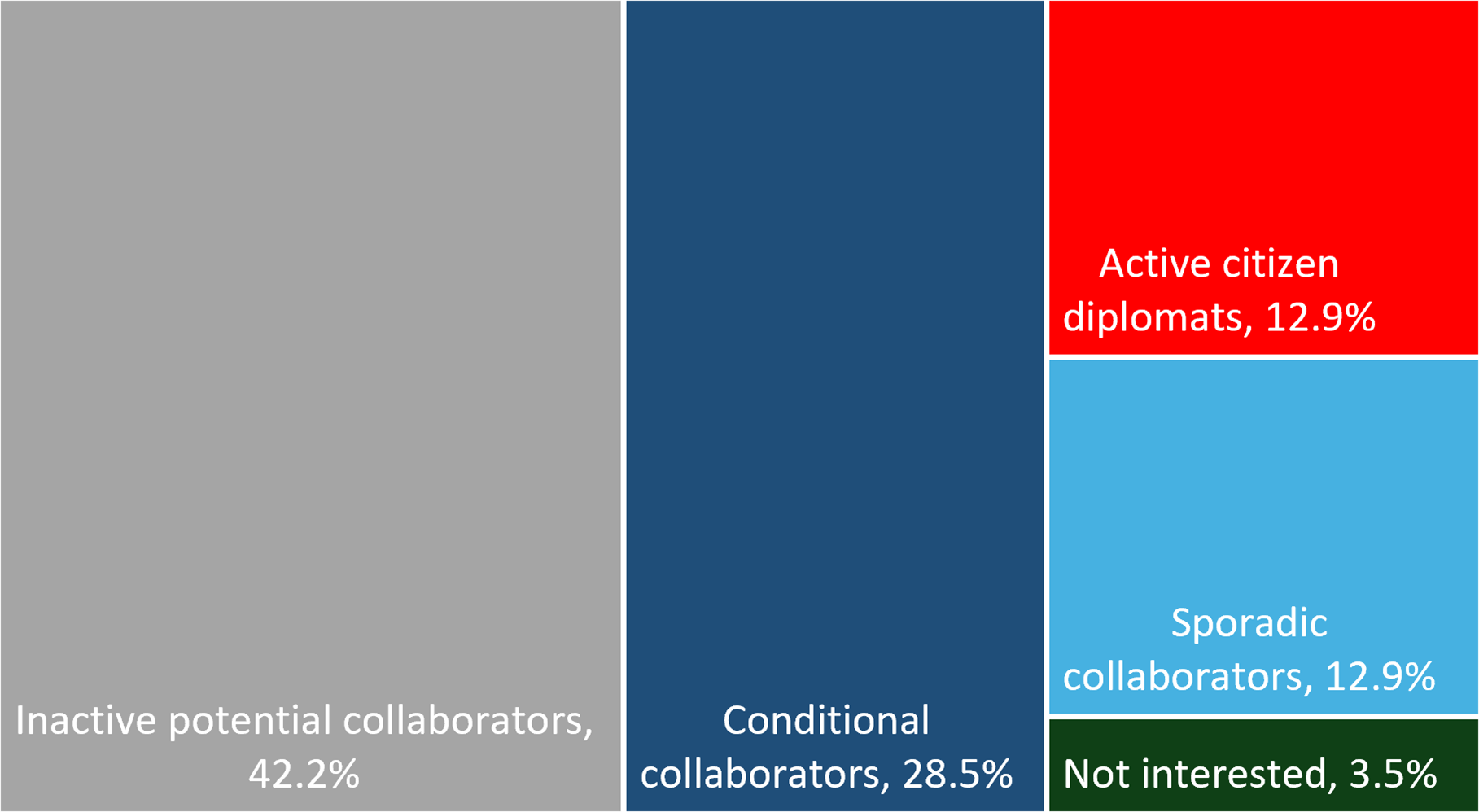
To better illustrate the extent and potential of the engagement of professionals working for international organisations in diaspora diplomacy, we examine how current involvement relates to the willingness to collaborate with stakeholders from Latvia in the future (Figure 3). We find that 12.9% can be considered active citizen diplomats – they collaborate with representatives of Latvia and are eager to do so in the future. Another 12.9% also seek to help Latvia, but so far have collaborated only sporadically; thus, their role as citizen diplomats has been less central. 28.5% are conditional citizen diplomats, i.e., they collaborate only when the circumstances are favourable, and the opportunity aligns with their interests. The largest group, however, consists of what we call ‘inactive potential collaborators’. While they have not yet collaborated with stakeholders from Latvia, they do not rule out this possibility in the future; whether they become citizen diplomats would largely depend on the circumstances. Only 3.5% refuse to consider collaborating with stakeholders from Latvia.
Collaboration potential between national stakeholders and professionals in international organisations (%).

While our focus is on individuals as actors, it is crucial to consider the international organisations in which they work, as these professionals can serve as a bridge between their country of origin and the respective organisation. The varying positionality and roles of these organisations in international relations shape the potential impact of such professional placements.
The results indicate a notable diversity of international organisations where Latvian diaspora professionals are employed. 79.9% of respondents are currently employed or have previous experience in intergovernmental organisations, whereas 22.8% have been engaged with international non-governmental organisations (INGOs). The areas of specialisation within both organisational categories cover a broad spectrum of issues. Some individuals focus on economic development, charitable initiatives, and support for less-developed countries, while others address critical areas such as human rights, health, and environmental concerns. This underscores the multifaceted contributions of the diaspora to global challenges and highlights the potential for extensive collaboration across various sectors. The diverse backgrounds and broad socio-spatial distribution of diaspora professionals indicate considerable potential for empowerment, understood as the power they are perceived to accumulate through their connections to various global contexts (Koinova Reference Koinova2018). However, the variety of organisations represented also brings considerable challenges in mobilising these resources effectively.
Even within a single organisation, respondents often belong to different substructures located in various countries. Our FGDs indicate that diaspora professionals working in international organisations typically do not know each other and do not engage in networking activities. Only in a few instances – such as among judges and professionals in Brussels and Luxembourg – did respondents report a level of mutual acquaintance and networking. This lack of connection may hinder collaborative efforts and the potential for resource-sharing among them. Additionally, the geographical dispersion adds another layer of complexity. Working in Belgium or Luxembourg, which are significant hubs for various European Union institutions, offers enhanced opportunities for professional networking. However, our research indicates that even in these locations, realising the full potential of diaspora diplomacy requires deliberate efforts from the state or diaspora activists.
The landscape of diaspora diplomacy reveals a notable diversity in the country of origin, too, characterised by the involvement of multiple stakeholders. In our survey, 26% of respondents reported engaging with the Ministry of Foreign Affairs, specifically its central office in Riga. Additionally, 31% interacted with embassies or honorary consulates located in their host countries. This highlights the important role that ambassadors and representatives of the formal diplomatic corps play in facilitating both formal and informal cooperation. However, an even larger percentage – 51% of the respondents – indicated collaborations with different ministries or institutions affiliated with sectoral ministries. This suggests that collaboration between the state and diaspora professionals working in international organisations extends beyond foreign relations professionals to include other actors with relevant expertise. The ministries involved in this collaboration include, but are not limited to, the Ministries of Education and Science, Interior, Finance, Culture, Health, and Transport, as well as numerous subordinate institutions.
About 25% of Latvian diaspora professionals working in international organisations have engaged in collaborative initiatives with higher education institutions in Latvia. Furthermore, the non-governmental sector emerges as a significant contributor to promoting and sustaining such collaboration; 20% of respondents reported working with Latvian diaspora or returnee organisations, while 26% indicated they collaborated with other NGOs operating in Latvia. In contrast, engagement with municipal authorities and private enterprises is much lower, with only 14% and 11% of respondents, respectively, acknowledging such collaborations. Overall, our data support the argument that the state cannot be seen as a singular entity in diaspora diplomacy; a diverse range of actors is involved in collaboration with diaspora professionals in international organisations (Koinova and Tsourapas Reference Koinova and Tsourapas2018).
Participants in the FGDs noted that previous cooperation efforts have often been irregular and ad hoc. There is a lack of a cohesive state-level vision for diaspora diplomacy that includes coordinated initiatives to harness the potential of diaspora resources. Consequently, cooperation often relies on the capacity and personal initiative of individuals in key positions, such as ambassadors, heads of missions, or specific officials within the state administration. As one respondent expressed, ‘If a good ambassador is appointed and invites people – great. If not, we turn to others. This is definitely not a state-level vision’ (FGD2). In situations where regular cooperation is established, it usually results from individual initiative rather than being an integral part of a systemic or strategic approach. This observation aligns with findings from a Czech study, which similarly indicated that successful instances of engagement tend to be based on personal narratives rather than a systematic approach (Hornát Šlosarčík, Tomalová et al. Reference Hornát, Šlosarčík, Tomalová and Váška2022). The findings highlight the critical role of individual actors within diaspora diplomacy, emphasising the importance of personal agency, especially in contexts where coordinated efforts by the state are insufficient or absent.
Conducting diaspora diplomacy: cooperation practices and initiatives
The second question our study posed is, ‘How is diaspora diplomacy enacted in practice by individuals working in international organisations?’ Accordingly, we asked about the forms of support that the professionals in international organisations have provided to Latvia. We identified four broad categories of contributions: (1) diaspora engagement encompassing the transfer of professional knowledge; (2) networking and transfer of social capital; (3) diaspora diplomacy functions, which involve advocacy and nation branding; and (4) the diaspora diplomacy dimension of listening, conceptualised as information-gathering in line with contemporary public diplomacy scholarship (Martino Reference Martino, Snow and Cull2020). The framework presented in Figure 4 illustrates that the diverse contributions of international professionals to their country of origin range from official representation by diplomats or members of the European Parliament (which is outside the scope of this paper) to more informal or covert activities. For professionals in official positions as civil servants of international organisations, these actions often fall into a grey area of diplomacy, where they must navigate the delicate boundaries of their professional ethics and loyalty to their country of origin (Rana Reference Rana2011, Reference Rana, Zaharna, Arsenault and Fisher2014; Trondal, Murdoch and Geys Reference Trondal, Murdoch and Geys2015).
The scope of diaspora diplomacy.

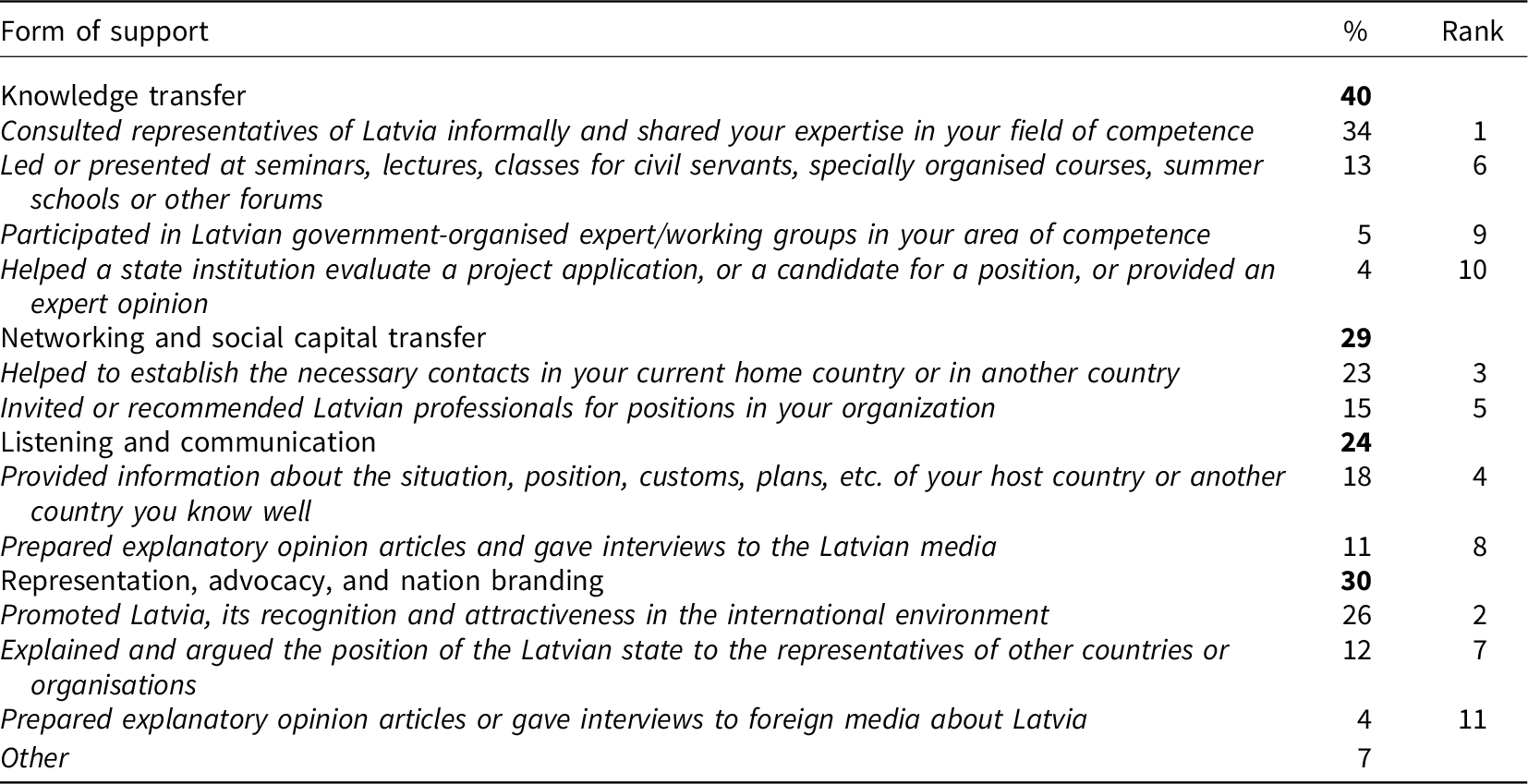
The data indicate that professionals working in international organisations primarily support their country of origin through knowledge transfer, accounting for 40% of professionals in our survey (Table 1). This contribution is seen as very important, and it often involves informal consultations with representatives from Latvia and the sharing of expertise relevant to various sectors, including public administration, civil society, higher education, and the economy. For public officials, students, and employees of non-governmental organisations, understanding the internal dynamics of these organisations is important as it facilitates more effective engagement with them, enables better navigation of career opportunities in these organisations, and improves their country’s capacity to achieve strategic objectives. In this context, one interviewee stated, ‘For the Ministry of Foreign Affairs or the relevant sectoral ministries, maintaining informal contacts is particularly beneficial. This ensures access to contextual information regarding international developments and enhances the ability to fill in certain applications or influence the pertinent institutions in the direction that Latvia would like’ (I1).
What kind of formal or informal support have you provided to Latvia (in the last 5 years)?

Table 1. Long description
The table titled ‘What kind of formal or informal support have you provided to Latvia’ outlines various forms of support provided to Latvia by professionals in international organizations over the last five years. It includes percentages and ranks for each type of support. The table has 11 rows and 3 columns. The columns are labeled ‘Form of support’, ‘%’, and ‘Rank’. The rows are grouped under different categories of support: Knowledge transfer, Networking and social capital transfer, Listening and communication, Representation, advocacy, and nation branding, and Other. Each row lists a specific form of support, the percentage of professionals providing that support, and its rank. Notable forms of support include consulting representatives of Latvia informally, helping to establish necessary contacts, and promoting Latvia’s recognition internationally.
Note: The bold values indicate the overall percentage for each diaspora diplomacy/cooperation category.
A better understanding of the perspective of international organisations can also serve as a valuable lens through which to analyse Latvia’s position or decisions, or the absence thereof, within a broader international context. Learning from international practices – both in terms of administrative solutions and professional activities within specific sectors – is also perceived as an important opportunity stemming from collaboration with professionals in international organisations. Feedback from several FGDs reveals a strong belief that public administration professionals in Latvia need to engage with global best practices in specific areas. Instead of simply replicating established norms and existing frameworks, it is essential to adopt innovative and effective strategies that align with the dynamic nature of international standards and practices.
Individuals working in international NGOs believe their primary potential contribution to the Latvian state lies in sharing knowledge about good governance practices and transferring insights from established European democracies regarding cooperation between the non-governmental sector and the state. They argue that creating space for discussion, encouraging more confident expression of critical opinions, and attracting internationally recognised experts would improve public administration and strengthen the functioning of democracy in general. Additionally, professionals working in international NGOs support Latvian NGOs in securing international cooperation projects, thereby significantly strengthening their capacity and resources.
Our research indicates that approximately 30% of professionals have engaged in activities related to representation, advocacy, and nation branding. While most of these individuals focused primarily on promoting Latvia, around 12% actively sought to advance and articulate Latvia’s interests in discussions with representatives from other countries or organisations. The FGDs suggest that successful advocacy and effective nation branding require a comprehensive understanding of the country’s strategic goals and priorities, as well as its key arguments and positions. Currently, this understanding is lacking, which hinders professionals’ ability to influence processes, policies, and decision-making in ways that align with Latvia’s interests. Additionally, a significant advantage of this engagement is that these professionals can counteract disinformation about Latvia. Their elevated status and trusted positions lend them considerable credibility.
The third most prevalent modality of diaspora diplomacy is related to social capital, which characterises 29% of the respondents. This primarily involves establishing essential contacts. Notably, 15% of professionals have invited or recommended Latvian colleagues for positions within their organisations. Providing recommendations or sharing insider information is crucial for securing desirable employment opportunities. As a participant in one FGD observed, ‘A lot of it is done through informal networking. No one doubts your intellectual capacity, but the end result is still quite dependent on who you know’ (FGD2). This highlights the importance of informal networking for professional advancement in international organisations.
24% of diaspora professionals have actively engaged in efforts related to ‘listening and communication’. This involvement has allowed them to deliver critical information to both the general public and government representatives, enhancing Latvia’s impact on the international stage. As noted in the FGDs, professionals working in international organisations are well positioned to provide insights into relevant international developments. They can provide essential contextual information about ongoing debates, share commentary on potential future developments, and elaborate on current and upcoming plans and campaigns from the perspective of specific organisations or sectors. Additionally, they can highlight the need for development cooperation across various countries while considering broader global trends. These professionals are also positioned to share information about processes, procedures, and the ‘behind-the-scenes’ discussions that shape specific decision-making processes. Their contributions are invaluable; for instance, they can help Latvian officials refine their strategies for engaging in multilateral development cooperation projects and addressing areas of thematic interest to Latvia. This in-depth information enables the administration to operate more effectively and make informed decisions that align with international objectives.
At the same time, the participants of FGDs noted that in international organisations, it is pivotal for professionals to adhere to specific employer conditions, which include principles of neutrality, equal treatment of all member states, and the obligation to maintain confidentiality regarding internal information. Individuals engaged in professional activities should refrain from overtly lobbying for or advocating the interests of their home countries, as such actions are incompatible with the principles of neutrality and impartiality. Nevertheless, the participants of our study have observed that collaborative practices often transcend formal protocols and are significantly influenced by customary practices and the diplomatic ethos of member states. As a result, a shared understanding among participating actors of the legal and ethical boundaries of informal, behind-the-scenes engagement is crucial to fostering effective collaboration.
The arguments presented in the FGDs were closely aligned with the survey findings. Alongside ‘diplomacy through diaspora’, which involves enhancing Latvia’s reputation and advancing its interests internationally, participants also frequently referred to the concept of ‘diplomacy for diaspora’. The most often cited benefit of collaborating with professionals from international organisations pertains to its contribution to Latvia’s development. This includes efforts aimed at strengthening Latvia’s public administration and facilitating the transfer of social capital, international experience, and knowledge across various fields and sectors. Additionally, social transfers were highlighted as encompassing the exchange of values, ideas, and attitudes that foster progressive social change.
On average, diaspora professionals participated in 2.44 different forms of diaspora diplomacy simultaneously. Interestingly, the diversity of collaborative activities tends to increase among professionals who received state support in attaining their current position. In these cases, support for networking (often referred to as social capital) is the most prevalent type of assistance (Sig. <0.05), i.e., those whose careers have been supported often reciprocate by helping others in turn. Further analysis shows that participation in diaspora diplomacy is relatively uncommon during the first year of employment with an international organisation. There are no significant differences in engagement in diaspora diplomacy based on an individual’s position within the organisation or the nature of the organisation itself.
Factors facilitating and hindering individual engagement in diaspora diplomacy
Our research indicates that diaspora professionals are generally willing to collaborate with their country of origin. As one interviewee noted, understanding this is an important first step towards establishing cooperation that ‘Latvia absolutely needs’ (I3). The FGDs suggest that professionals from smaller countries such as Latvia may feel a stronger sense of obligation to assist. One participant remarked, ‘We are not French or German, who can say, well if I don’t do it, there are 1600 other people who will. Well, there are other people, but we are not that many’ (FGD1). This highlights how resource scarcity amplifies the sense of responsibility to contribute within smaller communities: ‘we [Latvians] are too few to ignore the needs and potential benefits of cooperation’ (I2).
The primary barrier to closer collaboration between professionals in international organisations and stakeholders in Latvia is the perceived lack of interest on the part of Latvia, a sentiment expressed by nearly half of the survey respondents (47%) and echoed in FGDs. One respondent noted, ‘I am not in a high-ranking but rather an interesting position. I have been working here for years, and none of the Latvian officials who participate in various working groups here has called me during these years’ (I1). This perception is closely linked to the belief that the expertise of these professionals is undervalued in Latvia. In fact, 53% of surveyed professionals feel that their skills and knowledge are not recognised as valuable, while only 19% believe their experience and contributions are appreciated.
71% of our respondents – professionals working in international organisations – reported that the Latvian civil and diplomatic services have never shown interest in utilising their expertise. Only 14% have encountered a clear demonstration of interest, while a few others noted sporadic or inconsistent engagement. This issue is not unique to Latvia; a study conducted in the Czech Republic similarly found that Czech diaspora professionals often feel ‘abandoned’ by their home country (Hornát, Šlosarčík, Tomalová et al. Reference Hornát, Šlosarčík, Tomalová and Váška2022). This suggests a lack of awareness at the government level regarding the opportunities that diaspora diplomacy can provide. Consequently, this is the primary reason the potential for diaspora diplomacy remains significantly underutilised.
Participants in the FGDs identified a lack of professional culture and norms in Latvia that foster collaboration, both within public administration and in Latvian society more broadly. This issue was highlighted by 19% of survey respondents as a significant obstacle. In this context, collaboration relies heavily on the interest, openness, motivation, and strategic vision of individual officials or employees, both in public administration and among diplomats. For example, ambassadors play a crucial role in bringing together and connecting Latvian diaspora communities. However, many of them operate primarily in a traditional diplomatic capacity, often neglecting the importance of actively engaging with and networking with diaspora professionals.
As a result, initiatives aimed at fostering collaboration typically arise from the diaspora professionals themselves. However, not everyone has the time or motivation for proactive efforts. Therefore, there is an expectation that the Latvian public administration should take the lead in engaging senior professionals in collaboration. It is crucial that the approach to cooperation is strategic, intentional, and viewed with a long-term perspective. Without a systematic approach, individual initiatives often depend on the tenure of particular officials. When personnel change, new officials may introduce different priorities and perspectives, which can lead to the discontinuation of previous efforts. As a result, the goals of these initiatives often remain unmet.
A significant number of respondents (30%) cited a lack of information about who in Latvia could benefit from their expertise and assistance as a reason for the absence of closer cooperation. This indicates that diaspora diplomacy can be most effective when guided by a clearly defined strategy that fosters partnerships with professionals in international organisations, aligns engagement with the country’s specific expertise needs, and facilitates connections with those who would benefit most from this knowledge. Another obstacle is the unclear understanding of the country’s goals and priorities; these elements need to be discussed and presented clearly through both strategic policy documents and informal discussions with diaspora professionals.
On the employer’s perspective, a primary obstacle to cooperation is the belief that maintaining neutrality is crucial, as noted by 25% of respondents. Participants in FGDs emphasised that adherence to professional and ethical standards prevents them from advocating for or openly promoting Latvia’s interests or from disclosing internal information. However, real-world practices tend to be more complex; collaboration often occurs informally and is shaped by established norms and the diplomatic culture of each country. Many participants acknowledged the vital role of informal communication and social contacts in international organisations. One participant stated, ‘Brussels relies entirely on people talking to each other, mostly informally. State representative offices play a huge role in creating and utilising such opportunities to advance state priorities’ (FGD2).
There are notable differences across various national and institutional cultures in perceptions of informal information exchange. For example, FGD participants observed that staff from Southern European countries often meet with their ambassadors for informal discussions, for instance, over coffee. Based on subsequent decisions or actions, it becomes evident that these state representatives had access to information that they could not have accessed through formal channels. In contrast, informal collaboration and information sharing are not deeply rooted in Latvia’s diplomatic culture. Such practices are neither expected by the Latvian side nor widely adopted by many professionals, who often worry that engaging in them could violate confidentiality requirements.
While not all study participants agreed that informal information exchange is acceptable, many acknowledged the numerous other opportunities to indirectly represent Latvia’s priorities and interests. For example, professionals can highlight Latvia’s priorities when speaking at sector-specific conferences. Therefore, there should be more discussions and increased awareness about the various ways professionals working in international organisations can engage in diaspora diplomacy while remaining compliant with their employer’s neutrality requirements. When considering cooperation, it is important to recognise that diaspora professionals are not simply tools for the governments of their home countries. They have their own perspectives on which ideas should be advanced and what would best benefit their country and its citizens. As demonstrated by some of our interviewees, these opinions may differ significantly from the official stance of their home country’s government.
Conclusions and discussion
Our study contributes to the growing body of research on diaspora diplomacy in international studies. It explores an often-overlooked aspect of public diplomacy that transcends traditional diplomatic methods and protocols, specifically the role of citizen diplomats – individual professionals in international organisations who actively work to advance the interests of their home countries. Focusing on the diversity of actors and collaborative networks, our aim was to illuminate the multifaceted role of diasporas as dynamic resources for state influence and visibility on the global stage.
In contrast to previous research that focuses on organisations, our analysis underscores the significance of individual actors and grassroots involvement in international relations and diplomatic practice. By doing so, we advocate a shift toward a more decentralised, networked model of new diplomacy. Incorporating individual agency alongside collective efforts offers a more comprehensive framework for understanding new diplomacy and how members of the diaspora may enhance the capacities of nation-states in an increasingly networked world.
Drawing on the case of Latvian diaspora professionals in international organisations, we show that informal engagement can strengthen formal diplomatic efforts and bolster a nation’s soft power and overall development. Key functions of public diplomacy are actively performed at the individual level by ‘citizen diplomats’ – skilled professionals working in international organisations whose roles place them close to crucial decision-making arenas. Their capacity to represent and advocate informally for their country of origin serves as a distinct form of diaspora-driven soft power.
Our analysis demonstrates that diaspora professionals engage simultaneously in all three forms of diaspora diplomacy: ‘for’ diaspora, through knowledge transfer and contributions to national development; ‘through’ diaspora, by enhancing state visibility and influence in multilateral arenas; and ‘by’ diaspora, through their individual agency, perspectives, and initiative. Our findings reveal that citizen diplomats perform essential public diplomacy functions – communication, representation, advocacy, exchange, and nation branding – using their personal expertise, credibility, and transnational networks. These multifaceted engagements underscore the importance of personal initiative, particularly in the absence of a clear national strategy for diaspora diplomacy. They are further shaped by the institutional norms and professional ethics that prevail within ministries, state agencies, and international organisations.
While some contributions are formalised and carried out openly (e.g., expert groups or working groups within a professional’s field of competence, explaining how formal decision-making processes operate within international organisations), others are more covert, falling into a grey zone of informal diplomacy (e.g., sharing internal information, advocating for causes or issues important to their home country). While no participant in this study reported personally sharing confidential internal information with Latvian representatives or diplomats, several respondents suggested that such practices do occur among some professionals working in international organisations. This raises questions about the acceptable boundaries of informal collaboration. Both the research of Trondal, Murdoch, and Geys (Reference Trondal, Murdoch and Geys2015) and our findings suggest that professionals working in international organisations are generally aware of their primary commitment to the organisation and, in practice, tend to adhere strictly to principles of neutrality and impartiality. At the same time, our findings echo those of Hornát, Šlosarčík, Tomalová et al. (Reference Hornát, Šlosarčík, Tomalová and Váška2022), who observe that governments perceive the placement of their nationals in strategic positions as a source of strategic advantage because of the influence and privileged access to information these individuals can provide. Similarly, some participants in our study emphasised that governments which refrain from actively promoting their nationals for key positions or maintaining such informal channels of influence may find themselves at a disadvantage compared with those that do. Recognising the new realities of public diplomacy may require more explicit rules, revised guidelines, and comprehensive ethics training within organisations and public administration to maintain the credibility of the diplomatic process, particularly in an era of increasing global security risks.
From the perspective of nation states, our findings suggest strong potential for targeted diaspora diplomacy initiatives aligned with a country’s strategic foreign policy objectives. Individuals working in international organisations can serve as vital diasporic agents (Lartigue Reference Lartigue2021). They can share valuable knowledge and social connections, provide essential insider information, and advocate for their home country. However, to effectively mobilise the diaspora, countries need a coherent strategy integrated into their foreign and diaspora policies. While many countries recognise the importance of having their nationals in decision-making positions within international organisations, Latvia is only beginning to embrace this approach. The geographical spread and diversity of stakeholders complicate the implementation of an integrated diaspora diplomacy strategy, even for nations acknowledging its potential. Nevertheless, the Latvian example shows that professionals who work in international organisations are finding ways to engage in diplomacy led ‘by’ the diaspora, participating in initiatives that foster cooperation and strengthen international ties.
While our study focuses on Latvia, it is just one of many countries seeking to engage professionals in international organisations in their public diplomacy efforts. The extent to which such practices are widespread, which countries utilise their diaspora networks most and to what end, remains largely opaque due to limited transparency and the emergent nature of the field. This opens up important avenues for future research. Quantifying the exact impact of citizen diplomats on their countries’ efforts within international organisations poses significant methodological and ethical challenges (Cormac, Walton, and Van Puyvelde Reference Cormac, Walton and Van Puyvelde2022). Specific impact criteria would need to be established and carefully tracked, and even then, some of the impact might be extremely difficult, if not impossible, to measure (e.g., persuasion power in relation to certain decisions at the UN, or refuting Russia’s disinformation narratives). The individuals involved might be unable or unwilling to acknowledge this impact, or they may have a different understanding of what constitutes an ‘impact’. This remains both a methodological challenge and an important avenue for future research.
While diasporas have significant potential as agents of change and development, their instrumentalisation raises additional ethical, social, and political concerns. There is a need for further research and discussion on how states can engage diaspora communities while respecting their diverse roles, fostering mutual respect, and ensuring reciprocal benefits (Brinkerhoff Reference Brinkerhoff2011; Turner and Kleist Reference Turner and Kleist2013; Trondal, Murdoch, and Geys Reference Trondal, Murdoch and Geys2015). Comparative analysis across different national contexts could be particularly fruitful in examining the balance between enabling diaspora agency and safeguarding against its reduction to a narrow tool of state interests. As highlighted by Adler and Firestone (Reference Adler and Firestone2018), adapting to the evolving landscape of international relations will require fresh skills and innovative tools that align with network principles. This shift requires rethinking how we approach and implement foreign policy. Diaspora diplomacy plays, and will continue to play, a vital role in contemporary diplomatic strategies.
Despite more than a decade of discussion around new, public, and diaspora diplomacy, the integration of these ideas into practice has been slow. While some nations have developed strategies to enhance their representation in various EU institutions, others have yet to do so. As our study demonstrates, effective diaspora diplomacy necessitates active encouragement and support from the state, thereby intertwining all three forms – diplomacy for, through, and by the diaspora – to optimise outreach and engagement.
The governance of international organisations nowadays maintains significant power imbalances, leading to the systematic underrepresentation of the interests of smaller states. Institutional rules – such as veto powers, weighted voting, and agenda control – tend to favour dominant states. The leaders of major powers dominate crucial discussions on the international stage, leaving many smaller states observing from the sidelines. Engaging their citizen diplomats in public diplomacy offers smaller states a promising means of advancing their political and economic interests and amplifying their voices beyond what their size or economic capacity would typically permit (Pinto Reference Pinto, Broka and Sprūds2020). However, such strategies are also used alongside traditional diplomatic efforts by medium-sized states and any nation aiming to leverage any available tools to advance its strategic interests. As public diplomacy tools evolve and grow more complex, academic scholarship must keep pace with these developments.
Data availability statement
The data are highly sensitive and have therefore not been deposited in an open-access repository. Those wishing to replicate the findings may contact the authors to request access to the pseudonymised dataset.
Acknowledgements
The authors thank the anonymous reviewers for their valuable comments and constructive suggestions, which greatly helped to improve the manuscript. The authors are grateful to Dr. Phil. Daina Grosa of the Faculty of Humanities, University of Latvia, for her valuable assistance with the English language editing.
Funding statement
The paper is developed with the support of the state research programme «Cutting-edge knowledge and solutions to study demographic and migration processes for the development of Latvian and European society» Nr. VPP-LETONIKA-2021/4-0002.
Competing interests
Authors do not have a conflict of interest.
Ethical standards
In accordance with best practices in research ethics and the national and EU legal frameworks on data protection, participants were informed about the purpose of data collection, how their data would be processed, stored, and used for analysis and publication, as well as how their identities would be protected. The project obtained voluntary informed consent from all research participants.
Use of AI
Grammarly was used to correct the spelling and improve the wording of the text. No AI tools were used in the development of the research content, analysis, or interpretation.
Appendix A. Sources: Interview and Focus Group Discussion data
(I1) Interview with a professional working in the Foreign Affairs Council (FAC), Council of the European Union, 04.07.2022. online
(I2) Interview with a professional working in the European Bank for Reconstruction and Development, 05.07.2022. online
(I3) Interview with a professional working in the Secretariat-Generale, European Commission, 06.07.2022. online
(I4) Interview with a professional working in the United Nations Development Programme agency, 26.07.2022. online
(FGD1) FGD with international justice professionals (judges of the European Court of Justice), 04.07.2022. online
(FDG2) FGD with professionals working in international intergovernmental organisations (UN, OSCE, WHO, PB), 05.07.2022. online
(FGD3a) FGD with professionals working in EU institutions outside the EU, 04.07.2022. online
(FGD3b) FGD with professionals working in EU institutions inside the EU, 06.07.2022. online
(FGD4a) FGD with professionals working in international non-governmental organisations, 06.07.2022. online
(FDG4b) FGD with professionals working in international non-governmental organisations, 07.07.2022. online
Appendix B. Profile of the survey respondents (%)

Long description
The table is divided into three main sections: current status of employees, work experience in the current organization, and countries where respondents have worked. The first section lists the current status of employees with corresponding percentages: Civil servant (permanent) 59.1 percent, Other permanent employee 12.9 percent, Contract worker 9.7 percent, Consultant 7.5 percent, Volunteer 2.2 percent, Temporary worker 2.2 percent, Seconded Latvian employee 2.2 percent, and Other 7.4 percent. The second section details work experience in the current organization with percentages: Up to 2 years 8.4 percent, 3-5 years 15.8 percent, 6-10 years 23.2 percent, and More than 10 years 52.6 percent. The third section lists countries where respondents have worked and are working for at least 3 years during the last 10 years with percentages: Belgium 37.3 percent, Latvia 28.7 percent, Luxembourg 24.6 percent, France 14.8 percent, USA 12.3 percent, UK 12.3 percent, Germany 11.5 percent, Denmark 9.0 percent, Sweden 8.2 percent, Italy 8.2 percent, Switzerland 8.2 percent, Spain 7.4 percent, Netherlands 7.4 percent, Austria 6.6 percent, Norway 5.7 percent, Ireland 4.9 percent, Russia 4.1 percent, and Other country 26.2 percent.




 Open access

