Introduction
According to the National Epidemiologic Survey on Alcohol and Related Conditions, the lifetime prevalence of post-traumatic stress disorder (PTSD) reported among community-dwelling older adults aged 60 years and over was 4.5% in the USA and the lifetime prevalence of partial PTSD was 5.5% (Pietrzak et al., Reference Pietrzak, Goldstein, Southwick and Grant2012). A recent meta-analysis reported that the current (one month) prevalence of PTSD was 1.7% among older adults (Volkert et al., Reference Volkert, Schulz, Härter, Wlodarczyk and Andreas2013). These prevalence estimates are similar to other common mood and affective disorders in older adults.
Studies have shown that PTSD is associated with significant burden to individuals. PTSD has been associated with the presence of physical illness (Sareen et al., Reference Sareen, Cox, Stein, Afifi, Fleet and Asmundson2007; Spitzer et al., Reference Spitzer, Barnow, Völzke, John, Freyberger and Grabe2009; Glaesmer et al., Reference Glaesmer, Brähler, Gündel and Riedel-Heller2011a), co-morbid psychiatric disorders (Van Ameringen et al., Reference Van Ameringen, Mancini, Patterson and Boyle2008; Glaesmer et al., Reference Glaesmer, Kaiser, Brähler, Freyberger and Kuwert2012; Pietrzak et al., Reference Pietrzak, Goldstein, Southwick and Grant2012) and psychosocial difficulties (Pietrzak et al., Reference Pietrzak, Goldstein, Malley, Johnson and Southwick2009). Studies have also shown higher healthcare utilization among older adults with PTSD (van Zelst et al., Reference van Zelst, de Beurs, Beekman, van Dyck and Deeg2006; Chan et al., Reference Chan, Cheadle, Reiber, Unützer and Chaney2009; Glaesmer et al., Reference Glaesmer, Brähler, Riedel-Heller, Freyberger and Kuwert2011b). Chan et al. (Reference Chan, Cheadle, Reiber, Unützer and Chaney2009) showed increased outpatient and mental health specialist visits in older veterans with PTSD as opposed to veterans without. However, another study has reported that persons with PTSD did not have more general practitioner (GP) visits than persons without PTSD (van Zelst et al., Reference van Zelst, de Beurs, Beekman, van Dyck and Deeg2006). Glaesmer et al. (Reference Glaesmer, Brähler, Riedel-Heller, Freyberger and Kuwert2011b) also showed increased odds of being hospitalized during a 12-month period among older adults with PTSD as opposed to those without. Others however, did not report increased odds of being hospitalized or longer length of inpatient stays in persons with PTSD as opposed to those without (Chan et al., Reference Chan, Cheadle, Reiber, Unützer and Chaney2009; Ivanova et al., Reference Ivanova2011). Regarding medications use, studies have shown increased odds of BZDs (van Zelst et al., Reference van Zelst, de Beurs, Beekman, van Dyck and Deeg2006) and ADs (Chan et al., Reference Chan, Cheadle, Reiber, Unützer and Chaney2009) use in older adults with PTSD, as opposed to those without.
When looking at the impact on health system costs, several studies also showed that PTSD was associated with higher health system costs in a 12-month period (Marshall et al., Reference Marshall, Jorm, Grayson and O’Toole2000; Walker et al., Reference Walker, Katon, Russo, Ciechanowski, Newman and Wagner2003; Chan et al., Reference Chan, Cheadle, Reiber, Unützer and Chaney2009; Ivanova et al., Reference Ivanova2011). Ivanova et al. (Reference Ivanova2011) found that adults with PTSD incurred higher total costs, reaching $19,407 US versus $17,960 US for adults without PTSD in one year. A study conducted with veterans aged 55 years and over, showed a cost difference reaching $2,161 US in older patients with PTSD as opposed to those without (Chan et al., Reference Chan, Cheadle, Reiber, Unützer and Chaney2009). The impacts and costs related to PTSD in Canada have not been well documented. Considering that PTSD is as prevalent as other common mental health disorders in older adults, it may also be associated with a significant social and economic burden. Vasiliadis et al. (Reference Vasiliadis, Dionne, Préville, Gentil, Berbiche and Latimer2013) reported among a large Canadian population-based study of older adults, the per capita costs associated with anxiety, depression, and comorbid anxiety and depression reached $80.0, $27.4, and $120 million per million inhabitants.
In conclusion, studies have shown that PTSD is common in older adults and associated with significant burden to individuals and health systems. Given the aging population and the impact on health system resources, it is important to understand the economic consequences of PTSD from a healthcare perspective. The aim of this study was to assess in a public-managed healthcare system the patterns of healthcare utilization and related health system costs in a population of older adults. In contrast with previous studies, that assessed healthcare costs in veterans and community adult populations, our study used a large sample of older adults recruited and consulting in primary care practices. We hypothesize that healthcare and related costs will be higher among older adults with PTSS than those not reporting PTSS while controlling for a number of socioeconomic and clinical factors.
Methods
Data retained in this study came from a large sample of 1,456 older adults aged 65 years and over recruited in a primary medical clinic in one of the administrative regions of Quebec representing a population of 1,325,000 inhabitants. The study was conducted between 2011 and 2013.
First, the sampling strategy included the recruitment of GPs. The sample was stratified according on the type of clinics: local community health services center (CLSC), family medicine group (GMF), private medical clinics with less than three physicians (PC < 3) and medical clinics with three physicians or more (PC ≥ 3). The inclusion criteria for the recruitment of GPs included working full time (four days/week) in the studied administrative region. For each GP recruited, a pamphlet was placed in the waiting room of their clinic. This pamphlet explained the procedures and objectives of the study. Persons aged 65 years and over who were waiting to receive medical services were invited to participate in the study by the pamphlet. Out of the 744 GPs that were eligible, 245 physicians accepted to participate in the study and recruited a mean of 7.3 older adults.
Procedure
The participants had to leave a phone number where they could be reached within the following month in order to schedule a face-to-face interview at home. The interviewers (n = 19) were trained on the administration of the computerized ESA (Étude sur la Santé des Aîné(e)s)-Services questionnaire. Interviewers had to obtain written consent from the participants at the beginning of the meeting. Additional and separate consent was also requested to obtain access to the participant's medical and drug insurance coverage data from the Régie d’Assurance Maladie du Québec (RAMQ) and the MED-Echo databases. The RAMQ medical registry holds information on all physician claims and fees paid out for consultations and medical acts provided during an ambulatory visit in an outpatient and ED setting and during a hospital stay. The RAMQ drug registry holds information on all drugs delivered on an outpatient basis for residents of Quebec covered under the public drug insurance plan. The MED-Echo database provides information on all hospital stays and includes length of stay, diagnoses, services provided, and whether the patient was admitted trough the ED. The Canadian universal healthcare system ensures that all residents have access to basic healthcare services that virtually all physician contacts, medical consultations, and inpatient stays are covered for all residents. Healthcare services of all provinces and territories of Canada are funded mainly by the province or territory and partly by the Federal Government. However, for residents of the province of Quebec, medications may be covered under the public or private drug plan.
The survey and administrative data were linked using respondent's health insurance number. Further, in order to minimize the potential for information and desirability bias created by the presence of friends or family members, the interview took place in the most isolated area of the house. As memory problems can affect responses to the interview, participants with moderate or severe cognitive impairment having a score below 22 on the Mini-Mental State Examination (MMSE) were excluded from the study (n = 38). A compensation of $15 CAN was paid out for interviews. In the ESA-Services study, 1,765 respondents completed the face-to-face interview. Among these, 1,642 (94%) participants gave permission to link their health survey data during the at home interview with their medical files at the RAMQ. Further, 1,456 respondents were covered under the RAMQ public drug insurance plan and therefore constituted the analytic sample. The ESA-Services study was approved by the Ethics Committee of the University of Sherbrooke's Institute of Geriatrics.
Measures
Post-traumatic stress syndrome (PTSS)
In this study, the presence of a PTSS was measured using the PTSS scale developed by Préville et al. (Reference Préville2014). The PTSS scale ranged from 0 to 12 and a cut-off score of 10 was proposed to identify probable patients of PTSS. At this cut-off, the sensibility and specificity were 94% and 92%. The internal consistency of the instrument was 0.82. It includes three indicators: (1) the number of lifetime traumatic events, (2) the Impact of Event Scale-Revised (IES-R) (Christianson and Marren, 2012), and (3) the presence of impairment in different areas of functioning (ISF) in the last six months. The scale included 14 potential events based on the DSM-IV (Diagnostic and Statistic Manual for Mental Disorders, fourth revision) PTSD traumatic event list including military (war, combat), natural disaster (tsunami, hurricane, flood), and civil (car accident, family violence, life-threatening disease) traumatic events (American Psychiatric Association, 1994). IES-R was used to measure the number of symptoms in the previous six months associated with the traumatic event (Christianson and Marren, 2012). The IES-R includes 22 symptoms, similar to the DSM-IV criteria, and varies from 0 to 3 (not at all to often). As example question, participants were asked: “Any reminder brought back feelings about it in the last six months”. Despite that no cut-off on the IES-R has been proposed for older adults, Christianson and Marren (2012) reported that the IES-R could be used as a valid instrument in older adults exposed to various traumatic events. The presence of functional impairment associated with the trauma was measured by the presence of at least one functioning limitation in one of four areas: daily activities, social activities and leisure, household tasks, and relations with relatives. As example question, respondents were asked: “How this or these events had an impact (in terms of consequences) on your daily activities in the last six months”.
Depression, anxiety disorder, and cognitive status
Depression and anxiety disorders were measured using the structured computerized-assisted ESA-Services questionnaire. The depression and anxiety modules are based on DSM-IV criteria (American Psychiatric Association, 1994) and are similar to the one used in the Composite International Diagnostic Interview (CIDI) and the Diagnostic Interview Schedule (DIS). The presence of a major depression (yes/no) was defined by the following criteria: (1) a depressed mood or loss of interest in everyday activities almost every day and most of the day for at least two weeks, (2) the presence of at least five of the seven symptoms of depression and (3) impairment in one the areas of functioning. Minor depression as a sub-clinical depression was defined by the presence of at least two to four of the seven symptoms of depression as reported in the DSM-IV (American Psychiatric Association, 1994). Anxiety disorder was defined by the presence of at least one of the following disorders using DSM-IV criteria: specific phobia, social phobia, agoraphobia, panic attack, obsessive-compulsive disorder, generalized anxiety disorder (American Psychiatric Association, 1994; Préville et al., Reference Préville2008). Further, cognitive status was measure by the MMSE scale which screens for cognitive disability. Scores range between 0 and 30 and as mentioned earlier, respondents with an MMSE score below 22 were excluded from the study (Folstein et al., Reference Folstein, Folstein and McHugh1975).
Healthcare use
Information on respondent's ED and outpatient visits and hospitalization healthcare use in the year prior to the interview was obtained from the RAMQ and MED-Echo databases. According to the primary diagnoses based on Mental and Behavioral disorders from the ICD-10 classification (International Classification of Diseases, Tenth revision), outpatient visits and inpatient stays were classified as “mental health related” or “other”. Mental health related outpatient visits and inpatient stays included visits related to any psychiatric diagnosis and not only for PTSS. Outpatient and ED visits were measured by the number of visits and inpatient stay was defined by the number of days.
Medication use on an outpatient basis was ascertained from the RAMQ drug registry, which holds information on the drug identification number, the date that the prescription was delivered, quantity, dosage, length of prescription, and cost of the drug, which also includes pharmacist fee. The presence of ADs and BZDs use was identified through the RAMQ's drug registry and measured as a dichotomous variable (yes/no). A variable was also created to measure the total number of delivered prescriptions for all types of drugs in the year prior to the interview.
Cost
The measurement and costing of resources was based on published guidelines for economic evaluations (Drummond et al., Reference Drummond, Sculpher, Torrance, O’Brien and Stoddart2005; Canadian Agency for Drugs and Technologies for Health, 2006). The cost analysis was from the health system perspective. This perspective includes all direct and overhead costs related to public healthcare system including all medical services, medications, medical and office supplies, building, and security. The methodology used has been described in detail elsewhere (Reinharz et al., Reference Reinharz, Lesage and Contandriopoulos2000; Vasiliadis et al., Reference Vasiliadis2006; Vasiliadis et al., Reference Vasiliadis, Dionne, Préville, Gentil, Berbiche and Latimer2013). The cost of a hospital stay was valued on a per diem basis and outpatient and ED visits in public institutions were valued on a cost per visit. The Quebec ministry of health and social services annual budget and activity reports (AS-471, AS-478) provides data on costs (e.g. salaries, imagery test, medical supplies, pharmacy, nutrition, laundry, administrative costs, etc.) and levels of activity (e.g. number of days, number of visits, number of patients) by activity center or department for each institution in the province. The reports from the 2009–2010 fiscal years were used to calculate the mean provincial costs and activity levels. The cost data were indexed for the 2011, 2012, and 2013 fiscal year using the consumer price index for healthcare services. The direct allocation method and summary annual reports for the province of Quebec were used to calculate the unit costs.
The unit costs related to an inpatient stay, ED and outpatient visit included imagery and medical laboratory costs, pharmacy (drug costs, preparation, and monitoring), salaries associated with the care and management of patients, and medical and office supplies. Other costs included those relating to housekeeping, laundry, hygiene, and administration (coordination of general units and nursing staff). For maintenance of equipment and building and security, 9.7% of the total operating costs were added. In order to consider building and land opportunity costs, an additional 6% (inpatient stay) and 4% (outpatient and ED visits) was added to the unit costs (Rosenheck et al., Reference Rosenheck, Frisman and Neale1994). Costs associated with management, evaluation, and treatment such as psychotherapy and counseling in public settings were also added when the outpatient visits and inpatient stays were mental health related. Physician fees were calculated separately and were not included in the unit costs. The total cost included cost associated with total outpatient visits, total ED visits, total inpatient stays, physician fees, and all medications use.
Analyses
First, χ2 and t-test analyses were used to evaluate the difference in sociodemographic and clinical factors between persons with and without PTSS. χ2 and Mann–Whitney analyses were used to assess healthcare use among respondents with and without PTSS. GLM with a gamma distribution (Log Link) were used to evaluate the cost differences associated with healthcare use according to the presence or absence of PTSS. The log link function was used because costs did not follow a normal distribution. The GLM analyses were controlled for potential confounders such as sex, age, marital status, income, education, number of chronic illnesses, cognitive status, and the presence of a depression or anxiety disorder. SPSS 18.0 and an α-level of 5% were used for all the analyses.
Results
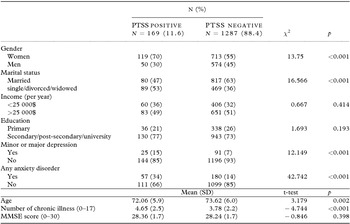
The six-month prevalence of PTSS reached 11.6% (Table 1). Participants with PTSS were more likely women, single/divorced/widowed and report depression or anxiety disorder. Respondents with PTSS were younger and reported more chronic disorders than those without.
Sociodemiographic and clinical characteristics between participants with and without PTSS (n = 1456)

Healthcare use
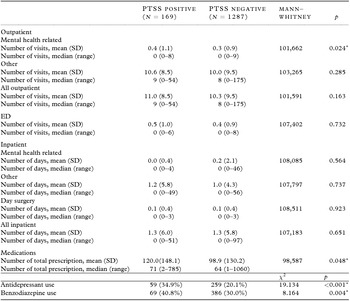
Results showed a significant difference in the number of mental health outpatient visits, and number of total prescriptions and the use (presence of at least one prescription) of ADs and BZDs between participants with a PTSS compare to those without (Table 2).
Past year healthcare use among respondents with and without PTSS (n = 1456)

Cost
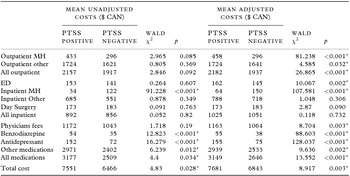
The multivariate analyses concerning costs as a function of PTSS are presented in Table 3. Participants with PTSS, as opposed to those without, incurred on average higher costs in overall outpatient visits (difference: $245 Wald χ 2: 26.865, df = 1, p < 0.001), including mental health related (difference: $162 Wald χ 2: 81.238, df = 1, p < 0.001) and other outpatient visits (difference: $83 Wald χ 2: 4.585, df = 1, p = 0.032). Participants with PTSS also had higher ED costs (Difference: 17$ Wald χ 2: 10.067, df = 1, p = 0.002) and physician fees (Difference: 99$ Wald χ 2: 8.704, df = 1, p = 0.003) than those without. Respondents with PTSS incurred lower mental health inpatient costs than participants without PTSS (difference: $86 Wald χ 2: 107.581, df = 1, p < 0.001). Further, higher costs related to BZDs (difference: $17 Wald χ 2: 88.603, df = 1, p < 0.001), ADs (difference: $80 Wald χ 2: 128.037, df = 1, p < 0.001), other medication (difference: $406 Wald χ 2: 9.636, df = 1, p = 0.002) and overall medication use (difference: $503 Wald χ 2: 13.552, df = 1, p < 0.001) was observed among participants with PTSS than those without. Finally, the total average adjusted healthcare costs incurred by respondents with and without PTSS were significantly different (difference: $838, Wald χ 2: 8.917, df = 1, p = 0.003).
One year cost associated with healthcare utilization among respondents with and without PTSS (n = 1456)

Costs adjusted for: age, sex, education, income, number of chronic illnesses, cognitive status, and the presence of a depression or anxiety disorder.
Discussion
To our knowledge, this is the first study that has assessed the healthcare costs associated with PTSS in a large sample of community-dwelling older adults living in a public-managed healthcare system. This study further adds to the literature by linking self-reported data from a health survey to administrative data on health service use thus allowing for the control of, potential important confounders such as, sociodemographic and clinical factors increasing the validity of results. Considering the high prevalence of PTSS, our study reported on the important healthcare burden associated with PTSS in older adults in Canada.
In this study, respondents reporting a PTSS incurred higher total adjusted healthcare costs reaching $7,681 than respondents without a PTSS ($6,843). These results are in agreement with a study on older veterans in the US reporting total healthcare costs reaching $7,300 for participants with PTSS and $5,860 for those without (Chan et al., Reference Chan, Cheadle, Reiber, Unützer and Chaney2009). Walker et al. (Reference Walker, Katon, Russo, Ciechanowski, Newman and Wagner2003) also showed on a population of adult women in the US that participants with a PTSS incurred twice as much costs than those without a PTSS. It is also interesting to note that the results are consistent even when different populations are being studied. The slightly differing costs may in part be attributed to the different healthcare settings, where our study was conducted in a public healthcare system and Walker et al. (Reference Walker, Katon, Russo, Ciechanowski, Newman and Wagner2003) and Chan et al. (Reference Chan, Cheadle, Reiber, Unützer and Chaney2009) in the Medicaid system in the US.
This study also looked at the impact of PTSS on total costs broken down into inpatient stays, ambulatory visits, and medication use. The findings of this study showed that respondents with PTSS incurred higher adjusted mental health and other outpatient visit related costs than those without PTSS. These findings are consistent with another study on older veterans showing higher healthcare costs among respondents with PTSS for mental health, other and overall outpatient visits (Chan et al., Reference Chan, Cheadle, Reiber, Unützer and Chaney2009). Our results also showed higher costs related to ED visits in respondents with PTSS, which has also been previously reported in a study reporting on a general population of adult women (Walker et al., Reference Walker, Katon, Russo, Ciechanowski, Newman and Wagner2003). Our results showed that older adults with a PTSS had higher outpatient mental health related visits than participants without, which is concordant with a study conducted on a general population of adults in the USA (Ivanova et al., Reference Ivanova2011).
In this study, after controlling for potential confounders, respondents with PTSS had lower mental health related inpatient costs. To our knowledge, no other study has studied the adjusted costs associated specifically with mental health related hospitalizations for PTSS. However, Chan et al. (Reference Chan, Cheadle, Reiber, Unützer and Chaney2009) did not report a significant difference in adjusted total inpatient costs in older veterans with and without PTSS. A possible explanation of decreased inpatient related costs in those with PTSS may be related to the fact that our results showed that respondents with PTSS had significantly more mental health related outpatient visits and costs than those without PTSS. This increased follow-up care may in part explain the lower mental health related inpatient costs observed in this older adult PTSS group in a public managed healthcare system. Also, Chan et al. (Reference Chan, Cheadle, Reiber, Unützer and Chaney2009) included older veterans that were followed in specialized clinics. These older adults might have healthcare use trajectories that are not generalizable to general population of older adults. Our results also did not show a significant difference in inpatient stay. This result is not consistent with Glaesmer et al. (Reference Glaesmer, Brähler, Riedel-Heller, Freyberger and Kuwert2011b) who reported that older adults with PTSS were nearly four times more at risk to be hospitalized in the past year. However, other researchers reported that annual hospitalization admission was not associated with the presence of a PTSS (Chan et al., Reference Chan, Cheadle, Reiber, Unützer and Chaney2009; Ivanova et al., Reference Ivanova2011).
Our study also showed that respondents with a PTSS incurred higher medication costs overall and specifically for BZDs and ADs use. These results were also reported elsewhere (Chan et al., Reference Chan, Cheadle, Reiber, Unützer and Chaney2009; Ivanova et al., Reference Ivanova2011). Chan et al. (Reference Chan, Cheadle, Reiber, Unützer and Chaney2009) reported differences reaching $199 for ADs costs and $473 for overall medication costs. Regarding medication use, our results are similar with previous studies that suggested that BZDs use was higher among persons with PTSS (van Zelst et al., Reference van Zelst, de Beurs, Beekman, van Dyck and Deeg2006; Ivanova et al., Reference Ivanova2011). Our results also showed that ADs and all medication use (total number of prescriptions) were higher in older adults with a PTSS as opposed to those without. This finding does not concord with previous reports showing no association between ADs (Ivanova et al., Reference Ivanova2011) or overall medication use (van Zelst et al., Reference van Zelst, de Beurs, Beekman, van Dyck and Deeg2006) and the presence of a PTSS. This result might in part be explained by the fact that the control group used by Ivanova et al. (Reference Ivanova2011) was a sample of adults with major depression suggesting higher ADs use in the control group.
The results of this study need to be considered with the following limitations. First, this study included older adults who were covered by the RAMQ's public drug plan and therefore excluded participants with private drug insurance or for whom medication use was not accessible (n = 309). These respondents may have different characteristics and patterns of health service use than those covered under public drug plan. However, the rates of PTSS between both groups did not differ, thus limiting bias in our study. Second, the PTSS scale is a self-reported instrument that identified respondents with a probable full and partial PTSS, which may have in part underestimated the association between PTSS and healthcare service use and related costs. Costs related to private psychologist sessions and other types of support (support groups, community programs) were not included in this study. This limitation may have underestimated the cost associated with PTSS. Future studies should focus on ascertaining cost differences related to the use of other mental health related services not covered by the public medical plan. Finally, the study results may therefore not be generalizable to other health system contexts or to individuals with additional out-of-pocket-paid private insurance. Despite these limitations, we used data from a large study on older adults aged 65 years and over who consulted in primary care services. Préville et al. (Reference Préville2014) previously validated the PTSS scale among older adults. Finally, the linkage between self-reported survey data from the ESA questionnaire and data from the RAMQ and MED-Echo databases increased the validity of the study by the decreasing the potential for recall bias for medication use.
Conclusion
To our knowledge, this is the first cost-illness study that has focused on the association between PTSS and healthcare costs among community-dwelling older adults in a public managed healthcare system. Considering that in this study, respondents with PTSS were more likely to be prescribed psychotropic medications and to have higher ambulatory costs but not inpatient related costs, more research is required to better understand whether the mental health needs of individuals with a probable PTSS are being met.
Conflict of interest
None.
Acknowledgments
Dr. Vasiliadis was supported as a Senior Research Scientist of the Fonds de la Recherche Québec – Santé during the ESA-Services study.
Description of authors’ roles
C. Lamoureux-Lamarche analyzed the data and wrote the paper. H.M Vasiliadis assisted with writing the paper. M. Préville conducted the ESA-Services study and assisted with writing the paper. D. Berbiche assisted the analysis of the data.