


%20--%3e%3c!DOCTYPE%20svg%20PUBLIC%20'-//W3C//DTD%20SVG%201.0//EN'%20'http://www.w3.org/TR/2001/REC-SVG-20010904/DTD/svg10.dtd'%3e%3csvg%20version='1.0'%20id='Layer_1'%20xmlns='http://www.w3.org/2000/svg'%20xmlns:xlink='http://www.w3.org/1999/xlink'%20x='0px'%20y='0px'%20width='64px'%20height='64px'%20viewBox='5.5%20-3.5%2064%2064'%20enable-background='new%205.5%20-3.5%2064%2064'%20xml:space='preserve'%3e%3cg%3e%3ccircle%20fill='%23FFFFFF'%20fill-opacity='0'%20cx='37.785'%20cy='28.501'%20r='28.836'/%3e%3cpath%20fill='%23595959'%20d='M37.441-3.5c8.951,0,16.572,3.125,22.857,9.372c3.008,3.009,5.295,6.448,6.857,10.314%20c1.561,3.867,2.344,7.971,2.344,12.314c0,4.381-0.773,8.486-2.314,12.313c-1.543,3.828-3.82,7.21-6.828,10.143%20c-3.123,3.085-6.666,5.448-10.629,7.086c-3.961,1.638-8.057,2.457-12.285,2.457s-8.276-0.808-12.143-2.429%20c-3.866-1.618-7.333-3.961-10.4-7.027c-3.067-3.066-5.4-6.524-7-10.372S5.5,32.767,5.5,28.5c0-4.229,0.809-8.295,2.428-12.2%20c1.619-3.905,3.972-7.4,7.057-10.486C21.08-0.394,28.565-3.5,37.441-3.5z%20M37.557,2.272c-7.314,0-13.467,2.553-18.458,7.657%20c-2.515,2.553-4.448,5.419-5.8,8.6c-1.354,3.181-2.029,6.505-2.029,9.972c0,3.429,0.675,6.734,2.029,9.913%20c1.353,3.183,3.285,6.021,5.8,8.516c2.514,2.496,5.351,4.399,8.515,5.715c3.161,1.314,6.476,1.971,9.943,1.971%20c3.428,0,6.75-0.665,9.973-1.999c3.219-1.335,6.121-3.257,8.713-5.771c4.99-4.876,7.484-10.99,7.484-18.344%20c0-3.543-0.648-6.895-1.943-10.057c-1.293-3.162-3.18-5.98-5.654-8.458C50.984,4.844,44.795,2.272,37.557,2.272z%20M37.156,23.187%20l-4.287,2.229c-0.458-0.951-1.019-1.619-1.685-2c-0.667-0.38-1.286-0.571-1.858-0.571c-2.856,0-4.286,1.885-4.286,5.657%20c0,1.714,0.362,3.084,1.085,4.113c0.724,1.029,1.791,1.544,3.201,1.544c1.867,0,3.181-0.915,3.944-2.743l3.942,2%20c-0.838,1.563-2,2.791-3.486,3.686c-1.484,0.896-3.123,1.343-4.914,1.343c-2.857,0-5.163-0.875-6.915-2.629%20c-1.752-1.752-2.628-4.19-2.628-7.313c0-3.048,0.886-5.466,2.657-7.257c1.771-1.79,4.009-2.686,6.715-2.686%20C32.604,18.558,35.441,20.101,37.156,23.187z%20M55.613,23.187l-4.229,2.229c-0.457-0.951-1.02-1.619-1.686-2%20c-0.668-0.38-1.307-0.571-1.914-0.571c-2.857,0-4.287,1.885-4.287,5.657c0,1.714,0.363,3.084,1.086,4.113%20c0.723,1.029,1.789,1.544,3.201,1.544c1.865,0,3.18-0.915,3.941-2.743l4,2c-0.875,1.563-2.057,2.791-3.541,3.686%20c-1.486,0.896-3.105,1.343-4.857,1.343c-2.896,0-5.209-0.875-6.941-2.629c-1.736-1.752-2.602-4.19-2.602-7.313%20c0-3.048,0.885-5.466,2.658-7.257c1.77-1.79,4.008-2.686,6.713-2.686C51.117,18.558,53.938,20.101,55.613,23.187z'/%3e%3c/g%3e%3c/svg%3e)
%20--%3e%3c!DOCTYPE%20svg%20PUBLIC%20'-//W3C//DTD%20SVG%201.0//EN'%20'http://www.w3.org/TR/2001/REC-SVG-20010904/DTD/svg10.dtd'%3e%3csvg%20version='1.0'%20id='Layer_1'%20xmlns='http://www.w3.org/2000/svg'%20xmlns:xlink='http://www.w3.org/1999/xlink'%20x='0px'%20y='0px'%20width='64px'%20height='64px'%20viewBox='5.5%20-3.5%2064%2064'%20enable-background='new%205.5%20-3.5%2064%2064'%20xml:space='preserve'%3e%3cg%3e%3ccircle%20fill='%23FFFFFF'%20fill-opacity='0'%20cx='37.637'%20cy='28.806'%20r='28.276'/%3e%3cg%3e%3cpath%20fill='%23595959'%20d='M37.443-3.5c8.988,0,16.57,3.085,22.742,9.257C66.393,11.967,69.5,19.548,69.5,28.5c0,8.991-3.049,16.476-9.145,22.456%20C53.879,57.319,46.242,60.5,37.443,60.5c-8.649,0-16.153-3.144-22.514-9.43C8.644,44.784,5.5,37.262,5.5,28.5%20c0-8.761,3.144-16.342,9.429-22.742C21.101-0.415,28.604-3.5,37.443-3.5z%20M37.557,2.272c-7.276,0-13.428,2.553-18.457,7.657%20c-5.22,5.334-7.829,11.525-7.829,18.572c0,7.086,2.59,13.22,7.77,18.398c5.181,5.182,11.352,7.771,18.514,7.771%20c7.123,0,13.334-2.607,18.629-7.828c5.029-4.838,7.543-10.952,7.543-18.343c0-7.276-2.553-13.465-7.656-18.571%20C50.967,4.824,44.795,2.272,37.557,2.272z%20M46.129,20.557v13.085h-3.656v15.542h-9.944V33.643h-3.656V20.557%20c0-0.572,0.2-1.057,0.599-1.457c0.401-0.399,0.887-0.6,1.457-0.6h13.144c0.533,0,1.01,0.2,1.428,0.6%20C45.918,19.5,46.129,19.986,46.129,20.557z%20M33.042,12.329c0-3.008,1.485-4.514,4.458-4.514s4.457,1.504,4.457,4.514%20c0,2.971-1.486,4.457-4.457,4.457S33.042,15.3,33.042,12.329z'/%3e%3c/g%3e%3c/g%3e%3c/svg%3e)
Introduction
Antibiotics are commonly prescribed at hospital discharge, and prior studies have shown that these postdischarge antibiotics are often unnecessary, excessively long in duration, or sub-optimally selected. Reference Feller, Lund and Perencevich1–Reference Vaughn, Gandhi and Chopra5 Despite these opportunities for improvement, stewardship strategies that improve antibiotic-prescribing at this transition of care are not well-defined.
One potential strategy to optimize antibiotic-prescribing at discharge is prospective audit-and-feedback (PAF). PAF is a persuasive strategy that involves antibiotic stewards auditing antibiotic use in real-time and providing immediate feedback to prescribers with the goal of improving planned postdischarge antibiotic therapy. This strategy has been evaluated in several single-center studies, a non-randomized study across five hospitals, and a stepped-wedge cluster-randomized trial. Reference Giesler, Krein and Brancaccio6–Reference Livorsi, Thompson and Green13 Performing PAF at discharge is also part of The Reducing Overuse of Antibiotics at Discharge Home Framework. Reference Vaughn, Hersh and Spivak14,Reference Vaughn, Ratz and Greene15
To our knowledge, only one prior study examined barriers and facilitators to implementing PAF at discharge at a single site. Reference Giesler, Krein and Brancaccio6 Our study builds on this work by examining these factors across 10 hospitals varying in size, structure, and context that participated in a stepped wedge cluster randomized trial (registered at clinicaltrials.gov as NCT05471726). Reference Livorsi, Thompson and Green13 We used qualitative interviews because they elicited the real-world workflows, perceptions, and contextual challenges that shaped hospitals’ ability to integrate a discharge audit-and-feedback intervention into routine practice.
Methods
Setting
The clinical trial was conducted at ten hospitals across the U.S. The study started on December 5, 2022, with each hospital in the control state for 24 weeks. On May 22, 2023, every two weeks one hospital initiated the intervention and maintained it until the study ended on November 17, 2023. The order of hospitals crossing from the control to intervention arms was randomly determined. Site recruitment, and characteristics of intervention sites and their stewardship teams have been described previously. Reference Livorsi, Thompson and Green13
Intervention
The intervention aimed to improve antibiotic use at hospital discharge through: (1) developing or updating institutional guidelines for oral antibiotic step-down therapy, (2) promoting these guidelines and project goals to participating units via face-to-face meetings with frontline prescribers and key partners one to two months prior to the site’s start of the intervention and (3) conducting PAFfor patients on participating units who were receiving antibiotics and had an anticipated discharge within 48 hours. This paper aims to identify factors that shaped the feasibility, acceptability, and consistency of intervention delivery across sites. While the broader trial evaluates the effectiveness of the intervention, our qualitative study sought to understand how stewardship staff implemented the intervention within the context of their workflows, communication channels, staffing, and organizational cultures.
Design
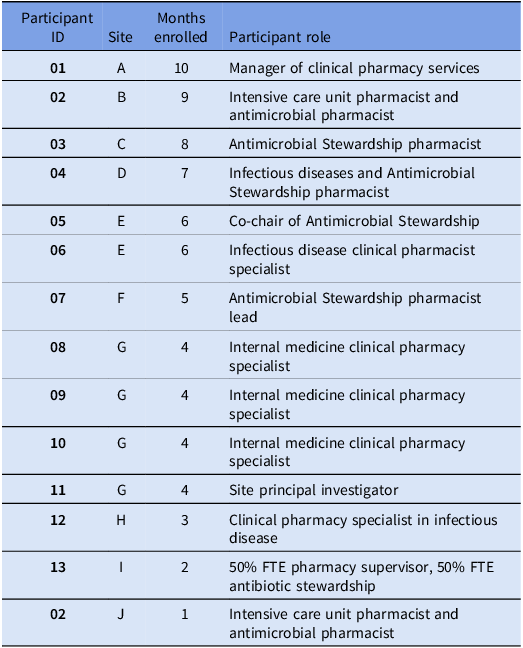
A qualitatively trained medical sociologist (D.J.) developed the postimplementation interview guide, drawing on the clinical expertise of D.L and the RE-AIM 2.0 framework. 16 The interview guide explored stewardship teams’ perceived barriers and facilitators implementing the intervention, with emphasis on penetration, feasibility, and acceptability (Supplement A). Penetration was defined as the proportion of eligible patients whose medical record was audited by the stewardship team and for whom, if warranted, antibiotic recommendations were delivered to frontline prescribers. Pharmacists involved in the implementation of the intervention were purposively selected from each of the participating sites, given their direct, on-the-ground experience with the delivery of the intervention and their ability to describe implementation barriers, facilitators, processes, and potential improvements. Each site identified a point-of-contact who provided the research team with names of pharmacists involved in implementation. We invited all recommended individuals, which resulted in some sites contributing only one participant and others several, depending on team size and involvement. Some interviews were conducted with two to three participants at the same time when this was the most feasible scheduling approach. Group interviews were well-suited to capture team dynamics and collective decision-making. This format also enabled participants to prompt each other’s memories, producing a richer and more accurate account of their experiences in real time. Interview timing varied by site due to the stepped wedge design, ranging from early to late intervention phases (Table 1).
Interviewee and intervention site characteristics

Our team comprised a project coordinator (C.P.), and two trained qualitative analysts (E.C. and D.J.), none of whom participated in implementing PAF, nor had ties to participating hospitals. E.C. and D.J. had prior experience in Antimicrobial Stewardship research. The team maintained reflexive memos, used a standardized interview guide, and conducted consensus-based coding to minimize the influence of researcher backgrounds on data collection and interpretation.
Data and analysis
All interviews were conducted by D.J. via videoconference and audio recorded. Immediately following each interview, D.J. recorded detailed field notes capturing observations about each sites’ context, relevant nonverbal cues, and early analytic reflections. These notes informed subsequent analytic discussions, supported ongoing reflexivity, and shaped future interviews. For example, when one interviewee described institutional challenges related to implementing a solution through Microsoft Teams, a new probe was added to later interviews to explore the role of institutional policies governing the use of specific software platforms.
The recordings were de-identified, transcribed using Rev.com, and imported into MaxQDA 22.1.1. 17 The analysis team (E.C., D.J., and C.P.) developed a preliminary codebook from the interview guide and RE-AIM framework after multiple readings of the transcripts. We applied a hybrid coding approach, combining deductive codes from the initial framework with inductive codes emerging from the data. To ensure consistent application of codes, the team collaboratively coded one-third of the transcripts asynchronously. Team members coded the remaining transcripts individually, but continued to meet routinely to resolve questions, refine the coding framework, and discuss emerging themes. Throughout coding and analysis, excerpts were flagged as “star quotes” when they clearly illustrated a code or, later, an emerging theme. These excerpts helped ground the themes in participants’ lived experiences and supported our interpretation of the data. Illustrative quotes were selected with intentional effort to include quotations from multiple sites where the theme appeared. Additional patterns were identified inductively, and major themes were iteratively merged, rearranged, and renamed to capture nuanced insights from the data.
Ethics
The Institutional Review Board (IRB) of the University of Iowa and Iowa City Veterans’ Health Care System approved this study. A waiver for written informed consent was granted. The consent process entails an informational sheet with the element of consent attached to the invitation email. Following participants’ agreement to be interviewed, consent was also verbally obtained before the interview. Participants were not offered compensation to participate.
Results
We conducted nine interviews with 14 individuals across 10 sites. Interviews were conducted between October 23 and December 19, 2023, overlapping with the end of the trial, which ran from December 5, 2022, to November 17, 2023. Interviews ranged from 25 to 42 minutes with an average of 30 minutes. Table 1 details each site, including implementation duration and interviewee roles. At one site, four participants were interviewed together, while pairs were interviewed simultaneously at two other sites. One participant implemented the intervention at two sites (B and J).
Using an iterative analytic process supported by the RE-AIM model and inductive patterns identified in the data, we developed four themes that reflect participants’ experiences implementing the PAF at discharge intervention: (1) the penetration of the intervention was shaped by the implementation teams’ ability to identify discharging patients (2) existing interventions enhanced the feasibility and penetration of the discharge-focused intervention, (3), ID consult services impacted the penetration of the intervention and created challenges assessing the impact of the stewardship team’s efforts, and (4) relationships developed through ongoing stewardship activities facilitated clinicians’ acceptance of antibiotic recommendations at discharge.
Theme 1: The penetration of the intervention was shaped by the implementation team’s ability to identify discharging patients
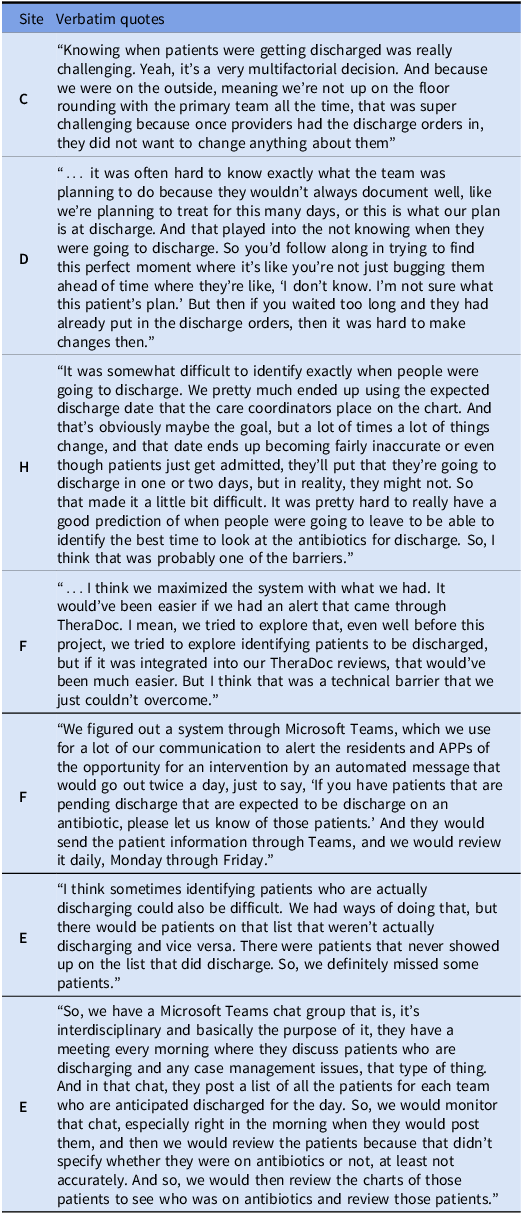
Many participants (Sites C, D, E, G, H) expressed difficulty in accurately identifying discharging patients (Table 2). Obtaining accurate discharge data was often cited as a challenge since determining when a patient will discharge is a “very multifactorial decision” (Site C). Difficulties identifying discharging patients emerged in both VA and non-VA sites and occurred across a wide range of intervention exposures (two to eight months) and hospital sizes.
Identifying patients ready to discharge

Stewardship teams that did not routinely round with frontline prescribers reported difficulty identifying discharging patients. At one site, its large size made it difficult for stewardship teams to consistently access accurate patient discharge data during rounds, as they could not work with the same care teams every day, “…the hospital that I work at is really large, so we have to split it up so we can’t look at everybody on it. But on Monday we look at patients on medicine firm, on Tuesday, a different area, and so on and so forth” (Site C). Smaller hospitals, where stewardship teams managed fewer patients, experienced fewer challenges in identifying patients at discharge, “I feel like if any person left on an antibiotic on my team, unless they were discharged on a weekend, then I was involved in the antibiotic plan” (Site G).
Some sites developed new strategies or leveraged existing systems to identify discharging patients. Two VA sites used Microsoft Teams to identify discharging patients. One site sent automated messages to ask frontline prescribers to notify them about patients pending discharge with antibiotics. The other site monitored an online chat used by multiple units to discuss case management for discharging patients; however, there were concerns about information accuracy. Some sites utilized new strategies such as sending EPIC messages to physicians with patients discharging within three days and intentionally developing plans for patients discharging early in the morning or over weekends. Another site developed a daily discharge list; however, competing job duties hindered regular generation of the updated list. These challenges highlight the need for electronic tools that integrate with existing systems to accurately alert stewards when patients will be discharged on antibiotics within a manageable time frame.
Theme 2: Existing interventions enhanced the feasibility and penetration of the discharge-focused intervention
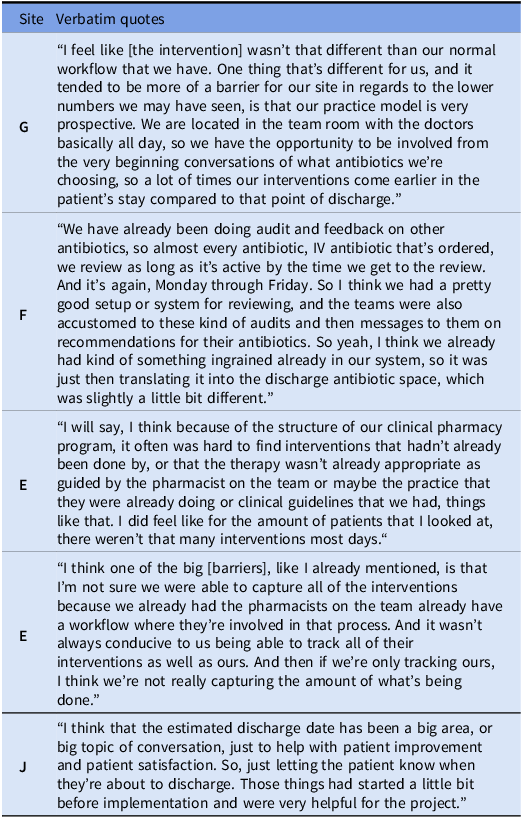
Prior to the trial’s initiation, stewardship teams were asked about auditing antibiotics at discharge and providing feedback. Features of handshake stewardship were reported by six sites (A, B, C, D, F, G), including embedding clinical pharmacists on care teams, discussing antibiotic prescriptions during rounds, and conducting inpatient PAF (Table 3). Although these sites were not auditing patient discharge plans, their existing interventions facilitated the integration of the PAF at discharge intervention into existing workflows.
Concurrent interventions

The stewardship team at site G already emphasized selection, dose, and duration of discharge antibiotics prior to the intervention. One member noted, “I feel like [the PAF at discharge intervention] wasn’t that different than our normal workflow.” Co-located with frontline prescribers, pharmacists working with the stewardship team at this site provided feedback early in patients’ stays, reducing the number of recommendations that needed to be made when the patient was ready for discharge. Site F was performing prospective audit and feedback processes for most inpatient antibiotics, easing integration of the discharge-focused process into their routine practice: “…we already had kind of something ingrained in our system, so it was just translating it into the discharge antibiotic space, which was a little bit different.”
Other hospital interventions facilitated the PAF at discharge intervention by making it easier to identify discharging patients. During the implementation of the PAF at discharge intervention, Site C implemented an intervention to assess patients’ tolerance of oral antibiotics before discharge. As a part of this intervention, a three-day discharge window was created to reach frontline prescribers before making final plans. Site J implemented initiatives to improve patient satisfaction, which included clearer communication with patients about discharge timing. Both interventions increased the likelihood of reaching patients and their care team prior to discharge.
Theme 3: ID consult services impacted the penetration of the intervention and created challenges assessing the impact of the stewardship team’s efforts
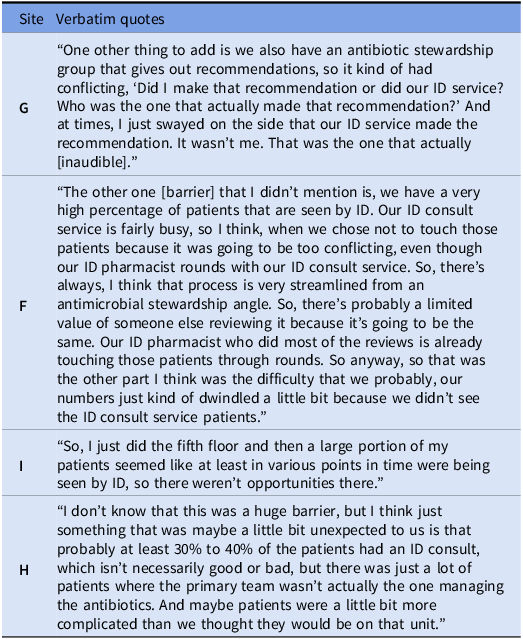
Four sites (F, G, H, I), each 2 to 5 months into enrollment at the time of the interview, indicated reduced penetration attributable to effective ID physician consultations (Table 4). The high-quality antibiotic oversight provided by ID physicians decreased the number of cases requiring stewardship review. The resulting reduced penetration reflects an evaluation rather than implementation limitation; stewardship teams had fewer opportunities to contribute recommendations when robust ID guidance was already in place, yet the intervention itself was delivered as intended. At these sites, a substantial portion of patients discharged on antibiotics received an inpatient ID consultation; site I estimated this proportion at 30%–40%.
ID consults

Site G exemplified this evaluation challenge where close collaboration between the stewardship team and frontline prescribers led to ambiguity regarding whether recommendations originated from the stewardship team or ID services, “…we have so many different people giving out recommendations between our ID team, our primary provider, and then the residents and students all on the medicine team. Again, we’d all be giving pretty much the same recommendations, but it’s, ‘Where is that first recommendation coming from? Is it from our ID service? Is it from the primary medicine team? Or was it us initially that gave that recommendation?’ And there was kind of a gray area. Which ones of those do we report that we actually made?”
While these findings provide evidence that ID services improved antibiotic recommendations at discharge, strong ID oversight does not indicate that the intervention was unnecessary. Rather it highlights the need for evaluation metrics that account for site-level context when making cross-site comparisons. To avoid this measurement complication, some sites intentionally chose patient populations with minimal involvement of ID services at the outset of implementation.
Theme 4: Relationships developed through ongoing stewardship activities facilitated clinicians’ acceptance of antibiotic recommendations at discharge
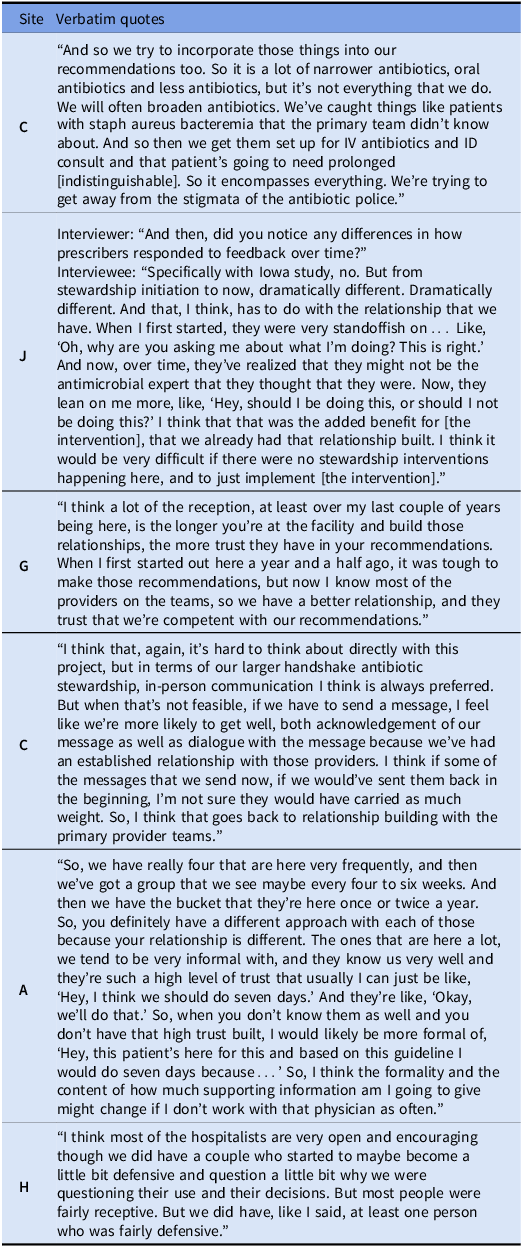
Careful development of steward-provider relationships facilitated provider’s receptivity to the stewardship teams’ recommendations surrounding discharge antibiotics (Table 5). Some stewardship teams noted that, prior to the intervention, providers were resistant to their involvement. One participant mentioned that providers sometimes saw them as ‘antibiotic police’ (Site C). However, over time, steward-provider relationships became more collegial, which facilitated the intervention. According to one steward implementing the intervention at Sites B and J, “When I first started, they were very standoffish on… Like, ‘Oh, why are you asking me about what I’m doing? This is right.’ And now, over time, they’ve realized that they might not be the antimicrobial expert that they thought that they were.”
Relationships

Stewardship teams built rapport with prescribers by being mindful of communication methods. Several non-VA sites noted that providers preferred in-person feedback on antibiotic prescribing, but this was often impractical due to difficulties in reaching providers. Other sites relied on direct electronic messaging, which was well-accepted and preestablished. Stewardship teams adjusted their recommendation language based on their familiarity with the provider and the provider’s experience. They were more casual with well-known providers and more direct with less experienced ones. “I feel like that’s the art of stewardship, adjusting your communication strategy to who you’re talking with. And even just between the medical residents and the hospitalists, we vary our approach a little bit with regards to how authoritative we talk, how strongly we make our recommendations, how much teaching we give in addition to the recommendation (Site C)”.
Discussion
Identifying key barriers and facilitators to implementing interventions for improving antibiotic use at discharge is crucial for developing effective strategies that enhance patient care and community health. This study highlights several factors influencing the penetration, acceptability, and feasibility of an audit and feedback intervention at discharge across ten U.S. acute care facilities.
In line with prior research, our interviews identified rapport between the stewardship team and frontline providers as a key facilitator of the discharge-focused audit-and-feedback intervention. Reference Giesler, Krein and Brancaccio6,Reference Manges, Groves and Farag18–Reference Giesler, Krein and Brancaccio20 Established trust enhanced acceptance of the stewardship teams’ recommendations and mitigated defensive reactions. Concurrent Antimicrobial Stewardship initiatives emerged as a new facilitator by providing workflows already aligned with the discharge-focused audit and feedback processes
A key implementation challenge not widely reported in the literature was the difficulty of identifying patients approaching discharge. Discharge planning is a complex, multidisciplinary process, but sites that leveraged existing systems—or developed new ones—to routinely review discharges were better equipped to address this barrier, which was a substantial obstacle at many sites. An additional challenge, at least at four sites, was the limited number of patients receiving antibiotics who had not already been evaluated by the ID consultation service. Because assessing the magnitude of these challenges was outside the scope of this qualitative study, we cannot determine their precise impact. Nonetheless, it is reasonable to infer that resolving them may have created more opportunities for stewards to provide recommendations.
This multi-site intervention captured important variations in organizational context, contributing to the limited body of quantitative and qualitative research on processes, resources, culture, and discharge practices in high-performing hospitals. Reference Vaughn, Gandhi and Chopra5,Reference Vaughn, Hersh and Spivak14–Reference Vaughn, Ratz and Greene15 One important limitation of our work is the absence of frontline providers’ and physician stewardship leaders’ perspectives, which limits our understanding of how the intervention aligned with their workflows and their perception of dynamics with the stewardship team. However, in our prior publication, we did survey frontline prescribers after the clinical trial ended. Among respondents to that survey, there was general agreement that the discharge-focused PAF process typically made recommendations in a timely fashion and helped to improve antibiotic-prescribing at discharge. Reference Vaughn, Ratz and Greene15 Additionally, incorporating the perspectives of administrators could have offered important insight into the intervention’s sustainability, as successful long-term implementation requires strong administrative commitment. Another limitation of this current study is that group interviews with multiple stewardship team members may have introduced bias, as participants could have been less likely to express dissent alongside their colleagues. Additionally, the phased rollout of the intervention led to varied levels of exposure, meaning some challenges discussed by sites with minimal exposure may have been resolved with a longer exposure time. Furthermore, because we recruited sites through professional networks, there may have been a selection bias toward well-resourced or highly engaged programs.
Future efforts should prioritize establishing strong rapport between stewardship team members and frontline prescribers before initiating interventions or incorporate sufficient time early on to build these relationships, as trust significantly influences the acceptability of stewardship team recommendations. Finally, reliable methods for identifying patients approaching discharge should be developed and tested in advance to ensure smooth integration of discharge-focused audit-and-feedback processes into routine clinical workflows.
Supplementary material
The supplementary material for this article can be found at https://doi.org/10.1017/ash.2026.10366.
Acknowledgements
We thank all the Antimicrobial Stewardship members from all VA and non-VA healthcare systems that participated in this qualitative study. Research reported in this publication was supported by the National Center for Advancing Translational Sciences of the National Institutes of Health under Award Number UM1TR004403. The content is solely the responsibility of the authors and does not necessarily represent the official position or policy of the National Institutes of Health, the Centers for Disease Control and Prevention, the Department of Veterans Affairs or the United States Government. The authors used Microsoft Copilot to explore editing options and improve clarity and grammar during manuscript preparation. No AI was tools were used for data analysis, interpretation, or drafting original content. All revisions were reviewed and finalized by the authors, who retain full responsibility for the content.
Financial support
This work was funded by the Centers for Disease Control and Prevention EpiCenter program. Colleagues from the CDC did not participate in any of the following activities: design and conduct of the study; collection, management, analysis, and interpretation of the data; preparation, review, or approval of the manuscript; and decision to submit the manuscript for publication.
Competing interests
The authors report no potential conflicts of interest. All authors have submitted the ICMJE form for disclosure of potential conflicts of interest.


 Open access

