I. INTRODUCTION
Polymer electrolyte membrane fuel cells (PEMFC), using hydrogen and oxygen gases, have been attracting attention as next-generation power generating device because they are clean energy systems, environment friendly, have high energy densities, and have high conversion efficiency.Reference Çelik and Bozkurt1 Perfluorosulfonic acid membranes were commonly used as proton conducting membrane in PEMFC systems. In that systems, the proton conduction is mainly provided by water content and therefore, their usage is limited to below 100 °C. For that reason, alternative membranes can be produced that have high proton conductivity at high temperatures.Reference Celik, Bozkurt and Hosseini2
A common technique used in the synthesis of anhydrous proton conducting material is the doping of the polymer matrix with heterocyclic proton solvents such as imidazole, benzimidazole, and triazole so that proton transport occurs almost entirely through the diffusion structure.Reference Celik, Bozkurt and Hosseini2–Reference Boroglu, Celik, Bozkurt and Boz8 Acid functional polymers such as polystyrene sulfonic acidReference Göktepe, Bozkurt and Günday4, Reference Günday, Bozkurt, Meyer and Wegner5 and polyvinyl phosphonic acidReference Çelik and Bozkurt1, Reference Yamada and Honma3 were mostly used in these studies and high proton conductivity was reported. However, these acidic polymers have high water swelling properties and low mechanical properties comparing to perfluorinated or aromatic backbone polymers. During fuel cell applications, soluble behavior of the polymer backbone or dispersion of free standing film is problem. Therefore, to produce a membrane with high proton conductivity and good mechanical and thermal properties, these heteocylic molecules should be incorporated into stable polymers such as Nafion, sulfonated polysulfone (SPSU), and sulfonated poly(ether ether ketone) (SPEEK).
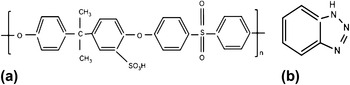
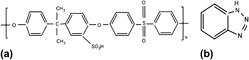
1H-1,2,3-benzotriazole (BTri) [Fig. 1(b)] is a heterocyclic molecule with melting and boiling points of 100 and 350 °C, respectively. Its proton does not tightly bind to any of the nitrogen atoms but mobile between nitrogen 1 and 3. Therefore, BTri can lose a proton to act as a weak acid (pKa = 8.2) or accept a proton using the lone pair electrons located on its nitrogen atoms as a very weak Bronsted base (pKa < 0).Reference Katritzky, Rachwal and Hitchings9 Previously, it was used as dopant in polyvinyl phosphonic acid and Nafion, and high proton conductivity (10−3 S/cm at 150 °C) was obtained.Reference Çelik and Bozkurt1 Polysulfones (PSUs) are high thermal, chemical, and mechanical stabile polymers due to their phenyl rings on the polymer backbone. PSUs can be used as polymer electrolyte membrane (PEM) material after sulfonation and increasing its water uptake property. The proton conductivity of the sulfonated polysulfone (SPSU) membranes depends on the sulfonation ratio and it can reach to ∼10−2 S/cm at 80 °C.Reference Lufrano, Gatto, Staiti, Antonucci and Passalacqua10 In addition, the SPSU membranes have lower gas permeability and liquid (water and methanol) permeability than the sulfonated perfluorinated ionomers.Reference Lufrano, Baglio and Staiti11 The studies about SPSU are mostly based on their humidity controlReference Lufrano, Gatto, Staiti, Antonucci and Passalacqua10, Reference Chen, Bocarsly and Benziger12, Reference Smitha, Devi and Sridhar13 but there are little worksReference Li, Zhou, Zhang and Liu14, Reference Fu, Li and Manthiram15 about its usage in anhydrous proton conducting systems.
Molecular structures of (a) Sulfonated polysulfone (SPSU) and (b) 1H-1,2,3-benzotriazole (BTri).

In this work, a new matrix was produced using SPSU and benzotriazole. Here, SPSU has a hydrophobic aromatic backbone and hydrophilic side groups. When the azole molecule is incorporated into the polymer, it may form a proton transfer path through sulfonic acid and azole molecule. Here, the SPSU was synthesized using trimethylsilyl chlorosulfonate (TMSCS) as sulfonating agent in homogeneous solution of 1,2-dichloroethane (DCE). The proton conductive hybrid membranes were prepared by blending SPSU and 1H-1,2,3-benzotriazole at several molar ratios. Homogeneous and transparent membranes were obtained and characterized with FTIR, TGA, and scanning electron microscopy (SEM). The effect of benzotriazole ratio on proton conductivity was investigated with impedance analyzer.
II. EXPERIMENTAL
A. Materials and preparation
The commercial PSU (Sigma-Aldrich, St. Louis, MO), trimethylsilyl chlorosulfonate (TMSCS; Sigma-Aldrich, Germany), 1,2-dichloroethane (DCE; Merck, Germany), methanol (Sigma-Aldrich, Steinheim am Albuch, Germany), 1H-1,2,3-benzotriazole (BTri; Alfa Aesar, Karlsruhe, Germany), and dimethylformamide (DMF; Merck, Darmstadt, Germany) were used as received.
SPSU [Fig. 1(a)] was prepared according to literature.Reference Chen, Bocarsly and Benziger12 The commercial PSU was dissolved in DCE at 25 °C for 4 h under nitrogen atmosphere. TMSCS was added at room temperature as the sulfonation agent. PSU/TMSCS mole ratio was set as 1:1.5. During the reaction, N2 was purging continuously through the reaction solution and HCl was continuously produced and released out of the reactor with N2. After about 36 h, methanol was added to quench the reaction and to cleave the silyl sulfonate moieties yielding SPSU. Silicon containing compounds, methyl sulfate, dichloroethane, methanol, and water were removed through evaporation first at 1 atm and then vacuum (400 mmHg) at 55 °C.
The degree of sulfonation (DS) of SPSU was determined by acid–base titration with standard NaOH solution.
Initially, the SPSU was dissolved in DMF. The solution of polymer was then titrated by an aqueous solution of 0.0147 N NaOH using phenolphthalein as the end point indicator. The titration method indicated a sulfonation ratio of 134% [(mol SO3H/repeat unit) × 100], which is higher than the reported maximum sulfonation level for this method (127%).Reference Chen, Bocarsly and Benziger12
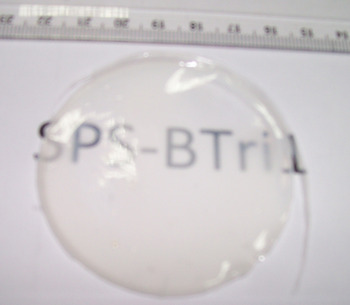
Proton conductive composite membranes were prepared by doping of SPSU with 1H-1,2,3-benzotriazole. A stoichiometric amount of SPSU and dopant was admixed in DMF with mol ratios SPSU:dopant: 1:0.5, 1:1, 1:2. The homogeneous solutions were kept overnight in contact with the solvent, and dissolution was completed with mechanical stirring at ambient temperature. The membrane was prepared by casting of the SPSU–dopant solution on a polished poly(tetrafluoroethylene), and the solvent was slowly evaporated at 50 °C for 24 h. To ensure complete solvent removal, the membranes were placed under vacuum 200 mmHg at 50 °C. Homogeneous and semitransparent membranes were obtained (Fig. 2).
Homogeneous and semi-transparent SPSU-BTri1 membrane

B. Characterizations
FTIR spectra were recorded on a Bruker Alpha-P (Wismar, Germany) in attenuated total reflectance (ATR) in range of 4000–400 cm−1.
Thermal stabilities of the polymer electrolytes were examined by thermogravimetric analyses with a Perkin Elmer STA 6000 (Waltham, MA). The samples (∼10 mg) were heated from room temperature to 700 °C under N2atmosphere at a scanning rate of 10 °C/min.
Differential scanning calorimetry measurements were carried out on a Perkin Elmer JADE DSC (Waltham, MA) under nitrogen atmosphere and heating–cooling curves were recorded at a rate of 10 °C/min.
The proton conductivity studies of the samples were performed using a Novocontrol (Obererbacher, Germany) dielectric impedance analyzer. The films were sandwiched between platinum blocking electrodes and the conductivities were measured in the frequency range 1 Hz to 3 MHz at 10 °C intervals. The temperature was controlled with a Novocontrol cryosystem, which is applicable between −100 and 250 °C.
The morphology of the membranes was observed by SEM-type JEOL 7001 FESEM (Tokyo, Japan). The samples were previously coated with gold in a sputtering device.
III. RESULTS AND DISCUSSION
A. FTIR studies
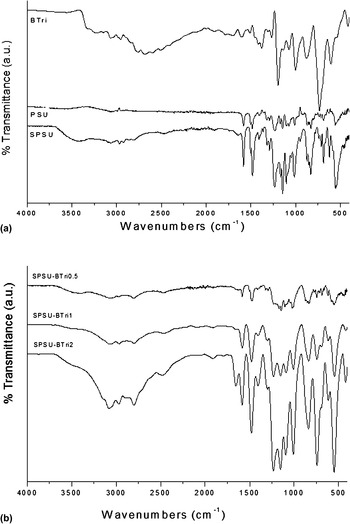
Figure 3(a) shows the FTIR spectra of pure PSU, SPSU, and BTri. SPSU has peaks at 690, 1041, 1103, 1149, 1238, 1485, 2950, 3110, 3500 cm−1, which correspond to C–S, SO3, C–O, R–SO2–R, C–O, C = C (aromatic), CH (aliphatic), CH (aromatic), and OH stretching bonds, respectively.Reference Boroglu, Celik, Bozkurt and Boz8, Reference Lufrano, Baglio and Staiti11, Reference Chen, Bocarsly and Benziger12 In FTIR of SPSU, the presence of –OH peaks at 3500 cm−1 and O = S = O stretching vibration of –SO3 groups near 1041 cm−1 confirms the sulfonation of PSU. BTri has C–N stretching at 1430–1650 cm−1 range and N–N stretching at 1270 cm−1. The peaks at 670–1225 cm−1 correspond to C–H and C = C stretching bands and the peaks at 1629 and 3380 cm−1 were attributed to N–H stretching. Figure 3(b) shows FTIR spectra of SPSU–BTriX blends. After doping the blends, the intensities of the bands corresponding to the azole ring stretchings at 1430 and 1650 cm−1 have changed. SPSU–BTri blends have a peak at 3380 cm−1 that corresponds to N–H stretching. Between 3000 and 2000 cm−1, a broadening of the band can be related to hydrogen bonding network formation N–H between BTri and SPSU. The peaks near 1100 and 979 cm−1are attributed to characteristic absorptions of BTri anion formation.Reference Coates and Meyers16
FTIR spectra of (a) polysulfone (PSU), sulfonated polysulfone (SPSU), 1H-1,2,3-benzotriazole (BTri) and (b) SPSU-BTri0.5, SPSU-BTri1 and SPSU-BTri2.

B. Thermal analysis
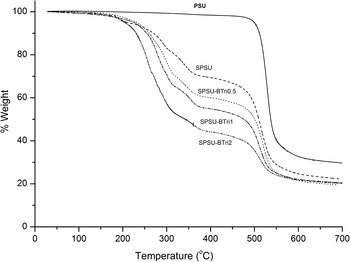
Figure 4 shows the thermogravimetric analysis of PSU, SPSU, SPSU–BTri0.5, SPSU–BTri1, and SPSU–BTri2. Pure PSU is thermally stable up to 500 °C and then, major weight loss occurs due to degradation of the polymeric backbone.Reference Lufrano, Baglio, Staiti, Arico and Antonucci17 The TGA curve of SPSU has two weight loss region where 30% weight loss occurs between 200 and 350 °C due to degradation of sulfonic acid groups and the degradation of polymer backbone occurs after 500 °C.Reference Smitha, Devi and Sridhar13, Reference Park, Shin, Lee and Rhim18 This distinct change in TGA curve also verifies the sulfonation of PSU. As SPSU was blended with BTri, the degradation temperature decreased a little but all SPSU–BTriX blends can be said to be thermally stable at least 200 °C.
TGA curves of PSU, SPSU, SPSU-BTri0.5, SPSU-BTri1, and SPSU-BTri2 at a heating rate of 10 °C min-1.

In DSC measurements, pure PSU and SPSU showed T g points at 185 and 120 °C, respectively. SPSU–BTriX (X = 0.5, 1, 2) blends showed no glass transition (T g) temperatures, which is similar to Nafion/1H-1,2,3-benzotriazole system in the literature.Reference Çelik and Bozkurt1
C. Morphology
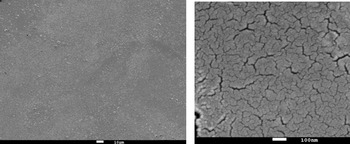
The morphology of the samples was analyzed with SEM and depicted in Fig. 5. For all the samples, the images exhibit single phase formation and the membranes seem homogeneous. This shows that the heterocyclic dopant uniformly distributed into the PSU matrix, and there is no agglomeration or phase separation at micrometer- and nanometer-scale level.
SEM images of (a) SPSU-BTri1 and (b) SPSU-BTri0.5 membranes.

D. Conductivity measurement
The frequency-dependent AC conductivities, σac (ω) of the polymer electrolyte membranes, were calculated at several temperatures using Eq. (1):
 $${\rm{\sigma \prime(\omega )}}\,{\rm{ = }}\,{\rm{\sigma }}_{{\rm{ac}}} {\rm{(\omega ) = }}\,{\rm{\varepsilon \Prime(\omega )\omega \varepsilon }}_{\rm{0}} \quad,$$
where σ′(ω) is the real part of conductivity, ω = 2πf is the angular frequency, ε0 is the vacuum permittivity (ε0 = 8.852 × 10⁻¹⁴F/cm), and ε″ is the imaginary part of complex dielectric permittivity (ε*). The proton conductivities of anhydrous polymer electrolytes were measured from 20 to 150 °C.
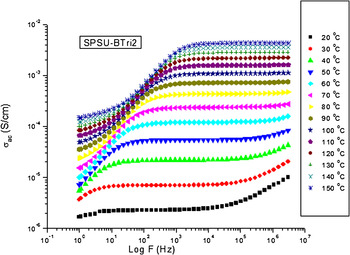
Figure 6 shows the AC conductivity of SPSU–BTri2 versus log frequency at several temperatures. There are several regions in the curves, which are typical for ion conducting polymers. At lower frequency regions, the conductivity increases with log frequency then leveled off, which is due to electrode polarizations. The irregularities at the low frequency side correspond to polarization blocking the electrode–electrolyte interface and the conductivity increases at low temperature and high frequencies result from the regular dispersion in polymer electrolytes.Reference Çelik and Bozkurt1 The plateau domains depend on the temperature, i.e., 100–104 Hz at 20 °C and 103−106Hz at 100 °C and shift to higher frequencies at higher temperatures.
AC conductivity of SPSU-BTri2 versus log frequency (Hz) at various temperatures.

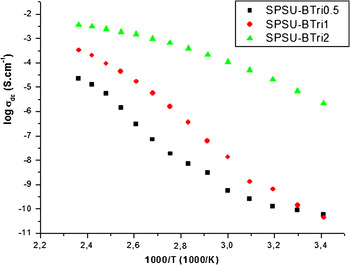
The DC conductivity (σdc) of the samples was derived from the plateaus of σac versus log frequency by linear fitting of the data. The DC conductivities of the SPSU–BTri0.5, SPSU–BTri1, and SPSU–BTri2 were compared in Fig. 7. It is clear that the DC conductivity strongly depends on the temperature and BTri ratio. The maximum proton conductivity was obtained as 2.2 × 10⁻⁵, 3.3 × 10⁻⁴, and 3.6 × 10⁻³S/cm for SPSU–BTri0.5, SPSU–BTri1, and SPSU–BTri2, respectively at 150 °C.
DC conductivities of SPSU-BTri0.5, SPSU-BTri1, and SPSU-BTri2 as a function of reciprocal temperature.

There are several studies about the proton conductivity property of SPSU but most of them are in humidified condition.Reference Lufrano, Gatto, Staiti, Antonucci and Passalacqua10, Reference Chen, Bocarsly and Benziger12 For anhydrous proton conductivity, SPSU/1H-1,2,3-triazole composite membranes were reported. In that study, high proton conductivity was obtained for very high dopant ratios (Tri/SO3H = 8.3).Reference Li, Zhou, Zhang and Liu14 In another study, SPSU/1,3-1H-dibenzimidazole-benzene blend membranes were reported. The blend membranes with 1,3-1H-dibenzimidazole-benzene content of 0.5 and 1.0 wt% show proton conductivities 3.4 × 10⁻⁴ and 2.9 × 10⁻⁴S/cm, respectively, in anhydrous condition.Reference Fu, Li and Manthiram15
In this work, PSU was sulfonated with high ratio (134%) and the resulting SPSU was blended with a heterogenic solvent 1H-1,2,3-benzotriazole. The pKa of this heterocyclic compound (8.2) is lower than benzimidazole (pKa = 12.9) and higher than 1H-1,2,3-triazole (pKa = 1.17).Reference Celik, Bozkurt and Hosseini2 Although pKa affects the molecules proton transfer ability, there are other factors contributing the proton conductivity also. These are acid and heterocycle mol ratios, presence of a regular ion conduction path and low glass transition temperature. In that study, the heterocyclic compound was considered to do ionic interaction with the sulfonic acid units, and as seen in SEM images, the dispersion of the dopant molecules is homogeneous in the polymer matrix. The proton conduction behavior for this system can be explained as Grotthuss mechanism where sulfonic acid groups protonate free nitrogens in BTri and proton transfer occurs between protonated and nonprotonated nitrogens in heterocyclic group and also sulfonate group.Reference Li, Zhou, Zhang and Liu14, Reference Fu, Li and Manthiram15 In addition, the DC conductivity curves have curvatives (more clear for SPSU–BTri2), which indicate the contribution of segmental motions on the proton conductivity. This behavior is interpreted with the Vogel–Tamman–Fulcher (VTF) equation [Eq. (2)]:
 $$\log \,{\rm{\sigma }}\, = \,\log \,{\rm{\sigma }}_{\rm{0}} \, - \,E_{\rm{v}} /[k{\rm{(}}T - T_{\rm{0}} )]\quad,$$
where σ0 is the conductivity at infinite temperature, E v is the Vogel activation energy, and T 0 is the Vogel temperature. VTF behavior was generally observed in low T g matrices where the increase in the temperature causes the increase in segmental motions, which have high contribution on the proton conduction. In that study, although T gwas not observed in DSC analysis, the sample SPSU–BTri2 shows VTF curves. This may be explained with more mobility of benzotriazole units in the matrix with temperature. Similar case was reported for Nafion/benzotriazole system.Reference Çelik and Bozkurt1
IV. CONCLUSIONS
In the present work, SPSU was produced with high sulfonation ratio using TMSCS as sulfonating agent. By titration with NaOH solution, the DS was determined as 134%. The polymer electrolyte membranes were prepared by doping of SPSU with 1H-benzotriazole. The sulfonation was verified by FTIR, TGA, and DSC. The ionic interaction between sulfonic acid groups and BTri azole ring was proved by FTIR. TGA showed that the materials are thermally stable up to at least 200 °C. The proton conductivity of these materials increased with increasing dopant content and the temperature. The maximum proton conductivity was measured for SPSU–BTri2 as 3.6 × 10⁻³S/cm at 150° C in anhydrous condition.
ACKNOWLEDGMENT
Dedicated to the memory of Prof. Wawang Suratno from Universitas Padjadjaran, Bandung, Indonesia.