Over the past few decades, great advancements have occurred in the surgical management of children with cyanotic congenital heart disease including notable improvements in mortality. This increased survival has revealed residual neurologic dysfunction in these children even when controlling for surgical and hospital factors. Reference Wright and Nolan1 In order to mitigate this increased neurologic injury, it is important to understand and address the causes.
The use of deep hypothermic circulatory arrest has been implicated in some studies as a cause of perioperative brain injury. This support technique provides for a bloodless surgical field and it is hypothesised that use of hypothermia is neuroprotective during the period of cerebral ischemia. Yet, there is conflicting evidence on the adverse impact of deep hypothermic circulatory arrest, and its potential for adverse consequences on vulnerable subgroups such as the cyanotic neonate, remains unclear. Reference Bellinger, Jonas and Rappaport2–Reference Wernovsky, Jonas and Hickey4 Given the inconsistency of findings regarding the impact of deep hypothermic circulatory arrest and the recognised potential for neurologic morbidity, the purpose of this study was to determine if cyanosis and deep hypothermic circulatory arrest, when used together, result in worse neurologic injury compared to either alone.
Materials and methods
All procedures were approved by Children’s Hospital of Philadelphia’s Institutional Animal Care and Use Committee in accordance with the National Institutes of Health Guide for the Care and Use of Laboratory Animals.
Animal model
The study utilised an established neonatal swine model of cardiopulmonary bypass and deep hypothermic circulatory arrest. Reference Myung, Kirshbom and Petko5 Cyanosis was established by creation of a left pulmonary artery to left atrium shunt.
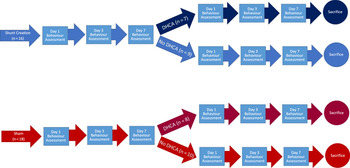
Neonatal (10–14 days old) piglets were randomised to either thoracotomy with pulmonary artery to left atrium shunt (shunt group) or thoracotomy alone (sham group). At experimental day 7, the animals were then randomised to deep hypothermic circulatory arrest or sham procedure, resulting in the creation of four groups (sham, sham + deep hypothermic circulatory arrest, shunt alone, shunt + deep hypothermic circulatory arrest). Neurobehavioural performance was assessed on post-operative days 1, 3, and 7 following both shunt and deep hypothermic circulatory arrest operative procedures. The animals were sacrificed on experimental day 14 after the initial procedure. The time-course of this experiment is detailed in Figure 1.
Diagram illustrating the division of the groups and the timing of the neurobehavioural assessments.

Surgical preparation
Animals were sedated with intramuscular ketamine (30 mg/kg) and acepromazine (1.2 mg/kg). Electrocardiography, pulse oximetry, and noninvasive cuff blood pressure were monitored throughout the procedure. Following mask ventilation with 5% inhaled isoflurane, the piglets underwent endotracheal intubation and subsequent ventilation. Anesthesia was maintained by inhalation of isoflurane (1–5%).
A left antero-lateral thoracotomy was performed and the pleural cavity entered through fourth intercostal space. The pericardial sac was opened anteriorly and parallel to the phrenic nerve. Heparin (100 U/kg) was injected into the left atrium and an arterial blood gas sample was taken. If any adjustments to ventilation were necessary, a second arterial sample was taken after 5 minutes.
In the shunt group, a pulmonary artery to left atrium anastomosis was created after placement of side-biting Satinsky clamp using a 5-mm thin-walled polytetrafluorethylene tube graft (Gore, Newark, Delaware). Sham animals underwent thoracotomy, pericardial dissection, and placement of side-biting clamps on the left atrium and the pulmonary artery. After the clamps were released, a 10-minute period was allowed for stabilisation before a third arterial sample was taken from the descending aorta.
Lung re-expansion and adjustments to ventilation were made as necessary to re-establish normo-ventilation, while fraction of inspired oxygen was maintained at 40%. The pericardial sac was re-approximated and the thoracotomy closed. Isoflurane was stopped and the piglets were extubated when awake. They were then monitored for a minimum of 4 hours and supplemental oxygen provided to maintain oxygen saturations greater than 70%. Post-operative analgesia was accomplished with intramuscular buprenorphine (0.1 mg/kg) initially and subsequently by a fentanyl patch (5 mcg) for 48 hours.
Deep hypothermic circulatory arrest protocol
Seven days following either sham procedure or shunt creation the piglets were randomised to undergo either deep hypothermic circulatory arrest or sham procedure. The method of deep hypothermic circulatory arrest used in this study has been successfully performed by our group and described previously. Reference Myung, Kirshbom and Petko5
Animals were sedated and intubated in the same manner described above. Initial ventilator settings were as follows: intermittent positive pressure ventilation at respiratory rate of 20, peak inspiratory pressure of 20, positive end-expiratory pressure of 5, and a fraction of inspired oxygen of 40%. Ventilation was adjusted according to arterial blood gas samples to keep the partial pressure of carbon dioxide between 35 and 45 mmHg; Fraction of inspired oxygen was kept at 40% throughout the duration of mechanical ventilation, with the exception of an oxygen saturation less than 50% in the cyanosis + deep hypothermic circulatory arrest group following discontinuation of cardiopulmonary bypass and weaning of mechanical ventilation.
The superficial femoral artery was dissected and cannulated for invasive blood pressure monitoring, arterial blood sampling, and pre-cardiopulmonary bypass administration of heparin. Through a left cervical incision, the carotid artery and the jugular veins were exposed. Systemic heparin (400 U/kg) was administered and the internal jugular vein and carotid artery were cannulated with a 10 Fr and 6 Fr cannulas, respectively. Central venous pressure was monitored through a cannula inserted to external jugular vein.
The cardiopulmonary bypass circuit consisted of a membrane oxygenator (Lilliput I, Cobe Cardiovascular, Arvada, Colorado), cardiotomy reservoir, and arterial filter (Capiox, Terumo, Ann Arbor, Michigan) with a roller pump (Sarns, Ann Arbor, Michigan). Perfusion temperature was controlled with a heat exchanger (Haemotherm, Cincinnati Subzero, Cincinnati, Ohio). A bridge of tubing connected to a haemofilter (Haemocor HPH, Minntech, Minneapolis, Minnesota) and a second roller pump was placed between the arterial and venous lines. The haemofilter was connected to vacuum suction. The circuit was primed with Normosol-R (Abbott, North Chicago, Illinois), homologous fresh citrate donor blood, furosemide (1 mg/kg), heparin (1000 U), sodium bicarboniate (20 mEq), 25% human albumin (60 cc), calcium chloride (40 mg/kg), dexamethasone (30 mg/kg), and mannitol (125 mg/kg). This prime was haemoconcentrated to achieve a haematocrit of 26–28 and a resulting total volume of 600–700 ml.
On initiating of cardiopulmonary bypass, the flow was brought to 150 ml/kg/minute, mechanical ventilation was discontinued, and the circuit was adjusted to achieve partial pressure of carbon dioxide of 35–45 mmHg and partial pressure of oxygen of 150–200 mmHg using an α-stat strategy. The animal was cooled on bypass, assisted by a cooling blanket and topical ice to 18°C over period of 20 minutes. Brain temperature was measured using a probe implanted underneath the external lamina of the frontal bone. Each animal underwent 60 minutes of deep hypothermic circulatory arrest at 18°C.
After reinstitution of cardiopulmonary bypass, the animals were warmed to 34°C over 30 minutes. The animals underwent 15 minutes of stabilisation followed by 15 minutes of modified haemofiltration. Crystalloid solution was added to the cardiotomy reservoir as needed. Piglets were then weaned from cardiopulmonary bypass and mechanical ventilation was re-established. The animals were decannulated and all skin incisions were closed. No procedure was performed in the animals randomised to no deep hypothermic circulatory arrest.
Isoflurane was stopped after a stabilisation period of 3 hours. The animals were extubated when awake and monitored for a period of 12 hours in the incubator with high-flow oxygen and intravenous fluids were given.
No procedure was performed in the animals randomised to no deep hypothermic circulatory arrest.
Assessment of neurobehavioural performance
On post-operative days 1, 3, and 7 following both shunt and deep hypothermic circulatory arrest randomisation a blinded observer assessed neurobehavioural performance and assigned a score. The score used is based on both behavioural and neurologic examination and includes components related to the level of consciousness, respiration, cranial nerve deficits, motor and sensor function, gait, and behaviour and is detailed in Table 1. The scores are summed across the aforementioned categories with a minimum score of 0 representing no deficits and a maximum score of 95 indicating severe neurologic damage. This score system has been described previously in the literature. Reference Myung, Kirshbom and Petko5–Reference Baker, Zornow and Grafe8
Neurobehavioural performance scoring criteria

Assessment of neuronal injury
Following the final neurobehavioural performance assessment on post-operative day 7, the animals were anesthetised, intubated, and mechanically ventilated in the same manner described above. The final arterial blood sample was taken from the femoral artery and systemic heparin (100 U/kg) was given prior to cannulating the descending aorta in a retrograde fashion with a 14 Fr arterial cannula. The animals were then euthanised with intravenous potassium chloride. Ventilation was discontinued and the ascending aorta was clamped. The right atrial appendage was accessed and perfusion with 1000 ml of 4°C normal saline commenced at a rate of 10–20 ml/minute.
A craniotomy was performed and an individually randomised hemisphere of the brain was harvested and processed as a fresh frozen tissue, while the remaining half was perfused with 4% paraformaldehyde solution at 4°C then maintained in a 4% paraformaldehyde and 70% alcohol solution for 24 hours before being embedded in paraffin.
Seven micrometer cuts were made and the slides were stained with haematoxylin and eosin to characterise neuronal damage. Sections of the hippocampus and neocortex were scored by a neuropathologist blinded to the experimental condition according to the criteria in Table 2. Changes indicative of neuronal injury include hyperchromatic and shrunken nuclei, cytoplasmic eosinophilia, and karyorrhexis. This scoring system has been described previously. Reference Myung, Kirshbom and Petko5,Reference Kurth, Priestley and Golden6
Histopathologic scoring criteria for haematoxylin and eosin

Statistical analysis
Data analysis occurred in two distinct phases, a descriptive phase and a hypothesis-testing phase. In the descriptive phase, frequency counts and summary statistics were calculated for the 34 piglets using both parametric as well as nonparametric measures of central tendency, variability, and association. For the hypothesis testing phase, three sets of analyses were conducted, all of which used a nonparametric one-way analysis of variance (Kruskal–Wallis) using shunt and deep hypothermic circulatory arrest status as the four (2 × 2) classification groups to test for differences for neuronal injury using histology score, neurobehavioural performance at day 1, and selected piglet characteristics (i.e., change in haematocrit, change in weight, change in partial pressure of oxygen). Where a statistically significant omnibus test was observed, follow-up tests were conducted using a Mann–Whitney U test of location. Our criterion for statistical significance was set an unadjusted α = 0.05 level. Analyses were performed using SAS versus 9.4 (SAS Institute, Cary, North Carolina).
Results
Piglet characteristics
A total of 34 neonatal piglets (median weight: 3.4 kg, range: (2.4–3.8 kg)) were used in this study; 16 (47%) of the piglets underwent shunt creation and 15 (44%) piglets received deep hypothermic circulatory arrest. This resulted in 10 piglets that underwent neither shunt placement nor deep hypothermic circulatory arrest (sham), 8 that underwent deep hypothermic circulatory arrest alone (sham + DHCA), 9 that underwent shunt creation only (shunt), and 7 that underwent shunt creation and subsequently deep hypothermic circulatory arrest (shunt + DHCA). There was no significant difference in weight at day 1 among any of the groups.
Operative indicators
To demonstrate that the shunt was successful in and achieving the desired state throughout the experimental period, shunted and nonshunted groups of piglets were compared with respect to haematocrit and PO2 levels. Animals that underwent shunt creation had significantly higher haematocrit and significantly lower PO2 levels than sham animals (p < 0.01). See Table 3 for a more complete listing of descriptive statistics for each group.
Piglet characteristics

Note. Each value presented as a median (minimum, maximum).
1,2Statistically significant differences between sham and cyanotic animals (p < 0.01).
3Statistically significant difference between Shunt + DHCA group and Sham group (n = 17, p = 0.02).
Neuronal injury
Our primary hypothesis, that histology score would be impacted by both shunt creation and deep hypothermic circulatory arrest status, together, was supported. An omnibus test of significance yielded a statistically significant interaction effect between the presence or absence of shunt creation and deep hypothermic circulatory arrest status for neuronal injury as determined by histology score (p = 0.03). All possible pairwise comparisons were conducted as a follow-up to the omnibus value, resulting in a single statistically significant difference between piglets that underwent both shunt creation and deep hypothermic circulatory arrest (shunt + deep hypothermic circulatory arrest: 2 (0–4)) and those not exposed to either (sham: 0 (0–0); p = 0.02). When compared to sham animals, only the shunt + deep hypothermic circulatory arrest group had evidence of significant neuronal injury. Neither the sham + deep hypothermic circulatory arrest nor the shunt alone animals had evidence of neuronal injury that differed significantly from the sham animals. These results can be seen in Table 3.
Neurobehavioural performance
No statistically significant interaction effect was observed between the presence or absence of shunt creation and deep hypothermic circulatory arrest status for neurobehavioural performance in the immediate post-operative period (p = 0.46). These results are summarised in Table 4.
Neurobehavioural scores by treatment group

Note. Each value presented as a median (minimum, maximum).
Discussion
The neurologic injury that is seen in children following cardiac surgery is the result of a complex interaction of patient-specific and environmental factors. It has been established in human studies that cyanotic children who undergo cardiac surgery have compromised neurological function including lower intelligent quotient, Reference Linde, Rasof and Dunn9 decreased school performance, Reference Griffin, Elkin and Smith10 motor function, vocabulary, and acquired abilities. Reference Hövels-Gürich, Seghaye and Däbritz11 However, even years following surgical correction, children with cyanotic heart disease have greater school difficulties and this is not fully explained by chronic hypoxia or surgical factors. Reference Wright and Nolan1 Additionally, total circulatory arrest has not been conclusively shown to have worse neurodevelopmental outcomes than other support strategies, namely low-flow cardiopulmonary bypass. Reference Bellinger, Jonas and Rappaport2 These discrepancies highlight the gaps in our understanding of why cyanotic children undergoing deep hypothermic circulatory arrest have compromised neurologic outcomes.
In this neonatal swine model, cyanotic animals who underwent deep hypothermic circulatory arrest had significant histological evidence of neurologic injury that was not seen in non-cyanotic animals who were not subject to deep hypothermic circulatory arrest. Additionally, there was no significant difference in neurological injury between animals that were cyanotic and did not undergo deep hypothermic circulatory arrest or non-cyanotic animals that underwent deep hypothermic circulatory arrest and sham animals. This finding suggests an interaction between preoperative cyanosis and deep hypothermic circulatory arrest that results in worsened neuronal injury. This degree of injury does not appear to be the result of cyanosis or deep hypothermic circulatory arrest alone, but rather an interaction between those two factors. Our findings suggest that children with cyanotic congenital heart disease are more susceptible to the neurologic damage that deep hypothermic circulatory arrest may impart than their non-cyanotic counterparts.
Other studies have found evidence of significant histological injury after deep hypothermic circulatory arrest alone. Reference Myung, Kirshbom and Petko5,Reference Kurth, Priestley and Golden6 It is likely that we did not see such an effect in this study due to a shorter duration of deep hypothermic circulatory arrest (90 versus 60 minutes) as there is evidence of increased neurologic damage with increased duration of deep hypothermic circulatory arrest in human neonates Reference Gaynor, Nicolson and Jarvik3 and shorter periods of deep hypothermic circulatory arrest have not resulted in reproducible neurologic injury in prior animal studies. Reference Kurth, Priestley and Golden6,Reference Priestley, Golden and O’Hara12 So while deep hypothermic circulatory arrest may result in adverse neurologic outcomes regardless of cyanosis status at prolonged durations, the results of this study indicate that cyanotic animals are more suspectable to the neurologic injury inflicted by deep hypothermic circulatory arrest than non-cyanotic piglets. Our findings support that the “safe” duration of deep hypothermic circulatory arrest may be heavily dependent on patient factors and its use clinically should be individualised to take this into account.
The findings from this study should be viewed in light of its limitations. It is an animal study with relatively small numbers, which may have prevented the detection of differences in neurobehavioural scores. Additionally, these animals survived for 14 days and impairment in the neurobehavioural scores may manifest at a later time. Neurobehavioural testing of piglets is nonspecific and will not pick up subtle deficits. Finally, while the elevated haematocrit and decreased partial pressure of oxygen partially validate this model as one of cyanosis, the neonatal swine model does not perfectly imitate a child with complex congenital heart disease undergoing surgical repair. Additionally, this study does not control for the effects of cardiopulmonary bypass without deep hypothermic circulatory arrest which is a target for other studies by our group. Reference Mavroudis, Karlsson and Ko13,Reference Volk, Mavroudis and Ko14 Furthermore, the cervical cannulation method used in this study represents another potential limitation, but even with this less invasive method, we were able to achieve comparable flows to central cannulation and this method has been described previously in the literature. Reference Myung, Kirshbom and Petko5
Future directions include further investigation of the pathways that lead to the neuronal injury that was seen in this study. Of particular interest is the effect that cyanosis and support strategies have on mitochondria. It is suspected that these organelles play a key role in determining the fate of the cell and cellular apoptosis. Other work by our group has shown the deleterious effect of deep hypothermic circulatory arrest and cardiopulmonary bypass has on cerebral mitochondria. Reference Mavroudis, Karlsson and Ko13,Reference Volk, Mavroudis and Ko14 This represents a possible intervention point for therapeutics. Mitochondria might be altered in cyanosis and this may explain the results seen in this study, but further research is needed to clarify this hypothesis.
Surgical repair remains a mainstay in the treatment of children with cyanotic heart disease and the results of this study suggest that there is an interaction between cyanosis and deep hypothermic circulatory arrest that results in increased neuronal damage that is evident on histologic examination. These results have important implications for the choice of and duration of deep hypothermic circulatory arrest in cyanotic neonates. These findings are an important step in elucidating the reasons that children with cyanotic heart disease are not able to reach their full neurologic potential and will hopefully inspire future work to further explain and create interventions to mitigate the increased injury.
Acknowledgments
The authors would like to thank the veterinary staff at the Children's Hospital of Philadelphia as well as our colleagues in the division of perfusion services for without their support these experiments would not have been possible.
Financial support
This work was supported by Daniel M Tabas Endowed Chair in Pediatric Cardiothoracic Surgery.
Conflicts of interest
None.
Ethical standards
The authors assert that all procedures contributing to this work comply with the ethical standards of the relevant national guides on the care and use of laboratory animals (National Institutes of Health’s Guide for the Care and Use of Laboratory Animals) and has been approved by the designated institutional committee (Children’s Hospital of Philadelphia’s Institutional Animal Care and Use Committee).