Attachment theory holds that the first year of life is a critical time for infants to develop a secure attachment relationship with their primary caregivers. Traditionally, primary care of infants has been assumed by mothers, and although the role of fathers as infant caregivers has increased dramatically in the past 30 years, recent research on the transition to parenthood of dual-earner couples indicates that mothers still overwhelmingly assume the primary role in infant care (Kotila, Schoppe-Sullivan, & Kamp Dush, Reference Kotila, Schoppe-Sullivan and Kamp Dush2013). Because early attachment plays such a key role in children's later social–emotional development, numerous studies have examined the relation of nonmaternal childcare during the first year of life and the development of mother–infant attachment security. However, researchers have not yet examined whether very extensive nonmaternal care in infancy predicts the later development of disorganized mother–infant attachment. In this paper, we examine the possibility that this may be more likely to occur if daily separations from mother are so lengthy that the infant spends almost no time interacting with the mother during the day.
As employment of women with infants under a year old increased dramatically during the 1970s and 1980s, the NICHD Study of Early Child Care and Youth Development (NICHD SECCYD) was initiated in 1991 in response to concerns that an infant's repeated daily separations from the mother might disrupt the process of attachment formation (Barglow, Vaughn, & Moliter, Reference Barglow, Vaughn and Molitor1987; Belsky & Rovine, Reference Belsky and Rovine1988). Although studies conducted prior to 1990 did find evidence that 20 or more hours of nonmaternal childcare per week predicted an increased risk of infants developing an insecure attachment (Belsky & Rovine, Reference Belsky and Rovine1988; Lamb & Sternberg, Reference Lamb and Sternberg1990), these studies had several methodological limitations (Friedman & Boyle, Reference Friedman and Boyle2008). They generally used small samples, did not control for maternal predictors of attachment such as maternal sensitivity, and were usually retrospective rather than prospective. In addition, data from earlier studies were collected during a historical period when nonmaternal infant care was much less prevalent (NICHD Early Child Care Research Network, 1997). Thus, the infants and parents examined in the earlier studies were likely to represent a population with different demographics, perhaps younger and less well educated, than mothers who used nonmaternal care in the 1990s and beyond.
Contrary to earlier studies, the NICHD SECCYD found no main effect of nonmaternal care during infancy on insecure attachment. However, a significant interaction indicated that longer hours of nonmaternal care combined with lower maternal sensitivity predicted increased insecure mother–infant attachment (NICHD Early Child Care Research Network, 1997), and this effect was replicated when attachment was assessed again at age 3 (NICHD Early Child Care Research Network, 2001). Thus, although the findings of NICHD SECCYD suggest that time spent in nonmaternal care does not put infants at significant risk for developing insecure attachment to the mother, as long as the mother is a sensitive caregiver (Friedman & Boyle, Reference Friedman and Boyle2008), they also indicate that extensive hours of nonmaternal care is nonetheless a risk factor for attachment development. Specifically, long daily separations from the mother may exacerbate the effects of poor mother–infant interactions.
It is surprising that no studies have specifically examined the relation of extensive nonmaternal care to disorganized mother–infant attachment, given that children with a history of disorganized attachment have been found to have a greater risk of developing later psychopathology than infants who are not disorganized (including those with insecure but organized attachment classifications; Lyons-Ruth & Jacobvitz, Reference Lyons-Ruth, Jacobvitz, Cassidy and Shaver1999). Specifically, these children have been found to be more likely to develop later externalizing behavior problems (Fearon, Bakermans-Kranenberg, van IJzendoorn, Lapsley, & Roisman, Reference Fearon, Bakermans-Kranenburg, van IJzendoorn, Lapsley and Roisman2010; Hazen, Jacobvitz, Higgins, Allen, & Jin, Reference Hazen, Jacobvitz, Higgins, Allen, Jin, Solomon and George2011), internalizing symptoms (Carlson, Reference Carlson1998; Shaw, Keenan, Vondra, Delliquadri, & Giovanelli, Reference Shaw, Keenan, Vondra, Delliquadri and Giovannelli1997), and dissociative symptoms (Carlson, Reference Carlson1998).
According to attachment theory, the adaptive function of the attachment relationship is to protect infants from harm; thus, infants monitor their caregivers' whereabouts so they may signal or seek proximity to the caregiver when they perceive a threat (Bowlby, 1969/Reference Bowlby1982). The attachment system works smoothly for securely attached infants, who are able to effectively use the caregiver as a secure base because they have typically received the comfort they need when they signal their distress. Because the caregivers of insecure–avoidant infants often ignore or reject their signals for comfort, these infants develop a strategy of minimizing their attachment behaviors when they are distressed, whereas infants with insecure–resistant attachment use the opposite strategy, maximizing their attachment cues to keep inconsistently responsive caregivers near by. In contrast, infants with disorganized attachment relationships lack a coherent strategy for obtaining comfort when they are distressed. They exhibit behavior with their caregiver that suggests a breakdown in behavior strategies to obtain the needed comfort, including freezing/stilling, confusion, disorientation, contradictory movements such as approaching the mother with the head averted, and incomplete interrupted movements (Main & Solomon, Reference Main, Solomon, Brazelton and Yogman1986).
Main and Hesse (Reference Main, Hesse, Greenberg, Cicchetti and Cummings1990; Hesse & Main, Reference Hesse and Main2000) proposed that the ability of disorganized infants to use a consistent, coherent attachment strategy (i.e., the strategy represented by their secondary attachment category of secure, avoidant, or resistant) is disrupted due to fear of their caregiver. When these infants are distressed, they are faced with an irresolvable conflict. The parent who should be the source of comfort is simultaneously a source of fear, resulting in the disoriented, conflicted approach–avoidance behaviors described above. In support of this hypothesis, studies have found that the disorganized attachment is more prevalent in samples of maltreated infants than in typical community samples (Carlson, Cicchetti, Barnett, & Braunwald, Reference Carlson, Cicchetti, Barnett and Braunwald1989; Lyons-Ruth, Connell, Zoll, & Stahl, Reference Lyons-Ruth, Connell, Zoll and Stahl1987). In addition, mothers with unresolved trauma (i.e., loss of a loved one or abuse that has not been resolved) have been found to be more likely to form disorganized attachments with their infants compared with mothers who have resolved or not experienced trauma, and this link has been found to be mediated by mothers' frightened–frightening (FR) behavior (Jacobvitz, Hazen, Zaccagnino, Messina, & Beverung, Reference Jacobvitz, Hazen, Zaccagnino, Messina, Beverung, Cicchetti and Roisman2011; Schuengel, Bakermans-Kranenburg, & van IJzendoorn, Reference Schuengel, Bakermans-Kranenburg and van IJzendoorn1999). Mothers with unresolved trauma are not typically maltreating, but they may at times be overcome with fear, causing them to nonconciously behave for brief moments in ways that frighten their infants. For example, they may show threatening behaviors (e.g., grabbing the baby from behind or suddenly speaking in a strange haunted voice), frightened behaviors (e.g., backing away from the baby for no reason), and dissociative behaviors (e.g., freezing or stilling for several seconds; Jacobvitz, Leon, & Hazen, Reference Jacobvitz, Leon and Hazen2006; Main & Hesse, Reference Main, Hesse, Greenberg, Cicchetti and Cummings1990).
Solomon and George (Reference Solomon and George1999) hypothesized that prolonged or repeated separations from the mother, particularly in adverse circumstances, may also disrupt the infants' attachment development and may thus be another pathway to disorganized attachment. They noted that in the early classic studies of infants who had been separated from their mothers a week or more, these infants showed behaviors characteristic of attachment disorganization upon reunion with their mothers, including disorientation and inhibition of activity, as well as a combination of avoidance, resistance, and unprovoked anger (Bowlby, Reference Bowlby1973; Heinicke & Westheimer, Reference Heinicke and Westheimer1966; Robertson & Robertson, Reference Robertson and Robertson1971). This was found even when the infants had experienced adequate care from both their mothers and their substitute caregivers. Soloman and George suggested that the disorganized/disoriented behavior displayed by these infants might reflect a breakdown of an organized strategy for eliciting responsiveness from the primary caregiver due to experiencing repeated or prolonged separations from her under stressful conditions. In support of this possibility, they found that infants of divorced or separated parents who experienced regular overnight visiting with their fathers were more likely to form disorganized attachments with their mothers, compared with infants who did not experience overnights away from their mothers.
Reviewing this research, Strous (Reference Strous2011) noted that although there is general agreement that very prolonged separations from the primary caregiver place stress on the developing attachment relationship, “the crucial question is, for what length of time can an infant or toddler comfortably tolerate repeated separations from the primary attachment figure?” (p. 203). One reason that hours of nonmaternal care were not related to attachment security in the NICHD SECCYD study may be because differences in amount of mother–infant interaction time between employed versus stay-at-home mothers were not as great as one might suppose (Friedman & Boyle, Reference Friedman and Boyle2008). In this sample, mothers of infants who spent over 30 hr per week in nonmaternal care interacted only 12 hr per week less than those whose infants spent no time in nonmaternal care (Booth, Clarke-Stewart, Vandell, McCartney, & Owen Reference Booth, Clarke-Stewart, Vandell, McCartney and Owen2002). The authors suggested that employed mothers compensate for reduced time with their infants by decreasing time in other activities so they can engage in quality interaction time with their infants.
However, a small percentage of infants may experience hours of nonmaternal childcare that are so extensive that they are separated from their mothers during nearly all of their waking hours during the work week. For example, if an infant is dropped off in childcare at 7 a.m. each day and picked up at 7 p.m. each day during the work week, the infant will be going to bed soon after he or she is picked up, and both infant and mother may be tired and stressed during the limited interaction time available to them. These lengthy daily separations may disrupt the infant's development of an organized attachment. Thus, during the sensitive period of attachment formation in the first year of life, there may be a maximum threshold of time that infants can be separated from the primary caregiver in a given week, beyond which infants will experience increased risk of forming a disorganized attachment with the primary caregiver. If there is such a threshold, existing studies provide little information as to what it might be. Extensive nonmaternal care was defined in research conducted prior to 1990 as over 20 hr per week (Belsky & Rovine, Reference Belsky and Rovine1988), but currently, full-time employment (i.e., 40 hr per week) of mothers with infants as young as 6 months old is fairly typical. Given the findings of the NICHD SECCYD, it seems likely that hours of nonmaternal care would need to be in excess of 40 hr per week to be considered extensive enough to present a risk for attachment disorganization.
Thus, the primary purpose of this research is to investigate whether a maximum threshold of time spent in nonmaternal care exists, beyond which infants have an increased risk of forming a disorganized infant–mother attachment relationship. We first examined the relation of extensive nonmaternal care to disorganized attachment using the Austin longitudinal sample, because this sample was one of only a few that not only obtained assessments of attachment security and hours of nonmaternal care during infancy, but also obtained assessments of two important covariates of disorganized attachment: mothers' unresolved trauma and FR behavior. In addition, even though this sample is relatively small (N = 125), it includes an unusually large percentage of disorganized children (34%), as well as a relatively high percentage of infants who experienced very long hours of nonmaternal care. To investigate whether infants who exceed a maximum threshold of time spend in nonmaternal care are at increased risk of developing disorganized attachment, we examined not only continuous hours of nonmaternal care as a predictor of disorganized attachment but also three dichotomous measures of very extensive nonmaternal care: whether or not infants were in nonmaternal care over 40 hr, over 50 hr, or over 60 hr per week. Infant temperament, family income, mothers' unresolved attachment status, and mothers' FR behavior were included as covariates. We hypothesized that both very extensive hours of nonmaternal care (i.e., the dichotomous measure of over 50 or 60 hr per week) and FR maternal behavior would independently predict disorganized mother–infant attachment. We did not expect that the continuous measure of hours of nonmaternal care or the dichotomous measure of greater than 40 hr per week would predict disorganized mother–infant attachment, and although mothers' unresolved trauma has also been found to predict attachment disorganization, we did not expect it to independently predict disorganization when examined simultaneously with maternal FR behavior, because maternal FR behavior has been found to mediate the relation between maternal unresolved attachment and infant disorganization.
Study I: The Austin Longitudinal Sample
Method
Participants
This sample was drawn from a longitudinal study that followed 125 couples from Austin, Texas, from 1 to 3 months before the birth of their first child until the child was 7 years old. Couples who were expecting their first child were recruited during the mothers' third trimester of pregnancy. The mean family income range for the sample was $30,000 to $45,000. The mean age for mothers was 29.3 with ages ranging from 17 to 42. Participants were primarily non-Hispanic White (85%); other participants were 8% Hispanic, 3% African American, and 4% other, including biracial. The infants were 59% boys and 41% girls.
The subsample for the current study consisted of 106 families that had data for all the measures used in the present study. Results from an independent t test showed that prenatal family income differed significantly for mothers who participated in the Strange Situation procedure (SSP) and those who did not participate, t (121) = 2.017, p < .05. The mean income range was $30,000 to $45,000 for participant families (n = 105), and $15,001 to $30,000 for nonparticipant families (n = 18). Participants with missing data did not differ in any other study variables from those included in the present study, nor did they differ demographically on ethnicity or age.
Procedure
The larger purpose of this longitudinal study was to examine parents' attachment representations, caregiving quality, and family interactions as predictors of child outcomes. Data were collected in five phases: prenatal–early postnatal, 8 months, 12–15 months, 24 months, and 7 years. Data collected from the first three phases are presented in this study. During their third trimester of pregnancy with their first child, mothers' representations of attachment were assessed using the Adult Attachment Interview. When infants were 6 weeks old, parents completed a measure of infant temperament. When infants were 8 months old, total hours of nonmaternal care per week were assessed, and mothers were observed interacting with their infants in everyday caregiving tasks. These interactions were videotaped and coded for caregiving quality, including FR behavior. Infant–mother attachment patterns (including disorganized attachment) were assessed using the Strange Situation when infants were between 12 and 15 months of age, once with mother and once with father in counterbalanced order.
Measures
Infant disorganized attachment classification
Disorganized infant–mother attachment was assessed using the SSP (Ainsworth, Blehar, Waters, & Wall, Reference Ainsworth, Blehar, Waters and Wall1978). The SSP is a 25-min series of brief separation and reunion episodes designed to be of increasing stress to infants, including two mother–infant separations and reunions. Infants first received a primary classification of secure (B), avoidant (A), or resistant (C; see Ainsworth et al., Reference Ainsworth, Blehar, Waters and Wall1978) by trained coders. They then were also categorized as to whether or not their attachment was disorganized (D) using the coding system developed by Main and Solomon (Reference Main, Solomon, Brazelton and Yogman1986, Reference Main, Solomon, Greenberg, Cicchetti and Cummings1990). Disorganized infants display fearful, odd, disoriented, dissociated, and/or conflicted behaviors in the SSP. One trained primary coder coded all of the SSP sessions for D versus not-D, and two other trained coders also coded 82 videotapes (65%) to obtain intercoder reliability (κ = 0.95 for D vs. not-D).
Nonmaternal childcare hours
Nonmaternal care was operationalized as all care provided for the infant when the mother was not physically present and the primary caregiving responsibility for the infant rested with someone other than the mother, including fathers, other relatives, nannies, family day home providers, center care, or any other type of nonmaternal childcare. When infants were 7–8 months old, one or both parents completed a Schedule of Care for Baby, indicating who cared for the baby each hour between 6 a.m. and 11 p.m. on each day of a typical week. A summed composite variable was created that included hours of all nonmaternal care each day of the week during a typical week.
Family income
Income was measured via a questionnaire completed by both parents prenatally and at 8 months. Respondents were given a range of incomes and asked to check which one represented their annual family income, including all sources of income. The average of the scores obtained prenatally and at 8 months were used in all analyses.
Infant temperament
This was assessed using Infant Behavior Questionnaire (Rothbart, Reference Rothbart1981), which mothers completed when their infants were 3–6 weeks old. The questionnaire assesses six dimensions: infants' activity level, smiling and laughter, fear, distress to limitations, soothability, and duration of orienting, using a 7-point scale (1 = never, 7 = always). We created a composite scale by subtracting the standardized positive reactivity score from the negative reactivity score, following Rothbart (Reference Rothbart1986). For the composite scale, α = 0.77.
Maternal unresolved attachment status
This was assessed using the Adult Attachment Interview (AAI; George, Kaplan, & Main, 1984/1985/Reference George, Kaplan and Main1996), a semistructured interview designed to assess adults' current states of mind regarding attachment relationships based on their recollections of their childhood relationships with their parents, as well as significant experiences of loss or trauma. Interviews were recorded and transcribed verbatim, and these transcripts were classified by two trained coders into one of four primary classifications (secure-autonomous, dismissing, preoccupied, or cannot-classify) using the coding procedures specified by Main, Goldwyn, and Hesse (1985/Reference Main, Goldwyn and Hesse2002). In addition to their primary classification, interviews were coded according to whether or not mothers were unresolved for trauma based on past loss of a loved one or past abuse. Only the unresolved classification is included in the present study. Indicators of unresolved loss include lapses in the monitoring of reasoning processes or discourse when discussing the death of someone close, or reports of an extreme behavioral response to the loss. Indicators of unresolved trauma due to past abuse include unsuccessful denial of abuse, feelings of being causal in the abuse, and fears of being mentally possessed by the abuser. Interrater agreement for the unresolved classification was κ = 0.86.
Maternal FR behavior
When their infants were 8 months old, mothers were observed engaging in 15 min of free play using their own toys and 15 min of routine caregiving tasks (feeding and a clothes change). Mothers' FR behavior with their infants was coded from these videotaped interactions based on Main and Hesse's (Reference Main and Hesse1992) initial version of the Frightening/Frightened mother–infant behavior coding system. Specific examples of FR behavior include the parent making unpredictable invasions of the infant's space (e.g., coming up from behind the infant or moving her hand across the infant's face or throat), baring teeth, making unusual vocalizations, scary pursuits of baby, trancelike or dissociative states lasting over 30 s, and covering the baby's face with stuffed toys. Specific examples of FR maternal behavior include stiff handling the baby as if he or she were an inanimate object, suddenly retreating from the baby as if fearful of being hurt, and guarded postures.
Two trained coders rated 100% of the mothers for FR behavior by recording all instances of FR behavior and then assigning a numerical rating of 1–9 for overall FR behavior. The intraclass correlation for these two coders was 0.85. For interactions in which these two coders disagreed by more than one point, a third coder was used. Scores of all coders were averaged to obtain final FR scores. Mothers with scores of 5 or over are considered to show clear FR behavior and are placed in the FR category. Categorical rather than continuous scores for FR behavior were used because it is unclear whether differences between scores within the FR or non-FR categories are meaningful (Jacobvitz et al., Reference Jacobvitz, Leon and Hazen2006, Reference Jacobvitz, Hazen, Zaccagnino, Messina, Beverung, Cicchetti and Roisman2011).
Results and discussion
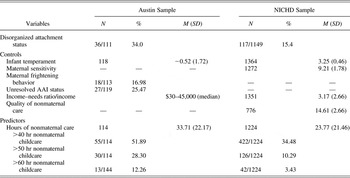
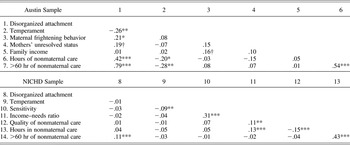
Descriptive statistics of the study variables are presented on the left side of Table 1, and correlations among the study variables are presented at the top of Table 2.
Descriptive statistics for study variables in NICHD and Austin samples

Note: For dichotomous measures (i.e., disorganized attachment status, maternal frightening behavior, unresolved AAI status, and nonmaternal care cutoffs), N is the total assessed divided by the total number who fell in the category. For continuous measures, N is the number of participants assessed.
Correlation coefficients among study variables in austin and NICHD samples
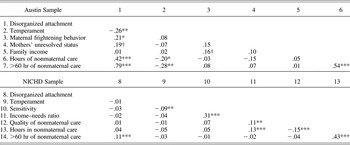
†p < .10. *p < .05. **p < .01. ***p < .001.
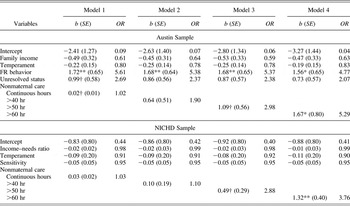
To examine whether extensive nonmaternal care predicts an increased risk of disorganized attachment, we ran a series of logistic regressions using hours of nonmaternal care assessed when infants were 8 months old to predict whether infants were classified as disorganized with mother by the time they were 12–15 months old (see top of Table 3). Four separate regressions were conducted for each dependent variable: continuous hours of nonmaternal care per week (Model 1), and three dichotomous measures of over 40 hr (Model 2), over 50 hr (Model 3), and over 60 hr per week (Model 4). In each regression, we included the following covariates: income, infant temperament, mothers' FR behavior, and mothers' unresolved AAI classification.
Logistic regression analyses regressing infant–mother disorganized attachment status on hours of nonmaternal care
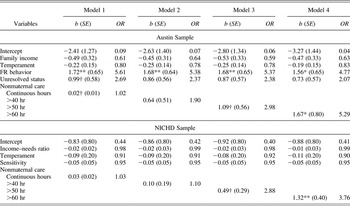
Note: N = 93 (Austin sample); N =1122 (NICHD sample). OR, Odds ratio; FR, frightening.
†p < .10. *p < .05. **p < .01.
As predicted, the continuous measure of hours of nonmaternal care (Model 1) did not significantly predict disorganized attachment, although the effect was marginally significant, Wald χ2 (1) = 3.48, p = .062. At the over-40 hr threshold (Model 2), the relation of nonmaternal care to disorganized attachment was nonsignificant, Wald χ2 (1) = 1.56, p = .211, ns. However, over 50 hr of nonmaternal care (Model 3) marginally predicted disorganized attachment, Wald χ2 (1) = 3.82, p = .051, and as predicted, infants with over 60 hr per week in nonmaternal care (Model 4) were significantly more likely to have a disorganized attachment with their mothers, Wald χ2 (1) = 4.35, p = .037. In addition, as expected, maternal FR behavior predicted disorganized attachment in all four models independently of extensive nonmaternal care. None of the other variables significantly predicted disorganized attachment.
Given the small size of the Austin sample, it is particularly important to replicate these results with a larger sample. In addition, these findings suggest that the relation between nonmaternal care and disorganized attachment might be modeled more accurately by a curvilinear exponential function than by a linear function. That is, perhaps there is essentially no relation between nonmaternal care and disorganized attachment until hours of nonmaternal care exceed a threshold of 60 hr per week, after which the risk of disorganized attachment rises exponentially as hours of nonmaternal care increase. However, it is not possible to test such on model on such a small sample. Thus, in Study 2, our primary goal was to replicate the results of Study 1 using the large NICHD SECCY sample, and also to use this sample to perform a more sophisticated test of our hypothesis using a curvilinear exponential function.
A key advantage of the Austin sample is that it includes assessments of two important covariates of disorganized attachment: maternal unresolved status and maternal FR behavior. Because these measures were not assessed in the NICHD sample, we controlled for maternal sensitivity rather than maternal FR behavior in analyses using the NICHD sample. It is important to note, however, that maternal sensitivity and FR behavior are distinct constructs and are only moderately correlated (r = –.24, n = 119, p < .01; Jacobvitz et al., Reference Jacobvitz, Leon and Hazen2006). In addition, meta-analyses indicate that although the relation of maternal sensitivity to attachment disorganization is significant, the effect size is much lower than that found for the relation between maternal FR behavior and attachment disorganization (van IJzendoorn, Schuengel, & Bakermans-Kranenburg, Reference van IJzendoorn, Schuengel and Bakermans-Kranenburg1999).
In addition to the obvious advantage of being a very large national sample, the NICHD sample also assessed quality of nonmaternal care. This enabled us to control for quality of nonmaternal care in our analyses, because it has often been argued that relations between insecure attachment and longer hours of nonmaternal care might actually be due to quality rather than quantity of nonmaternal care (Scarr, Phillips, & McCartney, Reference Scarr, Phillips and McCartney1989). In this case, it could be argued that children in very extensive hours of nonmaternal care were also experiencing low quality nonmaternal care, which might explain their attachment disorganization.
A secondary goal of Study 2 was to examine at which month during infant development extensive nonmaternal care begins to predict disorganized attachment. Bowlby (1969/Reference Bowlby1982) proposed that infants begin to show preferential attachment to their primary caregiver at about 6 months of age. By this age, most infants can differentiate their primary caregiver from others, and they begin to show a clear preference by seeking proximity to her when they are in need of comfort. Studies done by Rutter and his colleagues of infants adopted from the severely deprived social–emotional environment of Romanian institutions support this idea (Rutter & the English and Romanian Adoptees Study Team, Reference Rutter1998; Rutter, Kreppner, & O'Conner, Reference Rutter, Kreppner and O'Connor2001). Infants adopted after 6 months of age were more likely to develop attachment disorders and later problems with socioemotional adjustment than were infants adopted prior to 6 months, who did not differ from nondeprived infants. Thus, we expected that extensive nonmaternal care would predict disorganized attachment by 6 months, and would predict it even more strongly by 7 months, but would not predict it at 5 months.
Study II: The NICHD/SECCYD Sample
Method
Participants
This sample included 1,364 families recruited from hospitals in 10 study cites in the United States in 1991. The infants' ethnicity was distributed as follows: 76.9% non-Hispanic White, 12.3% non-Hispanic Black, 4.0% Hispanic, and 6.8% other. The infants were 52% boys and 48% girls. The distribution of mothers' education level was 10% did not complete high school, 21% completed high school, 34% had some college, 21% had bachelor's degree, and 15% had postcollege education. The mean age of mothers was 28.11 (SD= 5.63) at the first month. The mean of family income was $37,948 (SD = $34,102). The distribution of family income was diverse: 25% of families earned less than or equal to $15,000, 28% received from $15,001 to $30,000, 21% had from $30,001 to $45,000, and 26% earned more than $45,000.
Regarding the attrition of participants, a previous study using this sample (NICHD Early Child Care Research Network, 1997) reported no significant differences between the initially enrolled sample (1,364 families) and the 1,149 families who participated in the SSP in terms of their demographic characteristics, including ethnicity, the number of children in a family, maternal education, hours of maternal employment, and both maternal and nonmaternal incomes. We also tested for differences in terms of the other control variables used in the present study, maternal sensitivity and temperament, and found no significant differences.
Procedure
Children were followed from the ages of 1 month to 15 years, but only data from a subset of the infant phase of the study (1–15 months) are utilized in the present study. During this phase of data collection, at every 3 months (i.e., 3, 6, 9, 12, and 15 months), research assistants interviewed mothers either in their homes or on the telephone about their family demographics and their children's current nonmaternal childcare experiences, as well as their childcare since the prior interview. At 6 months, research assistants visited participants' homes and observed mother–child interactions. Finally, at 15 months, the mother and her child visited a university laboratory to participate in the SSP.
Measures
Disorganized attachment
The SSP was used to categorize disorganized mother–infant attachment using the coding system developed by Main and Solomon (Reference Main, Solomon, Brazelton and Yogman1986, Reference Main, Solomon, Greenberg, Cicchetti and Cummings1990). Three coders double-coded all of the SSP tapes to obtain intercoder reliability; κ = 0.70 for the five-way classification (A, B, C, D, and unclassifiable). Coders discussed any classifications that differed to reach agreement (see NICHD Early Childcare Research Network, 1997, for more details).
Nonmaternal childcare hours
As in the Austin sample, nonmaternal care was operationalized as all care provided for the infant when the mother was not physically present and the primary caregiving responsibility for the infant rested with someone other than the mother. Hours of infants' nonmaternal care per week were assessed every 3 months via phone interviews, as described above. Specifically, mothers were asked to estimate their babies' weekly nonmaternal childcare hours since their prior interview.
Family income
In this sample, income–needs ratios for each family were collected, rather than total income. This information was collected at 1 and 6 months by interviewing the mother at home. The average of these two ratios was used in all analyses.
Infant temperament
Mothers completed the Infant Temperament Questionnaire (Carey & McDevitt, Reference Carey and McDevitt1978) twice, at the 1- and 6-month assessments. This questionnaire assesses five temperament dimensions: activity, adaptability, approach, mood, and intensity, using a 6-point scale (1 = almost never, 6 = almost always). These indices were used to develop a measure of emotional reactivity. Some questions included on this scale are “My baby accepts right away any change in place or position of feeding or person giving it,” “My baby moves about much [kicks, grabs, squirms] during diapering and dressing,” and “My baby is fussy [frowns, cries] on waking up or going to sleep.” The α was 0.67 at 1 month and 0.81 at 6 months. For the purpose of our analyses, the 1- and 6-month scores were averaged to create an overall temperament score.
Maternal sensitivity
When their infants were 6 months old, mothers were observed engaging in 15-min play sessions with their infants. In the first half of the play session, the mother and her baby were asked to use their own toys, and during the second half, they were given a particular set of toys. Maternal sensitivity was later coded from videotaped interactions. In our analyses, we used a sensitivity play composite scale developed by NICHD SECCYD (NICHD Early Childcare Research Network, 1997), which consisted of the three scales, each coded on a 4-point scale: sensitivity/responsibility to the child's nondistress, positive regard for the child, and intrusiveness (inverse coded). Sensitivity/responsibility to the child's nondistress assesses the mothers' attention and responsiveness to her infants' social gestures and expressions. Positive regard for the child assesses the degree to which the mother expresses positive feeling toward the infant while interacting with him or her. Intrusiveness assesses the extent to which the mother imposes her interest on the infant regardless of the infants' ongoing behavior. The Cronbach α for the composite was 0.75 at 6 months and the interrater reliability for maternal sensitivity was 0.87.
Quality of care provided by nonmaternal caregivers
Quality of nonmaternal caregiving was observed at 6 and 15 months only for children who experienced at least 10 hr of nonmaternal care (N = 671). Observations were conducted at the site where the child spent the most time in the primary nonmaternal care arrangement. The NICHD research team developed the Observational Record of the Caregiving Environment to assess nonmaternal caregivers' behavior (for details, see NICHD Early Child Care Research Network, 1996). Specifically, researchers conducted two half-day visits within 2 weeks and observed two 44-min cycles. Each cycle consisted of four 10-min observations of caregiving and two 2-min observations of child behaviors. Ratings of caregiving quality were based on all four 10-min observations. If more than one caregiver was observed for a target child, their scores were averaged. NICHD created composite variables based on standardized behavioral summary scores: sensitivity to child's nondistress, stimulation of cognitive development, positive regard for child, emotional detachment (reverse coded), and flatness of affect (reverse coded). Cronbach α among the five nonmaternal caregiving scales was 0.87 at 6 months and 0.79 at 15 months. In our analyses, we used averaged ratings of the composite variables obtained at 6 and 15 months.
Results and discussion
Descriptive statistics
Descriptive statistics for the NICHD sample are presented on the left side of Table 1. As shown in Table 1, the Austin sample had a much higher percentage of disorganized children than the NICHD sample (over twice as high), and infants in the Austin sample spent more time in nonmaternal care, particularly extensive hours of nonmaternal care.
Correlations among the study variables for the NICHD study are presented at the bottom of Table 2. As in the Austin sample, disorganized attachment was positively correlated with over 60 hr per week of nonmaternal care, but not with other study variables.
Relation of extensive nonmaternal care to disorganized attachment
To examine whether findings from the Austin sample would replicate with a larger sample, we examined extensive hours of nonmaternal care as a predictor of disorganized attachment by using hours of nonmaternal care when infants were 7 months old to predict whether or not infants were classified as disorganized with mother by the time they were 15 months old (see Table 3, bottom). Again, four separate regressions were conducted, using first a continuous measure of hours of nonmaternal care per week (Model 1), then three dichotomous measures testing three different thresholds: over 40 hr (Model 2), over 50 hr (Model 3), and over 60 hr per week (Model 4). In each regression, we first entered income–needs ratio, infant temperament, and maternal sensitivity as covariates. We also examined quality of nonmaternal care as a covariate, but because this measure was available for far fewer participants (671 out of 1,224), we ran separate regressions when including this covariate.
As shown in Table 3, results from the two data sets were remarkably similar. Again, as predicted, the continuous measure of hours of nonmaternal care (Model 1) did not significantly predict disorganized attachment, Wald χ2 (1) = 1.98, p = .162, ns, and results were also nonsignificant at the over 40 hr threshold (Model 2), Wald χ2 (1) = 0.27, p = .612, ns. Again, the over 50 hr threshold (Model 3) marginally predicted disorganized attachment classification, Wald χ2 (1) = 2.88, p = .090, and infants with over 60 hr per week in nonmaternal care (Model 4) were significantly more likely to have a disorganized attachment with their mothers, Wald χ2 (1) = 10.83, p = .010.
Virtually the same results were found when we added quality of nonmaternal care as a control to the logistic regression: over 60 hr of nonmaternal care per week at 7 months significantly predicted disorganized attachment, even when controlling for quality of nonmaternal care, Wald χ2 (1) = 9.96, p = .002. In addition, quality of nonmaternal care was not a significant predictor of disorganized mother–infant attachment, Wald χ2 (1) = 0.892, p = .345, ns.
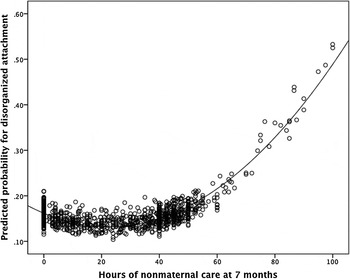
We next examined the possibility that there is essentially no relation between nonmaternal care and disorganized attachment until hours of nonmaternal care exceed a threshold of around 50–60 hr per week, after which the risk of disorganized attachment rises exponentially as hours of nonmaternal care increase. To test this possibility, we used a curvilinear polynomial logistic regression with a quadratic term to model the relation between hours of nonmaternal care and risk of disorganized attachment, in which the dependent variable was disorganized versus nondisorganized attachment classification and the independent variables were hours of nonmaternal care and their quadratic terms. To avoid a multicollinearlity problem, we centered hours of nonmaternal care by subtracting the mean hours from the observed hours of nonmaternal care. In addition, because quadratic terms could produce very large numbers, hours that an infant spent in nonmaternal care per week were divided by 5 days to get a smaller value of hours of nonmaternal care (e.g., 40 hr ÷ 5 days = 8 hr), and then their quadratic terms were calculated (e.g., 82 hr = 64 hr). First, we included hours of nonmaternal care to examine a linear association between hours of nonmaternal care and attachment disorganization (Step 1). Second, to examine a quadratic regression line, we added the squared term of hours of nonmaternal care to the regression model (Step 2). The same control variables were applied as in the linear regressions described above. Results of the polynomial regression supported our hypothesis, b = 0.008, SE = 0.004, OR = 1.008, Wald χ2 (1) = 5.43, p = .020 (see Figure 1). The increase of the chi-square from Step 1 to Step 2 was significant, χ2 (1) = 5.18, p = .020, indicating the quadratic regression model (Step 2) fits significantly better than the linear regression model (Step 1). Thus, these data support our hypotheses that hours of nonmaternal care do not relate to disorganized attachment until they reach a threshold of 60 hr per week, and the risk of disorganized attachment increases exponentially after this threshold is exceeded.
Nonlinear relation between predicted probability for disorganized attachment and hours of nonmaternal care (NICHD sample).

Relation of extensive nonmaternal care at 5, 6, and 7 months to disorganized attachment
To examine at what age infants' experiences in extensive hours of nonmaternal care begin to predict their disorganized attachment status, a series of logistic regression analyses were conducted (see Table 4). Separate regressions were conducted on the 5-month (Model 1), 6-month (Model 2), and 7-month (Model 3) data using the dichotomous variable of extensive nonmaternal care (defined as greater vs. less than 60 hr per week) as the independent variable and disorganized versus nondisorganized attachment classification as the dependent variable. In each regression, the same control variables as in the previous analyses were entered. As expected, infants who experienced over 60 hr per week of nonmaternal childcare at 6 months were more likely to be classified as disorganized, compared to those who spent fewer than 60 hr a week in nonmaternal care, Wald χ2 (1) = 4.75, p = .029. This effect was even stronger when infants were 7 months old, Wald χ2 (1) = 9.96, p = .002. However, the association between infants spending over 60 hr per week in nonmaternal care at 5 months and their later disorganized attachment was not significant, Wald χ2 (1) = 0.78, p = .377, ns. These data thus support Bowlby's hypothesis that infants form a preferential attachment around the age of 6 months.
Logistic regression analysis regressing infant–mother disorganized attachment status on whether infants experienced extensive nonmaternal care at 5, 6, and 7 months for the NICHD sample
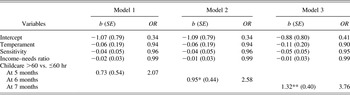
Note: N = 1122. OR, Odds ratio.
*p < .05. **p < .01.
General Discussion
These findings are the first to demonstrate that experiencing very extensive nonmaternal care when they are 6–8 months old predicts infant–mother attachment disorganization. Specifically, convergent results from two samples suggest that there may be a maximum threshold of nonmaternal care that, once exceeded, puts infants at increased risk for a disorganized mother–infant attachment. We found that in both samples, hours of nonmaternal care predicted attachment disorganization only after they exceeded 60 hr per week. In addition, in the much larger NICHD sample, we found a curvilinear relation between hours of nonmaternal care and the probability of disorganized mother–infant attachment, indicating that no relation between hours of nonmaternal care and attachment disorganization was found until hours of nonmaternal care exceeded 60 hr per week, after which the risk of disorganized attachment increased exponentially. These findings were significant even after controlling for other predictors of infant disorganization and extensive nonmaternal care, including mothers' unresolved trauma, FR maternal behavior, maternal insensitivity, quality of nonmaternal caregiving, infant temperament, and family income.
This research adds to a growing body of literature indicating that extensive nonmaternal care in infancy can be a risk factor for attachment development, at least under certain conditions. Although the NICHD study did not find that amount of nonmaternal care by itself predicted insecure attachment, nonmaternal care accompanied by low maternal sensitivity did predict insecurity, a phenomenon referred to as “dual risk” (NICHD Early Child Care Research Network, 1997). Similarly, in the present research, we found that hours of nonmaternal care did not predict disorganized attachment until they met the condition of being very extensive, passing a threshold of over 60 hr per week. It may be, however, that this threshold could be lower when combined with other risk factors, such as poverty, maternal depression, genetic vulnerability, or other adverse conditions.
Pathways to attachment disorganization
Research indicates that the most common pathway to attachment disorganization is through frightened, frightening, or dissociative maternal behavior (Lyons-Ruth & Jacobvitz, Reference Lyons-Ruth, Jacobvitz, Cassidy and Shaver1999; Main & Hesse, Reference Main, Hesse, Greenberg, Cicchetti and Cummings1990). Mothers' unresolved trauma, assessed by the AAI, has also been found to predict attachment disorganization, but its effects have been shown in previous studies to be mediated by maternal FR behavior (Jacobvitz et al., Reference Jacobvitz, Hazen, Zaccagnino, Messina, Beverung, Cicchetti and Roisman2011; Schuengel et al., Reference Schuengel, Bakermans-Kranenburg and van IJzendoorn1999). However, because we found that very extensive nonmaternal care predicted disorganized mother–infant attachment independently of maternal FR behavior, and we found no significant relation between very extensive hours of nonmaternal care and maternal FR behavior, our data indicate that very extensive nonmaternal care may be an alternate, albeit less common, pathway. Although nonmaternal care exceeding 60 hr per week is relatively uncommon (found in only 4% of the combined NICHD and Austin samples), it is nonetheless something that millions of infants will experience and thus is a phenomenon that merits further investigation.
It may be that when the infant is separated from the mother for almost all of his or her waking hours during the work week, the development of an organized attachment relationship is disrupted, even if the mother otherwise provides adequate care to the infant. In their study of the relation of infants' overnight visitation with the father to infant–mother attachment in divorced or separated couples, Solomon and George (Reference Solomon and George1999) similarly concluded that the elevated levels of disorganized infant–mother attachment they found in infants who participated in frequent overnight visitations with their fathers “may reflect the effects on infants of separation from primary caregivers under adverse conditions” (p. 24), rather than being the result of mothers' FR behavior due to unresolved trauma. They found that disorganized attachment was particularly likely to occur when conditions of the separation were more stressful. That is, among the infants who experienced frequent overnight visitations, those whose mothers actively tried to mitigate the infant's distress during overnight separations were less likely to be classified as disorganized, whereas those who failed to reassure infants at these critical times, or responded with impatience or frustration, were more likely to have infants classified as disorganized. Referring to the mothers of disorganized infants, Solomon and George (Reference Solomon and George1999) stated, “Although it is our impression that under other circumstances many of these mothers were able to maintain organized (‘good enough’) care, we speculate that the mother's failure to respond sensitively and/or her frightening behavior at these times of high arousal may be sufficient to disorganize the infant's attachment behavior during laboratory separations and reunions” (p. 25).
In the case of very extensive nonmaternal care, separations may frequently be tense and stressful. Mothers who are away from their infants for very long hours may be working two jobs, or they may have very demanding, high-powered careers. They may often be rushing to get to work and worrying about their jobs, so it may be particularly difficult for them to spend time reassuring their infants and helping them settle before the daily separations, even though they may provide sensitive caregiving under other circumstances. Thus, the present study provides some support for the idea that prolonged separations from the mother, particularly under stressful circumstances, may be an alternate pathway to disorganized mother–infant attachment.
However, it is also possible that the infant's fear of the caregiver is still the underlying mechanism explaining the relation between extensive nonmaternal care and disorganized attachment, even though we controlled for mothers' unresolved trauma, FR behavior, and sensitivity. If their infants are in nonmaternal care over 60 hr a week, these mothers may often return home from work late in the evening, extremely exhausted and stressed but wanting to spend time with their babies. This is likely to be true even when the father is available and happy to pitch in, because research indicates that employed mothers of infants face significant social pressures to be actively involved in infant care and to retain their role as primary caregiver (Sasaki, Hazen, & Swann, Reference Sasaki, Hazen and Swann2010; Townsend, Reference Townsend2002). The minimal interaction time mothers have with their infants during workdays may often be negative or emotionally distant, perhaps even frightening, if they are very stressed and sleep deprived. Nonetheless, these mothers may have displayed sensitive behavior when observed by the researchers, presumably during their days off when they were more rested and relaxed. If the mother is mostly absent during weekdays, stressed and tired at night, but present and sensitive on weekends, it is not surprising that the infant may feel confused and wary about approaching her when he or she is distressed in the SSP. Further research is needed to clarify the nature and quality of the caregiving and mother–infant interaction patterns characteristic of mothers who utilize very extensive nonmaternal care.
It could also be argued that infants in such extensive nonmaternal care do not perceive their mother as a primary caregiver and may not have even have spent sufficient time with her to develop expectations about whether or not she will provide comfort in times of distress, which could mean the baby does not even have an attachment relationship with the caregiver. We believe this is unlikely. By definition, the infant would not find lengthy separations from the mother to be frightening, leading to disorganized behavior, if she were not an attachment figure. In addition, the mothers in the Austin sample who used over 60 hr per week of nonmaternal care still spent an average of 44.8 hr per week with the infant (compared to 47.1 hr spent by the infants' main alternative caregiver).Footnote 1 Thus, despite their mothers' absences during workdays, these infants still spent almost as much time with their mothers as with an alternate caregiver, and hence it is likely they have developed expectations about her by the time they are assessed in the SSP. Therefore, higher rates of disorganized attachment are probably not due to unfamiliarity with their mother nor to invalidity of the SSP, but rather to a breakdown of their organized strategy for getting comfort due their mother's lengthy daytime absences and/or inconsistencies in her ability to provide consistent care.
Research on father–infant attachment suggests that extensive separations by themselves (i.e., when caregiving is adequate and other risk factors are not present) leads to disorganized attachment only if the infant perceives the attachment figure to be a primary caregiver. Specifically, meta-analyses indicate that frequencies of father–infant disorganization are comparable to those of mother–infant disorganization (van IJzendoorn et al., Reference van IJzendoorn, Schuengel and Bakermans-Kranenburg1999), even though extensive nonpaternal care is normative (Kotila et al., Reference Kotila, Schoppe-Sullivan and Kamp Dush2013; Townsend, Reference Townsend2002). For example, in the Austin sample, 96.5% of the infants experienced over 40 hr per week of nonpaternal care (compared to 47.4% for nonmaternal care), and 53% experienced over 60 hr per week of nonpaternal care (compared to 12.5% for nonmaternal care). Furthermore, in this sample, father–infant attachment disorganization was not related either to continuous hours of nonpaternal care or to over 60 hr per week of nonpaternal care but, rather, was predicted by an interaction of insensitivity and FR behavior (Hazen, McFarland, Jacobvitz, & Boyd-Soisson, Reference Hazen, McFarland, Jacobvitz and Boyd-Soisson2010).Footnote 2
Even if some of the infants experiencing extensive nonmaternal care view their mothers as secondary rather than primary caregivers, disorganized mother–infant attachment could be a risk factor for the infants' later development. Father–infant attachment research indicates that disorganized or insecure attachment with secondary caregivers has important consequences for children's later adjustment. For example, recent research indicates that father–child attachment predicts children's externalizing (Kochanska & Kim, Reference Kochanska and Kim2014) and internalizing (Brumariu & Kerns, Reference Brumariu and Kerns2010) symptoms as strongly as does mother–child attachment.
The importance of timing
This study is one of only a few that provides empirical evidence for Bowlby's (1969/Reference Bowlby1982) hypothesis that infants form a preferential attachment at around 6 months of age. Specifically, we found that extensive hours of nonmaternal care (i.e., over 60 hr per week) predicted later attachment disorganization beginning when infants were 6 months old and became an even stronger predictor at 7 months. However, extensive hours of nonmaternal care did not predict later attachment disorganization in 5-month-old infants, who have not yet formed a preferential attachment. This does not imply, of course, that infant caregiving prior to 6 months is unimportant. Even if early infant caregiving experiences are unrelated to infants' later attachment, they likely set the stage for infant–caregiver interaction patterns that will be more firmly established in later months. In addition, it is possible that very extensive nonmaternal care may cause undue stress to very young infants, which can have adverse effects on neurobehavioral development and, in particular, on the development of stress reactivity (Gunnar, Reference Gunnar and Nelson2000).
Future directions and implications
Fortunately, very few infants experience nonmaternal care that exceeds 60 hr per week. Although this makes it particularly difficult to study the consequences of extensive nonmaternal care, it is critical to better understand how it relates to disorganized attachment, and to examine the development of children experiencing extensive nonmaternal care over time. This is particularly important given that, in times of economic downturn, both mothers and fathers often need to increase their hours of employment to make ends meet. Larger groups of infants who experience extensive hours of nonmaternal care could be studied selectively with the goal of analyzing how much time these infants actually spend with their mothers, and what they do during these times, as well as their future developmental course. In particular, researchers should examine the quality of infant–mother separations during daily life and the extent to which the mother tries to reassure the infant at these times. Are mothers who utilize extensive nonmaternal care likely to be less emotionally attuned to their infants because they are tired and stressed during the time they have available? Is disorganization in these infants more likely to be primarily a consequence of stressful, aversive separation experiences?
Clearly, further studies are needed to examine the long-term effects of very extensive hours of nonmaternal care on children, parents, and family relationships. Perhaps over time, infants who experienced very extensive nonmaternal care may be more likely to develop organized relationships with their mothers, compared to infants who are disorganized due primarily to a frightening caregiver. Positive change in attachment quality and child outcomes may be particularly likely for infants whose mothers are able to later reduce their work hours enough to spend some quality time with the infant each day, or who are able to better protect and reassure their infants during separations. In addition, infants who had a secure relationship with a consistent substitute caregiver would be expected to have better long-term outcomes than infants with extensive nonmaternal care who had a disorganized or insecure attachment relationship with the substitute caregiver, or who experienced constant changes in their caregiving arrangements.
It is also important to extend this research to nontraditional families, including fathers who are primary caregivers and gay and lesbian parents. Much more research is also needed to better determine “primary caregiver” status and to further examine how childcare arrangements and caregiving quality of primary and secondary caregivers affect children's attachment to their caregivers, as well as their long-term outcomes. Finally, it is critically important to extend this research to high-risk samples. One of the key criticisms of the NICHD SECCY study has been that although it is nationally representative for the most part, it did not include the poorest and most disadvantaged families (Aviezer & Sagi-Schwartz, Reference Aviezer and Sagi-Schwartz2008). Because hours of nonmaternal care have been found to interact with other risk factors (e.g., low maternal sensitivity; NICHD Early Child Care Research Network, 1997), it also seems very plausible that extensive hours of nonmaternal care might interact with other risk factors such as poor childcare quality or environmental stressors, or that a lower threshold of hours of nonmaternal care might be found when other risk factors are present.
This study has practical applications for parents, employers, parent educators, and therapists. Employers should be informed of how very extensive nonmaternal childcare during infancy can affect relationships between parents and their young children, and should be encouraged to offer more flexible schedules to both fathers and mothers of infants. Parent educators and family therapists can assist employed parents in identifying strategies to increase the time they can spend daily in relaxed, high-quality social interactions with their infant. They also can instruct parents on how to ease the stress of daily separations on themselves and their infants. Although there is much more we need to know about the effects of extensive nonmaternal care, results of this study suggest that there may be an upper limit to how much time a mother can be away from her infant if that infant is to form a healthy attachment with her.