INTRODUCTION
Pseudomonas aeruginosa is a common cause of nosocomial infections, and 30% to 50% of hospital-acquired infections by P. aeruginosa are associated with water in intensive care units.Reference Exner1, Reference Blanc, Nahimana, Petignat, Wenger, Bille and Francioli2 Electronically activated faucets (efaucets) have been increasingly installed to meet water conservation goals, with varying degrees of complexity in their architecture and numerous internal parts materials.Reference Moore and Walker3, Reference Walker, Jhutty and Parks4
A direct link between contamination of faucets and clinical cases has been established for electronicReference Walker, Jhutty and Parks4–Reference Yapicioglu, Gokmen and Yildizdas7 and manualReference Blanc, Nahimana, Petignat, Wenger, Bille and Francioli2 faucets. Eleven peer-reviewed studies report the impact of efaucets on the positivity and level of contamination by P. aeruginosa in waterReference Durojaiye, Carbarns, Murray and Majumdar5, Reference Yapicioglu, Gokmen and Yildizdas7–Reference Chaberny and Gastmeier14 and swab samples.Reference Walker, Jhutty and Parks4, Reference Ehrhardt, Terashita and English6 Certain types of efaucet are more prone to contamination and more resistant to decontamination, leaving their replacement by manual faucets as the only option to resolve contamination.Reference Durojaiye, Carbarns, Murray and Majumdar5, Reference Berthelot, Chord, Mallaval, Grattard, Brajon and Pozzetto9, Reference Leprat, Denizot, Bertr and Talon11, Reference Van der Mee-Marquet, Bloc, Briand, Besnier and Quentin13, Reference Chaberny and Gastmeier14 The greater susceptibility of efaucets to contamination has led to recommendations limiting their installation.15, 16
Comparative measurements of P. aeruginosa in faucets show that the type of aerator, the use of flexible connectors, and the presence of a separate mixing valve favor the growth of opportunistic pathogens in biofilm.Reference Walker, Jhutty and Parks4, Reference Berthelot, Chord, Mallaval, Grattard, Brajon and Pozzetto9, Reference Halabi, Wiesholzer-Pittl, Schöberl and Mittermayer10 Other likely but not confirmed causes often cited include low flow rate, flow regime, stagnation volumes in the device, the type of material within the faucet, temperature of stagnation volume, configuration of upflow connecting pipes, and water usage pattern.Reference Halabi, Wiesholzer-Pittl, Schöberl and Mittermayer10, Reference Merrer, Girou and Ducellier12, Reference Sydnor, Bova, Gimburg, Cosgrove, Perl and Maragakis17 Only one study did not observe differences in contamination between efaucets and conventional faucets; the absence of difference was attributed to the short length of the connecting pipes (<25 cm).Reference Assadian, El‐Madani and Seper8
The last meters before the faucet are conducive to a significant increase of Pseudomonas spp. Reference Serrano-Suarez, Dellunde and Salvado18 and P. aeruginosa Reference Cristina, Spagnolo and Casini19–Reference Flemming and Bendinger21 detection. On the other hand, common environmental stressors present in water at the tap or within the distribution system, such as copper and chlorine, can influence the culturability of P. aeruginosa and induce a viable but nonculturable state.Reference Dwidjosiswojo, Richard, Moritz, Dopp, Flemming and Wingender22–Reference Xue, Hessler, Panmanee, Hassett and Seo24
The objectives of this study were to (1) determine whether efaucets are more likely to be contaminated by P. aeruginosa than manual faucets, (2) assess the influence of connecting water pipes and environmental stressors on faucet positivity, and (3) locate the pipe sections most susceptible to the proliferation of P. aeruginosa within the cold water system.
MATERIAL AND METHODS
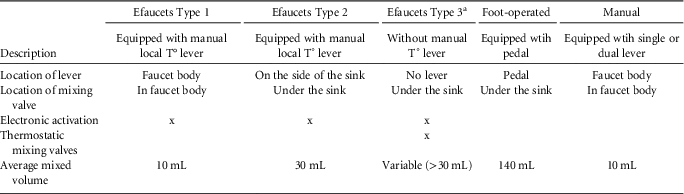
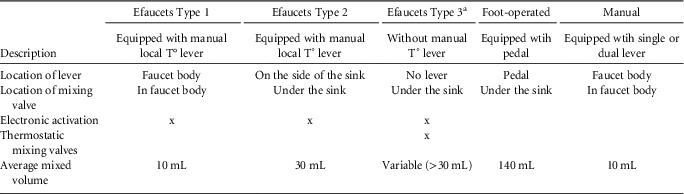
Samples were collected from 210 faucets and drains from April to August 2013 in 4 healthcare centers in the province of Quebec (Canada): 3 adult hospitals (405, 420, and 80 beds) and 1 pediatric hospital (450 beds). All hospitals were fed chlorinated surface water and no water quality events or outbreaks were reported during the study period. No onsite treatment was used in any of the hospitals. Most efaucets sampled were of simple architecture and equipped with a manual temperature control lever (no thermostatic mixing valves) (Table 1). For each faucet, environmental samples were collected: (1) a swab from the drain, (2) 1 L of first-flush cold water in sterile propylene bottle with 1% sodium thiosulfate, and (3) a swab of the aerator. Hot water temperature was measured after 1-minute flush, residual chlorine from the second liter, and water flow rate and copper ion concentration from first flush (50 mL) (resampled sites).
Description and Characteristics of Analyzed Faucets
a Not in this study.
P. aeruginosa in water was detected by standard culture method (ISO 16266:200625) and by enzyme detection (ED) using the Pseudalert kit (Idexx), an alternative detection method relying on cell multiplication and expressed as most probable number (MPN). For culture, 10 mL and 100 mL were filtered on 0.45-µm cellulose membrane in duplicate. Filters and environmental swab samples were placed on cetrimide agar with nalidixic acid (45.3 g/L Cetrimide Selective Agar [Remel], 10 mL/L glycerol [Fisher], 0.015 g/L nalidixic acid [Sigma-Aldrich]), incubated at 37.5°C for 48 h and counted after 24 h and 48 h. Residual chlorine concentrations were measured with a Pocket Colorimeter II (Hach). Total copper concentrations were measured by inductively coupled plasma mass spectrometry26 after acid digestion of 0.5% HNO3 for 24 h.
Laboratory-based studies were conducted on 2 brands of 12.5 mm–diameter certified (NSF61C) new braided flexible hoses and on 66 cm of new copper pipes. A length of 50.8 cm of Bélanger XCFC-420 PP (ELAST#1) and 76.2 cm of Uberhauss JLS38C12-030 (ELAST#2) were used. Preconditioned capped flexible (30 mL ELAST#1 and 45 mL ELAST#2) and copper pipes (100 mL) were then filled with sterile ultrapure phosphate-buffered water (pH=7.3) spiked with a suspension of P. aeruginosa strain PA14Reference Lee, Urbach and Wu27 to obtain 1×10⁵ cells/mL and maintained at temperatures of 20°C, 40°C, and 55°C for 24 h, 48 h, and 6 days.
Statistical analyses (χ2 test and multivariate adaptive regression [MARSpline]) were performed with Statistica, version10 (StatSoft). MARSpline regression is a nonparametric analysis in which continuous, categorical, and nominal variables can be added to the model and from which a better fit from a few or all variables is proposed.
RESULTS
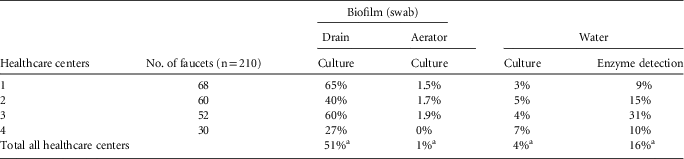
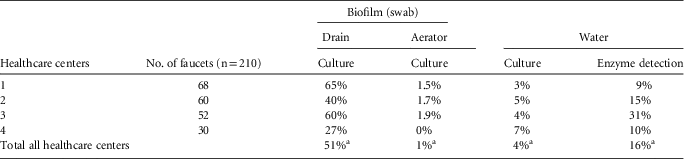
Table 2 shows the occurrence of P. aeruginosa in biofilm swab samples and water samples sorted by healthcare centers. In water, the occurrence of P. aeruginosa was also generally low but significantly higher with the ED method than the culture-based method.
Percentage of Positive Samples for Pseudomonas aeruginosa in Biofilm Swabs of Drains and Aerators by Culture and in 100 mL of Water Samples by Culture and Enzyme Detection
a P<.01.
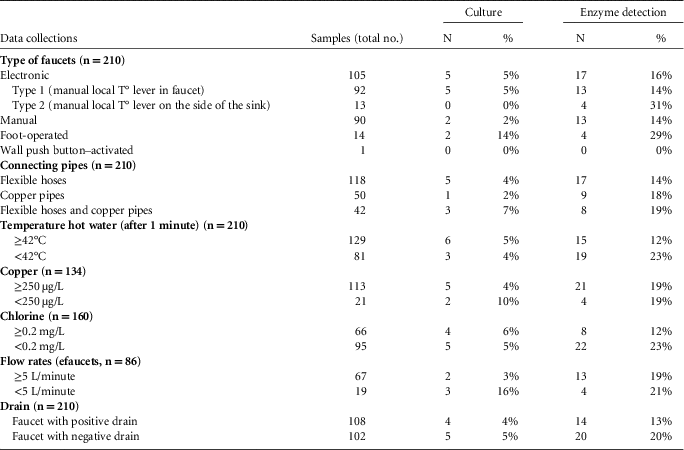
Specific positivity rates of water samples for each type of faucets, connecting water pipes, and physicochemical parameters are presented in Table 3. Prevalence in water samples was comparable between electronic and manual faucets while slightly higher for foot-operated faucets for both methods.
Summary Statistics per Types of Faucets, Connecting Water Pipes, and Physicochemical Parameters with Occurrence and Percentage Positive for Pseudomonas aeruginosa

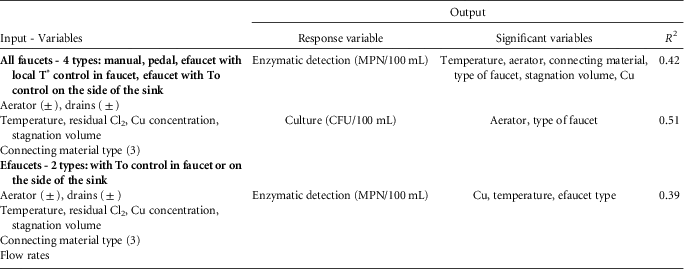
Because multiple factors can affect the response both by culture and by enzymatic detection, a regression (MARSpline) was conducted on all available variables for all faucets combined (4 types) and for efaucets (2 types). Significant variables contributing to model response are shown in Table 4.
Multivariate Adaptative Regression (MARSpline) Results Presenting Significant Variables for All Faucets (4 Types) and Specifically for Efaucets for Either Culture and/or Enzyme Detection as Response Variables
NOTE. CFU, colony-forming units; MPN, most probable number.
Results from the laboratory-based study on the impact of the connecting pipe’s material on the persistence of P. aeruginosa are presented in Figure 1a for water samples (MPN/mL) and Figure 1b for biofilm samples (expressed as level of abundance). Depending on the type of material, suspended densities decreased, remained stable, or increased at 40°C, while all materials but copper were colonized on swab samples.
Mean Pseudomonas aeruginosa (most probable number [MPN]/mL) by enzymatic detection in water (a) and by culture for swab samples (b), in flexible hoses (ELAST #1 and ELAST #2) and in copper pipe sections incubated at different temperatures for 24 h to 6 days. Initial inoculum value of approximately 1×10⁵ MPN/mL indicated by dotted line. Swab sample results are expressed as relative abundance (L0=0 colony-forming units [CFU]/swab, L1=1-10 CFU/swab; L2=10-100 CFU/swab, and L3=>100 CFU/swab). All values at 55°C were below detection level.
Figure 2 shows the mean copper and residual chlorine concentration for all sampling and for positive and negative samples for P. aeruginosa measured by culture and ED methods. Overall mean concentration of copper was 461 µg/L±212 µg/L (range, 17–1,081 µg/L).
Mean copper (n=160) and residual chlorine (n=134) concentration for all sampling and for negative or positive Pseudomonas aeruginosa samples with culture and enzymatic detection method.
Figure 3a shows concentration profiles of P. aeruginosa in volumes sampled sequentially in 3 faucets connected with flexible hoses. Mean concentrations in the first-flush sample of 25 mL were 204 colony-forming units (CFU)/100 mL compared with 0.4 CFU/100 mL in the distribution systems. Copper concentration profiles showed substantial variations whether considering concentrations at a faucet (77–463 μg/L) or peak concentrations from first and second flush, with varying chlorine concentrations (Figure 3b).
(a) Presence of Pseudomonas aeruginosa in water volumes taken in sequence (at 3 faucets) analyzed by culture (n=2) and by enzymatic detection (n=4); (b) copper (µg Cu/L) in water samples from sequential volumes and free chlorine concentrations (mg Cl2/L) measured for each sampling event.
DISCUSSION
Reported prevalence for P. aeruginosa in manual and electronic faucets varies widely with positivity rates ranging from 0 to 100%.Reference Walker, Jhutty and Parks4–Reference Chaberny and Gastmeier14, Reference Cristina, Spagnolo and Casini19, Reference Ferroni, Nguyen, Pron, Quesne, Brusset and Berche28–Reference Cholley, Thouverez, Floret, Bertrand and Talon30 These wide differences reflect the complexity and lack of consistency in the monitoring approaches, including sample type, sampling protocol, number of sampling sites, frequency, system configuration and characteristics, and sampling context. The present study investigated the following factors: mixed stagnant water volume, flow rate, aerator positivity, connecting pipe material, physicochemical parameters (Cl2, Cu, temperature), and distal versus systemic contamination.
In this study, 2 types of efaucets were compared with manual and foot-operated faucets. Manual faucet positivity results obtained were within the range reported by previous large studies (>25 faucets) for water (1%–18%)Reference Merrer, Girou and Ducellier12, Reference Ferroni, Nguyen, Pron, Quesne, Brusset and Berche28–Reference Cholley, Thouverez, Floret, Bertrand and Talon30 and swab (4%–48%)Reference Blanc, Nahimana, Petignat, Wenger, Bille and Francioli2, Reference Walker, Jhutty and Parks4, Reference Hota, Hirji and Stockton31, Reference Vianelli, Giannini and Quarti32 samples. Water from all types of efaucets combined (Table 1) was not more frequently positive for P. aeruginosa than water from manual faucets (16% vs 14%). Interestingly, for positive water samples, maximum concentrations were higher in manual faucets (>300 CFU/100 mL by culture; 2,419 MPN/100 mL by ED) compared with efaucets (97.5 CFU/100 mL by culture; 308 MPN/100 mL by ED). Both types of efaucets studied were equipped with manual local temperature control levers, but the mixing valve was located either in the faucet body (type 1) or at a distance under the sink (type 2). The percentage of positive taps was higher (31%) in type 2 faucets with a larger volume of stagnant water (30 mL vs 10 mL) than in type 1 faucets (14%). Foot-operated faucets with a mixed volume of 140 mL were also more frequently positive (29%). The mixed volume was a significant contributor to contamination of water (R 2 =0.42 for culture, R 2=0.51 for ED). These findings agree with prior reports of lower bacterial loads in water for efaucets with small mixed volume with local temperature control (7%) compared with type 3 faucets with larger mixed volume (74 %).Reference Halabi, Wiesholzer-Pittl, Schöberl and Mittermayer10
Flow rates in efaucets can be as low as 2 L/min for water conservation goals. The lower flow rates can result in less efficient flushing and were suggested as a cause of higher contamination of efaucets compared with manual faucets with higher flow rates.Reference Halabi, Wiesholzer-Pittl, Schöberl and Mittermayer10 In this study, the mean flow rate for efaucets was 5.8±1.7 L/min, comparable with manual faucet flow rates. This factor may explain in part the lower prevalence observed compared with other studies.
Despite its low positivity, the contamination of the aerator was a statistically significant variable predicting the concentration of P. aeruginosa in water by both methods (Table 4). The low level of colonization observed for aerator external swab samples was attributed to the simple structure of the aerators. Walker et alReference Walker, Jhutty and Parks4 observed 51% contamination of complex aerators whereas simple plastic and metal aerators were not contaminated.
Connecting pipe material was a significant contributor to the positivity and concentration of P. aeruginosa in water. Within positive samples, the percentage of faucets connected with flexible hoses was 1.9 times (ED) to 5.1 times (culture) higher than those connected with copper only (Table 3). This is in agreement with findings by Walker et alReference Walker, Jhutty and Parks4 showing that flexible hoses were more frequently contaminated than copper pipes (29% vs 5%). Plastic and elastomeric materials can support and favor P. aeruginosa biofilm development compared with copper.Reference Bressler, Balzer, Dannehl, Flemming and Wingender33–Reference Rogers, Dowsett, Dennis, Lee and Keevil35
Mean hot water temperatures were significantly (P<.0001) higher in manual faucets (55.0°C±7.6°C) than in efaucets (45.3°C±11.0°C). The 10°C difference observed can be explained (1) by a permanent cold water flow through the mixing valve for efaucets or (2) by mixing of hot and cold water supplies owing to defective or obstructed backflow valves (commonly reported by operators). Measured temperatures exceeded the ideal P. aeruginosa growth temperature upper limit of 42°C but clearly fell short of effective thermal inactivation conditions.Reference Brown36 However, results from the laboratory-based study on connecting pipe materials show the importance of maintaining 55°C to control suspended and fixed P. aeruginosa. Thermal eradication of P. aeruginosa was reported as successful following flushing faucets at temperature of 70°C or higher for 30 minutes or longer.Reference Van der Mee-Marquet, Bloc, Briand, Besnier and Quentin13, Reference Spinks, Dunstan, Harrison, Coombes and Kuczera37
Copper was a significant contributor to concentrations detected by the ED method but not by culture (Table 4). It is noteworthy that significantly more positive water samples were detected with the ED method than by culture. The presence of elevated copper ion concentrations may affect the enzymatic response whereas it inhibits growth on culture media. The correlation between culture and ED results is altered in the presence of 63.5 to 250 µg of copper per liter.Reference Bédard, Charron, Lalancette, Déziel and Prévost23, Reference Moritz, Flemming and Wingender34
Temperature and copper concentrations in water were significant contributors to predict the positivity of P. aeruginosa by ED, especially when comparing type 1 and type 2 efaucets (Table 4). This highlights the importance of selecting efaucets that are designed to sustain high temperature flushing and that minimize the mixing chamber stagnant volume. However, higher hot-water-system temperature cannot ensure thermal inactivation conditions sufficient to control distal growth of P. aeruginosa if efaucets have important stagnant volumes in mixing chambers.Reference Petignat, Francioli and Nahimana38 The presence and significance of viable but nonculturable P. aeruginosa in premise plumbing induced by environmental stressors should be addressed in future research.
The absence of any significant impact of chlorine residual in cold water (0.23±0.27 mg/L) was not surprising considering the demonstrated survival of P. aeruginosa to 0.5 mg Cl2/L after 30 minutesReference Shrivastava, Upreti, Jain, Prasad, Seth and Chaturvedi39 and reported inefficiency of low-dosage chlorine disinfection.Reference Berthelot, Chord, Mallaval, Grattard, Brajon and Pozzetto9, Reference Van der Mee-Marquet, Bloc, Briand, Besnier and Quentin13, Reference Ferroni, Nguyen, Pron, Quesne, Brusset and Berche28
Proliferation of opportunistic pathogens can be systemic within a building’s water distribution system or localized at the point of use (distal). In the present study, P. aeruginosa contamination was more important at the faucet and in the connecting plumbing compared with water from the system. Similar results obtained in previous studies suggest the first liter as ideal to detect contamination,Reference Serrano-Suarez, Dellunde and Salvado18, Reference Cristina, Spagnolo and Casini19 with P. aeruginosa mean concentrations of 4.7 CFU/100 mL in the first liter reduced by 7-fold after flushing. In this study, the first 25 mL was more concentrated in P. aeruginosa (535 times by culture and 72 times by ED) compared with concentrations in flushed samples. The steep concentration gradient observed in Figure 3 reveals that level of contamination will vary depending on the volume sampled at a given faucet. Indeed, our weighted average concentrations in the first liters (11 CFU/100 mL and 51 MPN/100 mL) were comparable with concentrations reported by Cristina et al.Reference Cristina, Spagnolo and Casini19 However, a sample volume of 1 L can mask the higher contamination of the first flush volume (25 mL) by factors of 9 (culture) and 6 (ED). The lower concentrations observed in the third volume sampled could be attributed to copper pipes in which water stagnates between uses. Low nutrient, low oxygen, and higher copper concentrations in this section will not be as favorable to biofilm. Finally, a significant concentration of P. aeruginosa was detected by ED after flushing, suggesting lower but sustained systemic contamination.
Retro-contamination from the drain has been proposed as a vector of faucet contamination.Reference Hota, Hirji and Stockton31 In this study, the rate of contamination was significantly higher for drains (108/210) than for water (9/210) or aerators (3/210). This marked difference may be caused by suboptimal culture conditions to recover stressed environmental strains from water as opposed to drains.Reference Lalancette, Bédard, Laferrière, Déziel and Prévost40
Our study is subject to a number of limitations. First, stagnation prior to sampling was not controlled. Second, a limited number of pedal-activated faucets were available for sampling, resulting in a smaller number of samples for this faucet type. Third, only 1 type of water quality was tested. Fourth, concentrations in drain biofilm are greater than in water, limiting result comparison.
Despite these limitations, results from this study reveal that simple-design efaucets with a smaller mixing chamber were not more susceptible to P. aeruginosa contamination than manual faucets. Multivariate regression models showed that aerator positivity, hot water temperature, copper concentrations, mixed stagnation volume, and type of faucets and connecting material are significant contributors to the prediction of P. aeruginosa in water, highlighting the importance of documenting all parameters. Furthermore, the demonstration of a higher contamination in the first water volume raises an issue inherent to efaucets design. Healthcare workers will systematically expose their hands to the first 25 to 50 mL when activating an efaucet, whereas the same volume will have been flushed while the workers are turning the knobs of a manual faucet. This raises the importance of evaluating the impact of water-saving measures on the water quality and bacterial exposure for vulnerable patients.
Acknowledgments
We acknowledge the contribution of the staff of the Natural Sciences and Engineering Research Council of Canada Chair.
Financial support. Natural Sciences and Engineering Research Council of Canada Industrial Chair on Drinking Water and its partners.
Potential conflicts of interest. All authors report no conflicts of interest relevant to this article.