Introduction
Globalized maritime trade has facilitated the transport of numerous species through fouling on ship hulls or floating platforms (Frey et al., Reference Frey, Simard, Robichaud, Martin and Therriault2014), enabling the establishment of non-native species outside their natural distribution range (Lambert, Reference Lambert, Sawada, Yokosawa and Lambert2001; Marins et al., Reference Marins, Novaes, Rocha and Junqueira2010). On such vectors, sessile benthic species gain an opportunity to disperse over long distances and different marine environments as adults (Dias et al., Reference Dias, Rocha, Godwin, Tovar Hernández, Delahoz, Mckirdy and Snow2016), which generates significant environmental and economic implications (Lins and Rocha, Reference Lins and Rocha2020; Pires-Teixeira et al., Reference Pires-Teixeira, Neres-Lima and Creed2021). Ascidians can demonstrate a remarkable capacity for tolerance to wide variations in temperature, salinity, and high levels of pollution (Rocha et al., Reference Rocha, Castellano and Freire2017). This highlights the susceptibility of regions located in areas of intense maritime activity to the introduction of non-native species (Lins et al., Reference Lins, Marco, Andrade and Rocha2018). Ascidians have gained increasing recognition as prominent invaders in marine ecosystems, being able to compete effectively with other sessile organisms and potentially disrupting ecosystem functioning in various ways (Zhan et al., Reference Zhan, Briski, Bock, Ghabooli and MacIsaac2015).
Microcosumus squamiger Michaelsen 1927 was described from Australia and recent genetic studies considered it a native species of this region, where populations have the greatest local genetic variability and a significantly higher number of unique haplotypes (Rius et al., Reference Rius, Pascual and Turon2008). Its occurrence is associated with calm and shallow habitats close to the coast. In the last 20 years, this species has been identified in several parts of the world, including the Pacific coast of North America (Lambert and Lambert, Reference Lambert and Lambert2003), South Africa (Monniot et al., Reference Monniot, Monniot, Griffiths and Schleyer2001; Holman et al., Reference Holman, Parker-Nance, Bruyn, Creer, Carvalho and Rius2022), the Iberian Peninsula and the Mediterranean Sea (Turon et al., Reference Turon, Nishikawa and Rius2007), the Tyrrhenian Sea (Mastrototaro and Dappiano, Reference Mastrototaro and Dappiano2008), the Eastern Aegean Sea (Önen, Reference Önen2021), and South Korea (Bae et al., Reference Bae, Lee, Kim and Yi2022) indicating the notable dispersal capability of this species. Due to this dispersal capability and its ability to colonize both natural and artificial substrates, M. squamiger has been identified as an exceptional model for studies on the dispersal and establishment of invasive species (Rius et al., Reference Rius, Pineda and Turon2009; Ordóñez et al., Reference Ordóñez, Pascual, Rius and Turon2013).
Lins et al. (Reference Lins, Marco, Andrade and Rocha2018) predicted the arrival of M. squamiger to the South West Atlantic coast of the Americas and this study reports the first record of many individuals in a large stretch of the Brazilian coast. We present a morphological description of those individuals and discuss their spatial distribution and the environmental risk associated with their presence.
Methodology
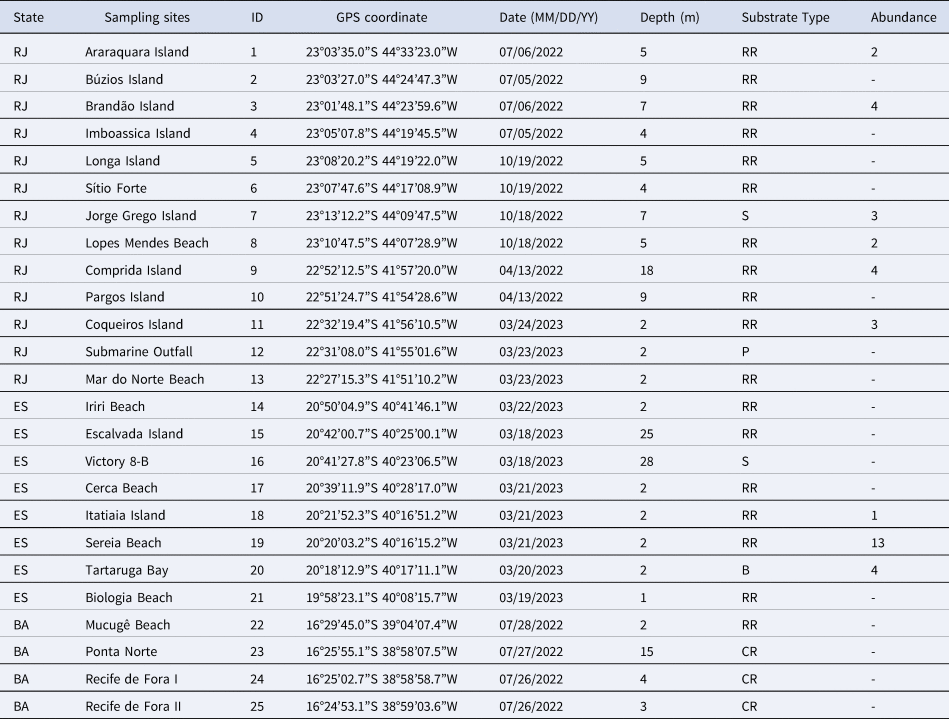
The research was carried out from the southern coast of Bahia (SBA) – 16°24'S, down to the centre-west of the State of Rio de Janeiro (RJ) – 23°03'S (Figure 1). The region is characterized by the presence of coral reefs in the SBA, and the abundance of rocky substrates in Espírito Santo and Rio de Janeiro. There is a marked change in the direction of the coast in Cabo Frio, RJ, which favours a seasonal upwelling of the South Atlantic Central Water (SACW) during the austral summer (Andrade and Dominguez, Reference Andrade and Dominguez2002; Coe and Carvalho, Reference Coe and Carvalho2013). Furthermore, these regions experience intense maritime traffic, especially within Ilha Grande Bay, RJ, and Tartaruga Bay, ES (ANTAQ, 2023; MARINETRAFFIC, 2023). During 2022 and 2023, collections were carried out at 25 locations (Table 1), both by free diving in places with depths less than 3 m and by SCUBA diving in places with depths greater than 3 m. Most collections took place on natural substrates, to inventory native species or those well adapted to local conditions.
Sampling locations of Microcosmus squamiger and Microcosmus exasperatus in the studied section of the Brazilian coast. (A and B) Rio de Janeiro, (C) Espírito Santo and (D) South Bahia. Check Table 1 for more information on locations.

Information about the 25 locations investigated in Rio de Janeiro (RJ), Espírito Santo (ES), and Bahia (BA)

The numbers present in (ID) correspond to the localities in Figure 1. Substrate type refers to natural substrates (rocky reef (RR) and coral reef (CR)), and artificial ones (piers (P), shipwrecks (S), and breakwaters (B)). The abundance corresponds to the number of Microcosmus squamiger individuals collected at each location, and (-) indicates the absence of the species at the location
Microcosmus specimens were collected from substrates that included rocks, corals, and artificial structures such as shipwrecks and breakwaters. To ensure preservation and adequate analysis, the specimens were anaesthetized with menthol diluted in seawater at the time of collection and were subsequently transported to the laboratory, where they were fixed in 96% ethanol. The specimens were dissected and described using routine methods which also included mounting slides of the spinules present in the syphons for observation under an optical microscope (Zeiss Stemi 305), equipped with a digital camera (Zeiss Axiocam ERc 5s), and under scanning electron microscopy (JEOL-JSM-6390-LV) after the samples underwent dehydration in an alcohol concentration gradient (70%, 80%, 90% and 100%). Voucher specimens were deposited in the Zoology Collection of the Faculdade de Formação de Professores (CZFFP), part of the Universidade do Estado do Rio de Janeiro (UERJ).
Results
A total of 36 M. squamiger individuals were collected, 18 in Rio de Janeiro (11 in Ilha Grande Bay and 7 between Cabo Frio and Rio das Ostras) and 18 in Espírito Santo, near Vitória/Vila Velha (Table 1). The specimens were collected from natural and artificial substrates.
Microcosmus squamiger Michaelsen, 1927
Material examined: CZFFP-607: 2 individuals, Araraquara Island, RJ, 06 July 2022; CZFFP-608: 4 individuals, Brandão Island, RJ, 06 July 2022; CZFFP-610: 3 individuals, Jorge Grego Island, RJ, 18 October 2022; CZFFP-609: 2 individuals, Lopes Mendes, RJ, 18 October 2022; CZFFP-612: 4 individuals, Comprida Island, RJ, 13 April 2022; CZFFP-611: 4 individuals, Coqueiros Island, RJ, 24 March 2023; CZFFP-613: 1 individual, Itatiaia Island, ES, 21 March 2023; CZFFP-615: 13 individuals, Sereia Beach, ES, 21 March 2023; CZFFP-614: 4 individuals, Tartaruga bay, ES, 20 March 2023.
Description: The animals were found in isolation or aggregations with encrusting algae and bryozoans growing on the tunic (Figure 2A). The animals range from 3 to 5 cm in diameter and are globular with a rigid and thick tunic. Externally, they are reddish brown while internally the tunic is purple. Some of this colour fades after preservation in ethanol. The body wall is beige, with well-separated apical syphons with similar diameters (Figure 2B, C). The syphons have small spinules (between 15–20 μm), shaped as ‘roof tiles’ or ‘fingernails’ with serrated edges (Figure 2G).
Microcosmus squamiger Michaelsen, 1927. (A) Three specimens in the natural environment forming clusters on Sereia beach (ES). (B) Dissected animal with oral tentacles and pharynx stained with methylene blue. (C) Animal removed from the tunic, making it possible to see the muscles. (D) Branched oral tentacle. (E) Dorsal tubercle with aperture in U with enrolled ends. (F) detail of the pharynx with stigmata and some parastigmatic vessels. (G) Syphon spinules of M. squamiger. (H) Syphon spinules of M. exasperatus, under a light microscope.

There are around 14–16 large branched oral tentacles and some smaller ones, all branched to the third order (Figure 2D). The dorsal tubercle is very prominent and large, with the opening forming two spiral loops in opposite directions, as described by Bae et al. (Reference Bae, Lee, Kim and Yi2022) (Figure 2E). The dorsal lamina is simple, with a smooth margin, and extends towards the oesophageal opening. The digestive tract is positioned on the left side, the stomach is covered by a brown digestive gland. The intestine is isodiametric and strongly adhered to the body wall, without endocarps, and the anus rim is smooth. Gonads are present on both sides, well adhered to the body wall, and divided into three lobes each, with short gonoducts. On the right side, the gonads are close to the endostyle. The pharynx has 8 to 10 folds on each side and 8 to 12 straight stigmata per mesh. Parastigmatic vessels are present (Figure 2B, F). The distribution of longitudinal vessels for a large individual is as follows: right side _ E 4 6 4 15 4 16 5 16 5 20 6 19 4 19 3 20 4 13 6 3 DL; left side _ DL 4 14 5 13 4 18 4 20 4 19 3 17 4 15 4 15 4 16 3 12 3 6 3 E.
The description of the specimens here is in agreement with the descriptions of Kott (Reference Kott1985) and Bae et al. (Reference Bae, Lee, Kim and Yi2022) and they were well differentiated from M. exasperatus that have larger, pointed syphon spinules (Figure 2H). The difference in these structures between both species is even more evident when viewed in scanning electron microscopy (Figure 3).
Images of the syphon spines of Microcosmus squamiger (A and C) and Microcosmus exasperatus (B and D) under scanning electron microscope.

Discussion
In this study, M. squamiger was recorded in approximately 46% of the locations investigated in the State of Rio de Janeiro. None of these locations were within or in direct proximity to ports or marinas. However, it is important to highlight that the areas chosen for investigation in Rio de Janeiro are strategically located on the route of intense international maritime and cabotage traffic, making them potential gateways for several exotic and invasive species (Castro et al., Reference Castro, Fileman and Hall-Spencer2017). In Espírito Santo (ES), specimens of M. squamiger were collected in locations adjacent to port and marina areas, which also increases the chance of finding exotic species (Clarke Murray et al., Reference Clarke Murray, Pakhomov and Therriault2011). In Southern Bahia (SBA), we did not find M. squamiger although Microcosmus exasperatus was recorded inhabiting the coral reefs (sites 23, 24, and 25 in Figure 1). In all locations where M. squamiger was documented, coexistence with M. exasperatus was observed. These two species share remarkable morphological similarities, with the main distinction being based on the shape and size of the spinules found in the syphons of both species (Mastrototaro and Dappiano, Reference Mastrototaro and Dappiano2008). While M. exasperatus exhibits larger spicules with a pointed shape, M. squamiger has smaller spicules, fewer in number, and with a conformation that resembles nails or shingles (Kott, Reference Kott1985). The subtlety of the morphological differences is the main reason these two species are confused with each other in different regions of the globe. It is important to highlight that the record of M. squamiger represents a recent and unprecedented introduction, not only in Brazilian waters but for the entire western Atlantic. This species had not been previously recorded by any of the research groups dedicated to Ascidiacea in Brazil, taking into account that research groups in Paraná and Rio de Janeiro have more than a decade of biological data in the region where this species was recently found. By 2010, surveys to the north (Rocha et al., Reference Rocha, Bonnet, Baptista and Beltramin2012) and neither to the south (Dias et al., Reference Dias, Rocha, Lotufo and Kremer2013) ever retrieved M. squamiger. On the other hand, M. exasperatus is considered a cryptogenic species in Brazil, with collection records dating back to more than half a century of presence on the Brazilian coast (Millar, Reference Millar1958). Two other species of Microcosmus have already been recorded for Brazil: M. helleri Herdman, 1881, which differs from M. squamiger mainly due to a lower number of pharyngeal folds (6 on each side) and the absence of spinules on the syphons, and M. anchylodeirus Traustedt, 1883, which differs in quantity, shape, and position of the gonads (Rocha et al., Reference Rocha, Bonnet, Baptista and Beltramin2012).
Detailed analyses of the life cycle of M. squamiger in the Mediterranean Sea indicate that this species is not particularly adapted to high water temperatures, with the optimum temperature for larvae varying between 20 and 25 °C, becoming unviable above 30 °C (Rius et al., Reference Rius, Pineda and Turon2009, Reference Rius, Clusella-Trullas, Mcquaid, Navarro, Griffiths, Matthee, Von Der Heyden and Turon2014). This might explain its absence in South Bahia, where the water temperature can exceed 27.5 °C in summer, reaching 31.4 °C in shallower reefs (PO.DAAC, 2023). We assume that the records of this species represent a recent introduction on the Brazilian coast, potentially facilitated by climatic events, such as the recent period of three consecutive years of La Niña (2020–23) (Fang et al., Reference Fang, Zheng, LI, Hu, Ren, Wu, Yuan, Fang, Cai and Zhu2023). This assumption is based on observations of expanded records of other ascidian species in the same region and during the same period, which might be influenced by a decrease in seawater temperature due to La Niña. For instance, the expanded occurrences of Rhodosoma turcicum (Savigny, 1816) and Cnemidocarpa irene (Hartmeyer, 1906), species originating or predominantly occurring in the Western Indo-Pacific Ocean (Nishikawa, Reference Nishikawa1992; Monniot and Monniot, Reference Monniot and Monniot1994) were observed (Barboza and Skinner, Reference Barboza and Skinner2021). Additionally, that study has also registered Ciona robusta Hoshino & Tokioka, 1967, which had not been found in the Ilha Grande Bay region since 2016 despite continuous monitoring. It is important to highlight that such climatic events, with global repercussions, have the potential to affect population dynamics and directly influence the distribution and survival capacity of benthic and pelagic species (Paes and Moraes, Reference Paes and Moraes2007; Wernberg et al., Reference Wernberg, Smale, Tuya, Thomsen, Langlois, Bettignies, Bennett and Rousseaux2012).
The presence of M. squamiger in many sites on natural substrates in a large stretch of coast suggests a fast spread of this species and raises concern about the potential impact of the population expansion of this invasive ascidian. Except for Sereia Beach, in Espírito Santo, local abundance now is low, probably as a result of the initial phase of establishment or non-ideal environment conditions, or both. Additionally, the presence of M. squamiger in the Baía da Ilha Grande (Figure 1A) raises concerns about population expansion because this region presents several areas designated for mariculture. M. squamiger has been reported in other locations as a potential competitor of bivalves, as well as colonizing aquaculture structures such as ropes and cages, thus increasing production costs due to maintenance (Rodriguez and Ibarra-Obando, Reference Rodriguez and Ibarra-Obando2008; Rius et al., Reference Rius, Pineda and Turon2009; Chebbi et al., Reference Chebbi, Mastrototaro and Missaoui2010; Ali et al., Reference Ali, Tamilselvi and Sivakumar2014). Its presence in mariculture facilities could allow its spread through secondary introductions outside the regions where the species was initially found, as observed for other species (Lins and Rocha, Reference Lins and Rocha2023). Lins et al. (Reference Lins, Marco, Andrade and Rocha2018) predicted the arrival of M. squamiger on the southwest coast of the Atlantic at latitudes higher than those studied here; thus, we anticipate observing a distribution expansion towards the south. Another outcome could be the disappearance of the species or its limitation to greater depths as a consequence of the predicted El Niño 2023–2024 (NOAA, 2023), because strong El Niños in the past have raised the sea surface temperature in the Ilha Grande Bay to 33 °C (Barboza and Skinner, Reference Barboza and Skinner2021). Therefore, we recommend that researchers and managers in the states south of Rio de Janeiro, as well as Uruguay and Argentina, remain vigilant regarding the arrival, expansion, and potential environmental impacts associated with the presence of this species in the natural environment.
Data
The data supporting the findings of this study are available upon request from the corresponding author.
Acknowledgements
Authors thanks to Coral Vivo network for field assistance and full access to its facilities, to Plataforma de Microscopia Eletrônica Rudolf Barth - Fiocruz, and to the anonymous reviewers for their valuable comments and suggestions.
Author contributions
PCAS: Conceptualization, Formal analysis, Data curation, Writing – original draft.
LFS: Formal analysis, Project administration, Resources, Writing – Review and editing.
RMR: Formal analysis, Writing – Review and editing.
Financial support
This study was financed in part by the Coordenação de Aperfeiçoamento de Pessoal de Nível Superior - Brasil (CAPES) - Finance Code 001; Grant CNPQ 306788/2022-5; by FAPERJ – Fundação Carlos Chagas Filho de Amparo à Pesquisa do Estado do Rio de Janeiro, Process SEI-260003/015490/2021 and E-26/210.444/2021); and by the National Council for Scientific and Technological Development – Brasil (CNPq, 306788/2022-5).
Competing interests
The authors declare that they have no known competing financial interests or personal relationships that could have appeared to influence the work reported in this paper.
Ethical standards
All samples were collected following Brazilian environmental laws and animal welfare guidelines for anaesthesia and sacrifice, adhering to best practices. This study was conducted under the ICMBio Licenses #36194-9 and #87660-1, and INEA License #016/2022.