


Introduction
Pregnancy is a crucial phase in a woman’s life, characterised by significant physiological changes that necessitate adequate nutritional intake to support foetal development and maintain maternal health.(Reference Adeoye1) Dietary practices during pregnancy are key for maternal and neonatal physical health, mental well-being, and foetal development.(Reference Olayemi, Williams and Adekugbe2) In developing countries, particularly in sub-Saharan Africa, poor maternal nutrition intake remains a significant public health challenge.(3,Reference Sosanya, Freeland-Graves and Gbemileke4) More specifically, malnutrition during pregnancy can result in low birth weight of the child, preterm birth, and other long-term developmental issues for the child.(Reference Omonkhua, Okonofua and Ntoimo5) These complications not only strain healthcare resources but also have long-term socio-economic consequences for new generations.(Reference Ojifinni and Ibisomi6)
Maternal dietary practices are shaped by a complex interplay of factors operating at multiple levels.(Reference Uzobo and Olaosebikan7) The ecological model provides a useful framework for understanding these influences by recognising that health behaviours are determined not only by individual-level factors but also by interpersonal, community, and broader institutional and policy factors.(Reference Sallis, Owen, Fisher, Glanz, Rimer and Viswanath45,Reference McLeroy, Bibeau, Steckler and Glanz46) Applying this perspective is particularly relevant in low- and middle-income settings, where cultural, social, and structural influences are deeply interconnected and collectively shape health behaviours.(Reference Sallis, Owen, Fisher, Glanz, Rimer and Viswanath45)
In Nigeria, maternal nutrition practices are shaped by socio-cultural, economic, healthcare, and household factors.(Reference Omonkhua, Okonofua and Ntoimo5,Reference Uzobo and Olaosebikan7) Poor dietary practices are often exacerbated by undesirable cultural beliefs and misconceptions about food during pregnancy, which are prevalent in many Nigerian communities.(Reference Olayemi, Williams and Adekugbe2) Addressing these challenges requires a comprehensive and collaborative strategy. A multi-stakeholder approach, involving healthcare professionals, policymakers, community leaders, and women leaders, is essential for creating effective interventions,(Reference Gresham, Bisquera and Byles8) thereby improving maternal and neonatal health outcomes.
Relevant stakeholders, such as healthcare workers, traditional birth attendants (TBAs), community leaders, women leaders, and policymakers, have diverse perspectives on what constitutes appropriate nutrition during pregnancy.(Reference Ojifinni and Ibisomi6) All stakeholder groups play a vital role in defining and influencing the dietary practices of pregnant women.(Reference Adinma, Umeononihu and Umeh9) For instance, primary healthcare health workers often serve as the first point of contact for pregnant women in many rural and semi-urban communities in Ibadan,(Reference Ojifinni10) while TBAs often provide direct counselling, health education, and nutritional guidance to pregnant women, addressing concerns about traditional food taboos or beliefs.(Reference Ekwochi, Osuorah and Ndu11) Women leaders and community leaders, representing the interests of women groups and community resident associations, on the other hand, influence dietary behaviours by advocating for improved maternal health practices and facilitating community-based interventions.(Reference Sacks, Morrow and Story12,Reference Anjorin13) Policymakers play a broader role by developing and implementing health policies, creating guidelines for maternal nutrition, and allocating resources to address nutrition-related challenges in maternal and neonatal health.(Reference Adeoye1,Reference Olayemi, Williams and Adekugbe2,Reference Adefolarin and Arulogun14)
Despite the central roles of these stakeholders, interventions often fail to adequately consider the perspectives of the entire spectrum of stakeholders influencing dietary choices.(Reference Omotayo15) This oversight can result in misaligned strategies that overlook critical socio-cultural and economic factors shaping dietary behaviours.(Reference Idris, Hamis and Bukhori16) For example, while health workers may promote dietary diversity, their efforts can be undermined by deeply rooted cultural norms or misinformation perpetuated by TBAs or community influencers.(Reference Olayemi, Williams and Adekugbe2,Reference Gresham, Bisquera and Byles8) Similarly, a lack of alignment between policy-level actions and community-level beliefs can undermine intervention efforts.(Reference Omonkhua, Okonofua and Ntoimo5) This makes it essential to examine not only the dietary habits of pregnant women but also the perceptions of relevant stakeholders on their dietary practices. Understanding the factors shaping dietary practices and stakeholders’ perspectives on them is critical for developing culturally appropriate and effective nutrition policies and interventions.(Reference Ojo, Adeyemi and Kayode17)
While numerous studies have explored maternal nutrition in Nigeria, there is limited research specifically addressing the perspectives of key stakeholders on dietary practices during pregnancy.(Reference Omonkhua, Okonofua and Ntoimo5,Reference Uzobo and Olaosebikan7) Therefore, the current study provides insight into the perspectives of diverse relevant stakeholders, on factors influencing the dietary behaviours of pregnant women in Ibadan, Nigeria, to generate actionable insights for both policy and practice. The research aims to address three main questions: What are stakeholders’ perceptions about the dietary practices of pregnant women in Ibadan? What are stakeholders’ perspectives about the factors related to the dietary practices of pregnant women in Ibadan? What are stakeholders’ ideas on possible solutions to the challenges faced by pregnant women in maintaining healthy dietary practices?
Methodology
Study design
The study was an exploratory qualitative research study conducted among relevant stakeholders directly involved with pregnant women in Nigeria. These stakeholders included frontline healthcare workers, policymakers, as well as informal stakeholders such as TBAs, community leaders, and women leaders. Stakeholders were selected based on their direct or indirect influence on or involvement in pregnant women’s dietary practices, including those involved in service delivery, policy formulation, and informal community-based maternal support systems. Data were collected from the participants using key informant interviews (KII) between March and May 2024. The study followed Standards for Reporting Qualitative Research.(Reference OBrien, Harris and Beckman18)
Study setting
The study was conducted in Ibadan, Oyo State, one of the 36 states in Nigeria, located in the southwestern region.(Reference Adeyi19) Ibadan is Nigeria’s largest city, with over 3 million inhabitants with diverse ethnic backgrounds, though predominantly Yoruba.(Reference Ajayi20,Reference Britannica21) Ibadan is divided administratively into eleven local government areas (LGAs). There are five (5) urban LGAs, which include Ibadan North, Ibadan North-East, Ibadan North-West, Ibadan South-East, and Ibadan South-West. Akinyele, Egbeda, Ido, Lagelu, Ona Ara, and Oluyole LGAs are often recognised as peri-urban LGAs. There are both formal and informal healthcare systems in Ibadan.(Reference Oluwatoye, Jabin and Tinuola22) The formal healthcare system covers both private and public health facilities, while the informal health sector includes faith-based maternity centres (Mission Homes), traditional maternity centres, TBAs, and other trado-medical centres.(Reference Oluwatoye, Jabin and Tinuola22) Food production and access in Ibadan reflect its urban and peri-urban composition, with food largely being sourced from surrounding rural areas and other food-producing states in the country and distributed through local markets and informal vendors. Access to food varies across communities, with differences in availability and affordability influenced by location and socio-economic conditions.(Reference Ilori, Christofides and Baldwin-Ragaven47)
Sample size and sampling methods
The study’s sample size was determined by data saturation, standard for qualitative research. Thematic saturation was assessed iteratively during data collection and preliminary analysis, whereby no new codes or conceptual insights emerged across successive interviews within and across stakeholder groups. A total of twelve KIIs were conducted, involving three groups of stakeholders to ensure comprehensive representation. Four KIIs were conducted, one for each group of stakeholders: frontline health workers, policymakers, and informal stakeholders. The KII participants were selected through purposive sampling, with participants being chosen based on their experience in working with pregnant women and their knowledge of related dietary practices for their respective workplaces. Efforts were made to enhance representativeness by selecting participants who held diverse but complementary roles in maternal health within the community. Where participants held overlapping roles across stakeholder categories, classification was based on their primary role according to job description and time allocation at the time of the study, to ensure consistency in reporting.
Data collection process
The proposed participants were verbally informed about the study by JF at their workplace, and a formal letter was later sent to those who were policymakers, as required by the Ministry of Health regulations. Interviews were scheduled and carried out face-to-face at a convenient and private location free from distraction, which was often the participants’ office or a meeting room at their workplace. Before the interviews, written informed consent was obtained. The interview was structured to last between 30 and 50 min. Each interview session was audio-recorded in addition to field notes that were taken. Two research assistants supported the data collection process by recording and taking observational notes during the sessions. Interviews were conducted in English and Yoruba, depending on participants’ preference.
Study instrument
The data collection instrument (KII guide) was developed following an extensive literature review.(Reference Esan, Maswime and Blaauw23–Reference Sotunsa, Vidonja-Uzelac and Fekete25) The instrument was used to probe stakeholders’ perception about the types of food pregnant women eat, their dietary practices, factors influencing these practices, challenges faced in maintaining a healthy diet during pregnancy, and the general support provided to pregnant women to overcome the challenges. The interview guide (see supplementary materials) for each stakeholder group (formal health workers and informal groups) was tailored to each category of participants. For instance, questions specific to health facilities were removed for the informal groups. The instrument included questions on common food choices, eating patterns, and food taboos, as well as challenges, supporting systems, and other perceived influencing factors of dietary practices of pregnant women. It also covered perceived differences in nutritional behaviour based on engagement with formal healthcare services. The instrument was pretested with a frontline healthcare worker (Community Health Officer) in Oyo West Local Government Area. The instrument was translated into Yoruba language (local language) and back-translated to English to establish the translation accuracy.
Data analysis
The data analysis process for this study involved several key stages: data transcription, data validation, coding, theme formation and review, and report writing.(Reference Braun and Clarke26) The recorded interviews were transcribed verbatim in English, ensuring that all responses were accurately captured. Interviews conducted in Yoruba were translated into English during transcription. To ensure accuracy, an independent bilingual translator back-translated the English transcripts into Yoruba, and any discrepancies between the original recordings and the back-translated versions were resolved through review and consensus to achieve conceptual equivalence. For coding, a hybrid approach combining both inductive and deductive methods was used.(Reference Fereday and Muir Cochrane27) Initially, a code guide was developed after a thorough review of the interview transcripts, which provided a framework for coding. This was further revised and grouped during the coding process. The hybrid coding method helped combine the strengths of both inductive and deductive coding approaches by using predetermined themes while remaining open to new ones arising from the data.(Reference Braun and Clarke26,Reference Fereday and Muir Cochrane27) The data were analysed using NVIVO version 12.
Following the coding, themes were generated and reviewed, with both consistent patterns and unique insights emerging from the data. Themes were generated from the research questions, the concepts in the KII guide, and sample quotes. The findings were synthesised into a narrative form, using direct verbatim quotes from the interviewees to illustrate key points and strengthen the narrative. This thematic approach ensured a clear and comprehensive summary of the research findings, capturing both converging and diverging viewpoints in a cohesive manner.(Reference Braun and Clarke26) The ecological model guided the analysis and interpretation of findings, enabling examination of maternal nutrition practices across individual, interpersonal, community, institutional, and policy levels. Data analysis and presentation were structured according to these levels to reflect the complexity of influences on dietary practices. To ensure reflexivity, the researchers remained aware of their roles in the research process, particularly during data collection and analysis.(Reference Berger48) Efforts were made to minimise potential bias through the use of a validated structured interview guide, consistent data collection procedures, and regular review of emerging codes and themes to ensure that findings were grounded in participants’ accounts.(Reference Braun and Clarke49)
Ethical consideration
Prior to data collection, ethical approval was obtained from the Oyo State Ethics Review Committee with the approval number AD/13/479/379. Written informed consent was obtained from the participants to ensure ethical compliance and respect for autonomy. Ethical considerations were guided by the principles of the Declaration of Helsinki.(Reference Association50) Participants were informed that participation was voluntary and that they would not suffer any consequences if they chose not to participate. Confidentiality of data, beneficence to participants, non-maleficence, and the right to withdraw from the study without loss of benefits were the ethical principles that guided the study.
Results
Socio-demographic characteristics of participants
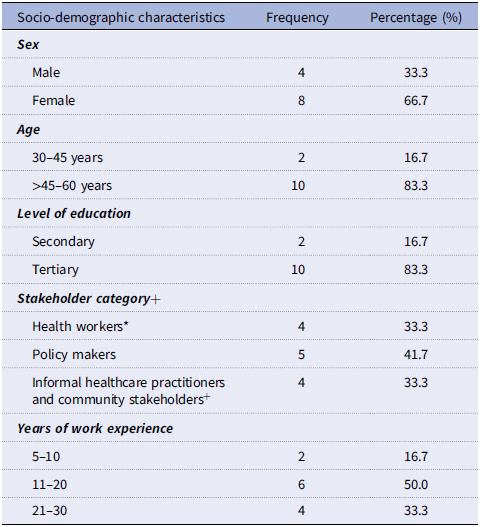
A total of twelve participants were involved in the KIIs, comprising a mix of stakeholder groups (health sector policymakers: four, frontline health workers: four, and informal and community stakeholders: four). The frontline health workers included a health extension worker, who provides essential health services and promotes public health at the community level, alongside a health educator, a nurse midwife, and a gynaecologist. Policymakers were represented by two officials from the State Primary Health Care Board and three key officials from the State Ministry of Health. The informal stakeholders comprised four participants: two TBAs, a community leader recognised for their influential role in mobilising and representing local residents, and a women’s leader who advocates for and represents women within their community. The majority (66.7%) of the participants were females, and their ages ranged between 33 and 56 years. The participants had varying levels of education, with the majority (83.3%) holding tertiary education qualifications. Years of work experience ranged from 7 to 34 years. Detailed socio-demographic information on participants is presented in Table 1.
Socio-demographic characteristics of participants (N = 12)

Table 1. Long description
Socio-demographic Characteristics (sex, age, level of education, stakeholder category, years of work experience) of Study Participants.
+ Traditional birth attendants, community leader, women leader.
* One of the respondents was a formal health worker and a woman leader.
Perceived dietary practices of pregnant women
Participants commonly revealed that pregnant women preferred eating familiar foods without incorporating much variety. Carbohydrates such as rice, pounded yam, amala (yam flour stodge), eba (cassava flour stodge), and pap (maize pudding) were reported as the most common foods consumed by pregnant women. Although protein- and nutrient-rich foods like vegetables, fish, and meat are recommended by health workers, they reported these were less common in most pregnant women’s diets. Concerns were also raised across stakeholder groups regarding the growing consumption of highly processed foods, sugary snacks, and carbonated drinks, often observed during antenatal care (ANC) visits.
Early stages of pregnancy were associated with nausea and food aversions, leading to inconsistent and minimal dietary intake. However, stakeholders reported that as the pregnancy progressed, many women experienced increased appetite and meal frequency, with some eating five to six times a day.
In this climate, … the most accessible food … usually are carbohydrates, …so some of them [pregnant women] – because they have appetite issues in early pregnancy – they take a lot of processed food and as well as carbonated drinks, and some of them – based on advice and counselling had proteinous diet – take fruit, vegetables and all that. But the staple food in this environment is the carbohydrates. – KII3, Male, Health Worker
Factors related to the dietary practices of pregnant young women
A variety of interconnected factors were perceived by the stakeholders to be related to the dietary practices of pregnant women. These were categorised into intrapersonal, interpersonal, community, and institutional/public policy factors as presented in Figure 1.
Factors related to the dietary practices of pregnant young women as identified by stakeholders. ANC, antenatal care.

Figure 1. Long description
Factors related to the dietary practices of pregnant young women as identified by stakeholders: Intra-personal factors, inter-personal factors, community factors and public policy.
Intrapersonal factors
Individual characteristics such as age, education, economic status, nutritional knowledge, personal experiences, emotions, cravings, and physiological responses were perceived as key determinants of the dietary practices of pregnant women. Most participants identified educational level and nutritional knowledge as key factors, explaining that women with higher levels of education were generally more likely to make informed dietary choices due to their understanding of pregnancy-related nutritional needs. Participants unanimously opined that lack of education can lead to poor dietary practices and ignorance about essential nutrients, even if financial resources are available.
We can’t rule out education! An educated woman knows what is good for her and her baby. – KII5, Male, Policymaker
Although many participants did not distinguish dietary practices by age, some opined that younger women, especially teenagers and those in their early twenties, particularly consume more carbohydrates and processed foods, due to higher metabolic needs and activity levels. Also, younger pregnant women (often primigravidae) were reported to be easily swayed by diverse dietary advice, even if inconsistent with the recommendations provided by trained health workers.
When you even look at the dietary pattern, even apart from being pregnant, their [younger women’s] dietary pattern is different from that of the adults. … they have high body metabolism … compared to the older ones. So, they need to take in more carbohydrates because they explore around or move around a lot, and most of them are involved in more activities than their adult counterparts. – KII6, Female, Policymaker
Physiological changes and emotional states during pregnancy were also perceived to influence dietary intake. The burden of cooking, combined with fatigue, and limited motivation were cited as barriers to healthy meal preparation by some of the participants. Cravings, food aversions, and sensory sensitivities were frequently mentioned as contributing to irregular or unbalanced diets. These cravings were noted to result in unusual or nutritionally unbalanced food combinations, with emotional and sensory stimuli such as smells and tastes strongly influencing food choices. Some women were also described as experiencing intense cravings for specific foods or combinations, often linked to hormonal changes or physiological needs. Convenience and accessibility of processed foods, coupled with work-related demands and personal habits, were further noted as factors promoting unhealthy eating practices.
I think most times, it [dietary practices] depends on how they [the pregnant women] feel. They will ask you at times, ‘I can smell something, who is cooking somewhere?’ – KII7, Male, Community Leader
The fact that the pregnancy actually affects their appetite is a big issue, most of them, because they are pregnant, they keep throwing up, many of them cannot eat what they cook. – KII3, Male, Health Worker
Interpersonal factors
A prominent issue identified by the majority of the stakeholders is the influence of husbands and family decisions on a woman’s diet, particularly in the location of study, where traditional gender roles influence decision-making. It was reported that the husband’s approval or disapproval was seen as decisive in whether a woman could seek the necessary information regarding nutrition or visit a health facility for guidance. According to the participants, women may have limited autonomy in selecting their food, reflecting broader gender power imbalances within the family.
In addition, the influence of family culture and peer advice was frequently mentioned, with participants pointing out that the broader family unit and close social networks played a role in shaping a pregnant woman’s food choices. Some pregnant women, despite intending to seek nutritional advice from health professionals, were swayed by friends or relatives who downplay the importance of certain foods during pregnancy. Social interactions within the community, including workplace or family environments, were also said to influence dietary decisions, as pregnant women may mirror the eating habits of those around them.
Family culture and peer group have been some major type of influence affecting the food choice of many pregnant women, the act of family emphasising the type of food to eat or the advice received from some of their friends influences their choice of food. – KII11, Male, Policymaker
Community factors
The participants highlighted various community factors that significantly shape dietary practices among pregnant women with specific reference to culture, religion, and economy. A few of the participants noted the influence of religion, observing that some women, including Christians and Muslims, sometimes prioritise prayer over seeking medical advice or following nutritional guidance during pregnancy. Participants stated that some religious beliefs also prohibit the consumption of certain foods irrespective of their nutritional content. Most of the participants believed that cultural norms further shape food choices. It was stated that women often traditionally prioritise heavy meals like ‘Amala’ or ‘Eba’ (local staple foods made from processed yam flour and cassava flour, respectively) over more nutritious options such as fruits. Participants emphasised that cultural influences were not limited to traditional food taboos and beliefs but also extend to modern social habits, including the preference for processed foods over more nutrient-dense options.
The main factor influencing their diets is social and cultural beliefs in our setting; the belief is that you have to take carbohydrates to make sure your stomach is full and to have enough strength, and you take less of proteinous food. For example, they prefer solid food like Amala, Iyan, eba [local staple foods made from processed yam flour, yam, cassava, and cassava flour] over any other high proteinous diet food and since it’s their socio-cultural belief that, especially in the afternoon they need to take swallow [solid food]. – KII2, Female, Health Worker
Most stakeholders further revealed that food taboos related dietary practices among pregnant women are slowly fading away due to increased awareness and education. Participants, however, noted that some cultural beliefs, such as avoiding snails and ‘okro’ (Abelmoschus esculentus) to prevent babies from salivating or experiencing other unfounded issues, are still being practiced by some pregnant women within the locality. They reported that the influence of elders, particularly grandmothers, who once strongly enforced these taboos, has waned as more families live independently. Nonetheless, participants opined that in some cases, the pressure from in-laws or adherence to cultural norms still leads some pregnant women to follow these outdated practices, despite their lack of scientific basis.
Food taboos are no longer an issue now compared to the past, where some women will say as a pregnant woman if you eat snail, your baby will be salivating, or you should not eat okro, …at least in this part of the country. I can’t say if it’s happening elsewhere, as for Oyo state, pregnant women are now knowledgeable. – KII6, Female, Policymaker
Poverty and low socio-economic status were consistently identified across stakeholder groups as major barriers to adequate dietary practices among pregnant women. Economic constraints limited the ability to purchase nutritious foods, even when such foods were available, and were particularly pronounced among women who depended on their spouses for financial support, thereby reducing their autonomy in food choices. Teenage pregnant women were reported to experience compounded financial vulnerability due to limited income opportunities and, in some cases, additional caregiving or reproductive responsibilities. Stakeholders further highlighted that wider macroeconomic conditions, including unemployment, inflation, and currency instability, intensified household food insecurity and restricted access to balanced diets. These economic realities also influenced healthcare delivery, as health workers reported adapting dietary recommendations to reflect what patients could realistically afford.
Poverty, now it is even getting worse because they [pregnant women] will tell you they can’t afford what you are telling them. For example, we do advise them if you can’t buy fish, there are other things you can buy which are high in protein, so we always encourage them to get good food which is affordable for them… Some pregnant women will be complaining they don’t have money to feed themselves, so how many of them [pregnant women] can we [health workers/policy makers] give our money to for feeding them? – KII10, Female, Policymaker
Our economy, … our low currency is causing a lot of problems, some [pregnant women] will come for the antenatal with an empty stomach, and when we ask them if they have eaten, they will reply say no they haven’t eaten, that when they get home, they will eat, that they don’t have money. – KII9, Female, Health Worker
Institutional and public policy
All participants reported a clear difference in dietary practices between pregnant women who attend formal ANC and those using informal services, with the former described as better informed and more economically secure. Health workers and policymakers highlighted the nutritional education, regular monitoring, and peer knowledge-sharing available in formal settings, while noting that women relying on TBAs or mission houses often missed this support, creating a nutritional knowledge gap that formal providers linked to poorer dietary intake. Conversely, the TBAs interviewed were of the opinion that they provide adequate dietary information and support, as they have also undergone training.
Definitely, there will be a kind of difference between them [pregnant women who attend ANC and those who do not] because those who attend public health facilities will have the opportunity to receive information from health care workers, because we build their capacity [with regard to nutritional knowledge]. And we [formal health care workers] do monitor them [health care workers] to ensure that they are passing the right message to mothers. But for the TBAs, we don’t monitor them because they are not recognised as skilled health workers. – KII8, Female, Policymaker
Some of the health workers and policymakers identified inadequate human and material resources necessary for implementing nutritional policies and supporting related interventions as an influencing factor. This influences the quality of nutritional education provided and practical food demonstrations.
At times, government policy… in terms of probably appointing the nutritional officers at the local government or in health facilities who will help these women to have informed nutritional or dietary choices. We have seen some states that don’t have nutrition focal persons [the person responsible for nutrition-related programs in the state], at their various facilities. – KII11, Male, Policymaker
Possible solutions to challenges faced by pregnant women in maintaining a healthy diet
Participants proposed several strategies to support pregnant women in overcoming challenges related to maintaining a healthy diet. They suggested that governmental efforts should focus on empowering low-income women through financial support and business development, enabling them to have better access to nutritious food. They also recommended that women should engage in small-scale income-generating activities, such as gardening or petty trading, to reduce financial dependence and improve food security. Gender equity and female empowerment were highlighted as essential factors in enabling women to make healthier dietary choices.
If the government can help pregnant women, especially those with low income, they can strengthen their businesses so that they can be empowered financially. – KII12, Female, TBA
Additionally, support systems, including spousal and community assistance, were deemed crucial. The recruitment of more human resources, especially nutrition officers, was highlighted to reduce the health workers’ burden and improve the effectiveness of their tasks. Participants suggested enhancing nutritional education through various channels, such as social and behavioural communication, community role models, and involvement of traditional and religious leaders. Media and NGOs were also identified as key players in disseminating nutritional information and providing practical support, such as food demonstrations and supplies. Overall, a multifaceted approach involving education, financial empowerment, community support, and practical assistance is seen as vital for improving dietary practices among pregnant women.
Discussion
By foregrounding the perspectives of diverse stakeholders, this study provides a multi-level understanding of pregnant women’s dietary practices that extends beyond individual-level explanations commonly reported in maternal nutrition research.(Reference Adeoye and Okekunle34) Rather than treating dietary behaviour as a matter of personal choice alone, the findings reveal how intrapersonal preferences intersect with household authority, community norms, economic structures, and institutional capacity to produce the observed patterns of intake. The study reveals a consistent pattern of dietary practices among pregnant women, with an over-reliance on energy-dense, carbohydrate-rich foods and low intake of protein, fruits, and vegetables, reflecting findings from earlier studies in Nigeria and similar contexts.(Reference Ezeama, Okunna and Ezeama28,29) The findings further underscore the complex interplay of individual, family, community, cultural, and institutional factors that shape the dietary practices of pregnant young women, in accordance with the ecological model.(Reference Sallis, Owen, Fisher, Glanz, Rimer and Viswanath45) This reflects the multi-level influences on poor nutritional status among women of reproductive age, as highlighted in previous reports.(Reference Fereday and Muir Cochrane27,Reference Ezeama, Okunna and Ezeama28)
At the intrapersonal level, dietary practices were characterised by limited dietary diversity, including low consumption of protein-rich foods, fruits, and vegetables. The study’s findings align with other studies in southwestern Nigeria,(Reference Anyasor and Olowu30,Reference Olatona, Olowu and Goodman31) where carbohydrates, including staple foods like rice, yam, and cassava flour products, dominate the diets of pregnant women. Olatona et al.(Reference Olatona, Olowu and Goodman31) found that only 16.7% of pregnant women in their study in Lagos State consume the recommended five servings of fruits and vegetables daily, whereas nearly half (45.4%) consume rice daily. Similar trends have been reported in Ogun State among pregnant women.(Reference Anyasor and Olowu30) This shows the need for improved nutritional interventions.(Reference Anyasor and Olowu30) The limited consumption of protein-rich foods, fruits, and vegetables indicates the challenge of achieving dietary diversity among pregnant women, which is critical for maternal nutrition and fetal development.(Reference Adinma, Umeononihu and Umeh9,Reference Lindsay, Gibney and McAuliffe32)
At the interpersonal level, the perceived influence of spouses and in-laws noted in this study is in line with observations from other African settings, where family roles strongly dictate women’s health behaviours, with the husband as the most influential figure.(Reference Akinyemi, Erinfolami and Adebayo39,Reference Udenigwe, Okonofua and Ntoimo40) These household dynamics can affect food choices and access, reinforcing or constraining recommended dietary practices. Efforts to mitigate negative influences from family members should include family-centred nutritional education and advocacy for women’s autonomy in decision-making, with an emphasis on involving the spouses, in-laws, and other key family actors in nutritional interventions.(Reference Idris, Hamis and Bukhori16) Incorporating community health workers and timely, targeted counselling could further enhance the effectiveness of these strategies by addressing the needs of both the pregnant woman and her family.(Reference Sacks, Morrow and Story12)
Additionally, the increasing consumption of processed and sugary foods noted by stakeholders echoes global trends in dietary transition, as highlighted by Popkin et al.(Reference Popkin, Corvalan and Grummer-Strawn33) Some studies conducted in southwest Nigeria have also reported these trends at the community level, with up to 75% of pregnant women consuming sugar-sweetened beverages at least once a week.(Reference Adeoye1,Reference Adeoye and Okekunle34) These trends may exacerbate maternal health risks, including gestational diabetes and pre-eclampsia.(Reference Adeoye1,Reference Schoenaker, Soedamah-Muthu and Mishra35) Differences in dietary habits between younger and older pregnant women were also noted in this study, with younger women reportedly consuming more processed foods. This finding aligns with research documenting shifts in dietary preferences among younger Nigerian women, who increasingly opt for convenience foods.(Reference Petrikova, Bhattacharjee and Fraser36) These evolving dietary patterns highlight the need for age-specific nutritional interventions, which may include personalised meal planning based on trimester-specific nutritional needs, community-based nutrition counselling sessions to address common dietary gaps, and supplementation programmes (e.g. iron and folic acid) targeted at younger (less than 25 years) or high-risk pregnant women.(Reference Nahrisah, Somrongthong and Viriyautsahakul37,Reference Skolmowska, Głąbska and Kołota38)
At the institutional level, economic constraints, particularly food affordability and inflation, were also reported as key barriers to optimal maternal nutrition. These findings are consistent with studies linking household poverty and financial vulnerability to poor maternal diets.(Reference Omotayo15,Reference Onyeneho, IAronu and Chukwu41) Household wealth and community-level poverty were reported to be associated with food insecurity, which, in turn, influenced the dietary practices of pregnant women. The preference for large, inexpensive meals that offer satiety over nutrient-rich foods noted in this study reflects a broader pattern that is common within low-resource settings, where the priority is often placed on meals that provide a sense of fullness, rather than on foods that offer essential nutrients for maternal and fetal health.(Reference Olatona, Olowu and Goodman31) To address this, the current stakeholders recommended targeted interventions such as vocational skills training, microcredit schemes, and financial literacy programmes, which previous studies have shown can improve economic empowerment and reduce food insecurity in low-income populations.(Reference Omowole, Urefe and Mokogwu42)
Implications for research and practice
This study underscores the need for multi-sectoral strategies to address the dietary challenges faced by pregnant women. At the policy level, stakeholders identified gaps in public policy, including the absence of dedicated nutrition officers in local governments, as critical barriers to effective implementation. Policymakers should integrate nutrition focal persons within local governments and explore economic empowerment programmes to enhance financial independence and improve access to nutritious foods. At the institutional level, stakeholders emphasised the role of formal health systems in promoting evidence-based nutritional guidance, a recommendation supported by WHO guidelines for ANC.(3) However, inadequate human and material resources compromise the quality of nutritional education and practical food demonstrations. Health workers should be supported to tailor advice to the economic realities of those they serve, and partnerships with community health workers, including TBAs, should be strengthened to enhance access to nutritional education,(Reference Sacks, Morrow and Story12) while the inclusion of practical demonstrations and the provision of affordable food packs during ANC visits can empower pregnant women, as supported by global best practices.(Reference Bhutta, Das and Rizvi44)
At the community level, strengthening community-based initiatives is crucial.(Reference OConnor, Meloncelli and Wilkinson43) Culturally sensitive interventions involving spouses and in-laws can address the interpersonal dynamics that shape food choices. Targeted counselling for younger pregnant women and those in early pregnancy can address trimester-specific needs and counter the rising consumption of processed and sugary foods. In terms of future research, studies could focus on evaluating the impact of community-based interventions on improving dietary practices among young pregnant women in Nigeria. More attention should be focused on culturally sensitive nutritional interventions involving spouses and in-laws,(Reference OConnor, Meloncelli and Wilkinson43) as well as economic empowerment programmes(Reference Bhutta, Das and Rizvi44) aimed at enhancing financial independence and improving access to nutritious foods for pregnant women.
Strengths and limitations
This study has several strengths, including its comprehensive involvement of diverse stakeholder groups (health workers, policymakers, informal health practitioners and community stakeholders), which provides a holistic view of the factors influencing the dietary practices of pregnant women in Ibadan. However, there are limitations regarding the focus on a single geographic region within Nigeria and the relatively small sample size, which may limit the generalisability of the findings, although data saturation occurred within the current sample. Additionally, the study relied on the participants’ perceptions, which may have introduced biases related to social desirability based on their views. To mitigate these limitations, efforts were made to ensure a broad stakeholder representation, enhancing the richness of the data. Future studies could include multiple regions to improve the generalisability of the findings. Longitudinal research could also be valuable in examining how dietary practices evolve throughout pregnancy and in response to specific interventions. Despite these limitations, the study offers valuable insights into the complex factors shaping the dietary practices of pregnant women in urban Nigeria.
Conclusion
This study aimed to explore the perceptions of stakeholders regarding the dietary practices of pregnant women in Nigeria and the factors influencing these practices. Stakeholders identified a range of interrelated factors, including cultural norms, family dynamics, economic constraints, and gaps in public policy, that impact the dietary choices of pregnant women. To address these challenges, targeted interventions should focus on community engagement, financial empowerment, and culturally sensitive, evidence-based health education.
Supplementary material
The supplementary material for this article can be found at https://doi.org/10.1017/jns.2026.10132.
Author contributions
JDF conceived the idea, coordinated data collection, and wrote the first draft. JSG, KB, and AOO contributed to the design of the study and development of the manuscript. All authors read and agreed to the final manuscript.
Financial support
This research received no specific grant from any funding agency, commercial, or not-for-profit sectors.
Open access funding provided by Maastricht University.
Competing interests
The authors declare none.


 Open access

