INTRODUCTION
Patients with cancer frequently face a wide range of symptoms that result in considerable distress. However, the etiological complexity of these symptoms often complicates the assessment and treatment of distress. Symptoms that fall under the rubric of depression constitute an important component of overall distress, with incidence rates for a current depressive episode across diagnoses ranging from 8 to 24% (Krebber et al., Reference Krebber, Buffart and Kleijn2014). The adverse effects of depression in cancer are well-established (Raison & Miller, Reference Raison and Miller2003), ranging from poorer quality of life to lower survival rates (Pinquart & Duberstein, Reference Pinquart and Duberstein2010).
A recent study observed that rates of depression in patients with advanced cancer (N = 969) ranged from 13.7 to 45.3%, depending on the diagnostic criteria applied (Lie et al., Reference Lie, Hjermstad and Fayers2015), which underscores the diversity in clinical presentations and measurement challenges in this population. In multivariate analyses that accounted for variables known to affect inflammation (e.g., age and gender), elevated levels of C-reactive protein (CRP) were significantly associated with depression when using an inclusive diagnostic approach (i.e., including such somatic symptoms as sleep problems, fatigue, weight loss/appetite change, and psychomotor retardation or agitation), but not an exclusive approach (i.e., omitting these somatic symptoms when establishing a diagnosis of depression). In this sample, anhedonia, difficulty sleeping, fatigue, and poor appetite were the most prevalent symptoms endorsed on the Patient Health Questionnaire–9 (Spitzer et al., Reference Spitzer, Kroenke and Williams1999), a measure that includes the nine symptoms that constitute a DSM–5 diagnosis of depression (American Psychiatric Association, 2013).
The experience of depression in patients with advanced cancer, both in terms of pathophysiology and symptom manifestation, is not well understood. Identification of symptom clusters are recognized as a research priority that may provide the specificity needed to improve treatment outcomes (Miaskowski et al., Reference Miaskowski, Dodd and Lee2004). Symptom clusters are conceptualized as co-occurring signs and symptoms that are related in some meaningful way, such as a common etiology. “Sickness behavior” is theorized to be a symptom cluster associated with inflammation, indicated by high levels of circulating proinflammatory cytokines and other acute-phase proteins (e.g., CRP) (Dantzer & Kelley, Reference Dantzer and Kelley2007). From an evolutionary perspective, sickness behavior represents an adaptive response to illness that promotes recuperation (Hart, Reference Hart1988). Symptoms of sickness behavior typically include anhedonia, fatigue, decreased appetite, and low libido, among other things (Raison & Miller, Reference Raison and Miller2003). Major depressive disorder (MDD) and sickness behavior share overlapping symptoms, yet the precise relationship between the two constructs is unclear. The distinction between sickness behavior and depression is complicated by the presence of a medical illness, such as cancer.
The Beck Depression Inventory–II (BDI–II; Beck et al., Reference Beck, Steer and Brown1996) is one of the most commonly used self-report measures to assess depressive symptom severity. It includes 21 items rated on a 4-point scale (0 to 3), where total scores range from 0 to 63. The scale measures the core and associated symptoms of depression, including the nine symptoms that comprise a diagnosis of MDD (American Psychiatric Association, 2013). Severity cutoff scores that distinguish minimal (0 to 13), mild (14 to 19), moderate (20 to 28), and severe (29 and greater) depression have been established (Beck et al., Reference Beck, Steer and Brown1996). The factor structure of the BDI–II has varied across studies (Huang & Chen, Reference Huang and Chen2015), and support has been observed for one- (Segal et al., Reference Segal, Coolidge and Cahill2008), two- (Steer et al., Reference Steer, Ball and Ranieri1999), three- (Harris & D'Eon, Reference Harris and D'Eon2008), and bi-factor (Brouwer et al., Reference Brouwer, Meijer and Zevalkink2013) models.
The polythetic diagnostic criteria for depression are generally recognized to include affective, cognitive, and somatic components, yet there is no consensus on the items that comprise each dimension, either statistically or conceptually. For example, some factor-analytic research has indicated that the BDI–II “crying” item loads onto a cognitive factor (Arnau et al., Reference Arnau, Meagher and Norris2001), whereas other studies include this item on an affective factor (Buckley et al., Reference Buckley, Parker and Heggie2001). The demarcation of symptoms is even more complicated in patients with cancer. Crying or tearfulness may represent a normative response in the context of a life-threatening illness or might represent a symptom of depression. Similarly, fatigue may arise secondary to the cancer itself, as a side effect of chemotherapy, or as a symptom of depression. Research using the BDI–II in cancer samples has typically focused on its utility as a screening instrument (Vodermaier et al., Reference Vodermaier, Linden and Siu2009) or indicator of treatment response (Brothers et al., Reference Brothers, Yang and Strunk2011; Hopko et al., Reference Hopko, Armento and Robertson2011). To our knowledge, the factor structure of the BDI–II has not been examined in an advanced cancer sample, and the present study sought to fill this void in the literature. Given the discrepancies in factor composition observed in published research, we applied a theory-driven model that incorporated the symptoms of sickness behavior as a factor.
METHODS
Participants
Patients (N = 167) were recruited from outpatient clinics at Memorial Sloan Kettering Cancer Center (MSKCC) as part of a psychotherapy research study, and the study was approved by their institutional review board. Eligibility criteria included stage IV cancer (or stage III cancer with a poor prognosis), English-speaking, and 18 years of age and older. Patients were excluded if they were unable to provide informed consent or had physical limitations that precluded participation in group psychotherapy. A minimum level of distress or depression was not required for entry into the study, although 14.4% (n = 24) reported ongoing treatment for depression. The sample ranged in age from 27 to 91 years (mean = 58.4 years, SD = 11.31) and was predominantly female (n = 125, 75.4%). Participants were largely white (n = 131, 78.4%) and educated (mean = 16.6 years of education, SD = 2.41), and 49.1% were married (n = 82).
Measures
In addition to the BDI–II, patients completed a number of scales, including the Beck Hopelessness Scale (BHS; Beck et al., Reference Beck, Weissman and Lester1974), the Schedule of Attitudes towards Hastened Death (SAHD; Rosenfeld et al., Reference Rosenfeld, Breitbart and Stein1999), and the Hospital Anxiety Depression Scale, Anxiety subscale (HADS–A; Zigmond & Snaith, Reference Zigmond and Snaith1983). The BHS is a 20-item true/false self-report questionnaire that measures the severity of pessimistic cognitions. It has been shown to have good test–retest reliability (r = 0.78, p < 0.001) and internal consistency (Cronbach's α = 0.94) in an advanced cancer sample (Mystakidou et al., Reference Mystakidou, Parpa and Tsilika2008). The SAHD is a 20-item self-report questionnaire that measures desire for death in medically ill patients. High internal consistency has been observed in patients with HIV/AIDS (Rosenfeld et al., Reference Rosenfeld, Breitbart and Stein1999) and advanced cancer (Rosenfeld et al., Reference Rosenfeld, Breitbart and Galietta2000). It is recognized as the most frequently used measure to quantify the desire or wish for hastened death in patients with advanced cancer (Nissim et al., Reference Nissim, Gagliese and Rodin2009). The HADS was developed to screen for the presence of clinically significant anxiety and depression in patients receiving medical care. It includes 14 items that yield a total score, as well as depression (HADS–D; 7 items) and anxiety (HADS–A; 7 items) subscale scores. This measure is widely used in research with medically complicated samples because of its minimal reliance on potentially confounding somatic symptoms (e.g., sleep disturbance). In a review of 747 studies comprised of diverse samples, the HADS–A demonstrated adequate to strong reliability (the value of α ranged from 0.68 to 0.93) (Bjelland et al., Reference Bjelland, Dahl and Haug2002).
Data Analysis
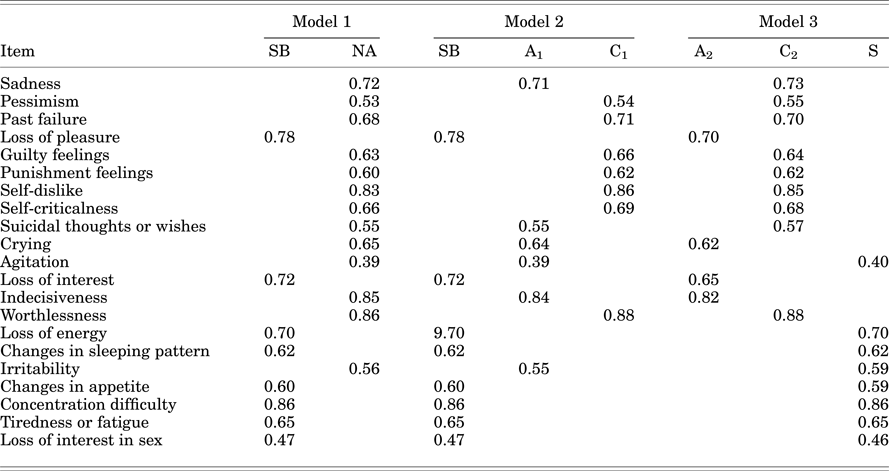
Descriptive statistics were employed to characterize depressive symptoms. Each of the 21 symptoms on the BDI–II was a priori assigned to factors based on competing theory-driven models. A two-factor model (model 1 in Table 1) included factors thought to represent “sickness behavior” (BDI–II items: loss of pleasure, loss of interest, loss of energy, changes in sleeping pattern, changes in appetite, concentration difficulty, tiredness or fatigue, loss of interest in sex) and “negative affectivity'' (i.e., symptoms of dysphoria not consistently linked to sickness behavior). A novel three-factor model (model 2 in Table 1) included sickness behavior (items listed above), but divided the negative affectivity into separate “affective1” (i.e., mood-related symptoms), and “cognitive1” factors (i.e., negative thoughts). A second, more traditional, three-factor model (model 3 in Table 1) included “affective2,” “cognitive2,” and “somatic” factors. MPlus software (Muthén & Muthén, Los Angeles, CA) was employed to fit factor models using unweighted least-squares parameter estimates with standard errors and a mean- and variance-adjusted chi-square test statistic. The reliability and validity of the BDI–II factors were examined for the model(s) that demonstrated the best fit.
Standardized factor loadings

A1 = affective1; A2 = affective2; C1 = cognitive1; C2 = cognitive2; NA = negative affectivity; S = somatic; SB = sickness behavior.
RESULTS
The mean total BDI–II score was 14.74 (SD = 8.52, range = 1–46). Using established cutoffs, approximately half of the sample reported minimal depression (52.1%, n = 87), followed by mild (24.6%, n = 41), moderate (16.8%, n = 28), and severe depression (6.6%, n = 11). When items were dichotomized as present or absent, the most prevalent symptoms were “loss of energy” (90%), “changes in sleeping pattern” (83%), “changes in appetite” (76%), “tiredness or fatigue” (94%), “loss of interest in sex” (74%), and “concentration difficulty” (70%).
Both the two-factor and the novel three-factor models were a good fit to the study data (models 1 and 2 in Table 1). Results showed support for the sickness behavior factor regardless of which factor structure was fit to the data. Standardized factor loadings were high, with the exception of two items (agitation and loss of interest in sex). These data were fit to another more traditional model (i.e., with affective2, cognitive2, and somatic factors; Table 1) that has been supported in diverse samples (Buckley et al., Reference Buckley, Parker and Heggie2001; Hall et al., Reference Hall, Hood and Nackers2013). Fit statistics for this model (i.e., model 3) were good, but the novel three-factor model with sickness behavior provided a slightly better fit (Table 2).
Statistics of fit

CFI = comparative fit index; χ2 = chi-square, RMSEA = root-mean-square error of approximation; SB = sickness behavior.
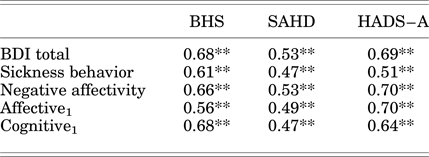
The internal consistency of the 21-item BDI–II was high (α = 0.90). The reliability for factors was as follows: sickness behavior (α = 0.82), affective1 (α = 0.71), and cognitive1 (α = 0.80). All BDI–II factor scores were significantly correlated with depressive severity (i.e., BDI–II total score), hopelessness, desire for hastened death, and anxiety (Table 3).
Factor correlations with models 1 and 2

** p < 0.01. BHS = Beck Hopelessness Scale; HADS–A = Hospital Anxiety and Depression Scale–Anxiety subscale; SAHD = Schedule of Attitudes towards Hastened Death.
DISCUSSION
The shortcomings involved in the recognition and treatment of depression in cancer patients are well-established (McDaniel et al., Reference McDaniel, Musselman and Porter1995). In the present study, we examined the dimensions of the BDI–II using three theory-driven factor models. While this sample endorsed a mild level of depressive symptoms overall, individual participants ranged from minimal to severe. Consistent with existing literature, symptoms that are typically classified as somatic in nature (e.g., fatigue) were highly prevalent.
Symptom clusters are recognized as a research priority that may elucidate neurobiological underpinnings and thereby improve treatment outcomes. Both the two- and three-factor models applied in our study provide initial psychometric support for the unique construct of sickness behavior in patients with advanced cancer. This finding was observed in a sample that varied in terms of age, cancer diagnosis, and symptom burden (25% of whom had moderate to severe depression). Support for a sickness behavior symptom cluster challenges the current conceptualization of depression, which posits vegetative/somatic symptoms as a distinct factor. Our novel factor structure provided a better fit to the data compared to a traditional factor model with affective, cognitive, and somatic factors. Our results also suggest that the demarcation of factors (e.g., affective, cognitive) other than sickness behavior is less salient within a cancer sample.
Divergent validity among constructs (e.g., sickness behavior, hopelessness, depression) was not observed, which raises questions about the relationships of theoretically related, but distinct constructs. However, our results are consistent with a theory of depression that proposes the symptoms of sickness behavior as primary, such that mood and cognitive symptoms are secondary and emerge as a result of feeling unwell (Charlton, Reference Charlton.2000). In this model, the successful treatment of inflammation before syndromal depression could potentially prevent the emergence of additional symptoms.
Alternatively, moderate to strong correlations between sickness behavior and other constructs (e.g., anxiety, hopelessness, desire for hastened death) are potentially related to suffering that exists in bodily, mental, and spiritual (or existential) dimensions (Frankl, Reference Frankl1969). An existential disturbance is uniquely human in its focus on meaning and purpose, as opposed to a biological disturbance such as sickness behavior, which has been observed in both animals and humans (Shattuck & Muehlenbein, Reference Shattuck and Muehlenbein2016). In our study, the SAHD is reasonably conceptualized as a proxy for existential distress by its assessment of desire for hastened death (e.g., failure to endorse the item “Despite my illness, my life has purpose and meaning”). Patients with advanced cancer may have cooccurring biological (e.g., sickness behavior), psychological (e.g., anxiety), and existential domains of disturbance that affect cognition and behavior.
Disentanglement of the dimensions of suffering in medically ill patients may help to facilitate targeted interventions. A cross-sectional study precludes examination of the temporal dimension of symptom development that would help to parse these complex relationships. Further research is needed utilizing inflammatory biomarkers to better understand the complex relationship between sickness behavior and depressive symptomatology. Longitudinal research on symptom clusters that have statistical support and clinical relevance may optimally guide treatment in medically complicated populations.