


Ranulf Higden's Polychronicon was the most widely disseminated Latin chronicle of late medieval England.Footnote 1 It covers a variety of subjects, but with a special concern for the history of England and Britain. The text begins with a geographic and ethnographic discussion of the known world, covers biblical and classical history, and carries its narrative to then contemporary times in the fourteenth century, drawing on many authorities throughout.Footnote 2 It is organized thematically and chronologically into seven books.Footnote 3 It soon became the historical text to own, if any were to be owned, likely because it offered a comprehensive treatment of so many subjects, references to other authorities for further reading, and an alphabetical index for quick navigation. In later years, continuations were added to carry the text's narrative to 1377 and beyond, and so allowed it to be more complete, versatile, and useful to readers. As a result, the Polychronicon (and its continuations) mostly supplanted independent monastic history writing in the period.Footnote 4 However, the length of the text and large number of manuscripts, along with confusion over the continuations, have made modern use and study of the text less common.Footnote 5 The present article corrects previously available information on the Polychronicon and its continuations, offers new insights on their development, discusses related texts, and includes a detailed list of all known manuscript copies. It is meant to serve as a starting point for further study of the texts and for the production of much-needed critical editions.
Polychronicon
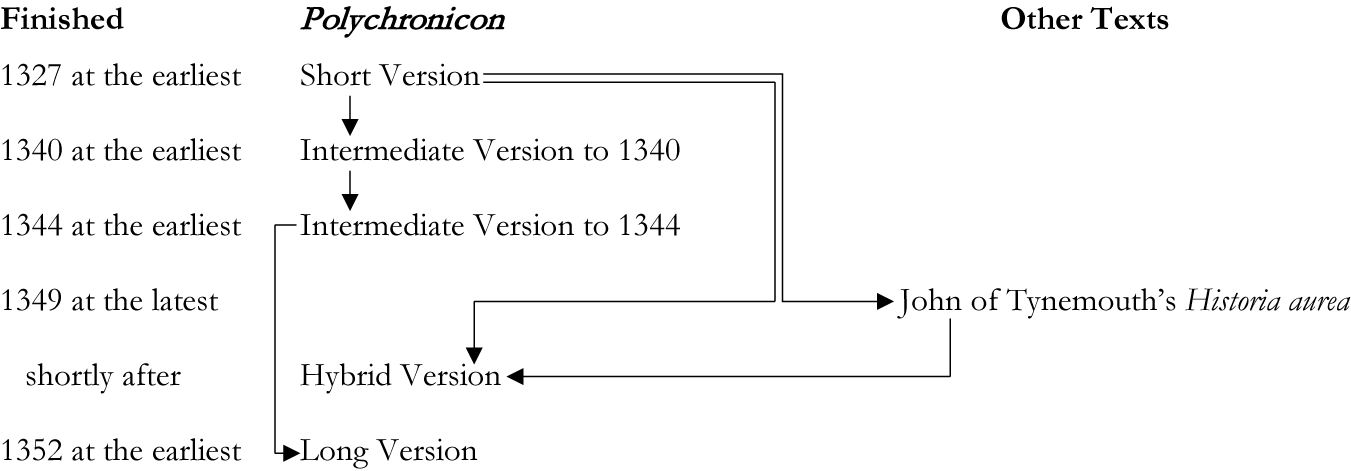
The main text survives in many different versions (see Figure 1). Three of these are authorial: the Short Version covering Creation–1327, which was modified into the Intermediate Version and extended first to 1340 and then 1344, which was in turn slightly modified into the Long Version and further extended in stages to 1352.Footnote 6 This process can be most clearly seen in Higden's autograph manuscript, MS 136 in the Table of Manuscripts, below.Footnote 7 Each of the three authorial versions was probably finished shortly after the final years narrated and well before 1364, when Higden died. The Long Version was likely finished before 1356, as it would be odd for it to omit Edward of Woodstock's campaign and the great English victory at Poitiers in the same year, if it were finished afterwards. However, more work is needed to arrive at more precise composition dates. The most recent edition of the text, published in the Rolls Series in the nineteenth century, is based on the Long Version (MS 132 as sigla E), which survives in only a handful of manuscripts, with variants from two texts each of the Short (MSS 26 and 3 as C and D) and Intermediate Versions (MSS 43 and 34 as A and B).Footnote 8 There are also several texts that appear to represent a transitional stage between the two earliest versions, and there are probably even more texts composited from different versions.Footnote 9 Some texts share abnormal start or end points, which indicate further patterns of transmission: from 1.1.9 in MSS 2, 4, 7, and 11; from 1.5 in MSS 50 and 99; from 1.5 (at a different point) in MSS 5, 16, 17, and 157; and to 1322 in MSS 2, 4, and 11.Footnote 10 Other texts are bound with very similar contents, such as MSS 41 and 70, which suggest they were produced in the same place. The Polychronicon is in great need of a modern critical edition, but it would be a massive undertaking due to the text's length and vast number of manuscripts, not to mention the question of which version to edit: the earliest (Short), the most widely read (Intermediate), or the fullest (Long)? The latter would be the most straightforward, as it has the fewest witnesses and an indisputable base manuscript to work from, Higden's autograph, MS 136.
Development of Polychronicon Versions.

The text quickly spread from Higden's Benedictine house, St. Werburgh's Abbey in Chester, throughout England. The bulk of the surviving copies are of the Intermediate Version to 1344, most with continuations to 1377 and beyond, often modified to suit different interests. It is difficult to work out the dissemination of the different continuations, but, as with the Polychronicon, some groups of texts share odd start and end points that might offer clues.Footnote 11 Other evidence suggests a wide readership for the Polychronicon throughout England, albeit mostly among religious houses and wealthy clerics.Footnote 12 Its audience was further broadened when it was translated into Middle English by John Trevisa and later (on several occasions) by others, and first printed in English in 1482.Footnote 13
The influence of the Polychronicon and its continuations on history writing in England cannot be overstated. Very few chronicles were produced in England from 1347 until the end of the fourteenth century, making the continuations particularly valuable. The text frequently served as a historical framework and supplied significant portions of narrative for other major chronicles, most notably the Eulogium historiarum (covering Creation–1366), Henry Knighton's Chronicle (939–1396), John of Reading's Chronicle (1346–67), John of Tynemouth's Historia aurea (Creation–1347), Thomas Walsingham's Chronica maiora (1272–1422) and Short Chronicle (1327–1419), and also some of the rejected texts in the Table of Manuscripts, below.Footnote 14 The Short Version Polychronicon was also combined with Tynemouth's text to form a distinct Hybrid Version that goes to 1347 in its fullest form. It was probably written shortly after 1349, when Tynemouth finished his Historia aurea.Footnote 15 This Hybrid Version is unedited, although it can be partly approached through the Rolls Series edition's Short Version text, variants of Tynemouth's Historia aurea for 1327–46, and sections edited by Galbraith.Footnote 16 Finally, the Polychronicon's most obvious influence can be seen in the many continuations attached to the text, marking its position as the foundation upon which further history was to grow from.
Continuations to 1377
The Polychronicon is continued in nearly all (74/80) of the Intermediate Version texts to 1344, four Transitional Version texts, and nine extracts of the Intermediate Version.Footnote 17 A little over half of these texts with continuations (44/87) include notes at the changeover point that explicitly signal a change in authorship, most often through a notice that “Ranulf wrote up to this point” (“usque huc scripsit Ranulphus”) or “here Ranulf of Chester ended his work” (“hic finiuit Ranulphus Cestrensis opus suum”) (see Figures 2–5).Footnote 18 There are several other versions of these notices, which are sometimes elaborated. These are given in the same hand as the text, or at least in a contemporary hand, except only in MSS 21 and 43, which are in later hands. The A, D, E (normal version), St. Albans B, St. Albans C, and Walsingham B Continuations typically have such notes, while the others only rarely do. In most texts without a clear explicit the continuation typically begins after a paragraph or chapter break, but in three (MSS 25, 85, and 126) there is no division at all, so that it appears to be a natural extension of the Polychronicon.
Changeover from Polychronicon to continuation (“usque hic scripsit Ranulphus” in text, slightly more formal and circled in rubric, with further notes and manicule in margin), in MS 67, fol. 178r (London, British Library, MS Harley 3884). Image © British Library Board.

Changeover from Polychronicon to continuation (“usque huc scripsit Ranulphus, monachus Cestrensis” in text, underlined and after paraph), in MS 112, fol. 189v (Oxford, Oriel College, MS 74). Image used by kind permission of the Provost and Fellows of Oriel College, Oxford.

Changeover from Polychronicon to continuation (“hic finiuit Ranulphus Cestrensis opus” in text, slightly more formal, with manicule in margin), in MS 102, fol. 178r (Oxford, Christ Church, MS 89). Image © the Governing Body of Christ Church, Oxford.

Changeover from Polychronicon to continuation (no signal), in MS 110, fol. 158v (Oxford, New College, MS 152). Image © and courtesy of the Warden and Scholars of New College, Oxford.

There has accordingly been some confusion about where the Intermediate Version ends and the continuations begin. This is exacerbated by a number of other factors: the continuations have varying start points (sometimes even within the same version) and often overlap chronologically with the end of the Polychronicon; the years given in the margins near the changeover point are sometimes in the wrong place or otherwise incorrect and replicated in editions; and the early years of the continuations are related to the Long Version, so that when they are compared to the Rolls Series edition's main text (based on a Long Version text to 1348), the changeover point is often pushed to the latter's end point.Footnote 19 To make matters worse, one of two continuations given in the edition (Walsingham A) independently adapts the Long Version through 1352 in its narrative, often closer than the two earliest full continuations, A (and derivative B, C, D, E, St. Albans B, and Walsingham B) and St. Albans A.Footnote 20 This can be clearly seen in the final sentence of the Long Version and its adaptation by the continuations:
Long Version Polychronicon (MS 136, fol. 281v)
Quo eciam anno incepit magna caristia rerum, plumbi, ferri, stagni, eris, clauorum, lignorum, canabi, lini, et specierum.
Walsingham A Continuation (MS 77, fol. 201v)
Quo eciam anno incepit magna caristia rerum, uidilicet bladi, plumbi, ferri, stagni, eris, lignorum, canabi, lini, et specierum.
A Continuation (MS 126, fol. 146v)
Quo in anno incepit magna caristia rerum uenalium ut duplo, quod plusquam solito uenderentur, mare eciam et terra steriliore esse ceperunt.
St. Albans A Continuation (MS 174, fol. 294v)
Quo tempore incepit magna caristia rerum uenalium, uidilicet ferri, plumbi, eris, et rerum omnium aliarum.
This all suggests to the reader without access to the manuscripts that Walsingham A, and therefore the other continuations, only begin at 1348 or later. This misunderstanding, along with a dearth of continuation editions, has made further work on the continuations difficult.
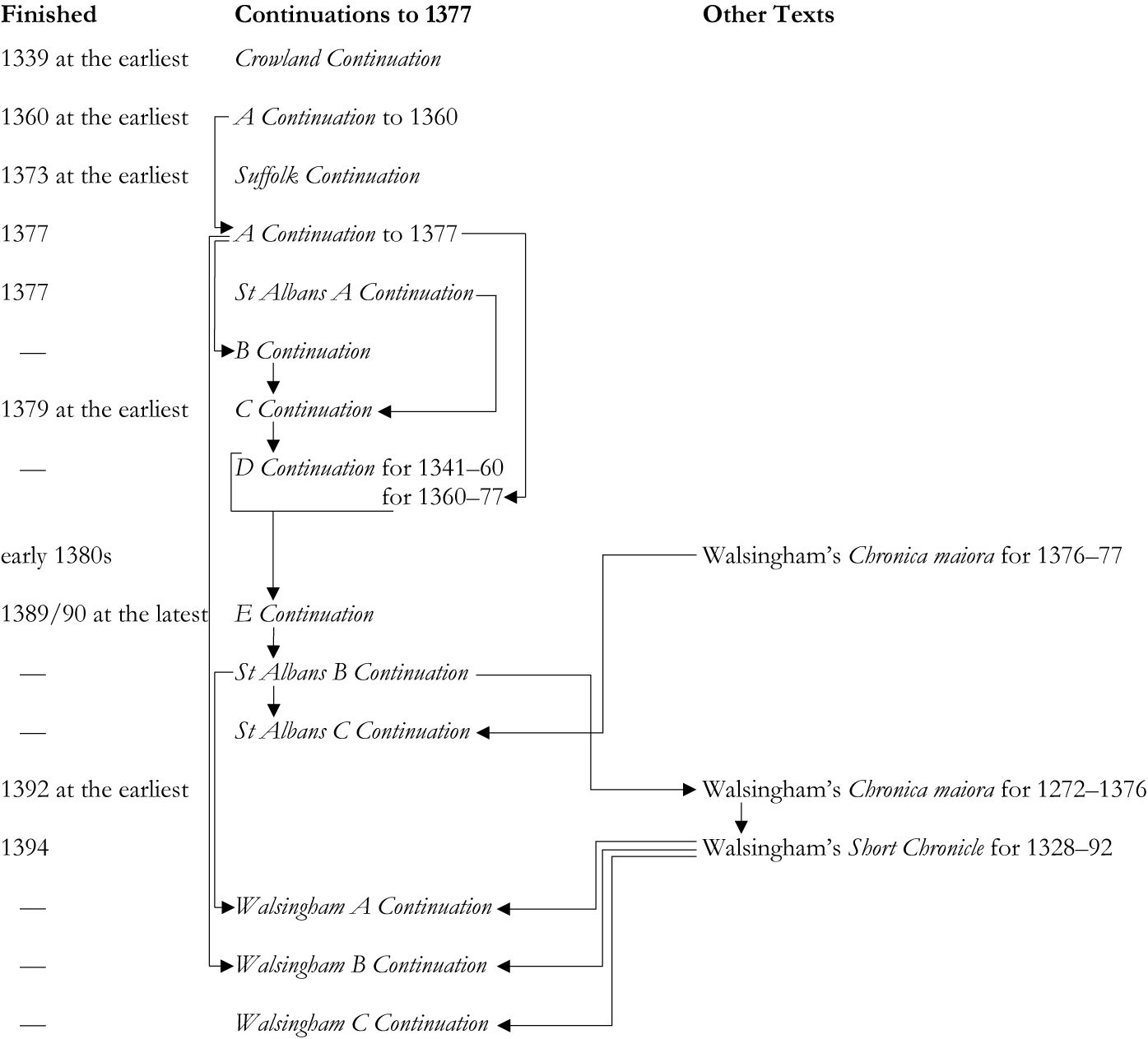
The development of the many major continuations up to 1377 was first laid out by Taylor. He named his first five continuations by letters (A, B, C, D, and E), and also discussed three related to St. Albans (which I have named St. Albans A, B, and C) and another three that draw upon the historical works of Thomas Walsingham, also of St. Albans (likewise, Walsingham A, B, and C).Footnote 21 These continuations normally begin anywhere from 1341 to 1346 and end in 1376 or 1377. The earliest two of these were written in stages, mostly before Richard II was crowned, 16 July 1377.
The first continuation, A, was started after the Long Version took its final form and was probably completed shortly after the death of Edward III, 21 June 1377. Its 1346–52 narrative is, with a few changes, derived from the Long Version Polychronicon. Taylor believed that it was composed in stages over time, but he offered little evidence to support this. Of the extant A texts he knew of (MSS 10, 50, 67, 68, 87, 92, and 112), only one, MS 50, ends early (at 1360), but it picks up again at the same point after an interpolation of the Wigmore Chronicle. There are in fact another four copies of the text that end at this same point, deliberately covering only 1346–60: MSS 36, 118, 126, and 168.Footnote 22 This is the first recension of the continuation and would have been started at the earliest in 1352 and finished in 1360 or shortly thereafter. MS 168 continues a copy of the Long Version that ends at 1344, where the full Intermediate Version ends and is typically continued, and so may represent a very early stage of composition. Other copies of A vary in their coverage between the standard start and end points of 1341/46 and 1376/77, which further demonstrates its composition through accumulation.Footnote 23
The second of the two early continuations that offer fuller narratives, St. Albans A, covers 1342–77. It was probably written in stages and finished around the same time as A. The earliest copy of the text, MS 174, now begins late due to lost leaves and is attached at the end of a two-volume copy of John of Tynemouth's Historia aurea, which itself ends early.Footnote 24 These two manuscripts also have a companion volume, probably written earlier, with an amalgamation of Thomas Walsingham's Chronica maiora and Short Chronicle for 1377–1422.Footnote 25 Although this manuscript was finished earlier, scribes attached its Walsingham text to later copies of St. Albans A. MSS 175 and 168 have a somewhat peculiar St. Albans A text in wording and order and are followed by a text similar to the above amalgamation of Walsingham's histories, especially towards the beginning. These two later manuscripts resemble each other very closely, but have differences that suggest they were copied from the same source. MS 168 includes a preceding narrative of an extract of the Long Version Polychronicon for 1327–44 and the first recension of A for 1346–60.Footnote 26 The inclusion of A here may indicate that the writer of St. Albans A knew of and worked consciously to expand and otherwise modify it, but more work on these continuations is required. MS 168's St. Albans A mentions the 1343 papal succession and refers the reader (fol. 6r: “uide supra”) to the passage in the Polychronicon above (fol. 3r), which is in turn clarified to state the source name in MS 175 (fol. 1r: “uide supra in Policronicon”).Footnote 27 MS 175 could have therefore had the Polychronicon and A in a companion volume, and so may indicate that the Long Version was fuller in the shared source manuscript, now untraced.Footnote 28 MS 187 offers a text closer to MS 174's, but it is more fully integrated into an amalgamation of Walsingham's histories and differs in other ways.Footnote 29 It likewise includes a note about the Polychronicon at its beginning, in larger and darker writing that declares, “here ends the work of Ranulf of Chester” (“hic finit opus Ranulphi Cestrensis”) (see Figure 6). A similar version of this note is used also in most copies of St. Albans B (MSS 49, 66, 114, 115, and 161) and both copies of St. Albans C (MSS 56 and 102): “hic finiuit Radulphus Cestrensis opus suum.” The latter of these notes is also included in some copies of Walsingham's Chronica maiora and Short Chronicle.Footnote 30 St. Albans A is sometimes closer to the Long Version than A, and both continuations have similar passages in their early years due to their shared source.Footnote 31 It is about twice as long as A and offers a far more detailed narrative, but it is largely unknown due to remaining unedited.
Changeover from Thomas Walsingham's histories to St. Albans A Continuation indicating it was once attached to the Polychronicon, in MS 187, fol. 38r (Oxford, Bodleian Library, MS Rawlinson B. 152). Image © The Bodleian Libraries, University of Oxford.

The other continuations to 1377 were written during the reign of Richard II (see Figure 7). The first, B, is based on A, and each subsequent continuation through E and St. Albans B and C is in turn developed from its predecessor. The only one not following this straightforward composition path is D, which is based on C to 1360 and then A to 1377, with a notably expanded narrative for 1343–46.Footnote 32 These continuations make progressively more additions and other changes to their source texts, as detailed by Taylor. D is in many places reworded, sometimes significantly enough to approach paraphrase, and so makes comparison of its text (as well as E and St. Albans B and C) with others difficult. There is little internal evidence to suggest at what point after 1377 these later continuations might have been written, except for a mention of Simon Langham's 1379 reburial in C. Other texts can help to narrow the composition dates of our continuations. A peculiar version of E was written in 1389/90, and so B–E must pre-date it. The retrospective part of Thomas Walsingham's Chronica maiora, for 1272–1376, circulated in draft by the 1380s and has an early copy surviving from c. 1390–94.Footnote 33 The first part of his Short Chronicle, for 1328–92, likewise circulated in draft by 1388 x 1392 and has copies from as early as 1394.Footnote 34 The former text is drawn upon by the latter, and so it must predate it. St. Albans B is used by the retrospective part of Walsingham's Chronica maiora, so therefore it (and the earlier continuations) must have been finished before 1388 x 1392. Walsingham A, B, and C do not follow the same linear trajectory as the first six continuations, described above. Taylor claims that Walsingham A is adapted from St. Albans B and Walsingham's Short Chronicle. However, a close comparison of the continuations reveals that through 1352 it is actually a fresh adaptation of the Long Version, independent of the others. Walsingham B is developed from C (and possibly other continuations), Walsingham's Short Chronicle, and the Eulogium historiarum, and Walsingham C draws far more directly from Walsingham's Short Chronicle. Most of the above continuations written after 1377 have other influences, especially St. Albans A, Thomas Walsingham, and (possibly) John of Reading, the last of whom probably wrote his chronicle 1366–68/69.Footnote 35 The continuations all remain anonymous, despite a note in MS 183 attributing St. Albans B to Walsingham himself and another in MS 153 attributing Walsingham A to John Malvern.Footnote 36 In any case, much work remains to be done on the development of these continuations.
Development of Continuations to 1377. Note that the end of the Long Version Polychronicon is used in A, St. Albans A, and Walsingham A Continuations.

Other texts related to the above continuations defy easy categorization. There are two composite texts, independent from each other, wherein a scribe (perhaps in an earlier exemplar) started copying one continuation and then switched to another (MSS 107 and 110), and four incomplete continuation texts that are so short they cannot be definitively identified here (MSS 39, 62, 101, and 172). Taylor was unaware of two further continuations, both of which appear to be independent from those described above: the Crowland Continuation for 1339 and the Suffolk Continuation for 1340–73, both of which were probably finished shortly after the last dates narrated. Crowland appears to have been used by the Louth Park Chronicle, which was written in stages and finished in 1413 or after. Louth, like the Crowland manuscript (MS 47), was written in Lincolnshire. It has a section of text that is almost exactly the same as Crowland and also draws on an Intermediate Version Polychronicon to 1340, a text of which Crowland likewise follows.Footnote 37 Suffolk picks up mid-sentence where the main Polychronicon text breaks off, and so suggests a spontaneous composition (see Figure 8).Footnote 38 It is written in a peculiar, haphazard order and appears to have been unknown.
Changeover from Polychronicon to Suffolk Continuation, in MS 96, fol. 209r (Oxford, Bodleian Library, MS Laud Misc. 545). Image © The Bodleian Libraries, University of Oxford.

The thirteen continuations up to 1377 are sporadically edited, and each only from a single manuscript. A is edited from MS 10, an incomplete text for 1353–77 only;Footnote 39 B from MS 34 for 1346–76;Footnote 40 St. Albans B from MS 169 for 1341–77;Footnote 41 and Walsingham A from MS 43 for 1346–77.Footnote 42 The eulogy for Edward III at the end of St. Albans C is edited from MS 56.Footnote 43 The other continuations (C, D, E, St. Albans A, Walsingham B and C, Crowland, and Suffolk) remain entirely unedited, but, with the exception of the last two, can be somewhat approached through the other editions.
A through E and St. Albans B all employ one of two standard beginnings and two endings, with some very minor variants:
Beginning no. 1 (Edmund Langley's birth, 5 June 1341)
Hoc anno nonas iunii natus est regi Edwardi Edmundus apud Langele
Beginning no. 2 (Crécy campaign begins, 11 July 1346)
In festo translacionis sancti Thome martyris, rex Edwardus ingressus est mare
Ending no. 1 (on John Wyclif [Wycliffe], 1376)
errores in populo uentilantes, et palam in eorum sermonibus predicantes.
Ending no. 2 (eulogy for Edward III, d. 21 June 1377)
ceperunt et quod dolendum, est longam continuacionem postea habuerunt.
The first and last of these are found in the beginning and end of the St. Albans B edition and the second and third in the beginning and end of the B edition.Footnote 44 The first of these beginnings is also used by St. Albans C and Walsingham B and the second by Walsingham A, but all with independent endings. Walsingham C is close to Walsingham's Short Chronicle, beginning with “Rex Edwardus fecit tres comites” (John of Eltham made Earl of Cornwall, 6 October 1328) and ending with “uero, quod ipsi dolose ma-” (Henry Hotspur's naval actions, August–October 1387), breaking off mid-word due to the final leaf's mutilation.Footnote 45 Another three have unique endings with no equivalents: St. Albans C ends with “ubi proteccionis littera non prerogaret” (eulogy for Edward III), Walsingham A with “non plus uiguit in discretione quam unus puer octo annorum” (eulogy for Edward III), and Walsingham B with “et reliquos quos repperant occiderunt” (French raid on Isle of Wight, late August 1377). In one copy of Walsingham A (MS 153), in the space between it and the Gesta regis Ricardi secundi that follows it, the main scribe added a second eulogy for Edward III, modified from that found in A, C, D, E, and St. Albans B.Footnote 46 His script here quickly becomes small and cramped, spilling into the margins, down around the following continuation, and finally below into the lower margin (see Figure 9). St. Albans A begins uniquely with “Tenuit rex Natale apud Kenyngtoun” (25 December 1342) and ends with “que famam eius indicibiliter minuerunt” (eulogy for Edward III).
Additional eulogy for Edward III written in space between Walsingham A Continuation and Gesta regis Ricardi secundi, in MS 153, p. 126 (Cambridge, Corpus Christi College, MS 197A). Image © The Parker Library, Corpus Christi College, Cambridge.

Other continuation texts have deliberately abnormal beginning or end points shared in multiple manuscripts, and so may represent different stages in their composition. Four copies of A (MSS 36, 50, 118, and 126) end early at “pro pace et pactis mutuis confirmandis” (Treaty of Brétigny, 1360) and two copies (MSS 10 and 14) begin late at “Hoc anno conuentum et concordatum” (Treaty of Guînes, 1353).Footnote 47 Two copies of St. Albans B (MSS 179 and 183), both without Polychronicon preceding them, begin late at “Circa festum sancti Bartholomei, Philippus” (Edward III's capture of Calais, 4 September 1347).Footnote 48 It should also be noted that the Intermediate Version Polychronicon texts that end early due to lost leaves (MSS 29, 42, 46, 86, 90, 99, 105, and 129) might have once included continuations. Although their indices may include entries for these later years, it is impossible to know whether the continuations were ever actually copied out.
Some texts to 1377 have titles in contemporaneous hands that set them apart and have caused some confusion. The Historia de Bruto, rege Britonum, cum aliis regiis Anglie linialiter ab eo descendentibus usque ad regem Ricardum secundum, as its title is given in rubric in MS 171, its earliest copy, and similarly in MSS 154 and 165, is a lengthy chronicle for Brutus–1377 surviving in four copies.Footnote 49 The rubric continues by stating that Richard II commissioned or otherwise encouraged the production of the text in 1389/90.Footnote 50 Two copies, MSS 154 and 171, are (appropriately) cleanly written and well decorated throughout.Footnote 51 The Historia's contents and focus suggest that it was composed at Bury St. Edmunds, where MS 154 can be traced. It is made to resemble a Brut chronicle, in that it begins its narrative with the legendary founding of Britain by Brutus and then continues, reign by reign, up to the then present, stressing the continuous line of rulers and their rights to rule all of Britain. It presents to Richard II the deeds of his ancestors, ostensibly to praise him and to show him what he can (and ought to) do as king. The Historia is not an independent chronicle, but is instead a series of extracts, sometimes lengthy and unbroken, from the Polychronicon to 1341 and then a somewhat peculiar version of E, concluding normally at Edward III's death. Then, as if it were merely a new chapter, there is a short description of Richard II crowned king, linking the present king with his predecessors (see Figure 10). This passage is taken directly from the short regnal chronicle, Cronica bona et compendiosa de regibus Anglie.Footnote 52 MS 171 includes a copy of this short text (fols. 155v–160r), along with a full Polychronicon and E Continuation (MS 125) and a Church history to 1370 that draws on the Polychronicon (fols. 161r–165v).Footnote 53 It likely represents the earliest text, as it is the earliest copy and also includes the text's immediate sources. Since the main text is a series of extracts and is followed by standard continuation, refrains from making drastic alterations or additions, and employs marginal Book and Chapter numbers that correspond to the Polychronicon, it is not considered here as an independent text.
Short chapter on Richard II added to peculiar E Continuation, in MS 154, fol. 99v (Cambridge, Corpus Christi College, MS 251). Image © The Parker Library, Corpus Christi College, Cambridge.

Continuations Past 1377
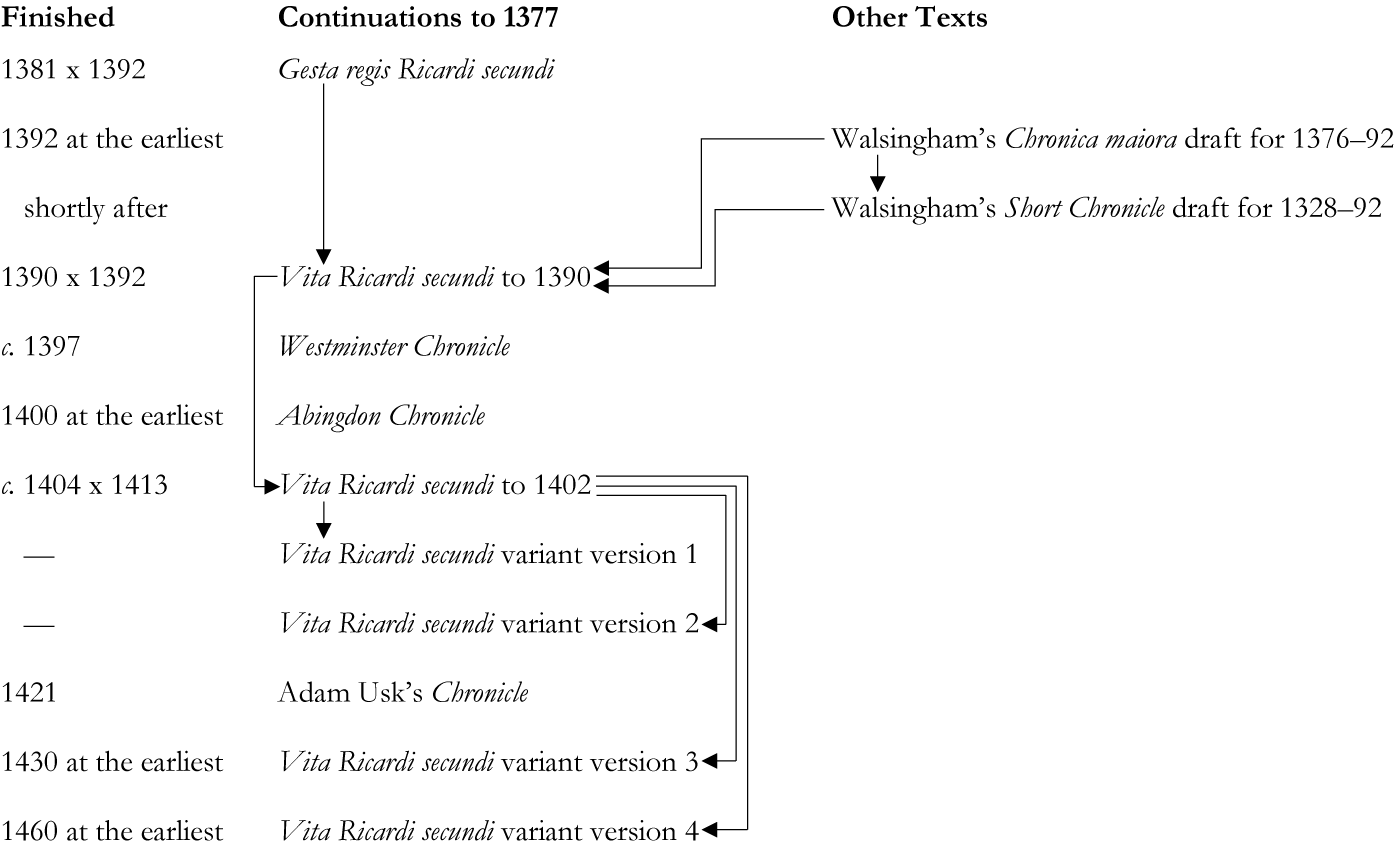
There are several further continuations starting at or after 1377 that go as far as the mid-fifteenth century (see Figure 11). They are attached to a variety of the earlier continuations and typically have the changeover here signaled with a large, decorated capital, and sometimes accompanying notes stating as much. Three of these later continuations have modern critical editions and are well known, so require no further introduction here: the Westminster Chronicle for 1381–94 (written c. 1389–97), Vita Ricardi secundi, or Historia uitae et regni Ricardi secundi, for 1377–1402 (in two sections, written 1390 x 1392 and c. 1404 x 1413), and Adam Usk's Chronicle for 1377–1421 (written 1377–1421).Footnote 54 The others have been mostly overlooked, however, and deserve further investigation.
Development of Continuations past 1377.

The Gesta regis Ricardi secundi covers 1377–81 and was probably written shortly after 1381 or as late as 1390 x 1392, when the first part of the Vita Ricardi secundi, which draws upon it, was finished.Footnote 55 In studies of the period, the Vita is often turned to instead for its more expansive narrative, even though the Gesta is the earlier source. It was not written by John Malvern, despite it often being titled as such by scholars.Footnote 56 It is not part of Walsingham A, even though it is typically found continuing it. The Gesta was probably written before Walsingham A and only attached to it as a further continuation at some later point. It is in turn continued by the Vita in MSS 33 and 78 with no indication of a change in text. It has been edited twice, from MS 169 and MS 43, although there is no indication that either of these are representative or early texts.Footnote 57 The text begins with “Ricardus de Bordeus, filius domini Edwardi principis Wallie” and ends with “Thomas Hatfeld, episcopus Dunelmensis, moritur senex multorum dierum.”
The Abingdon Chronicle covers 1380–1400 and was probably written shortly after the last date narrated. It continues the Gesta in MS 98. It has no known sources or analogues and remains unedited and unknown. I have so named it after the house to which its sole known manuscript has been traced, although it could have been composed elsewhere. What we have is merely a fragment of a fuller copy. Its later hand and use of book and chapter marginal navigation, different from the Polychronicon and Gesta that precede it, shows it was copied here from an earlier, now lost manuscript. It begins imperfectly, missing all but the first two leaves of its quire. The first line has been thoroughly scraped (almost completely illegible, even under multispectral imaging), but clearly begins in the middle of a sentence.Footnote 58 Another five lines further down the first page are only slightly less thoroughly scraped. Likewise, the final sentence breaks off incompletely before the index in the main, earlier hand of the manuscript begins on the following page. The sole copy thus begins, retroactively at the 1380–81 siege of Nantes, with “ad instanciam ducis Britannie” and ends imperfectly with “Item circa festum natalis sancti Iohannis baptiste rex.”
There are four variant versions of the Vita Ricardi secundi that have received comparatively little attention by scholars, especially for the narrative past 1402, when the standard text ends. The first of these covers 1377–1400 and was probably written shortly after the standard text was finished. Its wording is sometimes considerably different. At other times it departs radically from the standard Vita text. It remains unedited and (besides Stow mentioning MS 185 as a Vita variant) unknown.Footnote 59 It may have originally ended at a different point, but the earlier of the two surviving manuscripts ends only a few years into its narrative due to lost leaves. Likewise, the later, fuller manuscript breaks off in the middle of a sentence. The text begins with “Hoc anno Ricardus filius Edwardi, principis Wallie” and ends with “circa festum natiuitatis sancti Iohannis baptiste rex.”
Variant Version no. 2 covers 1377–1413 and was written in or shortly after 1415, probably in London.Footnote 60 The text is modified from the Vita through addition and omission. It occasionally turns to Walsingham's Chronica maiora for 1392–1406, but further sources or analogues for the 1403–13 narrative have yet to be identified. It has been associated with three further texts because they are typically found together in the same manuscripts: the Gesta Henrici quinti for 1413–16 (written 1416–17), Pseudo-Thomas Elmham's Vita Henrici quinti abridged for 1417–22 (c. 1455), and De actibus tempore regis Henrici sexti for 1422–55 (after 1455).Footnote 61 However, the autograph copy of the latter two texts, MS 181, places the reigns of Richard II and Henry IV from the Vita Ricardi secundi variant afterwards, out of chronological order. The Gesta Henrici quinti here is likewise taken from another manuscript. This strongly indicates that they were not originally all one text, but were instead included in the same volume for their shared historical content and only later put into chronological order by a copier so as to appear to be a continuous narrative. These texts have together been named Giles's Chronicle, after their editor. Giles mistakenly viewed them as one chronicle (in several parts) for the four reigns, but omits from his edition the reign of Richard II for being too close to the Vita and drops the Pseudo-Elmham in favor of the more famous Gesta Henrici quinti.Footnote 62 The Richard II narrative remains unedited and (besides Stow mentioning MSS 181 and 184 as Vita variants) mostly unknown.Footnote 63 The text begins with “Ricardus, iuuenis et etatis uix undecim annorum” and ends with “in magnum dispendium et detrimentum et cetera.”
Variant Version no. 3 covers 1377–1430 and was written shortly after the last date narrated, probably at Whalley Abbey, where the earliest copy is traced to.Footnote 64 The text for 1399 onwards has been named variously the Whalley Chronicle or Northern Chronicle. MS 64's continuations are copied into MS 178, but the latter omits a paragraph on Richard II's deposition and adds two lines of text to the end. It draws on a number of sources, most obviously the Vita, and was possibly first written to cover only 1377–1408. It is similar in places to the Short Kirkstall Abbey Chronicle (for 1290–1377) and the Dieulacres Chronicle (1337–1403), which suggests that volumes of historical literature and documents were exchanged between these two houses and Whalley.Footnote 65 Two parts of the text have been edited: a paragraph on the end of Richard II's reign and the text from 1400 to the end.Footnote 66 Most of the Richard II narrative remains unedited and (besides Stow mentioning the two manuscripts as Vita variants) mostly unknown.Footnote 67 The text begins with “Huic successit Ricardus, secundus filius idem Edwardi, principis Wallie” and ends with “et cum exercitu copioso” (MS 178 with “dominus Iohannes Butteler occisus”).
Variant Version no. 4 covers 1377–1455 in its fullest form and was probably finished between 1455 and 1460 or shortly afterwards.Footnote 68 It is an amalgamation and adaptation of other Latin texts, often overlapping in years, with some chronological gaps, and without any clear divisions between them.Footnote 69 It may, therefore, have been composed in stages over time. Indeed, MS 61 deliberately ends early in 1422 and Stow places MS 92 (to 1450) before MS 67 (to 1455) in his stemma of Vita Ricardi secundi texts. It notably includes the text of the Latin Prose Brut with ‘Long Life’ of Henry V for 1417–37 (four texts of which are here identified for the first time, bringing the number of known copies to eleven).Footnote 70 The first section (for 1377–1402) can be mostly arrived at through variants for MSS 67, 87, 92, and 112 to Stow's edition of the Vita and the third section (for 1417–37), somewhat, through variants for MS 87 to Kingsford's edition of the Latin Brut, while the fourth section (for 1444–45) is edited from MS 87.Footnote 71 The second section (for 1399–1419) remains unedited except for an imperfect paragraph from MS 87.Footnote 72 The text begins with “Ricardus de Burdeus, puer nondum etatis plene undecim annorum” (following the standard Vita text) and ends with “de malo regimine erga regem et regnum.”
There has been some confusion about other post-1377 texts and their writers that must be addressed. The most frequent of these is the authorship of John Malvern, who might have been prior of Worcester from 1395 and died in 1414, and to whom MS 153 is attributed in a note written between a Polychronicon extract and the Walsingham A Continuation, which are then continued by the Gesta regis Ricardi secundi and the Westminster Chronicle.Footnote 73 Robinson demonstrates that the final of the four texts here was written by a monk of Westminster, not Malvern, who he believes wrote the other two continuations, treating them together as one text.Footnote 74 However, there are several full copies of Walsingham A that are not continued by the Gesta. Three texts deliberately end at 1377 with no further continuation (MSS 77, 104, and 111) and two are continued instead by the Vita Ricardi secundi Variant Version no. 3 (MSS 64 and 178). If Malvern wrote both Walsingham A and the Gesta as one text, then it would be odd that multiple copies deliberately go only to 1377, quitting when it would take just a few more leaves to copy out the Gesta. Others argue that Malvern wrote only one of the two, Taylor for Walsingham A and Stow for the Gesta.Footnote 75 There is little reason at all, however, to suppose that Malvern wrote either of them, as this attribution is found nowhere else, not even in their early copies.Footnote 76 It seems more likely that Malvern was only a scribe who copied out an earlier text or was an owner of an exemplar manuscript, and statements to the effect of either were then confusingly modified to suggest authorship.Footnote 77 Another text, John Herryson's Abbreuiata cronica for 1377–1469, on fols. 128r–133v of MS 35, has sometimes been described as a continuation of the Polychronicon.Footnote 78 However, it is clearly separated from the Polychronicon and B Continuation to 1376 by John Lydgate's verses on the kings of England for 1066–1422 on fol. 127rv.Footnote 79 Herryson's text was therefore an afterthought and is another historical text among many others in the manuscript.
Other Texts
Besides the continuations described above, texts normally found elsewhere are sometimes attached to the Polychronicon. Accordingly, these are not treated as standard continuations here and are not described or listed in full. The most frequent of these are Adam Murimuth's Continuatio chronicarum (for 1303–47 in its fullest form) in MSS 2, 10, 14, 169, and 179;Footnote 80 John of Tynemouth's Historia aurea in MSS 174 and 183;Footnote 81 Thomas Walsingham's Chronica maiora in MS 88;Footnote 82 Walsingham's Short Chronicle in MSS 27, 51, and 183 (also see MS 88); and amalgamations of the latter two in MSS 168, 175, and 187.Footnote 83 Conversely, several Polychronicon extracts continue other historical narratives: MS 155 after Matthew Paris's Flores historiarum with Merton Continuation (for Creation–1306);Footnote 84 MS 161 after Walter of Guisborough's Chronicle (for 1129–1315);Footnote 85 and MS 172 after the Vita Edwardi secundi (for 1307–26).Footnote 86 One text, MS 50, breaks off its A Continuation about halfway through, includes extracts of the Wigmore Chronicle, and then resumes the earlier continuation where it left off, perhaps drawing on the same exemplar.Footnote 87 Two copies of the same set of continuations, C and the Vita Ricardi secundi Variant Version no. 1, follow a Latin Prose Brut unrelated to the Prose Brut tradition.Footnote 88 This Brut is amalgamated from a variety of other texts, including sections of verse. It adapts parts of the Polychronicon, especially for Edward III's reign, and concludes at the normal 1344 end point, but offers no signal of change in authorship. Of these two copies, the earliest is MS 173, but it is missing a great deal from the beginning and starts only at 1326, making it uncertain how similar this chronicle-compilation was to that in the later text, MS 185, which has another thirty-four folios of text before this point. Two other continuations are attached to historical compilations that resemble the Polychronicon in places, especially towards the end, in MSS 176 and 178. Other texts, MSS 75 and 176, are followed by short historical notes that continue the chronology, but do not serve as formal continuations.
Several manuscripts include other material that aided the medieval reader in navigating the lengthy text of the Polychronicon. Many anonymous historical narratives probably served as summary chronicles that could be used to quickly identify particular parts of the larger text that deserved further attention. The most notable of such supplemental texts is the Cronica bona et compendiosa de regibus Anglie (normally for Noah–1377) in MS 30, fols. 174r–178v; MS 46, fols. 8r–11v; MS 56, fols. 158r–161r; MS 91, fols. 183v–187v; MS 120, pp. 1–10; MS 125/171, fols. 155v–160r; and MS 128, fols. 1r–5r.Footnote 89 Other such texts, here in order of composition, are also found in MS 163/183, fols. 169v–176v (for Brutus–1377) and MS 107, fols. 327r–335v (continued to 1437);Footnote 90 MS 166, fols. 58r–62r (for Incarnation–1377 and continued to 1381);Footnote 91 MS 91, fols. 75r–77v (for Incarnation–1377); MS 76, fols. 264v–267r (for 843–1377); MS 41, fols. 159r–160v (for Anglo-Saxon kings–1381); MS 70/182, fols. 242v–243r (for founding of Rome–1385); MS 50, fols. 1r–2r (for 1066–1377);Footnote 92 MS 127, fols. 226r–228v (for 1348–1425); MS 107, fols. 325r–326r (for Creation–1437);Footnote 93 and MS 36, fols. 213v–217r (for 1327–1437). There are short notes on chronology in many of the manuscripts that are not listed here, including Higden's on the five ages of the world. Mappae mundi are included with many of the texts to help visualize the geographic sections of Book 1 and exotic places mentioned elsewhere in the narrative: MS 5, fol. xiiiv; MS 13, fol. 9v; MS 30, fol. 9r; MS 40, fol. 11r; MS 45, front board inside; MS 55, fol. 8r; MS 71, fols. 1v–2r and 2v; MS 91, fol. 195v; MS 101, fol. 15v; MS 103, fol. 12av; MS 108, fol. ivv; MS 114, fol. 2r; MS 123, fol. 171r (incomplete); MS 124, fol. iv; MS 126, fol. 7v; MS 128, fol. 13r; MS 136, fol. 4v; and MS 157, fol. 124r (see Figure 12).Footnote 94 Many other texts (especially with a historical focus) and visual aids (such as genealogical diagrams) are also bound with, but not directly connected to the Polychronicon, and so must be considered elsewhere.Footnote 95
Mappa mundi in the Polychronicon autograph manuscript, MS 136, fol. 4v (San Marino, Huntington Library, MS HM 132). Image used by kind permission of The Huntington Library, San Marino, CA.

Several so far unknown texts are derived in one way or another from the Polychronicon, but have sometimes been misidentified as it, and so merit discussion here (such manuscripts have their numbers prefixed by “x”).Footnote 96 The Extractus cronicarum cistrencium ac cronicarum Veteris testamenti (for Jerome–1431) is a Christian history with several details of Winchester that may suggest its origin. It sometimes draws considerable extracts from the Polychronicon, but it is so different that it should be considered independent. It is in five known texts, which have some differences among them: MSS x1, x4, x12, x14, and x15. There are several extremely abridged histories that occasionally resemble the Polychronicon: MSS x5, x8, x10, and probably many others that remain unidentified. Edwards lists MS x7 (and MS x9, which was copied from it) as an early modern transcript of a Polychronicon. However, it appears to be an amalgamation of extracts from several texts, including the Hybrid Version Polychronicon. There is a large historical compilation that sometimes resembles the Hybrid Version, beginning with geographic matters and ending in 1340. It survives only in MS x6 and deserves further study. Very brief extracts or passages used in other texts are numerous, but hardly qualify as Polychronicon texts, and so are rejected or omitted entirely below.
Previous Manuscript Lists
Given the dizzying number of manuscripts, variant versions, wide copying, and influence of the Polychronicon, it should come as no surprise that a comprehensive catalogue of manuscripts has yet to be produced. John Taylor, A. S. G. Edwards, and James Freeman have together listed and/or described 162 copies of the text and its continuations. Taylor lists 128 manuscripts of the Polychronicon and four of continuations with little or no Polychronicon preceding them, and importantly classifies (most of) the continuation texts within.Footnote 97 He does not offer a detailed catalogue, however, given the scope of his book. Edwards adds eight manuscripts (and another two that are rejected here), but offers no significant details on their contents.Footnote 98 Freeman adds nine manuscripts and relists 126, omitting extracts, fragments, and continuations without Polychronicon.Footnote 99 His descriptions are meticulous and of great value, especially for their codicology and provenance. Edwards and Freeman add twelve manuscripts, one continuation, and relist twelve manuscripts (and another eight that are rejected here).Footnote 100 Like Edwards's earlier list, they give basic details on the texts. None of the continuation texts discovered since Taylor's Polychronicon work were ever classified.
Another twenty-six manuscripts are listed and detailed for the first time in the Table of Manuscripts, below. Here substantial texts are defined as those with at least one full, continuous Book of the Polychronicon, or those that have suffered loss and were likely once much fuller, while extracts are texts deliberately less than a Book in length or discontinuous excerpts.Footnote 101 In total there are now 143 known substantial manuscripts, of which nineteen are Short, seven Transitional, 103 Intermediate, seven Long, and seven Hybrid Version texts. There are also eight fragments, some of which may be from known parent manuscripts, twenty-one extracts, and sixteen copies of standard continuations that are not (now) attached to the Polychronicon. Early modern copies and long untraced manuscripts are omitted.Footnote 102 The sole exception (to the latter) here is MS 172, because its contents were described in detail and mostly transcribed in the eighteenth century before it was almost certainly destroyed in a fire. Seventeen rejected texts are also listed, some of which are extremely brief extracts of only a sentence or two, small extracts used throughout other texts, or texts that draw from the Polychronicon mostly as paraphrase/abbreviation and are so different that they should be considered independent texts, but they have been elsewhere described as Polychronicons.Footnote 103
The Table of Manuscripts, below, offers many corrections and supplements to information in earlier descriptions and lists. The Polychronicon version is corrected in four manuscripts (MSS 47, 63, 130, and 138). The continuations up to 1377 in thirty-seven manuscripts are identified here for the first time (MSS 14, 25, 36, 39 first continuation only, 45, 47, 48, 50 fourth and fifth continuations only, 60, 61, 62, 69, 79, 80, 84, 85, 96, 101, 118, 120, 121, 124, 126, 127, 154, 161, 162, 165, 168, 171, 172, 173, 176, 178, 179, 182, and 185), while those in four other manuscripts are corrected (MSS 55, 109, 110, and 160).Footnote 104 The Crowland (MS 47) and Suffolk Continuations (MS 96) are newly listed here. Taylor does not list the texts past 1377 in his Table of Continuations, but mentions them elsewhere in his prose.Footnote 105 Stow, building on earlier studies, adds five manuscripts of the Gesta regis Ricardi secundi (MSS 33, 78, 79, 85, and 169) and eighteen of the Vita Ricardi secundi (MSS 7, 10, 11, 14, 33, 64, 78, 87, 95, 100, 109, 177, 178, 180, 181, 184, 185, and 188).Footnote 106 Smith adds two manuscripts of the Gesta (MSS 70 and 186) and four of the Vita (MSS 50, 60, 61, and 173), classifying the several variant versions of the latter for the first time.Footnote 107 The Abingdon Chronicle is newly listed here (MS 98).Footnote 108 Corrections to minor details, such as folios/pages occupied and years covered, are made silently throughout. A Table of Continuations, omitting texts that are not to be considered Polychronicon continuations, is also included to allow for easy comparison of texts, dates of production, and provenance. Manuscripts there are cross-referenced to entries in the Table of Manuscripts, where full details can be found.
The Tables offer a compromise between thoroughly detailed catalogues, such as those by Crick and Freeman, and spartan handlists offering only shelf marks. The present article's focus is on the text and its continuations, and so key information is laid out below to allow the reader to understand each manuscript's text, coverage, continuations, date, and provenance easily and quickly. All of the below-listed manuscripts, except for MS 172 (untraced), have been re-examined in order to describe them accurately and identify their Polychronicon and continuation texts.Footnote 109 The hands that texts are written in often change, sometimes several times, owing to their length. These moments are only mentioned when they occur towards the end of a text, or in a continuation, as these can suggest that another text was used to complete it. Likewise, many manuscripts are occasionally missing leaves, especially for the opening of Books, which sometimes include elaborate decorations and gold leaf. Loss is generally only mentioned when great or related to a text's beginning and end to indicate whether it was once full — or fuller, at least. For further, comprehensive details on hands, collation, and other codicological matters, one should turn to Freeman and modern manuscript catalogues. When available, Freeman is typically deferred to for provenance and dating; otherwise, the article depends on the most recent catalogue or Ker's Medieval Libraries of Great Britain for provenance and the most recent catalogue for dating, unless stated otherwise, although a few manuscripts are dated here in the absence of authorities (MSS 27 for later hand only, 47, 124, and 148).Footnote 110 Datings that dissent from modern catalogues (from 1955) are noted.Footnote 111 Other texts bound with the Polychronicon and continuation(s) may have been written at different times, or by different hands. Medieval institutional provenance (or if lacking, the earliest private owner) is given in simplified form, with full names of cathedrals and monastic houses truncated to place, type, and to which order (if any) they belonged. Where provenance is not given, it can probably be assumed that the manuscript was produced in England.Footnote 112 Shortened references are made to entries in lists by Taylor (T.#.# = page and MS from top of page), Edwards (E.x = MS letter), Freeman (F.# = MS no.), and Edwards and Freeman (EF.x.# = col. and MS from top of page).Footnote 113 Occasionally two texts in the same codex are given as separate entries, because they were originally bound separately (MSS 69 and 181, 70 and 182, and 149 and 150), they are two different versions of the text (MSS 107 and x15, and 125 and 171), or are independent writing campaigns (MSS 163 and 183, and 176 and x6).Footnote 114 Further notes and references given cannot claim to be exhaustive.
KEY
- x
-
Full beginning or end according to text, as given below.
Polychronicon:
Short Version (1.1.2–1327), Intermediate Version (1.1.1–1340 or 1344), Long Version (1.1.1–1352), and Hybrid Version (1.1.2–1347).
Continuations covering up to 1377:
Crowland (1339–1339), Suffolk (1340–1373), A–E and St. Albans B (1341 or 1346 to 1376 or 1377), St. Albans A (1342–1377), St. Albans C (1341–1377), Walsingham A (1346–1377), and Walsingham B (1341–1377).
Continuations covering 1377 and later:
Gesta regis Ricardi secundi (1377–1381), Walsingham C (1328–(?)1387), Westminster Chronicle (1381–1394), Abingdon Chronicle (1380–(?)1400), Vita Ricardi secundi (1377–1402), Vita Ricardi secundi vv. 1 (1377–(?)1400), Vita Ricardi secundi vv. 2 (1377–1413), Adam Usk, Chronicle (1377–1421), Vita Ricardi secundi vv. 3 (1377–1430), and Vita Ricardi secundi vv. 4 (1377–1455).
- S or I
-
Short or Intermediate Version full beginning or end, when needed for clarity (for example, for Transitional Version texts).
- 1 or 2
-
1st or 2nd full beginning or end, for Intermediate Version end and A–E and St. Albans B Continuations.
- #.#
-
Book and Chapter from Rolls Series edition through beginning of Book 7, afterwards years are given for greater precision.
Note that the Rolls Series edition has errors in its Chapter numbering: 1.20 given incorrectly as 1.21 (1:162), 1.21 as 1.22 (1:168), 1.22 as 1.23 (1:174), 1.24 as 1.25 (1:206), 1.27 as 1.25 (1:266), 4.18 as 4.11 (5:42), and 7.14 as 7.15 (7:436). Text coverage noted follows Chapters as corrected here.
- /
-
Hand change, immediately after point preceding it (for example, Intermediate Version text with x–x1/2 indicates a new hand for 1340–44). More complicated hand changes explained.
- *
-
Peculiar text, more than just a few small differences.
- d
-
Loss before start or after end (that is, not intentionally incomplete), according to which it follows in superscript. More complicated loss explained.
- i
-
With alphabetical index, separate from folios/pages given for text.
- toc
-
With table of contents, separate from folios/pages given for text.
- e
-
Changeover from Polychronicon to continuation is explicitly stated, in the same or contemporary hand unless stated otherwise.
- OCarm
-
Carmelite Friars. OESA Augustinian Friars.
- OCart
-
Carthusians. OFM Franciscans.
- OCist
-
Cistercians. OSA Augustinian Canons Regular.
TABLE OF MANUSCRIPTS

TABLE OF CONTINUATIONS