Introduction
The Philippines has witnessed fertility decline since the 1970s, from 6 births per woman to its current level of 3.5 in 2003 (Measure DHS, 2003), yet this decline is considered slow compared with other South-east Asian countries and is one of the highest in the region. Recent reports show the total fertility rate (TFR) to be near or at replacement level among several countries including Malaysia (2.7), Vietnam (2.3), Thailand (1.9) and Indonesia (2.4) (Gubhaju, Reference Gubhaju2007). It is estimated that if unwanted births were to be eliminated, the TFR of the Philippines could be reduced from the current levels of 3.5 to 2.5 births per woman (Measure DHS, 2003). Reducing or eliminating unintended pregnancies has become increasingly important for public health experts and policymakers, especially in the Philippines, due to the known implications for the health of the mother and child.
A wealth of research has focused on the role that autonomy plays in some fertility-related outcomes including contraceptive use, length of birth intervals and desired family size, to name a few. Others have also explored the interrelationships between women's autonomy and intimate partner violence (Heise et al. Reference Heise, Ellsberg and Gottmoelier2002; Pallitto & O'Campo, Reference Pallitto and O'Campo2005). The relationship between unintended pregnancies and women's autonomy, however, has remained largely unexplored, more so in the Filipino context (Morgan et al., Reference Morgan, Stash, Smith and Oppenheim Mason2002). This is surprising given that unwanted births in the Philippines are relatively high, particularly when Filipino women have higher educational levels than their male counterparts and that their status is among the highest in Asia. For instance, evidence shows that about 44% of births reported in the last five years were either unplanned or unwanted. Specifically, 24% reported they were wanted but at a later time, whereas a significant 20% were not wanted at all (Measure DHS, 2003). In fact, the percentage of births that were not wanted increased from 15.9% in 1993 to 18% and 20% in 1998 and 2003 respectively.
This paper examines the role of women's autonomy in unintended pregnancies among Filipino women. It also assesses the extent to which the relationship between women's autonomy and unwanted pregnancies is mediated by socio-demographic and other variables, capturing the husband's role in decisions surrounding contraceptive use and consensus regarding family size.
Background
While women's status is usually measured as educational attainment and work status, women's autonomy refers to the relative power that enables women to negotiate successfully and carry out their demographic-related preferences and other important life events within their partnership, regardless of their husband's preferences (Mason, Reference Mason1984; Ghuman et al., Reference Ghuman, Lee and Smith2006). Based on previous studies (see Hindin, Reference Hindin2000; Ghuman, Reference Ghuman2003; Ghuman et al., Reference Ghuman, Lee and Smith2006) women's autonomy is defined as the ability, or lack thereof, of women to make decisions in the household and about their sexual reproductive health. It is hypothesized that women with higher levels of autonomy will be less likely to report unwanted and mistimed births compared with those with lower levels of autonomy.
Although women's status and autonomy are used interchangeably in the literature, differences in their meaning imply that they may be correlated, though not perfectly (Hindin, Reference Hindin2000). Evidence surrounding the impact of women's status, autonomy and fertility and health-seeking behaviour demonstrates that education and earning for pay empower women to make their own decisions, and hence contribute to their own and their children's well-being (Mason, Reference Mason1984). In less restrictive gender systems, the costs of limiting family size may be lowered because women who have a greater sense of awareness, autonomy and control over their resources may learn about, and readily access, contraception (Mason, Reference Mason2001). It is also plausible that beyond the important role that women's status plays in fertility-related outcomes, their decision-making skills can directly influence pregnancy intentions. As past studies show, personal autonomy has a prevailing impact on demographic behaviour, net of education and employment, as evident in Cebu Philippines (Upadhyay & Hindin, Reference Upadhyay and Hindin2005). Indeed, direct measures of women's autonomy that entail domestic decision-making, freedom of mobility and sexual decision-making may also provide important insights by which gender relations influence women's and men's reproductive behaviour (Pallitto & O'Campo, Reference Pallitto and O'Campo2005; Ghuman et al., Reference Ghuman, Lee and Smith2006; Woldemicael, Reference Woldemicael2009).
The unique importance of women's autonomy suggests the persistent role it plays in fertility regulation regardless of women's status. In an Eritrean setting, where women are known to have relatively low levels of autonomy, those who had final say on making purchases for daily needs and who discussed family planning with their partners expressed a desire to limit childbearing and demonstrated higher use of contraception than those who had lower levels of autonomy (Woldemicael, Reference Woldemicael2009). Other studies point to its important role in lowering child mortality in Egypt (Kishor, Reference Kishor, Presser and Sen2000) and maternal health care utilization in northern India (Bloom et al., Reference Bloom, Wypij and das Gupta2001). Decision-making autonomy among Pakistani women was associated with lifetime and current contraceptive use, even when adjusting for demographic factors and standard of living characteristics (Saleem & Bobak. Reference Saleem and Bobak2005). Women with low levels of autonomy in India experienced unfavourable birth outcomes, including poor nutritional status and low birth weight (Chakraborty & Anderson, Reference Chakraborty and Anderson2011). Household decision-making was also found to be related to timing since last sexual intercourse in Ghana, Malawi, Mali, Rwanda, Uganda and Zimbabwe (Hindin & Muntifering, Reference Hindin and Muntifering2011). Women who lack sexual autonomy may also be at risk for unwanted pregnancies, especially if marriage is perceived as granting men unconditional sexual access to their wives (Heise et al., Reference Heise, Ellsberg and Gottmoelier2002).
The high levels of educational attainment among Filipino women purport that they generally have greater access to white collar positions than other women in Asia. A report examining the relationship between women's education and empowerment reveals that the Philippines ranks number one among 24 Asian countries in the percentage of those who hold administrative and managerial positions (Jayaweera, Reference Jayaweera1997). In the occupational sphere, Filipino women hold senior management positions in business and high-ranking positions in politics (including two female presidents). Holding such esteemed positions pre-dates colonial Spanish times, reflecting the paramount role of women in Philippine culture (Alcantara, Reference Alcantara1994; Upadhyay & Hindin, Reference Upadhyay and Hindin2005).
Understanding the mechanisms through which autonomy influences unwanted pregnancies is crucial. This is against the backdrop that higher levels of education among Filipino women may not necessarily translate into greater control over their sexual and reproductive behaviour. Husbands may have their own reproductive goals, and concerns over social acceptability of contraception within the couple's communities suggest that husbands may influence their wives' decisions regarding contraception (Casterline & Sinding, Reference Casterline and Sinding2000, p. 710; Voas, Reference Voas2003). A husband's desire for additional children may substantiate the inability of wives to protect themselves from pregnancy (Mason & Smith, Reference Mason and Smith2000).
Based on the background literature the following hypothesis is proposed:
1. Women's household and sexual autonomy are associated with lower risks of unwanted and mistimed births.
2. The more children the woman has, the higher the risks for unintended pregnancies.
3. The higher the level of the wife's and husband's education, the lower the risks for unintended pregnancies.
4. Wealth is expected to lower the risks of unwanted and mistimed births.
5. The use of contraception is associated with lower risks of unintended pregnancies, while non-use is positively associated with higher risks of unwanted and mistimed births.
6. Women whose husbands disapprove of contraception will be at higher risks for unintended pregnancies.
7. Women whose husbands want more children than their wives will have higher risks of unintended pregnancies.
It is anticipated that socio-demographic factors and other control variables mediate the effects of household and sexual autonomy.
Data and Methods
Survey
Data come from the 2003 Philippines National Demographic and Health Survey (DHS), a nationally representative sample of Filipino women that utilized a three-stage cluster design. From the 12,586 households interviewed, 13,945 women were identified as eligible respondents. Of these, interviews were completed for 13,633 women with a response rate of 98%. This article focuses on married women who are currently pregnant and those who had given birth in the last five years. Therefore the focus of the analysis will be the last birth and current/recent pregnancy with a final analytical sample of 4589.
Analytic approach
A multinomial logistic regression is employed to ascertain the risks of a recent birth/pregnancy being unwanted, mistimed or wanted. The bivariate analysis points to the factors associated with unwanted pregnancies that may not in turn be associated with mistimed pregnancies; hence these two are treated as distinct categories. The statistical program STATA 11.0SE was employed for univariate, bivariate and multivariate analyses. Adjustments were made for the multistage cluster design of the DHS by using the ‘cluster variable’ (identification numbers of respondents in the households). This adjusts the standard errors to produce more robust parameter estimates.
Dependent variable
Respondents were asked about their reproductive intentions for the last child born in the last five years to determine if the birth or pregnancy (if the woman was currently pregnant at the time of the survey) was wanted, mistimed or not wanted. Specifically, they were asked: ‘At the time you became pregnant, did you want to become pregnant then, did you want to wait until later, or did you not want to have any (more) children at all?’ The potential bias of rationalization, where unwanted pregnancies could in time have become wanted, was recognized, as well as any bias relating to recall and truthfulness. Nevertheless, these questions are a powerful indicator of the degree to which couples can successfully control childbearing (Measure DHS, 2003).
Mistimed and unwanted births are often considered together as unintended pregnancies, but research calls for different risks and outcomes associated with these two types of unintended pregnancies. A report by the Guttmacher Institute also reveals regional differences in the Philippines, with five times as many mistimed births in the Autonomous Region of Muslim Mindanao and unwanted births outnumbering mistimed births in the other regions, including the National Capital, Luzon, Visayas and the rest of Mindanao (Guttmacher Institute, 2009). Distinguishing between these two types of unintended pregnancies can help inform decisions regarding delivery of programmes and services to mothers and infants (D'Angelo et al., Reference D'Angelo, Gilbert, Rochat, Santelli and Herold2004).
Explanatory variables
The main independent variables in the multivariate analysis are household and sexual decision-making autonomy. Factor analysis was used to create these latent constructs. For household autonomy, respondents were asked: ‘Who in your family usually has the final say on the following decisions: your own health care, making large purchases for daily needs, visits to family relatives, what foods should be cooked each day?’ For attitudes surrounding sexual decision-making autonomy, respondents were asked: ‘Husbands and wives do not always agree on everything. Please tell me if you think a wife is justified in refusing to have sex with her husband when: she knows her husband has a sexually transmitted disease; she knows her husband has sex with other women; she has recently given birth, she is tired or not in the mood?’ Research in a Columbian setting also utilized this same measure of autonomy as it describes the extent of control the respondent has regarding sexual decision-making with her husband (Pallitto & O'Campo, Reference Pallitto and O'Campo2005). Cronbach's alpha values for household and sexual autonomy were 0.857 and 0.804 respectively. Factor loadings for both latent constructs ranged from 0.7 to 0.9. Wealth status was measured on ownership of household durable items with the following indicators: electricity, radio, television, refrigerator, bicycle, motorcycle and car/truck. Cronbach's alpha for socioeconomic status was about 0.75.
Other explanatory variables include age, total number of children living, respondent's and husband's years of education, residence (rural vs. urban), religion (coded as: Roman Catholic, Protestant, Islam and other religions, including Aglipay, Iglesia ni Kristo or Church or Christ, Born Again, Jehovah's Witnesses). Past studies show that unintended pregnancies were higher among older women than younger ones (Palomo-Nationales, Reference Palomo-Nationales2008; Adhikari et al., Reference Adhikari, Soonthorndhada and Prasartkul2009). Not many studies, however, have explored the potential moderation of the effects of autonomy by age. Here, cognizance is taken of the fact that decision-making power may not only be gendered but can also vary by age (Williams & Domingo, Reference Williams and Domingo1993). This may reflect in different conceptualizations of household autonomy among different age cohorts or generations, with implications for unintended pregnancies. To this extent, the effects of autonomy on unintended pregnancies are expected to be moderated by age such that younger women with higher autonomy may have lower unintended pregnancies compared with older women. Ethnic groups were divided into the following: Tagalogs, Cebuanos, Ilocanos, Illongos and other ethnic groups. The Tagalogs are considered to be the most widespread ethnic group with the majority residing in the following regions: National Capital Region (with Tagalog as the national language); the second most densely populated region, the Calabarzon located in the island of Luzon, south and western part of Manila; MIMAROPA, which is an acronym comprising the five provinces of Marinduque, Occidental Mindoro, Oriental Mindoro, Palwan and Romblon. The Cebuanos are an ethnic group from the province of Cebu in the central Visayan region, one of the most developed provinces in the Philippines, with Cebuano being the most widely used of the Visayan languages. The Ilocanos mostly live in the lowlands and coastal areas of northern Luzon. The Ilonggos live primarily in the western Visayan region in the provinces of Iloilo, Negros Occidental, Capiz, Aklan, Antique and the island of Guimaras. Explanatory factors pertaining to contraception include, specifically ‘ever used contraception in the last five years’ coded as: never used contraception; did not use contraception in the last five years; and used contraception in the last five years. Finally, husband's views on family planning were assessed, including approval or disapproval of contraception, and consensus surrounding family size. Respondents were asked: ‘Do you think your husband/partner approves or disapproves of couples using a contraceptive method to avoid pregnancy?’ For family size, respondents were asked: ‘Do you think your husband wants the same number of children that you want, or does he want more or fewer than you want?’ Given that the husbands' attitudes towards contraception and family size are based on the wives' reports, it is acknowledged that these beliefs may not match the husbands' reports. Past studies point to discrepancies with husbands reporting more use of modern contraception and a preference for larger family sizes (when there is disagreement) than their wives (Bankole & Singh, Reference Bankole and Singh1998). Nevertheless, these are useful measures of the level of consensus concerning fertility and contraceptive preferences.
Results
Background characteristics
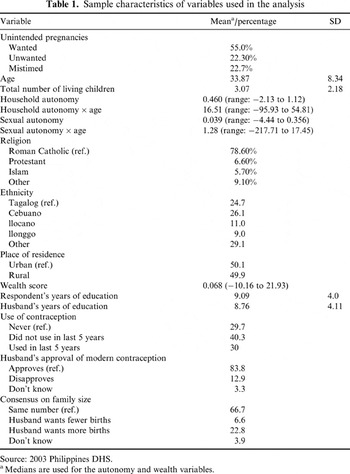
Table 1 shows that nearly half of pregnancies are unintended, with 22.3% of the respondents reporting that their last or current pregnancy was unwanted, while an additional 22.7% noted they wanted their births later. The average age of the sample is 33 years, with respondents having on average of three children. The median scores for household and sexual decision-making autonomy are 0.460 and 0.039 respectively. An overwhelming majority of the population adhere to Roman Catholicism (79%), while a small minority (almost 6%) are Muslim. About a quarter of each of the specified ethnic groups are the Tagalogs and Cebuanos, while 11% and 9% are Illocanos and Illongos respectively. Women had more years of schooling (9.09) than their husbands (8.76). The median of the wealth score is 0.068. Almost 30% reported that they have never used contraception, while 40% claimed they did not use it in the last five years. Another 30% reported that they have used contraception in the last five years. A vast majority of respondents reported that their husbands approved of contraception (83.8%), while 13% claimed their husbands did not approve of contraception. A small minority reported that they did not know of their husband's position regarding contraception. About two-thirds (66.7%) of women reported that there is consensus with their husbands on the number of children they would like to have, while only 6.6% stated their husbands wanted fewer children than their wives do. On the other hand, 22.8% reported that their husbands wanted more children than the wives, while a small minority (3.9%) stated they were not aware whether they wanted the same number of children as their husbands.
Sample characteristics of variables used in the analysis

Source: 2003 Philippines DHS.
a Medians are used for the autonomy and wealth variables.
Bivariate analysis
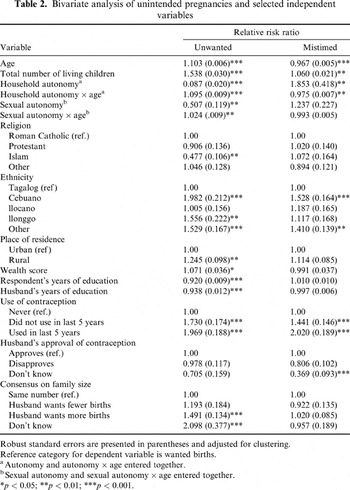
Table 2 shows that age is positively associated with unwanted pregnancies but is negatively associated with mistimed pregnancies. Not surprisingly, total number of living children had a strong association with unwanted births (1.54) but weaker association with mistimed births (1.06). Women with higher levels of household and sexual decision-making autonomy have lower risks of having unwanted births. A positive association between household autonomy and mistimed births is also noted. For older women, household and sexual autonomy is found to be associated with unwanted births. However, older women with more household autonomy are less likely to view their last birth as mistimed relative to a wanted one. In comparison with Roman Catholics, Muslims have lower risks of having unwanted births relative to wanted births. Compared with the Tagalogs, the Cebuanos, Ilonggos and women from other ethnic groups have higher risks of experiencing unwanted pregnancies. Cebuanos and respondents from other ethnic groups have higher risks of experiencing mistimed births/pregnancies relative to wanted ones. In comparison with those who reside in urban areas, rural residents have higher risks of unwanted births relative to wanted births. Residence, however, was not significantly related to mistimed pregnancies. Greater wealth, measured by ownership of household durable goods, is associated with higher risks of unwanted pregnancies, while higher education (for the respondents and their husbands) is associated with lower risks of unwanted births/pregnancies. Compared with those who have never used contraception, women who did not use contraception in the last five years (but have used it before) and those who used it in the last five years have higher risks of experiencing unwanted and mistimed births, relative to wanted births. In comparison with women whose husbands approved of contraceptive use, respondents who did not know their husband's position on family planning have lower risks of having mistimed births relative to a wanted one. Women whose husbands wanted more births have higher risks of experiencing unwanted pregnancies relative to wanted pregnancies, compared with women who wanted the same number of children as their husbands. Also, those who were not aware of their husband's ideal family size had higher risks of having unwanted births relative to a wanted one.
Bivariate analysis of unintended pregnancies and selected independent variables

Robust standard errors are presented in parentheses and adjusted for clustering.
Reference category for dependent variable is wanted births.
a Autonomy and autonomy×age entered together.
b Sexual autonomy and sexual autonomy×age entered together.
*p<0.05; **p<0.01; ***p<0.001.
Multivariate analysis
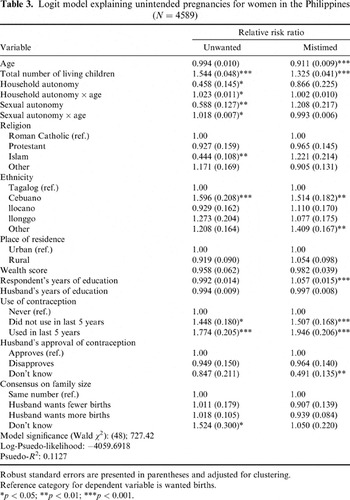
Table 3 shows the effects of selected independent variables on unwanted births for women aged 15–49 in the Philippines. Both the main effects and interaction terms for household and sexual autonomy are interpreted given their theoretical relevance and statistical significance. Household and sexual decision-making autonomy points to the saliency of women's position pertaining to household decisions and sexual relationships with husbands. Regardless of women's status, having a final say in household matters and attitudes that point towards greater sexual autonomy with husbands lowers the risk of unwanted births. Household and sexual decision-making autonomy, however, did not have a significant effect on mistimed births. Women with higher household and sexual autonomy have 54% and 41%, respectively, lower risks of experiencing an unwanted birth, compared with a wanted one. Though the effects are small, the significant interaction terms are noted, as older women with more autonomy (both household and sexual) have higher risks of reporting their last birth/pregnancy as unwanted. While household autonomy was highly significant in the bivariate models, the significance and the magnitude of the coefficient are attenuated when other variables are controlled. Islam is the only religion shown to be statistically significant and in the negative direction for unwanted births, suggesting the pronatalist views on childbearing among Filipino Muslim women. In comparison with the Roman Catholics, Muslim women had a 56% lower risk of experiencing their last birth or current pregnancies as unwanted relative to a wanted one. Differential effects of ethnicity are observed, which may also be capturing regional differences. Compared with the Tagalogs, Cebuanos have 1.6 and 1.5 times higher risks of having unwanted and mistimed births, respectively, relative to a wanted one. Other ethnic groups have 41% higher risks of having mistimed births relative to a wanted one. Wealth status and rural residence were not significantly associated with unwanted and mistimed births. Women's education has a significant effect on mistimed pregnancies, as one more year of education increases the risk of experiencing a mistimed birth by almost 6%. Total number of living children is associated with both types of unintended pregnancies, with each additional child increasing the risk of unwanted and mistimed births by 1.54 and 1.33, respectively. The effects of the coefficients for age, maternal education, Illonggos and the husband's desire for more children were reduced to non-significance once total number of living children was controlled for.
Logit model explaining unintended pregnancies for women in the Philippines (N=4589)

Robust standard errors are presented in parentheses and adjusted for clustering.
Reference category for dependent variable is wanted births.
*p<0.05; **p<0.01; ***p<0.001.
In comparison with women who have never used contraception, those who did not use contraception in the last five years have higher risks of experiencing unwanted and mistimed births/pregnancies relative to a wanted one. Also, those who reported having used contraception were 1.77 times and 1.95 times more likely to report their births/current pregnancy as unwanted and mistimed, respectively, relative to a wanted one. The husband's stance on contraception and consensus regarding family size reveals insights into the power dynamics among Filipino couples for unwanted and mistimed births. In comparison with husbands who approve of contraception, women who did not know their husband's views on family planning had 51% lower risks of having mistimed births/pregnancies relative to a wanted one. The uncertainty among couples' desire for number of children is also noted. Compared with women who wanted the same number of births as their husbands, those who did not know their husband's views on ideal number of children had higher risks (1.52 times) of having unwanted births/pregnancies relative to a wanted one. This highlights the crucial implication of the ambivalence in couples' preferences regarding ideal family size and contraceptive use.
Discussion and Conclusion
This study finds that Filipino women with higher levels of household and sexual autonomy are less likely to report unwanted births/pregnancies, but not mistimed pregnancies. As past studies have found, having the ability to make household decisions that range from major household purchases to minor ones, which include what to cook for the day, have links to important life choices that ultimately impact one's reproductive intentions (Upadhyay & Hindin, Reference Upadhyay and Hindin2005). Equally relevant is the need to consider other dimensions of autonomy, or the extent to which women are able to exercise their decisions in the sexual domain. It is also important to note that the interactions between autonomy and age were significant, indicating that higher autonomy among older women is associated with greater risks of unwanted births. There are probably strong generational differences in how younger and older women interpret and exercise their autonomy. Hindin (Reference Hindin2002) demonstrated that differences exist among younger and older married women regarding fertility intentions and preferences, with younger women reporting that they would be the sole decision-maker pertaining to the number of children they would have. Therefore, an in-depth examination of cohort differences may generate insights into how older and younger women understand these different dimensions of autonomy and how this manifests in their ability (or lack thereof) to exercise their fertility preferences. A limitation of the sexual autonomy measure is that it may be capturing attitudes rather than actual sexual decision-making behaviours of women. The DHS does not provide specific information about the circumstances in which the woman has actually refused sex with her husband. Nevertheless, it is important to consider other measures of autonomy that are relevant to less-developed societies, including one that attempts to capture some degree of control over one's sexuality (Dyson & Moore, Reference Dyson and Moore1983). This is even more critical in a country where women's education is among the highest in Asia, yet where they are not empowered enough to take control of their sexual and reproductive choices.
Education was not observed to be significantly related to unwanted pregnancies, but was positively related to mistimed pregnancies. This is consistent with studies in other geographical settings such as Indonesia (Jaeni et al., Reference Jaeni, McDonald and Utomo2009). The reason for this is that educated women have increased awareness of what constitutes a desirable family size, mostly achieved through effective family planning practices. Also, women with higher education usually have more control over their sexual and reproductive health, and consequently have fewer children than their uneducated counterparts, making them more likely to classify pregnancies as mistimed than unwanted (see Jaen et al., 2009). It is important to note, however, that the statistical significance of education on unwanted pregnancies/births disappeared once total number of children a woman has was controlled for. It was found that the more children the woman has, the greater the risks of having unwanted and mistimed births. Past studies point to number of previous births being associated with unwanted and mistimed pregnancies, in that women with more children may have already reached the desired family size making any extra child unwanted (Eggleston, Reference Eggleston1999). The 2003 Philippines DHS also reports that nearly one-third of fourth or higher-order births were unwanted (Measure DHS, 2003).
This study corroborates previous findings that report women's autonomy as being more important than women's status in influencing fertility intentions (Upadhyay & Hindin, Reference Upadhyay and Hindin2005). Recent evidence also questions the use of women's status as a proxy for women's autonomy, suggesting that irrespective of education or employment, women's decision-making capabilities have an independent role in reproductive behaviour (Woldemicael, Reference Woldemicael2009). As Heaton et al. (Reference Heaton, Huntsman and Flake2005) found, status variables such as education have a moderate relationship with autonomy in Bolivia, and an even weaker effect in Nicaragua and Peru, suggesting that programmes that increase girls' education would only have a modest impact on enhancing women's control over their lives. Indeed, the summary results from the 2003 DHS show women with a high school education or higher, and those with more wealth, had the least say in household decisions, suggesting that Filipino women with the highest status are not necessarily highly empowered to make household decisions. Partner's education had no impact on unwanted or mistimed births.
Regarding ethnicity, it was found that Cebuano women were more likely to report unwanted and mistimed births/pregnancies than their Tagalog counterparts. Cebu is one of the largest metropolitan cities in the Philippines and it is likely that women in large urban cities may hold expectations of a smaller family size. The increased risk of unwanted pregnancies among Cebuano women warrants further inquiries into the regional and ethnic differences in unintended pregnancies and what accounts for these variations.
In comparison with the majority of Filipino women who adhere to Roman Catholicism, Muslim women had lower risks of unwanted pregnancies, suggesting pronatalist views on childbearing among these groups. The Muslim minority in the Philippines constitute almost 6% of the country's population, with the majority residing in the southern part of the Philippines, notably Mindanao. Past studies have found that in comparison with non-Muslims, Muslims expressed desire for more children and that these pronatalist attitudes could not be explained by lower levels of autonomy among Muslim women (Morgan et al., Reference Morgan, Stash, Smith and Oppenheim Mason2002). According to Morgan et al. (Reference Morgan, Stash, Smith and Oppenheim Mason2002), these differences in demographic behaviour may be linked to group identity and political disadvantage, where reproductive intentions (including contraceptive use and ideal family sizes) reflect group solidarity and cohesiveness among this minority population. The region itself is experiencing one of the largest and long-standing conflicts in the country, with fourteen of the 20 poorest provinces being found in Mindanao (Schiavo-Campo & Judd, Reference Schiavo-Campo and Judd2005), calling for an investigation into how minority group status is intertwined with structural disadvantages among this minority population to ultimately impact reproductive intentions.
In comparison with women who never used contraception, those who did not use contraception in the last five years, as well as those who used contraception, had higher risks of both unwanted and mistimed births/pregnancies. Although counterintuitive, this finding is consistent with other studies that also report higher unintended pregnancies among women who used contraception in the past (Eggleston, Reference Eggleston1999; Jaeni et al., Reference Jaeni, McDonald and Utomo2009). There could be several reasons for this finding. First, given that the exact timing of contraception use is not known, it may be that women who got pregnant, or who had unwanted/mistimed births, began using contraception after the experience. It was not possible to establish the sequencing of contraception usage and unwanted/mistimed births due to the cross-sectional nature of the data, and the use of longitudinal data to disentangle the complex causal connections between the two variables is recommended. Second, is the possibility that users of contraception usually have higher expectations regarding limiting and spacing pregnancies and births, such that they are more likely to report pregnancies or births as unplanned/mistimed (Eggleston, Reference Eggleston1999).
Thus is seems that providing access to family planning is not enough, but must be accompanied by an effective means of conveying information about proper and continuous use of contraception (Jaeni et al., Reference Jaeni, McDonald and Utomo2009). A recent report indicates that fewer than half of women were using contraceptive methods with high effectiveness and that difficulties with obtaining contraceptive services, especially in rural areas, are quite common (Guttmacher Institute, 2009). Thus, addressing of economic, social and cultural barriers to family planning programmes is paramount in ensuring effective use of contraception as a pathway to reducing unintended pregnancies.
While respondents' uncertainties about their husbands' ideal family size were associated with higher risks of unwanted births, approval of contraception was associated with lower risks of mistimed births. It appears that communication, and an agreement on number of desired children, between spouses may determine fertility intentions among Filipino women. In a study of patterns of family planning behaviour, co-operation and understanding between spouses emerged as an important factor for the effectiveness of family planning (Avila & Wong, Reference Avila and Wong2001). Past literature has found that while Filipino women generally have higher levels of autonomy, Filipino husbands often dominate in the realm of family planning (David, Reference David1994). Evidence from Kenya points to the need to recognize husbands' fertility preferences in reproductive matters, especially where their preferences supersede those of their wives' (Dodoo, Reference Dodoo1998). DeVanzo et al. (2003) concur that whenever there is a spousal disagreement regarding desire for more children, the wife may be swayed by her husband, particularly if he prefers to have more children. A limitation of the present study is that the husbands' views surrounding contraception and family size were based on the wives' reports. This underscores the importance of future studies to investigate the dynamic relations between husbands and wives regarding fertility intentions.
This study has shown that, compared with education, women's household and sexual autonomy play an important role in reducing the risks for unwanted pregnancies in Filipino women, calling into question the use of status variables as indicators of women's autonomy. Past studies have mainly examined aspects of household autonomy, making this study very important as it adds to the literature by examining other facets of women's autonomy, namely sexual decision-making autonomy or a woman's ability to assert her needs on sexual matters with her partner. The inability of women to assert their needs or preferences in household matters and the sexual domain will undoubtedly have an impact on their ability to practise effective contraception and hence reduce the very high levels of unintended pregnancies in the Philippines.