Nineteenth-century anti-vice crusader Anthony Comstock has a reputation for fathering United States obscenity law. Even now, he enjoys a cult-like following among social conservatives, and an equally fervent contempt among social liberals. A little-known dry-goods clerk until 1872, he stepped into the limelight that year to take on the mantle of guardian of the nation's morality. Less well known are some surprising – and largely unintended – consequences of his anti-vice activities. It is ironic, for one thing, that the man who defined modern American censorship also goaded into existence the radical free speech opposition movement. His pursuit of educational reformers as if they were peddlers in obscene tracts forced some libertarians, despite their personal disgust with “vicious literature,” to embrace a free press position. But it is perhaps more significant that Comstock's manipulations of 1870s visual culture, particularly in depictions of sexual violence, heightened racial stereotyping in public print. Concurrent with his campaign against sexual education literature, his behind-the-scenes negotiations with popular illustrated newspapers led their editors to erase or reconfigure white sexuality, which they replaced with highly stylized morality tales about interracial rape of white women by black men. In fostering both the rise of the free press movement and the selective racialization of visual culture, Comstock left an indelible mark on the development of modern representation.
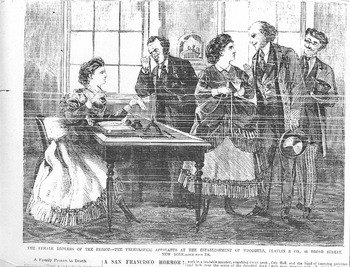
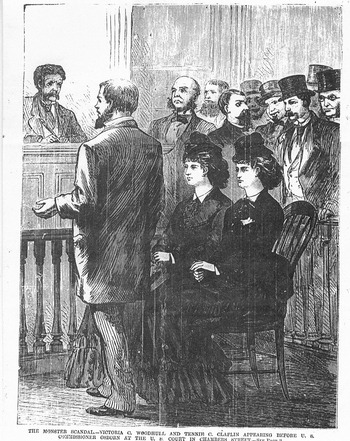
Comstock rose to national fame (or infamy) in November 1872, when he arranged the arrest of social radical and women's rights activist Victoria Woodhull. As part of his anti-vice campaign, he charged Woodhull with obscenity, because she had recently published a story in her newspaper accusing the popular Brooklyn pastor, Henry Ward Beecher, of adultery. Publication of this story launched the nineteenth century's most notorious sex scandal, and the Beecher–Tilton trial became a byword for sexual hypocrisy in the Protestant Church. Comstock was outraged by Woodhull's attack on Beecher, but was even more concerned about the scandal's wider influence on public opinion, and he took steps to limit her visibility. Early in 1873, Comstock put pressure on the publisher of a “sporting” newspaper, a sensational illustrated weekly called The Days' Doings, where Woodhull and her sister, Tennessee Claflin, had been regularly pictured. From the opening of their brokerage firm in 1870 (Figure 1), through their political campaigns, their support of “free love,” and their arrest and indictment for “obscenity” for the Beecher exposure Figure 2), the sisters were popular (if disreputable) celebrities in The Days' Doings.Footnote 1 Despite this prominence they disappeared from the illustrated weekly in 1873, on the heels of Comstock's intervention. Their erasure reflects his determination that their arguments for open discussion of sexual matters – in any form and context – must be suppressed.
Woodhull and Claflin, sporting the short skirts and bold stares of “fast” women, conduct business in their brokerage house. From this point, the sisters received regular coverage in the paper for three years. “The Female Brokers of the Period,” The Days' Doings, F 26, 1870.

Indictment of the notorious Woodhull and Claflin for “obscenity” after their exposure of Henry Ward Beecher for alleged adultery. Following Comstock's intervention in the publication, the sisters disappeared from the paper entirely. “The Monster Scandal,” The Days' Doings, November 20, 1872.

If the late nineteenth century constituted what David Rabban calls the “forgotten years” of the free speech struggle, I suggest that the 1870s comprised the critical decade, setting the terms for all subsequent debate. Because the 1865 postal law under which Comstock had Woodhull arrested proved inapplicable to newspapers (she was eventually acquitted), he used the case's notoriety to push through a stronger law in 1873, for the “Suppression of Trade in, and Circulation of, Obscene Literature and Articles of Immoral Use,” better known as the Comstock law. The earlier law, designed to protect young soldiers fighting in the Civil War, had pertained only to erotica in books and pamphlets sent through the mail, but the new law radically broadened the government's power to regulate printed material. First, it expanded the materials that could be deemed obscene to include newspapers, advertisements, and a variety of products geared toward contraception. Second, it defined obscenity in such vague terms as to include any kind of sexual information, including basic physiological facts. As Helen Lefkovitz Horowitz demonstrates, the Comstock law became, through successful prosecution, a weapon against social liberals and commercial publishers alike.Footnote 2 At first, social liberals, like Comstock convinced of the dangers of commercial eroticism, argued that their educational works would counteract the “invasive sensualism” of public culture. When Comstock applied his new law with equal fervor against educational publishers, however, they began to re-evaluate the implications of censorship itself.
Commercial publishers, by contrast, ducked the free press debate, adapting their images sufficiently to evade censorship. As the larger struggle over sexuality discourse raged in the courtroom and public print, Comstock waged a quieter campaign against sporting newspapers, illustrated men's publications that were widely available in public spaces, like barrooms and barbershops, and were cherished by youthful readers as gateways to urban excess. In January 1873 and February 1877, respectively, he targeted the producers of The Days' Doings and the National Police Gazette for “obscene” images and advertisements. Wielding like a club his growing celebrity as anti-vice crusader, he forced publishers Frank Leslie and Richard K. Fox to alter the tone and content of their illustrated weeklies. Each publisher adapted production in different ways; both struggled to adhere to Comstock's standards of what was too “lewd” for publication. The Days' Doings highlighted frontier violence for a family audience, while the Police Gazette repackaged its message of white male social and sexual prerogative for a broader market that included Irish American men. Both turned to violence along with stereotyped notions of race, crime, and sexuality to evade the censor's scrutiny. Together, the two interventions suggest that Comstock played a significant – and probably unintentional – role in shaping sensational media.
One of the difficulties in understanding nineteenth-century illustrations is that of seeing them as their contemporaries saw them, and of viewing them within what Frank Couvares calls “the broad social context of censorship struggles.” By today's standards sporting illustrations seem offensive on many levels, but hardly obscene. The internal debate of social liberals in the 1870s, who were also targets of Comstock's censorship campaigns, can help here, by revealing contemporary impressions and definitions of “lewd” and “vile” publications. Middle-class social activists, from moral reformers to women's suffragists, despised sporting illustrations. Even radical libertarians who championed individual freedoms, from self-styled “freethinkers” (i.e. opponents of organized religion) to anarchists and sex radicals, at first denounced a wide range of publications, including dime novels and sporting newspapers. As Rochelle Gurstein notes, many intellectuals shared Comstock's concerns about the rise of commercial, sensational media, which they believed “were undermining individual morality and the public good.” It was Comstock's persecution of social radicals that fractured this unspoken consensus and mobilized a free press opposition to censorship.Footnote 3
Comstock targeted marriage reform and sexual hygiene publications concurrently with sporting illustrations because he felt that both endangered the unwary reader. Indeed, Comstock found social liberals like Woodhull and D. M. Bennett (a later target) more threatening to public morality than sporting publishers. Because reform publishers were more concerned with social reform than profit, Comstock's attacks gradually pushed them to consider an ideology of a completely free press. As internal debate among social liberals between 1872 and 1879 reveals, their own contradictory views about obscenity and discomfort with “vile” publications made the free press position a difficult, if unavoidable, choice. Preoccupied with protecting their own educational materials from suppression, they reversed their early tolerance for censorship, but in the process ceded authority to criticize the visual content of sporting newspapers. Many women's rights advocates, labor activists, and former abolitionists were mute as new stereotypes of women, workers, and people of color took hold in commercial illustrations. In the absence of liberal opposition, Comstock's interventions in sporting illustrations downplayed white sexuality while mythologizing the criminal sexuality of black men. What began as a crusade against one radical woman left a marked imprint upon late nineteenth-century visual culture.
REFORM OPPOSITION TO “VILE” PUBLICATIONS
In this early phase of his career, between 1872 and 1879, Comstock consolidated his hold over public expressions of sexuality. From the arrest of Woodhull and Claflin, to the conviction of liberal D. M. Bennett (upheld by the US Supreme Court in US v. Bennett in 1879), Comstock reined in publications ranging from erotic novels, to nude pictures, to men's “sporting” newspapers like The Days' Doings and the National Police Gazette, to reform newspapers, to dry treatises on human physiology and marriage reform. He recognized no differences among these disparate productions. Together, they were to Comstock symptoms of a wider social problem: whatever their purposes, each kind fostered open discussion of ideas he found inappropriate for – and corrupting of – the public sphere. Publishers' intentions were irrelevant, in his view, because even factual information about human sexuality might encourage wanton behavior; publications concerning sexuality could be taken out of context by boys and girls, promoting sexual activity among young people. Comstock's belief that government was obligated to protect the young from all manner of sexuality discourse set the stage for a six-year struggle over the meaning of obscenity, a struggle that he ultimately won.Footnote 4
A zealous foe of pornography producers and vendors, Comstock saw sporting newspapers like The Days' Doings and the National Police Gazette as equally insidious purveyors of obscene images. Indeed, he felt that their effect on the young was worse than pornography because they were so readily available to view. As Comstock explained in 1883, looking back on the 1870s,
[Satan] resolved to make the most of these vile illustrated weekly papers, by lining the news-stands and shop windows along the pathway of the children from home to school and church, so that they could not go to and from these places of instruction without giving him an opportunity to defile their pure minds by flaunting these atrocities.Footnote 5
Sporting newspapers were dangerous, in other words, because they were so widely accessible. Reformers across the political spectrum who shared his underlying assumptions about their negative impact on morality agreed with Comstock's concern about both the content and the apparent popularity of such papers. A broad consensus existed that such “disgusting” material was unworthy of publication.
Comstock's rationale for suppressing The Days' Doings echoed views of middle-class white reformers, many of whom were women. Comstock's suppression campaign was quite compatible with women's moral reform sentiment in the post-Civil War years, for example, though he did not initially welcome women into his organization. The desire to curtail such publications was a logical outgrowth of a “separate spheres” ideology, which held that the private realm (and particularly women and children) needed protection from the public realm. “I know of our police papers only by hearsay,” veteran women's rights activist Julia Ward Howe told the Second Women's Congress in Chicago in 1874, “but I do hear that there is much in them which can only brutalize and pollute the minds of their habitual readers.” Like other moral reform activists, Howe abhorred the rampant sensuality and violence of public culture, and saw women as particularly well suited to protecting children's purity from such threats: “it becomes the guardians of society to keep a watchful eye upon the press,” she believed. Howe's separate spheres argument for cleaning up public culture was entirely compatible with, and supportive of, Comstock's determination to suppress “impure” literature. As Howe put it, “I can imagine nothing more important than the careful and rigid enforcement of the [obscenity] laws.”Footnote 6
From a slightly different perspective, woman suffragists objected to the way illustrated newspapers demeaned women's political aspirations. They saw illustrated sporting news as a political weapon men used to keep women down. One writer to The Revolution in 1869, for example, criticized “an obscene weekly paper” for publishing a caricature of woman suffragists in a recent edition, which she felt represented the “persistent attempt on the part of all the newspapers by personal ridicule and vilification, to choke down” the suffrage movement. Actress and theater reformer Olive Logan agreed that men disparaged or ignored suffrage coverage, while “Anything … that is written about women, particularly if it be anything scandalous or disgraceful, is eagerly perused.”Footnote 7 Sporting papers like the Police Gazette and The Days' Doings were so insulting to women, said western suffragist Abigail Duniway, that they should be called “man's rights journals.” Demeaning images of women in sporting news, she felt, even posed a physical barrier for women in public spaces:
Certain newsdealers in Portland [Oregon] from week to week exhibit to the public gaze through the medium of their shop windows obscene pictorial newspapers of the most disgusting character. No lady can enter such a place without being virtually insulted by the base caricatures of her sex.Footnote 8
The visibility of such images in newsstands and barbershops on city streets, in other words, deterred “respectable” middle-class women from the public realm.
Other social liberals agreed that sensual commercial publications, particularly pornography, posed many dangers. But Comstock's inclusion of physiology tracts as targets for censorship in the 1873 postal law forced reformers who opposed “vile” material to distinguish their publications from the works they abhorred. In 1873 and 1874, freethinker D. M. Bennett supported Victoria Woodhull during her famous legal struggles with Comstock, and along with readers of his journal the Truth Seeker sought to clarify how her publication of the Beecher scandal, as well as articles on sexual hygiene and marriage reform, was distinct from obscenity. As one Woodhull supporter writing to the Truth Seeker put it,
obscenity is certainly a vile crime, which should not be tolerated in civilized society, and the punishment of its author should be as severe as the law can inflict, but it is incumbent upon us to well define the lines of demarkation [sic] between decency and indecency.
Physiology writers and their supporters, in other words, challenged the definition, not the existence, of obscenity; they claimed that their own works, intended to educate and protect public health, were not obscene.Footnote 9
Early prosecutions under the Comstock law radicalized some social liberals, however. When Comstock arrested Woodhull's friend John Lant for mocking the Beecher–Tilton trial and discussing physiology in his paper, the Toledo Sun, late in 1875, and reformer E. B. Foote for his medical book, Plain Home Talk and Medical Common Sense, Bennett called both Lant and Foote “martyrs of a new war for liberty.” Like Bennett, Foote's supporters distinguished between education and titillation:
Laws against the sending out of licentious and immoral books, pictures, etc., are right, and should be rigidly enforced against the vile scoundrels, who, for a little paltry gain, are willing to debauch and ruin their victims. But to class your chaste physiological writings with these infamous publications is an utter confounding of distinctions, which even our wise legislators cannot fail to see.
In 1876, Foote and his supporters founded the National Liberal League, partly to advocate the separation of church and state, but also to protest this “confounding of distinctions” between educational materials and obscenity.Footnote 10
In short, advocates of sexual education sought to distinguish publications intending to increase sexual understanding from those seeking to titillate or entertain. Bennett, for one, agreed with Woodhull, even before her arrest, that frank discussion of sexuality and female physiology was a necessary part of raising healthy children. He shared with Woodhull and other sex radicals the belief that children needed some sexual knowledge, and also their conviction that such knowledge should be factual and wholesome rather than lurid and sensational: it should appeal to rational thought rather than base passions. But it was precisely this new sexual openness that so alarmed Comstock, who recognized no distinction between sexual education and titillation. Instead, he adhered to the more strict position of English (and American) common law, established in mid-century England and recently codified in the the Queen v. Hicklin decision (1868), that the intended purpose of a physiological tract was irrelevant if it had a “tendency … to deprave or corrupt” any one who might come across it, particularly the young. It was a view the US Supreme Court would endorse in 1879.Footnote 11
“LEWD” IMAGES IN THE DAYS' DOINGS
This debate over the boundaries for sexuality discourse was under way when Comstock turned his attention to sporting newspapers. Indirect association with Woodhull probably made the publisher of The Days' Doings a target of Comstock's suppression campaign in early 1873. The paper, while never a huge seller, nevertheless was a widely available source of male entertainment and titillation.Footnote 12 Frank Leslie, better known for his family journal Frank Leslie's Illustrated Newspaper, had recently defended Woodhull and Claflin as they sat in jail without formal indictment the previous November. While he condoned neither their views about free love nor their exposure of Beecher, Leslie challenged the legality of Comstock's actions against the sisters. Beecher should prosecute them for libel, instead of bringing federal charges against them, said Leslie in his illustrated family weekly; he argued on free speech grounds that “Woodhull & Co. have a right to public opinion, and public opinion depends on the press.”Footnote 13 Within weeks, Comstock enlisted the district attorney's support to indict Leslie for multiple counts of obscenity in his less reputable illustrated paper The Days' Doings. “At last, at last!!” Comstock wrote in his diary that day. “Thank god! At last action is commenced against this terrible curse. Now for a mighty blow for the young.”Footnote 14 Apparently assuming that Comstock's real goal was to punish him for supporting Woodhull, Leslie immediately removed her from The Days' Doings, suppressing her controversial – and highly newsworthy – interactions with Comstock that month.Footnote 15
At first, Leslie chose not to defend The Days' Doings on free press grounds; instead he challenged the obscenity charge itself. Apart from erasing Woodhull, Leslie at first seemed confident that his sporting paper was not obscene; he resisted intervention in The Days' Doings, claiming that neither the paper's advertisements nor its illustrations were inherently immoral. “Some busy, perhaps in some instances well-meaning people, for a long time past, have affected to dislike what they call the moral tone of the journal,” Leslie wrote in an editorial on the eve of his indictment for obscenity. The patronage of “good families” testified to the paper's moral tone, he felt; critics misunderstood the publication's mission “to illustrate with the pencil the striking and romantic news of the day.” Illustrations alone did not make a publication obscene. As Leslie saw it, “If our pencil is false to morality, then the entire news Press of the nation, which we simply illustrate, is a fountain of iniquity.”Footnote 16 He made no claim to his right to freedom of expression. Rather, he questioned whether illustrations themselves made stories gleaned from the national press obscene; he denied, in other words, that pictures were more corrupting than words.
Until he was formally indicted, Leslie likewise disputed the assertion that advertisements found in The Days' Doings were inherently immoral. Making humorous reference to one advertisement that seemed to offer “lewd books” for sale, he noted that upon request he found that “the publications advertised were three tracts which had been issued by a Christian Association.” Henceforth, he sarcastically promised, such dangerous advertising would be refused.Footnote 17 Indictment by the Grand Jury for obscenity on 28 January quenched this editorial humor, however. Perhaps to avoid a trial (as he did not publicly identify himself as the paper's editor), Leslie dispatched his lawyer the same day to invite Comstock to visit his premises and promised to conform to Comstock's definition of obscenity for both images and advertisements. As Comstock recalled the meeting in his ledger, “Leslie gave instructions to all his men, not to receive any advertisements of doubtful characters, [and] his artists not to put in any picture of lewd character.”Footnote 18 Threat of prosecution for obscenity, in other words, forced the editor to rein in the advertising page. “Advertisements have crept into this paper which, upon very recent investigation, we find have represented such business as the proprietors of The Days' Doings disapprove,” Leslie now explained. “We have thrown out of the present issue all equivocally-phrased advertisements. We shall receive none which are questionable hereafter, no matter how disguised whether as medical advertisements or otherwise.” He referred not only to advertising relating to abortion and venereal disease, but also “divorce advertisements” and those having a “sporting character” or even slightly “tinged with a double meaning of any sort.” The Days' Doings, Leslie promised, was and would remain a “family journal, fit for the instruction and amusement of intelligent, moral families.”Footnote 19
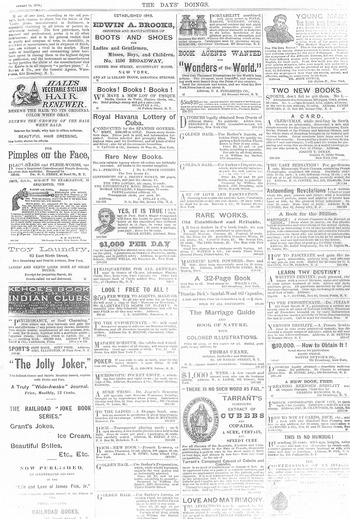
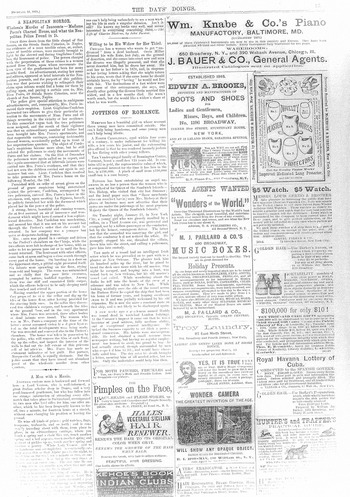
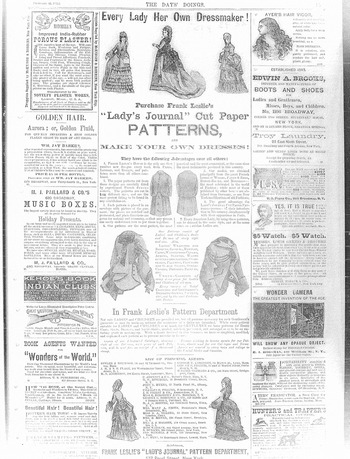
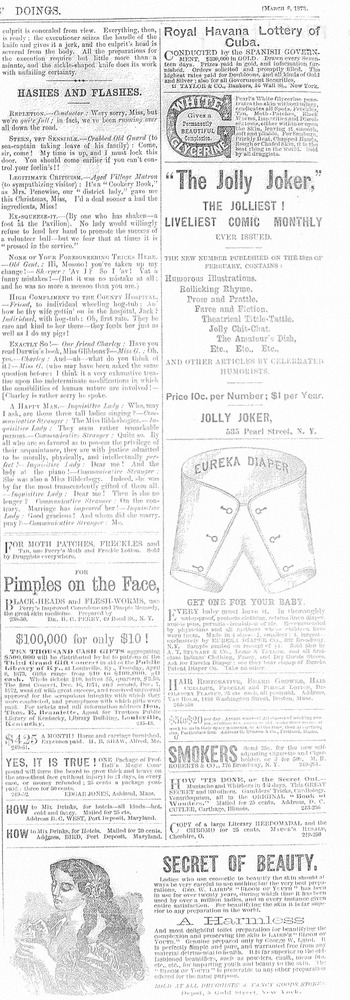
Leslie made no principled stand to defend free expression; his new compliance was immediately evident on the advertising page. The quantity of advertisements immediately shrank from four to two columns (Figures 3 and 4) with the abrupt removal of long-running advertisements of “doubtful character.” Gone were promises of “Divorces legally obtained – desertion sufficient cause. No publicity.” Erased were the more numerous mail-order cures for venereal disease. No longer did the forlorn features of a dissipated youth – heralded with the discreet “Young Man: You Have Been Imprudent” – appeal to those afflicted by “exposure” (to venereal disease) with a detailed catalogue of symptoms and cures for “certain diseases to male and female” without prescriptions. The offers of “Dr. Richau's Golden Remedies,” promising a thousand-dollar reward to anyone not cured, by his method, of “any private disease,” and like advertisements similarly vanished. Marriage manuals (with “colored illustrations”), “rich” transparent cards and books about French governesses likewise disappeared without a trace. Discreet propositions “to the ladies” of informative books and recipes that made “Every Woman Her Own Physician,” and other veiled abortifacients, shared the same fate.Footnote 20 Deprived of these sources of advertising income, the paper struggled for two weeks to secure replacement advertisements. A new array of products for the middle class gradually took over the advertising page. “Novelty Plaster Works Lung Protectors,” and the “Wonder Camera: the Greatest Invention of Our Age,” at first filled the void left by the banished “lewd” and “immoral” advertisements. By the third week, the paper filled its empty columns with advertisements designed for mixed middle-class family readers, and particularly women: Frank Leslie's dress patterns, pianos, and music boxes, and, finally, that most homely of consumer goods, a diaper (Figures 5 and 6).Footnote 21
Notices for divorce, prevention and treatment of venereal disease, and contraceptive devices were common in the paper's advertising page before Comstock intervened. The Days' Doings January 25, 1873, 15.

Advertisements shrank from four to two columns as Leslie, under threat of indictment for obscenity, abruptly dropped questionable advertisements, particularly those having sexual connotations. The Days' Doings, February 15, 1873, 15.

In the newly sanitized advertisements in the wake of Comstock's intervention, ladies dress patterns took the place of the controversial advertisements. The Days' Doings February 22, 1873, 15.

Two weeks later, a diaper appeared, suggesting a radical rethinking of potential audience. March 8, 1873.

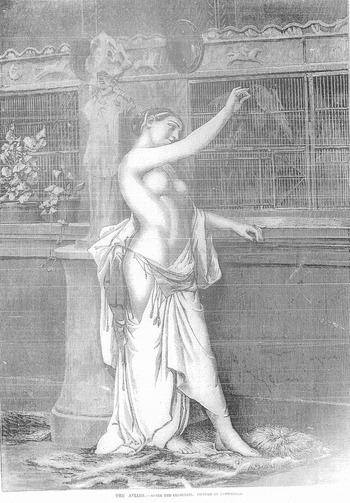
To avoid trial, Leslie likewise adapted his illustrations; the publisher had promised, after all, not just to refuse dubious advertisement, but also to prevent publication of “any picture of lewd character.” Adjustments to the paper's illustrations offer us an unusual opportunity to comprehend 1870s definitions of “lewd” imagery. Most strikingly absent after 1873 were the line reproductions of paintings and statues for the edification of more sheltered American eyes. Partially draped with cloths and shielded by body positioning, these classically inspired nudes or semi-nudes had long been a staple feature in The Days' Doings, appearing as occasion (or lack of titillating news spectacles) demanded. The reproduction in Figure 7, for example, had the authority of a “master” behind it. Similar reproductions invoked a high-art principle while mass marketing the female nude to barbershop audiences. As Nicola Beisel notes, Comstock was particularly concerned about the availability of nudity in high art to “the rabble,” as he described a mass audience.Footnote 22 Comstock's suppression of such images in sporting news left editors with the dilemma of how to satisfy popular demand for provocative images without violating his new visual standards.
A typical rendering of a “celebrated” classical nude; such images appeared regularly before Comstock intervened. “The Aviary,” The Days' Doings, July 2, 1871.

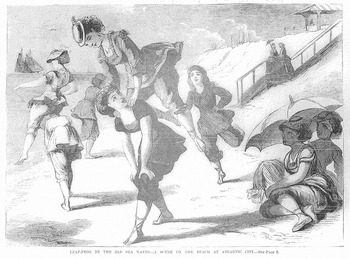
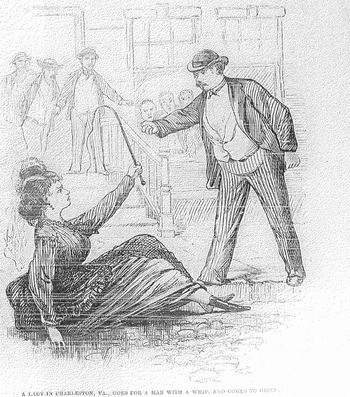
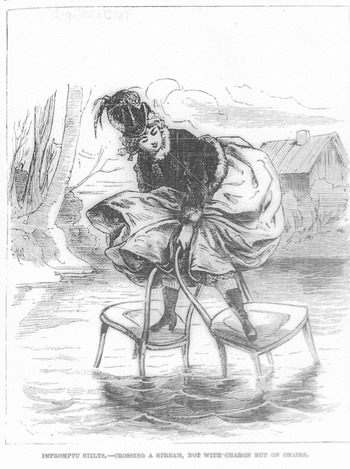
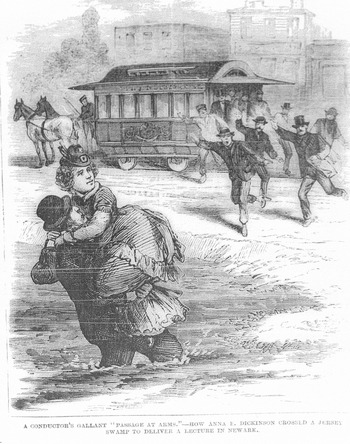
To do so, The Days' Doings stepped up its visual taxonomy of class and racial distinctions for female bodies. Even before 1873, the paper had a long tradition of differentiating women according to notions of private and public, respectable and “fast.” Put baldly, some women's bodies were fair game for illustration, and some were off-limits. This dichotomy in visual representation was under negotiation in the 1870s, as more “respectable” women ventured into the public realm, and thus into public print. Obvious candidates for illustration were feisty, saucy, or “plucky” public women, romping beachgoers (Figure 8), ballet girls, and circus women, their voluptuous bodies readily available for scrutiny.Footnote 23 Even respectable women could be marked by exposed ankles, typically in mockery (Figure 9).Footnote 24 After Comstock's intervention in 1873, middle-class women received more respectful treatment in The Days' Doings: ankles that might have been visible in the face of disaster or danger, before the intervention, were now respectably covered (Figures 10 and 11).Footnote 25 Comstock's definition of lewdness evidently shielded respectable middle-class women even from modest exposure.
Beach girls and ballet girls often figured in the sporting press, as a mechanism for revealing women's bodies to the viewer. “Leap Frog by the Sad Sea Waves,” The Days' Doings, July 27, 1872.

Accidents allowed sporting artists to reveal ankles and legs, even those of “respectable” women. “A Lady in Charleston, Va.,” The Days' Doings, September 28, 1872.

Ankles of respectable country girls were visually available to viewers in disaster before Comstock intervened. “Impromptu Stilts,” The Days' Doings, January 25, 1873.

After Comstock's intervention, the paper was far more respectful of middle-class women's legs. “A Conductor's Gallant ‘Passage at Arms’,” The Days' Doings, March 1, 1873.

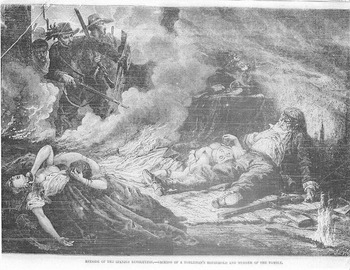
Far from championing free expression, Leslie likewise removed the questionable illustrations. Graphic depictions of violence and sexualized racial Others replaced the earlier titillating images in The Days' Doings. First, the editor made a special plea for stories from the western frontier, particularly those concerning Indians, animal attacks, or natural disasters. Immediately such stories and images filled the paper's pages, including encounters with bears (Figure 12) and wolves and battles with Indians, alongside fires, floods, and train wrecks.Footnote 26 In addition to a burst of frontier violence, the paper reconceptualized its class-based depictions of women's bodies in a new, nativist manner. Consider the explicit nudity of an “Episode of the Spanish Revolution” (Figure 13) This surprisingly frank portrayal of corpses revealed several of the women's bodies from the waist up, despite their status as kin to a “nobleman.” The nudity of such “other” women in exotic settings, apparently, did not violate Comstock's standards for lewd pictures; his vigilance shielded from public view some white women's ankles, but not the outlines or even frontal nudity of poor or racially distinct women.Footnote 27 With the editor's compliance, Comstock subtly adjusted sexual representation in 1873.
Days' Doings editor Frank Leslie explicitly solicited stories of vicious beasts and frontier conflict following Comstock's intervention, perhaps to fill the void left by more titillating fare. “A Pike County Hunt,” The Days' Doings, February 22, 1873.

Frontal nudity persisted in cases where the women were “non-white,” as in this illustration of the Spanish Revolution. “Episode of the Spanish Revolution,” The Days' Doings May 22, 1873, 13.

RACIALIZED RAPE IN THE POLICE GAZETTE
Four years after this successful suppression of lewdness in The Days' Doings, and alongside his pursuit of physiology tracts, Comstock targeted the National Police Gazette in February 1877. At the time, the Police Gazette was undergoing a transition; a year after the 1876 death of producer George Matsell (New York City's police chief), the paper came under the control of Irish sports promoter Richard K. Fox. To revive the paper from near-ruin,Footnote 28 Fox at first stepped up its salacious content, including a segment called “vice's varieties,” a fact that may explain Comstock's intervention in 1877. Afterwards, Fox struggled to redefine the paper, eventually introducing a revamped format and including new forms of entertainment; by 1883, sports became the paper's primary focus, with theatrical news, and specifically images of popular actresses in revealing costumes, ranking a close second. But the paper's most striking adaptation was its reconceptualization of sexual violence in racial terms.Footnote 29
Comstock's notes in this case suggest that he objected most strongly to Fox's introduction of explicit sexual scenarios into the Police Gazette in 1877. This time, Comstock approached the new publisher privately, sending Fox a copy of the obscenity laws by mail, and then dispatching an agent to visit the Police Gazette's offices. The censor's complaint focussed on the paper's visual narratives of sexually compromising situations, its “articles … on ‘Seduction, Rapes, Brothels, [and] Assignations’.” As Comstock's agent put it, “so many cases set out with large heading and accompanied with lewd pictures and advertisements of vile matter made it exceedingly objectionable and could not be tolerated. He said it should be changed & it was changed in the next issue very radically.”Footnote 30 Unlike the earlier concerns with lewd images and immoral advertisements in The Days' Doings, this complaint focussed more specifically on the visual re-enactment of immoral or even criminal sexual scenarios. Apparently, Fox honored his side of the bargain, for no subsequent complaint over such images appeared in Comstock's records; over the next few years, Comstock pursued the Police Gazette only for publishing lottery advertisements.
A dearth of sources obscures the immediate impact of Comstock's second intervention into 1870s visual expression. I have located only one issue for 1877.Footnote 31 Fox himself appears to have left no personal papers, a surprising fact for such an influential public man. Without even editorial commentary from the 1877 issues to illuminate the impact of the censorship event, we must rely entirely on the evidence of the publication – and its images – itself. “Before” and “after” snapshots of the paper's visual world give a sense of what changed. In the months following Comstock's complaints, it appears that Fox drastically altered the Police Gazette's form and content to carve out a new niche for visual entertainment. Fox did not follow The Days' Doings into the realm of frontier violence and family illustrated news; instead he innovated, and successfully cornered a new market for “sporting news.”
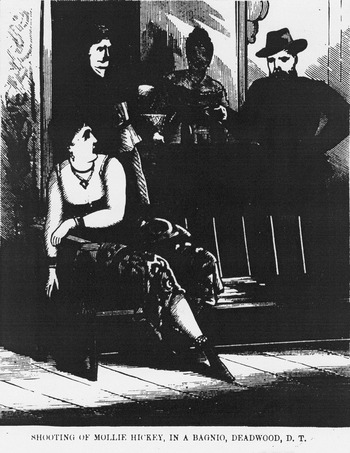
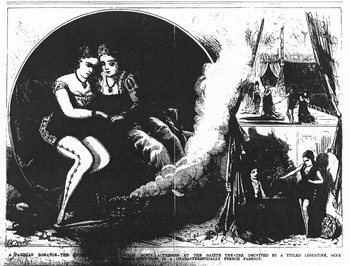
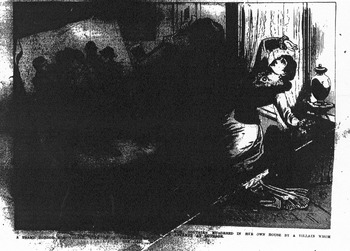
Like its former rival, The Days'Doings, the Police Gazette had always selectively revealed women's bodies according to class status. After Comstock's intervention, women's bodies remained visible within such constraints; ankles and legs exaggerated women's moral and class standing, and became an element in the paper's morality tales. For example, the exposed legs of a woman shot in a house of ill-repute in the Dakota Territory (Figure 14) both revealed her immorality and suggested that she may have deserved her fate. Still more leg appears in a depiction of actresses (Figure 15) but, as the caption explains, the women are French. By contrast, the Mississippi planter's wife in another image (even in the poorly preserved image shown here, Figure 16), remained covered from head to toe as she fought for her life; the framing of the inset image only implied the rape attempt that preceded her murder. Respectable white women's bodies were revealed under specific circumstances, and even these carried a lesson. The caption for the semi-nude drawing of a white Virginia schoolteacher (Figure 17) called her the victim of a racial (though not sexual) attack, but the illustration implied a different story; while her body was tastefully shielded from view, its lines suggested sexual danger for single white women in the South.Footnote 32 As prostitutes, foreign entertainers, and victims of racial crimes, these women offered glimpses of female nudity otherwise off-limits in the sporting paper's post-censorship world. Unlike the earlier intervention, however, this time the changes suggest that it was not the bodies so much as the re-enactments of sexual episodes that offended the censor.
As with the Days' Doings intervention, Comstock's informal censorship of the Police Gazette exaggerated existing class differences in representing women's bodies. Here, the women's visible legs denote her disreputable character just before she is shot in a brothel. “Shooting of Mollie Hickey,” National Police Gazette, May 18, 1878, 8.

The explicit depiction of legs and bodies of these Parisian actresses denotes them as sexually available and immoral, but focuses on them as visual objects for viewers rather than as part of sexual scenarios. “A Parisian Romance,” National Police Gazette, May 18, 1878, 16.

In this poorly preserved image, the respectable woman at right remains chastely covered from head to toe even as she fights for her life; the superimposed image at left barely suggests the women's alleged rape by white tramps who surround but do not touch or overpower her. “A Tramp Horror,” National Police Gazette, May 18, 1878, 16.

Visual conventions imply that this explicitly racial crime is also sexual, despite the reality. “Miss Stuart Murdered by Three Negresses,” National Police Gazette, My 18, 1878, 5.

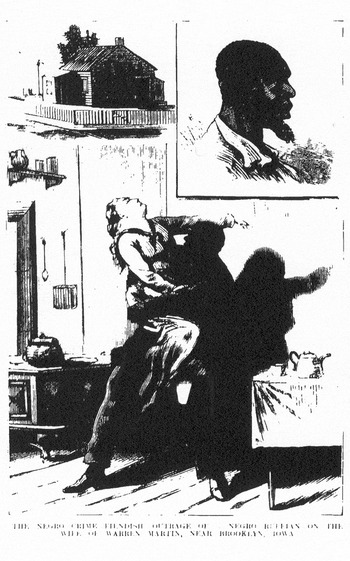
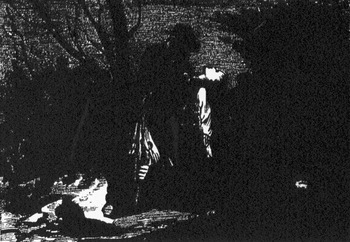
Interracial criminal sexuality was the notable exception to the censor's ban on sexual scenarios. A new racialization of Police Gazette imagery erased white male rape and exaggerated the threat of the black male rapist. With rare exceptions, after 1878 sexual re-enactments in the paper highlighted interracial sexuality, specifically the alleged rape of white women by men of color. Depictions of black rapists used stark visual conventions to underscore the message of menace and violation. For example, in one scenario the helplessness of the young white woman (Figure 18) only exaggerates her attacker's masterful posture. In another, the glowing whiteness of the female victim contrasts starkly with the forbidding darkness of the alleged rapist (Figure 19). Significantly, these racialized re-enactments did not provoke the censor, perhaps because they carried an implied justification for controlling black men, and even explicitly condoned or celebrated lynching as an appropriate response.Footnote 33 Representation of rape was apparently unproblematic if the alleged perpetrator was black, because it conformed to the post-Reconstruction political agenda of white supremacy. By contrast, white men were rarely depicted as rapists or seducers after Comstock's intervention. White women appeared exclusively as objects of desire or victims of male lust, and seldom as willing partners with men of color.
A notable exception to the ban on “seductions, rapes, etc” is this portrayal of an alleged inter-racial assault. Such images exaggerated racial distinctions with printer's ink; they increased in frequency in the 1880s. “The Negro Crime,” National Police Gazette, My21 '78, 9.

The color contrast here is even more vivid; the illustration's use of ink renders the alleged attacker blacker than the night itself, while his lifeless victim is almost luminous even in darkness. Detail, “Brutal Outrage on Miss Carrie Wayne, A Respectable Young Lady of Ellerbee, Ala,” National Police Gazette, Jl 27'78.

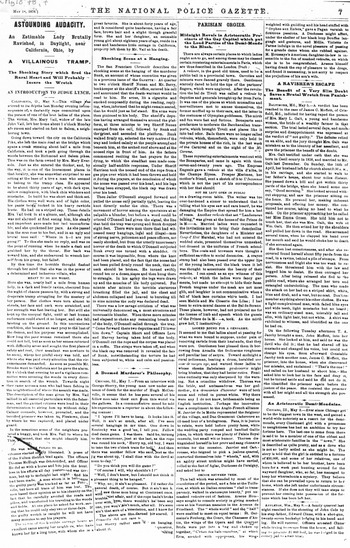
This becomes more evident in the stories that were not illustrated by the Police Gazette after Comstock's intervention. Contrast the above-mentioned depictions of interracial, criminal sexuality with two more evocative stories that were included as text, but, surprisingly in an image-based medium, without illustration. A single page in one 1878 issue offered two scenarios that might in the past have been worthy of illustration, but now received no visual representation (Figure 20). Two separate headlines reported brutal sexual assaults; the stories chronicled the rapes of two white, respectable women by (white) tramps, in graphic, melodramatic (and very similar) language. Readers learned how a tramp grappled with one “estimable lady” in a remote Ohio ravine until she became unconscious, whereupon “she became an easy prey to the lust of the demon, and his purpose was soon accomplished.” He subsequently escaped apprehension. A second tramp who assaulted and “outraged” a respectable married woman, in a Maryland ravine, likewise evaded capture. Vivid language aside, the Police Gazette illustrated neither story, which suggests the continued enforcement of Comstock's ban on the illustration of “Seduction, Rapes, Brothels, [and] Assignations,” but only when the alleged perpetrator was white.
Two alleged assaults by white tramps go without illustration here, adhering to the new strictures against sexual scenarios. “Astounding Audacity” and “A Ravisher's Escape,” National Police Gazette, My18 '78, 7.

Fox reinforced the paper's racialization of criminal sexuality by innovating in production early in 1878, when he introduced what became the Police Gazette's signature pink newsprint. The pink pages coincided with the paper's new focus on Irish sports heroes, geared toward an Irish, working-class audience.Footnote 34 Like mainstream illustrated publications of the period, the sporting paper used physiognomic conventions (degrees of darkness, exaggerated facial features, stereotyped head shapes) to inscribe racial identities. But now the Police Gazette's visual divisions became still more dichotomous in depicting black and “white.” Unlike Harper's Weekly and other mainstream illustrated journals of the period, the new Police Gazette de-emphasized the racial features of Irish and German immigrants. The pale pink newsprint homogenized ethnic complexions ranging from “white” to “ruddy” to “swarthy”; racial otherness was evident only in the presence of ink on the body.Footnote 35 In this sense, the pink pages established a new color line that was more amenable to Irish assimilation. The paper's stark black and pale pink contrasts embraced second- and third-generation immigrants as white, thereby highlighting the black/white divide. Meanwhile illustrations of interracial rape as black male aggression against white women exaggerated the myth of sexual predation by men of color. The paper's racialized stereotypes allowed Fox to evade the censor's ban on sexual scenarios for an expanding audience of “white” men.
SEXUAL KNOWLEDGE AND THE FREE SPEECH POSITION
Social liberals were silent about Comstock's interventions in sporting news, perhaps due to their own ambivalence about illustrated men's publications. As Walter Kendrick explains, Comstock's advantage was that the “simplicity” of his position that all sexual discourse was immoral and therefore must be suppressed was difficult to counter: “Few of Comstock's opponents were willing to match this [simplistic] stance with the equally simple opposite, to declare that nothing deserved burning, no matter how lewd or disgusting it was.”Footnote 36 Their concurrent clashes with the censor, however, gradually led liberals to question Comstock's right to determine what should be suppressed. At first, sex radicals and libertarians tried to defend their work on the basis of intent: unlike commercial illustrations found in sporting newspapers, their work provided necessary information, designed for educational purposes, intended not to corrupt but to enlighten readers. On this ground sex radicals like Ezra Heywood defended a number of reformers arrested for obscenity in the 1870s: government harassment of hygiene reformers revealed a “stubborn resistance to the diffusion of knowledge on subjects of the gravest importance.” D. M. Bennett, arrested late in 1877 for mailing two publications Comstock deemed obscene, likewise defended them as educational, and intending no harm. Educational works of physiology were never obscene, in this view: as sex radical Mattie Sawyer asked, “If it is important that physicians understand the human body and its functions why is it not equally so that all come in possession of the same knowledge?”Footnote 37 Sawyer distinguished information designed for self-knowledge from sexual titillation, implicitly denying any non-educational uses for physiological publications. Comstock clearly disagreed, holding that any sexual knowledge was corrupting and un-Christian, but further adhering to the Hicklin test that it was the publication's “tendency to deprave and corrupt” rather than the intention of its author – its impact rather than the author's motive – that made it obscene.
Radical libertarians like Angela and Ezra Heywood despised commercial sporting publications, but they saw their work as the antidote. When Comstock arrested Ezra Heywood for selling his critique of marriage, Cupid's Yokes, the latter defended the publication on the grounds that it would improve morality. “My object in writing ‘Cupid's Yokes’ was to promote discretion and purity in love by bringing sexuality within the domain of reason and moral obligation,” he wrote in January 1878. Angela Heywood saw a common goal in countering commercial eroticism: as she wrote while Ezra was in jail, “Gradually but surely the best minds in all schools of reform, are coming to see that our unsought conflict with invasive sensualism is theirs also.” The Heywoods shared many ideas with more conservative reformer Lucinda Chandler, who applauded Comstock's goal of protecting the young, but agreed that he “fails to distinguish and discriminate between helpful instruction, intended to remove low and sensual thoughts and those of the opposite character and design.” Others felt that “vile literature” was merely a symptom of social ills; suppression would not cure the larger problem of immoral urban culture. As Angela Heywood put it later that year, “Protection of public morals is not one of the functions of government. The true corrective for the evils of obscenity does not lie in necessarily ineffectual attempts at legal suppression, but in … education of the youthful mind.”Footnote 38
Angela Heywood's faith in education distinguished her from more conservative women reformers, who held that the “invasive sensualism” of contemporary publications could only be contained through official suppression. “Corrupting circumstances surround the individual at every stage of growth from youth onwards,” warned sanitarian and moral reformer Elizabeth Blackwell in 1878, echoing Comstock and earlier pro-censorship women. One of these circumstances, she felt, was the climate of “sensuality” in “vicious literature,” available in sources ranging from Greek literature to police reports. As Blackwell saw it, this rampant sensuality tended “to encourage the lowest passions of human nature … [and] must produce hereditary as well as social effects on daughters as well as sons.”Footnote 39 The women's moral reform and suffrage journal Alpha likewise praised Comstock for suppressing the “seeds of vice” and counteracting “the organized plans for the corruption of youth, by the circulation of indecent publications and other articles of the vilest nature among the boys and girls of this city, and of the whole country.” A decade before the WCTU's (Women's Christian Temperance Union) campaigns against “impure literature” in the 1880s, these women reformers saw Comstock's goal – the “suppression of vice” – as a worthy one, deserving support; freedom of expression was for them irrelevant to the goal of protecting communal morality.Footnote 40
Even liberals – or freethinkers – whose own publications were vulnerable to anti-blasphemy censorship, at first sought to distinguish their work from “vile” publications. As Helen Lefkovitz Horowitz explains the dilemma facing freethinkers, “They sought to reconcile free speech with barring obscenity, but this proved to be a difficult trick.”Footnote 41 Freethinkers like Horace Seaver, editor of the Boston Investigator, insisted on the distinction between education and obscenity. As Seaver saw it, high-minded social reformers were incapable of doing anything “really immoral,” and physiological tracts could only corrupt the impure-minded. Seaver's main concern was that liberalism should not be tainted as supporting obscenity.Footnote 42 Torn between disgust over “really immoral” material and a desire to protect educational work (even if controversial), such liberals revealed their own dismay over the “invasive sensualism” of commercial publications. Like their conservative foes, freethinkers worried that the pernicious influence of “blood-and-thunder” literature, whether in dime novels or sporting newspapers, would corrupt the moral development of youth. “There is a kind of literature concerning the character and the tendency of which all decent persons are agreed,” said liberal B. F. Underwood. “The circulation of this vile trash is, as it should be, prohibited by law.” Obscenity was a crime against youth, agreed freethinker Francis Abbott, editor of the Index, sounding quite a lot like Comstock himself: like libel, “it is no less a crime to mail really obscene literature to school-children – a crime at once against the children, their parents, and society itself; and we therefore hold that to punish criminals of this disgusting class involves not the slightest violation of the freedom of the press.” Such cautious freethinkers abandoned more radical liberals who formed the National Defense Association (NDA) (to defend people like Heywood and Bennett from Comstockery), because the organization demanded repeal, rather than reform, of the Comstock law.Footnote 43 Yet even repealers in the NDA continued to support obscenity prosecution, albeit through local and state statutes rather than federal postal law.
Despite cries for repeal of the Comstock law, in fact, only a small minority of radical libertarians fully opposed censorship. Heywood's conviction led one such thinker, who had some serious misgivings about the content of Cupid's Yokes, to the reluctant conclusion that the recent government suppression made the free speech position unavoidable:
I hold that freedom of speech and the press, should be restricted, if at all, only in cases of the most palpable and generally admitted immoral teachings. And yet the dangers of trammeling speech are so great, I am not sure it ought not to be left entirely free, trusting to reason to counteract errors.
Heywood, writing from Dedham jail in August 1878, more enthusiastically agreed. The question was, “whether the American people, themselves and for themselves, or Anthony Comstock, shall decide what books may be read; whether freedom of conscience, of speech, of the press, and of the mails … are to be permanently suppressed.” After a visit to Heywood in prison, another writer went further, concluding that
all publications, whether “blasphemous,” “obscene,” or not, should be freely read and circulated, that the people may judge for themselves what they need. I have the right to read any publications that I choose, and also to furnish them to others who wish to read them, and vice versa.
Since Comstock's elastic definition of obscenity would include the Bible, said others (echoing Woodhull's defense strategy in 1874), it was clear that no publication could be considered safe from malicious persecution. Anarchist Benjamin Tucker encapsulated this individualistic approach:
We must win from a misguided or uneducated public the full and free acknowledgement of every man's absolute right to express his opinion. The moment you inquire what the opinion is, as though that had any thing to do with his exercise of his right, you attack or abandon the principle.Footnote 44
OBSCENITY AS THE “TENDENCY TO DEPRAVE”
Tucker's extreme position merely emphasized the dilemma introduced by Comstock's refusal to distinguish between education and titillation. Arrests of what they saw as sincere and progressive reformers dismayed social liberals, who feared that Comstock's methods, and his increasing power to define obscenity, gave him unlimited power to suppress controversial ideas. As Elizur Wright put it, Comstock's
Society for the Suppression of Vice does not care a pin for the suppression of the clandestine and really vile book-trade; but, taking advantage of the great elasticity of the adjective “obscene,” they first make a raid upon raid upon the clandestine trade as cover to their attack upon the science of human physiology, in the interest of their peculiar religion … [and] come to their real work, which is to suppress science, and cultivate ignorance and superstition among the people.
Obscenity law was a trap, Horace Seaver explained to freethought critics who questioned his support of Heywood, that lay “in the hands of the ignorant and prejudiced, to catch honest men, and in a professedly free country such laws should be repealed at once.”Footnote 45
In the end, Comstock's arrest of social reformers like Heywood and Bennett overcame some social liberals' personal reservations about “vile literature” and led them to embrace the radical individualism of the free press position. A very few reluctantly concluded that, given Comstock's inability to distinguish between reform literature and pornography, “obscenity” was too subjective a category to be enforceable. As Elizur Wright put it, “Lawgivers ought to remember the old maxim, de gustibus nil est disputandum [there is no disputing taste], and not make asses of themselves by undertaking to correct what they deem bad taste, by making laws under which their Creator might be indicted.” As Seaver unenthusiastically concurred,
This [obscene literature] is not to be approved of, but it can hardly be prevented by law, because what one man might deem obscene, another would not. Education or improvement will settle this question and establish the opinion that there is no more need of a law against obscene literature than a law against blasphemy.
In fact, he decided the next month,
better to have no laws that cannot be enforced except by the use of hypocrisy, fraud, and falsehood, for such remedy is worse than the disease it pretends to cure … Law is of but little restraint, after all, in comparison with education and a correct public opinion.Footnote 46
Comstock's campaign to suppress sexuality discourse drove this few, despite continued misgivings about pornography and sporting news, to oppose censorship entirely.
Heywood received a pardon from President Hayes and was released from prison in 1878. Meanwhile, D. M. Bennett was again arrested, this time for selling a copy of Heywood's Cupid's Yokes at a free love conference. Like Heywood, Bennett applied for a pardon, but the political climate had shifted and his petition was denied. He served six months in jail, and failed in his attempt to appeal his conviction. In 1879, the US Supreme Court validated Comstock's perception that a marriage reform tract like Cupid's Yokes was just as corrupting as a pornographic book, and solidified the power of the Comstock Law to regulate public sexuality discourse. The US v. Bennett decision (1879) dismissed the idea, cherished by social liberals, that intention separated physiology literature from commercial sensual publications. Instead, the court found that whether produced for educational or entertainment purposes, both kinds of publication could corrupt an audience. The decision, conforming to the Hicklin standard, said that any publication could be deemed obscene if any part of it, even taken out of context, had the “tendency to deprave or corrupt” any person who might come across it. In particular, it emphasized the dangers posed to the innocent, particularly children, who might encounter a publication without understanding its larger purpose.Footnote 47
Woodhull (1872) and Bennett (1879) were bookends to this early phase of Comstock's career. While Comstock failed to convict Woodhull, the Bennett decision sanctioned his protective view of the public sphere, and also validated his pursuit of the decade's most unorthodox thinkers. Looking back on the 1870s, D. M. Bennett concluded
that it was the intention of the power that began to bear down upon the Liberals of the country to go through and make clean work of all, stopping one publication after another, throwing into prison one publisher after another, and one editor after another, until all were suppressed or ruined.Footnote 48
Comstock's stark perception of reality allowed no possibility for negotiation with social liberals, whom he saw as attacking traditional values he held dear. Woodhull succeeded in bypassing the censor, but under the new Comstock law Bennett served six months in jail merely for selling Heywood's critique of marriage at a conference for adults. The Bennett decision effectively changed the definition of obscenity by blurring the line between educational and commercial publications. Social liberals knew that relegating sexual knowledge to sensational entertainment cheapened and distorted basic scientific facts, but the free press position left them no standing to challenge commercial representations of sexuality.
Comstock's attempts to control popular illustrations in The Days' Doings and the National Police Gazette in the 1870s occurred within this larger debate over the meaning of obscenity. Commercial sporting papers, driven by profit rather than a reform impulse, chose not to confront the censor; they adapted their content and avoided prosecution. The Days' Doings compensated by bringing the violence of frontier life, and exotic racial Others, to an increasingly urban population. The Police Gazette more successfully broadened circulation by expanding its appeal to Irish immigrants, highlighting sports and theater news, and broadcasting a chaotic universe of racial violence and vice. Violence, racialized sexuality, and particularly stereotypical narratives of criminal sexuality, turned out to be effective substitutes for the earlier sexualization of white women. Spectators who turned to illustrated newspapers for visual stimulation found racialized nudity and sexual assaults that championed white male chivalry in defense of white womanhood. While Comstock shared many reformers' desire to halt the cheapening or vulgarization of American culture, he apparently did not respond to “lewdness” when the women's bodies were racially or ethnically distinct, or when illustrations of “Seduction, Rapes, Brothels, [and] Assignations” stereotyped black men as racial predators. Evidently such scenarios did not strike him as having a “tendency to deprave or corrupt.” And social liberals, stung by Comstock's persecution, were in no position to challenge the new visual taxonomy of sporting news.
The struggle over sexual knowledge in the 1870s – what it is, who conveys it, who receives it, and how – simultaneously opened up and set constraints upon a very modern debate. In six years, Comstock's zeal fractured an unspoken consensus about the nature and dangers of commercial sensual publications. Intentionally or not, he reshaped visual representation in the process, protecting white women's respectability while ignoring the sexualization of women of color and criminalizing interracial sexuality when black men were involved. The new world of sporting illustration established visual conventions – erasure of white male rape and white female sexuality, and exaggeration of criminal sexuality perpetrated by men of color – that went uncensored because they conformed to the political backlash following the collapse of Reconstruction. Even as the ideal of disinterested, scientific knowledge of sexuality lost in court and in public opinion, distorted notions of sexual behaviors infused the commercial realm. Young people found access to sexual knowledge, as before, but many now learned their lessons from the racialized and class-skewed representations found in sporting news.