Despite the mounting evidence of the importance of history for economic development, the precise mechanisms linking colonial history to contemporary outcomes need to be better understood. Particularly widespread is the idea that former British colonies are more prosperous because of the institutions and culture they inherited from Britain (Landes Reference Landes1998; North Reference North1989; La Porta et al. Reference La Porta, Silanes and Shleifer1998, Reference Porta, Rafael, Silanes and Shleifer1999), or because of better education (Grier Reference Grier1999; Woodberry Reference Woodberry2004; Cogneau and Moradi Reference Cogneau and Moradi2014). Cameroon was divided between the British and the French after WWI and reunited in 1961. This has created a unique natural experiment to study the legacies of different colonizers holding present-day national institutions constant, thus focusing on local level mechanisms behind colonial legacies. Using a border discontinuity analysis of geolocated population census microdata, I study the variation over time of colonial legacies in Cameroon.
This article focuses on education, which historians and economists have identified as a key aspect of the relatively more favorable nature of British colonial rule in Africa. British colonial education relied on Christian missions which sought to convert as many people as possible, taught in local languages and employed many African teachers. The French, by contrast, regulated teachers’ qualifications and schools’ curricula, and imposed French as the only language of instruction. In the French colonies of Africa, the government became the main provider of education, but it targeted only a small segment of the population (Gifford and Weiskel Reference Gifford, Weiskel, Gifford and Louis1971; Woodberry Reference Woodberry2004; Garnier and Schafer Reference Garnier and Schafer2006; Cogneau and Moradi Reference Cogneau and Moradi2014). Primary enrollment rates were higher in British Africa (Benavot and Riddle Reference Benavot and Riddle1988). Differences in education could still be observed around 2000 (Brown Reference Brown2000; Cogneau Reference Cogneau2003; Garnier and Schafer Reference Garnier and Schafer2006), and Robin Grier (Reference Grier1999) argued that they could account for differences in economic growth between former French and British colonies.
Two problems arise when trying to understand whether and how the identity of the colonizer shaped the development path of African countries. First, British and French former colonies are not directly comparable: Britain colonized regions that were richer and where missionary presence was more important (Cogneau Reference Cogneau2003; Frankema Reference Frankema2012). Second, it is a challenge to identify the mechanisms of causality from colonial institutions or policies to present-day outcomes (Nunn Reference Nunn2009).
Researchers working on the persistence of human capital shocks propose several mechanisms. Edward Glaeser et al. (Reference Glaeser, Porta and Silanes2004) and David Brown (Reference Brown2000) propose a national-level mechanism where colonial education shapes national political institutions, which in turn affect economic development and education. Others put forward persistence in education demand, because of inter-generational transmission of preferences (Wantchekon, Klašnja, and Novta Reference Wantchekon, Marko and Novta2015; Cagé and Rueda Reference Cagé and Rueda2016), often through religious conversion (Woodberry Reference Woodberry2004; Nunn Reference Nunn2010). Elise Huillery (Reference Huillery2009) proposes a local mechanism of persistence in supply where fixed costs create a path dependency in the location of schools. The last mechanism is persistence in pedagogical culture and practices, that is, Maurice Garnier and Mark Schafer (Reference Garnier and Schafer2006) talk of “educational model” and Robert Woodberry (Reference Woodberry2004) of “teaching style.” In particular, the practice of having students repeat a grade if they are deemed insufficiently proficient (a practice much more prevalent in former French colonies than in former British colonies) is described as raising dropout rates and preventing countries from increasing primary and secondary completion rates (Bernard, Simon, and Vianou Reference Bernard, Simon and Vianou2005; Ndaruhutse et al. Reference Ndaruhutse, Branelly and Latham2008; Majgaard and Mingat Reference Majgaard and Mingat2012).
The unique history of Cameroon allows me to tackle the problem of causal identification and restrict the number of potential mechanisms of persistence. After WWI, German Cameroon was divided between France and the United Kingdom under a mandate of the League of Nations. The two parts were ruled as colonies (British Cameroon became part of colonial Nigeria) until independence in 1960. In 1961, after a plebiscite, the southern part of British Cameroon was reunited with French-speaking Cameroon.
I take advantage of this history to identify the causal effects of colonizer identity on education. I use a spatial discontinuity analysis, relying on the local arbitrariness of the border between French and British Cameroon. Near the border, the fact that a given village fell on the French or British side at the time of partition was quasi-random. This follows a recent literature using African borders as natural experiments. As noted by John McCauley and Daniel Posner (Reference McCauley and Posner2015), in these experiments, the treatment and control groups, once separated, continue following different paths, and have different post-colonial experiences, making it hard to identify mechanisms of persistence. Cameroon offers the unique example of two regions ruled by different colonizers but then reunited after independence. In this setting I can test for the importance of local level mechanisms of persistence.
Using 1976 census microdata, I show that men of school age after partition had, all else being equal, one more year of schooling if they were born on the British side of the border. This positive British effect completely disappeared for those of school age in the last decade of colonization and beginning of independence. Using 2005 census microdata, I find that the discontinuity in education, if anything, favored the Francophone side for cohorts of school age in the 1960s and 1970s, but that the Anglophone advantage re-emerged more recently: people born in the former British part after 1970 are about 8 percentage points more likely to complete high school, and more likely to have a high-skilled occupation.
To explore the demand and supply mechanisms that might explain these results, I start by estimating a border discontinuity in a housing-quality based wealth index in 1976. Household heads born on the British side of the border had, all else being equal, better quality housing. Decomposing the index into various components, I estimate a strong discontinuity in public goods provided locally, like piped water, suggesting better local institutions in former British Cameroon, but no discontinuity in a private wealth index excluding public utilities. I then present new data on colonial public finances in British and French Cameroon and use recent administrative data on the universe of schools in Cameroon with their date of construction to estimate border discontinuities in the supply of schools over the twentieth century. This evidence suggests that colonial education policies played a role in the emergence of a discontinuity in education after partition, and that the convergence in education after 1945 was explained by a surge in education expenditure on the French side in the last decade of colonization, followed by a school supply policy favoring the Francophone side after independence.
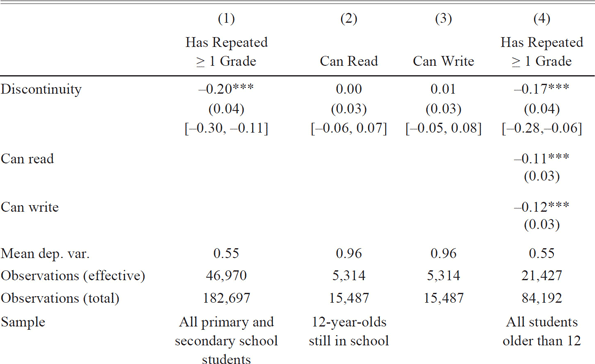
In 2005, I estimate no difference at the border in a housing-quality based wealth index, in night-time light per capita or in industrialization, but I find that the Francophone side is more urbanized. To explain the re-emergence of a positive Anglophone effect in education, I propose and test for the mechanism of legacies in pedagogical culture, more specifically the widespread use of grade repetition in former French Cameroon and its detrimental effect on school dropout rates. Students born in Francophone Cameroon are 20 percentage points more likely to have repeated at least a grade, and the border discontinuity in secondary school completion falls to zero when controlling for district-level repetition rates.
This article contributes to the literature on the historical determinants of economic development and the impact of colonizer identity (North Reference North1989; Landes Reference Landes1998; La Porta et al. Reference La Porta, Silanes and Shleifer1998, Reference Porta, Rafael, Silanes and Shleifer1999). The “history matters” literature has sometimes been accused of “compressing history” (Austin Reference Austin2008), relating an event in the past to an event in the present, but leaving unexplained the complex causal chain running from then to now. I can track the variation in colonial legacies over time using cohort analysis and focus on local level mechanisms of persistence, holding national-level institutions constant, thanks to Cameroon’s unique history.
This article also adds to the literature that uses African borders as natural experiments (McCauley and Posner Reference McCauley and Posner2015, for a review). Denis Cogneau and Alexander Moradi (Reference Cogneau and Moradi2014) study the partition of German Togo between the British and the French. They find that the two parts started diverging after partition and that the divergence persisted, but in contrast with Cameroon, the two parts of Togo belonged to different countries after independence. Alexander Lee and Kenneth Schultz (Reference Lee and Schultz2012) also study the border between former French and British Cameroon, using present-day survey data, and find that households located in the former British part have higher wealth and better access to piped water, which they attribute to the legacy of indirect rule and better local institutions. Merima Ali et al. (forthcoming) also use survey data to confirm the greater importance of chiefs in Anglophone countries in general and in Cameroon in particular. The data used in these studies do not allow the authors to study the time variation in historical legacies, nor to take selective migration into account. Knowing the place of birth of respondents as well as their place of residence, I show that taking selective migration into account by comparing people born close to the border rather than living close to the border can seriously reduce estimated discontinuities in education or wealth.
Finally, this article contributes to the debate on the merits of grade repetition (Jacob and Lefgren Reference Jacob and Lefgren2009; Manacorda Reference Manacorda2012), particularly relevant in Africa, where the percentage of students repeating a grade is high (Bernard, Simon, and Vianou Reference Bernard, Simon and Vianou2005; Ndaruhutse et al. Reference Ndaruhutse, Branelly and Latham2008). This article is the first to provide evidence of the causal link between French colonization and high repetition rates. It also provides some evidence that high repetition rates can decrease high school completion rates and, as a result, the percentage of high-skilled workers.
HISTORICAL BACKGROUND
Before the nineteenth century, European presence in Cameroon remained coastal and devoted to the slave trade. Despite the presence of British missions from the mid-nineteenth century on, the region fell under German influence and became the colony of Kamerun in 1884. During WWI, it was invaded by the British and the French and divided into two administrative regions in 1916. The border between the two zones was hastily decided. Negotiations over the division of Cameroon were part of broader negotiations over the future of German colonies in Africa. Because the British had their eyes on other German colonies,Footnote 1 they allowed the French to get “most of the spoils” in Cameroon (Louis Reference Gifford and Louis1967). The division was confirmed in 1919 (with a few modifications) and, in 1922, the two zones became mandates of the League of Nations: the British part was attached to Nigeria, while the French part became the protectorate of Cameroun (Louis Reference Gifford and Louis1967; Brownlie Reference Brownlie1979; Ngoh Reference Ngoh1987), as shown in Figure 1.
THE EVOLUTION OF CAMEROON’S BOUNDARIES

In Cameroon, as in other regions of Africa, British and French colonization differed in education and institutions. Christian missions, both Protestant and Catholic, were active in German Cameroon and remained the main provider of education in both parts after partition. The two colonizers differed, however, in the incentives they set up for missions to provide formal education.
The British colonial government inspected mission schools and subsidized them on the basis of efficiency (Fonkeng Reference Fonkeng2007; Fafunwa Reference Fafunwa1974), while the French colonial government turned a blind eye to the large private, missionary sector, leaving it mostly unsupervized and unsubsidized (Fonkeng Reference Fonkeng2007; France, Ministère des Colonies 1921–1938).Footnote 2 In British Cameroon, all mission schools were inspected by supervisors under government control, and the most efficient ones, representing 7.5 percent of all mission schools in 1938, were subsidized (Fafunwa Reference Fafunwa1974; Fajana Reference Fajana1978; Great Britain, Colonial Office 1938).Footnote 3 Government control was more extensive, but less stringent than in French Cameroon. There, very few mission schools were recognized by the government and could receive subsidies (3 percent of the total number of mission schools in 1938), but the ones that were had to meet a demanding list of requirements in terms of teachers’ qualifications, curriculum, and the language of instruction; teaching in French was mandatory (France, Ministère des Colonies 1921, 1938). Subsidies were more generous in British Cameroon: in 1937, subsidies to private schools represented 68 percent of the subsidized schools’ wage bill in British Cameroon versus 19 percent in French Cameroon.Footnote 4
Both colonizers invested in a small public education sector. It was more decentralized in British Cameroon, where public schools were often run by native administrations (local governments empowered by indirect rule).Footnote 5
In Cameroon, like elsewhere in Africa, the French and the British set up a dual legal system where “traditional” rules coexisted with a formal legal system copied from the colonizing country: a common-law system in British Cameroon and a civil-law system in French Cameroon. Early studies underlined another institutional difference between the two colonizers: while the French favored centralized colonial administration, that is, direct rule, the British relied on local “traditional” authorities, that is, indirect rule (Mair Reference Mair1936; Perham Reference Perham1967). However, historians have stressed that, within each empire, colonial administration differed by geography and by time period. In Cameroon, according to Peter Geschiere (Reference Geschiere1993), the British and the French wavered about their policies towards traditional authorities but, on balance, chiefs seem to have gained more legitimacy under British rule than under French rule.
Finally, the two colonizers differed in their attitude towards forced labor. The German labor tax of 30 days per year was abolished by the new colonizers, but the French rapidly reintroduced a labor tax of 10 days a year, and used conscripted paid labor to build railways, subjecting laborers to harsh working conditions (Le Vine Reference Le Vine1964; Buell Reference Buell1928). There was no evidence of forced labor in British Cameroon. Plantations in British Cameroon were sold back to their former German owners soon after WWI and attracted many wage workers from Nigeria and French Cameroon (Le Vine Reference Le Vine1964).
In Africa, colonial policies changed markedly in the last 15 years of colonization, a period characterized as the era of “developmental colonialism” by Frederick Cooper (Reference Cooper2002). As colonization was increasingly questioned inside and outside the colonial empires, Britain stressed the need for self-government, while France sought ways to assimilate its colonial empire into a large French polity. In Cameroon, the French abolished forced labor and established some representative institutions. In Nigeria, of which British Cameroon was a part, the British gradually introduced self-government and federalism (Ngoh Reference Ngoh2001). Both colonizers started transferring funds to their African colonies for large infrastructure projects. Internal revenue also increased, and public expenditure per capita, including education expenditure, boomed (Cogneau, Dupraz, and Mesplé-Somps Reference Cogneau, Dupraz and Mesplé-Somps2018).
In French Cameroon, the transition to independence was far from peaceful: in 1955, the French government disbanded the Union des Populations du Cameroun (UPC), an independence party created in 1948, which also sought reunification of Cameroon within its German borders. An armed struggle began, taking place mostly in French Cameroon in regions close to the border with British Cameroon. The deadliest operations hit the Bamiléké region between 1959 and 1961 (Deltombe, Domergue, and Tatsitsa Reference Deltombe, Domergue and Tatsitsa2011). In 1960, France granted independence to the pro-French Ahmadou Ahidjo, Cameroon’s first president, who continued fighting the rebels with help from the French army until 1971.
Nigeria also became independent in 1960. Since the 1940s, political parties in French Cameroon and in Nigeria had been demanding reunification of the two territories (Ngoh Reference Ngoh1987; Deltombe, Domergue, and Tatsitsa Reference Deltombe, Domergue and Tatsitsa2011). In 1961, a referendum was organized in British Cameroon: while the North voted to remain part of Nigeria, the Southern part voted to be reunited with former French Cameroon, as shown in Figure 1. In this article, I consider only the part of the border between French and British Cameroon that is today an internal border in Cameroon.
At first, the former British part retained some autonomy within the Federal Republic of Cameroon, but in 1972, the federation was replaced with a unitary state. However, present-day Cameroon stands out for the duality of its judicial and education systems. In primary and secondary education, two separate school systems coexist: Francophone and Anglophone students prepare for different end-of-cycle examinations. Yet, there is a single higher education system (World Bank 2003). Cameroon has two official languages, French and English, but Anglophones are a minority (one-fifth of the total population) in a predominantly Francophone country. Both presidents that Cameroon has had since independence (Paul Biya succeeded Ahmadou Ahidjo in 1982) were born in the former French part, and inhabitants of the former British part have long felt disadvantaged by the Francophone center.Footnote 6
DATA
The article’s main results are estimated using Cameroonian population censuses, which provide enough statistical power to focus on geographic units located within a very short distance of the border. The data also allow me to consider heterogeneous effects across cohorts to provide a time-varying view of French and British comparative legacies in education. I use the full 1976 Cameroonian census (more than 7 million individuals in total) and a 10 percent nationally representative extract of the most recent census (2005).Footnote 7
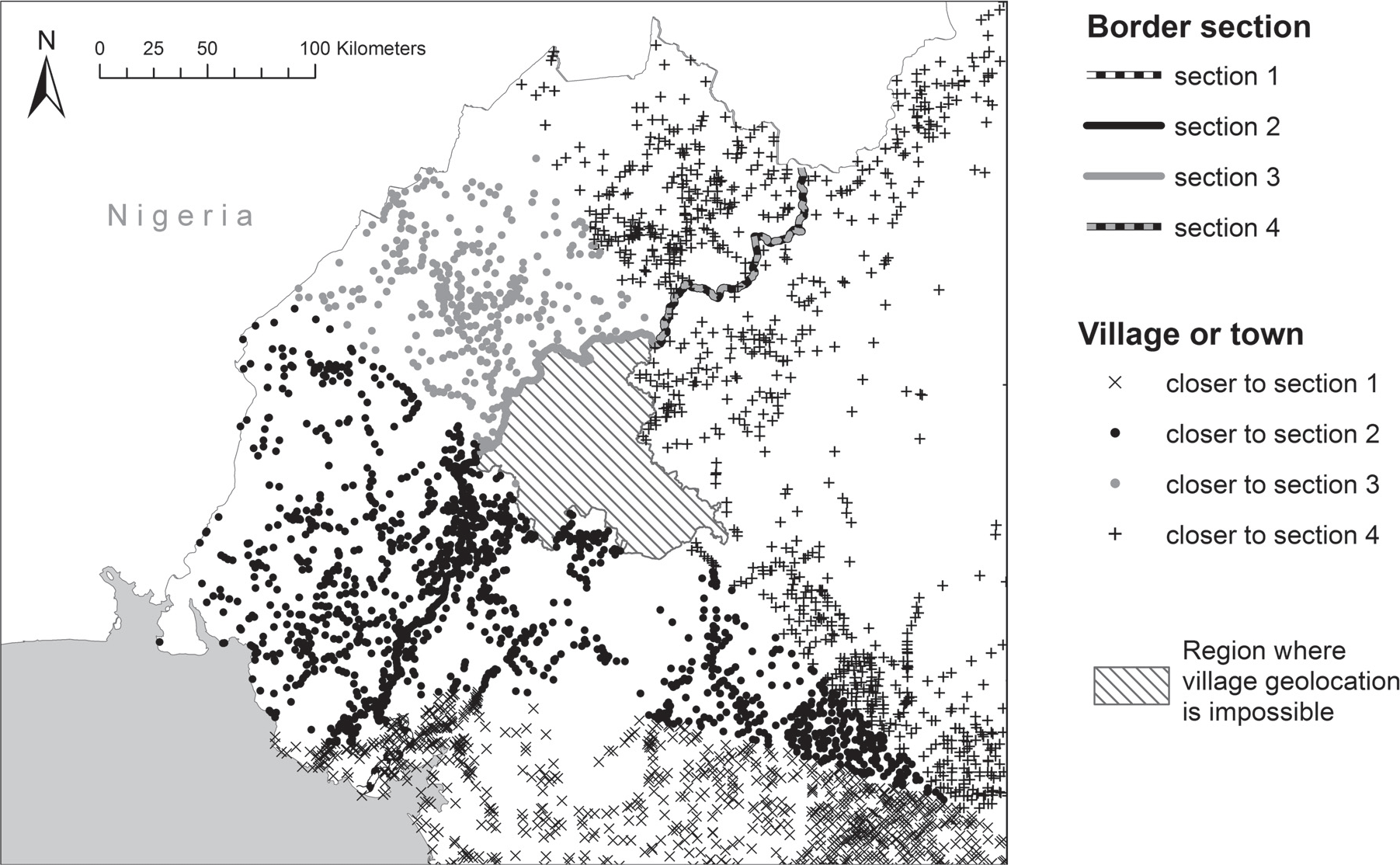
I geolocated the 1976 census down to the village level. Figure 2 shows the very dense spatial distribution of villages in the border region. However, in a big part of the Francophone Ouest region, geolocation of 1976 data at the village level is impossible (dashed area on Figure 2). The 2005 census data cannot be geolocated more precisely than the district level, which still gives a reasonable degree of geographic variation (121 districts within 100 km of the border with an average surface area of 740 km2, see Online Appendix Figure B.2).
LOCALIZATION OF VILLAGES IN THE 1976 POPULATION CENSUS

Because individuals rarely go back to primary school in adulthood, education variables give information about the education system during the time an individual was of schooling age.Footnote 8 This allows me to identify the effect of colonizer identity on education in different periods by looking at different age groups within a census, provided I show that results are not explained by differences in mortality rates by education levels across the border (selective mortality). To mitigate the problem of age heaping, I focus on 10-year cohorts around ages ending in 0.Footnote 9 The Online Data Appendix describes in more detail the variables contained in the census data and used in the analysis.
To undertake balance tests at the border, I use a variety of geographic datasets, as well as data on the location of German schools in 1911. I collected historical public finance data and recent administrative school data to help understand mechanisms underlying the results. All these sources are described in more detail in the Online Data Appendix.
IDENTIFICATION STRATEGY
Local Randomness of the Border
I use a border discontinuity analysis to identify the causal impact of colonizer identity on education outcomes over the twentieth century. My identifying assumption is that, when it was drawn, the border between the two parts of Cameroon was locally random. That is, it did not coincide with an existing political, linguistic, or ecological division. According to Alfred Milner, representing the United Kingdom at the Paris Peace conference in 1919, the boundaries between the two spheres of occupations “cut across tribal and administrative divisions, [took] no account of economic conditions and [were], in every way, objectionable” (Louis Reference Gifford and Louis1967, p. 148; also quoted in Lee and Schultz Reference Lee and Schultz2012).Footnote 10
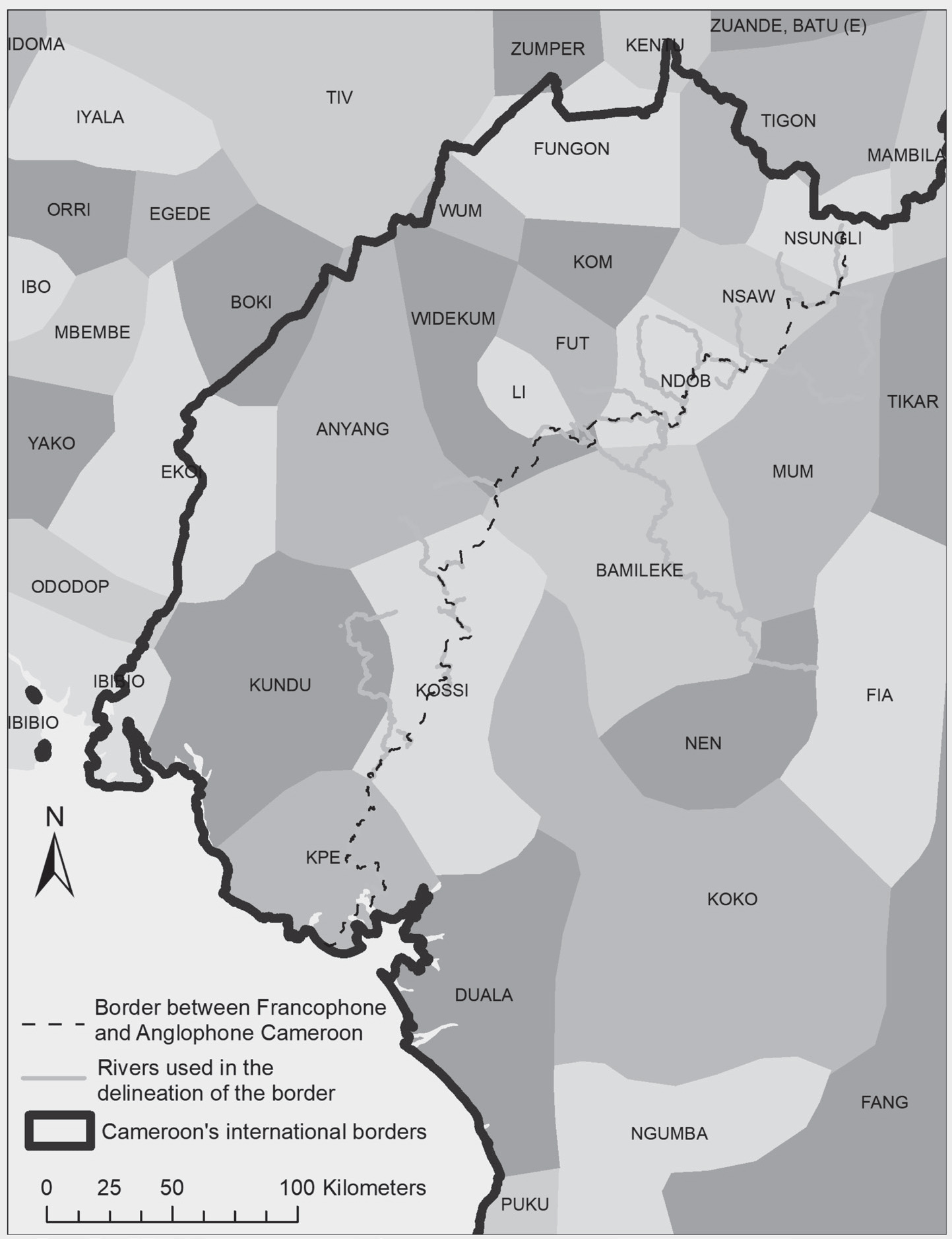
The border was not drawn as a straight line. It mainly followed small rivers and watersheds (Brownlie Reference Brownlie1979), as displayed on Figure 3. Geographic or ethnic were not considered, with one exception: the declaration refers to “the tribal boundary between Bansso and Bamum” (Brownlie Reference Brownlie1979, p. 567).
ETHNIC GROUPS IN WEST CAMEROON ACCORDING TO MURDOCK’S MAP

Figure 3 superimposes the border on George Murdock’s (Reference Murdock1959) tribal map. Online Appendix Figure B.3 replicates this exercise using postcolonial ethnographic data. These maps confirm that the border cuts across ethnolinguistic groups in the south. In the north, however it seems to respect ethnolinguistic boundaries, in particular the boundaries of the Bamun (or Mum) ethnic group. King Njoya, King of the Bamun (or Bamum) from 1883 to 1931, converted to Islam together with his court, invented a system of writing, the Shumom script, and had a school built to teach it (Tardits Reference Tardits1980). Because this history might have influenced the supply and demand of education, I never use the section of the border corresponding to the Bamun Kingdom in the analysis (section 4 on Figure 2). Additionally, the border analysis controls for ethnic homeland fixed effects.
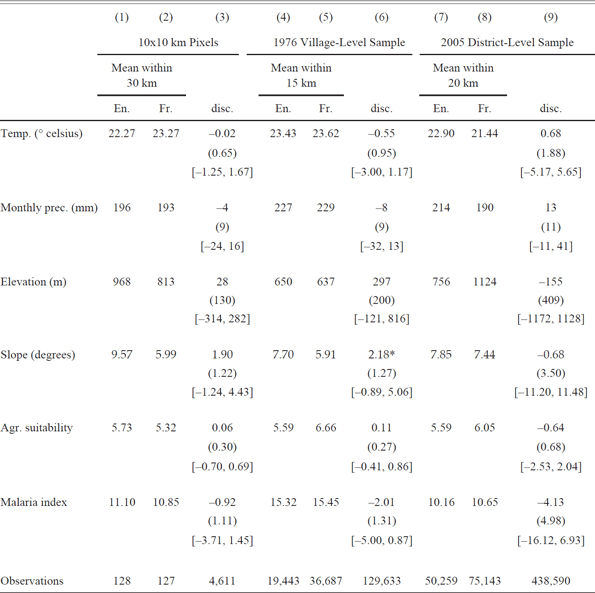
Table 1 presents balance tests on geographic variables, using 10×10 pixel-level data (Columns (1) to (3)), the 1976 data geolocated at the village level (Columns (4) to (6)), and the 2005 data geolocated at the district level (Columns (7) to (9)). Discontinuities are obtained using the same specification and samples as for the main results of the article.Footnote 11
ABSENCE OF GEOGRAPHICAL DISCONTINUITIES ACROSS THE BORDER

Notes: In Columns (1) to (3), the unit of observation is the 10 × 10 pixel. Robust standard errors in parentheses. In Columns (4) to (6), the sample is the same as for results using 1976 census data: men older than 15 born in villages within 100 km of the southern section of the border (section 2). Geographical variables are at the level of the village of birth. Standard errors clustered by village in parentheses. In Columns (7) to (9), the sample is the same as for results using 2005 census data: all individuals older than 15 excluding those born in Douala and in districts closest to the northernmost section of the border (section 4). Geographical variables are at the level of the district of birth. Standard errors clustered by district in parentheses. *p < 0.1, **p < 0.05, ***p < 0.01. Discontinuities obtained employing a local linear non-parametric estimation with triangular kernel and optimal MSE bandwidth. Robust Calonico, Cattaneo, and Titunik (Reference Calonico, Cattaneo and Titiunik2014) confidence interval in [ ]. The choice to present averages within 30, 15, and 20 km of the border is guided by the average optimal MSE bandwidth for estimating discontinuities: 33.9 km in Column (3), 14.7 km in Column (6), and 17.51 km in Column (9).
Sources: Temperature and monthly precipitation from WorldClim (http://www.worldclim.org). Temperature is average temperature over 1950–2000, precipitation is average monthly precipitation over 1950–2000. Elevation data from NASA Shuttle Radar Topography Mission, available on the CIAT-CSI SRTM website (http://srtm.csi.cgiar.org). Slope computed from the elevation data using the slope tool in ArcGIS. Agricultural suitability is suitability for rainfed crops excluding forest ecosystems, from Global Agro-Ecological Zones (http://webarchive.iiasa.ac.at/Research/LUC/GAEZ/index.htm). Malaria stability index from Kiszweski et al. (Reference Kiszweski, Mellinger and Spielman2004), downloaded on https://sites.google.com/site/gordoncmccord//datasets.
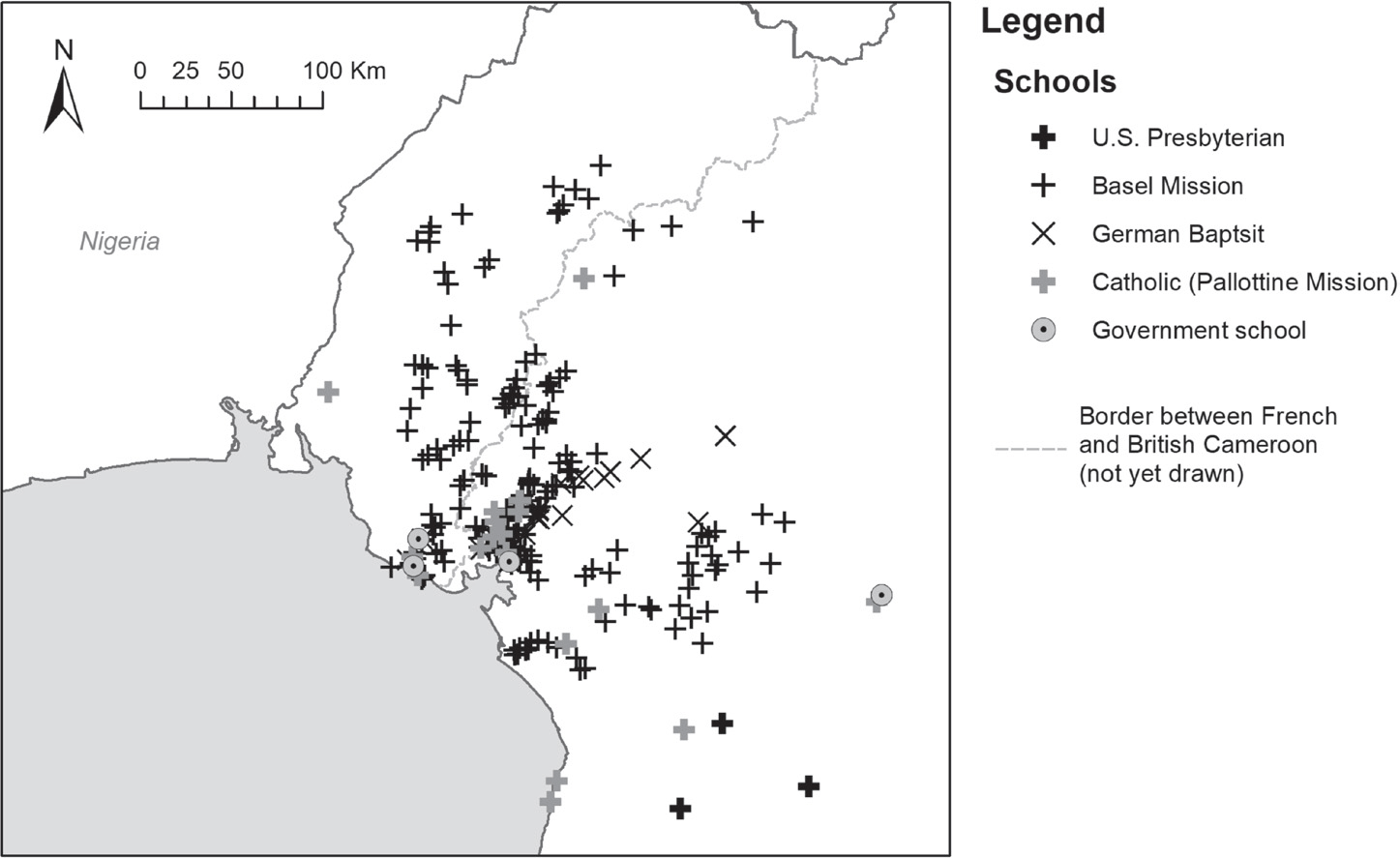
I also run balance tests on the number of German schools prior to partition, using data on German mission schools from Martin Schlunk (Reference Schlunk1914), which are described in the Online Data Appendix. Figure 4 displays the spatial location of schools in German Cameroon in 1911, five years before partition. The density of schools is very comparable on both sides of the future border. Table C.1 in the Online Appendix shows that there is no border discontinuity in the density of German schools in 1911.
SCHOOLS IN GERMAN CAMEROON IN 1911

Migration
Migration is one of the major concerns threatening the validity of a border discontinuity analysis. Cross-border migration can be thought of as a problem of non-compliance, as individuals assigned to one treatment (one colonizer) change treatment by moving to the other part. Migration away from the border region can be thought of as a problem of attrition, as individuals leave the sample (McCauley and Posner Reference McCauley and Posner2015). In most border discontinuity designs, the researcher observes the place of residence of individuals at the time of enumeration, not the place of residence at the time of treatment.
Cameroonian population censuses give the district of birth of individuals, so that the problems created by migration are largely tempered under the reasonable assumption that most people are schooled in their district of birth. In 2005, I use variation at the district level. The 1976 population census gives the village of residence and the district of birth, but not the village of birth. To use variation at the village level, I assume that individuals still living in their district of birth never moved and were born in their 1976 village of residence. To avoid the problem of selective attrition created by migration, I randomly repatriate each migrant in a village of their district of birth, weighting the probability to be from a given village by its (non-migrant) population, which means I assume constant migration rates across villages of the same district.Footnote 12 To check the sensitivity of my results to this way of reallocating migrants, I also present discontinuities estimated on the sample of non-migrants only.
Even when the place of birth of individuals is known, potential selective migration of the parents is a concern. It might be that individuals with a particular preference for educating their children moved to one side of the border or the other after partition. If these population movements were important, we should observe a jump at the border in the density of individuals born after partition. Figure C.1 in the Online Appendix displays Justin McCrary tests for the absence of border discontinuity in the density of villages and individuals (McCrary Reference McCrary2008). The top panel plots the number of villages in bins of 500 meters on either side of the border along with a local linear polynomial fit and displays the associated discontinuity estimate. The bottom panel does the same for the density of men born between 1922 and 1931, in the decade following the partition.Footnote 13 There is no border discontinuity in the density of either the villages or the individuals.
Though the absence of density discontinuity is reassuring, migration could still bias the results on education if different types of selective migration compensated each other. Section D.5 in the Online Appendix tries to assess the biases that are introduced by various types of cross-border and internal migration, as well as migration from Cameroon to Nigeria after reunification, and concludes that they are unlikely to affect results.
Econometric Specification
To obtain border discontinuities, which I interpret as the causal effect of having been colonized by the British rather than the French, I estimate the following equation
 $$S_{ij} = \tau BR_j + f({\text{geographic}}\,{\text{location}}_j ) + x'_j \beta + u_{ij}$$
(1)
where sij is the variable of interest for individual i born in village j; BRj is a binary equal to 1 if village j lies on the British side of the border; f(geographic locationj) is a function of geographic location of village j; xj is a vector of ethnic homeland fixed effects. Cameroonian censuses do not give ethnicity, so that ethnic fixed effects are not at the individual level, but at the village level; a village j is attributed ethnicity e if it falls in the ethnic homeland of ethnicity e on Murdock’s (Reference Murdock1959) map. In 2005, geolocation at the village level is impossible: j indexes districts, and I use the geographic location of the district’s centroid. Because districts can cut across several homelands, I do not control for ethnic homeland fixed effects, but I ensure that I do not compare districts close to the border but rather further away from each other by controlling for border section dummies.Footnote 14 The coefficient of interest is τ: it measures the discontinuity at the border, and is positive when it favors the British side. To study time variations in colonial legacies, I estimate Equation (1) separately for different 10-year cohorts.
I control for the smooth effects of geographic location using a local linear non-parametric function of distance to the border, with a triangular kernel and mean squared error (MSE) bandwidth (Cattaneo, Idrobo, and Titiunik forthcoming).Footnote 15 I also show the robustness of my results to specifications controlling for geographic location with a polynomial in longitude xj and latitude yj, similar to Melissa Dell (Reference Dell2010). Standard errors are clustered by the unit of geolocation (village or district), and I also present the robust non-parametric confidence interval proposed by Sebastian Calonico, Matias Cattaneo, and Rocio Titiunk (Reference Calonico, Cattaneo and Titiunik2014).
I exclude from the sample villages close to Douala, the main port and economic capital of Cameroon, lying very close to the border on the French-speaking side (border section 1 on Figure 2). I also exclude villages on either side of the northern border section (section 4 on Figure 2), which is not plausibly exogenous as it respected the boundaries of the Bamun Kingdom. In the end, because villages cannot be geolocated in part of the Ouest region, I estimated village-level discontinuities on border section 2 on Figure 2. District-level results are obtained on a sample excluding the northernmost border section and Douala (Online Appendix Figure B.2). Section D.6 in the Online Appendix assesses the comparability of results obtained on different border sections and using a different type of geographical variation (villages versus districts).
RESULTS
Colonial Period Results: Cohort Analysis of 1976 Census Data
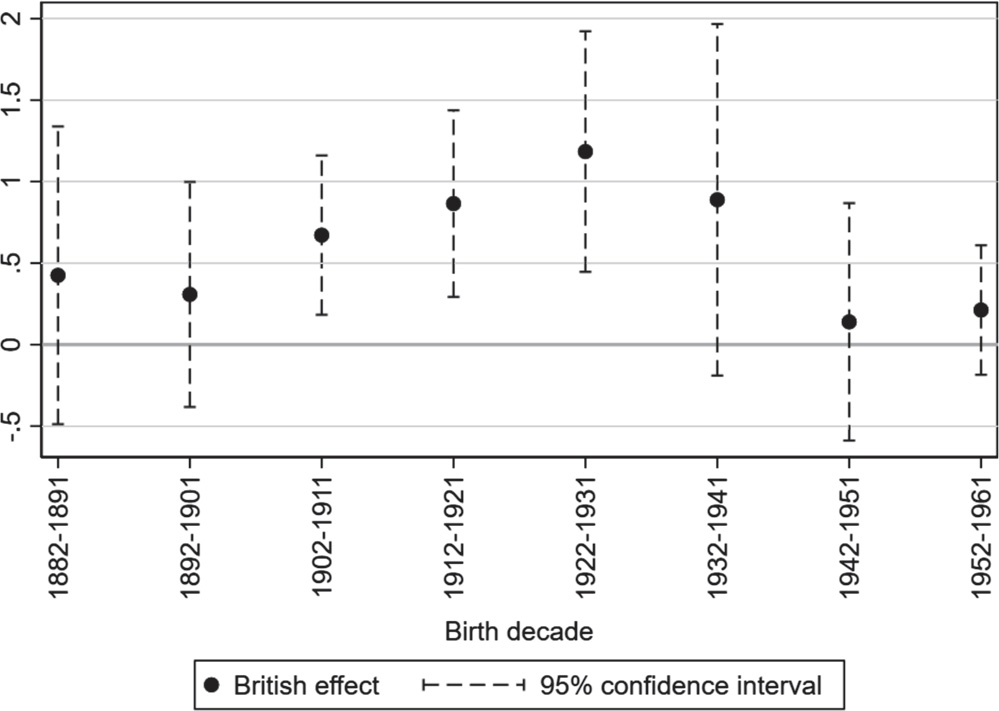
I start by presenting discontinuities in male education estimated cohort by cohort on 1976 census data geolocated at the village level.Footnote 16 Men born between 1912 and 1941 and who were of school age in the 30 years following partition had, all else being equal, about one more year of schooling if they were born on the British side of the border (Figure 5).Footnote 17 The positive British effect vanishes in the late colonial period: it is close to zero and not statistically significant for cohorts born after 1942. One might be surprised that the estimated discontinuity is positive and significant for the cohort born 1902–1911, but the youngest members of this cohort were 5 in 1916, when Cameroon was divided into two zones of occupation, and 8 in 1919 when it was officially partitioned. Because of errors in reporting age (see Online Appendix Figure B.1), many of them were likely younger. Because of late school entry and intermittent schooling, the majority of this cohort was actually young enough to be in primary school in 1919.Footnote 18
DISCONTINUITIES IN MALE YEARS OF SCHOOLING IN 1976 (SOUTHERN SECTION)

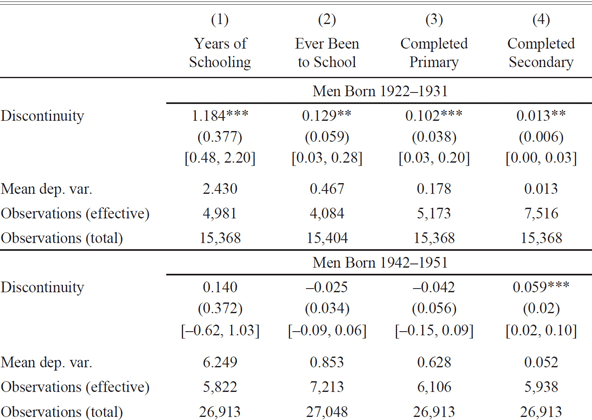
Table 2 decomposes the British effect on years of schooling into the different margins of school participation, and primary and secondary cycle completion. Men born between 1922 and 1931 were 12.9 percentage points more likely to enroll in school if they were born on the British side of the border and 10.2 percentage points more likely to complete a primary cycle. They were 1.3 percentage points more likely to complete a secondary cycle (first panel of Table 2). Men born between 1942 and 1951 were unlikely to have been to school or to have completed primary, but they were 5.9 percentage points more likely to have completed secondary school if they were born on the British side of the border (second panel of Table 2).Footnote 19
DECOMPOSITION OF THE DISCONTINUITY IN EDUCATION INTO DIFFERENT MARGINS

Notes: Sample of men born in villages within 100 km of the southern section of the border. Discontinuities obtained employing a local linear non-parametric estimation with triangular kernel and optimal MSE bandwidth. Added covariates: ethnic homeland fixed effects. Standard errors clustered at the village level in parentheses. *p < 0.1, **p < 0.05, ***p < 0.01. Calonico, Cattaneo, and Titiunik (Reference Calonico, Cattaneo and Titiunik2014) confidence interval in [ ]. The effective number of observations is the number of observations within the optimal bandwidth.
Source: Author’s calculations from the 1976 Population and Housing Census of Cameroon.
Two types of selection problems might bias the estimation of the British effect: selection by mortality and selective migration. The problem of selection by mortality would occur if there were differences in mortality rates by education level across the border; colonial period results are obtained on individuals observed in 1976, when they were in their 40s and 60s. Online Appendix D.4 estimates discontinuities in the share of each cohort in total population and shows that selection by mortality is unlikely to explain the results. Selective cross-border and internal migration might also bias the results, for example, if parents with a preference for educating their children migrated from French to British Cameroon after partition, or migrated within French Cameroon away from the border region.Footnote 20 Online Appendix D.5 uses the 1976 census to document patterns of migration in the border region and estimate upper bounds for the biases they could create. Migrants from French to British Cameroon born before 1912 were not more educated than locals; those who migrated away from the border region in French Cameroon were indeed more educated than those who stayed, but this would account for a difference of at most 0.25 years of schooling at the border in the cohorts born just after partition. Online Appendix D.5 also shows results obtained without repatriating migrants in their village of birth and simply considering those who never migrated: the only significant difference is that the British effect does not fall to zero for the cohorts of school age in the late colonial period, because, in these cohorts, the most educated on the French side migrated. Finally, Online Appendix D.5 discusses the potential biases introduced by the migration of Nigerians to British Cameroon during the colonial period and their departure after reunification.
Because observations cannot be geolocated below the district level in the 2005 census, results for more recent cohorts use geographical variation at the district rather than the village level. To ensure the comparability of 1976 and 2005 results, Online Appendix D.6 replicates the village-level results using district level variation.
Present-Day Legacies: Analysis of 2005 Census Data
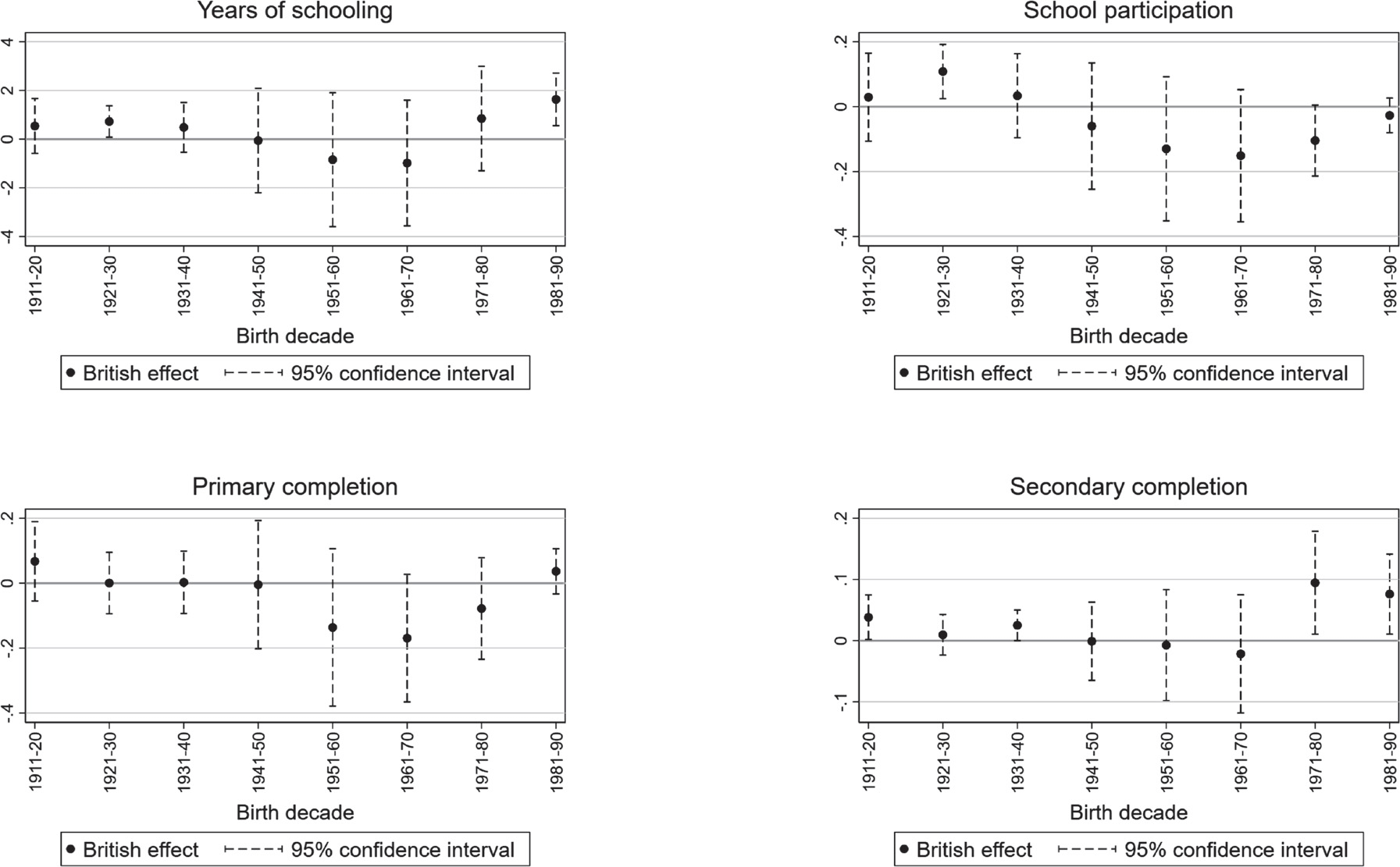
I now present discontinuities in education estimated on 2005 census data geolocated at the district level.Footnote 21 Figure 6 displays cohort by cohort the discontinuities in years of schooling, school participation, and primary and secondary school completion. Like with the 1976 census data, I estimate a positive and statistically significant British effect on years of schooling and school participation for the cohort born between 1921 and 1931.Footnote 22 The effect disappears for cohorts of school age in the 1940s and 1950s. Perhaps a sign of discrimination in school supply in a Francophone majority country, individuals born after 1961 are more likely to have been in school and have completed a primary cycle if they were born on the Francophone side of the border. Estimated discontinuities in school participation and primary completion are large (more than 10 percentage points in the 1950s and 1960s), but not statistically significant at conventional levels, and become smaller over time. What is remarkable is the resurgence of an Anglophone advantage in recent cohorts, driven by higher rates of secondary school completion on the Anglophone side of the border. Individuals born in the 1970s and in the 1980s are about 10 percentage points more likely to have completed a secondary cycle if they were born on the Anglophone side of the border.
DISCONTINUITIES IN EDUCATION IN 2005

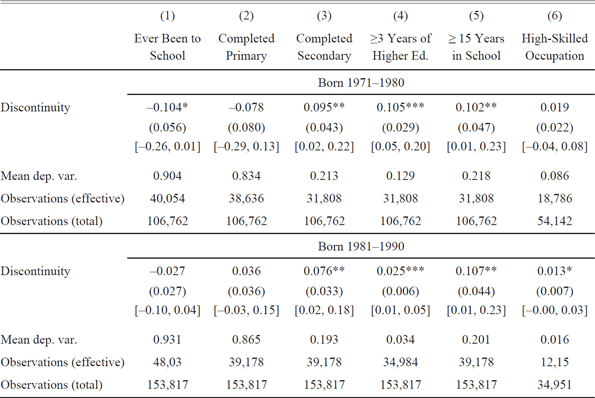
For the sake of space, more detailed results are presented only for the 1971–1980 and 1981–1990 cohorts in Table 3. For these cohorts, the advantage of the Anglophone system lies in its capacity to retain students in school longer. The discontinuity in school participation and primary school completion is actually negative, favoring the Francophone side, for the cohort born 1971–1980, though it is (barely) statistically significant for school participation only. The two sides of the border appear to have converged in school participation and primary completion for the cohort born 1981–1990 (Table 3, Columns (1) and (2)). However, individuals of both cohorts born in Anglophone Cameroon are more likely to have completed secondary school and have some years of higher education. The estimated discontinuity in secondary school completion is 9.5 percentage points for the cohort born 1971–1980 and 7.6 percentage points for the cohort born 1981–1990 (Column (3)). The estimated discontinuity in the probability to have at least 3 years of higher education is 10.5 percentage points for the cohort born 1971–1980 and 2.5 percentage points for the cohort born 1981–1990 (Column (4)).Footnote 23
The Anglophone advantage is not only manifest in attainment levels, but also in actual years spent in school (considering repetition and differences in the length of the primary cycle, see the Online Data Appendix). Individuals born in Anglophone Cameroon are about 10 percentage points more likely to have spent 15 years in school or more (Table 3, Column (5)). Students in Anglophone Cameroon do not attain higher levels of schooling because passing from one grade to the next is easier (something we might suspect because of differences in repetition rates): they actually spend more years in school. Furthermore, those who work are more likely to have a high-skilled occupation: the discontinuity of 1.3 percentage points is statistically significant at the 10 percent level for the cohort born 1981–1990 (Column (6)). This indicates that these education differences have labor market effects.Footnote 24
DISCONTINUITIES IN EDUCATION IN THE 2005 CENSUS

Notes: The sample excludes individuals born in Douala and born in districts closest to the northernmost section of the border. Discontinuities obtained employing a local linear non-parametric estimation with triangular kernel and optimal MSE bandwidth. Added covariates: border section dummies. Standard errors clustered at the district level in parentheses. *p<0.1, **p<0.05, ***p<0.01. Calonico, Cattaneo, and Titiunik (Reference Calonico, Cattaneo and Titiunik2014) confidence interval in [ ]. The effective number of observations is the number of observations within the optimal bandwidth.
Source: Author’s calculations from the 2005 Population and Housing Census of Cameroon.
DISCUSSION OF MECHANISMS
I will now examine the mechanisms that can explain the main results of the article. The multiplicity of treatments coming with the assignment to French or British Cameroon (policy, institutional, and cultural) means that there is no perfect tool to exactly pin down mechanisms; instead, one has to rely on carefully weighing competing explanations (McCauley and Posner Reference McCauley and Posner2015). I first consider the mechanisms behind the divergence and convergence in education during the colonial period, broadly distinguishing between demand and supply channels. I estimate border discontinuities in a wealth index in 1976, present newly collected data on the financing of education in British and French Cameroon, and use recent administrative data on the universe of schools in Cameroon to estimate discontinuities in school supply over the twentieth century. I conclude that supply policies played an important role in the evolution of differences in education at the border. I then turn to the mechanisms explaining the resurgence of an Anglophone advantage in education. I estimate border discontinuities in various measures of economic development in 2005, as well as discontinuities in secondary school supply and in the share of students repeating a grade. I propose that Anglophone Cameroonians are, in 2005, more likely to finish high school and go to a university because the practice of grade repetition in the Francophone system fosters dropout and limits secondary school completion. Lastly, I undertake a mediation analysis to provide evidence for this mechanism.
Explaining Divergence and Convergence at the Border
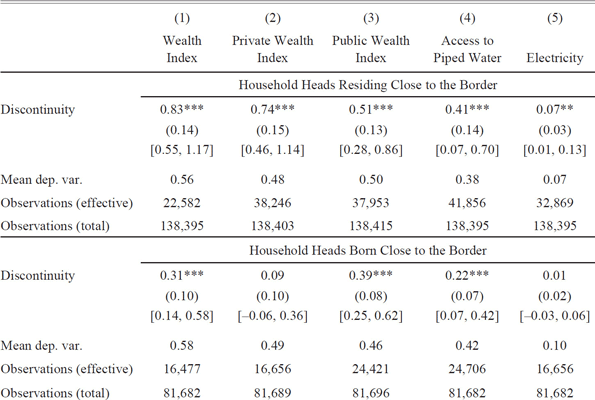
How did colonizer identity affect education levels? Mechanisms explaining the divergence and convergence in education at the border can be broadly grouped into demand and supply channels. Comparatively better economic conditions under British rule could have increased the demand for education through an income effect or higher returns to education. There is no precisely geolocated data on economic development during the colonial period, but a wealth index can be built from data on housing quality in the 1976 population census to assess differences in economic development at the border. Of course, these differences could have emerged in the postcolonial period, and they could be the consequence of better education in British Cameroon, but the exercise is still informative.Footnote 25 I estimate a large discontinuity in household wealth of 0.83 standard deviations favoring the former British side in 1976 (Table 4, top panel, Column (1)). However, part of this effect might be explained by selective migration away from the border region. One concern is that, on the French side of the border, richer and more educated individuals migrated to the administrative capital Yaounde or the economic capital Douala. In the bottom panel of Table 4, I allocate the wealth index to the household head and estimate a discontinuity controlling for the location of the place of birth of the household head rather than his place of residence. The effect is divided by more than two, which confirms that migration is a serious concern, but it remains important at 0.31 standard deviations (Table 4, bottom panel, Column (1)).
DISCONTINUITIES IN WEALTH IN THE 1976 CENSUS

Notes: Sample of household heads (all cohorts) residing in or born in villages within 100 km of the southern section of the border. Discontinuities obtained employing a local linear non-parametric estimation with triangular kernel and optimal MSE bandwidth. Added covariates: ethnic homeland fixed effects. Standard errors clustered at the village level in parentheses. *p < 0.1, **p < 0.05, ***p < 0.01. Calonico, Cattaneo, and Titiunik (Reference Calonico, Cattaneo and Titiunik2014) confidence interval in [ ]. The effective number of observations is the number of observations within the optimal bandwidth. The mean of the standardized wealth index is not zero because the sample is in the South, which is closer to the coast and richer.
Source: Author’s calculations from the 1976 Population and Housing Census of Cameroon.
To have a better idea of the mechanisms behind a higher wealth index on the British side of the border, Columns (2) and (3) of Table 4 decompose the wealth result into a public and a private wealth index. The public index uses housing quality variables that are strongly dependent on public utilities, like water or light source, while the private index excludes them.Footnote 26 When I control for the location of the place of birth of the household head rather than place of residence, I find that the discontinuity in the wealth index is entirely driven by public wealth. Next, I distinguish between a utility provided locally, piped water, and a public utility provided nationally, that is, electricity (Columns (4) and (5)). Only access to piped water increases when one crosses the border from French to British Cameroon. One likely mechanism, proposed by Lee and Schultz (Reference Lee and Schultz2012), is that British indirect rule resulted in better local institutions. However, from the limited measure I have, these better local institutions do not seem to have increased private wealth.Footnote 27
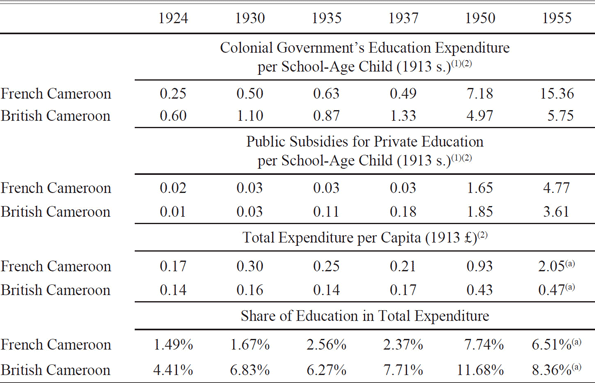
The divergence in education could also be explained by supply mechanisms, that is, by the direct effect of education policies.Footnote 28 In Cameroon, like elsewhere in Africa, the British colonial government gave incentives for religious missions to provide formal education through a system of subsidies. Though religious education played a more important role in French Cameroon than elsewhere in French Africa, Christian education did not receive as much support in French Cameroon as in British Cameroon. Built using newly collected public finance data (see Online Data Appendix), Table 5 shows that, in the 1930s, the British spent more per capita than the French on education. Education expenditure was, however, low in both parts. In 1937, the British colonial government in Cameroon was spending 1.33 1913 shillings (about $10 in 2018 USD) per school age child, while the French colonial government was spending 0.49 1913 shillings (about $3 in 2018 USD). Subsidies for private education were 6 times higher in British Cameroon than in French Cameroon (0.18 versus 0.03 1913 shillings per school age child). The British spent more per capita than the French on education because they were pursuing a different education policy, not because they were raising and spending more overall. Indeed total government expenditure per capita in British Cameroon was lower than in French Cameroon, which means that the share of education in total government expenditure was higher in British Cameroon (7.71 versus 2.37 percent in 1937).
PUBLIC FINANCING OF EDUCATION, FRENCH AND BRITISH CAMEROON

Sources: France, Ministère des Colonies (1921–1938, 1947–1957); Great Britain Colonial Office (1922–1938, 1949–1959). Colonial budgets were used as an additional source for French Cameroon (Cameroun, various dates). (1) School-age population is assumed to be 20 percent of total population. (2) British Cameroon figures were deflated to 1913 pounds using a UK retail price index (London and Cambridge Economic Service and Alford Reference Alford1973). French Cameroon figures were first deflated to 1913 francs using the French consumer price index of Villa (Reference Villa1997), and then converted to pounds using the 1913 official exchange rate (London and Cambridge Economic Service and Alford, Reference Alford1973). 1913 was chosen because both countries were then in the gold standard and the exchange rate had been stable for decades. There are 20 shillings (s.) in a pound (£). (a) 1953 figures.
It is important to stress that British colonial education policies relied heavily on local actors. Public education was, on the British side, largely delegated to native administrations, local governments empowered by indirect rule. The British government also relied extensively on Christian missions.Footnote 29 To show that different colonial policies regarding missions had an impact on religious conversion, I estimate discontinuities in religion in the 2005 census in Online Appendix Table F.2. In 2005, Cameroonians were 18.4 percentage points more likely to be Christian and 14.6 percentage points less likely to have no religion if they were born on the Anglophone side of the border. The discontinuity in Christianity is largely driven by a discontinuity in the percentage of Protestants. We therefore need to consider another type of demand mechanism, involving nonlabor market returns to education: Protestantism encourages personal reading of the Bible, which can increase the demand for education (Woodberry Reference Woodberry2004; Becker and Woessmann Reference Becker and Woessmann2009).
The British advantage in education was quickly erased starting after WWII, at the same time as education policies were changing on the other side of the border. In the 1950s, public expenditure increased in both parts of Cameroon, but the surge was particularly pronounced in French Cameroon: total expenditure per capita was multiplied by 6 between 1937 and 1955, and education expenditure per capita was multiplied by 20 (Table 5, Columns (5) and (6)). In 1955, French Cameroon was spending 3 times more than British Cameroon on education, and it had even surpassed the British side in subsidizing private schools (last column of Table 5).
Though the change in education expenditure started before independence and reunification, post-colonial developments reinforced the convergence in education between both sides of the border, and even resulted in a Francophone advantage for cohorts born after 1960. Since reunification, inhabitants of the former British part have felt discriminated against by the Francophone center. I provide some evidence that school supply policies since independence have disadvantaged Anglophone Cameroon.
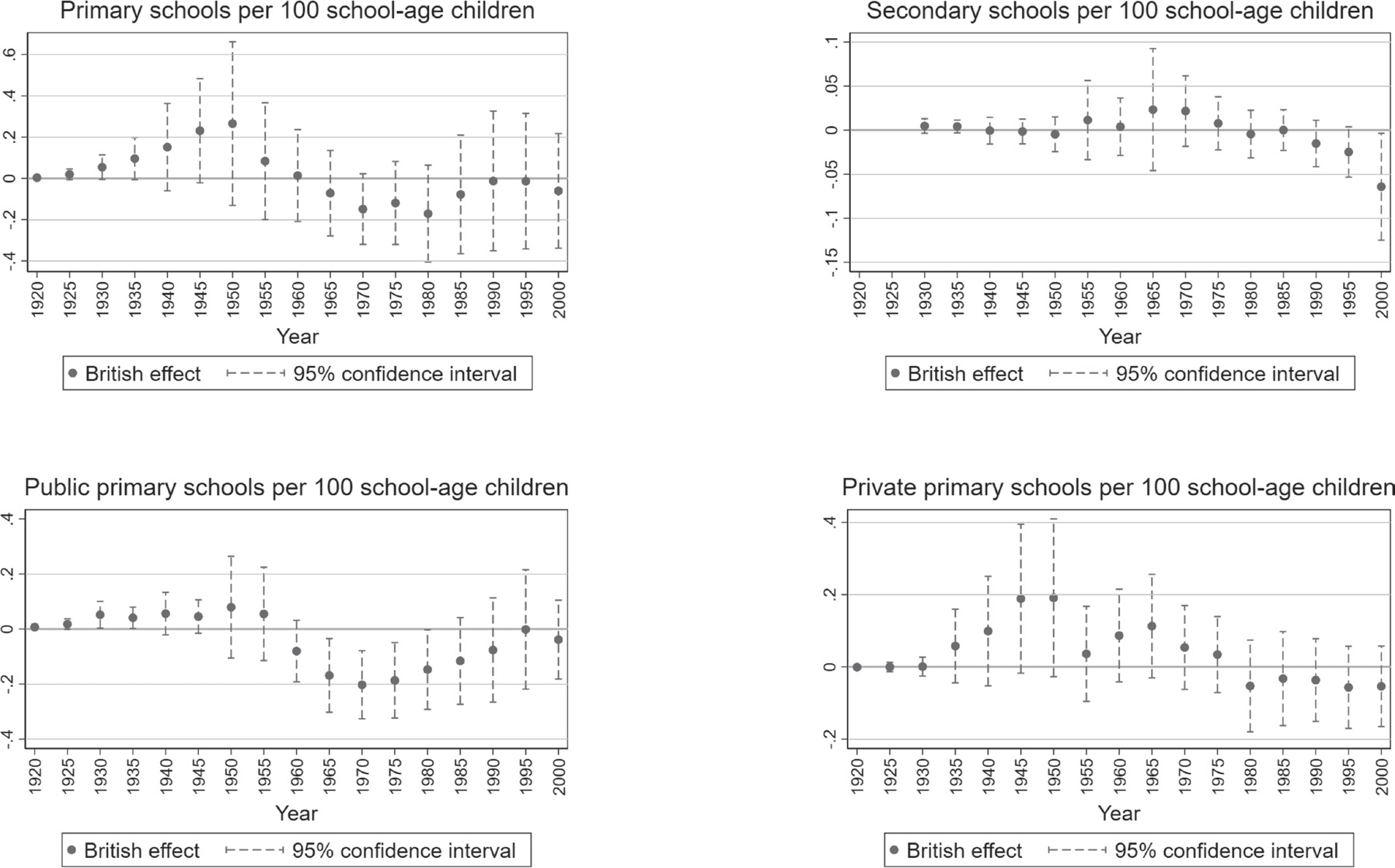
Figure 7 plots border discontinuities in the number of schools per 100 children every 5 years between 1900 and 2000. Because historical data on the location of schools is not available, I use 2003 administrative data giving the opening date of every school in Cameroon. Therefore, I do not observe schools that closed between their opening and 2003. If attrition was selective with respect to colonial origins, this would introduce a bias in the estimation of border discontinuities. The twentieth century was a period of high population growth and primary schooling expansion in Cameroon, so massive public schools closings are unlikely.Footnote 30 Turnover of schools might be more important for private schools, and it might be more important in British Cameroon, where local actors had more autonomy in education. Lastly, the bias introduced by selective attrition should be stronger in the colonial period than in recent times, as schools had more time to close down and disappear from the sample. Overall, selective attrition might lead to an underestimation of the British effect during the colonial period.
BORDER DISCONTINUITIES IN SCHOOL SUPPLY OVER THE TWENTIETH CENTURY

The number of primary schools per children starts diverging in 1930, the positive British effect reaching 0.27 schools per 100 school age children in 1950 (Figure 7, Panel 1). The British effect then decreases to zero between 1950 and 1965, and inverts after independence before reverting back to zero in the 1990s. The third and fourth panels of Figure 7 distinguish between public and private schools: the advantage of the Francophone side after independence is entirely explained by public schools: the discontinuity in the number of public primary schools per 100 school-age children reaches –0.2 in the 1970s. This is consistent with the discrimination of the Francophone government against the Anglophone part after independence, and might explain why primary completion rates are lower in Anglophone Cameroon for the cohorts born in the 1960s and 1970s (Figure 6 and Table 3).
Re-emergence of an Anglophone Advantage: The Legacy of Pedagogical Culture
If the initial divergence in education was erased by the boom in education spending in French Cameroon starting at the end of the colonial period and favoritism towards the Francophone part after reunification, what then explains why individuals born in the 1970s and 1980s in former British Cameroon were more likely to finish high school and go to a university?
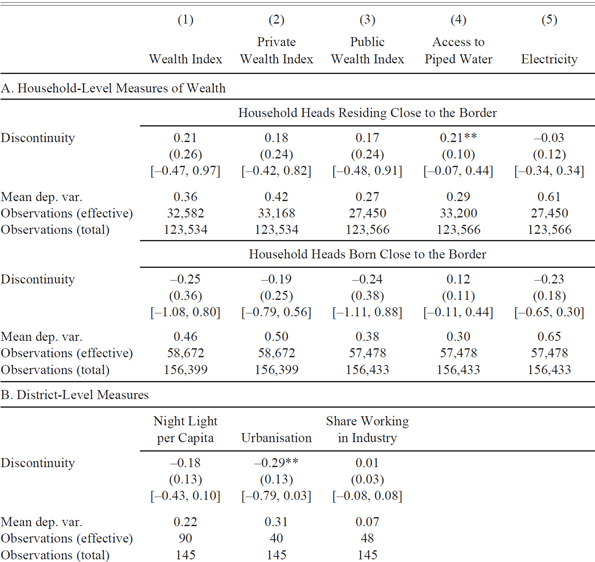
Here again, mechanisms can be broadly divided into supply and demand. With respect to demand mechanisms, individuals born in former British Cameroon might be more likely to finish high school and pursue tertiary education because the returns to tertiary education are higher. Table 6 estimates discontinuities in wealth and in various measures of economic development in the 2005 census. Whether I control for the geographic location of the household head’s place of residence or place of birth (Panel A), I estimate no statistically significant discontinuity in the housing-quality based wealth index.Footnote 31 In Panel B, I look at three district-level measures of economic development—night-time light per capita, urbanization, and the share of workers in the industrial sector. I estimate no discontinuity in night-time light or industrialization, but I estimate a strong discontinuity in urbanization favoring the Francophone side (–29 percentage points).Footnote 32 These results make it unlikely that the Anglophone advantage re-emerged because of differences in economic development affecting the demand for education. At the same time, these results seem to indicate that the Anglophone advantage in higher education has no effect on economic development, but it is important to note here that it is a recent phenomenon affecting only cohorts born after 1970 (Figure 6, Panel 4), who were younger than 35 in 2005. It is likely that the effects of the difference in education did not have time to materialize in such a short period.
DISCONTINUITIES IN VARIOUS MEASURES OF ECONOMIC DEVELOPMENT IN 2005

Notes: The sample excludes Douala and the districts closest to the northernmost section of the border. Discontinuities obtained employing a local linear estimation with triangular kernel and optimal MSE bandwidth. Added covariates: border section dummies. Standard errors clustered at the district level in parentheses. *p < 0.1, **p < 0.05, ***p < 0.01. Calonico, Cattaneo, and Titiunik (Reference Calonico, Cattaneo and Titiunik2014) confidence interval in [ ]. The effective number of observations is the number of observations within the optimal bandwidth. Urbanization is the share of the district population living in an urban area. The industrial sector includes mining.
Source: Author’s calculations from the 2005 Population and Housing Census of Cameroon and Version 4 DMSP-OLS Nighttime Lights Time Series.
Demand for higher education might also be different because of differences in preferences, explained by culture, especially religious factors and the inter-generational transmission of educational preferences. The share of Protestants was higher in Anglophone Cameroon in 2005 (Online Appendix Table F.2). However, the positive effect of Protestantism on education is generally explained by the necessity to be able to read the Bible. This is at odds with the finding that the British advantage appears only in high school completion and university participation, and not in primary school, where children typically learn to read.
Inter-generational transmission of education might be another channel. Migration from the border region was more important on the Francophone side of the border (see Online Appendix D.5). If migration selected away the most educated individuals on the Francophone side of the border, inter-generational transmission of education could explain the resurgence of a British advantage in education for children born close to the border in the 1970s and 1980s. This explanation, however, fails to explain why rates of primary school completion tend to be higher in Francophone Cameroon while rates of secondary education are much lower.
With respect to the education supply channel, neither the supply of primary schools nor the supply of secondary schools favored Anglophone Cameroon at the end of the twentieth century (Figure 7). The border discontinuity in the number of secondary schools per school-age child actually favored Francophone Cameroon in 2000 (Panel 2). Pedagogical culture, though, is likely to differ between two sub-systems with very different colonial histories.
Grade repetition (or grade retention) is much more common today in France than in other OECD countries (OECD 2012). In Africa, the average repetition rate, one of the highest in the world, is brought up by former French colonies (Ndaruhutse et al. Reference Ndaruhutse, Branelly and Latham2008).Footnote 33 The merits of grade repetition as a pedagogical tool are heavily debated, but recent research provides well identified evidence of its detrimental effect on school dropout in the United States and Uruguay (Jacob and Lefgren Reference Jacob and Lefgren2009; Manacorda Reference Manacorda2012). Grade repetition discourages students and sends them a signal of low ability, which encourages them to leave school early. In Marco Manacorda’s (Reference Manacorda2012) study of Uruguay, grade failure is associated with a lower educational attainment of −0.8 school years.
Rates of grade repetition are much higher today in former French Cameroon and jump discontinuously at the border. From the 2005 census, I build a measure of grade repetition for students still enrolled in school (primary and secondary). A student is considered to have repeated a grade if they are older than what their normal progression through the system would predict, taking into account average school entry age in each district (see the Online Data Appendix). Students are 20 percentage points more likely to have repeated at least one grade if they were born in Francophone Cameroon (Table 7, Column (1)).
DISCONTINUITIES IN REPETITION AND LEARNING OUTCOMES IN THE 2005 CENSUS

Notes: The sample excludes individuals born in Douala and in districts closest to the northernmost section of the border. Discontinuities obtained employing a local linear non-parametric estimation with triangular kernel and optimal MSE bandwidth. Added covariates: border section dummies. Standard errors clustered at the district level in parentheses. *p < 0.1, **p < 0.05, ***p < 0.01. Calonico, Cattaneo, and Titiunik (Reference Calonico, Cattaneo and Titiunik2014) confidence interval in [ ]. A student is deemed to have repeated a grade if they are older than what their normal progression in the system would predict, given average school-entry age in the district (computed as the average age of students in their first year of schooling).
Source: Author’s calculations from the 2005 Population and Housing Census of Cameroon.
Two reasons might explain why students repeat more grades in the Francophone system: either, as argued by Jean-Marc Bernard, Odile Simon, and Katia Vianou (Reference Bernard, Simon and Vianou2005) and Susy Ndaruhutse et al. (Reference Ndaruhutse, Branelly and Latham2008) for Francophone Africa as a whole, pedagogical practices differ, or they are similar, but students in the Francophone system have lower learning outcomes, because of some other difference between the two systems, so that they do not have the required level to move to the next grade. The only measure of learning outcomes in the 2005 census is the ability to read and write (asked only of individuals older than 12). Columns (2) and (3) of Table 7 show that students’ performance, measured as the ability of 12-year-old students to read and write, is not lower in the French system. Column (4) estimates a border discontinuity in repetition controlling for the ability to read and write (for children still in school older than 12). Though illiteracy is a very strong predictor of the probability of having repeated a grade, the estimated discontinuity in repetition remain very large, at 17 percentage points.
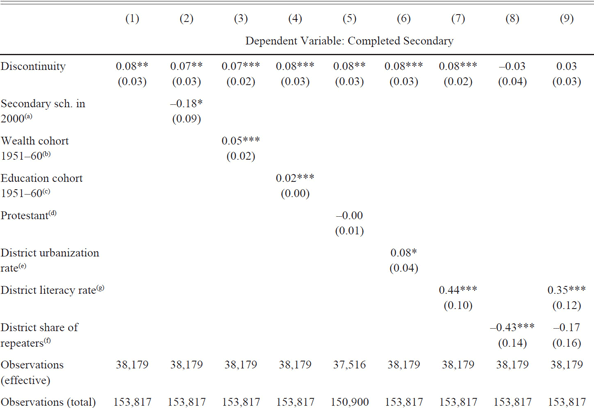
To disentangle the different mechanisms of persistence, I use mediation analysis, studying what happens to the treatment effect (the border discontinuity in secondary school completion) when controlling for plausible mediating variables.Footnote 34 Because my measure of grade repetition is obtained from students still in school in the 2005 census, I focus on the youngest cohort, born 1981–1990. I proxy for the district-level repetition rate to which this cohort was exposed using the repetition rate of students still in middle school in 2005, as defined earlier. Grade repetition is a combination of a policy variable (the extent to which schools are using grade repetition as a pedagogical tool) and an individual variable (the learning outcomes of a student). I am interested in measuring the policy variable, so I add district level literacy rates in the cohort 1981–1990 as a control. I also consider as a likely mediating variable of the Anglophone effect the number of secondary schools in 2000, the wealth and education of cohorts born 1951–1960 (the parents), religion, and urbanization rates at the district level. Table 8 shows that controlling for district-level rates of grade repetition causes the border discontinuity in secondary school completion to fall to zero (Columns (8) and (9)), while controlling for other mediating variables hardly affects the estimated discontinuity of 8 percentage points. Though the results of this mediation exercise are to be interpreted with caution, they provide evidence in favor of the pedagogical culture channel and the role of grade repetition.
DISCONTINUITIES IN SECONDARY COMPLETION WITH CONTROLS, COHORT 1981–1990

Notes: The sample excludes individuals born in Douala and born in districts closest to the northernmost section of the border. Discontinuities obtained employing a local linear non-parametric estimation with triangular kernel and optimal MSE bandwidth. Added covariates: border section dummies. Standard errors clustered at the district level in parentheses. *p < 0.1, **p < 0.05, ***p < 0.01. The effective number of observations is the number of observations within the optimal bandwidth. (a) Number of secondary schools per 100 secondary school age children in the district in 2000. (b) District average wealth index of household whose head was born between 1951 and 1960. (c) District average years of schooling of the cohort born between 1951 and 1960. (d) Protestants comprise other Christians, who are neither Protestant, Catholics, and Orthodox. (e) District urbanization rate in 2005. (f) Share of middle school students who are older than what their normal progression through the system would predict (in 2005). (g) Share of the cohort born 1981–90 who can write in the 2005 census.
Source: Author’s calculations from the 2005 Population and Housing Census of Cameroon and 2015 administrative school data.
How could pedagogical culture, a fixed characteristic of the Francophone education system, have different effects over time? Why were individuals born in the 1940s, for example, not more likely to complete a secondary cycle in the Anglophone system? A first explanation is that the favoritism towards the Francophone side in primary school supply seems to have decreased at the end of the twentieth century, making apparent the positive effect of lower repetition rates in the Anglophone system. The third panel of Figure 7 shows that the public supply of primary schools strongly favored the French-speaking side of the border in the 1960s and 1970s, but that there was no more discontinuity at the border in the 1990s.
Another potential explanation lies in the overall increase in average years of schooling. Within 25 km of the border, average years of schooling went from less than 4 years for people born in the 1940s to 8.5 years for people born in the 1970s Though in the Francophone system, repetition rates are high in both the primary and the secondary cycle,Footnote 35 the effect of grade repetition on dropout is likely to be more important for older students because they have a higher opportunity cost of staying in school, that is, they could start working. A student who repeats the first year of primary school is more likely to remain in school than a student who repeats the first year of secondary school. Though I do not have data on historical repetition rates, we have no reason to believe that they were lower in the 1950s and 1960s than they are today. However, it is likely that their discouraging effect did not matter as much because the number of children going on to secondary education was low.
The education system inherited from the British colonizer seems more efficient at retaining children in school and allows them to pursue higher education, but what are the implications in terms of welfare? If returns to one year of education are higher on the Francophone side of the border, then it might be that the Francophone system, though providing fewer years of effective education, is actually giving students a similar set of skills. Answering this question fully requires detailed work on teaching quality in the two systems, which is left for future research, however, there are two things that must be emphasized. The first is that the Anglophone advantage is not only manifest in attainment levels, but also in numbers of years spent in school, taking repetition into account (Table 3, Column (5)). The second is that the probability of having a high-skilled occupation is higher in Anglophone Cameroon (Table 3 Column (6) and Online Appendix Table E.1); it appears that differences in rates of secondary school completion have labor market effects.
CONCLUSION
How does the history of Cameroon help us understand the mechanisms of persistence of colonial legacies, notably the respective roles of local and national-level mechanisms? The important lessons here are that colonial legacies are not set in stone and that national-level policies play a major role. The initial divergence in education at the border was short lived, because of a boom in education expenditure on the French side in the very last decade of colonization, and because of favoritism towards the Francophone side after reunification.
This is not to say that colonial history does not matter. First, British and French colonization left very different cultural legacies: people born in former British Cameroon are today far more likely to identify as Christian, while people born in former French Cameroon are far more likely to say they have no religion. Moreover, the educational advantage of the British part resurfaced more recently. To explain it, I put forward the channel of different pedagogical practices—another cultural legacy. Though more research is needed, the French legacy of high repetition rates is not limited to Cameroon and concerns Francophone Africa as a whole. Efforts to lower grade repetition rates in Francophone education systems might help decrease the dropout rate and allow more students to finish high school and go to a university.