


Introduction
Health Technology Assessment (HTA) is based on systematic processes aimed at identifying the clinical, economic, and social effects resulting from the incorporation of technologies into health systems. In this context, rapid technological advances and the growing demand for innovations in hospital settings have increased healthcare costs. This scenario makes it essential to adopt evidence-based approaches to guide the incorporation and management of new technologies (1). In the scope of the Brazilian Unified Public Health System (Sistema Único de Saúde, SUS), HTA has been consolidated as a strategic decision-support tool, promoting greater safety, quality, and equity.
Defining organizational priorities involves choices regarding resource allocation and positioning in relation to institutional challenges and opportunities (Reference Porter2). Hospitals can be characterized as knowledge-intensive professional organizations. In such organizational contexts, part of the information that may guide institutional decisions emerges from the experience accumulated at the frontline of care. (Reference Mintzberg3) The systematic identification of technological gaps and unmet medical needs (UMNs) may therefore contribute to transforming dispersed perceptions from clinical practice into more structured inputs for defining institutional priorities related to technological development, research agendas, and innovation initiatives.
Therefore, examining the technology incorporation process within a large teaching public hospital can offer a particularly relevant context for investigating how HTA activities can contribute to identifying UMNs and informing research and development agendas.
In the Brazilian context, HTA decentralized units, mostly located at public university hospitals, were conceived by the National Ministry of Health primarily to support incorporation decisions at the local level (4). These HTA units also work in collaboration with the National Committee for Health Technology Incorporation into SUS (CONITEC) and are reunited in a national HTA network (REBRATS). (4;Reference Toma, Elias, Diniz and Novaes5) At the international level, these initiatives are recognized as hospital-based HTA (HB-HTA), in which units embedded within hospitals conduct analyses of technologies in specific clinical contexts, supporting managers and policymakers. This concept has been formally developed and systematized in Europe, particularly through the AdHopHTA project, which defined organizational models, guiding principles and good practices for HB-HTA units across several European countries (Reference Sampietro-Colom, Lach and Cicchetti6). Although HB-HTA has gained international recognition, it remains an approach that is still under consolidation. (Reference Itaborahy, Santos, Salomon, Bregman, Mateus and Santos7).
To explore this proposition in an empirical context, this study examines the experience of the Hospital de Clínicas de Porto Alegre (HCPA), recognized as the best public hospital in Latin America (8). The hospital is affiliated with the Federal University of Rio Grande do Sul and plays a nationally renowned role in healthcare, teaching, and research (8). Its HTA unit has been active since 2009 and represents a consolidated result from the expansion of HTA initiatives in the country (Reference Sampietro-Colom, Lach and Cicchetti6).
Authors consider that beyond technology assessment, HB-HTA units can also act as institutional mechanisms for identifying UMNs, repositioning themselves as sources of institutional intelligence, as well as research and innovation driven by clinical care needs. Accordingly, the objective of this study is to provide methodological enhancement to HB-HTA by (i) analyzing technical-scientific reports (TSRs) produced by HB-HTA units and (ii) examining their relation to the identification of UMNs. Based on this proposal, the following research question is formulated: how should HB-HTA processes be designed and conducted to identify UMNs and innovation potential?
As an expected result, the study aims to recognize the relevance of HTA activities as systematic sources of contextualized evidence, contributing not only to more qualified decisions about technology adoption but also to identifying research needs and innovation opportunities.
Method
This study adopted a qualitative case study with a methodological enhancement strategy, appropriate for investigating complex phenomena in real institutional contexts, where multiple variables interact simultaneously (Reference Yin9). In addition, it also represents a methodological development effort, aiming to propose an approach that can be replicated in other HB-HTA contexts.
Multiple research techniques were employed, including documentary analysis and content analysis, complemented by a literature review to provide theoretical grounding and contextualize the findings (Reference Marconi and Lakatos10;Reference Minayo11). The methodological HTA process at the HCPA HTA unit is guided by the Brazilian HTA Network (REBRATS) guidelines, which are in alignment with international frameworks and recommendations from organizations such as AdHopHTA handbook (Reference Sampietro-Colom, Lach and Cicchetti6), EUnetHTA, and HTAi (Reference Minayo11). The empirical basis comprised 37 sequential HTA TSRs issued by the HCPA HB-HTA unit between 2018 and 2023, related to nonpharmacological technologies incorporation requests. The technology domains evaluated in the TSRs included clinical and epidemiological contexts, technology functions/description, scientific evidence of comparative effectiveness, patient and health professionals’ safety, environmental impact, budgetary and economical aspects, organizational, legal, and ethical aspects.
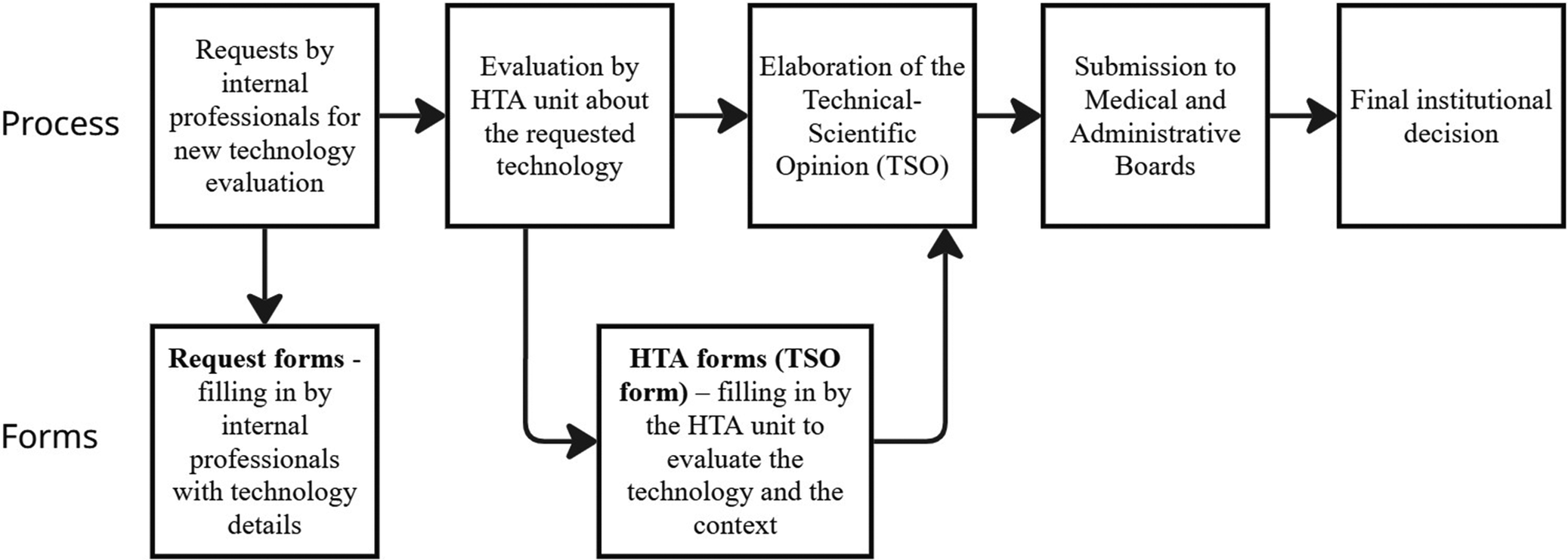
HTA flow in HCPA institutional HTA flow follows a structured process: requests for the evaluation of technologies are submitted exclusively by hospital and university staff members, through an electronic form available on the hospital intranet. This form collects detailed information on the proposed technology, including clinical indications, target population, comparators, expected outcomes, costs, organizational impact, and clinical evidence supporting the incorporation request. Based on this data, the HTA unit prepares the scientific technical report. Figure 1 demonstrates this process.
Institutional flow of the health technology assessment (HTA) unit at Hospital de Clínicas de Porto Alegre (HCPA). Source: Prepared by the authors.

Figure 1. Long description
The flowchart is divided into two horizontal tracks. The top track is labeled Process and the bottom track is labeled Forms.
Process Row (Left to Right):
1. Requests by internal professionals for new technology evaluation. An arrow points down to a box in the Forms row and another arrow points right to the next process step.
2. Evaluation by H T A unit about the requested technology. An arrow points down to a box in the Forms row and another arrow points right to the next process step.
3. Elaboration of the Technical-Scientific Opinion (T S O). An arrow points right to the next process step.
4. Submission to Medical and Administrative Boards. An arrow points right to the final step.
5. Final institutional decision.
Forms Row (Left to Right):
1. Request forms - filling in by internal professionals with technology details. This box receives an arrow from the first process step.
2. H T A forms (T S O form) - filling in by the H T A unit to evaluate the technology and the context. This box receives an arrow from the second process step and sends an arrow up to the third process step (Elaboration of the T S O).
Building on this institutional flow, the study advanced to a structured analysis of the technical reports to extract and categorize UMNs. The definition of analytical variables and the structure of the categorization process were guided by the central objective of the research: to provide methodological enhancement to HB-HTA by (i) analyzing TSRs produced by HB-HTA units and (ii) examining their relation to the identification of UMNs and research gaps. An exploratory reading of all 37 TSRs from the corpus was initially conducted by the study authors to allow familiarization with the structure and content of the reports and to support the preliminary construction of analytical variables. The subsequent analysis focused on the systematic identification of explicit or implicit gaps in the documents, which were then organized into thematic blocks representing different types of UNMs. This step was conducted in a participatory manner, involving the researcher, active engagement with the HTA unit within the empirical field, and oversight academic supervision. This approach ensured alignment between the study objectives and the categorization criteria adopted. Each TSR was individually analyzed, and the collective set of reports (the corpus) was subsequently synthesized into coded analytical variables and thematically grouped according to the categories identified during the exploratory phase. Examples of coded variables, thematic domains, and categorization criteria are presented in Supplementary Table S1. This structured procedure sought convergence with international models of priority setting in health, thereby increasing comparability and methodological robustness.
Data analysis followed the principles of content analysis, according to the categorical thematic approach proposed by Bardin (Reference Bardin12), consistent with the documentary nature of the material analyzed. The coded variables were subsequently organized into an interpretative matrix of UMNs, making it possible to build a proposal for a prioritization framework, from which the findings were systematized and translated into operational insights. Based on this documentary analysis and international frameworks, including the NEED project (Needs Examination, Evaluation and Dissemination) (Reference Maertens de Noordhout, Levy and Claerman13), the evaluation process of TSRs was refined through the introduction of new questions aimed at explicitly capturing UMNs in the hospital context. The NEED framework provides structured criteria and indicators to identify patient and societal unmet health-related needs, supporting evidence-based prioritization of health conditions and interventions. This refinement drew on consolidated practices in prioritization and HTA.
Results
In total, 37 TSRs issued between 2018 and 2023 were analyzed, covering technologies proposed by different clinical departments of the HCPA. The peak of submissions occurred in 2021 (n = 11; 29.7 percent), followed by 2022 (n = 9; 24.3 percent). Vascular and peripheral surgery stood out as the area with the highest number of requests. This may reflect both the prevalence of vascular diseases among patients and specific technological gaps in their clinical management.
Regarding the classification of technologies, the data showed the following distribution: medical procedures (35.1 percent), equipment (29.7 percent), diagnostic technologies (24.3 percent), and orthoses or prostheses (10.8 percent). Concerning the final recommendations for incorporation, 21 technologies (56.8 percent) were recommended, 11 (29.7 percent) were not recommended, and 5 (13.5 percent) presented inconclusive decisions, signaling the need for more robust evidence. From the reading of the TSRs, it was possible to identify and classify a total of 39 UMNs, explicitly or implicitly described in the documents. The UMNs were classified into three types: therapeutic (21 cases – 56.8 percent), diagnostic (12 cases – 32.4 percent), and preventive (4 cases – 10.8 percent).
UMNs were recognized in some TSRs but often in an implicit or generic way. For example, in the case of epilepsy in critically ill patients, there was mention of the need for continuous monitoring of subclinical seizures in the ICU but without detailing technical or clinical parameters. This lack of precision highlights the need to transform general descriptions into specific research problems with objective criteria.
The classification of UMNs showed a predominance of therapeutic needs, representing 56.8 percent of the total. This result likely reflects the fact that HCPA is a tertiary referral hospital for the treatment of highly complex conditions and highlights limitations in access to more effective or innovative therapeutic interventions in a public hospital. On the other hand, 32.4 percent of UMNs were related to diagnosis, reflecting demands for more accurate, faster, or accessible methods for identifying health conditions, especially in critical subpopulations. The lowest percentage was observed in preventive UMNs (10.8 percent), which may indicate a structural gap in the prioritization of technologies aimed at preventive measures or a lower perception of these needs in the hospital setting.
The UMNs were categorized into specialized medical areas, with Neurology being the most representative, accounting for 16.2 percent of the requests. This prominence may reflect the growing care demand related to chronic neurological conditions of high complexity. The analysis of the submitted technologies wasbased on the final decisions of the TSRs, the additional recommendations of the HTA Unit, and the evaluation of the institutional context. To ensure the adequate classification of technologies in terms of research and/or development needs, two authors independently applied criteria that were inductively defined based on elements identified in the TSRs. For this analysis, “research need” was defined as the lack of additional studies proving the efficacy, safety, or cost-effectiveness of the technology, while “development need” refers to the absence of fully developed technological solutions that meet the identified demands. Of the 37 health technologies submitted for incorporation, 81.1 percent presented a need for additional research and/or development.
Overall, the results indicate a significant gap in both access to and development of innovative technologies, with direct implications for the ability to meet the specific needs of the hospital. These findings suggest that most of the evaluated technologies still lack robust evidence or technical maturity, which underscores the relevance of strategies in translational research and technological development.
Discussions
The results of this research show that the TSRs prepared by the HTA Unit of HCPA frequently identify health technologies associated with UMNs, which can guide institutional research and development (R&D) agendas. This finding reinforces the importance of aligning HTA with innovation policies (Reference Caetano14), as also argued by Scott et al. (Reference Scott, Guyatt and Cogo15), who highlight the potential of HTA as a structured source of research gaps relevant to public policy formulation.
The findings of this study reinforce this characteristic of hospital organizations. Many of the UMNs identified in the analyzed reports reflect limitations and opportunities perceived directly in clinical practice, showing how relevant information for strategic orientation may emerge from the accumulated experience of frontline healthcare professionals (Reference Mintzberg3). Systematizing these perceptions through structured technology assessment processes allows dispersed knowledge from clinical practice to be transformed into more structured organizational intelligence capable of informing institutional decisions and technological development priorities. By making technological gaps and development opportunities visible, these processes can stimulate the generation of ideas among professionals within the organization. They may also encourage interactions with external actors from the health innovation ecosystem, linking concrete clinical needs with broader research, development, and innovation agendas. (Reference Chesbrough16). In this sense, HTA processes may also contribute to organizational strategy formation by transforming UMNs and experiential knowledge from clinical practice into inputs for strategic intelligence and the evolution of institutional priorities (Reference Mintzberg, Ahlstrand and Lampel17).
When analyzing the data comparing therapeutic areas in relation to the target population, there was a significant concentration of demands in conditions of high complexity and clinical impact, particularly in neurology and oncology. Such predominance in the analyzed reports reflects the need for prioritization based on criteria such as the severity of conditions, the cost-effectiveness of the proposed interventions, and the potential impact on clinical outcomes.
The analysis of the formal structure of the TSRs revealed some limitations, as researchers often had to infer UMNs indirectly: clinical outcomes and final considerations suggested unresolved demands but without dedicated space for explicit recording in the HTA reports; the literature review exposed knowledge gaps due to poor-quality or absent systematic reviews, yet these remained scattered in the text; and cases where available options were ineffective, unavailable, or not cost-effective pointed to innovation opportunities but lacked structured categorization. Other issues, such as organizational limitations or infrastructure deficits, also emerged in sections on organizational impact but were not captured as strategic gaps. In response to these shortcomings, the study proposed the introduction of new questions to the TSR structure template, designed to ensure that such needs could be systematically identified and recorded.
One of the main technical contributions of this research is precisely the definition of these new questions, which allow HTA unit staff to explicitly register: (i) unmet clinical demands, (ii) knowledge/research gaps, (iii) opportunities for technological development, and (iv) other relevant needs. With this addition, TSRs cease to be only narrative reports of technology incorporation and evolve into structured instruments capable of generating standardized data. These data are applicable both in the local hospital context and in comparative analyses across institutions, consolidating TSRs as replicable methodological products that strengthen the integration between hospital-based technology assessment and institutional R&D agendas. The feasibility of these new questions was preliminarily assessed by independent evaluators, reinforcing their role as a methodological contribution rather than a merely conceptual proposal.
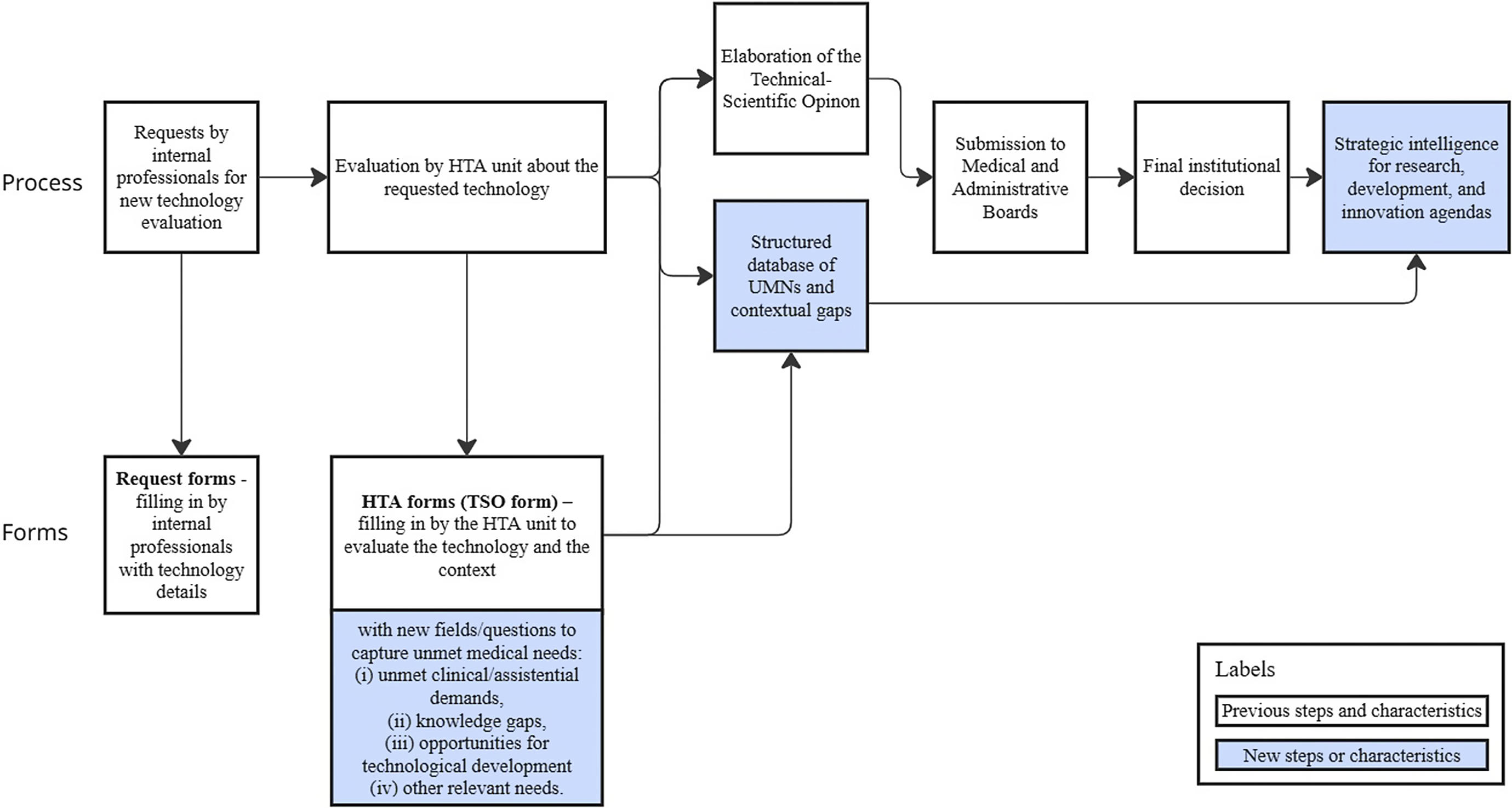
The management of the HCPA HB-HTA unit acknowledged that the systematization of these findings represents a significant methodological advancement. This improvement is not limited to the technical detailing of the reports but encompasses multiple contextual dimensions – from explicit clinical gaps to organizational and infrastructure constraints. Such institutional recognition reinforces that the proposed model can transcend the level of the analyzed hospital, providing inputs for a more systemic approach to identifying unmet needs. By making visible the gaps that previously remained scattered within the reports, the process contributes to aligning research, development, and innovation agendas in a more strategic and generalized way across hospitals and health systems. Building on this recognition, Figure 2 illustrates how the instruments and processes were advanced.
From technology evaluation to strategic intelligence: enhanced hospital-based health technology assessment (HB-HTA) framework. Source: Prepared by the authors.

Figure 2. Long description
The flowchart is organized into two horizontal rows: Process at the top and Forms at the bottom.
Starting at the far left:
* Process: Requests by internal professionals for new technology evaluation. An arrow points down to the corresponding form.
* Forms: Request forms - filling in by internal professionals with technology details.
Moving right:
* Process: Evaluation by H T A unit about the requested technology. An arrow points down to the corresponding form.
* Forms: H T A forms (T S O form) - filling in by the H T A unit to evaluate the technology and the context. This box includes a blue-shaded section with new fields to capture unmet medical needs: (i) unmet clinical/assistential demands, (ii) knowledge gaps, (iii) opportunities for technological development, (iv) other relevant needs.
The process then splits into two parallel paths:
* Upper path: Elaboration of the Technical-Scientific Opinion.
* Lower path (blue-shaded): Structured database of U M N s and contextual gaps. This box receives input from both the H T A unit evaluation and the T S O form.
The upper path continues to:
* Submission to Medical and Administrative Boards.
* Final institutional decision.
Both the final institutional decision and the structured database of U M N s lead to the final blue-shaded outcome:
* Strategic intelligence for research, development, and innovation agendas.
A legend at the bottom right identifies white boxes as Previous steps and characteristics and blue-shaded boxes as New steps or characteristics.
By addressing the previously identified difficulties, incorporating the proposed improvement, and assessing its applicability, the framework demonstrates that combining technology evaluation with a more contextual analysis of UMNs and research gaps creates a more dynamic and comprehensive process for fostering innovation and strategic intelligence. In the same direction, we suggest that other hospitals and healthcare environments with governance structures beyond HTA may also benefit from adopting a broader approach to UMN identification and integration.
To consolidate the use of these new questions, it is necessary to foster networking among different HTA units. This involves standardizing the assessment templates, ensuring data interoperability, and conducting joint periodic analyses. Through such integration, UMNs could be monitored at a national level, creating a strategic database to inform research and innovation agendas. In practical terms, converging toward a minimal dataset and a shared taxonomy of UMNs would facilitate benchmarking across institutions and over time, improving comparability and prioritization.
The predominance of requests focused on procedures and equipment reflects the dynamics of technological innovation in the hospital environment, especially in high complex contexts. The proportion of technologies recommended for incorporation (56.8 percent) suggests adherence to clinical and organizational requirements. However, the significant rate of non-recommendations and inconclusive decisions (43.2 percent) highlights limitations in the robustness of the evidence presented, signaling the need for greater investment in applied research and context-specific evaluations.
The pattern of UMNs identified in the TSRs reinforces how HB-HTA can support incorporation decisions while also signaling priority areas for innovation and applied research within the health system. In line with national priority agendas (18;Reference Jommi, Tarricone and D’Angela19), the mapped needs point to clinical domains in which incremental gains in effectiveness, safety, and access tend to generate disproportionate value for public providers, particularly when technologies target high-risk groups and complex care pathways. Considering recent discussions on equity and impact criteria in prioritization (20), future versions of the template should explicitly capture distributional implications and differential effects across subpopulations, so that the UMN register can support both adoption decisions and strategic R&D orientation.
In addition, the evidence limitations recurrently reported in the TSRs indicate that context-specific uncertainty remains a major barrier for decision-making and for technology maturation in middle-income settings. This finding is consistent with calls to strengthen applied studies and real-world evidence generation through coordinated initiatives involving hospitals, universities, startups, and funding agencies (Reference Mohtasham, Majdzadeh and Nedjat21). In this sense, the proposed questions function as an operational mechanism to convert narrative justifications into structured intelligence, enabling the formal registration of research gaps and supporting prospective portfolio choices in hospital innovation governance.
TSRs also demonstrate potential to act as instruments of technological foresight and institutional strategic intelligence, reinforcing their integration with research and innovation agendas (Reference Scott, Guyatt and Cogo15;20). However, the concentration of requests in high complexity areas such as oncology and neurology contrasts with the scarcity of submissions focused on prevention and primary care. Explicit prompts in the template for preventive and community-oriented solutions may mitigate this asymmetry and broaden the innovation funnel.
This research has limitations as a single case study with methodological enhancement, focused on a specific institution, which implies institutional biases and reinforces the need for multicenter and comparative studies. Future work should test external validity across hospitals with different governance models and resource constraints and evaluate process outcomes such as time to decision, transparency, and downstream R&D initiation.
Although the empirical analysis was conducted in a single hospital, the objective of this study is not statistical generalization but analytical generalization, which is commonly adopted in qualitative case study research (Reference Yin9;Reference Eisenhardt and Graebner22). In analytical generalization, findings are extended not to a population but to a theoretical or methodological proposition. In this study, the proposed analytical framework supports such generalization through two main contributions applicable to other hospital environments: (i) the improvement of the technical and scientific analysis conducted in health technology assessment processes, including the structured use of TSRs and (ii) the systematic identification of UMNs as part of technology assessment activities.
The replicability of this study may be confirmed through analyses conducted in similar institutional contexts, particularly in hospitals that operate HB-HTA units and produce structured technology assessment reports. Under comparable analytical conditions, other studies may apply the same procedure and verify whether similar patterns regarding the identification of UMNs and innovation opportunities also emerge.
The effective identification of UMNs requires robust data and stakeholder involvement. However, the lack of interoperable systems for clinical and administrative data hampers comprehensive mapping of care gaps and limits planning. Furthermore, areas with lower commercial attractiveness, such as neglected diseases, tend to receive little attention from the productive sector (Reference Munos23). Codesign with clinicians, managers, and patients can improve the specificity of UMNs and increase the likelihood that identified gaps translate into fundable research questions.
Final remarks
The HTA Unit of HCPA, created under the National Policy for Health Technology Management, illustrates how HB-HTA can evolve into a strategic tool for innovation. With the inclusion of new questions, TSRs cease to be merely comparative reports and become structured data sources for applied research agendas, hospital innovation, and public policymaking.
The analysis of UMNs from TSRs issued between 2018 and 2023 revealed that 81.1 percent of the evaluated demands required technological development and/or additional scientific investigation, reinforcing the role of these units as institutional intelligence mechanisms capable of connecting local care demands to strategic R&D agendas (Reference Lima, Silva and Caetano24). By aligning the enhanced template with international references such as the methodological guidance developed by EUnetHTA and ISPOR guidance, institutions can increase methodological convergence and facilitate cross-country learning (25;26).
The methodology adopted in this pilot study, based on flexible HTA approaches, aligns with principles of mission-oriented innovation, where priorities are guided by concrete public challenges (Reference Mazzucato27). By articulating UMN identification with institutional R&D agendas, the model proposes a more strategic and needs-driven approach, contributing to the development of cost-effective and socially relevant solutions. A phased implementation plan that includes training, periodic audits, and public dashboards can strengthen governance and transparency. As a single case study, the generalization can be affected, reinforcing the need for multicenter approaches to map the diversity of realities and priorities within the SUS.
In summary, HB-HTA can act as a catalyst for health innovation by transforming TSRs into strategic instruments of knowledge management. This reframing repositions the units as key actors in building a more responsive, efficient, and evidence-driven health system. The main innovation was the improvement of TSO evaluator form, consolidated as a replicable instrument for HB HTA in different contexts, capable of transforming narrative outputs into structured data for R&D agendas. At the international level, the model presented here has replication potential, as it can be adapted by hospitals from different realities, expanding its relevance to the global field of HB HTA. The study contributes methodologically, integrates HTA with innovation management, and positions TSRs as strategic R&D inputs.
Supplementary material
The supplementary material for this article can be found at http://doi.org/10.1017/S0266462326104036.
Funding statement
This study was financed in part by the Coordenação de Aperfeiçoamento de Pessoal de Nível Superior - Brasil (CAPES) - Finance Code 001, and by the Financiamento e Incentivo à Pesquisa (Fipe/HCPA) - https://ror.org/010we4y38.
Competing interests
The authors declare none.


 Open access

