Over the course of the past decade, scientists have increasingly begun to adopt a multiple levels of analysis perspective in their quest to elucidate the developmental processes and mechanisms contributing to the genesis and epigenesis of normal, atypical, and resilient functioning (see, e.g., Cicchetti, Reference Cicchetti, Hartup and Weinberg2002; Cicchetti & Blender, Reference Cicchetti and Blender2004, Reference Cicchetti and Blender2006; Cicchetti & Curtis, Reference Cicchetti, Curtis, Cicchetti and Cohen2006, Reference Cicchetti and Curtis2007; Cicchetti & Dawson, Reference Cicchetti and Dawson2002; Curtis & Cicchetti, Reference Curtis and Cicchetti2003, Reference Curtis and Cicchetti2007; Gottlieb & Halpern, Reference Gottlieb and Halpern2002; Gottlieb, Wahlsten, & Lickliter, Reference Gottlieb, Wahlsten, Lickliter and Lerner1998; Hernandez & Blazer, Reference Hernandez and Blazer2006; Lester, Masten, & McEwen, Reference Lester, Masten and McEwen2006; Masten, Reference Masten2007; Pellmar & Eisenberg, Reference Pellmar and Eisenberg2000). Among the goals of this inherently interdisciplinary endeavor are to utilize advances in scientific knowledge to inform efforts to translate the findings emanating from a multiple levels of analysis approach to the development and implementation of interventions to ameliorate, remediate, and prevent psychopathology and to promote resilience (Chang, Howe, Gallelli, & Miklowitz, Reference Chang, Howe, Gallelli and Miklowitz2006; Cicchetti & Toth, Reference Cicchetti and Toth2006; Curtis & Cicchetti, Reference Cicchetti and Luthar2003; Fisher, Gunnar, Dozier, Bruce, & Pears, Reference Fisher, Gunnar, Dozier, Bruce and Pears2006; Greenberg, Reference Greenberg2006; Luthar & Cicchetti, Reference Luthar and Cicchetti2000; Luthar, Cicchetti, & Becker, Reference Luthar, Cicchetti and Becker2000).
Recent years also have witnessed a renascence of interest in investigating the interaction between genes and environments in the development of psychopathology (Kendler & Prescott, Reference Kendler and Prescott2006; Moffitt, Caspi, & Rutter, Reference Moffitt, Caspi and Rutter2006; Plomin & Rutter, Reference Plomin and Rutter1998; Rutter, Reference Rutter2006; Rutter & Plomin, Reference Rutter and Plomin1997). The development of mental disorder has been generally expected to be caused by genetic predispositions in concert with the impact of an individual's past and present life experiences (Cicchetti, Reference Cicchetti1993; Gottesman & Hanson, Reference Gottesman and Hanson2005; Rutter & Sroufe, Reference Rutter and Sroufe2000). In contrast, genes are equally likely to serve a protective function against environmental insults for some individuals (Cicchetti, Reference Cicchetti and Luthar2003; Curtis & Cicchetti, Reference Cicchetti and Luthar2003; Haglund, Nestadt, Cooper, Southwick, & Charney, Reference Haglund, Nestadt, Cooper, Southwick and Charney2007). Developmental psychopathologists have begun to examine behavioral effects that are the outcomes of the interdependence between a specific identified variation in the DNA sequence and a specific, well-defined environmental pathogen known as Gene × Environment interaction (G × E; Moffit et al., Reference Moffitt, Caspi and Rutter2006; Rutter, Reference Rutter2006). In G × E, environmental experiences moderate genetic effects (or vice versa) on normal, psychopathological, and resilient outcomes. For example, genetic effects on functioning outcomes may be observed only under certain environmental contexts or in conjunction with different histories of experience, or conversely, experience may only relate to outcomes among individuals with specific genetic characteristics.
Maltreated children are at risk for developing a profile of relatively enduring vulnerability factors that place them at high risk for future maladaptation and psychopathology (Cicchetti & Toth, Reference Cicchetti and Toth2005; Cicchetti & Valentino, Reference Cicchetti, Valentino, Cicchetti and Cohen2006). In keeping with the dynamic systems concepts of equifinality and multifinality (Cicchetti & Rogosch, Reference Cicchetti and Rogosch1996), multiple pathways to adaptation and maladaptation, as well as varied developmental outcomes, are possible for maltreated children. The variability shown in children's behavioral responses to the environmental hazard of child maltreatment suggests that this heterogeneity may be within the sphere of genetic influence (cf. Moffit et al., Reference Moffitt, Caspi and Rutter2006).
To permit investigators to discover ways in which genes may moderate environmental experiences, or vice versa, environmental variables must be precisely defined and clearly specified (Moffitt et al., Reference Moffitt, Caspi and Rutter2006). The advances that have occurred in the measurement and operationalization of child abuse and neglect (Barnett, Manly, & Cicchetti, Reference Cicchetti1993; Cicchetti & Manly, Reference Cicchetti and Manly2001; Manly, Reference Manly2005) have enabled developmental psychopathologists to investigate the interaction of genes and maltreating environments in the development of psychopathology and resilience. The experience of child maltreatment has proven to be a candidate environmental pathogen that has generated a number of provocative findings that have contributed to engendering renewed excitement and interest in G × E.
Numerous investigations have reported links between child maltreatment and aggressive or antisocial behavior (Caspi et al., Reference Caspi, McClay, Moffitt, Mill, Martin and Craig2002; Cicchetti & Lynch, Reference Cicchetti, Lynch, Cicchetti and Cohen1995; Cicchetti & Valentino, Reference Cicchetti, Valentino, Cicchetti and Cohen2006; Widom, Reference Widom1989). However, not all maltreated children are aggressive or develop antisocial behavior. Research conducted with transgenic mice that lacked monoamine oxidase A (MAOA) revealed that these mice exhibited an extremely aggressive phenotype. Extrapolating from these findings, Caspi and colleagues (Reference Kim-Cohen, Caspi, Taylor, Williams, Newcombe and Craig2002) examined the interaction between MAOA and maltreatment to ascertain if the heterogeneity of outcomes in maltreated children could be explained by a G × E. MAOA is a mitochondrial enzyme that is expressed predominantly in catecholaminergic neurons (Youdim, Edmondson, & Tipton, Reference Youdim, Edmondson and Tipton2006). It is responsible for the degradation of a variety of biogenic amines (e.g., the neurotransmitters dopamine, norepinephrine, and serotonin; Youdim, Finberg, & Tipton, Reference Youdim, Finberg, Tipton, Trendelenburg and Weiner1998). There is a well-characterized upstream variable number tandem repeat (uVNTR) polymorphism in the promoter region of the MAOA gene that is known to affect gene expression; the length of this polymorphism (i.e., low vs. high number of tandem repeats) determines the efficiency with which MAOA is transcribed and ultimately produced within individuals (Caspi et al., Reference Caspi, McClay, Moffitt, Mill, Martin and Craig2002; Kim-Cohen et al., Reference Kim-Cohen, Caspi, Taylor, Williams, Newcombe and Craig2006).
Caspi et al. (Reference Caspi, McClay, Moffitt, Mill, Martin and Craig2002) found that the MAOA-uVNR polymorphism moderated the impact of child maltreatment on the development of antisocial behavior in males. Specifically, Caspi et al. (Reference Caspi, McClay, Moffitt, Mill, Martin and Craig2002) found that the effect of child maltreatment on antisocial behavior was significantly less among males with high MAOA activity than among those with low MAOA activity. These findings suggest that the probability that child maltreatment will eventuate in male antisocial behavior in adulthood is greatly increased among children whose MAOA is not sufficient to render maltreatment-induced changes in neurotransmitter systems inactive (Caspi et al., Reference Caspi, McClay, Moffitt, Mill, Martin and Craig2002). Although not all investigators have replicated the findings of Caspi et al. (Reference Caspi, McClay, Moffitt, Mill, Martin and Craig2002), the results of an updated meta-analysis of studies conducted to date provide support for the interaction of low MAOA activity and child maltreatment upon later aggressive/antisocial behavior (Taylor & Kim-Cohen, Reference Taylor and Kim-Cohen2007).
These findings are compelling as they demonstrate not only that there are genetic elements that, in interaction with the experience of child maltreatment, are associated with maladaptive developmental outcomes and psychopathology, but also that there are genetic variations that may serve a protective function for some maltreated children (Cicchetti & Blender, Reference Cicchetti and Blender2006). Although researchers investigating the genetics of mental disorder have long focused on the vulnerabilities that certain genetic elements may confer, it is equally probable that genes may, from an evolutionary perspective, serve a protective function against environmental insults for some individuals (Cicchetti & Blender, Reference Cicchetti and Blender2004).
In addition to its contribution to aggression and antisocial behavior, the variable expression of the MAOA gene has a wide-ranging pleiotropic effect that has been implicated in the development of a number of mental disorders, including mood disorders (Meyer et al., Reference Meyer, Ginovart, Boovariwala, Sagrati, Hussey and Garcia2006). The extant literature reveals that differing levels of MAOA activity are linked to a large number of high-risk conditions and mental disorders (e.g., aggression, autism, bipolar disorder, depression, panic disorder, suicidal tendencies, comorbid antisocial personality disorder, and alcoholism; Deckert et al., Reference Deckert, Catalano, Syagailo, Bosi, Okladnova and Di Bella1999; Rende & Waldman, Reference Rende, Waldman, Cicchetti and Cohen2006; Shin, Chen, & Ridd, Reference Shin, Chen and Ridd1999; Youdim et al., Reference Youdim, Edmondson and Tipton2006). This heterogeneity in behavioral outcomes suggests that the genetic influences of MAOA are most likely moderated by environmental pathogens.
Maltreated children also have been found to be at high risk for the development of depressive disorder and depressive symptomatology (Cicchetti & Rogosch, Reference Cicchetti and Rogosch2001b; Kaufman, Reference Kaufman1991; Manly, Kim, Rogosch, & Cicchetti, Reference Manly, Kim, Rogosch and Cicchetti2001; Toth, Manly, & Cicchetti, Reference Toth, Manly and Cicchetti1992; Widom, DuMont, & Czaja, Reference Widom, DuMont and Czaja2007). In addition, maltreated children have been shown to meet diagnostic criteria for dysthymia (Kaufman, Reference Kaufman1991). Various factors have been posited to mediate or moderate the impact of maltreatment on depression. These include subtype(s) of maltreatment experienced, the quality of the child's attachment relationship to her/his mother, social supports and stressful life events, attributional style, social competence, self-esteem, and neuroendocrine and neurotransmitter dysregulation (Cicchetti & Toth, Reference Cicchetti and Toth1998; Gibb, Wheeler, Alloy, & Abramson, Reference Gibb, Wheeler, Alloy and Abramson2001; Harter, Reference Harter, Cicchetti and Cohen2006; Kaufman, Reference Kaufman1991; Kaufman et al., Reference Kaufman, Birmaher, Perel, Dahl, Moreci and Nelson1997; Kim & Cicchetti, Reference Kim and Cicchetti2006; Rudolph & Clark Reference Rudolph and Clark2001; Toth & Cicchetti, Reference Toth and Cicchetti1996a, Reference Toth and Cicchetti1996b; Toth et al., Reference Toth, Manly and Cicchetti1992).
The neurotransmitter serotonin also has been shown to be involved in the development of diverse forms of psychopathology, including anxiety disorders and depression (Cicchetti & Toth, Reference Cicchetti, Toth, Cicchetti and Cohen1995; Murphy et al., Reference Murphy, Li, Engel, Wichems, Andrews and Lesch2001). The serotonin transporter (5-HTT) gene, one of the major genes involved with serotonergic transmission, has a functional insertion/deletion polymorphism region, the 5-HTT linked promoter region (5-HTTLPR), that has two allelic forms: long (l) and short (s) variants. Because the s variant appears to be dominant, heterozygote (s/l) individuals can be functionally categorized with individuals who possess the s/s genotype (Lesch et al. Reference Lesch, Bengel, Heils, Sabol, Greenberg and Petri1996). In vitro research has shown that the l allelic variant has two to three times the basal level of transcriptional activity than the s variant (Lesch & Hiels, Reference Lesch and Hiels2000). Moreover, investigations with nonhuman primates and clinical studies of humans have demonstrated that individuals who possess the s/s and s/l allelic variants have lower levels of serotonergic activity than do individuals with the l/l variant (Heinz et al., Reference Heinz, Jones, Mazzanti, Goldman, Ragan and Hommer2000; Williams et al., Reference Williams, Marchuk, Gadde, Barefoot, Grichnik and Helms2001). As with MAOA, the diversity in behavioral outcomes associated with 5-HTTLPR suggests the likely plausibility of its genetic influences being moderated by environmental pathogens.
Several investigations have recently been conducted examining how the influence of life stress on depression may vary by genetic makeup. In a groundbreaking prospective-longitudinal study of a representative birth cohort, Caspi et al. (Reference Caspi, Sugden, Moffitt, Taylor, Craig and Harrington2003) sought to explain why stressful experiences eventuated in depression for some adults but not for others. These investigators found that the 5-HTTLPR polymorphism moderated the influence of stressful life events on adult depression. Specifically, when confronted with high stress, individuals with one or two copies of the s allele of the 5-HTT promoter polymorphism exhibited more depressive symptoms, depressive disorders, and suicidality than individuals homozygous for the l allele. Moreover, Caspi et al. (Reference Caspi, Sugden, Moffitt, Taylor, Craig and Harrington2003) discovered that adult depression was predicted by the interaction between individuals carrying the s/s or s/l genotype in the 5-HTT gene-linked polymorphism and child maltreatment that occurred during the first decade of life. The results from the Caspi et al. (Reference Caspi, Sugden, Moffitt, Taylor, Craig and Harrington2003) epidemiological investigation provide evidence for a G × E in which an individual's response to the insult of child maltreatment is moderated by her or his genetic makeup.
A number of subsequent studies have investigated the interaction of social adversity or stressful life events and the 5-HTTLPR polymorphism on the development of depressive disorder in adults. To our knowledge, a meta-analysis of these investigations has not been published. There appears to be some inconsistency in attempts at replicating the initial findings of Caspi et al. (Reference Caspi, Sugden, Moffitt, Taylor, Craig and Harrington2003). Although no literal replication (Lykken, Reference Lykken1968) of the initial Caspi et al. (Reference Caspi, Sugden, Moffitt, Taylor, Craig and Harrington2003) study has been undertaken, some investigations have replicated the G × E finding of stressful life events and the 5-HTTLPR polymorphism in the prediction of depression (e.g., Jacobs et al., Reference Jacobs, Kenis, Peeters, Derom, Vlietinck and van Os2006; Kendler, Kuhn, Vittum, Prescott, & Riley, Reference Kendler, Kuhn, Vittum, Prescott and Riley2005), whereas others have failed to do so (e.g., Gillespie, Whitfield, Williams, Heath, & Martin, Reference Gillespie, Whitfield, Williams, Heath and Martin2005; Surtees et al. Reference Surtees, Wainwright, Willis-Owen, Luben, Day and Flint2005).
Eley et al. (Reference Eley, Sugden, Corsico, Gregory, Sham and McGuffin2004) examined G × E for the development of depression in adolescence. These investigators assessed interactions among five markers within or close to the serotonin system, including 5-HTTLPR and MAOA and a composite measure of family-level environmental risk (e.g., social adversity and stressful life events) in the prediction of high levels of depressive symptomatology among adolescents. Eley et al. (Reference Eley, Sugden, Corsico, Gregory, Sham and McGuffin2004) discovered a G × E for 5-HTTLPR in predicting depression in adolescent females, but not in males.
Kaufman and colleagues (Reference Kaufman, Yang, Douglas-Palumberi, Houshyar, Lipschitz and Krystal2004, Reference Kaufman, Yang, Douglas-Palumberi, Grasso, Lipschitz and Houshyar2006) have conducted two studies investigating the interaction between child maltreatment and the 5-HTT gene and their contribution to risk for depression. Participants in these studies ranged in age from 5 to 15, with a mean of approximately 10 years. In the first study, Kaufman et al. (Reference Kaufman, Yang, Douglas-Palumberi, Houshyar, Lipschitz and Krystal2004) found that the quality and availability of social supports moderated the risk for depression associated with a history of child maltreatment and the presence of the short allele of the 5-HTTLPR gene polymorphism. This investigation of Kaufman et al. (Reference Kaufman, Yang, Douglas-Palumberi, Houshyar, Lipschitz and Krystal2004) replicates and extends the finding reported by Caspi et al. (Reference Caspi, Sugden, Moffitt, Taylor, Craig and Harrington2003) with adults. Specifically, maltreated children who were homozygous for the s allele and who had a dearth of positive social supports, had depressive symptoms that were nearly twice as high as maltreated children with the s/s genotype and positive social supports. The latter group of maltreated children had levels of depressive symptoms that were comparable to those of nonmaltreated children in the comparison group with the same s/s genotype. Thus, the negative developmental sequelae associated with child maltreatment are not inevitable. There are many factors that contribute to the developmental course embarked upon by maltreated children (Cicchetti & Lynch, Reference Cicchetti, Lynch, Cicchetti and Cohen1995; Cicchetti & Toth, Reference Cicchetti and Toth2005). In the Kaufman et al. (Reference Kaufman, Yang, Douglas-Palumberi, Houshyar, Lipschitz and Krystal2004) study, even in the presence of a genotype that might otherwise be expected to confer vulnerability to mental disorder, the quality and availability of social supports were environmental factors that promoted resilience in maltreated children.
In the second study, Kaufman et al. (Reference Kaufman, Yang, Douglas-Palumberi, Grasso, Lipschitz and Houshyar2006) conducted a multigenic investigation in which measures of depressive symptomatology and social supports, as well as genotypes of brain-derived neurotrophic factor (BDNF) and 5-HTTLPR, were obtained from a sample of maltreated and nonmaltreated children. BDNF genetic variation has been found to be associated with the onset of depression in childhood (Strauss et al., Reference Strauss, Barr, King, Macciardi, Shaikh and Kovacs2004a, Reference Strauss, Barr, King, Macciardi, Shaikh and Kovacs2004b). Moreover, BDNF and 5-HT have been shown to interact at both the intracellular and intercellular level (Duman et al., Reference Duman, Heninger and Nestler1997; Malberg, Eisch, Nestler, & Duman, Reference Malberg, Eisch, Nestler and Duman2000).
A three-way interaction (Gene × Gene × Environment [G × G × E]) was found between BDNF genotype, 5-HTTLPR, and maltreatment history in predicting depression in a sample of school-aged children. Maltreated children who possessed the met allele of the BDNF gene and who were homozygous for the short allele (s/s) of 5-HTTLPR had the highest levels of depressive symptomatology. In contrast, the vulnerability to depression associated with these two genotypes was not found in the nonmaltreated children. The Kaufman et al. (Reference Kaufman, Yang, Douglas-Palumberi, Grasso, Lipschitz and Houshyar2006) investigation was the first study to obtain a G × G × E that conferred vulnerability to childhood depression. Furthermore, a four-way interaction revealed that the presence of positive social supports was shown to ameliorate the genetic and environmental risk for depression.
Because genetic influences on depression are likely to be quite complex (Cicchetti & Toth, Reference Cicchetti, Toth, Cicchetti and Cohen1995; Leonardo & Hen, Reference Leonardo and Hen2006), involving many genes in concert, we chose to conduct a multigenic investigation of the interaction among the 5-HTT and MAOA polymorphisms and maltreatment in predicting depressive symptomatology in adolescents. MAOA appears to have a particular affinity for degrading serotonin over all of the other neurotransmitters. The preference of MAOA for the degradation of serotonin suggests that MAOA-uVNTR and 5-HTTLPR may be mutually influential and may work collectively to affect a variety of behaviors and disorders, including depression.
In addition to possessing genetic elements that may serve a protective function, mitigating the risk for maladaptive outcomes (Cicchetti & Blender, Reference Cicchetti and Blender2006), research has coalesced to suggest that maltreated children who demonstrate resilient functioning have developed an active coping mechanism to confront the vicissitudes of their daily lives. Taken together, it appears that self reliance and self-confidence bode well for the development of resilient adaptation in maltreated children (Cicchetti & Rogosch, Reference Cicchetti and Rogosch1997), underscoring the critical role that children play in constructing their outcomes and in influencing their ultimate adaptation through processes of self-coping (Cicchetti & Rogosch, Reference Cicchetti and Rogosch2007).
Hypotheses
This investigation was guided by the following hypotheses and research questions:
1. Differences in the distributions of the MAOA and 5-HTTLPR genotypes in maltreated and nonmaltreated adolescents will be examined for evidence of evocative gene–environment correlation. Because we do not believe that maltreatment is evoked in response to children having different genetic characteristics, we anticipated that maltreatment group differences would not exist.
2. Low versus high MAOA activity will moderate the relation between maltreatment and depressive symptoms. This G × E will demonstrate that maltreated youth with the low MAOA activity genotype will exhibit higher levels of depressive symptomatology.
3. 5-HTTLPR will moderate the relation between maltreatment and depressive symptoms, indicating the presence of a G × E. In particular, maltreated youth with the s/s genotype will have higher depressive symptoms than maltreated youth with the s/l or l/l genotypes.
4. When both polymorphisms are examined in conjunction with child maltreatment in relation to depressive symptoms, a G × G × E effect will be observed, demonstrating the moderating effect of one polymorphism on another in the context of child maltreatment.
5. Coping strategies will provide a more detailed perspective on processes reducing risk for depression among maltreated youth with different genotypes.
6. G × E effects on depression will be more prominent among youth with more extreme maltreatment experiences (more subtypes of maltreatment; sexual abuse).
Method
Participants
The participants in this investigation included 339 adolescents (M age = 16.70, SD = 1.31) who previously had attended a summer camp research program designed for school-aged low-income children during the school age years (Cicchetti & Manly, Reference Cicchetti, Manly, Brody and Sigel1990). The participants were followed up during adolescence and invited to take part in a series of interviews and research assessments. The sample included both individuals with a history of child maltreatment (n = 207) and youth with no history of maltreatment (n = 132). Among the participants, 54.3% were boys. The maltreated and nonmaltreated adolescents were comparable in terms of racial/ethnic diversity and family characteristics; 61.7% of the sample was African American, 23.3% was Caucasian, 12.7% was Hispanic, and 2.4% was from other racial/ethnic groups. The families of the children were low income, with 93.5% of the families having a history of receiving welfare benefits. Single mothers headed 73.7% of the families.
Parents of all maltreated and nonmaltreated adolescents provided informed consent for their child's participation, as well as consent for further examination of any Department of Human Services (DHS) records pertaining to the family. Participants in the maltreated group had been identified by the county DHS as having experienced child abuse and/or neglect, and the sample was representative of the children in families receiving services from the DHS. Comprehensive searches of DHS records were updated, and all historical maltreatment information was coded utilizing operational criteria from maltreatment nosology specified in the Maltreatment Classification System (MCS; Barnett et al., Reference Barnett, Manly, Cicchetti, Cicchetti and Toth1993).
The MCS utilizes DHS records detailing investigations and findings involving maltreatment in identified families over time. Rather than relying on official designations and case dispositions, the MCS codes all available information from DHS records, making independent determinations of maltreatment experiences. Based on operational criteria, the MCS designates all of the subtypes of maltreatment children have experienced (i.e., neglect, emotional maltreatment, physical abuse, sexual abuse). Coding of the DHS records was conducted by trained research assistants, doctoral students, and clinical psychologists. Adequate reliability has been obtained (weighted κs = .86–.98; Manly et al., Reference Manly, Kim, Rogosch and Cicchetti2001). Other investigators have demonstrated that the MCS is reliable and valid in classifying maltreatment (Bolger & Patterson, Reference Bolger and Patterson2001; Bolger, Patterson, & Kupersmidt, Reference Bolger, Patterson and Kupersmidt1998; English et al., Reference English, Upadhyaya, Litrownik, Marshall, Runyan and Graham2005; Manly, Reference Manly2005; Manly, Cicchetti, & Barnett, Reference Manly, Cicchetti and Barnett1994; Manly et al., Reference Manly, Kim, Rogosch and Cicchetti2001; Smith & Thornberry, Reference Smith and Thornberry1995; Stouthamer-Loeber, Loeber, Homish, & West, 2001).
In terms of the subtypes of maltreatment, neglect involves failure to provide for the child's basic physical needs for adequate food, clothing, shelter, and medical treatment. In addition to inadequate attention to physical needs, forms of this subtype include lack of supervision, moral–legal neglect, and educational neglect. Emotional maltreatment involves extreme thwarting of children's basic emotional needs for psychological safety and security, acceptance and self-esteem, and age-appropriate autonomy. Examples of emotional maltreatment of increasing severity include belittling and ridiculing the child, extreme negativity and hostility, exposure to severe marital violence, abandoning the child, and suicidal or homicidal threats. Physical abuse involves the nonaccidental infliction of physical injury on the child (e.g., bruises, welts, burns, choking, broken bones). Injuries range from minor and temporary to permanently disfiguring. Finally, sexual abuse involves attempted or actual sexual contact between the child and caregiver for purposes of the caregiver's sexual satisfaction or financial benefit. Events range from exposure to pornography or adult sexual activity, to sexual touching and fondling, to forced intercourse with the child.
Adolescents in the maltreatment group all had documented histories of abuse and/or neglect as indicated by DHS records. Among the maltreated adolescents, 81.2% had experienced neglect, 62.3% had experienced emotional maltreatment, 49.8% had experienced physical abuse, and 20.8% had experienced sexual abuse. As is typical in maltreated populations (Bolger et al., Reference Bolger, Patterson and Kupersmidt1998; Manly et al., Reference Manly, Cicchetti and Barnett1994, Reference Manly, Kim, Rogosch and Cicchetti2001), the majority of adolescents had experienced multiple subtypes of maltreatment. Specifically, 68.6% of the maltreated adolescents had experienced two or more maltreatment subtypes, and 38.2% had experienced three or more. Moreover, 14 of the 15 possible combinations of presence/absence for the four maltreatment subtypes were observed in the sample.
To consolidate subtype groups for comparison purposes, a hierarchical classification system was used, based on the degree to which the subtype violates cultural standards and the relative frequency of the different forms of maltreatment, as indicated above. Accordingly, any adolescent who had experienced sexual abuse was categorized as sexually abused (n = 43). Youth who had been physically abused, but not sexually abused were included in a physical abuse group (n = 78). Adolescents experiencing neglect but not physical or sexual abuse were classified as neglected (n = 73), whereas participants who had experienced emotional maltreatment alone were included in an emotional maltreatment group (n = 13).
Because maltreated children are predominantly from low socioeconomic status families, demographically comparable nonmaltreated children had been recruited during the school age years from families receiving Temporary Assistance for Needy Families. DHS record searches were completed for these families to verify the absence of any record of child maltreatment. Trained research assistants also interviewed mothers of children recruited for the nonmaltreatment group to confirm a lack of DHS involvement and prior maltreatment experiences. Subsequently, record searches were conducted during adolescence to verify that all available information had been accessed. At the time of initial recruitment, only children from families without any history of documented abuse and/or neglect were retained in the nonmaltreatment group. In addition, families who had received preventive services through DHS because of concerns over risk for maltreatment also were excluded from the nonmaltreated comparison group to reduce the potential for unidentified maltreatment existing within this group.
Procedure
Interview sessions
Trained research assistant conducted individual interview sessions with adolescents in private interview rooms. The participants completed an extensive measurement battery that included questionnaires and semistructured interviews. A subset of the measures was utilized in the present report.
DNA collection, extraction, and genotyping
Using an established protocol, trained research assistants obtained DNA samples from participants by collecting buccal cells with the Epicentre Catch-All Collection Swabs. Subsequently, using the conventional method, DNA was extracted with the Epicentre BuccalAmp DNA Extraction Kit to prepare DNA for PCR amplification.
Genotyping was conducted following previously published protocols. For MAOA, the procedures of Sabol, Hu, and Hamer (Reference Sabol, Hu and Hamer1998) for genotyping and the classification of alleles into high and low activity were utilized. For 5-HTT, we used the methods of Gelernter, Kranzler, and Cubells (Reference Gelernter, Kranzler and Cubells1997). Representative genotypes were identified and sequenced with a Beckman–Coulter CEQ8000 semiautomated fluorescent sequencing system, utilizing the Fragment Analysis Application and associated software.
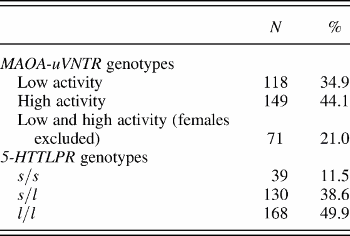
Table 1 presents the distributions of the resulting MAOA-uVNR and 5-HTTLPR genotypes. MAOA repeats of 3.5 or greater were categorized as high MAOA activity, whereas fewer repeats were categorized as low MAOA activity. Because of the MAOA locus on the X chromosome, it is uncertain which X chromosome is active for females. Accordingly, females who were heterozygous, with repeats in both the low and high range of MAOA activity, were excluded from subsequent analyses involving MAOA effects.
Distribution of MAOA-uVNTR and 5-HTTLPR genotypes
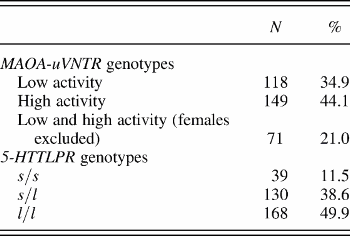
Note: MAOA-uVNTR, monoamine oxidase A upstream variable number tandem repeat gene; 5-HTTLPR, serotonin transporter linked promoter region gene; s, short allele; l long allele.
Measures
Diagnostic Interview Schedule for Children (DISC)
The DISC is a highly structured psychiatric interview for children and adolescents, specifically designed for use by lay interviewers in epidemiological studies. The DISC questions are organized around diagnostic categories. The DISC provides both diagnostic scoring for DSM diagnoses, as well as symptom scales. Extensive evaluation of the psychometric properties of the DISC has been conducted, demonstrating its interrater reliability, test–retest reliability, criterion validity, and sensitivity (Fisher et al., Reference Fisher, Shaffer, Piacentini, Lapkin, Kafantaris and Leonard1993; Piacentini et al., Reference Piacentini, Shaffer, Fisher, Schwab-Stone, Davies and Goia1993; Schwab-Stone et al., Reference Schwab-Stone, Fisher, Piacentini, Shaffer, Davies and Briggs1993; Shaffer et al., Reference Shaffer, Schwab-Stone, Fisher, Cohen, Piacentini and Davies1993). In the current investigation, the total score for depressive symptoms was utilized.
Youth Self Report (YSR)
The YSR (Achenbach, Reference Achenbach1991b) is a self-report version of the widely used Child Behavior Checklist (CBCL; Achenbach, Reference Achenbach1991a). The questionnaire is designed for 11- to 18-year-olds to rate their own competencies and problems in a standardized format. As with the CBCL, the YSR yields broadband continuous dimensions of internalizing and externalizing symptoms. Syndrome subscales of interest in the current investigation included anxious/depressed symptoms and somatic complaints. The YSR was normed on a representative US sample of 1,719 youth, ages 11–18 years. The YSR has acceptable reliability and validity (Achenbach, Reference Achenbach1991b).
Adolescent Coping Orientation for Problem Experiences (A-COPE)
The A-COPE (Patterson & McCubbin, Reference Patterson and McCubbin1987) assesses 12 strategies that adolescents use to cope with stressful experiences. These include expressing anger and blame, seeking diversions, developing self-reliance, developing social support, sharing feelings, avoiding problems, seeking spiritual support, investing in close friends, seeking professional support, engaging in demanding activity, being humorous, and relaxing. The scale consists of 54 items that are rated on a 5-point Likert scale. Alpha values for the subscales range from .50 to .75, with only one subscale below .67. Patterson and McCubbin (Reference Patterson and McCubbin1987) report differential relationships between various coping patterns and youth problem behavior.
To reduce the number of coping dimensions, we combined six different subscales (developing self-reliance, sharing feelings, seeking spiritual support, seeking professional support, avoiding problems, and anger and blame) into three variables aimed at assessing conceptually different coping strategies including self-coping, seeking others, and avoidance coping. To examine the empirical viability of our theoretical conceptualizations of these coping domains as three distinct constructs, we conducted an exploratory factor analysis of the six subscales of adolescent coping. The analysis utilized varimax rotation to extract three factors in which subscale loadings within factor ranged between .67 and .92. In addition, subscale loadings across factors ranged from .03 to .34.
Results
MAOA, 5-HTTLPR, and maltreatment
We first examined whether there were differences between the maltreated and nonmaltreated group on the frequency distributions of the MAOA and 5-HTTLPR genotypes. Chi-square analyses revealed that for MAOA, the rate of low versus high MAOA activity did not differ between maltreatment groups, χ2 (1, N = 267) = 3.08, ns. Specifically, 40.0% of the maltreated children had low-level MAOA activity compared to 51% of nonmaltreated children. Similarly, for 5-HTTLPR, the distributions of the s/s, s/l, and l/l variants did not differ between the maltreated and nonmaltreated children, χ2 (2, N = 337) = 3.33, ns. For the maltreated versus nonmaltreated groups, respectively, the percentages were as follows: s/s: 14.1 versus 7.6%; s/l: 36.9 versus 41.2%; and l/l: 49.0 versus 51.1%. These findings indicated that maltreatment status was not differentially associated with polymorphic variation of these two genes, thereby not supporting the existence of an evocative gene–environment correlation.
MAOA, 5-HTTLPR, and symptom variables
We next examined whether the MAOA and 5-HTTLPR genotypes were directly related to the dimensional measures of symptomatology. For MAOA, low versus high activity was not associated with the DISC depression score, t (265) = .27, ns, or the YSR combined Depression, Anxiety, and Somatic Symptom Scale, t (265) = .63, ns. Similarly, for 5-HTTLPR, significant differences were not observed for the DISC depression score, F (2, 334) = .17, ns, or for the YSR Symptom Scale, F (2, 334) = 2.62, ns.
Maltreatment, MAOA, and DISC depression symptoms
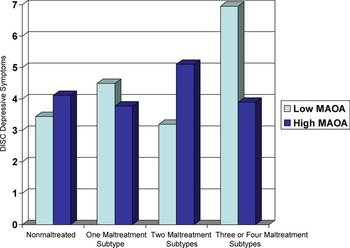
Using an analysis of covariance (ANCOVA), we first examined the main effects of maltreatment status (nonmaltreated vs. maltreated) and MAOA activity (low vs. high), as well as their interaction in relation to the DISC depressive symptoms. To control for possible confounds, gender and race (African American vs. other) were included as covariates. Because the majority of participants were African American, we utilized this dichotomy in efforts to provide some control over potential population stratification (Cardon & Palmer, Reference Cardon and Palmer2003). Analyses revealed that none of the effects was significant. Subsequently, the maltreatment variable was examined in more detail. More specifically, as an indicator of the extensiveness of maltreatment, we summed the number of subtypes of maltreatment (neglect, emotional maltreatment, physical abuse, and sexual abuse) each child had experienced. Because of a low number of children experiencing all four subtypes of maltreatment, children with three or four subtypes were combined to represent the highest level on the maltreatment continuum, ranging from 0 (nonmaltreated children) to 3 (three or four maltreatment subtypes present). When this maltreatment designation was utilized in the same ANCOVA procedures, no main effects were significant. However, a significant MAOA by maltreatment extensiveness interaction was observed, F (3, 257) = 3.20, p = .02. The interaction effect is depicted in Figure 1. What stands out in the interaction is the high symptom levels observed for adolescents with three or more subtypes of maltreatment and low MAOA; comparable youth with high MAOA did not evidence a symptom elevation. When only adolescents with low MAOA were examined in an ANCOVA, the effect of number of maltreatment subtypes was significant, F (3, 112) = 4.58, p = .005. Planned contrasts indicated that adolescents with three or more subtypes of maltreatment had significantly higher depression scores than adolescents who had zero, one, or two subtypes of maltreatment. In contrast, for adolescents with high MAOA activity, no effect was found for the number of subtypes of maltreatment, F (3, 143) = .54, ns. In addition, we examined whether depression scores differed for youth within each of the number of subtype groups, depending on whether participants had low or high MAOA activity. In the group with three or more forms of maltreatment, youth with low MAOA had significantly higher depression scores than youth with high MAOA, F (1, 55) = 4.51, p = .038. For youth in each of the other number of subtype groups (zero, one, or two), contrasts between adolescents with low versus high MAOA activity were all nonsignificant.
The interaction of the number of subtypes of maltreatment and monoamine oxidase A activity level genotype in relation to depressive symptoms. [A color version of this figure can be viewed online at www.journals.cambridge.org]

The influence of coping in youth with multiple forms of maltreatment
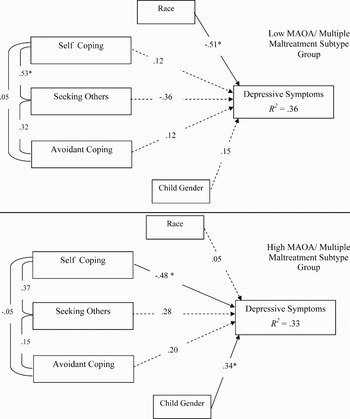
We next examined how different patterns of coping with stress might further elucidate the differences in depressive symptom levels observed for maltreated children with three or four subtypes of maltreatment with low versus high MAOA activity. Structural equation modeling procedures for path analysis of manifest constructs were utilized to test the hypothesized model. The model was estimated using the full-information maximum likelihood method (FIML) through the AMOS 7.0 statistical software (Arbuckle & Wothke, Reference Arbuckle and Wothke1999). Use of FIML allows for the estimation of missing data. Model fit was assessed using the (a) the root mean square error of approximation (RMSEA), with values of .08 or less reflecting reasonable fit (Browne & Cudeck, Reference Browne, Cudeck, Bollen and Long1993) and (b) the χ2/df ratio, with values between 1 and 3 indicating acceptable fit (Arbuckle & Wothke, Reference Arbuckle and Wothke1999). To examine the moderating role of Gene × Maltreatment interaction in associations between adolescent coping strategies and depressive symptoms, a multigroup, path analysis was employed. Among adolescents with three or four subtypes of maltreatment, the model in Figure 2 was estimated simultaneously for participants in the low MAOA and high MAOA groups. The model provided an acceptable fit to the data, χ2 (14, N = 59) = 18.21, χ2/df ratio = 1.30, and RMSEA=.07. Examination of the model yielded interesting group differences in coping strategies. A comparison of group differences on adolescent's self-coping skills revealed that for adolescent's in the high MAOA group, self-coping was significantly associated with lower depressive symptoms (β = −.48, p < .05), whereas self-coping was not significantly associated with depressive symptoms in the low MAOA group (β = .13, p = .51). Furthermore, pairwise parameter comparisons of these pathways revealed that this effect was also significantly different between the two groups (t = −2.01), suggesting that not only is the ability to develop self-coping skills associated with lower depression for extensively maltreated adolescents with high MAOA, but it is also significantly different from similar adolescents with low MAOA. Finally, for both the low MAOA and high MAOA groups, adolescent report of both seeking (β = −.36 and .28, respectively, p > .05) and avoidant (β = .12 and .20, respectively, p > .05) coping strategies were not significantly associated with depressive symptoms.
Structural equation modeling of the relationships of coping processes to depressive symptoms among multiply maltreated youth with low versus high monoamine oxidase A activity genotypes.

5-HTTLPR, maltreatment, and depression and anxiety symptoms
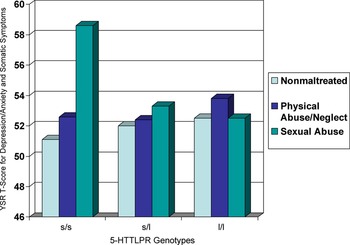
We next examined the independent and interactive effects of 5-HTTLPR in predicting depression and anxiety symptoms. ANCOVA analyses with the DISC depressive symptoms score did not yield significant results. However, a composite of the YSR anxiety/depression and somatic symptom scales was informative. Initially, an ANCOVA was conducted with maltreatment status, 5-HTTLPR, and their interaction, along with gender and African American versus other race as covariates. The effect of maltreatment was significant, F (1, 329) = 7.04, p = .008, whereas the effect of 5-HTTLPR and the interaction were nonsignificant. To examine this effect in more detail, an ANCOVA examining maltreatment subtype groups was conducted. Because of cell size restrictions, the small subgroup of emotionally maltreated children (n = 13) was excluded. In this analysis, consistent with the overall maltreatment effect, the effect of subtype group was significant, F (3, 310) = 4.51, p = .004, whereas the effect of 5-HTTLPR was not significant, F (2, 310) = .42, ns. Moreover, a significant subtype by 5-HTTLPR interaction effect was found, F (6, 310) = 3.47, p = .002. This interaction effect is depicted in Figure 3. What is notable is the elevation in symptomatology for children in the sexual abuse group who have the 5-HTTLPR s/s genotype, relative to all other conditions. When the sexual abuse group was compared to the nonmaltreated group, the effect of sexual abuse was significant, F (2, 166) = 12.05, p < .001, as was the interaction of sexual abuse with 5-HTTLPR, F (2, 166) = 5.19, p = .007. Similarly, the sexual abuse group was elevated in symptom levels compared to the other maltreated children, F (1, 185) = 4.46, p = .036, and the interaction with 5-HTTLPR also was significant, F (2, 185) = 5.74, p = .004. Thus, sexual abuse in combination with the s/s genotype was shown to relate to high symptomatology, whereas elevations for sexually abused children with the s/l and l/l alleles did not evidence higher symptoms. Moreover, maltreated children who had not been sexually abused, as well as the nonmaltreated children, did not vary in symptom levels depending on the presence of the different 5-HTTLPR genotypes.
The interaction of a history of sexual abuse and serotonin transporter length polymorphic repeat genotypes in predicting depressed/anxious symptoms. [A color version of this figure can be viewed online at www.journals.cambridge.org]

Effects of MAOA, 5-HTTLPR, and sexual abuse on depression and anxiety symptoms
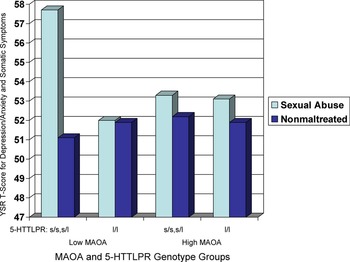
Given the interactive effects observed for sexual abuse and 5-HTTLPR in relation to the composite of symptoms of depression, anxiety, and somatic symptoms, we next examined whether MAOA activity would contribute further to these relations. That is we explored whether a G × G × E was present. To accomplish this, an ANCOVA with sexual abuse versus nonmaltreated children, 5-HTTLPR, and MAOA as main effects was conducted, along with African American versus other race and gender as covariates. Because of sample size concerns with further breakdown of effects by the addition of MAOA, the 5-HTTLPR factor was dichotomized by combining s/s and s/l alleles compared to the l/l allele. Results of the ANCOVA indicated that sexual abuse maintained a significant main effect, F (1, 121) = 6.59, p = .01. Furthermore, there also was a marginally significant sexual abuse by 5-HTTLPR interaction effect, F (1, 121) = 3.66, p = .058. However, both of these findings were clarified by a statistically three-way interaction of sexual abuse, 5-HTTLPR, and MAOA, F (1, 121) = 3.91, p = .05. Figure 4 illustrates the three-way interaction effect. To examine this three-way interaction, adolescents with high MAOA activity were examined first. An ANCOVA with sexual abuse and 5-HTTLPR was conducted, and no main or interactive effects were significant. In contrast, among adolescents with low MAOA activity, the analogous ANCOVA revealed a main effect for sexual abuse, F (1, 55) = 5.70, p = .02, as well as a significant sexual abuse by 5-HTTLPR interaction, F (1, 55) = 5.74, p = .02. Sexually abused youth in the combined s/s and s/l genotype group evidenced increased depression, anxiety, and somatic symptoms in comparison with sexually abused adolescents with the l/l 5-HTTLPR genotype. Nonmaltreated children with low MAOA did not differ in symptomatology depending on the 5-HTTLPR groups. Thus, the previously observed sexual abuse by 5-HTTLPR interaction was clarified. It appears that this G × E occurs primarily in the context of low MAOA activity.
Gene × Gene × Environment interaction: the moderation of sexual abuse by serotonin transporter length polymorphic repeat interaction by monoamine oxidase A activity. [A color version of this figure can be viewed online at www.journals.cambridge.org]

Discussion
Because the etiology of depression is multifactorial in nature (Cicchetti & Toth, Reference Cicchetti, Toth, Cicchetti and Cohen1995), in this multigenic study, we investigated the main effects and the two-way and three-way interactions among 5-HTT and MAOA (two genes implicated in the etiology of mood disorders) and child maltreatment in the prediction of depressive symptomatology. We chose to examine these main and G × E and G × G × E effects during adolescence because this is a developmental period during which many individuals experience their first onset of mood problems (Costello & Angold, Reference Costello, Angold, Cicchetti and Cohen2006; Romer & Walker, Reference Romer and Walker2007).
Adolescents who had been maltreated were not found to differ from nonmaltreated comparison adolescents on their respective distributions of the MAOA and 5-HTT genotypes. These findings suggest that there is not a greater vulnerability to maltreatment based on differences in the rates of the allelic variants of the MAOA and 5-HTT genes. Maltreatment is not more common among adolescents with different MAOA or 5-HTT genotypes.
The absence of any differences in the distribution of the MAOA and 5-HTT genotypes between maltreated and nonmaltreated adolescents addresses the important issue of evocative gene–environment correlation (Rende & Waldman, Reference Rende, Waldman, Cicchetti and Cohen2006; Rutter, Reference Rutter2006; Scarr & McCartney, Reference Scarr and McCartney1983). We did not find support for maltreatment being related to genes; moreover, we cannot interpret child maltreatment to be the result of a genetic process that could explain symptom differences between maltreated and nonmaltreated youth. In addition, the MAOA and the 5-HTT polymorphisms examined in this investigation did not directly relate to the differences in depressive symptoms found in this sample of maltreated and nonmaltreated adolescents. This result argues against a main effect influence of genes on depressive symptoms, at least in this high-risk low-income adolescent sample.
Maltreatment and MAOA
When we examined maltreatment status and low versus high activity MAOA, we did not find any main or interactive effects in predicting depressive symptomatology scores. However, we decided to probe the maltreatment variable further and examine whether extensiveness of maltreatment, as indexed by the number of unique maltreatment subtypes experienced by each individual, would provide a more refined perspective. This more in-depth examination of the candidate environmental pathogen of child abuse and neglect revealed significant Maltreatment Extensiveness × MAOA interaction effect. Specifically, only adolescents who had experienced three or four unique forms of maltreatment and who possessed the low activity variant of the MAOA gene evinced higher levels of depressive symptomatology, whereas comparably maltreated adolescents who possessed the high activity variant of the MAOA gene, did not evince an elevation in symptoms. Nonmaltreated youth did not vary in depressive symptom levels based on whether they possessed either the low or high activity variant of the MAOA gene, as was the case for maltreated adolescents with one or two subtypes of maltreatment. Taken together, these findings suggest that adolescents with low MAOA activity are more vulnerable to the effects of the chronic stress of extensive maltreatment; conversely, maltreated adolescents with high MAOA activity appear to be protected.
Thus, a G × E effect appears to operate for the more extreme cases of child maltreatment and is not seen across all maltreated children. The present sample of maltreated and nonmaltreated youth is a highly stressed, low-income sample overall, rather than a randomly selected representative sample from the general population. Accordingly, it is conceivable that because our investigation was conducted with a sample of maltreated and nonmaltreated adolescents who resided in risky, highly stressful environments, we only discovered the G × E effect at the extremes of the distribution. Nonetheless, our findings bear similarity to those reported by Caspi et al. (Reference Caspi, McClay, Moffitt, Mill, Martin and Craig2002), wherein a G × E between low activity MAOA and antisocial behavior was obtained in adults who had experienced severe maltreatment but not in those who had been classified as experiencing probable maltreatment.
We also examined differences between the adolescents with extensive maltreatment who possessed the gene for high versus low activity of MAOA. Among the adolescents who experience extensive maltreatment and possessed the gene for high MAOA activity, differences in their coping strategies for dealing with stress contributed to lower depressive symptomatology. In particular, self-related coping processes significantly predicted lower depression scores, whereas help-seeking and avoidant coping processes were not significant predictors of lower levels of depressive symptoms. In contrast, among extensively maltreated youth who possessed the gene for low activity MAOA, none of the coping strategies examined were related to variation in depressive symptomatology. Consequently, the self-related form of coping displayed by adolescents who experienced extensive child maltreatment further contributed to their protection from developing depressive symptoms.
These results are consistent with prior studies conducted in our laboratory on the psychological and biological contributors to resilience (see, e.g., Cicchetti & Rogosch, Reference Cicchetti and Rogosch1997, Reference Cicchetti and Rogosch2007; Cicchetti, Rogosch, Lynch, & Holt, Reference Cicchetti, Rogosch, Lynch and Holt1993). For example, in a 3-year longitudinal investigation, positive self-esteem, self-determination, and the development of adaptive coping mechanisms that rely upon the self were found to predict resilient functioning in maltreated, but not nonmaltreated, school-age children (Cicchetti & Rogosch, Reference Cicchetti and Rogosch1997). In addition, Cicchetti and Rogosch (Reference Cicchetti and Rogosch2007) discovered that physically abused children who evidenced elevated morning cortisol levels as an adaptation to stressors in their lives, in contrast with the majority of physically abused children who tend to have lower morning cortisol and to develop maladaptively, demonstrated greater self-strivings for competence compared to nonresilient abused children.
Maltreatment and 5-HTT
With 5-HTT, similar results were obtained for the YSR internalizing composite of depression/anxiety and somatic symptoms. Maltreatment status predicted higher symptoms, but the G × E was not significant. However, when we examined the presence of specific forms of maltreatment, evidence of a significant G × E for sexual abuse was found. As was the case with MAOA and maltreatment, the 5-HTT × Maltreatment interaction was for those adolescents who experienced the more extreme maltreatment rather than for all maltreated children. Consistent with the Kaufman et al. (Reference Kaufman, Yang, Douglas-Palumberi, Houshyar, Lipschitz and Krystal2004) and Kaufman et al. (Reference Kaufman, Yang, Douglas-Palumberi, Grasso, Lipschitz and Houshyar2006) studies, the G × E effect in the present investigation occurred for an extreme maltreatment group, which were youth who had experienced sexual abuse. All of the maltreated participants in the two Kaufman et al. studies resided in foster care; accordingly, it is highly likely that they were severely maltreated because they had been removed from their homes. In concert with the results of the current investigation, the results of the Kaufman et al. studies pertain to the s/s genotype only. Adolescents with a history of sexual abuse and the s/s genotype evinced higher depression symptom levels, whereas youth with sexual abuse histories with the s/l and l/l genotypes did not manifest elevations in depressive symptomatology. None of the three genotypes of the 5-HTT gene was related to depressive symptoms among the nonmaltreated adolescents. Thus, the s/s genotype contributes to vulnerability among adolescents who are sexually abused. Alternatively, the s/l and l/l genotypes may be viewed as serving a protective function for youth with sexual abuse histories.
Maltreatment, MAOA, and 5-HTT
The consideration of two genes broadened our understanding of the interaction between 5-HTT and sexual abuse. Although the 5-HTT × MAOA two-way interaction (i.e., G × G) was not significant, a significant three-way interaction between 5-HTT, MAOA, and maltreatment suggests further moderation of the 5-HTT × Maltreatment interaction by the second gene, MAOA. Specifically, it was the youth who possessed both the s/s genotype and the low MAOA activity genotype who exhibited the extreme symptom scores. The adolescents with the s/s genotype and the low activity variant of the MAOA gene appear to be those who were most vulnerable to the stressful effects of sexual abuse. In contrast, sexually abused adolescents who possessed other combinations of the variants of the 5-HTT and MAOA genes appear to be more protected from their adverse abusive experiences.
Conclusions and Future Directions
The findings of the present investigation also add to the growing knowledge of the biological processes involved in the epigenetic pathways from child maltreatment to maladaptive, psychopathological, and resilient developmental outcomes (Cicchetti & Toth, Reference Cicchetti and Toth2005; Cicchetti & Valentino, Reference Cicchetti, Valentino, Cicchetti and Cohen2006; De Bellis, Reference De Bellis2001). The inclusion of genetic, environmental, and behavioral variables within the same investigation contributed a more refined understanding of the pathways from child maltreatment to depressive symptomatology. Likewise, the finding that there were genotypes that conferred protection to a subset of highly vulnerable individuals provides further evidence that both biological and psychological factors contribute to competent functioning in the face of significant adversity and should exhort researchers who study resilience to include both biological and psychological variables in their measurement batteries (Charney, Reference Charney2004; Cicchetti & Blender, Reference Cicchetti and Blender2006; Cicchetti & Curtis, Reference Cicchetti, Curtis, Cicchetti and Cohen2006, Reference Cicchetti and Curtis2007).
Although our sample provides a strong comparison of maltreated and nonmaltreated youth, its size is not large enough to form all of the cell sizes in the analyses (i.e., the different allelic variants for the different genes and the diverse subtypes of child maltreatment). In addition, females who were heterozygous with low and high MAOA activity alleles were excluded from the analyses because which gene had been X-linked inactivated was indeterminate.
Despite its limitations, this study demonstrated that adequate prediction of either normality, disturbance, or resilience often requires the simultaneous consideration of multiple risk and protective factors and their interplay. Our ability to demonstrate relations between the genes, environmental pathogen, and psychopathological or resilient outcomes suggests that there must be pathways of biological and psychological causal processes that contribute to forming their interconnection.
Future G × E investigations should increasingly seek to discover endophenotypes that may be intermediate between genes, environments, and developmental outcomes (Gottesman & Gould, Reference Gottesman and Gould2003). Such endophenotypes are heritable constituents of mental disorders and may be neurophysiological, neurochemical, endocrinological, neuropsychological or cognitive, among other possibilities, in nature (Gottesman & Hanson, Reference Gottesman and Hanson2005; Moffitt et al., Reference Moffitt, Caspi and Rutter2006). In particular, the inclusion of neurobiological endophenotypes that may be intermediate between genes and depression (or other mental disorders) in future G × E studies should make an invaluable contribution to a multiple levels of analysis perspective on psychopathology and resilience (Frodl et al., Reference Frodl, Schule, Schmitt, Born, Baghai and Zill2007; Hariri & Holmes, Reference Hariri and Holmes2006; Hariri et al., Reference Hariri, Muttay, Tessitore, Kolachana, Fera and Goldman2002; Pezawas et al., Reference Pezawas, Meyer-Lindenberg, Drabant, Verchinski, Munoz and Kolachana2005; Viding, Williamson, & Hariri, Reference Viding, Williamson and Hariri2006).
Individuals with major depressive disorder have been shown to have fewer 5-HTT gene binding sites in blood platelets as well as in the prefrontal cortex, occipital cortex, hypothalamus, and brainstem (Malison et al., Reference Malison, Price, Berman, vanDyck, Pelton and Carpenter1998). In addition, maltreated adults with posttraumatic stress disorder have been shown to have a number of anomalies of brain structure, most notably a reduction in hippocampal volume (Bremner et al. Reference Bremner, Randall, Vermetten, Staib, Bronen and Mazure1997; De Bellis, Reference De Bellis2001). In contrast, maltreated children and adolescents with posttraumatic stress disorder reveal several neurobiological structural anomalies, including a reduction in the size of the corpus callosum, smaller cerebral and frontal cortices, less prefrontal white matter, and reduced temporal lobe volumes (DeBellis, 2001). The smaller hippocampal volumes that have been reported for adults with child maltreatment related posttraumatic stress disorder (PTSD) have not been reported in the studies of pediatric maltreatment related PTSD. Further, persons with depression, individuals who have been maltreated, and those who have been maltreated and are depressed often exhibit additional patterns of psychophysiological and neuroendocrinological responding that are reflective of impairments in the processing and regulation of stress-sensitive neurobiological processes (Cicchetti & Rogosch, Reference Cicchetti and Rogosch2001a, Reference Cicchetti and Rogosch2001b; De Bellis et al., Reference De Bellis, Baum, Birmaher, Keshavan, Eccard and Boring1999; Heim & Nemeroff, Reference Heim and Nemeroff2001; Pollak, Cicchetti, Klorman, & Brumaghim, Reference Pollak, Cicchetti, Klorman and Brumaghim1997).
As more stress-sensitive neural processes are identified and incorporated into future multiple-levels studies aimed at elucidating pathways to pathological and resilient outcomes, the results of such investigations may pave the way for developing and implementing pharmacological and behavioral prevention and intervention efforts to ameliorate the deleterious impact that early stressful experiences exert on neurobiological development and functioning. Similarly, such information could play a vital role in developing resilience-promoting interventions that target protective and vulnerability forces at multiple levels of influence (Luthar & Cicchetti, Reference Luthar and Cicchetti2000; Luthar et al., Reference Luthar, Cicchetti and Becker2000).