My last two annual reports sounded a theme of continuity from year to year in the number and variety of the papers that we received and the articles that we published and in the pace of our review process. This year, too, many of these elements have differed only slightly from those of past years. In some important respects, though, 2005–2006 has been a significant departure from the years immediately preceding it. For one thing, as detailed below, during 2005–2006 we received a record number of submissions. For another, while we were considering more papers than ever before, we were simultaneously faced with the self-imposed challenge of conducting a separate review process for the November 2006 centennial issue of the Review.
As in previous reports, it seems appropriate to begin by acknowledging the contributions made by Assistant Editor Elizabeth Cook; centennial issue Co-Editor M. Elizabeth Sanders; this year's cohort of Editorial Assistants (Jennifer Deets, Beth Franker, Kara Heitz, and Jennie Schulze); the members of the Review's Editorial Board; staff members too numerous to list at the APSA office, the George Washington University, and the Cambridge University Press; the authors who submitted their papers; and the reviewers who donated their time, expertise, and good will to assessing these submissions. Sadly, I must also note the passing of Timothy Cook, a valued member of the Editorial Board and a good friend.
Submissions and Processing
The number of papers submitted
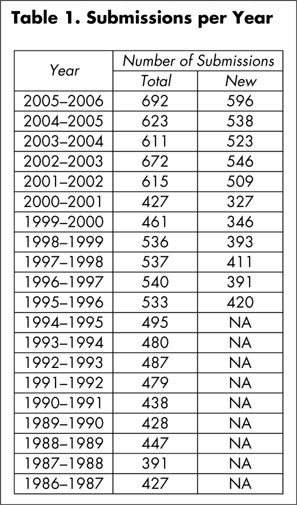
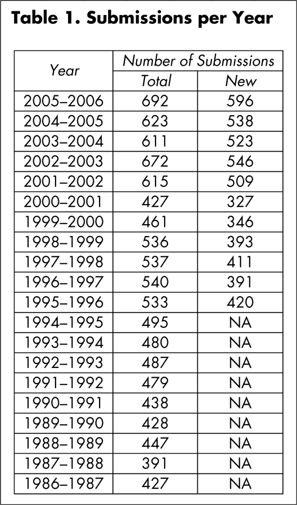
Since 2001–2002 (my first year as editor), “total” submissions to the Review have typically hovered slightly above 600 per year, except for a spike during 2002–2003, and “new” submissions have run 100 or so below that (see Table 1).1
As in previous reports, “total submissions” count successive resubmissions of the “same” paper separately. By this measure a paper that was submitted, revised and resubmitted, and then finally resubmitted following its conditional acceptance pending final changes would count as three submissions, not one. In terms of assessing the workflow for the editorial office, this counting rule is reasonable, for in the example just given, several separate review processes would have been conducted. For “new” (i.e., “original”) submissions, by contrast, that sequence would be counted as a single submission, not as three.
Submissions per year
Turnaround times
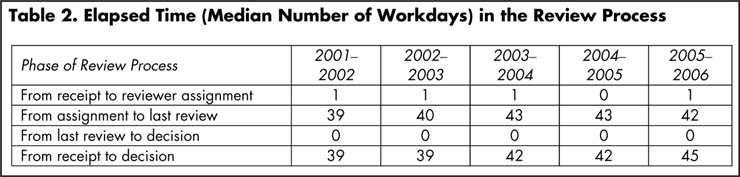
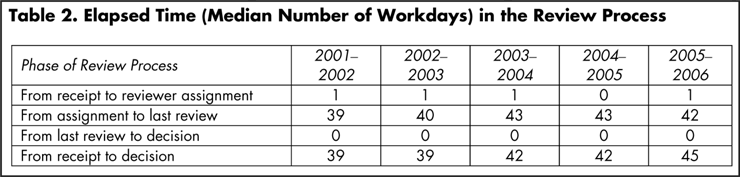
In the face of this record number of submissions and the challenge of simultaneously running a separate operation for centennial submissions, our review process continued to run at virtually the same pace as in previous years (see Table 2). Once again we were typically able to get papers out for review within a day of receiving them. Despite the growing burden that we and other journals are placing on reviewers, our reviewers continued to return their reports in a timely manner—a median of 42 working days. And more often than not, we put a decision letter in the mail on the same day that the last review arrived. Regrettably, the review process on a small number of papers dragged on far too long, but in my judgment the overall pace of our review process continued to be highly acceptable.
Elapsed time (median number of workdays) in the review process.
The mix of submitted papers
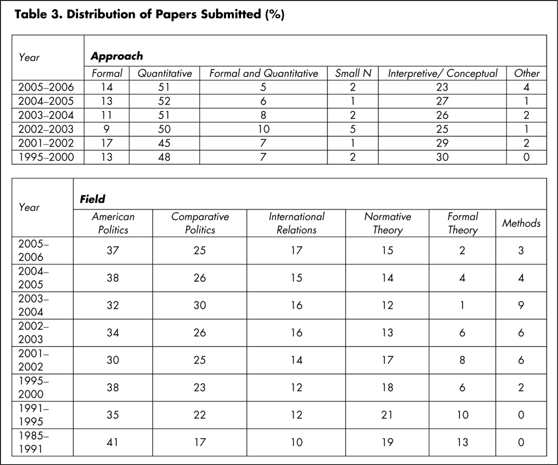
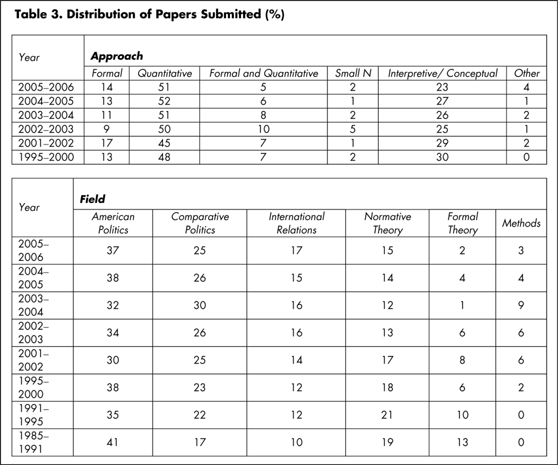
Categorized according to primary analytical approach and disciplinary subfield, the distribution of papers submitted to the Review remained virtually unchanged in 2005–2006 (see Table 3). Again in 2005–2006, most submissions were quantitative and/or formal, and about one in four was classified broadly as “interpretive/conceptual.” We continued to receive few “small-N” papers. American politics-focused submissions outnumbered those in any other subfield, followed in order by comparative politics, international relations, and normative theory. Little importance should be attached to year-toyear fluctuations in these figures, which not only are small but also are subject to the vagaries of categorizing papers that may not fit unambiguously into a particular approach or subfield.
Distribution of papers submitted (%)
Outcomes
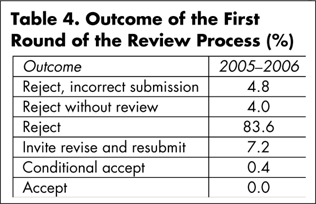
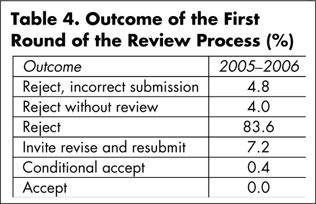
In terms of the outcomes of our review process, only minor fluctuations from previous years emerged during 2005–2006 (see Table 4). The percentage of first-round manuscripts that were rejected following full-scale review declined slightly, from 88% in 2004–2005 to 84% in 2005–2006. That did not, however, imply a corresponding increase in “revise and resubmit” invitations or conditional or outright acceptances, which collectively held at the level of the previous year—approximately 8%. As in 2004–2005, we rejected 4% of the papers that we received without putting them through the peer review process, based on my own judgment of their unsuitability for the Review. Spurred by reviewers' complaints about the length of the papers we were sending them, we also began enforcing our 45-page limit more stringently by refusing to open our peer review process for papers that met our page limit only via subterfuges of various sorts (e.g., tiny fonts, single- or 1.5-line spacing, or coast-to-coast and border-to-border text). Consequently, during 2005–2006 the percentage of “incorrect submissions” rose from 1% to 5%. In such instances, we informed the authors of our willingness to open our review process without prejudice if they submitted an appropriately formatted version of the paper that observed our length requirements. Virtually without exception, these authors did follow through by submitting a shorter version of the paper.
Outcome of the first round of the review process
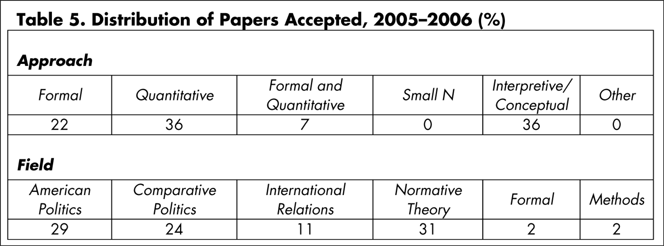
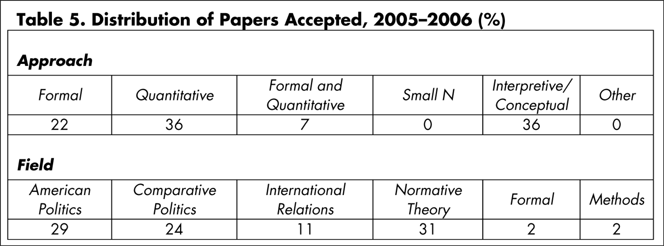
Distribution of papers accepted, 2005–2006 (%)
As in previous years, we issued “revise and resubmit” invitations sparingly and did not pile one on top of another. The great majority—85–90%—of revised-and-resubmitted papers were ultimately accepted.
With few exceptions, the analytical and substantive distribution of papers that were accepted during 2005–2006 continued to reflect the pattern of recent years. Most accepted papers featured either formal or quantitative analyses or both, with formal papers looming larger this year than last; American politics continued to lead the fields in terms of its presence among accepted papers, with international relations papers down and normative theory papers up. Here again, I would caution against making too much of annual fluctuations, which are subject to the idiosyncrasies of fitting complex papers into simple categories and the small number of cases on which these percentages are based.
The Centennial Issue
The November 2006 issue completed the 100th volume of the Review, which began publication in November 1906. To mark this occasion, we began planning two years ago for a thematic issue on “The Evolution of Political Science.” My co-editor for the theme issue was M. Elizabeth Sanders, a member of the Review's Editorial Board.
During 2004–2005, we circulated a call for expressions of interest in submitting brief papers, for which we specified a maximum length of 17 pages in order to enable us to represent a large and diverse array of perspectives on the evolution of the discipline. The submission and review processes for the thematic issue were based on those employed by Perspectives on Politics rather than on our own standard model. In announcements of the issue, we advised prospective authors to submit brief abstracts rather than full-blown papers. Throughout 2005 we devoted considerable time and energy to providing extensive reactions to each expression of interest that we received, conveying feedback about whether a proposal seemed promising and detailed advice about how it might be developed. When we announced the issue, we had no idea whether it would spark much interest. It did. In all, we received almost 100 expressions of interest. Based on our feedback, many prospective authors decided not to follow through with their proposed projects. As those projects fell by the wayside, the ones that remained were, for the most part, the most promising that we had received; in every case, however, we informed prospective authors that we could offer no advance guarantee that their paper would be accepted. Ultimately, by or shortly after our January 2, 2006 deadline, we received 42 full-blown submissions. Each of these was put through a full-scale peer review process. Based on the reviewers' recommendation and on our own assessments of each paper, we rejected 16 and issued “revise and resubmit” invitations to the authors of the remaining 26, providing detailed instructions about the revisions that should be undertaken. Of these, we subsequently accepted 24.
Along with these 24 essays, the centennial issue included two special features. One is an essay that I prepared, titled “The Coevolution of American Political Science and the American Political Science Review,” based in large part on a content-analytic survey of every research article that has appeared in the Review from its founding to the present. The other was a set of 20 brief commentaries on the most frequently-cited articles in the history of the Review, by the authors of these articles or by appropriate stand-ins. We expect these “Top 20” essays to be read with particular interest.
I want to emphasize that although the contents of the special issue do, as we had hoped, represent a wide array of perspectives on the evolution of the discipline, many important topics are unrepresented and others may be overrepresented. That was inevitable, given the limited space available and also given our approach of issuing a general call for papers on a broad theme rather than soliciting papers on a pre-selected set of topics. Still, we are confident that every reader of the Review will find something of interest in the centennial issue.