Introduction
Insects respond to diverse external cues when they search for food, shelter, mates, and oviposition locations (Dukas Reference Dukas2008). Responses to most of these cues are innate, although some might be learned (Remén Reference Remén2004; Giurfa Reference Giurfa2013, Reference Giurfa2015). Learning helps insects to adapt to their current environment (Moreyra and Lozada Reference Moreyra and Lozada2021). However, the speed, reversibility, and mechanism of learning are related to the frequency with which insects must switch resources in their lifetime (Vet and Dicke Reference Vet and Dicke1992). The ability to learn differs among insect taxa, and some predatory groups are more prepared to learn certain stimuli than others are (Papaj and Lewis Reference Papaj and Lewis2012). The rates at which insect predators encounter prey likely increase if the learned information facilitates their prey-searching process (Papaj and Lewis Reference Papaj and Lewis2012). However, because the process of learning takes time, learning might have negative effects if the environment changes too quickly (Remén Reference Remén2004).
A changing environment acts directly upon the environment-sensitive physiological processes of insect predators (Bell Reference Bell1990). The predators perceive such changes in the environment and, based on that information, might alter their behaviour (Bell Reference Bell1990). Studies have shown that under changing environmental conditions, the availability of prey often fluctuates (Dixon Reference Dixon2000; Hodek et al. Reference Hodek, Van Emden and Honek2012). This, in turn, influences the vital rates and population dynamics of predators (Ostfeld and Keesing Reference Ostfeld and Keesing2000).
Coccinellids (Coleoptera: Coccinellidae) are an important group of insect predators, and they are the most successful biocontrol agents of aphids and other insect and acarine pests (Hodek and Honek Reference Hodek and Honek1996; Hodek et al. Reference Hodek, Van Emden and Honek2012). However, their ability to learn has not been studied extensively (Remén Reference Remén2004). Few studies have looked into coccinellid learning (Mondor and Warren Reference Mondor and Warren2000; Ninkovic and Pettersson Reference Ninkovic and Pettersson2003), and the studies that have been undertaken have all suggested that visual and olfactory cues drive coccinellids’ detection of their prey. Aphidophagous coccinellid beetles are best at exploiting aphids, whose populations fluctuate rapidly in space and time, thereby severely affecting the life attributes of coccinellids (Santos-Cividanes et al. Reference Santos-Cividanes, Dos Anjos, Cividanes and Dias2011). The most informative way to study the response of coccinellid beetles to aphid fluctuations is to measure the beetles’ functional responses to different aphid abundances (Fathipour et al. Reference Fathipour, Hosseini, Taleb and Moharramipour2006; Bayoumy Reference Bayoumy2011a, Reference Bayoumy2011b; Bayoumy and Michaud Reference Bayoumy and Michaud2012).
Several studies have evaluated the functional responses of coccinellids, both individually (Bayoumy Reference Bayoumy2011a; Osman and Bayoumy Reference Osman and Bayoumy2011; Gupta et al. Reference Gupta, Pervez, Guroo and Srivastava2012) and within guilds (Snyder and Ives Reference Snyder and Ives2003; Snyder Reference Snyder2009; Grez et al. Reference Grez, Zaviezo and Mancilla2011, Reference Grez, Viera and Soares2012; Omkar and Pervez Reference Omkar and Pervez2011; Jamour and Shishehbor Reference Jamour and Shishehbor2012; Vanaclocha et al. Reference Vanaclocha, Papacek, Monzo, Verdu and Urbaneja2013; Kumar et al. Reference Kumar, Bista, Mishra and Omkar2014a), and report either a type II or a modified type II functional response. Despite the important role of predation in shaping community structure, comparisons of functional responses of coccinellids under fluctuating-prey conditions are rarely investigated (Hiltunen and Laakso Reference Hiltunen and Laakso2013). In addition, the role of learning in modulating the functional response curves of coccinellid beetles has rarely been studied.
In the present study, we investigated the functional responses of two coccinellid beetles, Menochilus sexmaculatus and Propylea dissecta, under varying aphid abundances to assess whether the prey density experienced during early larval development would affect the functional response curves of the beetles’ late-larval and adult stages. We hypothesised that, under rearing conditions, the larvae and adults would learn to use the available prey resource with their usual predation rates but that, when tested under different prey-density conditions, the larvae and adults would modulate their predation attributes in response to the available prey resource. We hypothesised that, as a consequence of this, the beetles reared on scarce prey would exhibit higher functional response curves than those reared on optimal- or abundant-prey densities when the beetles suddenly encountered prey-resource fluctuations or irregular prey densities.
The two beetle species investigated in the present study are Asian predatory coccinellids, have wide prey ranges, and coexist abundantly in aphid-infested agricultural fields of India (Omkar and Pervez Reference Omkar and Pervez2000). The present study provides information on the feeding behaviour of these beetles in relation to varying prey density and also contributes to the understanding of the biological control potential of these beetles under fluctuating resource conditions.
Materials and methods
Stock maintenance
Adult males and females of M. sexmaculatus and P. dissecta were collected from agricultural fields in Lucknow, India (26° 50´ N, 80° 54´ E) and paired randomly in plastic Petri dishes (9.0 × 1.5 cm2). The insects were reared under 27 ± 2°C temperature, 65 ± 5% relative humidity, and a 14:10 light:dark photoperiod in environmental test chambers (York BOD incubator, Super Deluxe, Yorco Scientific Industries Pvt. Limited, Ghaziabad, Uttar Pradesh, India) on daily replenished supply of cowpea aphid, Aphis craccivora Koch (Hemiptera: Aphididae) that had been reared on bean (Dolichos lablab Linnaeus) (Fabaceae) in a polyhouse (Chaudhary et al. Reference Chaudhary, Kumar, Mishra and Omkar2016). Beetle eggs laid were collected every 24 hours, and the subsequent first-instar larvae were used for further experimentation.
Experimental design
Our study comprised three experiments. The first experiment optimised different food conditions for life stages of both coccinellid species. The second experiment investigated the rearing of beetle larvae under scarce-, optimal-, and abundant-prey conditions (herein referred to as “rearing prey densities”) until the emergence of fourth-instar larvae and adults. The third experiment evaluated the functional response of fourth-instar beetle larvae and 10-day-old unmated females under five prey densities – extremely scarce, scarce, suboptimal, optimal, and abundant (herein referred to as “testing prey densities”).
The fourth-instar larvae and 10-day-old unmated females are the most voracious feeding stages of coccinellids that are generally employed in biological control programmes (Mishra et al. Reference Mishra, Omkar, Kumar and Pandey2012; Omkar et al. Reference Omkar, Mishra, Kumar, Singh and Pandey2014). Because of this, the functional response experiments were conducted with only these two developmental stages.
Prey optimisation
Individual fourth-instar larvae of both coccinellid species were provided with aphid biomass ranging from 1 to 20 mg (i.e., 1, 2, 5, 10, 15, and 20 mg) of intermediate instars (i.e., second and third nymphal stages) of A. craccivora for 24 hours in five replicates. Biomass was measured using the Sartorius Weighing Balance BSA 124 S-CW (0.01 mg precision; Sartorius Lab Instruments GmbH & Co. KG, Goettingen, Germany). The minimum biomass at which no aphid was left and the larvae survived was considered the “scarce” prey-density condition, whereas the minimum biomass at which aphids were left (1.00 ± 0.50 mg) in some replicates and larvae survived was referred to as the “optimal” prey-density condition. The replicates in which a minimum biomass of 4.00 ± 1.00 mg was left were referred to as the “abundant” prey-density condition. Based on the optimisation experiment, the scarce, optimal, and abundant prey biomasses were 2, 10, and 15 mg of aphids per individual beetle per day, respectively. However, the “extremely scarce” and “suboptimal” prey biomasses were found to be 1 and 5 mg of aphids per individual beetle per day, respectively (see Chaudhary et al. Reference Chaudhary, Kumar, Mishra and Omkar2015).
Exposure of predatory stages to three rearing prey densities
The first-instar larvae of M. sexmaculatus and P. dissecta were individually reared under scarce (n = 150 larvae per coccinellid species), optimal (n = 150 larvae per coccinellid species), and abundant (n = 150 larvae per coccinellid species) prey densities up to the third-instar larval stage under abiotic conditions similar to that of stock culture. After the third-instar larvae moulted to the fourth-instar stage, 10 larvae per coccinellid species from each rearing prey density were used to assess their functional response on each testing prey density. After completion of the experiment, the fourth-instar larvae per rearing density were shifted to their respective prey biomass until they became 10-day-old adults. Thereafter, 10 adult females from each rearing prey density were identified, separated, and used in the experiment to assess their functional response on each testing prey density.
A total of 20 larvae of M. sexmaculatus and 30 larvae of P. dissecta died before reaching the fourth-instar stage when fed under the scarce-prey conditions. After that, more first-instar larvae of each coccinellid species from the stock cultures were added to the experimental setup to equalise the sample size to 50 individuals at each of the three prey densities.
Functional responses of predatory stages under five testing prey densities
The fourth-instar larvae (n = 50 larvae per coccinellid species) from each rearing prey density were divided into five groups of 10 each. The beetles (M. sexmaculatus or P. dissecta) were kept singly in Petri dishes (size mentioned above) in the above-described abiotic conditions for 24 hours and provided with prey comprising second- and third-instar larvae of A. craccivora in the following amounts: (1) extremely scarce supply (1 mg); (2) scarce supply (2 mg); (3) suboptimal supply (5 mg); (4) optimal supply (10 mg), or (5) abundant supply (15 mg). After 24 hours, the prey remaining were weighed in their respective Petri dishes separately from the beetles.
The same experiment was replicated with 10-day-old unmated adult female beetles from each prey supply. The adult females were divided into five groups of 10 each, giving a total of 50 females per coccinellid species, and shifted to extremely scarce, scarce, suboptimal, optimal, or abundant prey conditions under the above abiotic conditions. The rest of the experimental protocol described above was applied.
The natural reduction in aphid biomass in the absence of predators, if any, was analysed by keeping 1, 2, 5, 10, and 15 mg of preweighed aphids, in five replicates each, under similar abiotic conditions for 24 hours and then reweighed, with the average loss in aphid biomass thereby determined. Using the average loss in aphid biomass in the absence of predators, the loss in biomass of aphid prey left remaining by the individual predator (larva or adult) after 24 hours was determined. Then the loss in biomass of aphid prey left remaining by individual predator after 24 hours was deducted from the aphid biomass consumed by that predator in 24 hours to determine the predator’s actual consumption rate.
Statistical analysis
The distribution of data sets obtained in the present study was checked for normality using the Kolmogorov–Smirnoff test. The means were separated using Tukey’s test when data were normally distributed, and the variances were found to be homogeneous (Bartlett’s test for equal variances).
Analyses of the functional responses recorded involved determining the type of functional response and estimating the parameters of functional response curves (Juliano Reference Juliano2001). Initially, to discriminate type II and type III responses, the shape of functional response curve was analysed using a logistic regression (Juliano Reference Juliano2001) of the proportion of prey consumed (Ne) as a function of initial prey biomass provided (No). The data were fitted to a polynomial regression function. The equation used was:
 $${{{{\rm{N}}_{\rm{e}}}} \over {{{\rm{N}}_{\rm{o}}}}} = {{{\rm{exp}}\,\left( {{{\rm{P}}_{\rm{o}}} + {{\rm{P}}_{\rm{1}}}{{\rm{N}}_{\rm{o}}} + {{\rm{P}}_{\rm{2}}}{{\rm{N}}_{\rm{o}}}^{\rm{2}} + {{\rm{P}}_{\rm{3}}}{{\rm{N}}_{\rm{o}}}^{\rm{3}}} \right)} \over {{\rm{1}} + {\rm{exp}}\,\left( {{{\rm{P}}_{\rm{o}}} + {{\rm{P}}_{\rm{1}}}{{\rm{N}}_{\rm{o}}} + {{\rm{P}}_{\rm{2}}}{{\rm{N}}_{\rm{o}}}^{\rm{2}} + {{\rm{P}}_{\rm{3}}}{{\rm{N}}_{\rm{o}}}^{\rm{3}}} \right)}}$$
where Po (intercept), P1 (linear), P2 (quadratic), and P3 (cubic) were the parameters to be estimated. Positive linear (P1 > 0) and negative quadratic (P2 < 0) parameters indicate a type III functional response. If P1 is less than zero, the proportion of prey biomass consumed declines monotonically with the initial biomass of prey offered, suggesting a type II functional response (Juliano Reference Juliano2001). The Proc CATMOD procedure (Juliano Reference Juliano2001) was used to estimate these parameters. The second analysis used a nonlinear least-squares regression, Proc NLIN (Juliano Reference Juliano2001), to estimate the parameter values (T h and either a for type II or b, c, and d for type III). Because the experiment was carried out without replacing prey biomass that were eaten, the appropriate model for a Type II functional response is the “random-predator” equation (Roger Reference Roger1972):
 $${{\rm{N}}_{\rm{e}}} = {{\rm{N}}_{\rm{o}}}\left\{ {{\rm{1}}-{\rm{exp}}\,\left[ {a\left( {{T_{\rm{h}}}{{\rm{N}}_{\rm{e}}}-{\rm{T}}} \right)} \right]} \right\}\,{\rm{type}}\,{\rm{II}}$$
For modelling the type III response, the attack rate (a) in equation 3 was set in equation 2 as a function of prey density (Hassell Reference Hassell1978). In the simplest generalised form, attack rate (equation 3) is a function of the initial biomass of prey:
 $$a = {{d + b\;{\rm{N_o}}} \over {1 + c\;{\rm{N_o}}}}$$
in which b, c, and d are constants that must be estimated. The simplest form arises when a is a function of initial density, as in equation 4.
 $${{\rm{N}}_{\rm{e}}} = {{\rm{N}}_{\rm{o}}}\left\{ {{\rm{1}}-{\rm{exp}}\,\left[ {\left( {d + b{{\rm{N}}_{\rm{o}}}} \right)\,\left( {{T_{\rm{h}}}{{\rm{N}}_{\rm{e}}}-{\rm{T}}} \right)/\left( {{\rm{1}} + c{{\rm{N}}_{\rm{o}}}} \right)} \right]} \right\}\,{\rm{type}}\,{\rm{III}}$$
where Ne is the number of prey consumed, No is the initial prey biomass, T h is the handling time per prey, T is the total time of exposure, and b, c, and d are constants. The parameters T h and a in this case were also obtained using equation 2. All statistical analyses were performed using SAS, version 9.0 (SAS Institute Inc., Cary, North Carolina, United States of America; https://www.sas.com (accessed 14 October 2020)).
Results
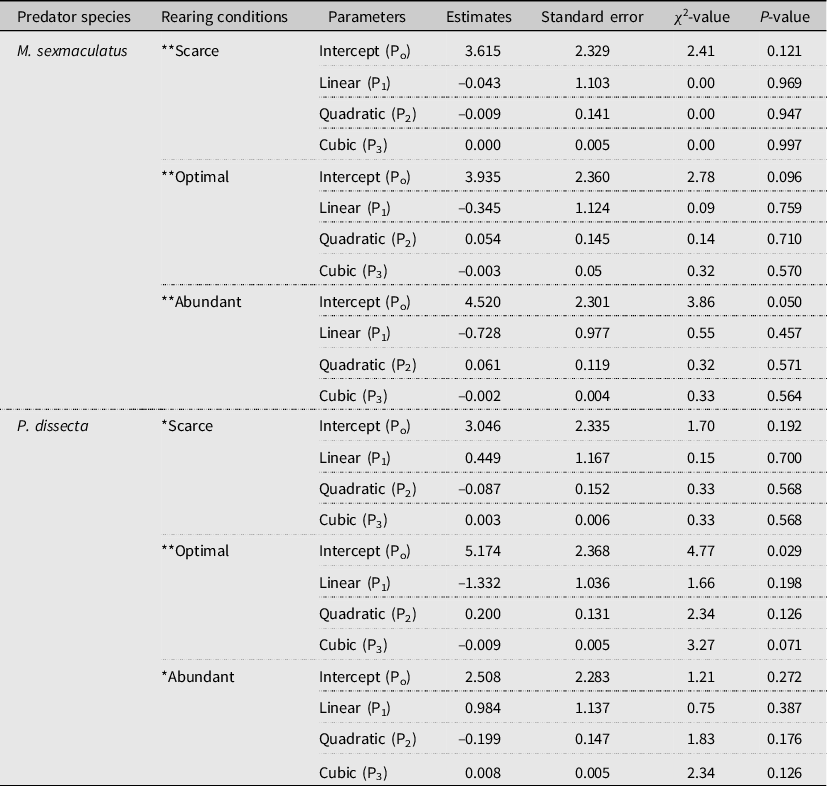
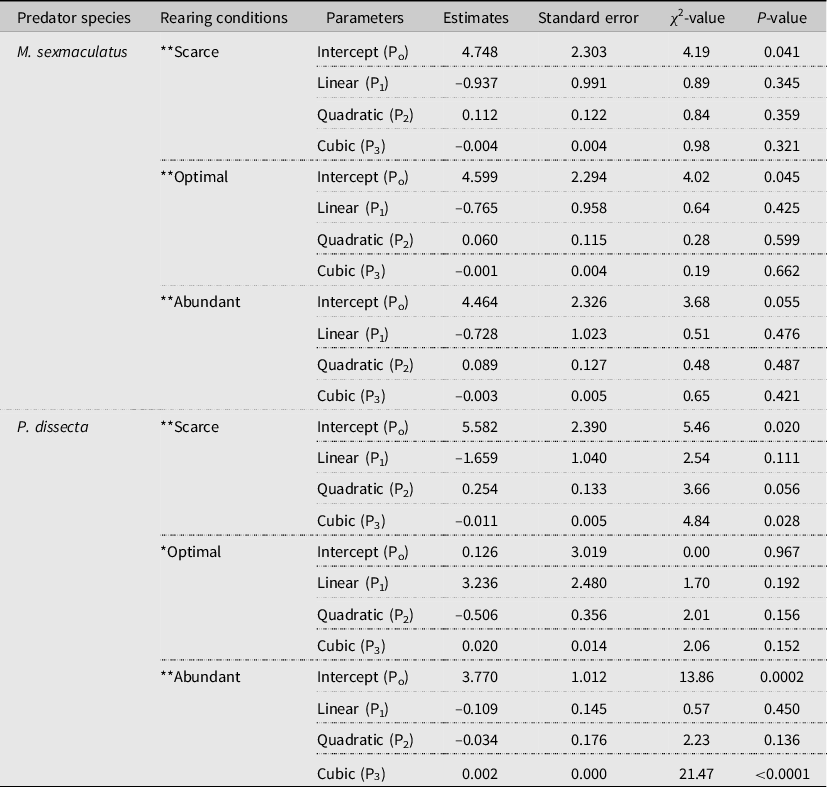
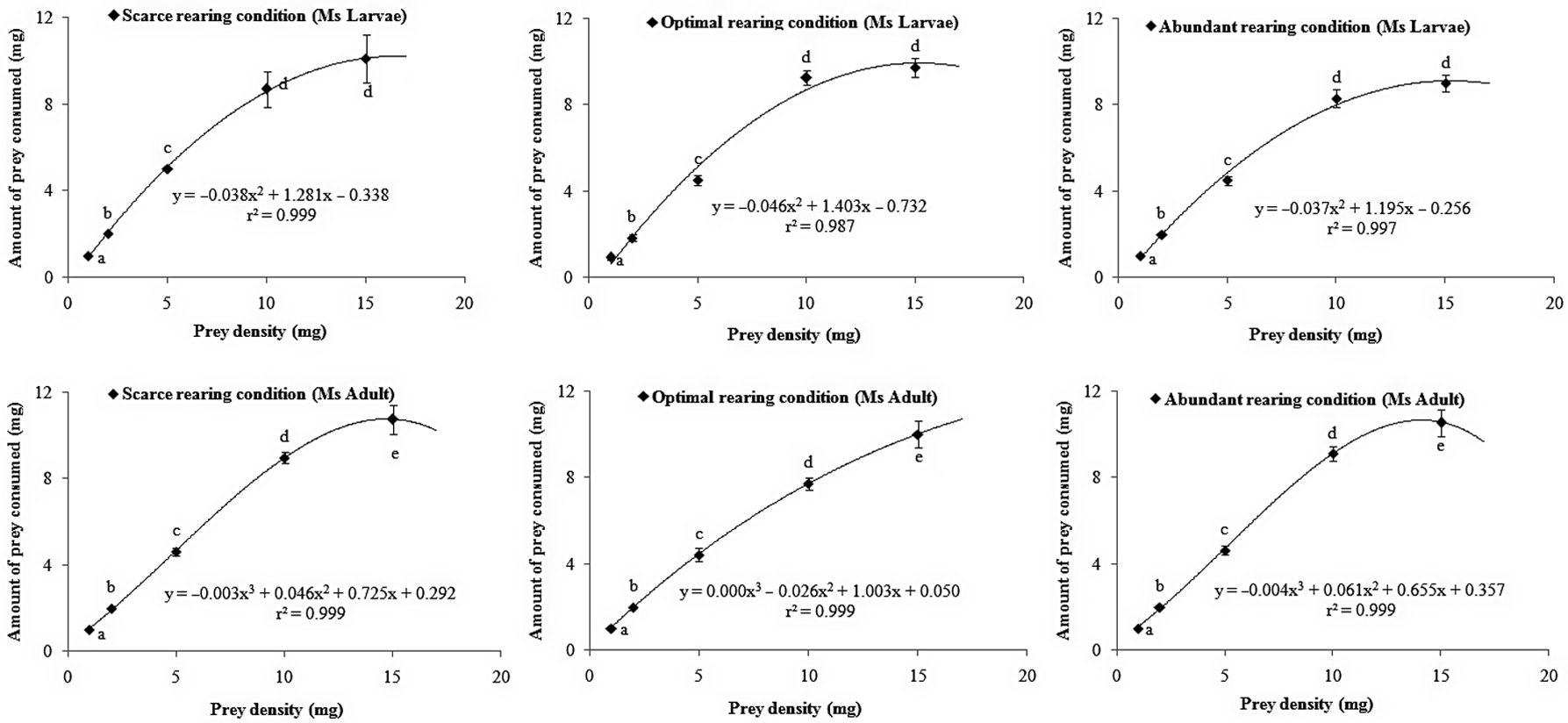
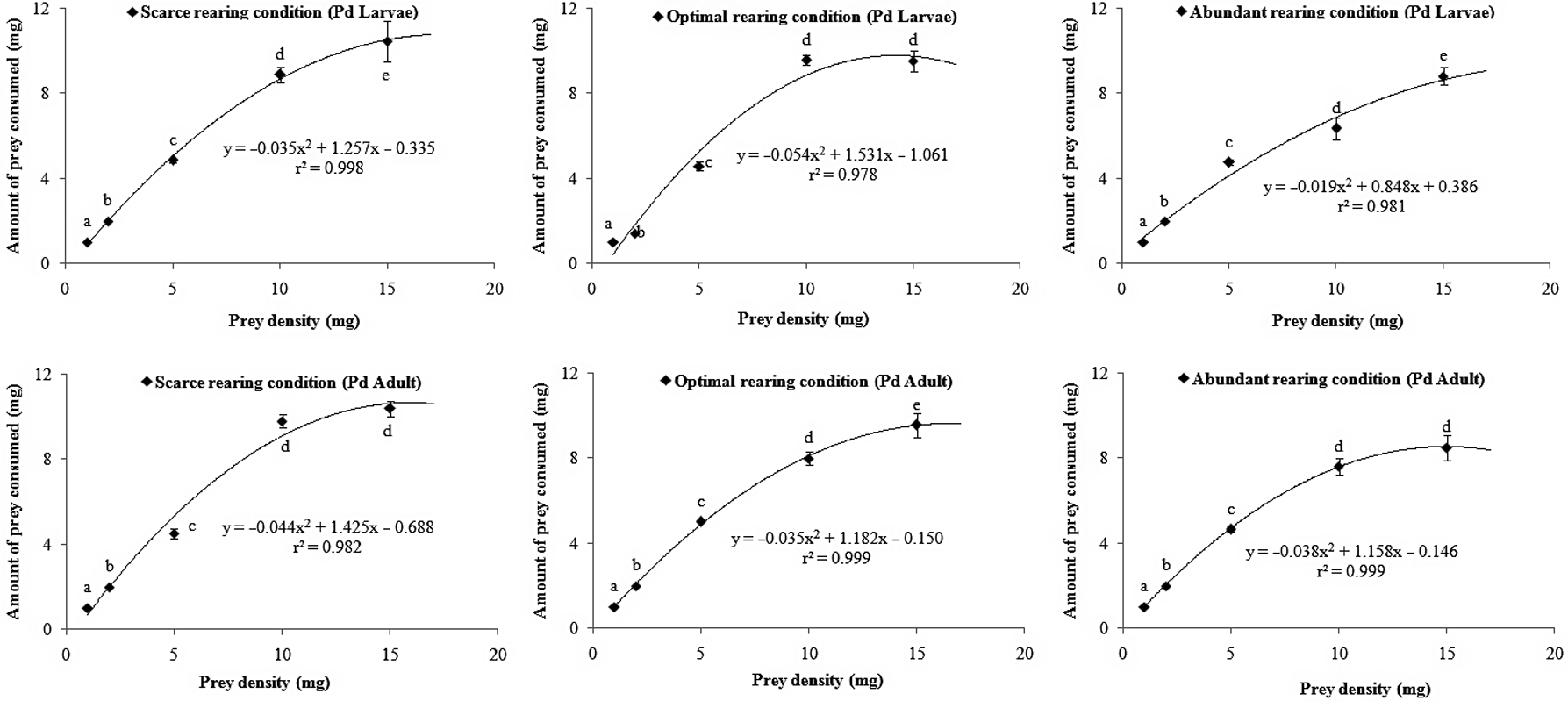
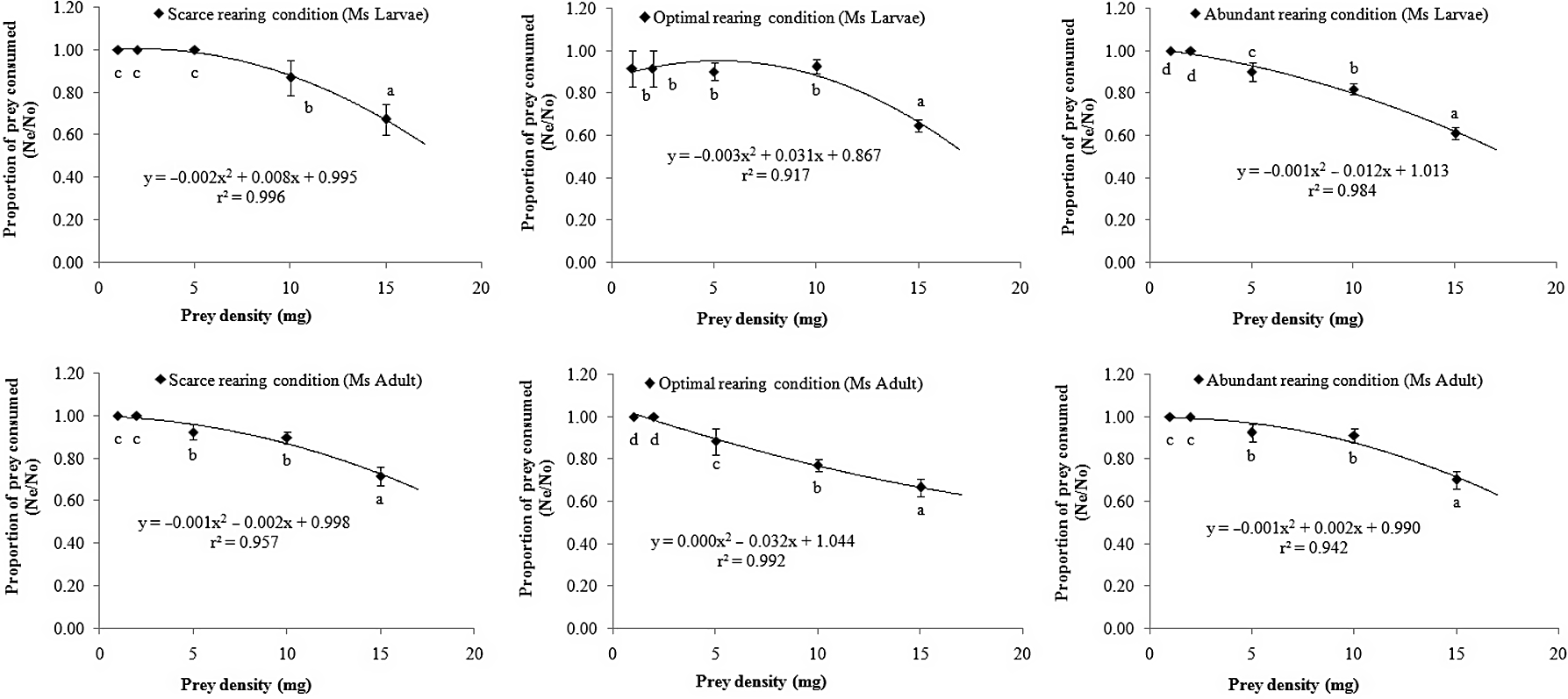
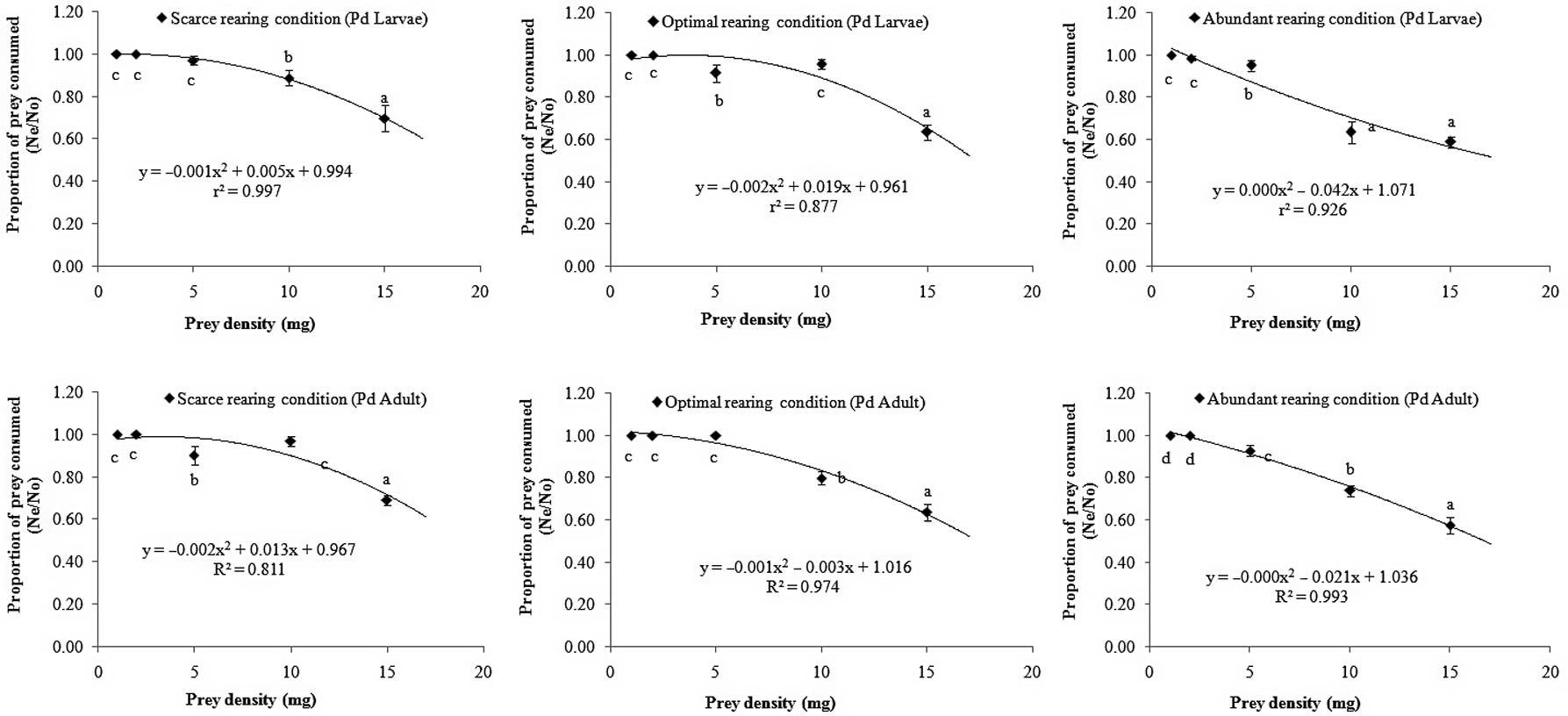
In the present study, the decreased proportion of prey consumed by the predatory stages when provided with an increased biomass of aphid prey points to a type II functional response. From the results of our maximum-likelihood analyses, type II functional response is confirmed for M. sexmaculatus fourth-instar larvae and adult females under the scarce, optimal, and abundant rearing prey densities, and for P. dissecta fourth-instar larvae under the optimal rearing prey density and P. dissecta adult females under the scarce and abundant rearing prey densities (Tables 1 and 2). By plotting a type II functional response and then fitting polynomial logistic regression models to the biomass and proportions of prey consumed, respectively, the resulting regression lines fitted the data well (Figs. 1, 2, 3, and 4).
Functional response parameters exhibited by fourth-instar larvae of Menochilus sexmaculatus and Propylea dissecta when fed on different densities of prey.

*A positive estimate for parameter P1 and significant negative estimate for P2 indicate a type III functional response. **A significant negative estimate for parameter P1 indicates that the slope of the functional response curve is declining, which indicates a type II functional response.
Functional response parameters exhibited by adult females of Menochilus sexmaculatus and Propylea dissecta when fed on different densities of prey.

*A positive estimate for parameter P1 and significant negative estimate for P2 indicate a type III functional response. **A significant negative estimate for parameter P1 indicates that the slope of the functional response curve is declining, which indicates a type II functional response.
Fitted relationships for the amount of prey consumed by fourth-instar larvae and adult females of M. sexmaculatus (Ms) when provided with five different biomasses of aphid prey. Small letters represent comparison of means between the five prey biomasses.

Fitted relationships for the amount of prey consumed by fourth-instar larvae and adult females of P. dissecta (Pd) when provided with five different biomasses of aphid prey. Small letters represent comparison of means between the five prey biomasses.

Fitted relationships for the proportion of prey consumed (Ne/N0) by fourth-instar larvae and adult females of M. sexmaculatus (Ms) when provided with five different biomasses of aphid prey. Small letters represent comparison of means between the five prey biomasses.

Fitted relationships for the proportion of prey consumed (Ne/N0) by fourth-instar larvae and adult females of P. dissecta (Pd) when provided with five different biomasses of aphid prey. Small letters represent comparison of means between the five prey biomasses.

However, significant positive linear and negative quadratic coefficients for P. dissecta fourth-instar larvae under the scarce and abundant rearing prey densities and for this species’ adult females under the optimal-prey rearing density suggested a type III functional response (Tables 1 and 2). For this reason, equation 3 was substituted in equation 2, and the two data sets were fit to a type III functional response curve. Results of the nonlinear least-squares regression indicated that parameters c and d did not significantly differ from zero; therefore, they were removed from the model, and a reduced model (equation 4) was used (Juliano Reference Juliano2001). Furthermore, the proportion of prey consumed (Ne/N0) by P. dissecta fourth-instar larvae under the scarce and abundant rearing prey densities and this species’ adult females under the optimal-prey rearing density did not increase with increased prey density as usually observed for a type III functional response; instead, it decreased when the biomass of prey provided was increased, similar to a type II functional response. This would therefore suggest a modified type II functional response for these predators (Figs. 1, 2, 3, and 4; see Chaudhary et al. Reference Chaudhary, Kumar, Mishra and Omkar2015; Patel et al. Reference Patel, Kumar and Kumar2017).
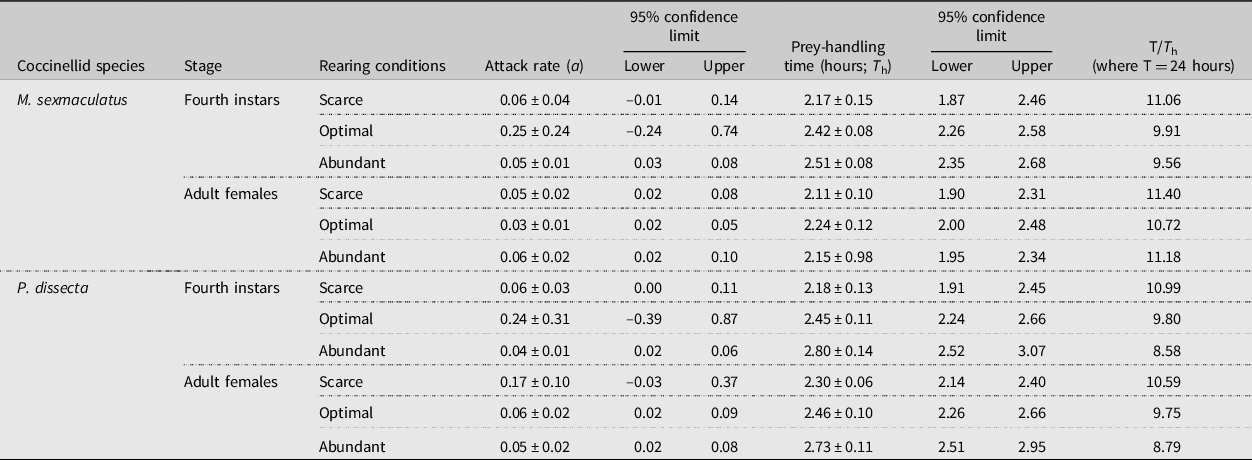
The results also revealed that the attack rate (a) was highest for M. sexmaculatus and P. dissecta fourth-instar larvae under the optimal rearing prey density, whereas the adult females of the two predators demonstrated the highest attack rate under the abundant and scarce rearing prey densities, respectively. However, both species’ fourth-instar larvae and adult females showed the shortest prey-handling time (T h) under the scarce rearing prey density. Moreover, the consumption of prey over 24 hours (T/T h) was greatest when both species’ fourth-instar larvae and adult females were reared under the scarce-prey density (Table 3).
Attack rate and prey-handling time (T h) for Menochilus sexmaculatus and Propylea dissecta, derived from their functional response parameters.

The beetles of both the species had lower prey-handling time and higher prey consumption as adults than as larvae. However, between the two coccinellid species, M. sexmaculatus consumed more prey than P. dissecta did.
Discussion
In the present study, negative linear coefficients (P1) for M. sexmaculatus fourth-instar larvae and adult females that had been reared on the scarce, optimal, and abundant prey densities but were provided with the five testing prey densities revealed that the rate of prey consumption decreased with increase in abundance of prey, which functionally indicates a type II response. Similar type II–response results were obtained both for P. dissecta fourth-instar larvae that had been reared under the optimal rearing prey density and then were provided with the five testing prey densities and for the species’ adult females that had been reared under scarce and abundant prey densities and then were provided with the five testing prey densities. The curves of the proportions of prey consumed by the above predatory stages of M. sexmaculatus and P. dissecta were similar and took the form of a decelerating type II functional response when the beetles were provided with prey-supply amounts ranging from extremely scarce to abundant. The findings agree with previous studies reported for many insect species (Bayoumy Reference Bayoumy2011a, Reference Bayoumy2011b; Omkar and Pervez Reference Omkar and Pervez2011; Osman and Bayoumy Reference Osman and Bayoumy2011; Gupta et al. Reference Gupta, Pervez, Guroo and Srivastava2012; Kumar et al. Reference Kumar, Bista, Mishra and Omkar2014a) and are characterised by a curvilinear increase in predation with increase in prey density, becoming asymptotic at high prey densities and thereafter remaining constant due to satiation (Jalali et al. Reference Jalali, Tirry and De Clercq2010).
Furthermore, the logistic regression analysis in the present study indicated a type III response for P. dissecta fourth-instar larvae under the scarce and abundant rearing prey densities and for the species’ adult females under an optimal rearing prey density, with no plateau observed for the function. However, the proportion of prey consumed (Ne/N0) by these predators did not increase with increasing prey density, as is generally observed for a type III functional response; instead, it decreased when the biomass of prey provided was increased, similar to the type II functional response. Based on this, the results suggest a modified type II functional response for these predators. Bayoumy (Reference Bayoumy2011b) and Osman and Bayoumy (Reference Osman and Bayoumy2011) reported similar results with modified type II functional response curves for the parasitoid Aphytis diaspidis Howard and coccinellid predator Stethorus gilvifrons Mulsant.
Kumar et al. (Reference Kumar, Mishra and Omkar2014b) also reported modified type II functional response curves when Coccinella septempunctata (Linnaeus) and Coccinella transversalis Fabricius were kept in conspecific and heterospecific combinations and exposed to increasing biomass of pea aphid. According to Chaudhary et al. (Reference Chaudhary, Kumar, Mishra and Omkar2016), females of M. sexmaculatus also exhibited modified type II functional response curves when provided with increasing biomass of cowpea aphid. It is highly probable that the functional responses of such predators would be better estimated using more natural arenas like small plants. Using a wider range and number of different prey abundances might also greatly increase the accuracy with which functional responses can be estimated.
Although the attack rate was highest for M. sexmaculatus and P. dissecta fourth-instar larvae under the optimal rearing prey density, both species’ adult females had the highest attack rates under abundant- and scarce-prey rearing conditions, respectively. Furthermore, the fourth-instar larvae and adult females of both species had the shortest prey-handling time (T h) and the greatest predicted consumption of prey over 24 hours (T/T h) when reared on the scarce-prey density. These results substantiate the hypothesis that the larvae and adults might have an innate energy accumulation threshold that they try to reach under limited prey availability by investing less time in attacking and consuming the prey compared to their usual predation rates that are displayed under optimal or abundant prey availability. Because environmental unpredictability encourages behavioural flexibility in insects (Dejean et al. Reference Dejean, Gibernau, Lauga and Orivel2003), the individuals that fed poorly during their early larval stages might accumulate fewer reserves – presumably in the form of stored fat – to carry through pupation into adulthood. As a result, they might feed more aggressively during their late-larval stages or as adults, as demonstrated by higher attack rates and lower prey-handling times.
The fourth-instar larvae of both coccinellid species that had been evaluated earlier for their functional response parameters were assessed again as adults for the same parameters. We found that the M. sexmaculatus larvae and adults exhibited similar functional response curves on the three rearing prey densities, whereas the functional response curves of P. dissecta larvae differed from those of this species’ adult females. Moreover, both species showed lower prey-handling time and higher prey-consumption rates as adults than as larvae. These results further substantiate the hypothesis that the fluctuating-prey densities that coccinellids experience during larval development might modulate the functional response curves of adults and also make the adults more voracious and more efficient in handling prey.
In comparison to P. dissecta, the higher prey consumption or functional response curves of M. sexmaculatus under the five testing prey densities might be ascribed to certain intrinsic advantages possessed by M. sexmaculatus to maintain its stable coexistence. Mishra et al. (Reference Mishra, Kumar, Shahid, Singh and Omkar2011, Reference Mishra, Omkar, Kumar and Pandey2012) reported higher prey-consumption rates of M. sexmaculatus over those of P. dissecta when the beetles were fed on a constant biomass of A. pisum, Aphis craccivora Koch, and Lipaphis erysimi (Kaltenbach). Omkar et al. (Reference Omkar, Mishra, Srivastava, Gupta and Singh2005) reported the intrinsic advantages of M. sexmaculatus, in terms of higher reproductive performance, over the other coexisting coccinellid beetles. Mishra et al. (Reference Mishra, Omkar, Kumar and Pandey2012) established that M. sexmaculatus is a better predator than P. dissecta is because the former establishes itself earlier in an area of introduction due to its better predation attributes. The present study’s findings strengthen the understanding that M. sexmaculatus exploits the prey more efficiently under prey resource fluctuation conditions than P. dissecta does, thereby making the former a better biocontrol agent of aphid prey than the latter is.
The present study’s results suggest that individuals of M. sexmaculatus reared on scarce, optimal, or abundant prey densities exhibit type II functional response curves, both as larvae and adults. Individuals of P. dissecta reared on scarce or abundant prey densities display modified type II functional response curves as larvae and type II functional response curves as adults, whereas the individuals of P. dissecta reared on an optimal-prey density display type II functional response curves as larvae and modified type II functional response curves as adults. The results further substantiate the hypothesis that the scarce rearing prey condition might set the stage for coccinellid beetles to compensate for the earlier shortage of food by consuming higher prey biomass than usual when they suddenly encounter an optimal or abundant prey resource. The larvae and adults might have an innate energy accumulation threshold that they try to reach under scarce-prey availability by feeding more aggressively, with higher attack rates and lower prey-handling time. Furthermore, M. sexmaculatus is shown here to have a better compensatory ability to overcome prey resource fluctuations than P. dissecta does. As a result, the former would likely behave as a better biological control agent of aphids than the latter would. Field-based studies are needed to confirm these findings.
Acknowledgements
The authors thank the University Grants Commission, Government of India (Letter no. 30-420/2018) for providing financial assistance under UGC-BSR Start-up grant and the Department of Higher Education, Govt. of U.P. India (125/Sattar-4-2010-46(32)/2009 dated January 16 2010) for financial assistance under the Centre of Excellence programme.
Disclosure
All authors contributed significantly, and all authors are in agreement with the content of the manuscript and have no conflicts of interest.