Many decades of research have been directed toward understanding how and when readers gain access to morphological information in visual word recognition (Bybee, Reference Bybee1995; Colé, Beauvillain, & Segui, Reference Colé, Beauvillain and Segui1989; Taft & Forster, Reference Taft and Forster1975). Full-listing theories propose that morphologically complex words are stored and retrieved as whole entities in the lexicon (e.g., Butterworth, Reference Butterworth and Butterworth1983; Manelis & Tharp, Reference Manelis and Tharp1977). Recently, however, research has begun to more extensively explore the concept of morphological decomposition. Postlexical decomposition accounts propose that morphologically complex words are always initially mapped onto whole-word representations and only decomposed after access to the lexicon has been achieved (e.g., Giraudo & Grainger, Reference Giraudo and Grainger2000, Reference Giraudo and Grainger2001). Prelexical accounts of morphological decomposition suggest that morphologically structured words are automatically decomposed into their morphoorthographic subunits, which then in turn activate the lexical representation of the whole word (e.g., Duñabeitia, Perea, & Carreiras, Reference Duñabeitia, Perea and Carreiras2007; Grainger, Colé, & Segui, Reference Grainger, Colé and Segui1991; Longtin & Meunier, Reference Longtin and Meunier2005; Longtin, Segui, & Hallé, Reference Longtin, Segui and Hallé2003; Rastle, Davis, Marslen-Wilson, & Tyler, Reference Rastle, Davis, Marslen-Wilson and Tyler2000; Rastle, Davis, & New, Reference Rastle, Davis and New2004; Taft, Reference Taft, Assink and Sandra2003, Reference Schoonbaert and Grainger2004). Other researchers favor a dual-pathway account, proposing a combination of pre- and postlexical decomposition strategies, such that a morphologically complex input letter string can be either processed prelexically (via the decompositional pathway) or postlexically (via the whole-word route; e.g., Diependaele, Sandra, & Grainger, Reference Diependaele, Sandra and Grainger2009; see also Baayen, Dijkstra, & Schreuder, Reference Baayen, Dijkstra and Schreuder1997, for a related account).
More recently, it has been debated as to when exactly semantic influences in automatic morphological processing can be found. In this respect, theories of morphological decomposition split into two different camps. One hypothesis proposes that early morphological decomposition is purely based on the analysis of orthographic form (e.g., McCormick, Rastle, & Davis, Reference McCormick, Rastle and Davis2008, Reference McCormick, Rastle and Davis2009; Rastle & Davis, Reference Rastle and Davis2008). This hypothesis argues that morphological decomposition is initially semantically “blind,” as it operates purely on the basis of morphoorthographic encoding, and that morphosemantic information then gradually comes in as time increases. The second hypothesis considers that semantic influences on morphological parsing can already be observed at initial stages of word recognition (e.g., Diependaele et al., Reference Diependaele, Sandra and Grainger2009; Feldman, O'Connor, & Moscoso del Prado Martin, Reference Feldman, O'Connor and Moscoso del Prado Martin2009). Results favoring this view have been obtained in experiments reporting processing asymmetries between truly polymorphemic words (such as the derived word teacher), and pseudocomplex monomorphemic words that have an internal structure that resembles that of polymorphemic words (such as corner, which could be incorrectly decomposed in corn+er; see Feldman et al., Reference Feldman, O'Connor and Moscoso del Prado Martin2009, for review). It is thus considered that morphoorthographic and morphosemantic processing co-occur at initial morphological processing stages.
The masked priming paradigm has been typically used to explore automatic stages of the processing of derivationally affixed words (Longtin et al., Reference Longtin, Segui and Hallé2003; Rastle et al., Reference Rastle, Davis, Marslen-Wilson and Tyler2000). In a prototypical masked priming experiment, a forward mask is presented, followed by a briefly presented stimulus (the prime), which in turn is immediately replaced by another stimulus (the target). Participants are not aware of the existence of the masked prime, but its influence can still be measured on target recognition. The processing of the briefly presented prime (typically shown for 40–70 ms) is posited to show early, automatic processes (Forster & Davis, Reference Forster and Davis1984; Forster, Davis, Schoknecht, & Carter, Reference Forster, Davis, Schoknecht and Carter1987). In this line, many masked priming studies have shown that the recognition of a target (e.g., corn) is facilitated by the prior presentation of a morphoorthographically related prime (e.g., corner), suggesting that there is a mechanism that decomposes morphologically complex letter strings at early prelexical stages in visual word recognition (e.g., Longtin & Meunier, Reference Longtin and Meunier2005).
Our present studies aimed at further investigating early morphological decomposition and affix-stripping mechanisms in visual word recognition in masked priming to explore whether priming still occurs for morphologically complex primes including a letter transposition within their stems (Experiment 1) and exploring the influences of semantics on early morphological transposed-letter (TL effect) priming effects by altering the lexical status of the primes (Experiment 2). As explained below, this manipulation represents a critical test for accounts based on early and automatic morphological decomposition, due to the orthographic nature of the TL-similarity effect (see also Christianson, Johnson, & Rayner, Reference Christianson, Johnson and Rayner2005; Duñabeitia, Perea, & Carreiras, Reference Duñabeitia, Perea and Carreiras2007; Rueckl & Rimzhim, in press).
Evidence from masked TL-priming studies shows that a nonword prime with two TLs at internal positions such as wlak facilitates the recognition of the target walk relative to an orthographic control like whuk (e.g., Andrews, Reference Andrews1996; Forster et al., Reference Forster, Davis, Schoknecht and Carter1987; Perea & Lupker, Reference Perea, Lupker, Kinoshita and Lupker2003; Peressotti & Grainger, Reference Peressotti and Grainger1999; Schoonbaert & Grainger, Reference Schoonbaert and Grainger2004). This masked TL-similarity effect can be accounted for by models of orthographic encoding that assume imprecise initial coding of letter positions at early stages of word processing (Gómez, Ratcliff, & Perea, Reference Gómez, Ratcliff and Perea2008; Grainger & van Heuven, Reference Grainger, van Heuven and Bonin2003; Whitney, Reference Whitney2001). As a consequence of the imprecise position encoding of the letters within a string, when a TL nonword like wlak is presented the orthographic representation of the word walk is activated, and consequently the lexical representation of the word walk is the one receiving the highest activation, because this is the closest pattern matching the misspelled input (see Duñabeitia et al., Reference Duñabeitia, Perea and Carreiras2009). Hence, the TL effect is assumed to reflect positionally imprecise whole-word processing (Gómez et al., Reference Gómez, Ratcliff and Perea2008).
In a recent lexical decision study in English, Rueckl and Rimzhim (2010) investigated the effects of TL manipulations in morphological masked priming to test the time course of morphological processing in visual word recognition. Critically, compared to previous studies (e.g., Christianson et al., Reference Christianson, Johnson and Rayner2005; Duñabeitia et al., Reference Duñabeitia, Perea and Carreiras2007) that have always used morphologically complex targets, Rueckl and Rimzhim (2010, Experiments 1–3) were the first to investigate the effects of TL-manipulated morphologically complex word primes on stem–target recognition. Primes were created by either transposing the two last letters of the stem (teahcer-TEACH) or by transposing the last letter of the stem and the first of the suffix (teacehr-TEACH). An additional condition was introduced in which targets were preceded by a morphologically related prime (teacher-TEACH). TL primes and morphologically related primes were compared to a replaced-letter (RL) control, in which the two TLs (teahcer) were replaced with two new letter identities (teakser).
These experiments revealed that the recognition of the target (teach) was facilitated by the prior masked presentation of morphologically related TL primes, independently of whether it comprised a TL manipulation within the stem or across the morpheme boundary (teahcer-TEACH vs. teacehr-TEACH). These results conflict with previous findings (Christianson et al., Reference Christianson, Johnson and Rayner2005; Duñabeitia et al., Reference Duñabeitia, Perea and Carreiras2007) suggesting that the position of the transposition had no impact on the obtained size of priming. In fact, there was no difference between the size of the priming effects in the morphologically related and the TL-across condition when compared to the RL condition (Rueckl & Rimzhim, 2010; Experiments 2 and 3; teacher-TEACH vs. teacifr-TEACH and teacehr-TEACH vs. teacifr -TEACH). Of interest, however, the difference between the morphologically related and the TL-within condition (teacher-TEACH vs. teakser-TEACH and teahcer-TEACH vs. teakser-TEACH) was significant in Experiment 1, but not in Experiment 3.
The evidence reported by Rueckl and Rimzhim (2010) show that inconsistencies remain in morphological TL-priming studies. Although Christianson et al. (Reference Christianson, Johnson and Rayner2005) and Duñabeitia et al. (Reference Duñabeitia, Perea and Carreiras2007) reported evidence for the disappearance of TL priming for across-boundary transpositions, Rueckl and Rimzhim (2010) demonstrate that this is not always the case. However, two points should be noted regarding the generalization of their findings. First, position-specific orthographic prime-target overlap was always greatest in the morphologically related condition (teacher-TEACH, 5 letter overlap), less in the across-morpheme boundary condition (teacehr-TEACH, 4 letter overlap), and lowest in the within-morpheme boundary condition (teahcer-TEACH, 3 letter overlap). It cannot therefore be ruled out that the largest priming effects found in the morphologically related condition relative to the TL-within condition were due to greater orthographic prime-target overlap as measured in terms of position-specific overlap. A second concern arises with the external position of letter transpositions (teahc). It is known that TL nonwords with transpositions at external positions resemble their corresponding real word to a lesser degree than TL nonwords with transpositions at internal positions (Johnson, Perea, & Rayner, Reference Johnson, Perea and Rayner2007; Perea & Lupker, Reference Perea and Lupker2007; Rayner, White, Johnson, & Liversedge, Reference Rayner, White, Johnson and Liversedge2006). It is possible that the involvement of external letters reduced the amount of priming observed in the TL-within condition. It is therefore important to establish whether this difference would also be obtained when (a) the amount of orthographic prime-target overlap is balanced across conditions and (b) only internal letters of the stem are transposed.
We conducted two masked primed lexical decision experiments to further explore the role of TL manipulations in morphological processing, in Spanish. In particular, we were interested in directly comparing the magnitudes of the priming effects obtained for suffixed primes and TL primes relative to an unrelated control, in order to gain a better understanding of the impact of letter transpositions in morphological processing. Our goal was to control for orthographic prime-target overlap by introducing an unrelated priming condition while transposing at internal positions of the stem morpheme only. We conducted two masked primed lexical decision experiments. Experiment 1 assessed the role of letter position coding in morphologically complex word processing in Spanish. Experiment 2 was designed to extend the findings from Experiment 1, in particular, to investigate the influences of semantic factors in early morphological processing.
EXPERIMENT 1
TL-nonword primes were constructed from Spanish suffixed words (e.g., dlooroso from doloroso [painful]). Targets were made of the monomorphemic stems of these suffixed words (DOLOR [pain]). To guarantee that the TL-similarity effect would not be reduced by the transposition of external letters (Johnson et al., Reference Johnson, Perea and Rayner2007; Perea & Lupker, Reference Perea and Lupker2007; Rayner et al., Reference Rayner, White, Johnson and Liversedge2006), transpositions were only performed with internal letters of the stem. Priming in the TL conditions (dlooroso-DOLOR) was compared to a RL control (dteoroso-DOLOR). Furthermore, we used a morphologically related priming condition (doloroso-DOLOR [painful-PAIN]) and a fully unrelated word priming condition (tumoroso-DOLOR [tumorous-PAIN]).
If it is the case that morphological effects operate purely over early orthographic encoding mechanisms with high positional uncertainty (e.g., Longtin & Meunier, Reference Longtin and Meunier2005; Rastle et al., Reference Rastle, Davis and New2004; Taft, Reference Taft, Assink and Sandra2003), no differences between the size of the priming effects for morphologically related primes and morphologically complex TL primes (doloroso-DOLOR vs. dlooroso-DOLOR) should be observed, as measured against the unrelated word priming condition. That is, although some basic positional context is needed in order to recognize a morpheme, positional information is still underspecified at the time that morphological information is encoded. If, however, morphologically complex words are decomposed at later stages in lexical processing with less positional uncertainty (e.g., Giraudo & Grainger, Reference Giraudo, Grainger, Baayen and Schreuder2003; Marslen-Wilson, Tyler, Waksler & Older, Reference Marslen-Wilson, Tyler, Waksler and Older1994, see also Diependaele et al., Reference Diependaele, Sandra and Grainger2009), dlooroso should prime dolor to a lesser degree than doloroso. That is, the magnitude of priming in the TL condition should be reduced.
Method
Participants. Thirty-six undergraduate students from the University of the Basque Country participated in this study. All participants were native Spanish speakers and had normal or corrected to normal vision.
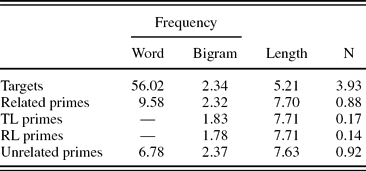
Materials. A set of 76 Spanish words was selected as targets (e.g., dolor [pain]; see Table 1 for characteristics). Each target could be preceded by four possible primes: a morphologically related prime (doloroso [painful]), a TL prime (dlooroso), an RL control prime (dteoroso), or an unrelated prime (tumoroso [tumorous]). Related and unrelated prime words were matched on length, orthographic N, word frequency, bigram frequency, stem length, stem orthographic N, and stem frequency (see Table 1). In order to control for the potential impact of the suffix, the unrelated word selected for each related word prime always included the same suffix (doloroso and tumoroso). TL-nonword primes were created by transposing two internal letters of the stems (dlooroso). None of the transpositions included two vowels (see Lupker, Perea, & Davis, Reference Lupker, Perea and Davis2008), and none of the letter transpositions led to the creation of a real word (Duñabeitia, Molinaro, Laka, Estévez, & Carreiras, Reference Duñabeitia, Kinoshita, Carreiras and Norris2009; Duñabeitia et al., Reference Duñabeitia, Molinaro, Laka, Estévez and Carreiras2009). The RL-control condition was created by substituting the two TLs with two new letter identities with a similar formal resemblance (dteoroso). TL and RL primes were matched on length, orthographic N, and bigram frequency (see Table 1). A complete list of stimuli is provided in Appendix A.
Mean word frequency, bigram frequency, length, and orthographic N for the stimuli in Experiment 1

Note: The data are according to Davis and Perea (Reference Davis and Perea2005). TL, transposed letter; RL, replaced letter.
For the purpose of the lexical decision task, we included a set of 76 nonword targets that were all orthographically legal and pronounceable by replacing the first and the last letter of a real word (e.g., the nonword ozus from the word azul). Each nonword target was preceded by four different primes, following the same conditions used for word trials (morphologically related: ozusado; TLs: ouzsado; RLs: oicsado; unrelated: loctosado).
Four lists were created, so that each target only appeared once in each list, but each time in a different priming condition. Nine participants were randomly assigned to each of the lists.
Procedure. Stimuli were presented in the center of a CRT computer screen using the DMDX display system (Forster & Forster, Reference Forster and Forster2003) in randomized order. Each participant was tested individually in a quiet room located at the Basque Center on Cognition, Brain and Language. Each trial consisted of the presentation of a forward mask of # symbols for 500 ms, followed by the presentation of the prime in lowercase for 53 ms, and immediately followed by the presentation of the uppercase target stimulus. The target remained on the screen until the subject responded or for a maximum of 2500 ms. Participants were asked to decide as quickly and accurately as possible whether the visually presented targets were real Spanish words (i.e., a lexical decision task). Two keys of the keyboards were appropriately labeled. The whole experimental session lasted for about 10 min.
Results and discussion
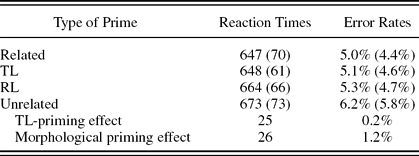
Reaction times (RTs) longer than 1500 ms or shorter than 300 ms were discarded (18 outliers were identified, 0.7% of the data). Mean reading latencies and error rates averaged over subjects are presented in Table 2.
Mean (standard deviation) lexical decision times (ms) and percentage of errors for real word targets in Experiment 1
Note: TL, transposed letter; RL, replaced letter.
RTs were transformed logarithmically and the main analyses were performed using linear mixed effect model modeling (e.g., Baayen, Reference Baayen2008; Baayen, Davidson, & Bates, Reference Baayen, Davidson and Bates2008). To reduce the variance in the models, we included the predictor trial number as a measure of how far the participant has progressed into the experiment. This measure allows us to control for longitudinal task effects such as fatigue or habituation. Furthermore, because every participant was presented with items in a different random order, the order of trial presentation may have had different effects on individual subjects. Therefore, to adjust the by-subject random slopes for trial number, we included a correlation parameter specified in the random-effect structure of each subject (Baayen, Reference Baayen2008, pp. 251–252). A generalized linear mixed-effects model as implemented in the lme4 package (from http://cran.r-project.org/web/packages/) in the statistical software R (version 2.10.1, R Development Core Team, 2008) was used with two fixed effects factors (trial number and prime type: related, TL, RL, unrelated) and two random-effects factors (random intercepts for subjects and items). Factors were selected in a stepwise model selection procedure and only included when a formal comparison between models showed a significant improvement of the model's fit when the factor was added to the model. Significance was accessed with p-value sampling pvals.fnc, as implemented in the language R-package (Baayen, Reference Baayen2008).
The model revealed that words preceded by morphologically related primes were responded to significantly faster than words preceded by unrelated primes (26 ms; t = 4.3, p < .001). Similarly, words in the TL-priming condition were classified significantly faster than words preceded by unrelated primes (25 ms; t = 4.0, p < .001). The RL condition did not differ significantly from the unrelated condition (9 ms; t = 1.5, p = .125). No significant differences were obtained between the morphologically related and the TL-priming condition (t = 0.4, p = .704). It is critical that there was a significant difference between the RL priming condition and the morphologically related priming condition (17 ms; t = 2.8, p = .005). Similarly, the TL primes significantly facilitated target recognition compared to RL primes (16 ms; t = 2.4, p = .015). None of the effects in the error rate analyses and in the nonword data were significant.
The results obtained in the present masked priming experiment can be summarized as follows: first, we replicated the well-known masked morphological priming effect using Spanish materials (doloroso-DOLOR vs. tumoroso-DOLOR). Second, a significant priming effect was also obtained for morphologically related primes that included a letter transposition within the stems (dlooroso-DOLOR vs. tumoroso-DOLOR). Third, the priming effect was no larger in the morphologically related condition (doloroso-DOLOR) than in the TL condition (dlooroso-DOLOR). Fourth, we replicated the TL-priming effect, showing that targets preceded by TL primes were recognized significantly faster than targets preceded by primes including a letter replacement (dlooroso-DOLOR vs. dteoroso-DOLOR). Fifth, we showed that no signs of priming effects are found when two of the internal letters of the morphologically related primes are replaced by other letters, compared to completely unrelated primes (dteoroso-DOLOR vs. tumoroso-DOLOR).
The key finding in this study was the lack of difference in the magnitude of the priming effects observed for the nontransposed morphologically related primes and the morphologically related primes that included a letter transposition within the stem (viz., for doloroso-DOLOR and dlooroso-DOLOR; 26 and 25 ms, respectively, compared to the unrelated primes, and 17 and 16 ms, respectively, compared to the RL primes). The masked TL-priming effect (Andrews, Reference Andrews1996; Forster et al., Reference Forster, Davis, Schoknecht and Carter1987; Perea, Duñabeitia, & Carreiras, Reference Perea, Duñabeitia and Carreiras2008; Perea & Lupker, Reference Perea, Lupker, Kinoshita and Lupker2003; Peressotti & Grainger, Reference Peressotti and Grainger1999; Schoonbaert & Grainger, Reference Schoonbaert and Grainger2004) has been generally taken as clear-cut evidence in favor of models that assume imprecise initial coding of letter position (Grainger & van Heuven, Reference Grainger, van Heuven and Bonin2003; Whitney, Reference Whitney2001). The present results confirm that masked morphological subset priming effects (doloroso-DOLOR) do also occur for nonword primes in which internal letters of the stem have been distorted by means of letter transpositions (dlooroso-DOLOR). Despite the increased complexity of the nonword string dlooroso (suffixed and TL manipulated) compared to the word doloroso (only suffixed, no TL manipulation), no difference was found between the priming effects.
The present priming effects, are in line with Rueckl and Rimzhim's (in press) Experiment 3 in English, which found equal amounts of morphological priming and within-boundary TL priming (teacher-TEACH vs. teahcer-TEACH). However, the present findings differ from Rueckl and Rimzhim's (in press) Experiment 1, which showed significantly less within-boundary TL priming than morphological priming. Our results may have differed for the following two reasons. First, Rueckl and Rimzhim (in pressReference Rueckl and Rimzhim) measured morphological priming and TL priming against a RL control. Therefore, because the position-specific orthographic prime-target overlap in the morphologically related condition was greater than in the TL and RL condition, the obtained effects may reflect an orthographic boost of priming for highly orthographically related prime-target pairs. Second, the decreased size of priming in the TL-within condition in Rueckl and Rimzhim's (in press) Experiment 1 may be attributed to the inclusion of external letter positions in within-boundary transpositions. TL priming has been found to be less reliable for letter transpositions at external positions of a letter string (Johnson et al., Reference Johnson, Perea and Rayner2007; Perea & Lupker, Reference Perea and Lupker2007; Rayner et al., Reference Rayner, White, Johnson and Liversedge2006). However, more systematic investigations of internal versus external stem transpositions are needed to draw explicit conclusions.
In summary, the present results show that stem-target priming is equally obtained from both morphologically complex real words and morphological complex TL nonwords. The virtually identical effect size in both conditions indicates that dlooroso and doloroso are practically the same at these early stages in visual word processing. This is inconsistent with the hypothesis that morphological decomposition effects are triggered at late processing stages (e.g., Giraudo & Grainger, Reference Giraudo, Grainger, Baayen and Schreuder2003). If letter position coding had already had time to develop precise representations of positional information prior to the stem morpheme activation process, then the input string dlooroso, with high positional certainty, would prime dolor to a lesser extend than doloroso. The present data thus support the hypothesis that morphological processing operates with high positional uncertainty over early orthographic stages in visual word recognition (e.g., Longtin & Meunier, Reference Longtin and Meunier2005; Rastle & Davis, Reference Rastle, Davis and New2004; Taft, Reference Taft, Assink and Sandra2003). This has critical implications for letter position encoding schemes indicating that the encoding of letter position and morphological information both occur at the same time, at early automatic word processing stages.
However, the evidence reported in Experiment 1 does not allow us to draw conclusions regarding the influences of semantics on morphological parsing. It is possible that morphological decomposition does not exclusively rely on morphoorthographic encoding mechanisms and that the observed priming effects in Experiment 1 were at least partially driven by the morphosemantic relationship between the prime and the target. There are thus two possible interpretations of the results. Because we only used primes that were either derived from real words (dlooroso or dteoroso) or were real words themselves (doloroso or tumoroso), it is not clear whether priming from doloroso or dlooroso to dolor occurred because of (a) early semantically “blind” morphoorthographic decomposition of doloroso into dolor or dloor and oso (Longtin & Meunier, Reference Longtin and Meunier2005; Rastle & Davis, Reference Rastle and Davis2008) or (b) a combination of early morphoorthographically and morphosemantically guided parsing into morphemes (e.g., Diependaele et al., Reference Diependaele, Sandra and Grainger2009; Feldman et al., Reference Feldman, O'Connor and Moscoso del Prado Martin2009). The first hypothesis proposes that automatic affix-stripping occurs for all presented letter strings, based on purely structural information. Because this account predicts that early morphological processing stages operate solely on basis of orthographic analysis, priming to the stem would be expected to occur independently of the semantic prime-target relationship. The second hypothesis considers that morphological decomposition does not exclusively rely on morphoorthographic encoding mechanisms and that the observed priming effects in Experiment 1 were at least partially driven by the morphosemantic relationship between the prime and the target. Stem-target priming would therefore largely depend on the semantic transparency of morphemic subunits. Given that the primes in Experiment 1 were always words, these two hypotheses cannot be distinguished, as both hypotheses would predict the same pattern of effects from word primes. In order to understand to what extent the priming effects in Experiment 1 were affected by the semantic relatedness between prime and target, we designed Experiment 2 using suffixed nonword primes.
EXPERIMENT 2
Based on a similar procedure as in Experiment 1, primes were now constructed by using lexically illegal stem–suffix combinations. Primes in all four conditions were created such that the whole prime did not have a lexical representation on its own (i.e., all primes were nonwords). Primes in the related condition were constructed from a Spanish stem morpheme (total) and a suffix (ito), and were followed by the stem target (totalito-TOTAL). In addition, we introduced a TL condition (ttoalito-TOTAL) with letter transpositions within the stem, and a RL-control condition (tfealito-TOTAL). Finally, for every related prime we created an unrelated control prime by combining the same suffix (ito) with an orthographically unrelated stem of the same length (sudorito-TOTAL).
Due to the lack of semantic relationship between the stems and the whole primes (e.g. total has a meaning, but totalito does not), we significantly reduced the likelihood that any of the effects obtained in Experiment 2 could be driven by the semantic relationship between target and prime. The nonlexical nature of the primes allowed us to explore the influences of semantics on masked morphological priming. If morphological decomposition is purely based on orthographic analysis (e.g., Rastle et al., Reference Rastle, Davis and New2004; Taft, Reference Taft, Assink and Sandra2003), priming should occur independently of whether or not there is a semantic relationship between the prime and the target. We would thus expect priming to occur in the morphologically related condition (totalito-TOTAL) and in the TL condition (ttoalito-TOTAL). However, if morphological decomposition was triggered by a combination of morphoorthographic and morphosemantic factors (e.g., Diependaele et al., Reference Diependaele, Sandra and Grainger2009; Feldman et al., Reference Feldman, O'Connor and Moscoso del Prado Martin2009) priming in the morphologically related and in the TL condition should be reduced or disappear.
Method
Participants. Forty undergraduate students from the University of the Basque Country participated in this study. All participants were native Spanish speakers and had normal or corrected to normal vision.
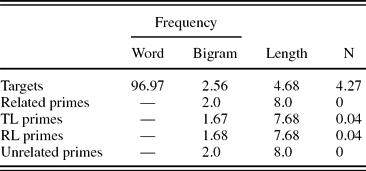
Materials. A set of 84 Spanish words was selected as targets (e.g., TOTAL; see Table 3 for characteristics). Each target could be preceded by four possible primes: a morphologically related prime (totalito), a TL prime (ttoalito), an RL-control prime (tfealito), or an unrelated prime (sudorito). Related primes were created by combining stems (e.g., total) and suffixes (e.g., ito) such that the whole letter string would not make a word (e.g., totalito is not a word). All stem–suffix combinations were orthographically legal and pronounceable.Footnote 1
Mean word frequency, bigram frequency, length, and orthographic N for the stimuli in Experiment 2
Note: The data are according to Davis and Perea (Reference Davis and Perea2005). TL, transposed letter; RL, replaced letter.
Related and unrelated nonword primes used the same suffixes and were matched on length, bigram frequency, orthographic N, stem length, stem orthographic N, and stem frequency (see Table 3). As in Experiment 1, TL-nonword primes were created by transposing two internal letters of the stems (ttoalito). None of the transpositions included two vowels (see Lupker et al., Reference Lupker, Perea and Davis2008), and none of the letter transpositions led to the creation of a real word (Duñabeitia, Molinaro, et al., Reference Duñabeitia, Kinoshita, Carreiras and Norris2009; Duñabeitia, Perea, et al., Reference Duñabeitia, Perea and Carreiras2009). The RL-control condition was created by substituting the two TLs with two new letter identities with a similar formal resemblance (tfealito). TL and RL primes were matched on length, orthographic N, and bigram frequency (see Table 3). A complete list of stimuli is provided in Appendix B.
For the purpose of the lexical decision task, we included a set of 84 nonword targets that were all orthographically legal and pronounceable by replacing the first and the last letter of a real word (e.g., the nonword fotan from the word total). Each nonword target was preceded by four different primes, following the same conditions used for word trials (morphologically related: fotanito; TLs: ftoanito; RLs: fdeanitio; unrelated: sigacito).
Four lists were created, so that each target only appeared once in each list, but each time in a different priming condition. Ten participants were randomly assigned to each of the lists.
Procedure. We followed the same procedure as in Experiment 1.
Results and discussion
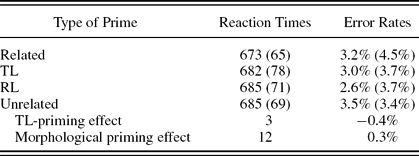
Reaction times longer than 1500 ms or shorter than 300 ms were discarded (28 outliers were identified, 0.9% of the data). Mean reading latencies and error rates averaged over subjects are presented in Table 4.
Mean (standard deviation) lexical decision times (ms) and percentage of errors for real word targets in Experiment 2
Note: TL, transposed letter; RL, replaced letter.
RTs were transformed logarithmically and the main analyses were performed using linear mixed effect model methodology as in Experiment 1. The model used had two fixed effects factors (trial number and prime type: related, TL, RL, unrelated) and two random-effects factors (random intercepts for subjects and items). Significance was assessed with p value sampling pvals.fnc, as implemented in the language R-package (Baayen, Reference Baayen2008).
The model revealed that words preceded by morphologically related primes were responded to significantly faster than words preceded by unrelated primes (12 ms; t = 2.0, p = .05). However, there was no significant difference between the TL-priming condition and the unrelated condition (3 ms; t = 0.6, p = .459). The RL condition did not differ significantly from the unrelated condition (0 ms; t = 0.0, p = 1). No significant differences were obtained between the morphologically related and the TL-priming condition (9 ms; t = 1.4, p = .162). There was a significant difference between the RL priming condition and the morphologically related priming condition (12 ms; t = 2.0, p = .04). There was no difference between the TL primes compared to RL primes (3 ms; t = 0.6, p = .549). None of the effects in the error rate analyses and in the nonword data were significant.Footnote 2
The morphological priming effect obtained in Experiment 2 (totalito-TOTAL vs. sudorito-TOTAL) adds evidence to a growing body of studies showing that nonwords with an apparent polymorphemic structure are initially taken by the visual word recognition system as truly polymorphemic words. For instance, Meunier and Longtin (Reference Meunier and Longtin2007) showed that morphologically complex interpretable pseudowords effectively prime existing target words (rapidifier-RAPIDE [quickify-QUICK]) in masked priming. In a similar line, McCormick et al. (Reference McCormick, Rastle and Davis2009) have recently offered evidence showing that this is also the case in English. Our results confirm that morphologically complex Spanish nonword primes like totalito are also morphologically decomposed on the mere appearance of morphological complexity.
These findings are incompatible with full-listing accounts (e.g., Butterworth, Reference Butterworth and Butterworth1983; Manelis & Tharp, Reference Manelis and Tharp1977) that entirely reject the concept of morphological decomposition. Experiment 2 also provides evidence against postlexical morphological processing theories (e.g., Giraudo & Grainger, Reference Giraudo, Grainger, Baayen and Schreuder2003; Marslen-Wilson et al., Reference Marslen-Wilson, Tyler, Waksler and Older1994), as they assume that morphological decomposition is based on the prior activation of lexical representations and would therefore occur only for lexically represented letter strings. That is, they would predict the absence of priming effects for suffixed nonword primes such as totalito-TOTAL, and therefore cannot account for the observed pattern.
It is interesting, however, that no priming was obtained for nonword primes in which internal letters of the stem had been distorted by means of letter transpositions (ttoalito-TOTAL). That is, in contrast to the morphologically related condition, there was no evidence for a TL-priming effect. However, it should be noted that the results for the comparison between the morphologically related and TL condition were not entirely clear cut, showing a statistically nonsignificant 9 ms difference. If it was truly the case that only morphologically related words produced priming, the morphologically related condition and the TL-priming condition should have differed significantly. The strength of conclusions that can be drawn thus needs to be qualified in light of the absence of significance for this critical comparison. Most critically, however, the lack of masked TL-priming effect proposes a challenge to purely morphoorthographic processing accounts (e.g., Taft, Reference Taft, Assink and Sandra2003), which we discuss in more detail below.
GENERAL DISCUSSION
The present experiments provide evidence for the morphological decomposition of affixed words and nonwords and affixed TL nonwords and have important implications for models of morphologically complex written word recognition as well as theories of letter position coding. Experiment 1 investigated suffixed word primes and showed that morphologically complex primes without (doloroso) and with transpositions (dlooroso) equally facilitate participants' lexical decision response to the stem target (DOLOR). Experiment 2 extended this pattern of results to the domain of nonword primes showing that stem-target priming was only obtained in the morphologically related condition (totalito) but not in the TL condition (ttoalito).
The findings of Experiments 1 and 2 demonstrate that priming occurs with morphologically complex primes independently of whether stem and suffix do combine to a real word (dolor + oso) or not (total + ito). Because these results cannot be attributed to the semantic similarity of prime and target, one explanation of the results is to argue that the data are a reflection of orthographic relatedness. This explanation, however, seems highly unlikely given that numerous masked morphological priming studies have reported the absence of or inhibitory priming for orthographically related prime-target pairs with no shared morphology (brothel-BROTH; see Rastle & Davis, Reference Rastle and Davis2008, for a review of 14 related masked priming studies). In the present set of experiments, however, robust priming effects were obtained for morphologically related primes over an equivalent baseline. Hence, the former argument seems hard to make. We thus conclude that the present results are a reflection of the morphological relationship between prime and target supporting the view that morphological analysis occurs at a very early prelexical stage in word recognition (e.g., Rastle et al., Reference Rastle, Davis and New2004; Taft & Forster, Reference Taft and Forster1975).
Our findings are incompatible with purely postlexical accounts of the processing of written polymorphemic words (Giraudo & Grainger, Reference Giraudo and Grainger2001, Reference Giraudo, Grainger, Baayen and Schreuder2003; Marslen-Wilson et al., Reference Marslen-Wilson, Tyler, Waksler and Older1994; Plaut & Gonnerman, Reference Plaut and Gonnerman2000). These accounts assume that decomposition is a semantically driven process that takes place once the whole word has been recognized in the lexicon (e.g., full-listing accounts; see Colé et al., Reference Colé, Beauvillain and Segui1989). If this were the case, no priming effects would have been observed for nonword primes such as totalito-TOTAL, because the nonsense string would not be listed in the lexicon, and therefore no morphological decomposition could occur for this type of primes, preventing morphological priming. Thus, although these accounts could predict priming effects for morphologically related prime words (doloroso-DOLOR) and for TL-manipulated real-word primes (dlooroso-DOLOR) as used in Experiment 1, they would predict an absence of priming effects for suffixed nonword primes such as totalito-TOTAL, and therefore cannot account for the observed pattern. Hence, the present data converge with earlier masked morphological priming results (e.g., Meunier & Longtin, Reference Meunier and Longtin2007; McCormick et al., Reference McCormick, Rastle and Davis2009) showing that morphologically complex Spanish nonword primes like totalito are morphologically decomposed on the mere appearance of morphological complexity.
Taken together, Experiments 1 and 2 reveal important insights into how exactly readers access the internal structure of morphologically complex words. The priming effects found for suffixed real word primes (doloroso-DOLOR, Experiment 1) and for suffixed nonword primes (totalito-TOTAL, Experiment 2) confirm the hypothesis of an early automatic decomposition of strings with an apparent morphological structure (see Rastle et al., Reference Rastle, Davis and New2004), based on affix-stripping mechanisms (e.g., Taft, Reference Taft1979; Taft & Forster, Reference Taft and Forster1975). On the basis of the presence of an affixed string, the visual word recognition system strips off the affix, starting a lexical search of the remaining letter chunk, independently of whether the whole string is a real word or not.
The findings in the TL conditions, however, are not as clear-cut. Although a significant TL-priming effect was found in Experiment 1 (dlooroso-DOLOR), there was no evidence for TL priming in Experiment 2 (ttoalito-TOTAL). The observed difference cannot be explained by early letter position encoding accounts, because similarly to Experiment 1, the TL stems in Experiment 2 (ttoal) only differed with respect to two letter positions to the target word (total). This difference also cannot be due to a morphological decomposition mechanism operating at the level of orthography, because both types of items equally comprise morphoorthographic surface structures that the system would identify as formally identical. The differences must therefore be due to a mechanism originating from a different higher level locus in the word recognition system.
Previous evidence suggests that the semantic interpretability of morphologically complex nonwords is taken into account at early processing stages (Diependaele et al., Reference Diependaele, Sandra and Grainger2009; Feldman et al., Reference Feldman, O'Connor and Moscoso del Prado Martin2009). In the present study, the semantic interpretability of the TL nonwords differed across the two experiments. Given that the TL nonwords used in Experiment 1 were created by transposing two letters in an existing letter string comprising a lexically legal combination of stems and suffixes (doloroso), readers could easily attach a meaning to the presented TL-nonword primes. The TL nonwords in Experiment 2, however, were created by combining stems and suffixes such that the whole string was not a word (totalito), reducing the semantic interpretability of the letter string and inhibiting the reader's ability to attach a meaning to the presented nonword primes.
One explanation for the different results obtained in Experiment 1 and Experiment 2 may therefore be that the semantic interpretability of printed words affects early morphological processing stages. Thus, the priming of TL nonwords like dlooroso obtained in Experiment 1 would not purely rely on the activation of the stem dloor (and dolor, respectively) but also be partially driven by the semantic interpretability of the whole prime doloroso. The activation of doloroso through dlooroso would provide a boost to the activation of the morphemic subconstituent dolor, which would then in turn facilitate the TL-priming lexical decision response. In Experiment 2, however, the TL prime ttoalito would not activate a whole prime, as the lexical representation for totalito does not exist. Compared to dlooroso, the processing of ttoalito would be lacking the same “semantic boost” from the whole word level, and therefore purely rely on a morphoorthographic processing mechanism, insufficient to produce TL priming. Thus, the increased size of priming obtained for suffixed TL nonwords in which the nontransposed whole string is a real word must origin from a different type of representational constraint within the word recognition system taking the semantic interpretability of the morphemic constituents into account.
In line with this interpretation, recent morphological decomposition accounts have proposed that meaning relatedness contributes to masked morphological priming (e.g., Diependaele et al., Reference Diependaele, Sandra and Grainger2009; Feldman et al. Reference Feldman, O'Connor and Moscoso del Prado Martin2009) suggesting that morphological decomposition does not exclusively rely on morphoorthographic mechanisms (Duñabeitia, Kinoshita, Carreiras, & Norris, in press). Such accounts are primarily based on evidence showing increased priming effects for truly suffixed prime-target pairs (cleaner-CLEAN) compared to pseudosuffixed prime-target pairs (corner-CORN; the so-called semantic transparency effect; Diependaele et al., Reference Diependaele, Sandra and Grainger2005). Effects of semantic-transparency indicate that there is a morphoorthographic decomposition process that operates in a way such that every word bearing a true morphological structure (cleaner) or a morphological pseudostructure (corner) is decomposed. However, the greater priming effects obtained for truly suffixed items suggest that there is a mechanism that takes into account the semantic or syntactic relationships between the lexical representations of prime and target. Although this difference has not always been significant in masked priming studies (see Rastle & Davis, Reference Rastle and Davis2008, for a review of 16 related masked priming studies), a numerical difference has almost always been observed. Particularly, it has been shown that semantic transparency effects in masked priming are more likely to be revealed with increased prime-target relatedness proportions (e.g., Feldman et al., Reference Feldman, O'Connor and Moscoso del Prado Martin2009) and with procedures in which primes are partially or fully visible (e.g., Meunier & Longtin, Reference Meunier and Longtin2007).
Further evidence for the co-occurrence of morphoorthographic and morphosemantic mechanisms in morphological decomposition comes from a set of masked priming studies by Diependaele et al. (Reference Diependaele, Sandra and Grainger2009) using cross-modal lexical decision, in English. In order to test the depth of the processing of the prime, the complexity of the prime was manipulated by comparing stem-primes (followed by derived targets) to derived-primes (followed by stem targets). The findings revealed that truly affixed (rename-NAME) and pseudo-affixed (relate-LATE) primes equally produced priming to their stem targets. However, when the prime-target order was reversed, significant priming was only obtained in the truly affixed condition (name-RENAME), whereas priming in the pseudoprefixed target condition completely disappeared (late-RELATE). It was concluded that, due to shorter length and higher frequency of stem-primes, they were processed more rapidly than their morphologically complex counterparts allowing the processing of the prime at a deeper semantic activation level. Thus, while Diependaele et al.'s (Reference Diependaele, Sandra and Grainger2009) results provide evidence for a decomposition mechanism operating at the level of orthography and decomposing any letter string bearing a morphological surface structure, there is clear support for a second decomposition procedure that takes into account the semantic relatedness between stem and whole word.
In light of these findings, the interpretation of the lack of TL priming observed in Experiment 2 (ttoalito-TOTAL) seems straightforward. Although the semantically transparent TL nonwords in Experiment 1 (dlooroso) are experiencing feedback activation from the morphosemantic parsing system, the semantically opaque TL nonwords in Experiment 2 (ttoalito) do not benefit from higher level semantic activations. Despite the initially fuzzy encoding of the graphemes, the morphosemantic system sends back reinforcing information helping to better establish and to reorder the position of the letters. The system will therefore process dlooroso based on the semantic coherence between the prime and the target, leading to nearly equal magnitudes of priming of doloroso-DOLOR and dlooroso-DOLOR. In the case of affixed TL-nonword primes like ttoalito, the feedback is so weak that it has limited influence on reordering processes. The lack of priming observed for TL-nonword primes with ungrammatical stem–suffix combinations (ttoalito) may therefore be attributed to the influences of higher level processing mechanisms rather than entirely being due to decoding mechanisms operating at the level of orthography.
According to this account, it is also not surprising that the magnitude of morphological priming obtained in Experiment 1 (26 ms; doloroso-DOLOR) was numerically greater than that observed in Experiment 2 (12 ms; totalito-TOTAL). A word-prime like doloroso would be decomposed into its morphemic subunits, which would in turn activate their semantic features, so that then the combined meaning of the morphemic subconstituents would strongly activate the existing representation of the whole word. Thus, a combination of a prelexical morphoorthographic and a postlexical morphosemantic processing mechanism would lead to an increased activation of the stem morpheme dolor, producing priming. Similarly, a prelexical morphological parsing mechanism would decompose a nonword prime like totalito into its morphemic subconstituents, which would also activate their corresponding semantic features, producing priming. As opposed to doloroso, however, the subunits total and ito do not combine to form a meaningful unit in the lexical system. That is, totalito would be purely decomposed on basis of an orthographic form analysis, which explains the relatively smaller size of priming observed in Experiment 2. Obviously, this involves drawing conclusions across experiments. A combined design would offer a more direct test of morphological parsing mechanisms underlying the processing of true morphological structures relative to morphologically complex nonword structures and provide a desirable extension of the present research.
An interesting way of teasing out further whether differences between the observed effects of priming were due to feedback from whole-word form activations or rather triggered by the semantic compatibility of stem and affix, would be to look at pseudostructural TL nonwords (nmuber-NUMB). Pseudoderivations make an interesting case, given that although the whole string exists, the stem (numb) and the whole word (number) are semantically incompatible. If the TL-priming differences in Experiment 1 and 2 were entirely morphosemantic in nature, priming of nmuber-NUMB should be reduced. If, however, TL priming was at least partially driven by the activation of preexisting lexical form representations, nmuber-NUMB and number-NUMB should produce similar magnitudes of priming. Future research is needed to explore these alternatives.
In summary, our data suggest that morphoorthographic parsing mechanisms benefit from semantic influences at early stages in the reading system producing increased amounts of priming (doloroso or dlooroso) compared to semantically noninterpretable (totalito or ttoalito) letter strings. The present semantic transparency effect obtained with nontransposed letter primes (doloroso-DOLOR vs. totalito-TOTAL) is consistent with models proposing an early semantically “blind” morphoorthographic segmentation stage (e.g., Rastle et al., Reference Rastle, Davis and New2004; Taft, Reference Taft, Assink and Sandra2003; Taft & Nguyen-Hoan, Reference Taft and Nguyen-Hoan2010). These models suggest that semantic transparency effects arise at a later stage in the reading system, due to links between lexical form representations (Taft & Nguyen-Hoan, Reference Taft and Nguyen-Hoan2010) or morphosemantic activations of transparent derivations (Rastle & Davis, Reference Rastle and Davis2008). They predict, for example, that if the morphoorthographic parsing system initially generates morphemic subunits that are semantically transparent (doloroso), then these processes will later benefit from higher-level semantic activations and thus produce additional priming in comparison to semantically opaque morphoorthographically segmented letter strings (totalito). However, it is more challenging to account for the pattern of TL effects observed in the present set of studies in the context of these models. On the one hand, one would expect significant TL priming to arise from both semantically transparent (dlooroso) and semantically opaque (ttoalito) TL-manipulated letter strings, which is inconsistent with the lack of masked TL priming in Experiment 2. However, it is also possible that initial morphoorthographic processing is influenced by extremely rapid feedback from higher level semantic processing stages, such that semantic constraints are able to influence letter reordering processing, which is not necessarily inconsistent with the idea that morphological processing stages are initially semantically blind.
Finally, the present work provides evidence for accounts postulating the simultaneous processing of morphoorthographic and morphosemantic information via two different pathways (e.g., Baayen et al., Reference Baayen, Dijkstra and Schreuder1997; Diependaele et al., Reference Diependaele, Sandra and Grainger2009; Feldman et al., Reference Feldman, O'Connor and Moscoso del Prado Martin2009; Meunier & Longtin, Reference Meunier and Longtin2007). The hybrid model, for instance, proposed by Diependaele et al. (Reference Diependaele, Sandra and Grainger2009), considers that any word possessing a true morphological structure (doloroso or dlooroso) is simultaneously decomposed via a (a) morphoorthographic parsing route and a (b) morphosemantic pathway (after the activation of the whole word in the lexicon). Morphologically complex nonwords, however (totalito or ttoalito), are parsed via the morphoorthographic pathway only, given that the subunits total and ito do not form a meaningful unit in the lexical system. The hybrid model thus provides an explanation for the increased pattern of activation observed for lexically represented words compared to nonexisting letter strings.
In conclusion, the present masked priming letter transposition experiments demonstrate that morphologically structured words and nonwords are decomposed at early morphoorthographic processing stages with high positional uncertainty. These Spanish data converge with evidence from other languages with morphologically complex structures suggesting that morphological decomposition is a universal language-independent mechanism. The current studies further provide evidence for influences from higher level processing stages to the morphological recognition system, suggesting that morphoorthographic parsing mechanisms benefit from semantic constraints at early stages in the reading system. The exact mechanisms underlying morphoorthographic and morphosemantic mechanisms still remain to be explored.
APPENDIX A
Stimuli for Experiment 1
APPENDIX B
Stimuli for Experiment 2
ACKNOWLEDGMENTS
This paper was prepared while Elisabeth Beyersmann was supported by an International Macquarie University Research Scholarship (MQRES). This research was partially supported by Grants CONSOLIDER-INGENIO 2010 (CSD2008-00048) and SEMA (PSI 2009-08889) from the Spanish Ministry of Science and Innovation. The authors are grateful to Lee Wurm and Joanna Morris for their helpful comments on an earlier draft of this manuscript.