INTRODUCTION
Although bipolar disorder (BD) is associated with deficits in several cognitive domains, there is some evidence suggesting that impairment in sustained attention may be particularly characteristic of the disorder. Several cross sectional studies have demonstrated that individuals with BD exhibit deficits in sustained attention during both manic (Clark, Iversen, & Goodwin, Reference Clark, Iversen and Goodwin2001; Najt et al., Reference Najt, Glahn, Bearden, Hatch, Monkul, Kaur and Soares2005) and depressive episodes (Borkowska & Rybakowski, Reference Borkowska and Rybakowski2001). More recently, however, it is becoming increasingly recognized that neurocognitive deficits in sustained attention may partially persist during periods of euthymia (Latalova, Prasko, Diveky, & Velartova, Reference Latalova, Prasko, Diveky and Velartova2011; Pattanayak, Sagar, & Mehta, Reference Pattanayak, Sagar and Mehta2012), and may even be present among unaffected family members of patients with BD (Sepede et al., Reference Sepede, De Berardis, Campanella, Perrucci, Ferretti, Serroni and Gambi2012). Such findings raise the question of whether deficits in sustained attention may be a trait-like feature of BD, rather than a secondary effect of the psychopathologic symptoms on test performance.
Studies using Continuous Performance Tests (CPT) that reveal deficits in attention during euthymic phases of the disorder offer preliminary evidence that sustained attention/vigilance may be a stable trait of the disorder (Ancín et al., Reference Ancín, Santos, Teijeira, Sánchez-Morla, Bescós, Argudo and Cabranes-Díaz2010; Clark, Kempton, Scarnà, Grasby, & Goodwin, Reference Clark, Kempton, Scarnà, Grasby and Goodwin2005; Walshe et al., Reference Walshe, Schulze, Stahl, Hall, Chaddock, Morris and Kravariti2012). Some researchers have suggested that sustained attention may be one of the most sensitive markers of cognitive impairment in BD as it is unrelated to medication status and even partially present in patients with a good functional recovery (Clark & Goodwin, Reference Clark and Goodwin2004). Further investigation of sustained attention over time may aid in better understanding the degree to which sustained attention is a stable trait-like deficit in BD.
Despite a growing literature on sustained attention in BD, there remains a paucity of literature specifically examining the stability of sustained attention within individual patients. Exploring within-person stability of sustained attention among people with BD may provide further information to researchers and clinicians about potential barriers and/or the most effective timing for psychotherapeutic interventions. Additionally, knowing whether individual fluctuations in attention are associated with symptom exacerbation may be helpful in explaining functional outcomes in the disorder as impaired sustained attention likely impacts social activities as well as school and work performance (Goodwin & Jamison, Reference Goodwin and Jamison1990).
The aim of the present report was to examine level and stability of sustained attention among outpatients with BD, and the degree to which this stability is affected by concurrent severity or fluctuations in psychopathologic symptoms. Subjects were repeatedly assessed with a measure of sustained attention at baseline, and 6-, 12-, and 26-week follow-up evaluations, regardless of current symptomatology. We first compared level of sustained attention among patients relative to normal comparison (NC) subjects. We hypothesized that the BD group would have worse sustained attention performance relative to the NC group. [We also ran a sub-analysis at baseline to compare sustained attention among euthymic patients and NC subjects.] In regard to stability over time, we hypothesized that, within patients, having more severe manic or depressive symptoms would result in significantly worse sustained attention than when less symptomatic.
METHODS
Participants
Subjects included 106 adult outpatients with bipolar disorder (BD) (84 Type I and 22 Type II) and 66 psychiatrically healthy normal comparison (NC) subjects. Data in the present report were collected as part of subjects’ participation in an ongoing study of capacity for informed consent among people with BD. Some (n = 91) of the subjects provided data for a prior report in which we examined the stability of overall neurocognitive functioning (Depp, Savla, Vergel de Dios, Mausbach, & Palmer, Reference Depp, Savla, Vergel de Dios, Mausbach and Palmer2012), but the present analyses represent our first examination of the sustained attention data.
Patient participants were recruited through a variety of sources including the University of California, San Diego (UCSD) and Veterans Affairs San Diego Healthcare System outpatient psychiatry services, the San Diego County Adult and Older Adult Mental Health Services, as well as through San Diego area Board and Care facilities. The NC subjects were recruited through flyers posted in newspapers, online, or in the community.
Inclusion criteria included: (a) DSM-IV diagnosis of BD or, if NC, absence of a major neuropsychiatric disorder, and (b) English fluency. Participants were excluded from the study if they: (a) met diagnostic criteria for substance dependence (per DSM-IV criteria) within the 2 months before enrollment, (b) had a known diagnosis of dementia or other neurological or medical conditions known to affect cognitive functioning, or (c) had medical problems that would interfere with the participant's ability to complete the study assessments. Diagnostic status of patients and NC subjects was established with the Structured Clinical Interview for the DSM-IV-TR Axis I Disorders (SCID-I; First, Spitzer, Gibbon, & Williams, Reference First, Spitzer, Gibbon and Williams2002) administered by a trained research assistant and subsequently reviewed by a board certified psychiatrist. Approval for this study was provided by the UCSD Human Research Protections Program and all participants provided written informed consent before enrollment.
Measures
Sociodemographic information
Information about each subject's age, education, gender, and ethnicity was collected via interview and/or review of available records. Premorbid verbal cognitive functioning was estimated with the Word Reading subtest from the Wide Range Achievement Test – 4th edition (WRAT-4) (Wilkinson & Robertson, Reference Wilkinson and Robertson2006).
Psychiatric background
Clinical history and status information was determined as part of the SCID-I administration including age of onset and current affective episode type (if any).
Severity of psychopathology
Severity of manic symptoms was evaluated at each study visit (baseline, 6, 12, and 26 weeks) with the Young Mania Rating Scale (YMRS; Young, Biggs, Ziegler, & Meyer, Reference Young, Biggs, Ziegler and Meyer1978). The presence and severity of depressive symptoms was evaluated at each study visit using the Montgomery-Asberg Depression Rating Scale (MADRS; Montgomery & Asberg, Reference Montgomery and Asberg1979).
Sustained Attention
Sustained attention was assessed at each visit in both NC and BD participants using the Continuous Performance Test-Identical Pairs (CPT- IP) from the MATRICS Consensus Cognitive Battery (Nuechterlein & Green, Reference Nuechterlein and Green2006). This task measures attention with increased memory load using computer-generated two, three, and four-digit stimuli. The software for this test provides separate results for the two, three, and four-digit stimuli, but does not provide an index of overall performance. Rather than analyze all three conditions in parallel (and thus risk inflated Type I error due to multiple comparisons), we focused our analyses on the results for the four-digit trials, as this block of trials requires the highest cognitive demand in sustained attention. However, to determine whether task complexity affected the pattern of results, we also conducted secondary analyses in which we examined the pattern of results for our key comparisons when substituting the simplest (two-digit) condition scores.
In the four-digit condition, participants are shown a rapid sequence of four-digit numbers (150 trials) presented on a computer screen, and are instructed to press a mouse key any time two numbers in a row are identical. Each of the 150 trials consists of presenting a four-digit number. Responses to trials were scored as either correct detections/hits, false alarms (stimulus presented was very similar but not identical to that of the preceding trial), or random errors (responses to randomly distributed fillers). D-prime (d’), a statistic applied in signal detection theory, was used to measure each individuals’ ability to discriminate signal from background noise (this was calculated as the difference between z-transformations of hits minus false alarms). As prior studies have indicated that both hits and false alarms may be sensitive to fluctuations in depression and mania (Snyder, Nussbaum, & Robins, Reference Snyder, Nussbaum and Robins2006), it appeared prudent to include both in the present analyses, along with d’.
Data Analysis
All statistical analyses were performed using SPSS software version 20. Independent t-tests were performed to compare BD and NC groups on quantitative demographic variables. Pearson chi-square tests were used for categorical variables such as gender and race.
Mixed model analyses were performed to compare mean sustained attention scores of the BD and NC groups across time. In these analyses, random intercepts were modeled and diagnostic group (BD or NC) were entered as fixed effects. Hits, false alarms, and d’ were used separately as the dependent variable.
In addition, a sub-analysis was conducted by using independent t-tests to compare CPT-IP performances of euthymic patients (per SCID-I) at baseline and NC subjects.
Next, we restricted the analysis to only the BD group. First, within and between person variables were created for each mood measure (YMRS and MDRS). For the within-person scores, each participant's YMRS or MDRS score at a given study visit was expressed in terms of deviation from the mean of his or her YMRS or MDRS scores across all study visits. Development of this variable isolates within-person change in symptoms so that we can correlate change in symptoms to change in attention. For the between-person scores, we first calculated each participant's mean YMRS or MDRS score across all study visits, and then expressed that score in terms of deviation from the mean of all patients. This variable allows us to examine average (long-term) symptom levels and their relation to the attention intercepts across time. These within and between variables were entered into a linear mixed model analysis with random intercepts and age, education, and either YMRS within and between or MADRS within and between total scores entered as the fixed effects. Separate analyses were conducted for each of the CPT-IP outcome variables: hits, false alarms, and d’ to determine whether within the BD group, age, education, and symptoms explained within or between differences in CPT-IP performance. Number of random errors was also explored, however due to the limited variability between patients (across all visits, 90.6% of patients had less than 4 random errors), it was not a primary focus of this study. Significance was defined as p < .05, two tailed, for all analyses. In an effort to estimate the effect sizes for all significant statistical analyses, we computed pseudo R-square statistics consistent with the approach outlined by Singer and Willet (Reference Singer and Willet2003). Specifically, this statistic was calculated by squaring the correlation between the actual CPT-IP scores and the model predicted CPT-IP scores. Cohen's d effect sizes were calculated for independent t-tests.
RESULTS
Demographic and Clinical Characteristics:
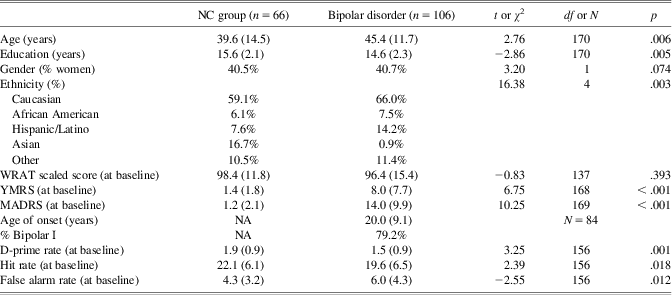
As shown in Table 1, relative to the NC group, the BD group was older (45.4 years vs. 39.6) had slightly fewer years of education (14.6 years vs. 15.6), and had differences in ethnic composition (χ2(4) = 16.38; p = .003). However, there were no significant differences between the two groups in gender (40.7% vs. 40.5%) or estimated premorbid verbal ability (WRAT-4 Reading; scaled score of 96.4 vs. 98.4).
Demographic characteristics, severity of symptoms, and overall cognitive functioning by diagnosis

Note. Values represent means (and SDs) or percentages (where indicated).
YMRS = Young Mania Rating Scale; MADRS = Montgomery-Asberg Depression Rating Scale; WRAT = Wide Range Achievement Test – 4th edition.
As expected, the BD group endorsed significantly more severe manic and depressive symptoms relative to the NC group (although even in the BD group the baseline scores were, on average, in the mild range of severity). Also, per the SCID-I, within the month preceding the baseline evaluation, 62% of patients were euthymic, 25% experienced a major depressive episode, 8% a hypomanic episode, and 5% had met criteria for a mixed or a manic episode. In terms of current medication status, 71.7% of patients were taking a mood stabilizer, 37.7% an anti-depressant, and 42.7% were taking an anti-psychotic. Some participants were taking a combination of more than one of these drug classes including 2.8% of patients on both antipsychotics and anti-depressants, 14.2% on both anti-depressants and mood stabilizers, 16.4% on both mood stabilizers and anti-psychotics, and 16.0% on all three.
All participants with at least one baseline visit were included in the analyses. Within the patient group, 87% (n = 92) of patients had at least 2 CPT-IP scores from two different time-points [67% (n = 71) had at least three scores and 36% (n = 38) of patients had CPT-IP scores from all four visits]. In the NC group, 82% (n = 54) had at least 2 CPT-IP scores from two different time-points [76% (n = 50) had at least three scores and 46% (n = 30) of NC subjects had CPT-IP scores from all four visits].
Between Group Differences in Sustained Attention
Within the entire sample, compared to NC subjects, participants with BD performed significantly worse across all time points on d’ [estimate = −0.504; SE = 0.133; t = −3.795; p < .001, 95% confidence interval (CI) (−.766, −.241)], had significantly lower hit rates [estimate = −2.178; SE = 0.905; t = −2.407; p = .017, 95% CI (−3.964, .392)], and exhibited a significantly higher rate of false alarms on the CPT-IP four-digit task [estimate = 1.735; SE = 0.478; t = 3.630; p < .001, 95% CI (.791, 2.678)]. These predictors accounted for 6.9%, 3.0%, and 5.2% of the variance in d’, hit rate, and false alarm scores respectively.
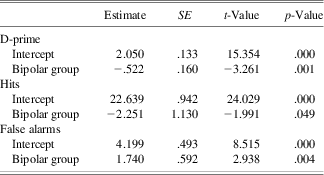
Due to the fact that the BD and NC groups differed in terms of mean age and education, we performed additional statistical analyses after removing participants whose age or education values were outside of the range of either group (age ≥23 and ≤72; years of education ≥9 and ≤17). This restriction led to a subsample of 39 NC subjects and 91 patients with BD (mean age 44.4 vs. 45.1 years and mean years of education 14.7 vs. 14.2 years, respectively). The pattern of differences between NC subjects and BD in this subsample (see Table 2) was consistent with our original analyses. Specifically, relative to NC subjects, the BD group performed significantly worse on d’ [estimate = −0.522; SE = 0.160; t = −3.261; p = .001; 95% CI (−.840, −.205)], had lower hit rates [estimate = −2.251; SE = 1.130; t = −1.991; p = .049; 95% CI (−4.489, −.014)], and had significantly higher false alarm rates [estimate = 1.740; SE = 0.592; t = 2.938; p = .004; 95% CI (.568, 2.912)].
Group differences in sustained attention between age and education matched patients with bipolar disorder (n = 91) and normal comparison subjects (n = 39) (parameter estimates, standard errors, t-values, and p-values)

After substituting the two-digit task scores, and using the demographically matched subsample, the BD group showed significant impairment across all measures of sustained attention relative to NC subjects including d’ [estimate = −0.446; SE = 0.122; t = −3.667; p < .001; 95% CI (−.687, −.205)], hits [estimate = −1.656; SE = 0.619; t = −2.678; p = .008; 95% CI (−2.880, −.432)], and false alarms [estimate = .660; SE = 0.233; t = 2.837; p = .005; 95% CI (.199, 1.122)].
In our other sub-analysis just looking at baseline visit, euthymic patients had significantly lower d’ [t(117) = 3.556; p = .001] and hit rates [t(117) = 2.647; p = .009] on the CPT-IP when compared to NC subjects. Moreover, euthymic patients showed higher rates of false alarms relative to NC subjects [t(117) = −2.507; p = .014]. Cohen's d effect sizes were .65, .49, and .46, respectively, suggesting effects in the medium range. These results were generally consistent using the age and education matched sample, however false alarms did not quite reach statistical significance [d’ t(82) = 3.105; p = .003; hits t(82) = 2.470; p = .016; false alarms t(82) = −1.943; p = .055]. Effect sizes in this latter analysis were comparable with those using the full euthymic sample (Cohen's d = .67, .54, and .44, respectively).
Within-Patient Impact of Affective Symptoms on Sustained Attention over Time
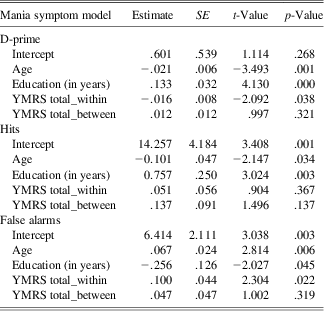
Adjusting for age and education, we examined the impact of change in affective symptoms on sustained attention within the BD group. As shown in Table 3, a negative relationship was found between severity of manic symptoms (YMRS) and the ability to accurately discriminate between target and non-target stimuli (d’) in that increases in manic symptoms were related to decreases in d’ [estimate = −.016; SE = 0.008; t = −2.092; p = .038; 95% CI (−.031, −.000)]. Based on the pseudo R-squared statistic, results of this model indicate that approximately 20.0% of the variance in d’ scores was accounted for by the predictors in our model. In addition, a relationship also emerged between manic symptoms and false alarms showing that as manic symptoms increased, a patient's rate of false alarms also increased [estimate = .100; SE = 0.044; t = 2.304; p = .022; 95% CI = (.014, .186)] (in respect to pseudo R-squared, 8.8% of the variance was explained). However, no significant association was found between manic symptoms and hit rate [estimate = .051; SE = 0.056; t = 0.904; p = .367; 95% CI = (−.060, .162)].
Associations of sustained attention and mania within and between bipolar disorder subjects (parameter estimates, standard errors, t-values, and p-values)

YMRS = Young Mania Rating Scale.
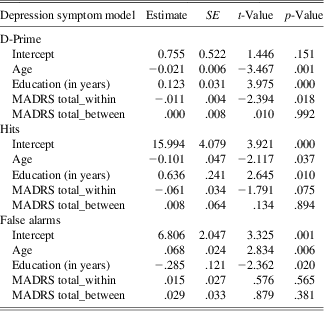
As shown in Table 4, changes in depressive symptoms over time were not significantly associated with change in hits or false alarms. However, increases in depressive symptoms appeared to be associated with decreases in discriminability [d’ estimate = −0.011; SE = 0.004; t = −2.394; p = .018; 95% CI = (−.020, −.002)]. Specifically, pseudo R-square statistic indicated that 19.6% of the variance in d’ scores was accounted for by the predictors used in our model.
Associations of sustained attention and depression within and between bipolar disorder subjects (parameter estimates, standard errors, t-values, and p-values)

MADRS = Montgomery-Asberg Depression Rating Scale.
When the within BD analyses were performed with the scores from the two-digit CPT-IP task, neither manic [d’ t(208.907) = −1.878; p = .062; hits t(−1.780) = 209.444; p = .077; false alarms t(219.684) = .233; p = .816] nor depressive symptoms [d’ t(211.084) = −1.011; p = .313; hits t(211.593) = −.772; p = .441; false alarms t(222.602) =−.755; p = .451] were associated with significant changes on any of the sustained attention outcome variables.
Between-Patient Impact of Affective Symptoms on Sustained Attention over Time
Between-patient mania and depression measures, which represent the individual's overall mean across the total number of assessments completed, were not significant predictors of sustained attention measures in any analyses (see Tables 3 and 4).
DISCUSSION
This study investigated sustained attention, assessed at multiple time points using the Continuous Performance Test- Identical Pairs (CPT-IP), in a sample of 106 patients with BD and 66 NC subjects. Results of this study suggest that compared to NC subjects, participants with BD show sustained attention impairment across time. These results remained, even after performing additional analyses restricting the two groups to comparable age and education ranges. Of note, patients with BD also performed worse across all measures of sustained attention on the two-digit CPT-IP task relative to NC subjects. However, patient performance did not appear to be affected by exacerbation in mood symptoms on the two-digit task. Use of four- rather than two-digit stimuli may increase cognitive load, thereby taxing a greater proportion of limited working memory resources (Backs & Seljos, Reference Backs and Seljos1994; van Merrienboer & Sweller, Reference Van Merrienboer and Sweller2005). In our other sub-analysis, it was also found that euthymic patients performed significantly worse on all three CPT-IP outcomes relative to NC subjects, signifying that attentional deficits may represent a partially trait-like marker of dysfunction in patients with BD (Clark & Goodwin, Reference Clark and Goodwin2004).
Our results also indicate that certain aspects of sustained attention, namely discrimination and false alarms, are potentially sensitive to within-person mood variability. At the group level (comparing between subjects), severity of manic or depressive symptoms did not impact performance on attention. However, within patients, those who had increases in either manic or depressive symptoms over time demonstrated decreases in the ability to discriminate between target and non-target stimuli. Together these findings provide support to the theory that sustained attention may be both trait and state-like in regard to mood symptoms.
Attentional impairments are among the most common behavioral manifestations of brain dysfunction, and underlie many higher order cognitive deficits (Glisky, Reference Glisky2007; Sarter, Givens, & Bruno, Reference Sarter, Givens and Bruno2001; Shi et al., Reference Shi, Li, Song, Zhao, Sun, Xia and Tomoda2012). Sustained attention, specifically, requires the selection of salient sensory information for future processing, and must be maintained over time. Waxing and waning attention is a common cognitive symptom of major affective disorders, such as BD or Major Depressive Disorder. Previous research has indicated that the quality of sustained attentional impairment varies as a function of affective state, in that more false alarms are observed in patients who are in a manic state and fewer hits are observed in patients with depressive symptomatology (Snyder et al., Reference Snyder, Nussbaum and Robins2006). Our results are consistent with these findings in the patients exhibiting more severe mania, but not in those exhibiting depressive symptoms. The reason for this discrepancy in findings is unclear; however one possible explanation for this difference is that our sample, as a whole, endorsed only mild levels of depressive symptoms. A study that looked cross-sectionally within more mildly depressed participants also did not find significant associations between hit rates and depression, but did find significant associations between mania and false alarms (Swann, Anderson, Dougherty, & Moeller, Reference Swann, Anderson, Dougherty and Moeller2001). Therefore, it is possible that subsyndromal depression does not impact sustained attention in patients with BD as much as subsyndromal mania.
The finding that increases in manic symptoms were associated with higher false alarms rates may be attributed to impulsivity (Riccio, Reynolds, Lowe, & Moore, Reference Riccio, Reynolds, Lowe and Moore2002). Specifically, as patients become more impulsive they may have a lower threshold for responding to near miss stimuli (i.e., those that are close to but not identical to the target). That possibility noted, however, it is unclear why such a lowering of response threshold did not lead to a parallel increase in hit rates.
Increases in false alarm rates when manic are of particular interest because they may represent an inability for manic patients to discriminate between subtle differences in visual information. Alternatively, the tendency for increased false-alarms may represent difficulty inhibiting a response when a near target stimulus is presented. Deficits in response inhibition have frequently been noted in BD on the CPT test (Quraishi & Frangou, Reference Quraishi and Frangou2002), as well as performance on the Stroop Color Word Interference Task (Pompei et al., Reference Pompei, Jogia, Tatarelli, Girardi, Rubia, Kumari and Frangou2011; Stefanopoulou et al., Reference Stefanopoulou, Manoharan, Landau, Geddes, Goodwin and Frangou2009). Furthermore, Glosser, Deutsch, Cole, Corwin and Saykin (Reference Glosser, Deutsch, Cole, Corwin and Saykin1998) and Corwin, Peselow, Feenan, Rotrosen, and Fieve (Reference Corwin, Peselow, Feenan, Rotrosen and Fieve1990) have previously reported on the impact that elevations in mood can have on producing more liberal response bias. This liberal response bias may be a result of distractibility, impulsive behavior, increased levels of arousal, or a combination of all of these symptoms that are typically characteristic of mania.
The ability to allocate attentional resources to relevant sensory information while simultaneously ignoring non-relevant information can have a significant impact on everyday functioning and quality of life. For example, in a sample of chronically hospitalized patients with schizophrenia, Silverstein, Schenkel, Valone, and Nuernberger (Reference Silverstein, Schenkel, Valone and Nuernberger1998) demonstrated that 50% of change from a conversation skills training program could be predicted by measures of sustained attention and verbal learning. Another study found that improvement on a measure of social problem solving skills could be linked back to sustained attention and cognitive flexibility in outpatients with schizophrenia (Ucok et al., Reference Ucok, Cakir, Duman, Dişcigil, Kandemir and Atli2006).
One limitation of the present study is that sustained attention findings are based solely on performance on the CPT-IP. Whether the same pattern of results would generalize to other measures of sustained attention is unknown.
A potential confound in comparing the NC and BD groups is that only the latter were receiving psychotropic medications. Even the comparisons within the BD group may be complicated by the wide range of pharmacological treatments that patients with BD typically receive. There is some evidence that stimulant medications may enhance performance on the CPT task (Tucha et al., Reference Tucha, Mecklinger, Laufkötter, Klein, Walitza and Lange2006), but only four participants in our study reported taking stimulants at the time of testing. Many of our participants were taking mood stabilizers, but these do not appear to have substantial effects on attention (Quraishi & Frangou, Reference Quraishi and Frangou2002; Wingen, Kuypers, van de Ven, Formisano, & Ramaekers, Reference Wingen, Kuypers, van de Ven, Formisano and Ramaekers2008). While benzodiazepines have been known to impair processing speed, previous research reported no significant correlation between performance on attentional tasks and benzodiazepine use (Clark et al., Reference Clark, Iversen and Goodwin2001). Combined, these studies seem to provide some assurance that the deficits in sustained attention in the BD group are not primarily attributable to medication effects (Clark & Goodwin, Reference Clark and Goodwin2004; Goswami et al., Reference Goswami, Sharma, Varma, Gulrajani, Ferrier, Young and Moore2009; Phillips, Travis, Fagiolini, & Kupfer, Reference Phillips, Travis, Fagiolini and Kupfer2008).
The preceding conclusion does not necessarily suggest that within patient changes in medications would have no effect on sustained attention, particularly if such a change resulted in exacerbation or improvement in symptoms; it only suggests that there is not a strong relationship between type or specific dose of medications on sustained attention when comparing between patients. (In fact, in the present study, the association between symptom severity and sustained attention was only present when examined within subjects, not when comparing between patients.)
In addition to the aforementioned limitations, there are some methodological issues that deserve mention. The study did not include a measure of effort level, so it is conceivable that BD related performance deficits partially reflect suboptimal motivation rather than attention skills, per se. We also did not screen participants for ADHD which may be co-morbid with BD. [The actual co-morbidity of ADHD and BD continues to remain controversial as some studies suggest that the two disorders share overlap in diagnostic symptoms and are sometimes difficult to distinguish from one another (Youngstrom, Arnold, & Frazier, Reference Youngstrom, Arnold and Frazier2010).] Furthermore, although those with recent (within 2 months) substance dependence were screened out, we did not exclude people with alcohol or substance abuse. Questions about abuse were included as part of the SCID-I interviews; only five patients met criteria for current alcohol abuse, one of whom also met criteria for substance abuse. But these values are based largely on self-report so may underestimate the true levels. Therefore, it is possible that some of the attentional effects attributed to BD in our results may further reflect effects of undetected co-morbid disorders.
It is also possible that the generalizability of our results may be restricted as the BD participants in this study, as a whole, endorsed relatively mild levels of manic and depressive symptoms and reported above average education levels. Finally, the proportions of specific ethnic minority participants (particularly Latino and Asian American) differed between the NC and BD groups. The potential effects of ethnicity/culture on CPT performance are currently unknown. Future research is needed to explore group differences in CPT performance in various minority populations.
A major strength of this study is that it included measures of sustained attention and symptomatology over time rather than the use of only cross-sectional or static indices of attentional capacity. Additionally, we evaluated both within- and between-patient performance, which allowed us to examine intra-individual variability as well as group differences. In a previous longitudinal study of overall cognitive functioning using a subset of participants from this sample, it was concluded that manic and depressive symptoms had little effect on overall level of cognitive impairment (Depp, Savla, et al., Reference Depp, Savla, Vergel de Dios, Mausbach and Palmer2012). Therefore, it may be the case that there is something unique about sustained attention in isolation that is more susceptible to symptom fluctuations than is overall cognitive functioning. In general, patients with bipolar disorder have exhibited more intra-individual variability in neurocognitive functioning, as a whole, relative to patients with schizophrenia and NC subjects (Depp et al., Reference Depp, Savla, Moore, Palmer, Stricker, Lebowitz and Jeste2008); sustained attention appears to be one of the domains consistent with this variable pattern.
One practical implication of these findings is that psychosocial interventions for BD, particularly those requiring high levels of sustained attention, may need to be adjusted according to a patient's current symptom severity. Our findings suggest that when patients with BD are symptomatic, their ability to pay attention may be compromised. Therefore, it may be helpful for clinicians providing psychotherapy or rehabilitation services to take this into consideration and to evaluate whether patients are attending to and understand material presented. Cognitive supports (e.g., repetition of information, multi-modal presentation) may be useful to aid in the successful translation of instructions (e.g., medication dosing) to action. Moreover, there is some evidence that attention/vigilance deficits in BD may adversely impact everyday functioning (reviewed in Depp, Mausbach, et al., Reference Depp, Mausbach, Harmell, Savla, Bowie, Harvey and Patterson2012); investigation of the benefits of cognitive training interventions specifically targeting sustained attention would be a welcome addition to the field.
Acknowledgments
This work was supported, in part, by National Institutes of Health (grants MH64722, T32MH019934, 5P30MH066248) and by the Department of Veterans Affairs. The authors have no conflicts of interest to report.