INTRODUCTION
Natural mortality is one of the most important parameters in understanding the population dynamics of animals, however in marine species it is difficult to obtain reliable estimates and the parameter is lacking for many species (Pauly, Reference Pauly1980; Jørgensen & Holt, Reference Jørgensen and Holt2013). Archaster angulatus Müller & Troschel, 1842, is one of the most common sub-tidal sea stars found along the west coast of Australia. It occurs from Cape Naturaliste in the west north to the Northern Territory and south to the Whitsunday Islands in Queensland (Edgar, 2012) as well as occurring throughout the Indian Ocean, north to Japan and eastwards to parts of the western Pacific Ocean (Clark & Rowe, Reference Clark and Rowe1971). Aspects of its population biology including reproductive periodicity, and reproductive physiology and growth have been studied (Lawrence et al., Reference Lawrence, Keesing and Irvine2010; Keesing et al., Reference Keesing, Graham, Irvine and Crossing2011; Keesing, Reference Keesing2017). Along with its congener Archaster typicus, which has been studied extensively in Indonesia, Hong Kong, Taiwan, the Philippines and the Ryukyu Islands (Japan) (Boschma, Reference Boschma1924; Ohshima & Ikeda, Reference Ohshima and Ikeda1934a, Reference Ohshima and Ikedab; Clemente & Anicete, Reference Clemente and Anicete1949; Komatsu, Reference Komatsu1983; Mukai et al., Reference Mukai, Nishihara, Kamisato and Fujimoto1986; Run et al., Reference Run, Chen, Chang and Chia1988; Bos et al., Reference Bos, Gumanao, Van Katwijk, Mueller, Saceda and Tejada2011, Reference Bos, Gumanao, Mueller and Saceda2013), A. angulatus is one of just three species of asteroids where males and females are known to pair up in a pseudocopulatory ‘mating’ posture when spawning (Keesing et al., Reference Keesing, Graham, Irvine and Crossing2011).
Although a large body of literature on population dynamics, biology and physiology of asteroids exists (Lawrence, Reference Lawrence2013), measurements of mortality rates are scant. This paucity of studies is surprising given the importance of such studies to population dynamics of sea stars and early work which characterized growth patterns and methods of parameterizing growth and mortality in asteroids (e.g. Ebert, Reference Ebert1973, Reference Ebert1975; Yamaguchi, Reference Yamaguchi1974, Reference Yamaguchi1975, Reference Yamaguchi1976, Reference Yamaguchi1977). This paper reports on population size structure, growth rates, mortality rates, arm number and arm damage in a population of A. angulatus from south-western Australia.
MATERIALS AND METHODS
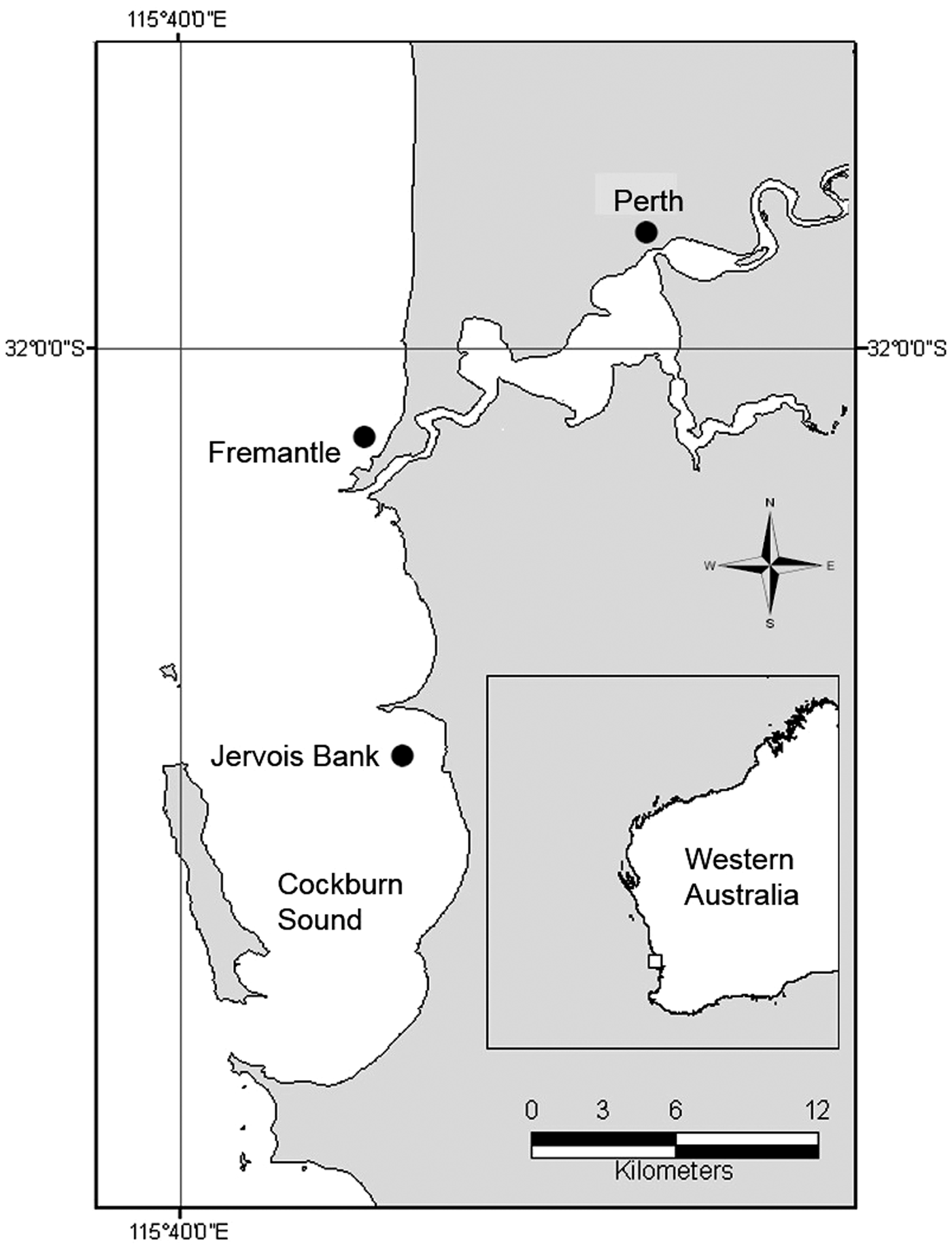
The sampling carried out for this project was done as part of studies which have been previously published (Yeo et al., Reference Yeo, Keesing and van Keulen2015; Keesing, Reference Keesing2017) and the collection details are only summarized briefly here. Samples of A. angulatus were collected approximately monthly between February 2009 and June 2011 from Jervois Bank (32°09′13″S 115°45′03″E, water depth 8 m) in Cockburn Sound (Figure 1) using a 85 cm wide by 45 cm high epibenthic sled with a 5 cm cutting depth and 10 mm mesh which was towed along the sea bed at a speed of about 1 knot from 100–200 m behind a 17 m power vessel. The arm radius (mouth to tip of longest undamaged arm) of each sea star was measured to the nearest mm using a pair of callipers. For the analyses presented in this paper, the measurements of sea stars from all monthly samples were pooled and plotted in 5 mm size classes to give a length frequency distribution for the entire study period.
Locality map of the collection site of the Archaster angulatus samples.

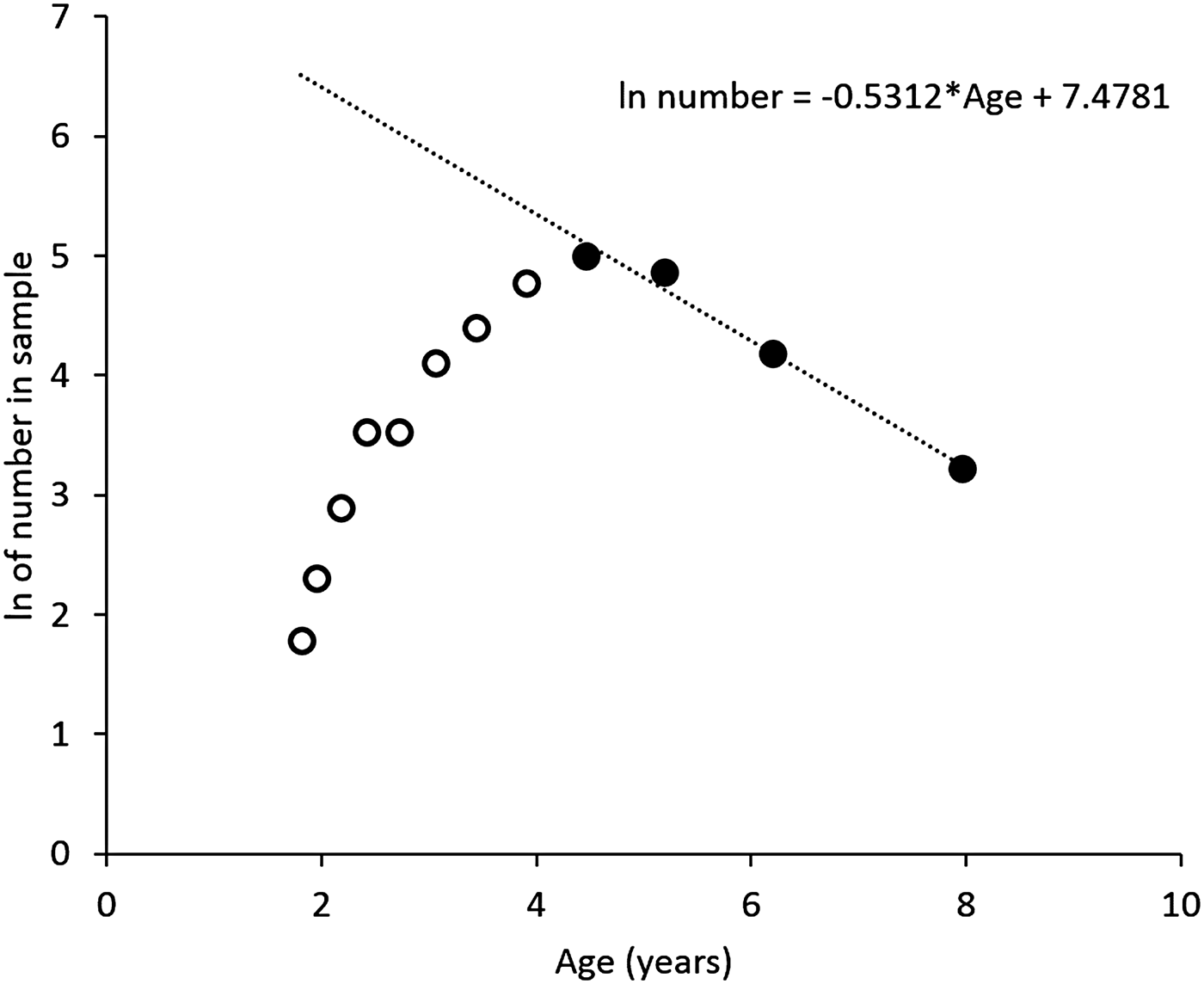
Natural mortality rates were calculated by constructing a length converted catch curve (King, Reference King1995) whereby the natural log of the abundance of each size class is plotted against the mean age of sea stars of that size class and the slope of the resulting line (best linear fit by least squares) is the estimated rate of natural mortality. The predicted age for each size class (at the midpoint of each 5 mm size class) was calculated using the growth parameters of the von Bertalanffy growth model for A. angulatus of 2 years and over from Keesing (Reference Keesing2017), equation (1).
 $${\rm Arm}\;{\rm radius}\;{\rm in}\;{\rm mm} = 73.7 + [53.2(1 - e^{ - kT})],$$
where age in years is T + 2. Mortality rates were calculated for growth coefficients over the range of 0.35–0.45.
RESULTS
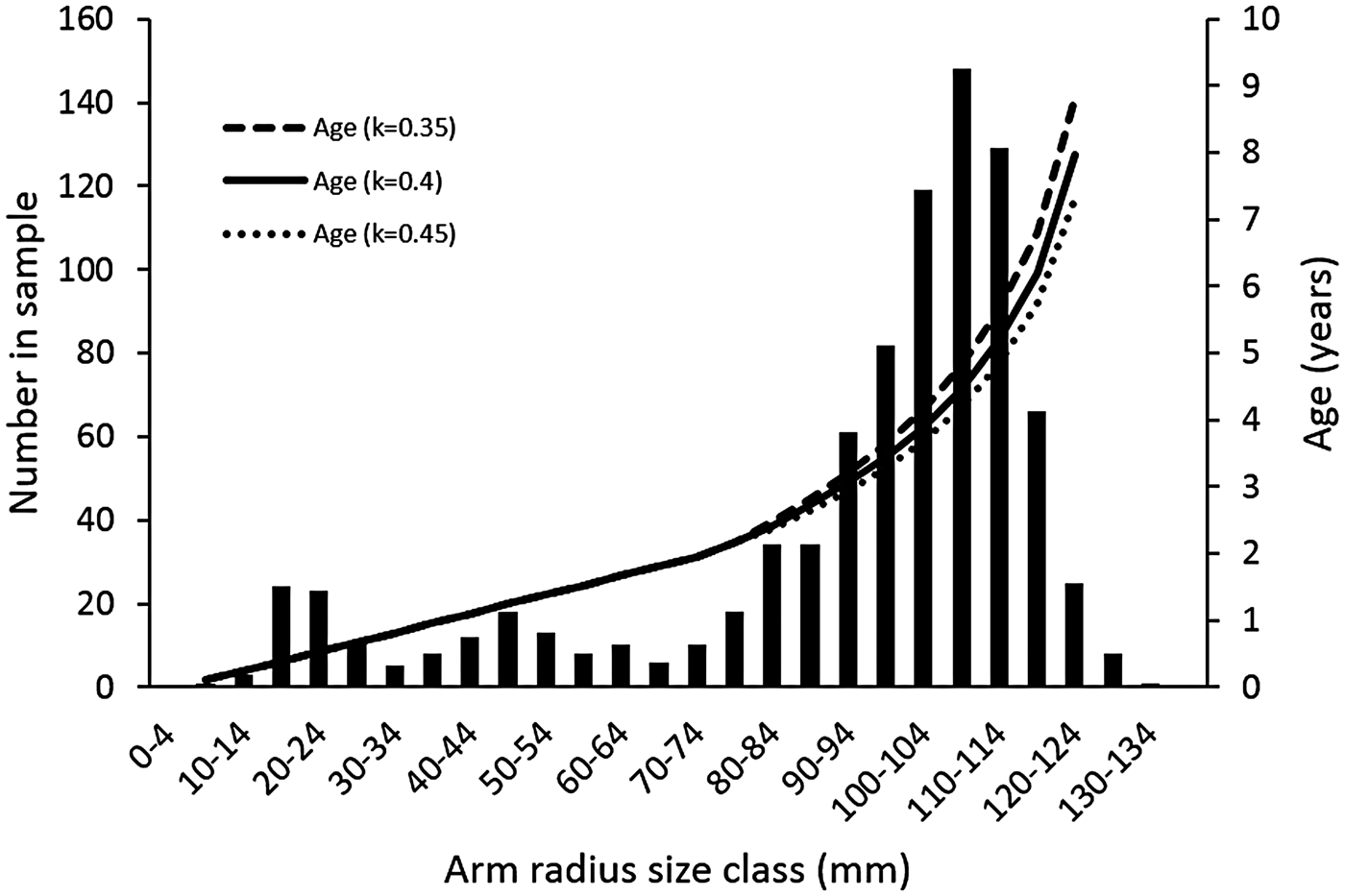
Abundance of A. angulatus peaked at the 105–109 mm size class with 148 animals or 17% of all animals sampled (Figure 2). The mid-point of this size class (107 mm) corresponds to a mean age of 4.5 years when the growth constant (k) is 0.4. For the range of likely k values between 0.35 and 0.45 the mean age of this size class is between 4.8 and 4.2 years. Beyond this peak, abundance at subsequent size classes declines due to a decreasing rate of annual survivorship with just 1% of sea stars predicted to live beyond 8 years (Figure 2). The length converted catch curve (Figure 3) plots this decline and yields an estimate of mortality of 0.53 year−1 (for growth coefficient k = 0.4). For the most likely upper and lower estimates of k (0.35 and 0.45) mortality is estimated to be within the range of 0.46–0.59 year−1.
Size frequency distribution (bars) of Archaster angulatus for all 869 sea stars captured between February 2009 and June 2011. Age in years (lines) is estimated from the von Bertalanffy growth model at three values of k with L inf set at 126.9 mm.

Length converted catch curve for Archaster angulatus showing the natural log of abundance of each size class (see Figure 2 for abundance) plotted against the mean age of sea stars of that size class according to the von Bertalanffy growth model with parameters of maximum average size (L inf) of 126.9 mm and growth rate (k) of 0.4. The slope of the line fitted by least squares best fit to the points of peak and declining abundance (closed circles) (0.5312) is the estimated rate of natural mortality per year.

DISCUSSION
Despite the important role sea stars play in structuring benthic communities by predation, both where they occur naturally (e.g. Acanthaster planci, Endean, Reference Endean1973) and as invasives (e.g. Asterias amurensis, Byrne et al., Reference Byrne, O'Hara, Lawrence and Lawrence2013) together with their impact on bivalve aquaculture industries (e.g. Asterias spp., Galstoff & Loosanoff, Reference Galstoff and Loosanoff1939; Sloan & Aldridge, Reference Sloan and Aldridge1981), quantification of the key population parameters of growth and mortality remain poorly studied. Growth parameters are established for a modest number of species (see summary of this literature in Keesing, Reference Keesing2017) but estimates of natural mortality are especially scant. Indeed, there have been few other estimates of the rate of population decline in adult sea stars, with most studies having focussed on measuring the mortality rates among juveniles (e.g. Doherty & Davidson, Reference Doherty and Davidson1988; Zann et al., Reference Zann, Brodie and Vuki1990; Keesing & Halford, Reference Keesing and Halford1992; Keesing et al., Reference Keesing, Weidermeyer, Okaji, Halford, Hall and Cartwright1997). Doherty & Davidson (Reference Doherty and Davidson1988) followed populations of juvenile A. planci and found rates of mortality of 99.3% (1.08% day−1) between 8 and 23 months of age (18–130 mm diameter) and 75% (0.39% day−1) from 22 and 34 months of age (95–220 mm). Ebert (Reference Ebert1973) had access to limited data for Acanthaster planci and estimated M of 0.11 year−1 and k of 0.1 which suggested that the species was slow growing and long lived. Later, Lucas (Reference Lucas1984) showed that A. planci was fast growing and lived for 5–8 years with a k of about 0.3. In general species with a rapid growth rate and early maturity also exhibit higher mortality rate and shorter lifespan (Ebert, Reference Ebert1975) and A. angulatus appears to conform to this pattern. In terms of longevity, A. angulatus is similar to that estimated for Asterina stellifera (>5.5 years, Meretta et al., Reference Meretta, Farias, Cledón and Ventura2016) but less than that estimated for Protoreaster nodosus (at least 17 years; Bos et al., Reference Bos, Gumanao, Alipoyo and Cardona2008). Nojima (Reference Nojima1979) did measure mortality in A. latespinosus, however post-spawning morbidity of >99% of spawning adults was a significant feature of mortality rates in that species. There are no confirmed reports of post-spawning morbidity in A. angulatus. However, there are frequent reports of mass mortalities of A. angulatus at different times of the year, including summer in Cockburn Sound where this study was undertaken (Cockburn Sound Management Council, 2008, 2009, 2010, 2011, 2012; Rose et al., Reference Rose, Smale and Botting2012). The cause of those mortality events is not known but other possible explanations include disease, high water temperatures and/or strandings at low tide. Predation is also a possible cause of mortality in A. angulatus. Lawrence et al. (Reference Lawrence, Keesing and Irvine2010) and Keesing (Reference Keesing2017) measured arm damage rates attributed to sub-lethal predation of between 5.4 and 13.7% in two populations of A. angulatus. The higher of these rates was measured at the same location as in this study. For A. typicus arm damage of 3% was recorded in Taiwan (R. Chen, unpublished, in Lawrence, Reference Lawrence, Scalera-Liaci and Canicatti1992).
Although there are few measurements of mortality rates of asteroids, there have been numerous such studies on echinoids (reviews by Ebert, Reference Ebert1982, Reference Ebert and Lawrence2013) and these can provide some context to the rate estimated here for A. angulatus. Ebert (Reference Ebert and Lawrence2013) showed that a strong inverse relationship exists between growth rate and annual survivorship. That is, echinoids that grow rapidly tend to have a short lifespan and a high value of M while those that grow slowly, live a long time and have a low value of M.
Typifying these two examples in echinoids are the short-lived tropical Tripneustes gratilla with k values of 1.08 to 1.80 and M values of 4.74–5 year−1 (Bacolod & Dy, Reference Bacolod and Dy1986; Regalado et al., Reference Regalado, Campos and Santillan2011) and those such as the long lived Antarctic Sterechinus antarcticus with k of 0.017 and M of 0.07 year−1 (Brey, Reference Brey1991) and the sub-Arctic Strongylocentrotus droebachiensis (M = 0.04–0.30 year−1) which lives commonly in excess of 50 years and may reach 100 years (Russell et al., Reference Russell, Ebert and Petraitis1998). Intermediate among these extremes and comparable to A. angulatus are the subtropical echinoid Cassidulus mitis (k = 0.39 and M = 0.812 year−1, Freire et al., Reference Freire, Santos, Fontoura, Magalhaes and Grohmann1992) and the temperate S. franciscanus (k = 0.51 and M = 0.26–0.34 year−1, Ebert & Russell, Reference Ebert and Russell1993).
A similar degree of variation in growth rate patterns and longevity probably exists among species in asteroids and will be instructive in understanding their ecology and physiology. For example, Ebert (Reference Ebert1982) found fast-growing, short-lived urchins had thinner, less ossified test than long-lived species contrasting the investment in body wall maintenance between short- and long-lived species. He also found that body wall thickness was related to exposure to wave energy with urchins in sheltered waters having to invest less energy in heavy test ossification. Birkeland (Reference Birkeland1989) also suggested this may occur in asteroids by contrasting the fast-growing, fast-moving, thin body walled A. planci with the slow-growing, slow-moving, thick body walled Linckia laevigata. However, a wider set of studies of sea star growth and survivorship are required in order to relate asteroid life history strategy to biology, ecology and physiology.
ACKNOWLEDGEMENTS
Thank you to Dr Sharon Yeo for providing the monthly samples of sea stars for this study and to Kirsty Brooks and Dr Baoquan Li for assistance in sorting and measuring the sea stars.
FINANCIAL SUPPORT
This study was funded in part by the Western Australian Marine Sciences Institution (WAMSI).