INTRODUCTION
Sandy beaches are dynamic systems where the continued dynamism of environmental variables determined by winds and the tidal movements on the sandy substrate influence the spatial and temporal distribution of benthic organisms (Brown & McLachlan, Reference Brown and McLachlan1990). Short & Wright (Reference Short, Wright, McLachlan and Erasmus1983) suggested that the morphodynamic state is a useful concept to classify sandy beaches in an objective way, because it refers to the depositional forms of sandy beaches and their hydrodynamic processes, namely the interactions between wave height, sediment granulometry and tide ranges. Moreover, the geological setting can influence the morphological development and beach states (Jackson et al., Reference Jackson, Cooper and Rio2005). According to the intensity of these factors, sandy beaches can be classified into two extreme states: dissipative and reflective (Defeo & McLachlan, Reference Defeo and McLachlan2005). The dissipative state is characterized by low beach slope, smooth profile, sediment with high content of organic matter and great water retention, with waves breaking and dissipating energy within an extensive area. On the other hand, the reflective state is characterized by high beach slope, coarse sediment, low content of organic matter and strong wave exposure.
The benthic macroinfauna of sandy beaches has low richness and diversity and high dominance of a few species. Such characteristics are closely related to the morphodynamic state of the beach, with richness and diversity increasing from the reflective to the dissipative state (Brown & McLachlan, Reference Brown and McLachlan1990). Several macroinfaunal species are tolerant to a wide spectrum of morphodynamic conditions, keeping stable population in both energy states (Veloso et al., Reference Veloso, Silva, Caetano and Cardoso2006). Moreover, the vertical distribution of the organisms (zonation) is a sequential species replacement, in which all or some of the species have restricted ranges of distribution (McLachlan & Jaramillo, Reference McLachlan and Jaramillo1995; Brazeiro & Defeo, Reference Brazeiro and Defeo1996; Neves et al., Reference Neves, Da Silva and Bemvenuti2007). Four biological zones have been considered on sandy beaches according to the hydrodynamic state and interstitial water contents (Salvat, Reference Salvat1964): (1) dry sandy zone, at the top of the beach; (2) retention zone, slightly wet zone with water retention at ebb tide; (3) resurge zone, where water flows in and out of the sediment; and (4) saturation zone, a permanently water-saturated zone.
Seasonal changes in the density of macroinfaunal populations are common and closely associated with the reproductive dynamic of species and with fluctuation in environmental variables, resulting in different macroinfauna structures between winter and summer (Souza & Gianuca, Reference Souza and Gianuca1995). Moreover, sandy beach urbanization is an increasing phenomenon that contributes to decreasing composition and density of benthic organisms by affecting sediment characteristics and consequently the macroinfaunal community (Veloso et al., Reference Veloso, Silva, Caetano and Cardoso2006; Defeo et al., Reference Defeo, McLachlan, Shoeman, Schilancher, Dugan, Jones, Lastra and Scapini2009). Main threats are linked with the social and economic use of beaches such as, sand nourishment to counter erosion, the mechanical cleaning of beaches and disturbance by tourist pressure. The enrichment of coastal waters with nutrients has very likely exerted a significant influence on the macroinfauna in recent years.
This study aimed to assess the effect of morphodynamics and zonation on the macroinfauna assemblages during two seasons (winter 2005 and summer 2006), considering the permanently subaquatic infralittoral zone and the intertidal swept zone on two sandy beaches of south-eastern Brazil. The hypothesis raised is that morphodynamics determine the composition and relative abundance of macroinfauna, with the dissipative beaches having comparatively higher richness and density than the reflective beaches, and that the structure assemblage changes according to morphodynamics and zonation.
MATERIALS AND METHODS
Study area
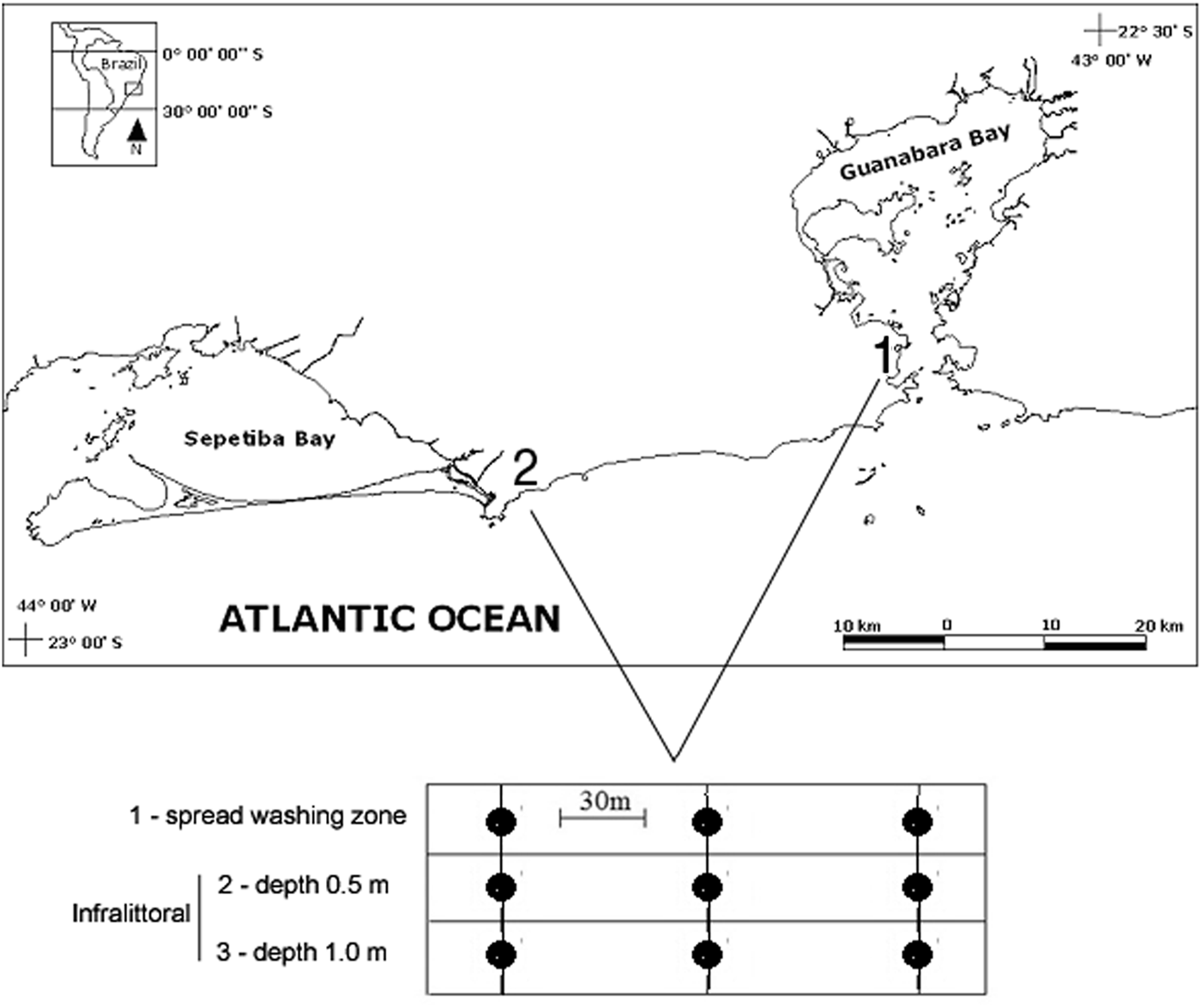
Flamengo beach (22°55′S 43°10′W) is a dissipative beach in the outer zone of Guanabara Bay (Vasconcellos et al., 2010), while Grumari beach (23°03′S 43°32′W) is a reflective oceanic beach (Veloso et al., Reference Veloso, Caetano and Cardoso2003) (Figure 1).
Study area with indications of the two beaches on the coastline of Rio de Janeiro State (1, Flamengo beach; 2, Grumari beach) and the design of quantitative samplings of the sediment.

Flamengo beach is located near to the sea connection in the south-western part of Guanabara Bay, which is surrounded by one of the largest metropolitan areas in Brazil. The beach is approximately 1800 m long and has low amplitude semi-diurnal tides with 0.7 m of mean range. It is characterized by median to fine sand grains size with mean diameter of 0.20 mm and gentle slope profile (Vasconcellos et al., Reference Vasconcellos, Araújo, Santos and Silva2011).
Grumari beach is located in an unprotected coastal area where the action of waves is most striking. The beach is approximately 2500 m long. It is characterized by medium to coarse sand, with mean grain size of 0.43 mm, tide range of approximately 1 m, and intertidal slope varying from 1/5.29 to 1/17.82 (Petraco et al., 2003; Veloso et al., Reference Veloso, Silva, Caetano and Cardoso2006).
Field sampling and laboratory procedures
Sampling was conducted according to a systematic design in which three transects (fixed 30 m apart) during two seasons (winter 2005 and summer 2006) were performed. In each transect, three sampling points were defined (strata 1, 2 and 3), distributed at the spread washing zone (stratum 1), at 0.5 m depth (stratum 2) and at 1 m depth (stratum 3) (Figure 1). Samples were collected at each point for sediment analysis during ebb tide, with tide height ranging between 0.0 and 1.3 m.
Sediment samples were taken with a PVC ‘corer’ (50 cm long, 10 cm diameter) with a collecting area of 0.00785 m2 at a depth of 15 cm. For biological samples (macroinfauna), two samples and two replicates were collected at each stratum, totalling 36 samples (3 transects × 3 strata × 2 samples × 2 replicates). Sediment samples for particle-size and organic matter (g.dm−3) were determined in 18 samples per season on each beach (3 transects × 3 strata × 2 replicates).
The collected sediment was placed in plastic bags, then weighed (precision of 0.01 g) and dried at 80°C in a stove. A sub-sample of 300 g was collected for the particle-size analysis in sieves of different mesh size over 15 min., according to Suguio (Reference Suguio1973). Six sieves of respectively 2 mm, 1 mm, 0.5 mm, 0.25 mm, 0.09 mm and 0.06 mm mesh size were used, which corresponded to granule fractions of very coarse, coarse, medium, fine, very fine and finest. Organic matter content (g.dm−3) was obtained by the volumetric method of potassium bichromate (Walkey & Black, Reference Walkey and Black1943) modified by Frattinni & Kalckmam (Reference Frattini and Kalckman1967).
Biological samples were initially screened in plastic trays (80 cm × 40 cm × 7 cm) using tap water for removal of the largest specimens, than sieved through a 0.5 mm mesh and examined under light stereo microscope for identification of the smallest specimens. All identified specimens were preserved in 70% ethanol solution. Vouchers specimens were deposited in the macroinfauna collection of the Laboratory of Fish Ecology, Universidade Federal Rural do Rio de Janeiro.
Morphodynamics measurements
On each sampling occasion, the wave height and period were estimated. Wave height was estimated by measuring the height of the waves with graduated poles against the horizon. The wave period (T) was estimated with a chronometer and corresponded to 1/10 of the real time between eleven wave consecutive crests from a fixed point in the surf zone. Three replicates were performed to obtain an average measurement.
Classification of the morphodynamic state of each beach was assessed through the adimensional Dean parameter, Ω (Short & Wright, Reference Short, Wright, McLachlan and Erasmus1983). The Dean parameter was determined according to the following equation:
 $$\Omega = \hbox{Hb}/\lpar \hbox{Ws} \times \hbox{T}\rpar \comma \;$$
where Hb is the mean wave height (cm); Ws is the velocity of settling sediment (cm.s−1), obtained through the mean sediment diameter, considering a density of 2.65 and a temperature of 22°C (Gibbs et al., Reference Gibbs, Matthews and Link1971) and T is the time interval (period, in seconds) between two consecutive waves. Thus, reflective beaches have Ω < 2, intermediary beaches have 2 < Ω < 5, and dissipative beaches have Ω > 5.
Data processing
The mean granules size was determined from each granulometric fraction weight retained in each sieve, using the software Sysgran 3.0 (Camargo, Reference Camargo2006). A multifactorial design (nested ANOVA) was used to compare differences in sediment granules and Dean parameter between seasons (fixed factor), beaches (fixed factor) and strata (nested in beaches). Wave height and period were compared between beaches and seasons, using factorial ANOVA. These analyses were performed using the software Statistica, v.8.0 (StatSoft, 2007).
Macroinfauna assemblage structure was compared between the two beaches and among the three strata using analysis of similarity (ANOSIM). A similarity matrix for these biological samples was obtained using the Bray–Curtis index with the numerical data undergoing four-root transformation to balance the rare and abundant species (Clarke & Warwick, Reference Clarke and Warwick2001). A cluster analysis on the similarity matrix using the group average method was performed to assess eventual spatial (strata and beaches) and seasonal patterns. The species that most contributed to similarity with the groups were determined by similarity percentage—SIMPER. These analyses were performed using the software PRIMER, v.6.0 (Clarke & Warwick, Reference Clarke and Warwick2001). Canonical correspondence analysis (CCA) was performed to assess environmental influences on the macroinfauna assemblages by using CANOCO v.4.5 (ter Braak & Šmilauer, Reference Ter Braak and Šmilauer2002) on fourth-root transformed data.
RESULTS
Physical characteristics
SEDIMENT GRANULES
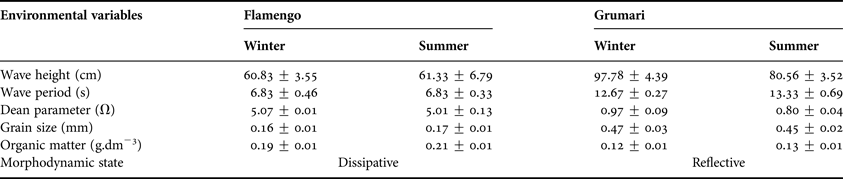
At Flamengo beach, the granule diameter ranged from 0.11 to 0.33 mm in winter, and from 0.12 to 0.23 mm in summer, with no significant difference between seasons (F = 0.386; P = 0.54) (Table 1). On the other hand, Grumari beach had coarser sediment with granule diameter ranging from 0.29 to 0.66 mm in winter and from 0.35 to 0.54 mm in summer, with no significant differences between seasons (F = 0.377; P = 0.54) (Table 1). However, a clear difference in the mean granule diameter between the two beaches (Flamengo = 0.17 ± 0.05 mm; Grumari = 0.46 ± 0.08 mm; mean ± standard deviation) was detected (F = 277.06; P = 0.0001).
Means (±standard error) for environmental variables in Flamengo and Grumari beaches by seasons.
WAVE HEIGHT
At Flamengo beach, wave height ranged from 20 to 80 cm in winter and from 10 to 70 cm in summer, with no significant difference between seasons (F = 0.116; P = 0.736) (Table 1). Grumari beach had comparatively higher wave height, ranging from 70 to 130 cm in winter, and from 40 to 90 cm in summer, with significant between-seasons differences (F = 22.52; P = 0.001) (Table 1). Significant differences (F = 21.57; P = 0.0001) were also detected between the two beaches (Flamengo = 61.6 ± 21.9 cm; Grumari = 83.7 ± 21.3 cm).
WAVE PERIOD
No significant difference was found for the wave period on Flamengo beach between seasons (F = 0.00; P = 1.0), with values ranging from 4 to 10 s in winter, and from 5 to 9 s in summer (Table 1). On Grumari beach, the wave period ranged from 11 to 14 s in winter and from 9 to 19 s in summer, with no significant difference between seasons (F = 1.42; P = 0.243) (Table 1). Significant differences in the wave mean period were found between the two beaches (F = 175.64; P = 0.0001) with comparatively higher values for Grumari beach (13.0 ± 2.1 s) compared with Flamengo beach (6.8 ± 1.6 s).
DEAN PARAMETER (Ω)
At Flamengo beach, the Dean parameter was >5, therefore, this beach was classified as dissipative. On the other hand, Grumari beach had a Dean parameter <1 and was classified as a reflective beach. At both beaches, no significant differences for Dean parameter were detected between seasons (F = 4.0; P = 0.054) and strata (F = 2.0; P = 0.083) (Table 1), although a significant difference was found between the two beaches (F = 2253.0; P = 0.0001).
ORGANIC MATTER (g.dm−3)
The content of organic matter in sediment differed significantly between seasons and beaches (Table 1). Significantly higher values were recorded in summer compared with the winter at both Flamengo (t-test = −5.75; P = 0.0001) and Grumari (t-test = −3.46; P = 0.003) beaches. There was a clear difference between the beaches, with significant higher values for Flamengo beach (0.201 ± 0.005 g.dm−3) compared with Grumari beach (0.125 ± 0.003 g.dm−3) (t-test = 20.64; P < 0.0001).
Beach comparisons
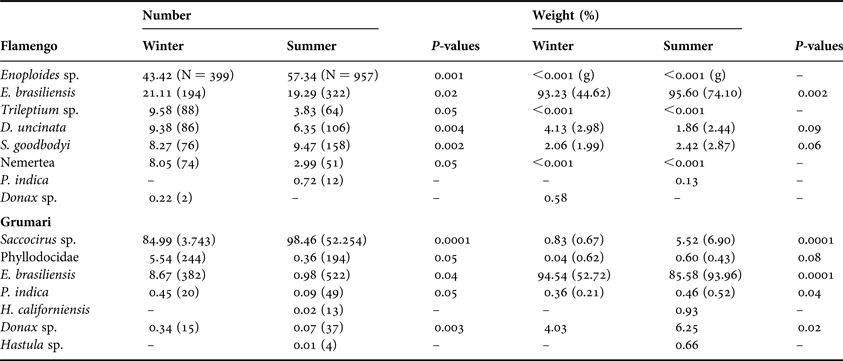
A total of 12 taxa was recorded at the two examined beaches, five of them at species level, five at genus level, one at family level and one at phylum level. Polychaeta and Nematoda were the numerically dominant groups (Table 2).
Percentage and absolute (in parentheses) values for number and biomass (weight) of macroinfauna species in Flamengo and Grumari beaches by seasons. Seasonal comparisons for absolute values (P-values) according to Student's t-test also indicated. N, number of individuals.
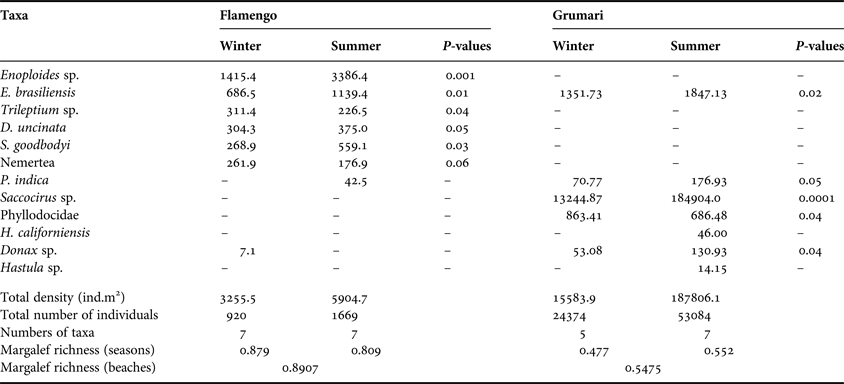
At Flamengo beach, eight taxa were recorded: (1) Polychaeta: Dispio uncinata Hartman, 1951; Scolelepis goodbodyi Jones, 1962; and Pisionidens indica (Aiyar & Alikuhni, 1940); (2) Crustacea Decapoda: Emerita brasiliensis Schmitt, 1935; (3) two Nematoda genus: Trileptium sp. and Enoploides sp., (4) specimens of Nemertea; and (5) Mollusca (Donax sp.). Enoploides sp. and E. brasiliensis were the numerically dominant taxa in winter (43.4% and 21.1% of the total number of individuals, respectively) and in the summer (57.3% and 19.3%, respectively) (Table 2). Emerita brasiliensis made the highest contribution to biomass, with 93.2% of the total weight in the winter and 95.6% in the summer (Table 2). The highest density (individuals.m−2) was recorded in summer, except for Trileptium sp. and Nemertea, with the highest contributions from Enoploides sp. (3386.4 individuals.m−2) and E. brasiliensis (1139.4 individuals.m−2) (Table 3). The highest Margalef richness was recorded in winter (0.879) (Table 3).
Densities (individuals.m−2), richness and total number of individuals in Flamengo and Grumari beaches by seasons. Seasonal comparisons for species densities (P-values) according to Student's t-test also indicated.
At Grumari beach, a total of seven taxa was recorded: (1) Polychaeta: Saccocirus sp.; specimens of the Phyllodocidae family; P. indica; and Hemipodus californiensis (Hartman, 1938); (2) Emerita brasiliensis; and (3) Mollusca: Donax sp. and Hastula sp. In winter, the numerically dominant groups were Saccocirus sp. (84.9% of the total number of individuals) and E. brasiliensis (8.67%), and a similar pattern was also recorded in summer, when Saccocirus sp. reached 98.5% of total number of individuals (Table 2). Emerita brasiliensis made the greatest contribution to biomass, with 94.5% of the total weight in winter, and 85.58% in summer (Table 2). The highest densities were recorded in summer, except for Phyllodocidae, with Saccocirus sp. having 184,904 individuals.m−2 and E. brasiliensis 1847.1 individuals.m−2 (Table 3). The highest Margalef richness (0.552) was recorded in summer.
The highest densities were recorded at Grumari beach (187,806.1 individuals.m−2), while the highest Margalef richness was at Flamengo beach (0.891) (Table 3). Three taxa were common at the two beaches: P. indica, E. brasiliensis and Donax sp. Scolelepis goodbodyi, D. uncinata, Trileptium sp. and Enoploides sp. were recorded exclusively on Flamengo beach, while Saccocirus sp., H. californiensis, Hastula sp. and Phyllodocidae occurred on Grumari beach only.
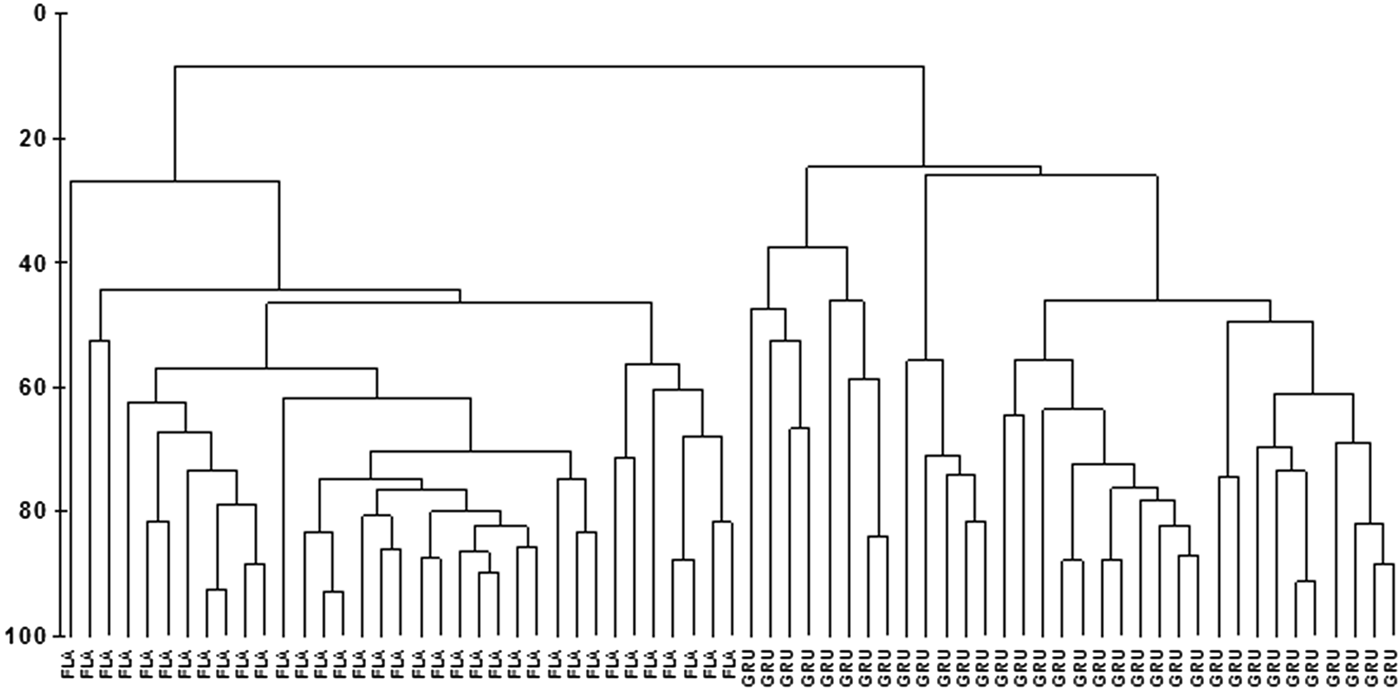
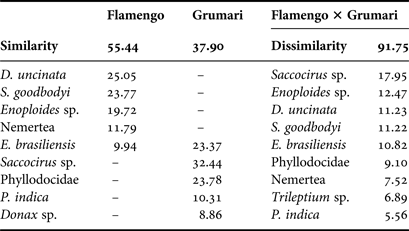
Cluster analysis on macroinfauna density showed a clear separation between the two beaches, which were clustered in different groups (Figure 2). ANOSIM used to compare assemblage structure indicated the macroinfauna differed between the two beaches (R global = 0.835, P < 0.001). The SIMPER analysis showed a high dissimilarity between the two beaches (91.75%), with Saccocirus sp., Enoploides sp., D. uncinata, S. goodbody and E. brasiliensis explaining 63.70% of the difference between the two beaches (Table 4). Species characteristics for Flamengo beach had 55.54% of average similarity, with the greatest contribution from D. uncinata, S. goodbody and Enoploides sp. At Grumari beach, the characteristic species that explained most of the 37.90% average similarity were Saccocirus sp., Phyllodocidae and E. brasiliensis (Table 4).
Dendrogram from cluster analysis on the density of the macroinfauna of Flamengo (FLA) and Grumari (GRU) beaches.
Species contribution for the average within similarity in Flamengo and Grumari beaches according to SIMPER analysis. Dissimilarity also indicated.
Environmental variables and macroinfauna assemblages
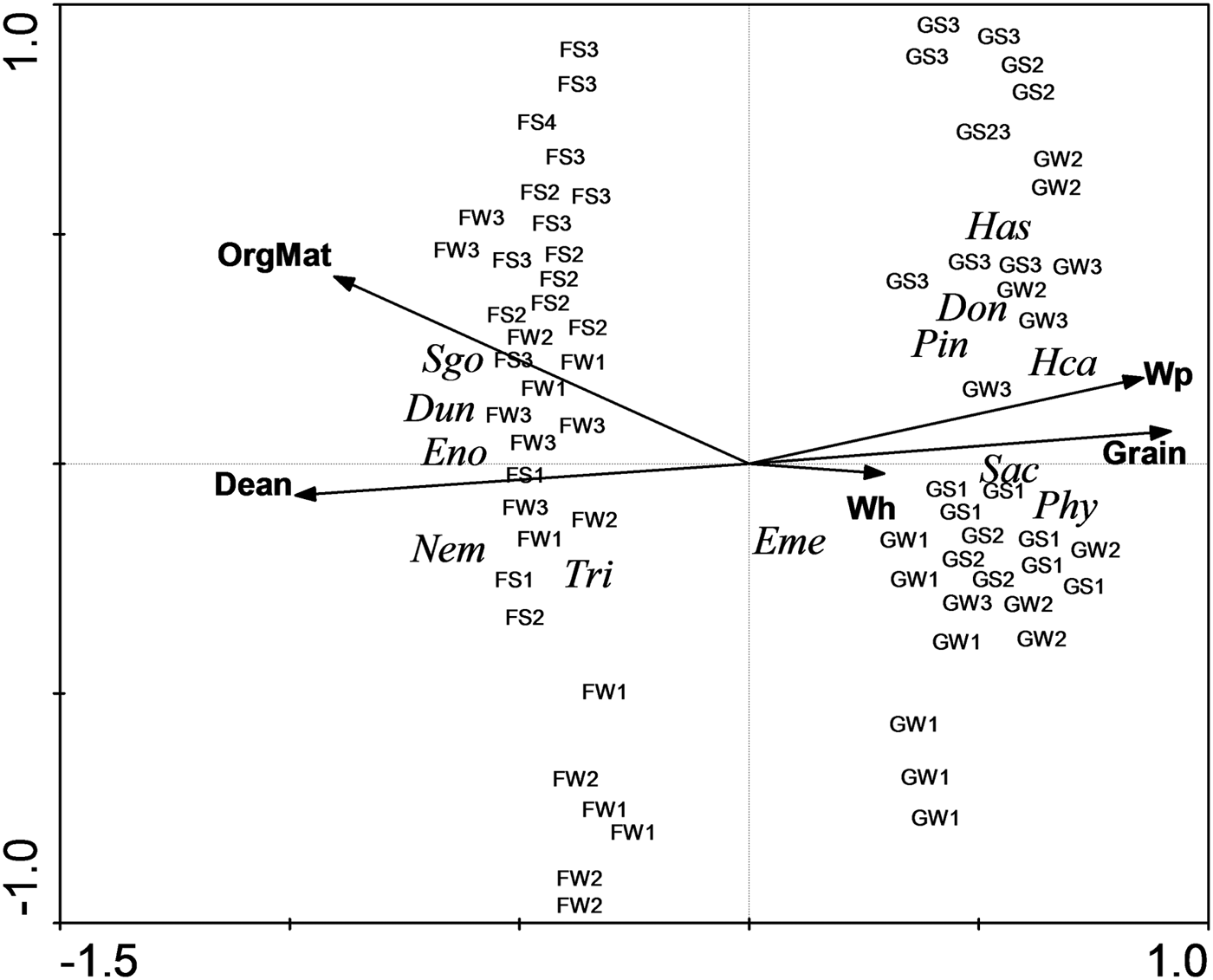
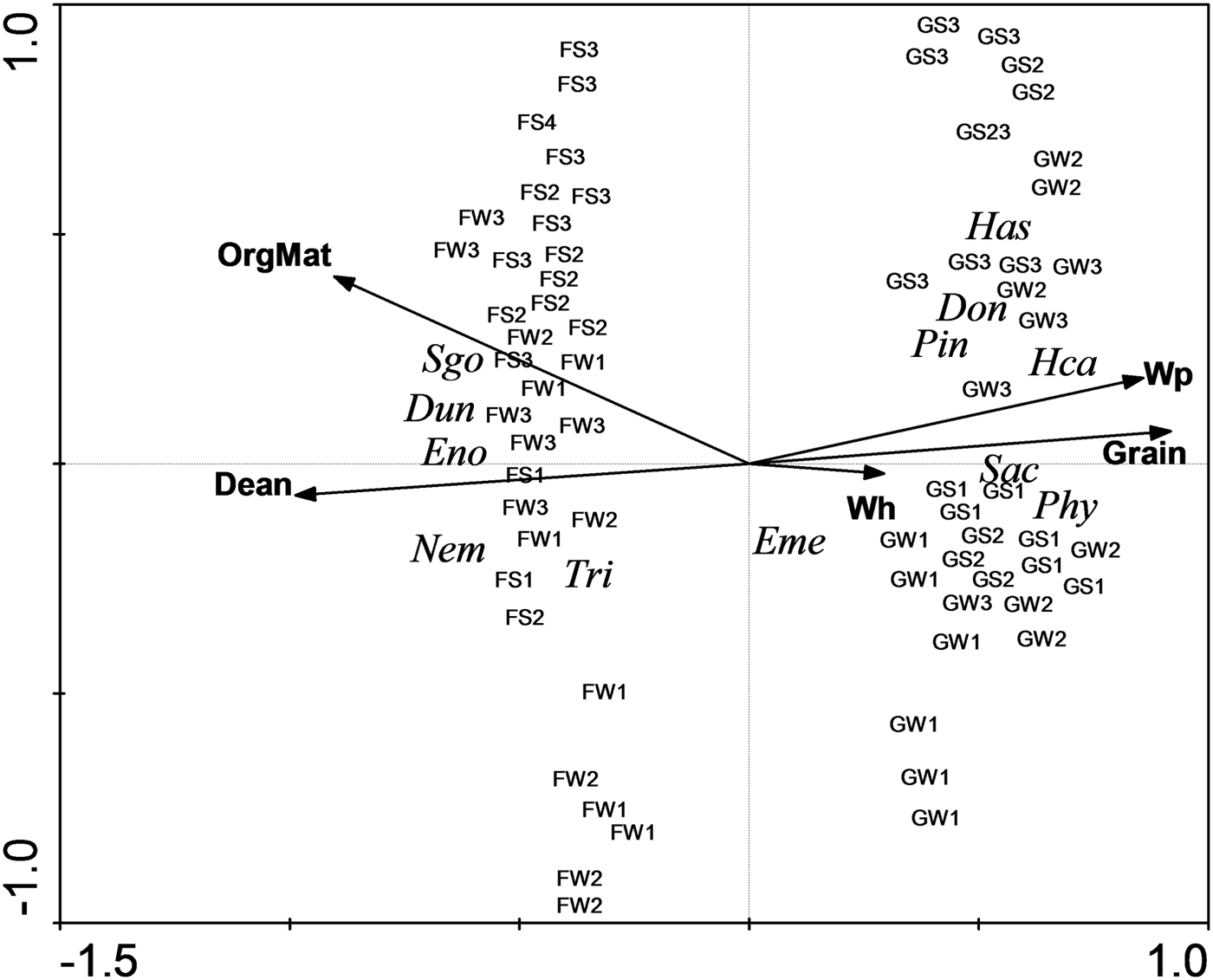
The first two axes of CCA explained 92.8% of the total variance of the species–environment correlation. The first axis revealed a well-defined spatial pattern and separated the two beaches (Figure 3), whereas the second axis showed a slight separation along the strata for each beach. According to the CCA, S. goodbodyi, D. uncinata, Enoploides sp., Nematoda and Trileptium sp. were closely associated with higher values of organic matter and the Dean parameter of Flamengo beach. In contrast, Hastula sp., Donax sp., P. indica, H. californiensis, Saccocirrus sp. and Phyllodociidae were associated with the higher values of wave period and grain size of Grumari beach. Emerita brasiliensis appeared near the centre of the diagram, suggesting a wide spatial distribution across the two beaches (Figure 3).
Ordination diagram (triplot) from canonical correspondence analysis of macroinfauna species abundance, environmental variables and seasons. Species code: Sgo, Scolelepis goodbodyi; Dun, Dispio uncinata; Eno, Eneploides sp.; Nem, Nematoda; Tri, Trileptium sp.; Has, Hastula sp.; Don, Donax sp.; Pin, Pisionidens indica; Hca, Hemipodus californiensis; Sac, Sacocirrus sp.; Eme, Emerita brasiliensis; Phy, Phyllodocidae. Environmental variables code: OrgMat, organic matter; Dean, Dean parameter; Wp, wave period; Grain, grain size; Wh, wave height. Samples code (beach, season and stratum), e.g. FS1, Flamengo beach, summer, stratum 1; GW3, Grumari beach, winter, stratum 3.
Strata comparisons
FLAMENGO BEACH
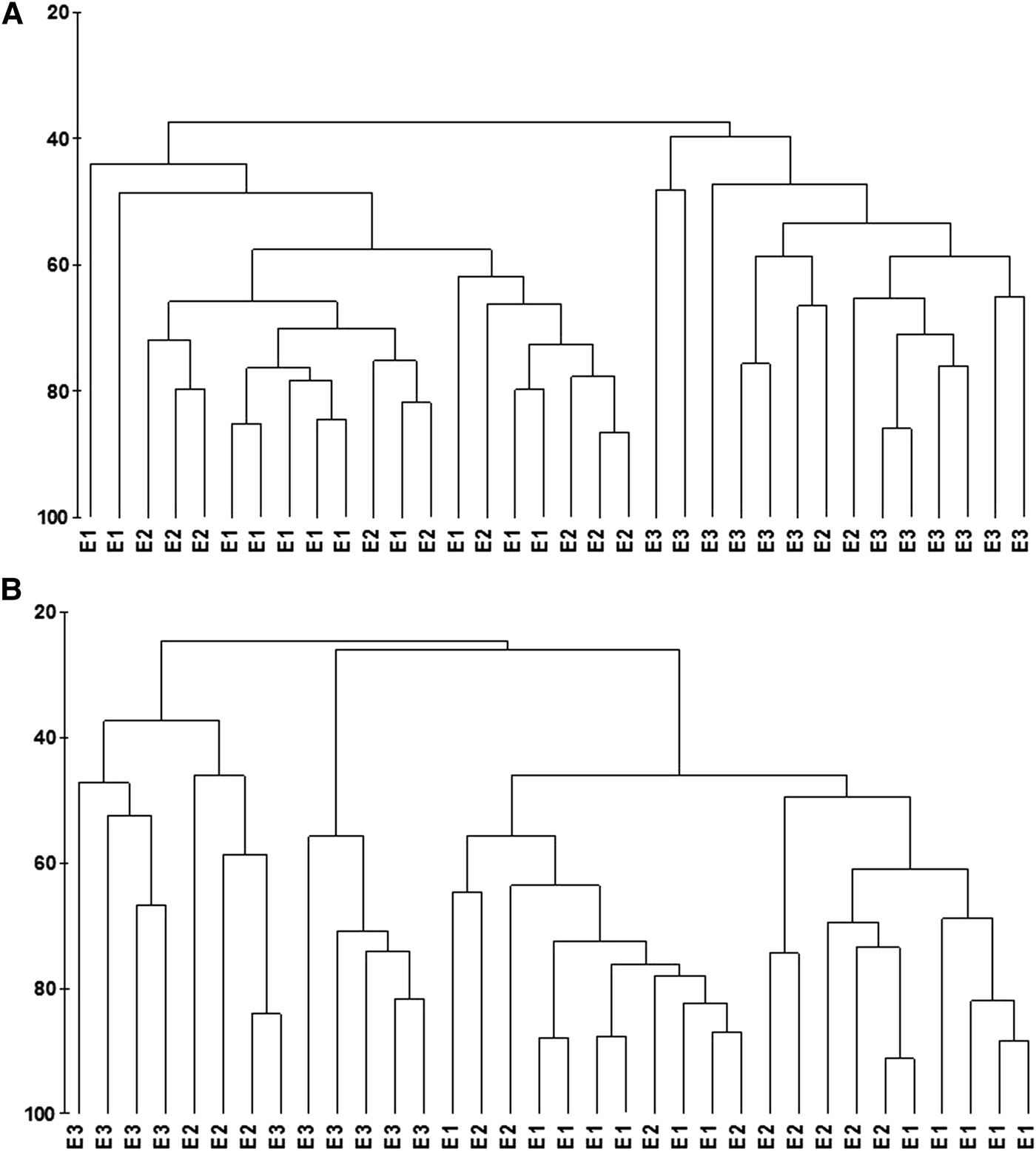
According to ANOSIM, different structures of the macroinfauna were found among the three examined strata (R global = 0.424, P = 0.03). A spatially differentiated pattern suggesting zonation of the macroinfaunal community was found by cluster analysis on the density data (Figure 4A).
Dendrogram from cluster analysis of the density of the macroinfauna in Flamengo (A) and Grumari (B) beaches, with samples coded by strata. E1, intertidal swept zone; E2, infralittoral at 0.5 m depth; E3, infralittoral at 1.0 m depth.
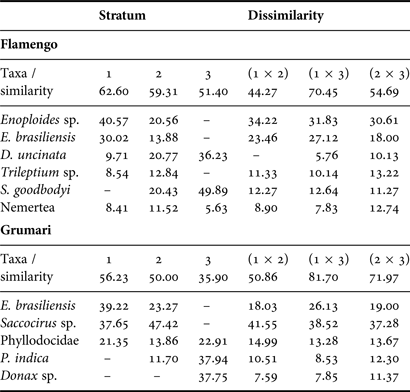
According to ANOSIM, strata 1 and 2 did not differ significantly (R = 0.168, P = 0.02), with SIMPER analysis indicating as characteristic species from stratum 1 the taxa Enoploides sp. and E. brasiliensis, which contributed 40.57% and 30.02% to the average similarity, respectively (Table 5), whereas Enoploides sp., D. uncinata and S. goodbodyi were the species with greatest contribution to the within similarity in stratum 2 (Table 5). Dissimilarity between these two strata was only 44.27%, with the greatest contributions from Enoploides sp. (34.22%) and E. brasiliensis (23.46%) (Table 5).
Species contribution for the average within similarity by strata in Flamengo and Grumari beaches according to SIMPER analysis. Dissimilarity also indicated. Strata: 1, spread washing zone; 2, infralittoral at 0.5 m depth; 3, infralittoral at 1.0 depth.
ANOSIM indicated significant difference in structure assemblages between strata 1 and 3 (R = 0.704, P = 0.001), with SIMPER analysis determining that the Polychaeta S. goodbody and D. uncinata had the greatest contribution to within similarity in stratum 3. Average dissimilarity between these two strata was 70.45%, with Enoploides sp. (31.83%) and E. brasiliensis (27.12%) having the greatest contribution (Table 5).
Strata 2 and 3 differed significantly in structure assemblage, although with some indication of species overlapping because of the intermediary R-value (ANOSIM, R global = 0.418, P = 0.01). Average dissimilarity between these two strata was 54.69%, with greatest contribution from Enoploides sp. (30.61%) and E. brasiliensis (18%) (Table 5).
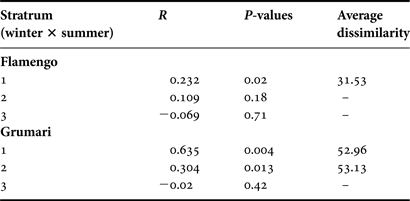
Seasonally, the macroinfauna structure differed slightly between summer and winter for the pooled strata (R global = 0.361, P = 0.01). Only stratum 1 had no significant difference in assemblage structure (R = 0.232, P = 0.02) between seasons, with low percentage of dissimilarity (31.53%) and the greatest contribution from Enoploides sp. (33.46%) (Table 6).
R and P-values for seasonal (winter × summer) comparisons of macroinfauna assemblage structure in each stratum at Flamengo and Grumari beaches according to ANOSIM. Average dissimilarity for significant differences also indicated.
GRUMARI BEACH
The assemblage structure had significant differences between the three examined strata according to ANOSIM (R global = 0.41, P = 0.01) and cluster analysis (Figure 4B), indicating differences in assemblage macroinfauna structure between the three strata.
Strata 1 and 2 did not differ in assemblage structure (R global = 0.128, P = 0.03) according to ANOSIM (Table 5). In stratum 1, E. brasiliensis and Saccocirus sp. were the species to contribute most to within similarity, with 39.22% and 37.65% of the average similarity, respectively (Table 6). In stratum 2, Saccocirus sp. (47.42%) had the greatest contribution to within similarity. Average dissimilarity between these two strata was only 50.86%, with the greatest contribution from Saccocirus sp. (41.55%) (Table 6).
A significant difference in assemblage structure was found between strata 1 and 3 (R = 0.689, P = 0.01), with SIMPER analysis indicating Saccocirus sp. and E. brasiliensis as having the greatest contribution to average similarity in stratum 3 (Table 6). Average dissimilarity between these two strata (81.70%) was mainly due to the contribution from Saccocirus sp. (38.52%) and E. brasiliensis (26.13%) (Table 6).
Strata 2 and 3 differed significantly in assemblage structure according to ANOSIM (R global = 0.445, P = 0.01). Average dissimilarity between strata 2 and 3 was 71.97%, with the greatest contribution from Saccocirus sp. (37.28%) (Table 6).
Seasonally, a slight difference was found for assemblage structure between the summer and winter for the pooled strata (R global = 0.463, P = 0.01). However, stratum 3 did not differ between seasons (R global = 0.201, P = 0.42) (Table 6). In strata 1 and 2, Saccocirus sp. made the greatest contributions (60.99% and 37.57%, respectively) for average dissimilarity between seasons (Table 6).
DISCUSSION
The macroinfauna assemblages structure in the two studied sandy beaches were closely associated to the morphodynamic states. High grain size and wave periods at Grumari beach determined the predominance of the Saccocirus sp., whereas high organic matter at Flamengo beach favoured high abundances of Enoploides sp. Grain size often is coarser at reflective rather than at dissipative beaches as a result of intense wave action at the former (McLachlan, Reference McLachlan1990; Defeo et al., Reference Defeo, Ortiz and Castilla1992; McArdle & McLachlan, Reference McArdle and McLachlan1992; Borzone et al., Reference Borzone, Souza and Soares1996). Close association between high abundances of Saccocirrus with coarse sands and high wave period was also reported by Di Domenico et al. (Reference Di Domenico, Lana and Garraffoni2009) for reflective beaches in southern Brazil, suggesting that exposed beaches provide an ideal environment for the occurrence of Saccocirrus species. Conversely, the predominance of fine sediment particles at Flamengo beach favoured high abundances of Enoploides sp. Maria et al. (Reference Maria, Paiva, Vanreusel and Esteves2013) found that the sediment characteristics influence the nematode community distribution, among them Enoploides sp., and these findings coincide with the results of the present study.
Emerita brasiliensis was abundant in both beaches irrespective of the morphodynamic state. Veloso et al. (Reference Veloso, Caetano and Cardoso2003) also did not detect significant differences in densities of E. brasiliensis on 15 exposed beaches, both dissipative and reflective, along the coast of Rio de Janeiro. Therefore, it is reasonable to suppose that E. brasiliensis has a high ability to occur in different environmental conditions, and that the morphodynamic state seems to play a secondary role in determining its distribution on sandy beaches.
Our findings pointed to a higher richness at the dissipative Flamengo beach, which is in accordance with the expectation that the morphodynamic state is the main factor determining macroinfaunal richness on sandy beaches (McLachlan, Reference McLachlan1990; Defeo et al., Reference Defeo, Ortiz and Castilla1992; Borzone et al., Reference Borzone, Souza and Soares1996), with an increasing trend from the reflective to the dissipative state. However, lower densities at Flamengo beach could be associated with high anthropogenic influences on this beach, and the allochthonous material that arrives into the sea may affect the macroinfauna community. The higher density of Saccocirus sp. at Grumari beach is not in accordance with Dexter (Reference Dexter1992), who reported Polychaeta preferring sheltered beaches. On the other hand, a higher diversity of these animals in areas with poorly-selected sediments with biogenic contributions (shell fragments) rather than in muddy or sandy–muddy sediments was found by Villora-Moreno (Reference Villora-Moreno1997). Sacocirrus sp. was not recorded in previous studies at Grumari beach (Veloso et al., Reference Veloso, Caetano and Cardoso2003, Reference Veloso, Silva, Caetano and Cardoso2006). Differences between the findings of Veloso et al. (Reference Veloso, Caetano and Cardoso2003, Reference Veloso, Silva, Caetano and Cardoso2006) and this study could be due to the larger sampling size in the present study, which also incorporates a permanently-submersed zone (strata 2 and 3), while those studies covered only the spread washing zone.
A clear zonation was found for the macroinfauna assemblage along the three strata on the two beaches, with more evident differences at Grumari beach. The most abundant taxon in stratum 1 (spread washing zone) was E. brasiliensis in both seasons, with comparatively higher values in the summer. According to Defeo & Cardoso (Reference Defeo and Cardoso2002) this suspensivorous-filtering crustacean is found in the tidal zones of reflective and dissipative beaches, with comparatively higher values on the reflective beaches. In the most studied Rio de Janeiro sandy beaches, E. brasiliensis occurs in high densities, mainly in those with a reflective state (Veloso et al., Reference Veloso, Cardoso and Fonseca1997, Reference Veloso, Silva, Caetano and Cardoso2006; Cardoso et al., Reference Cardoso, Veloso and Caetano2003), and our results corroborate those findings, since the highest density of E. brasiliensis was recorded for Grumari beach. Fernandes & Soares-Gomes (Reference Fernandes and Soares-Gomes2006) found that E. brasiliensis persists on beaches with higher sediment thrust caused by water pressure, which favours its suspensivorous-filtering habit. Veloso & Cardoso (Reference Veloso and Cardoso1999), Gianuca, (Reference Gianuca1985) and Petracco et al. (Reference Petracco, Veloso and Cardoso2003) found higher densities of E. brasiliensis during spring and summer, which partially corroborates our findings of highest density during the summer.
At Grumari beach, the predominance of Saccocirus sp. in stratum 2, and P. indica and Donax sp. in stratum 3 suggests a clear pattern of vertical zonation for this reflective beach. According to several studies (e.g. Hill & Hunter, Reference Hill, Hunter, Davis and Ethington1976; Leber, Reference Leber1982; Knott et al., Reference Knott, Calder and VanDolah1983) the species composition between the tidal and infralittoral zones differs because of the micro-habitat selection and hydrodynamic state that determines the stability of the communities. Jaramillo (Reference Jaramillo1987) and McLachlan et al. (Reference McLachlan, Jaramillo, Donn and Wessels1993) found that macroinfaunal diversity and density increase with depth, which is in accordance with the findings of the present study.
In Flamengo beach, a high similarity between strata 1 and 2 was most influenced by the common occurrence of Enoploides sp. (Nematoda) and E. brasiliensis taxa, which had the highest density in summer. Giere (Reference Giere1993) observed that the tidal zone offers favourable conditions for Nematoda occurrence, and Rodriguez et al. (Reference Rodriguez, Lopez and Jaramillo2001) found that this group of animals has the greatest density in dissipative sandy beaches. A similar pattern was observed in the present study, with the great density of Enoploides sp. at Flamengo beach, which coincided with the greatest content of organic matter. According to Fleeger & Decho (Reference Fleeger and Decho1987), the density of Nematoda is related to the quantity of organic matter in the sediment. In stratum 3, S. goodbodyi and D. uncinata were the most representative taxa. Scolelepis goodbodyi is recognized as a dominant species in beaches of intermediary to dissipative state (Souza & Gianuca, Reference Souza and Gianuca1995; Borzone et al., Reference Borzone, Souza and Soares1996, Reference Borzone, Melo, Rezende, Vale and Krul2003; Barros et al., Reference Barros, Borzone and Rosso2001). Souza & Gianuca (Reference Souza and Gianuca1995) associated the highest density of this species to the recruitment season in the summer.
In this study, we found that the dissipative beach had a different macroinfauna composition and higher richness compared to the reflective beach, and that this latter beach had a comparatively higher density. Furthermore, the macroinfauna also differed between strata, mainly between the spread washing zone (stratum 1) and the deeper infralittoral zone (stratum 3). Therefore, the hypothesis of different macroinfauna composition between the beaches and strata was confirmed, with the dissipative beaches having comparatively higher richness but lower density than the reflective beaches.
ACKNOWLEDGEMENTS
We thank Dr Paulo Cesar de Paiva (UFRJ) for helping in Polychaeta identification. We also thank Ana Paula Penha Guedes, Antonio Gomes da Cruz-Filho and Benjamin Carvalho T. Pinto for helping in fieldwork.
FINANCIAL SUPPORT
The authors are grateful to the FAPERJ—Fundação Carlos Chagas de Amparo à Pesquisa do Estado do Rio de Janeiro and CNPq—Conselho Nacional de Desenvolvimento Científico Tecnológico, for financial support.