Introduction
Much has been written about the way in which neoliberalism emerged as a phase of capitalism around the end of the 1970s, in response to a series of ongoing problems faced by capitalist economies at that time. This process of neoliberalisation saw a heightened emphasis upon the role of the market in allocating resources, with public policy geared towards the introduction of market-marking legislation, actively generating competition in new areas of human life, and upholding (increasingly through authoritarian means) the operation of the market (Bruff, Reference Bruff2014). This has included the liberalisation of trade, financialisation, privatisation, the flexibilisation and liberalisation of the labour market, and public policy reforms designed to remove the state as a source of resource allocation, especially in the form of welfare retrenchment and fiscal discipline, and through the advance of austerity measures. This occurred in a variegated way, in interaction with the national political-economic contexts in which it happened (Peck et al., Reference Peck, Brenner, Theodore, Cahill, Cooper, Konings and Primrose2018).
This turn towards neoliberalism witnessed a prolonged period of growth between the early 1980s and 2007-8, often referred to now as the Great Moderation. The global financial and economic crisis that occurred at the end of this period in 2008 exposed neoliberal growth as having been, at least in part, a result of excessive financial speculation (Keen, Reference Keen2013). One of the main consequences of this global economic crisis was a rapid escalation of public debt within the advanced industrial democracies, as national governments sought to coordinate a rescue package that largely consisted of substantial support for the financial industry and unconventional (ultra-loose) monetary policy (Schäfer and Streeck, Reference Schäfer, Streeck, Schäfer and Streeck2013). The debt accrued during this initial post-2008 period was subsequently interpreted by both governments and financial markets as necessitating a major programme of public spending cuts in an attempt to reduce public debt to ‘sustainable’ levels (Cameron, Reference Cameron, Bermeo and Pontusson2012). Efforts were also made to engineer a return to economic growth through a series of reforms that would further liberalise (especially labour) markets, reducing job security and putting downward pressure upon wages (Clauwaert and Schömann, Reference Clauwaert and Schömann2012; Heyes et al., Reference Heyes, Lewis and Clark2012). From 2008 onwards, therefore, neoliberal capitalism entered a new phase: stagnation, austerity, and heightened insecurity and hardship for the (broadly defined) working class.
These trends, and the way that they vary across different national contexts, have been well documented across the literature (Farnsworth and Irving, Reference Farnsworth and Irving2012). Less commonly noted are the changing forms of social struggle and resistance that we have witnessed throughout this period of neoliberalisation and crisis. Social struggle, dissent and resistance during this period have typically been considered in terms of defeat, acquiescence, and/or decline (Worth, Reference Worth2013; Reference Worth2019; Humphreys and Cahill, Reference Humphreys and Cahill2017). The decline of the role of trade unions and organised labour is considered a key feature of the transition to a neoliberal socio-economy (Peters, Reference Peters2011). Trade union density, militancy and confidence are all considered to have declined throughout much of the Global North during the period of neoliberalism and the transition to post-Fordist production (Western, Reference Western1995; Rubery, Reference Rubery2015; Baccaro and Howell, Reference Baccaro and Howell2017). The neoliberal period has also seen a modification of the nature of social democratic parties, witnessing a systematic move from Keynesian-redistributive policies towards a ‘third way’ agenda (Przeworski, Reference Przeworski and Glyn2001; Bailey, Reference Bailey2009). The consequence was a process of dealignment of parts of the working class in terms of both their support for social democratic parties and their association with established trade unions (Jylhä et al., Reference Jylhä, Rydgren and Strimling2019). Support for social democratic parties and trade union membership developed unevenly throughout the Global North, yet the social bonds tying those trade unionists or social democratic voters to their respective organisations were subject to a process of silent erosion (Köhler and Calleja Jimenez, Reference Köhler and Calleja Jimenez2012). Popular input into, and the contestation of, policy-making processes are also considered to have been diminished as a result of depoliticising governing strategies that have sought to sideline other social influences, except for those of corporations and business interests (Bruff, Reference Bruff2019; Buller et al., Reference Buller, Dönmez, Standring and Wood2019). The move towards a more commercial, financialised, surveilled, competitive, entrepreneurial and individuated society – all of which are key features of neoliberalisation – is considered to have been a way in which potential agents of dissent and resistance have been regulated and deposed of their power resources.
Yet, such an account of resistance during the so-called ‘age of austerity’ arguably fails to document, and explain, the forms of anti-austerity that we have witnessed since the global economic crisis (Huke et al., Reference Huke, Clua-Losada and Bailey2015). New forms of opposition, resistance, disruption and/or survival have emerged and arguably flourished during the post-2008 period (Flesher Fominaya, Reference Flesher Fominaya2017; Fishwick and Connolly, Reference Fishwick and Connolly2018). We require an account of the ‘age of austerity’ that can also explain the prevailing forms of anti-austerity that this period has witnessed, alongside an understanding of the variegated way in which anti-austerity and resistance has developed differently in different contexts over the past ten years. In doing so, we focus on developments in the UK, US, Spain, Japan and Germany, chosen in order to highlight trends across a variety of models of advanced capitalist economies.
Neoliberalisation, crisis, and the (variegated) return of struggle and resistance
The onset of a financial crisis of (financialised) neoliberal capitalism occurred in 2008 in a context where the major pillars of resistance had been eroded. Arguably the most effective and vibrant source of collective social opposition at the time of 2008 was the so-called ‘anti-globalisation movement’. This had existed since the 1990s as a ‘movement of movements’ organised largely around neo-anarchist principles of direct action, prefigurativism and horizontalism (Graeber, Reference Graeber2002). It sought to highlight the damage created by neoliberal globalisation, including through a series of summit protests against international institutions such as the G8, International Monetary Fund (IMF), World Trade Organization (WTO), and European Union, through the creation of movement spaces such as the World Social Forum, and by providing concrete illustrative examples of non-capitalist forms of association through experimental initiatives such as solidarity movements, squats, independent media, and social centres (Juris, Reference Juris2008).
As 2010 witnessed, governments routinely move to adopt an austerity agenda, and in a context of decline for the ‘traditional’ left and the continued influence of the ‘anti-globalisation’ left, anti-austerity movements erupted (especially in 2011) and were significantly influenced and informed by the same principles of prefigurativism and horizontalism as had been prevalent within the earlier anti-globalisation movement (Flesher Fominaya, Reference Flesher Fominaya2015; Bailey et al., Reference Bailey, Clua-Losada, Huke and Ribera-Almandoz2018). This witnessed public square occupations in southern Europe, the Occupy movement across many of the cities of the Global North, and the use of tactics such as direct action, occupations, disruptive demonstrations and blockades, all in an attempt to highlight opposition to austerity and to seek to impede its imposition. At the same time, many of the solidarity movements that emerged in an attempt to support those who were most vulnerable to the effects of austerity were also informed by similar principles of horizontalism and prefigurativism (Arampatzi, Reference Arampatzi2017). For the remainder of the 2010s a wave of different anti-austerity initiatives emerged across much of the Global North.
The decline of traditional working class organisations left a political vacuum that catalysed the emergence of anti-austerity movements, although it also fed into the rise of authoritarian populist parties. These developments varied according to the different forms of social movements, labour movements and political parties that had been in place before and during the onset of the global economic crisis and subsequent ‘age of austerity’. In some countries (for instance, Spain and the UK) new forms of class-based struggle and solidarity amongst precarious workers emerged that finally led to the re-institution of a more progressive form of social democracy (most obviously, with the emergence of Podemos in Spain, and the election of Jeremy Corbyn as the British Labour Party’s leader). In countries where no new forms of solidarity emerged, in contrast, individualised responses to economic hardship gained ground as parts of the population tried to adopt to the neoliberal dogmas of individual responsibility and the notion that ‘There is no alternative’ in their day to day life. Socioeconomic demands were in consequence increasingly side-lined in public debate. The decline of traditional working class organisations left a political vacuum that catalysed the emergence of anti-austerity movements, but also prompted the rise of authoritarian populist parties. Authoritarian populists made use of the dealignment from the left, to redirect feelings of being ‘left behind’ towards enmity against migrants and ‘others‘ (as witnessed in Germany, the UK, and the US). We therefore see a variegated pattern of anti-austerity movements, each reflecting the national political-economic context in which they emerged.
Anti-austerity in national political economy contexts
In order to explore in more detail the variegated nature of anti-austerity movements that have emerged during this period, we present here a discussion of key instances of resistance and protest witnessed in five advanced industrial democracies. This allows us to consider different ways in which anti-austerity initiatives emerged and interacted with the particular national model of capitalism in place prior to, and during, the crisis of 2008. This obviously raises the question of what types of resistance should be considered to be specifically ‘anti-austerity’. For the purposes of the present article, we consider ‘anti-austerity’ protests to be those which can be considered a response to the heightened forms of hardship that have emerged as a result of public policies which have sought to either reduce public spending on, or the generosity of, welfare policies, and/or policy reforms or outcomes that have focused on ensuring heightened economic competitiveness in the post-2008 context. This therefore includes welfare spending cuts and reduced welfare provision, as well as increased precarity and lower incomes arising from labour market flexibilisation. Protests that relate to perceived injustices in the differential treatment by the state of different groups following the crisis – particularly those in the financial sector compared with low-income families and workers – may therefore also be considered as anti-austerity. Our empirical discussion draws on two main sources. First, we have selected exemplary anti-austerity events from a comparative protest event analysis we conducted across five advanced industrial democracies – the UK, Germany, US, Japan and Spain – during the post-2008 period.Footnote 1 Second, this is complemented with a discussion of other high-profile protest events that are drawn from our own research and from secondary accounts. In doing so, we seek to place each of these instances of anti-austerity protest within their national-specific political-economy context. The aim is not to provide a comprehensive overview of all types of anti-austerity protests witnessed in each country, but rather to offer a preliminary suggestion regarding the types of differences witnessed across different national contexts.
UK
Prior to the global economic crisis, the UK was widely considered (along with the United States) to have been at the forefront, amongst the advanced industrial democracies, of global moves towards neoliberalisation. This especially witnessed a strong move towards financial market liberalisation and a growth in the importance of the finance sector; labour market reforms were focused on removing the influence of trade unions and ensuring a more ‘flexible’ labour market. One of the effects of these changes was a growth in low paid and precarious jobs and a declining wage share. At the same time, aggregate demand was largely maintained through a rise in private debt which produced a rapid increase in house prices (Crouch, Reference Crouch2009; Lavery, Reference Lavery2019: 21-28). The highly financialised nature of Britain’s economy, and especially the strong reliance on housing (financed through mortgages), was ultimately central to the crisis in the UK as it unfolded during 2007-8. The emblematic near-bankruptcy of Northern Rock, one of Britain’s leading mortgage providers, which was subsequently taken into public ownership, was reflected across the financial industry (Hodson and Mabbett, Reference Hodson and Mabbett2009: 1051). The immediate impact of the crisis was a rapid rise in the budget deficit and public debt. Subsequently, upon its election to office in 2010, the Conservative-Liberal Democrat coalition government sought to address this growth in debt by adopting a policy programme that was aimed principally at reducing public spending while also increasing employment and international competitiveness (Lavery, Reference Lavery2019: 114-8).
In this context, anti-austerity mobilisations tended to reflect two key conditions present within the UK’s political economy context. First, many of the more significant responses from organised labour that emerged in response to reductions in pay or working conditions tended to come from outside the established trade unions, reflecting the long period of weakening and demobilisation that organised labour had experienced in the UK during the neoliberal period. For instance, a prolonged industrial dispute took place in 2009, in which engineering construction workers staged a series of wildcat (unofficial) strikes in opposition to what they claimed were unfair attempts by the employer at the East Lindsey Oil Refinery to use foreign labour to undermine existing terms and conditions. These wildcat strike actions were explicitly conducted outside of the formal unions, who nominally represented the affected workers. This dispute, organised around the slogan, ‘British Jobs for British Workers’, rapidly spread throughout the oil refinery sector, eventually securing an agreement from Total to address the demands of the striking workers, and to reinstate those workers who had been dismissed during the dispute (Ince et al., Reference Ince, Featherstone, Cumbers, MacKinnon and Strauss2015; Bailey et al., Reference Bailey, Clua-Losada, Huke and Ribera-Almandoz2018: 74-7). Other worker-led, non-union, protests were witnessed the same year, with occupations of factories in opposition to plant closures and redundancies in two firms, Vestas and Visteon. The impact of austerity measures upon precarious workers was also reflected in terms of a rise in campaigns led by new unions that were specifically focused on mobilising the growing group of precarious, migrant and gig workers within Britain’s labour market (including the newer unions, Industrial Workers of Great Britain (IWGB) and the United Voices of the World (UVW)) (Bailey et al., Reference Bailey, Clua-Losada, Huke and Ribera-Almandoz2018: 73-4).
Alongside the response from labour, a range of movements emerged at different times in opposition to public spending cuts and the effects of those cuts. In many of these cases, the influence of the tactics of direct action, as part of a general commitment to prefigurativism and horizontalism, could be witnessed in the way in which the movements were organised. This included UK Uncut, which used tactics of direct action to highlight the inequities of the austerity measures adopted, and to target the reputation of firms who were accused of benefiting unfairly from government support, especially as a result of lenience towards tax evasion (Bailey et al., Reference Bailey, Clua-Losada, Huke and Ribera-Almandoz2018: ch. 4). Similar tactics were used by groups of activists opposing the introduction of ‘workfare’, a policy which tightened the conditionality of welfare benefits. Many of these movements also overlapped with and were influenced by participants in the student anti-tuition fee protests that staged a number of disruptive protests and occupations of universities in 2010 in opposition to the announcement that university fees would be tripled. Other similar developments saw the emergence of a housing movement (especially led by the group, Focus E15) that sought to use the method of occupations to highlight the effect of reduced social housing, and campaigns focused more specifically on areas of public spending targeted for cuts, including the closure of public libraries and sharp reductions in the provision of legal support for low-income citizens seeking to access the judicial system.
In sum, therefore, we see in the case of the UK the development of a range of anti-austerity initiatives by campaign groups that are largely non-institutionalised and drawing on some of the direct action methods associated with prefigurative and horizontalist politics. Likewise, the response of workers’ movements has seen a number of attempts to use new and/or non-institutionalised routes through which to mobilise opposition in a context in which established trade unions have been systematically disempowered during the course of the neoliberal period.
Spain
Spain’s pre-crisis economic model was largely focused around an expansion of the building sector and housing market; supported by the supply of low-cost lending arising from membership of the EU’s Economic and Monetary Union. One of the key consequences of the 2008 crisis was a rapid decline in the availability of credit, with the resulting effect that Spain’s debt-led growth model was subjected to a dramatic decline in demand, hitting the construction sector especially badly. In this context, unemployment grew dramatically, alongside a rapid further increase in public debt, and a bursting of the housing bubble. Spain’s mainstream political parties subsequently sought to reduce public spending through a broad austerity programme. At the same time, mortgages became unpayable for many, witnessing tens of thousands of indebted households evicted from their homes (Buendía and Molero-Simarro, Reference Buendía, Molero-Simarro, Buendía and Molero-Simarro2018: 3-13).
Protest movements reflected these trends. Workers’ movements opposed pay cuts, redundancies and changes to working conditions. As the major trade unions Confederacion Sindical de Comisiones Obreras (CC.OO.) and Unión General de Trabajadores (UGT) struggled to adapt to the new political conditions characterised by fundamental attacks on the system of collective bargaining and the breakdown of social dialogue, which had previously constituted the main resources of trade union power, new horizontal forms of protest emerged (Huke and Tietje, Reference Huke, Tietje, Nowak, Dutta and Birke2018). In education and health, the so-called ‘tide movements’ (marea blanca and marea verde) organised mass demonstrations and other actions through newly established or reactivated workers’ assemblies. In some major industrial disputes, for instance at Panrico, Coca-Cola, and Movistar, workers turned towards direct action methods and collective assemblies to circumvent what were considered to be relatively ineffective formal trade union organisations (Bailey et al., Reference Bailey, Clua-Losada, Huke and Ribera-Almandoz2018: 86-104).
Spain also experienced large numbers of protests conducted by housing activists, who sought to oppose the housing crisis that followed 2008, and which resulted in part from the government’s handling of the global economic crisis and its aftermath. This reflected the importance of housing in terms of both the boom and the bust of Spain’s political economy. These protests were largely organised by local assemblies of the group, Plataforma de Afectados por la Hipoteca (PAH) (Platform for People Affected by Mortgages). Methods of protests included public demonstrations that sought to raise awareness of the prevalence of evictions which occurred as mortgages became unrepayable. Also, anti-eviction movements sought to prevent evictions from taking place through the staging of blockades that were designed to obstruct bailiffs. In addition, the occupation of houses took place in an attempt to accommodate evicted families (Bailey et al., Reference Bailey, Clua-Losada, Huke and Ribera-Almandoz2018: 230-5). Anti-corruption protests also sought to highlight and oppose the important role played by Spain’s political elite in overseeing and contributing to the housing bubble during the pre-crisis years (Moreno Zacares, Reference Moreno Zacares2018). Much of this onset of different forms of opposition was launched in 2011 by a wave of direct action public square occupations which are usually referred to as ‘15-M’. This wave of protests, which took place across Spain, was largely informed by principles of horizontalism and prefigurativism, much of which had developed in movements in Spain prior to the crisis (Flesher Fominaya, Reference Flesher Fominaya2015). These focused explicitly on highlighting the failures of the political system in producing the crisis and in acting to pass the costs of the crisis onto the shoulders of Spain’s most precarious low paid workers, unemployed and underemployed youth (Huke, Reference Huke2016).
As witnessed in the case of the UK, therefore, the erosion of the capacity for more established institutions, especially trade unions, to counter austerity measures resulted in the emergence of new non-institutionalised workers’ movements. Similarly, a number of anti-cuts social movements emerged to focus on the specific effects of austerity and the crisis, especially the housing crisis and mass evictions which affected Spain, and often adopting the prefigurative, direct action, and horizontalist methods of the earlier anti-globalisation movement. In the case of Spain, moreover, the scale of the crisis and the depth and impact of austerity were such that the size of the protests were considerably greater than those witnessed in the UK. In recent years, however, we have seen anti-austerity activism decline, while the authoritarian populist party VOX became the third largest party in the Spanish parliament.
United States
The United States adopted a debt-led growth strategy prior to (and following) the global economic crisis. This took on a notably racialised character, with the most risky forms of debt typically found amongst lower paid and financially precarious racialised minorities.
Likewise, once the bubble burst, it was racial minorities who were hit hardest by housing dispossession and homelessness, as well as a relative decline in wealth, as housing owned by people of colour fell behind in the wealth recovery process after the crisis (Hall et al., Reference Hall, Crowder and Spring2015; Zhang and Feng, Reference Zhang and Feng2017). This therefore also reflected broader patterns of income inequality within the United States.
The patterns of anti-austerity mobilisations during this period reflect these trends. One of the most significant and widespread protest movements to emerge during the post-2008 period was the Black Lives Matter movement, which was primarily opposed to police treatment of black people, but also reflected broader frustrations borne of the long-term discrimination of racial minorities in the United States, including regarding the impact of the housing crisis and declining wages in the crisis context (Taylor, Reference Taylor2016). In addition, the United States witnessed an outpouring of opposition by radicals and anti-capitalists, typically in the form of the Occupy movement, reflecting the influence of methods associated with the anti-globalisation movement, especially in a context where more conventional left institutions such as social democratic parties or trade unions have either been absent (in the case of social democratic parties) or increasingly marginalised in comparison with most other advanced democratic economies. Finally, and also reflecting the liberalised nature of the US labour market, those worker movements that were visible during the 2010s were largely organised by unions or branches that had adopted reforms through which to empower the union rank-and-file, and as a result adopted some of the more campaign-oriented styles of social movements. This could be seen, for instance, in the case of the Chicago Teachers Union strike in 2012, the ‘Fight for $15’ campaign, and the strikes against Verizon in 2016 (Moody, Reference Moody2017: 81-4).
As with the UK and Spain, therefore, the neoliberalised United States context witnessed a considerable amount of anti-austerity activity adopting the horizontalist and direct action methods of the earlier anti-globalisation movement. The heightened racialised nature of US neoliberalism was also reflected in the types of anti-austerity protests witnessed. When labour movements did emerge, moreover, they tended to reflect the move towards ‘social movement unionism’ that is often seen by trade unions attempting to reverse their experience of declining capacity, through the incorporation of methods and practices associated with social movements.
Japan
One of the main consequences of the 2008 crisis in Japan was an intensification of trends towards international economic integration which had been ongoing since the bursting of the country’s bubble economy in 1991. This saw the erosion of some of the key features of the post-war economic model, including interlinked ownership by so-called ‘main banks’, horizontal and vertical networks of trading and industrial companies (keiretsu), and stable patterns of long-term employment (Shibata, Reference Shibata2020). As the proportion of the workforce hired on temporary contracts had grown prior to 2008, the onset of the global economic crisis saw many of Japan’s non-regular workers (part-time, temporary, agency and contract workers) fired. This prompted a number of protests conducted by Japan’s growing group of non-regular workers – with, for instance, a direct action protest camp (in Japanese, named Haken Mura) springing up in one of Tokyo’s central parks in order to provide support for many of Japan’s impoverished workers who had been made homeless as a result of the wave of unemployment which followed the 2008 recession. The same period saw the growth in a number of smaller independent trade unions that focused specifically on supporting precarious workers and seeking to shift public policy so that it would be more supportive of this particular group of workers (Shibata, Reference Shibata2020).
The particular forms of austerity witnessed in Japan during the post-2008 period were especially focused on liberalising a number of key features of its coordinated market economy. This included agricultural reforms which would remove national trade protections that had been central to the social compromise in Japan for much of the post-war period, and labour market reforms that would make it easier for non-regular workers to be employed. In addition, a number of regressive tax increases in VAT were scheduled. Each of these measures were considered necessary as a response to the post-2008 low growth context and were especially promoted by Prime Minister Shinzo Abe, who coined the term, ‘Abenomics’ (Shibata, Reference Shibata2017; Bailey and Shibata, Reference Bailey and Shibata2019).
These reforms met opposition from a number of organised interests within Japan. In part, this reflected the continuation of the country’s more coordinated model of capitalism, meaning that organised interests were sufficiently well mobilised to be able to lead many of the most visible forms of protest. This included the main agricultural organisation – JA – which led a series of protests against agricultural liberalisation; whilst opposition to labour market reforms was typically conducted by the main trade union confederations, Rengo and Zenrouren. Thus, in contrast to the more neoliberalised country cases studied here, opposition to austerity measures in Japan typically took the form of trade union-organised demonstrations, and protests staged by farmers’ organised interest groups who opposed the reforms being proposed as part of the Trans-Pacific Partnership (TPP) negotiations (Bailey and Shibata, Reference Bailey and Shibata2019). This occurred alongside newly emergent worker-led protests that were especially associated with the newer group of precarious workers that increased to nearly 40 per cent of Japan’s labour market.
Germany
Germany has had one of the most export-oriented advanced capitalist democracies of the past twenty-five years. This export focus has also been associated with the dualisation of the country’s labour market, between precarious ‘outsiders’ and a shrinking ‘insider’ labour market; as well as the relatively early introduction of welfare reforms, prior to 2008 (most obviously, Hartz IV) (Carlin and Soskice, Reference Carlin and Soskice2009: 70-1). Following the 2008 crisis, Germany was hit by declining global demand, but recovered quickly whilst continuing to undergo a process of labour market dualisation in the post-2008 context (Márquez-Ramos, Reference Márquez-Ramos2018). These developments have therefore produced a division in Germany between ‘insider’ workers in permanent and stable employment and ‘outsiders’, with insecure, low-paid employment. This creates insecurity and anxiety on both sides of the divide – based either on the experience of being an ‘outsider’, or the risk for ‘insiders’ that they might be pushed to the ‘outside’ (Nachtwey, Reference Nachtwey2018: 125-8). Austerity measures were relatively mild in Germany following the 2008 crisis, in part due to the earlier introduction of reforms prior to 2008. As a result, the key source of social strain in Germany is often considered to be the tense divide between labour market insiders and outsiders, rather than direct opposition to austerity welfare reforms (Heuer and Mau, Reference Heuer, Mau, Taylor-Gooby, Leruth and Chung2017: 33-40).
Worker-led protests in Germany also reflected this bifurcation between insiders and outsiders within the domestic labour market. Manufacturing union, IG Metall, took strike action over pay in some of the major manufacturing plants, such as Mercedes Benz, and sought to oppose the erosion of workers’ privileges within the sector; whilst the service-sector union, Ver.di, typically adopted a more ‘social movement unionism’ approach with more rank-and-file led strike activity and a focus on ‘outsider’ workers, perhaps most visibly in the case of the long-running dispute with Amazon which spanned much of the decade (Dribbusch et al., Reference Dribbusch, Lehndorff, Schulten, Lehndorff, Dribbusch and Schulten2018).
The record of protest and anti-austerity mobilisations during the post-2008 period also reflects these trends in political economy in the case of Germany. Perhaps most notable is the prevalence of both right-wing protesters and anti-fascists. A polarisation of German society could be observed. The Pegida movement (Patriotic Europeans against the Islamification of the Occident), mobilising anti-Muslim racism, emerged in 2014 and organised large demonstrations in Dresden and smaller protests in other cities. These were not a direct result of, or response to, austerity measures introduced in Germany. Racist attitudes and other forms of group-focused enmity had already been widespread in previous decades. However, these already-existing racist attitudes were increasingly activated in the post-crisis period, in a climate of heightened anxiety and a rapid decline of support for the Social Democratic Party (SPD) (and, in some segments of society, also a decline in support for Die Linke). Whereas left parties had earlier served to integrate those working class voters with authoritarian attitudes within the left of the spectrum, the capacity to do so declined considerably during the 2010s (Decker and Brähler, Reference Decker and Brähler2018).
While the authoritarian populist party, AfD (Alternative for Germany, Alternative für Deutschland in German), thrived, and violent attacks on refugee shelters, journalists, refugee supporters and refugees soared, anti-austerity protest movements were unable to profit from the dealignment of parts of the working class from social democracy. Anti-austerity protests that did occur were mainly focused on the domestic government’s promotion of an austerity agenda outside of Germany, and especially the policies that it promoted within the European Union. These protests often remained limited to radical-left or anti-capitalist groups, including the series of Blockupy events that targeted the European Central Bank (ECB) in Frankfurt and the protests that met the G20 summit in Hamburg in July 2017 (see, for instance, Mullis et al., Reference Mullis, Belina, Petzold, Pohl and Schipper2016). A successful rearticulation of social grievances from below in social movements with broad support from different segments of society – as experienced in Spain or the UK – did not develop.
The main sources of strain in the case of Germany’s political economy therefore appears to be over the question of the ongoing process of labour market dualisation, and the way in which this is motivating divisions between insiders and outsiders, and in the process fuelling more reactionary politics which feed off the anxiety that dualisation is creating. The continued relevance of trade unions within Germany’s more coordinated political economy tended to ensure that much of this opposition to dualisation remained channelled within the established trade unions, although in the service sector there was more of a willingness to seek alliances with rank-and-file activists and the methods of social movements. Further, the directly anti-austerity initiatives that were witnessed tended to reflect (and oppose) Germany’s role within the European Union, where the national government was a key advocate of austerity measures for deficit countries within the Eurozone. For this latter type of protest, moreover, the methods of direct action and horizontalism were more present, especially with the highly visible Blockupy movement.
Conclusions: variegated anti-austerity in the post-2008 context
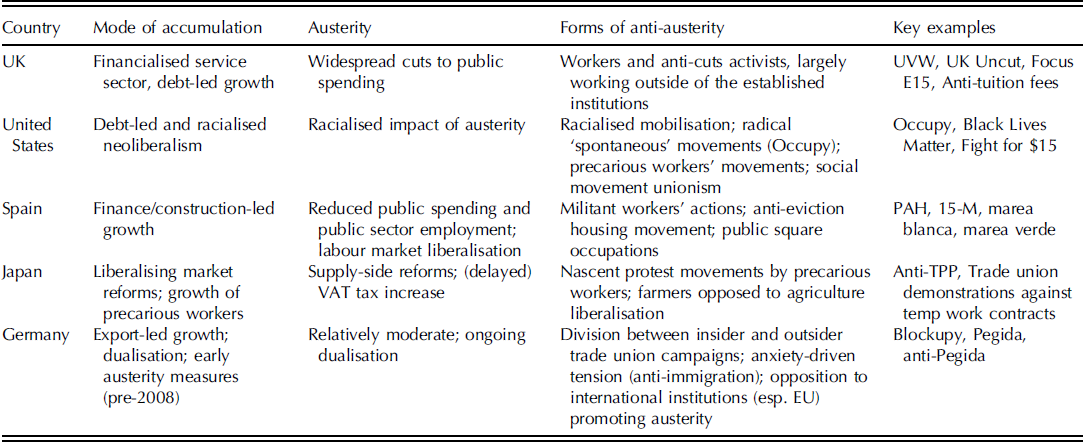
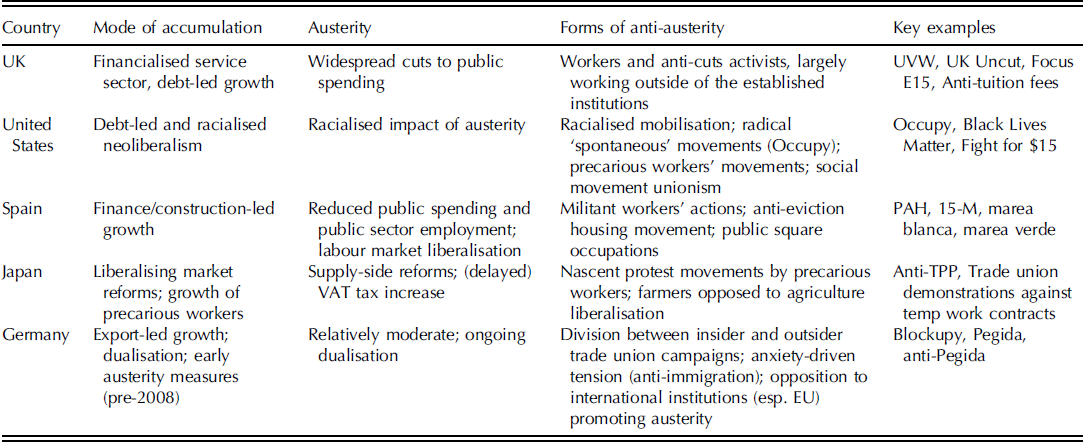
As Table 1 highlights, the main types of anti-austerity mobilisations witnessed in each of the advanced industrial democracies that we have covered in the present article have illustrated the emergence of a variegated trend of anti-austerity mobilisation during the post-2008 period. This combines both general trends and national specificities. In general terms, we see the emergence of new and innovative modes of organising as a means of articulating grievances. These draw upon some of the repertoire of activities that were associated with the anti-globalisation movement that developed in the period leading up to the global economic crisis. This includes a focus on direct action, horizontalism and relatively non-institutionalised forms of dissent. It also reflects the weakening of organised labour, especially in the most neoliberalised socio-economic contexts. This has led to a situation in which these more prefigurative, non-institutionalised expressions of dissent have often been the most practical means by which to mobilise and articulate opposition to the austerity measures being implemented, as well as in many cases representing a way in which to create opportunities for mutual support and survival for those experiencing the effects of austerity and insufficient welfare provisions. Within this general trend, we also see the influence, within each national context, of the particular model of capitalism, and the legacies of the different national trajectories that these are associated with, upon the particular form, degree, and content of the different types of anti-austerity mobilisation witnessed in each case. The more neoliberalised contexts (US, UK, Spain) have seen more non-institutionalised forms of anti-austerity mobilisation, as well as trade unions showing a greater willingness to turn to social movement methods (social movement unionism) in an attempt to respond to the weakened capacity of organised labour. In those countries with a stronger tradition of economic coordination (Germany, Japan) – albeit a tradition that is also being eroded – we have witnessed a stronger role for more established institutions representing those groups suffering as a result of austerity measures. As the case of Germany shows, the dealignment from social democratic parties and trade unions did not necessarily lead to a successful reinvention of social resistance. Where grievances were left without voice, crises of representation occurred that implied the possibility of a realignment of parts of the working class with authoritarian populist parties and movements that side-lined social demands and the critique of austerity while (re-)directing anger and frustration towards the hatred of ‘others’. Donald Trump, VOX or Boris Johnson indicate that similar developments are a threat also in other countries discussed in this article, especially at times when non-institutionalised mobilisations decline, and public discourse subsequently shifts away from social hardship and austerity. All of this suggests, therefore, that the newer forms of class struggle we witness in the present are likely to continue to develop in a variegated manner, combining methods that are prevalent in different contexts, and responding to different types of grievances, all within a more general trajectory marked by what appears to be a longer-term stagnation of neoliberalism.
National political economies and variegated anti-austerity
Acknowledgments
This article was presented at the University of Birmingham IPE Workshop, 12 July 2019. We are grateful to the participants for their feedback, and especially that of discussants, Christel Koop and Elio di Muccio. We also thank the journal referees and issue editors, Zoë Irving and Kevin Farnsworth.