Introduction
Schema therapy (ST), developed by Jeffrey Young (Young, Reference Young1994; Young et al., Reference Young, Klosko and Weishaar2005), is one of the most effective methods used in the treatment of personality disorders (PDs), notably borderline personality disorder (Giesen-Bloo et al., Reference Giesen-Bloo2006; Arntz et al., 2005; Farrell et al., Reference Farrell, Shaw and Webber2009). In a recent study, ST was reliably superior to treatment as usual and clarification-oriented psychotherapy in the treatment of avoidant, dependent, obsessive-compulsive, histrionic, narcissistic, and paranoid PDs (Bamelis et al., Reference Bamelis, Evers, Spinhoven and Arntz2014). Chronic psychiatric diseases such as depression and anxiety disorders can also be treated by ST.
ST integrates elements of cognitive and behavior therapy, object relation theory, and gestalt therapy into one unified, systematic approach (Young et al., Reference Young, Klosko and Weishaar2005). A schema is defined as a pervasive maladaptive theme regarding oneself and one's relationships with others, developed during childhood and elaborated throughout life. Schemas include thoughts, memories, feelings, physical sensations, and behavior. In daily life, a schema can be triggered by a situation, thought, or memory. When a schema is activated, intense and negative effects are experienced (Young, Reference Young1994). Schemas are familiar to a person and resistant to change (Schema Therapy Institute, c2004). Every schema refers to a basic unmet emotional need during childhood. For example, when a mother does not react to her baby's crying, the baby's need for consolation is not met, and the schema “emotional deprivation” can arise. Systematic early childhood trauma (for example, chronic neglect or aggression) can easily lead to the formation of maladaptive schemas.
Young initially defined 16 schemas, formulated in the Young Schema Questionnaire (YSQ). After factor analysis, 14 of 16 schemas were confirmed in two studies with patient samples. The schema “social undesirability” was not confirmed in either study and was therefore removed. (Schmidt et al., Reference Schmidt, Joiner, Young and Telch1995; Lee et al., Reference Lee, Taylor and Dunn1999). The YSQ is significantly related to both axis I and axis II symptomatology suggesting sufficient convergent validity.
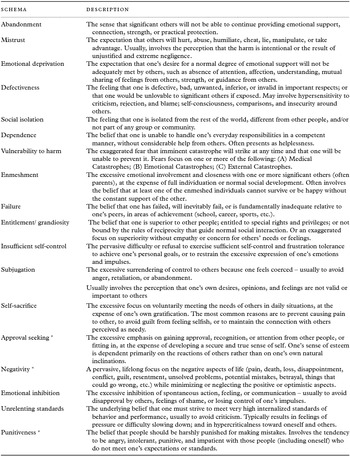
Recently, three new schemas were added, namely “punitiveness,” “negativity,” and “approval seeking.” The validity of these new schemas is still being studied. All 18 schemas are described in Table 1.
Young's 18 schemas. Adapted from Schema Therapy Institute (c2004)

*Was not involved in this study because of lack of empirical validation at this point of time.
Despite the promising results of ST in the treatment of PDs in adults, research in the older adult population is scarce. We conducted a literature search in Embase, Psychlit, and Pubmed using the following English keywords and combinations; “schema” and “cognitive behavior therapy” were separately combined with “aged,” “gerontology,” “geriatrics,” and “geriatric psychotherapy.” This yielded just seven hits addressing topics of clinical experiences, psychometric research, and feasibility studies (James, Reference James2003; Antoine et al., Reference Antoine, Antoine and Poinsot2007a; Antoine et al., Reference Antoine, Antoine, Poinsot and Balieu2007b; Antoine et al., Reference Antoine, Antoine and Nandrino2008; Kindynis et al., Reference Kindynis, Burlacu, Louville and Limosin2013; Pauwels et al., Reference Pauwels2014; Videler et al., Reference Videler, Rossi, Schoevaars, van der Feltz and van Alphen2014). James (Reference James2003) suggested a few adaptations relevant to ST in older adults, recommending that the life course should be taken into account when working with the elderly. Schemas can be overlaid or forgotten and can be reactivated again during the life course. They will also be continually evolving and fading over the person's life, in line with the dominant themes associated with each stage of development. This waxing and waning concept of schemas is important and should make therapists cautious about focusing too heavily on one schema domain.
With regard to existing psychometric research, Antoine et al. performed three studies on schemas in an elderly population in France in 2007–2008. First, they validated 10 out of 12 original schemas in a small sample (n = 67). Next, they added three age-specific schemas: “disengagement,” “loss of individuality,” and “refusal of help.” These schemas were not based on empirical data. After factor analysis in a sample of 160 elderly persons, a 44-item inventory remained representing nine schemas. In the final phase, the inventory was validated in a larger sample (n = 296; age range 61–103) after which seven schemas remained, namely “disengagement,” “loss of identity,” refusal to help,” “abandonment,” “dependence,” “fear of losing control,” and vulnerability.” Pauwels et al. (Reference Pauwels2014) investigated the age neutrality of the items of the Young Schema Questionnaire in a sample of patients with a substance use disorder (n = 321), by examining whether most schema scales are equally measured across age using differential item functioning (DIF) analyses. Results show that six of 205 items showed DIF, implying age neutrality of the questionnaire.
We found two studies that shed light on the subject of treatment: Kindynis et al. (Reference Kindynis, Burlacu, Louville and Limosin2013) demonstrated the feasibility of group and individual ST in the treatment of depression and anxiety in an elderly population. In a recent study on the outcome of group ST in elderly patients, suffering from mood disorders and (features of) PDs, a significant decrease in symptomatic distress was found along with changes in schema's in pre- and post-treatment (Videler et al., Reference Videler, Rossi, Schoevaars, van der Feltz and van Alphen2014). However, although this is promising, these studies had no control conditions, therefore conclusions on efficacy cannot be made. To date, there have been no efficacy studies on ST in aged populations. Moreover, research into the validation of schema theory in an older population is absent. At present, the way schemas manifest themselves in an older population is unclear and their evolution over the life course is unknown. To understand diagnostics and treatment concerning ST in geriatric psychiatry, more research is needed.
The focus of the present study was the evolution of schemas during the life span and their eventual manifestation in an aged population, based on the following questions:
-
1. Are schemas variable during the life course?
-
2. What kind of biopsychosocial aging factors can cause change in schemas?
The perspective of psychological, biological, and social gerontological features might help to answer these questions. Such insights are necessary to understand the possible implications for psychotherapy in the elderly and to help psychotherapists adjust ST to an aging population; if the clinician has a better understanding of why certain schemas suddenly arise or how others evolve during the life course, this will improve understanding the patient and the therapist will have a better idea how to modify the maladaptive schema's matching the patients developmental phase. In addition, knowledge of which behaviors and emotions are appropriate in the fourth life phase will also help prevent under- or over-diagnosis.
Given that empirical research into schema theory and therapy in aged populations is lacking, we applied the Delphi technique by asking experts in this field their opinions and explanations for possible schema changes in older adults.
Methods
The Delphi technique is a series of sequential questionnaires, or “rounds,” interspersed with controlled feedback, that seek to gain the most reliable consensus of opinion of a group of experts (Linstone and Turoff, Reference Linstone and Turoff1975; Powell, Reference Powell2003). The method is useful in situations in which individual judgments must be combined in order to address a lack of agreement or incomplete state of knowledge (Delbecq et al., Reference Delbecq, van de Ven and Gustafson1975; Powell, Reference Powell2003). Usually, the information is gained through questionnaires and there is no contact between the experts so that objectivity is ensured. Here, however, to enhance creativity, to encourage an open discussion, and reduce the drop out of experts due to “questionnaire fatigue,” we chose a group meeting of several iterative rounds following the Delphi technique.
Selection of the chairman
To obtain meaningful information from a group meeting, a skilled and objective chairman capable of leading a structured discussion and monitoring the different stages of the Delphi technique is crucial (Fink et al., Reference Fink, Kosecoff, Chassin and Brook1991). The selection of the chairman was therefore carefully considered. We invited someone who had experience as a chairman and was also an expert in clinical practice and research of ST in an adult population (Michiel van Vreeswijk).
Selection of experts
We first approached members of the Dutch expert panel on PDs in older adults, in short named EPO. Two authors (M.L. & and S.v.A.) are members of EPO. The inclusion criterion was a minimum of three years’ experience in ST with elderly patients. This yielded five experts, two of whom had also ST research experience. We then asked these five persons to search their network for experts considering our inclusion criterion. In this way, we recruited 18 Dutch experts, of whom nine joined the meeting. Reasons for not participating in this expert meeting were lack of time, the meeting being too far away, or permission from the employer was not granted.
Procedure
Prior to the meeting there were several gatherings between two authors (M.L. & S.v.A.) and the chairman (M.v.V.) to discuss the structure of the meeting. During the meeting itself two statements relating to our research questions were presented to the experts for discussion, the second of which was only introduced if the panel thought the first to be true:
-
1. Schemas are variable during the life course.
-
2. There are several biopsychosocial factors that can cause change in schemas.
Each statement was presented on a PowerPoint slide and briefly explicated by the chairman after which the discussion started. In the first phase, the panel discussed without the chairman intervening. Regarding the first statement, the chairman had a list of the 15 schemas and made sure that all schemas were covered in the discussion. When no new information was generated by the panel, the chairman formulated a summary (similar to the first Delphi round), and the discussion resumed thereafter. When a schema was missing, he explicit brought it into the discussion. This procedure was repeated until a consensus was reached or when no new points of views came forward. Consensus was reached if two-thirds of the experts agreed on the statement during an open, non-anonymous vote. The meeting was captured on film for qualitative analyses after.
Results
Statement 1: schemas are variable during the life course
All nine experts considered the statement acceptable. However, there was discussion whether onset of schemas could occur in old age. Also, the term “variable” was questioned by the panel; after discussion, the following conclusions were made:
-
1. Schemas can be present to a greater or lesser extent depending on certain events, periods, or roles in life. In old age, a person has different roles than before and a history of life events that can influence schema activation. Examples of the causes of this variability that came forward in the discussion were situational factors (such as crisis) or positive interactions in life (such as a healthy spouse leading to more healthy schemas). The life course and one's development provide further possibilities for a schema to mellow or intensify. For example, the role of being a grandparent can repair the “defect” schema, or the loss of a spouse can trigger the “emotional deprivation” schema.
-
2. Schemas can be more or less apparent at a certain points in time because of strategies that allow schemas to stay hidden (for example, a person can conceal the dependence schema by letting their spouse make all the decisions). Owing to the processes accompanying the aging process, such coping styles may no longer be feasible and the schema manifests itself as a result. So, the schema was already there but was under control by successful coping. The panel also agreed that a completely new schema cannot originate in late life.
Moreover, the experts mentioned that not all schemas vary to the same extent. Schemas that arise early in development were thought to be very resistant to change. These schemas are of such a fundamental nature that they trigger very easily in a given situation, are very persistent, and not likely to fade or disappear. The expert panel felt that schemas arising at a later developmental stage were more flexible and less resistant to change because the basic constructs of safety and secure attachment are already established. However, there was discussion about which schemas arise early and which come later in development. The conclusive round resulted in the identification of the following “early” schemas: “emotional deprivation,” “mistrust,” and “social isolation,” and the following “later” schemas: “self-sacrifice,” “subjugation,” “high standards,” and “emotional inhibition.” The panel had no clear opinion on the remaining schemas. The possibility of a schema diminishing is presumably dependent on the severity of the (chronic) trauma that was responsible its emergence. According to the experts, severity of trauma is negatively correlated with change: the more severe or longer lasting the trauma, the more maladaptive schemas grind in a person's belief system and the less likely they are to change. Furthermore, the panel believed that particular schemas decrease during the life- span as part of normal development; these schemas are “defectiveness,” “subjugation,” and “unrelenting standards.”
Very prominent in the discussion was the emphasis on the flexible, dynamic, and multi-dimensional nature of schemas. They can be seen as constructs that arise in early childhood, but are not rigid; during the life course they can change, mellow, or recur due to multiple factors.
Statement 2: there are several different biopsychosocial aging factors that can cause change in schemas
Biological factors: the panel agreed that biological events or diseases can cause schema change, such as sleeping disorders, stroke, illness, disability, neurodegenerative diseases, hormonal changes (menopause), and reduced biological resilience. There was, however, disagreement about whether a schema is directly influenced by biological factors or whether this influence is mediated via psychological variables. Five of nine panel members (55%) agreed that biological factors can be a direct influence (for example, lack of sleep leads to psychological instability, a state in which schemas are more easily triggered). Four of nine panel members (44%) were of the opinion that a mediating psychological factor is responsible for the change. They argued that a somatic event is followed by a negative thought such as “I cannot function anymore, and if I can't function, I'm worthless” which causes the schema change. In the second part of the discussion, the panel was almost unanimous; eight out of the nine experts (89%) agreed that some biological factors would directly influence schemas, but that the majority will go through a mediating psychological process. The schema “vulnerability to harm” is explicitly emphasized in this context; because of a higher prevalence of disease in the elderly this schema is thought to increase with age.
Psychological factors: the panel, without discussion, unanimously believed that psychological factors can cause schema change. First, developmental tasks accompanying the third and fourth phase of life were considered to be relevant. In these phases, a person is confronted with the challenge of making up the balance of life. As a result schemas can change; choices made earlier in life may be placed in a new perspective. For example, people can forgive themselves for certain actions and as a result schemas such as “unrelenting standards,” “failure,” or “defect” can mellow. Or the reverse can happen: the narcissist, who realizes how little time he has spent with his family due to his self-centeredness, has a growing awareness of his failure. Second, systemic factors were identified as relevant. It is of interest to see which roles a person had or still has in different groups in their lives and which schemas were active in each group; older people have had more roles, and therefore a richer pallet of schemas from which to choose. Third, changes in personality were considered to be important; the panel referred to studies on the course of the adaptive personality traits (Big Five) and maladaptive personality traits (DSM-5 PD's; APA 2013); with aging there is a more altruistic perspective, less neuroticism, and a more inward orientation (Debast et al., Reference Debast2014). Regarding DSM-PDs, the prevalence of cluster B personality disorders (especially acting out and behavioral problems) diminishes during the life course, whereas the prevalence of cluster A and cluster C disorders stay the same or increases (Debast et al., Reference Debast2014). The panel generalized this knowledge to schema theory and assumed that schemas as such as “unrelenting standards,” ”insufficient self-control,” and “entitlement” may decrease. Fourth, the context of approaching death was named. In the clinical experience of the panel, most old people are not afraid of death per se; mostly they have peace with it and a process of detachment sets in. Maybe in this process there is a shift in schemas; they can be seen from the perspective of mildness and equilibrium.
Social and cultural factors: the expert panel unanimously agreed that social and cultural factors can cause schema change. Seven experts (78%) believed that social factors have a direct influence on schemas, whereas two experts (22%) doubted this, believing that there is a mediating psychological factor. The following factors were specifically named in the discussion:
-
1. Becoming a grand-parent: this role gives new chances to deal with old maladaptive schema such as “failure” (with my grandchild I am caring and attentive where I was not with my own child) or “social isolation” (I am part of the group of grandparents).
-
2. Loss of social embedding: with aging there is often a loss of family members and friends. Elderly persons spent more time on their own. This can trigger the schemas “emotional deprivation” or “social isolation.”
-
3. Cohort effect: large numbers of children were born in the 1930s–1950s in the Netherlands; therefore, parents possibly did not have enough time to give all their children the attention they needed. Because of this, the schema “emotional neglect” is likely to be present in today's elderly population.
Discussion
The aim of this study was to consolidate the state of knowledge about schema theory in the elderly by asking experts in the field. We chose an exploratory technique, matching the current state of knowledge, through a meeting of a group of experts, following the Delphi method. This study is a first step toward integrating the personality theory of maladaptive schemas into geriatric psychiatry. Consensus was achieved concerning the assumption that schemas can and do change during the life course, although they might not all change to the same extent. Situations and roles during the life-span can mellow or enhance schemas already present. Prominent in the expert discussion was the view that change takes place not by the appearance or disappearance of schemas, but via mechanisms of schema triggering (the chance that a schema is activated) and schema coping (the way that people cope with their schema). As for the causes of the change there was consensus that biopsychosocial processes can cause changes in schemas, but no consensus was reached concerning the direct or indirect (via a mediating psychological factor) influence of biological and social processes on schema change. The majority of the experts believed that cultural and social factors play a direct role in schema change. The factors considered to be of greatest influence on schema change are connected with psychological processes, developmental tasks, systemic factors, change in personality, and approaching death.
Regarding implications for psychotherapy, the panel agreed with James (Reference James2003) that schemas are dynamic and can be forgotten and overlaid. This implies that the psychotherapist should be aware that psychopathology that was first invisible can suddenly manifest itself due to failing schema coping. It is very important to search the life course on schemas as well as to understand the psychological meaning of life-events and relationships (adaptive as well as maladaptive) for insight into how schemas evolved in a patient's life. From this perspective, the therapist can better understand why problems arise at this point of time. The experts also confirmed James’ comment on taking into account the life course, and different roles over the life span; schemas associated with successful roles are often adaptive and can be used as a repairing instrument in psychotherapy. Acknowledgment of the importance of these roles leads to a rich source of therapeutic instruments to draw upon. Understanding the trauma of the patient, and the way in which this is repeated later in life (for example by selecting a spouse matching a maladaptive schema), helps the therapist to understand the depth of the schema and select the appropriate interventions. Patients often know that the schemas are irrational, but they are not aware of them when they are activated. Interventions such as reparenting (the therapist assumes the role of a surrogate parental figure, in order to repair psychological disturbances caused by defective parenting) and experiential techniques (such as imaginary work) in the therapeutic process are necessary to accomplish change.
The therapist working with aged people should be aware of biopsychosocial factors in geriatric psychiatry such as diseases, fragility, elimination of the support system, and approaching death and the influence these factors have on schemas. Knowledge of the literature on how PD's evolve during the life span is recommended, so that the therapist will know that some thoughts or behaviors are normal for old age (such as reduction of the schemas “defectiveness” and “unrelenting standards”). The complexity of this and the different factors that should be taken into account inevitably lead to a unique pallet of schemas and schema dynamics in each individual. To understand an older person fully and to maximize the effect of therapy, an unique and thorough evaluation of this pallet is necessary. We have already seen that the first results of this approach are promising (van Alphen et al., Reference Van Alphen2015). If we take into account the factors revealed in the present study, we might see further improvements in the effectiveness of therapy.
There are several limitations to this study. First, there are mixed reports on the reliability and validity of consensus methods (Delbecq et al., Reference Delbecq, van de Ven and Gustafson1975; Linstone and Turoff, Reference Linstone and Turoff1975; Powell, Reference Powell2003). Indeed, there is a lack of quantitative data about reliability and validity on using a process of response-analyses-feedback-response as main method. However, a consensus method, such as this Delphi study, has become increasingly valuable in dealing with topics about which there are sparse, if any, empirical data in the literature. Second, the expert panel consisted of a small number of experts. Our results should therefore be interpreted with caution. However, the small number (of which half eventually participated in the study) is representative of the gap in research on ST in the second half of life. Third, the face-to-face variant of the Delphi method has a few constraints. Much depends on the skills of the chairman. Possible risks are dominant individuals in the group, social pressure, and mutual influence; we tried to minimize these by using an experienced chairman. In the meeting evaluation, we concluded that we had reached this goal. Fourth, the panel members were clinicians; as a result it is possible that the discussion was biased towards psychological change and that schema changes were overvalued. Also, related to this limitation is the patient point of view which dominated the discussion. In reality, there could be a difference in how schemas evolve between normal and patient populations. However, schemas are constructs that deal with a clinical population and indeed our main focus is the treatment of PDs so this perspective is relevant to our research questions. Finally, a specific coding manual for the chairman about how data conclusions were made and info about data summary were not included in this study. However, this expert meeting was captured on film to optimize our subsequent qualitative analyses, including the way consensus was reached. Moreover, the way to achieve consensus was not anonymous and therefore not independent.
In summary, the present study consolidates the understanding of how schemas manifest themselves in the elderly and the contributing factors that influence these manifestations and is a first step toward the integration of the maladaptive schema therapy in geriatric psychiatry. However, this is only a report of expert opinions and quantitative research is needed for empirical validation of the framework of schemas in an aging population. Clinically, the study is also a first step in directing psychotherapists when performing ST with the elderly and in helping them to work with this often complex group of patients.
Conflicts of interest
None.
Description of authors’ roles
M.J.H. Legra designed the study under supervision, collected the data, and wrote the paper. F.R.J. Verhey critically reviewed the manuscript for intellectual content and approved the final version. S.P.J. van Alphen contributed substantially to the conception and design of the study and the acquisition, analysis, and interpretation of data and approved the final version.