Background
As more people find old age to be a time of positive change and productivity, research attention needs to be focused on how older people cope with everyday life. In this paper, we explore the essential components of the daily life experiences of women 90 years or older. Being very old means, besides suffering from the ailments and decline that come with ageing, becoming more vulnerable and frail in the final phase of life. This project has a salutogenic perspective.
Researchers into ageing have indicated the positive and negative aspects associated with becoming a very old person. Ageing is often described as a series of declines in many important domains of everyday life. Sensory acuity declines, physical abilities weaken, cognitive capabilities decrease and social networks shrink. Becoming old in westernised societies has traditionally been seen as a downward curve with various types of losses of physical function, of social relationships (also social status, friends and family members) and of cognitive functioning, as well as increasing disability (Christensen et al. Reference Christensen, Doblhammer, Rau and Vaupel2009; Femia, Zarit and Johansson Reference Femia, Zarit and Johansson2001; Gondo Reference Gondo2012; Zarit Reference Zarit, Bengtson, Silverstein, Putney and Gans2009). Compared to younger persons, older people have a higher prevalence of physical diseases and disabilities (Christensen et al. Reference Christensen, Doblhammer, Rau and Vaupel2009; Zarit, Johansson and Malmberg Reference Zarit, Johansson and Malmberg1995), as well as more limitations on their ability to perform the activities of daily living (ADLs) (Bould, Smith and Longino Reference Bould, Smith and Longino1997). But there are gains as well as losses. For example, older adults typically report levels of wellbeing at least as high as those of younger adults (Carstensen Reference Carstensen2006). Several studies show that many people continue to mature in old age, both intellectually and with regard to skills, which results in a high degree of wellbeing (Kunzmann, Little and Smith Reference Kunzmann, Little and Smith2000) and a good quality of life (Sarvimäki and Stenbock-Hult Reference Sarvimäki and Stenbock-Hult2000). Blaxter (Reference Blaxter2010: 25–6) defines ‘health capital’ as consisting of ‘fitness, strength, immune status, inherited characteristics, resistance to physical damage, protection against vulnerability, psychological strength and stability, and all the other components of health’. In addition, the concept of ‘health capital’, which Blaxter (Reference Blaxter2010: 16) attributes to Antonovsky, is included in a social model with opportunities for augmentation or depletion. Antonovsky introduced the concept of ‘salutogenesis’ in the late 1970s, which focuses on the factors that promote health and beneficial change processes rather than on the factors that cause disease (Antonovsky Reference Antonovsky1987). Adopting a salutogenic approach primarily means exploring health and the factors that protect and maintain it, contributing to invulnerability (Antonovsky Reference Antonovsky1979, Reference Antonovsky1987; Volanen Reference Volanen2011).
The sense of coherence has three main components:
1. Comprehensibility, which means the degree to which the patients understand their illness/situation and grasp the consequences of living with a disease. Comprehensibility represents the cognitive dimension. It refers to a person's perception of internal or external stimuli as ordered, structured and predictable, and that information is clear, rather than chaotic, puzzling, incidental and inexplicable. A high level of comprehensibility marks a solid capacity to judge reality.
2. Manageability represents the instrumental dimension. It refers to a person's perception of having adequate resources to face the demands of external stimuli, and their belief that these resources are either under their own control, or alternatively are benevolently controlled by others (whether relatives, friends, colleagues or God). People with high levels of manageability do not feel they are victims of people or events. Coping includes both the ability to mobilise resources in order to manage the situation (instrumental), and the ability to regulate emotions in the situation (emotional) (Lazarus and Folkman Reference Lazarus and Folkman1984; Volanen Reference Volanen2011).
3. Meaningfulness relates to a person's ability to ascribe meaning to and be actively involved in situations (Antonovsky Reference Antonovsky1979, Reference Antonovsky1987). This third component represents the motivational dimension. It refers to the value a person attributes to being involved in the process of shaping their own destiny and daily experience. It concerns the perception of their own life as emotionally meaningful and the idea that life's challenges should not be avoided or denied but rather confronted with effort and commitment. The ability to comprehend the problem also enables the management and identification/regulation of emotions, thus motivating action. Meaningfulness reflects the degree to which people feel that life is emotionally significant and that some of their problems are perceived as challenges rather than hindrances.
Antonovsky (Reference Antonovsky1979, Reference Antonovsky1987) has developed a scale to measure the degree of sense of coherence, and numerous quantitative studies have been published that have shown a ‘sense of coherence’ to be a crucial factor in self-rated health (Coward Reference Coward1996; Langius and Bjoervell Reference Langius and Bjoervell1993; Lundberg and Peck Reference Lundberg and Peck1994; Lundman and Norberg Reference Lundman and Norberg1993; Nygren Reference Nygren2006; Söderberg, Lundman and Norberg Reference Söderberg, Lundman and Norberg1997), quality of life (Caap-Ahlgren and Dehlin Reference Caap-Ahlgren and Dehlin2004; Drageset et al. Reference Drageset, Eide, Nygaard, Bondevik, Nortvedt and Natvig2009; Konttinen, Haukkala and Uutela Reference Konttinen, Haukkala and Uutela2008; Nygren Reference Nygren2006; Schnyder et al. Reference Schnyder, Büchi, Mörgeli, Sensky and Klaghofer1999), a feeling of purposefulness in life (Nygren Reference Nygren2006; Sarvimäki and Stenbock-Hult Reference Sarvimäki and Stenbock-Hult2000) and hardiness (Nygren Reference Nygren2006; Williams Reference Williams1990). On the one hand, Rennemark and Hagberg (Reference Rennemark and Hagberg1997) found that the stronger their sense of coherence the more positively older men and women could evaluate their life histories. Sense of coherence has also been shown to correlate positively with overall health (Callahan and Pincus Reference Callahan and Pincus1995) and hope (Coward Reference Coward1996). On the other hand, a low sense of coherence has been found to be associated with mental and physical diseases and symptoms. Negative correlations with a sense of coherence have been found in relation to psychiatric symptoms (Bengtsson-Tops and Hansson Reference BengtssonTops and Hansson2001; Nygren Reference Nygren2006) and depression (Rennemark and Hagberg Reference Rennemark and Hagberg1997, Reference Rennemark and Hagberg1999), as well as pain and fatigue (Nesbitt and Heidrich Reference Nesbitt and Heidrich2000) and physical symptoms from muscles, bones and joints (Rennemark and Hagberg Reference Rennemark and Hagberg1999). Other studies confirm that a high degree of sense of coherence is related to good health (Forbes Reference Forbes2001; Saevareid et al. Reference Saevareid, Thygesen, Nygaard and Lindstrom2007; Schneider et al. Reference Schneider, Driescha, Kruseb, Wachterb, Nehenc and Heufta2004; Söderhamn, Bachrach-Lindström and Ek Reference Söderhamn, Bachrach-Lindström and Ek2008). Cole (Reference Cole2007) and Nilsson et al. (Reference Nilsson, Holmgren, Stegmayr and Westman2003) also concluded that a low degree of sense of coherence seems to have a connection with a higher risk of disabilities. Ciairano et al. (Reference Ciairano, Rabaglietti, De Martini and Giletta2008) analysed the sense of coherence of a sample of 198 Italian senior citizens in respect to gender, educational level, living arrangements and former employment. Their findings showed that higher level of education, jobs with a high level of responsibility and living with a spouse or partner were all positively associated with a high sense of coherence. Furthermore, in a recent publication examining the role of Antonovsky's sense of coherence and social support in mediating the effects of spirituality on life satisfaction in a sample of older adults living in the community over a four-year period, Cowlishaw et al. (Reference Cowlishaw, Niele, Teshuva, Browning and Kendig2013) found that the meaningfulness dimension of the sense of coherence mediated the influence of spirituality on life satisfaction over time. The authors suggested that their study provides evidence for the positive role of spirituality in the lives of older people.
Qualitative studies related to a ‘sense of coherence’ are scarce and tend to focus on problematic areas in their everyday life (Söderhamn, Dale and Söderhamn Reference Söderhamn, Dale and Söderhamn2011). In the study reported here, we pay attention to the resources used by the older female population to cope with everyday challenges. We are curious about the older women who are the oldest old, aged 90 years and over, and their experiences of managing everyday life at home. We hypothesise that the qualities denoted by the concept of sense of coherence will affect their perception of challenges in their daily lives.
Several authors have discussed the term ‘health capital’. Grossman (Reference Grossman1972) discussed the term from an economic and quantitative perspective and described a model for viewing health as a capital stock that produces an output of healthy time. Grossman also argued that health can be treated as a stock of human capital that can be utilised both in earning wages through the labour market and in producing household commodities. Consequently, rational individuals will invest in their health capital through the purchase of medical care or through behaviours such as diet and exercise, so that the net benefits of health investment are maximised. As an individual ages, depletion occurs and eventually the health capital stock is allowed to decline below the subsistence level, and the individual dies. Since Grossman (Reference Grossman1972), health is regarded as an important determinant of human capital and hence a factor of productivity. The importance of health in a country's economic growth has been well documented in the literature (Knowles and Owen Reference Knowles and Owen1995). Knowles and Owen (Reference Knowles and Owen1995) stated that it has long been recognised that human capital can also be accumulated through improvement of health. Their research showed that there is a robust relationship between life expectancy, as a proxy for the health capital stock, and income per capita. The results by Knowles and Owen suggest that the relationship between income per capita and health capital is stronger than the one between income per capita and educational human capital. Picone, Uribe and Wilson (Reference Picone, Uribe and Wilson1998) explored the effect of the uncertainty of the incidence of illness and the demand for medical care, as well as the accumulation of health capital in old age after retirement by using Grossman's (Reference Grossman1972) model for health capital.
The study reported in this paper views health capital from a qualitative perspective more like Smith et al. (Reference Smith, Easterlow, Munro and Turner2003), who concluded that the network of environments, social and professional relations, and institutional rules and procedures plays an important role in the constitution of health capital. The overarching aim of this study was to explore how older women create a sense of coherence in everyday life.
Methods
This study has a qualitative hermeneutic design and adopts a salutogenic perspective as developed by Antonovsky (Reference Antonovsky1979, Reference Antonovsky1987). The participants were ten women, age 90 and older, living alone in their own homes in Norway during the autumn of 2012. All the participants had initially been recruited to another project in 1997–98 (Bergland Reference Bergland2002), and had been invited to participate in this follow-up study. The study had the approval of the Regional Ethical Committee and the participants had each given their voluntary, informed, written consent. The interviews were conducted in the participants' homes and followed a semi-structured interview guide focusing on Antonovsky's items in his discussion of a ‘sense of coherence’ (Antonovsky Reference Antonovsky1987). Six main themes developed from the shortened version of Antonovsky's sense of coherence scale (Antonovsky Reference Antonovsky1987) and the following topics were addressed: (a) attitudes towards the environment (item 1); (b) experiencing family (items 2 and 3); (c) sense of meaning and justice (items 4, 5 and 12); (d) meeting with unfamiliar situations and daily living activities (items 6 and 7); (e) relation to own feelings (items 8, 9, 10 and 13); (f) circumstance or case assessment (item 11).
The participants were encouraged to talk openly and share their thoughts and experiences about how they create a sense of coherence in everyday life, thereby trying to make their everyday lives more comprehensible, manageable and meaningful. The interviewer encouraged participants to offer suggestions, explain their choices and give reasons for the answers, potentially leading to richer or deeper expressions of opinion.
The data were analysed by inductive content analysis based on the ten women's experience of coping with the challenges of everyday life, from a salutogenic perspective, by identifying themes when reading the transcripts. The inductive approach enables researchers to identify key themes in the area of interest by reducing the material to a set of themes or categories (Graneheim and Lundman Reference Graneheim and Lundman2004). The intention was to provide a compact and yet general description of the phenomenon under investigation. We based the inductive content analysis on inductive reasoning, in which themes emerged from the raw data through repeated examination and comparison. Through the analysis process we experienced increased understanding of the material, describing the women's coping with the challenges of everyday life from a salutogenic perspective.
The transcripts were read through several times by both authors independently in order to get a sense of the whole subject. This reading was done inductively, with an open mind, so as to grasp the informant's own views on the subject. Further analysis was carried out using the following procedure (Malterud Reference Malterud2001, Reference Malterud2012): (a) the transcripts were read to gain a contextualised impression of the text and previous preconceptions were highlighted – in this part of the analysis the hermeneutic approach was obvious as the preconception played a part in our understanding; (b) units of meaning were identified and coded – inter-rater agreement on the codes was high between the two authors; (c) the meaning in the coded groups was then condensed; (d) descriptions reflecting the women's experiences were generalised into categories and in this process the hermeneutic interpretation of the categories were understood with the help of our preconception of the theory of ‘sense of coherence’. Mapping preconception is a key aspect of Malterud's method (Reference Malterud2001, Reference Malterud2012) and highlights the aspect of researchers' preconceptions. At the time of the interviews and analysis, our immediate preconceptions were very much linked to the experiences of both authors working and doing research among older persons living at home and their health-care needs. Instead of bracketing these, they enabled us to challenge some of the interviewees' statements and descriptions. These preconceptions were challenged and discussed throughout the analytic process. Both authors have experience of formulating analytical texts. To ensure transparency and reliability, all the qualitative data were independently read and analysed by both authors. Consensus regarding the categorisation of statements was reached by discussion. To encourage trust and to develop plausible interpretations throughout the categorical content analysis, two colleagues read the description of the participants as well as the results of the qualitative analysis, so that they could act as ‘critical friends’ (Norris Reference Norris1997).
Findings: a ‘sense of coherence’ in everyday life
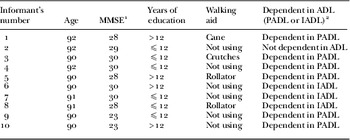
The participants (see Table 1) were characterised by various health complaints including heart problems, cardiac fibrillation, breathlessness, diabetes, hernia of the oesophagus, osteoarthritis, unsteadiness and balance problems. All of them had multiple conditions, i.e. two or more health complaints. Several suffered from sensory deprivation, such as vision and hearing problems. They required varying degrees of care and help in order to be able to pursue their lives at home. Table 1 shows disability in the activities of daily living (ADL). ADL were recorded according to the need for assistance (1) or not (0) within the following areas: mobility indoors, mobility outdoors, grooming, dressing, eating, shopping, preparing meals, heavy housework, light housework and medication. ADL consist of ‘personal ADL’ (PADL) and ‘instrumental ADL’ (IADL). The PADL contained the items grooming, dressing, toileting and eating. IADL contained the items shopping, preparing one's own meal, doing heavy housework and doing light housework. Dependency in PADL and IADL was defined as needing help on at least one item (Bergland Reference Bergland2002).
Characteristics of the participants

Notes: N=10. 1. The Mini-Mental State Examination, used to assess global cognition, scored between 0 and 30, where a higher score indicates better performance (Folstein, Folstein and McHugh Reference Folstein, Folstein and McHugh1975). 2. Women who need help in any of the personal activities of daily living (PADL) or instrumental activities of daily living (IADL) were classified as dependent in activities of daily living (ADL), while those who do not need help were classified as not dependent (Keeler et al. Reference Keeler, Guralnik, Tian, Wallace and Reuben2010).
Five overarching themes emerged from the interviews: (a) positive expectations as a health resource; (b) reflection as a health resource; (c) performance and active contribution as a health resource; (d) relationships as a health resource; and (e) the home as a health resource.
The number of participants is shown in brackets after each quotation. This number could vary between 1 and 10. For instance, when a quotation represents only one informant, N=1; if three participants reported similar experiences, N=3.
Positive expectations as a health resource
According to the informants, the role of an older person must not be devoid of all requirements. There have to be positive expectations and coping requirements placed on older persons to the same degree as those placed on younger persons. Older persons are required by the health-care personnel and politicians in the society to contribute as best they can and actively cope with life, despite disability, diseases and personal losses. Furthermore, they should not always take on the role of a victim and demand that others should sort out their problems. The informants emphasised that they still experienced life as meaningful and as having a purpose. They stated that there was no point in thinking that one thing or the other might be beneficial, but then not doing anything to make it happen. Tiring oneself out is not harmful for older people, and particularly not if they accomplish something, they said. Older people often do not have to go to work the next day and can recuperate tomorrow. One participant said she was not satisfied unless she had made an effort and done her best. The informants had opinions about other people and they had opinions about themselves, and they did not like to think of themselves as feeble people who were just making demands without trying to do their best. This applied to both mental and physical efforts, and it is what gave them a feeling of satisfaction. One informant said:
What makes me angry is when people sort of think that because I am 90 years old I can't do this or that. I want to manage on my own and am motivated by the meaning the daily tasks have for me. I don't want my activities to be reduced just because I am older … Older people are very different, and I want to be respected as the older person I am and for what I do. For example, my grandchild's mother-in-law lived in Oslo. I sent her an invitation; first, I tried to call her on her mobile phone, and then I sent her a text message. So then she asked my grandchild if his grandmother got help in writing the text message she had received. That made me a little angry. But then my grandchild answered no, grandmother has learned to do all that, so she didn't get any help. And does she really drive a car? As if I had been doing something illegal! (N=1)
Reflection as a health resource
The informants stated that their position as individuals and members of society is dependent on their knowledge of society, values, attitudes and practices, which makes for greater predictability in the activity and interaction of everyday life. They still want to use their brains. The informants reflected upon how other people or society treat them as an older person. They liked to be met with openness without too many prejudices about old people, and this seemed to have positive effects. They pointed out differences between older people and individual ageing habits:
Because I think that as old people we are just as different, if not more different, than people who are younger. Becoming old is not a predetermined fate, and you have to make your contribution. You still have goals you want to reach. I want to be me. (N=6)
Our participants recognised the need to accept that age does not have the same qualities as youth and adulthood once had. They try to appreciate the qualities that old age may offer. One said:
Though a positive outlook is very important in situations such as ours, we all know that we will get weaker as years go by. I don't mean that I need to be 100 per cent healthy and have no problems. Good is good enough. If necessary, it is good to know that you can receive help from the social and health services – such as help with housework, a community nurse, a personal security alarm or transport. You need to be able to cherish the joys of life even when you are very old, and you need to have enough energy for things that make your life special. (N=4)
Most of them had home carers and felt this helped. It is important to accept that someone else can do what they cannot do for themselves, without it being an excuse for doing nothing. All the women said that adaptive strategies are an important resource in everyday life. They also find it important to compensate for decreasing capacities and to be realistic about ageing processes and what this implies for their lives. One said:
However, I can't maintain a quarter-acre garden, so I have decided that whatever is outside the house is nothing I should worry about. I just let it grow, but then I have invested a lot of work in the flowers on the terrace. (N=2)
Another said:
There is a saying: ‘What matters is not what you have, but how you use it…’ (N=4)
Respect as an important factor in having a good life, good health and therefore thriving, is one of the themes expressed by the informants, as one woman stated:
Respect is very important, both self-respect and other people's respect. It may be difficult to keep your self-esteem. Lack of physical strength makes you dependent on help for some things, and when decisions are being made, they tend to ignore you, so you need to have a ‘positive attitude and to show that you are still curious and motivated to learn’. (N=5)
Two of three informants reflected on their lives and the importance of living consciously. One said:
To make good choices, it is important to spend time developing a secure inner identity. To live consciously requires a strong focus. Self-control is important as well as the feeling of being able to perform the activities of daily living. (N=6)
Performance and active contribution as a health resource
Several informants had a pragmatic view of health and spoke of failing health as anticipated and a challenge with which they have to cope. One important health resource asset is associated with good mental faculties, expressed by some people as being satisfied that they were still in good mental shape. They emphasised that being able to understand things is very important. As long as they felt in good mental shape, they were grateful. Many of them experienced becoming older as tough, but they could handle it:
Old people are prone to assume the role of blaming their age if they can't manage to do something or hope to do something in vain. (N=6)
The informants stated the importance of feeling useful and at the same time they found that it was good to experience receiving some care from their relatives. Some of the informants described being satisfied when they were reasonably fit and had the energy to do a lot but had to accept inevitable losses. The informants said they would pull themselves together and think they could do this and that. They thought it important not to give in. They said ‘if you stop doing things, it's all over’ and ‘people have to shape their own lives’ (N=8).
They felt their energy was waning. Having energy to meet a new day was important. They did not want to just settle down in a chair. In fact, they considered that their performance and the contribution they made in their daily life were important for their self-esteem. They wanted to manage as much as possible on their own. This seemed to give them pleasure and made them optimistic.
The feeling is that I do these daily tasks because it is important in motivating me to do my best. The feeling of autonomy and competence make me happy and are important for my health. (N=5)
Perseverance was deemed by several participants to be healthy. In order to have a good old age they saw the importance of contributing as long as they could.
Most of them were satisfied that their body was still functioning. It was significant for them to be able to get around and walk, even though many had a lot of pain and disabilities. One woman expressed what she thought:
It is a bit sad to become so old, because it takes such a long time to do things; I have always wanted to go quickly, to put things in order. I can't do that any longer. I turned 90 last month. Losing one's energy is the worst thing about becoming old. I need energy in order to think and feel as well as make choices. Ninety years is an advanced age, and I don't think I am in such bad shape. When my health is fairly good, I have the energy to make my own decisions and prioritise what is of greatest importance to me. (N=5)
Some informants said that being able to get around provides them with feelings of independence and self-worth, as well as providing the opportunity to participate in society and learn new things.
Relationships as a health resource
The informants had experienced how relationships promoted their health and contributed to a feeling of coping in their everyday life. One informant, referring to trying times, said that she attempted to console herself and that life was good:
I have a lovely family. I have grandchildren and great-grandchildren, and they are so sweet. We get text messages and I get telephone calls and then I think you should almost be ashamed of yourself since you are so well off, and so on. (N=7)
The informants related how their formal and informal carers had made arrangements so that they could remain in their own homes. However, they had different experiences with carers and had made autonomous decisions:
I hovered a little because, you see, I had home help once a month and that used to make me so nervous. First of all, they didn't show up sometimes and, secondly, they worked on the middle of the floor, and I can take care of the area in the middle of the floor myself. So I became cross and told them I didn't want this anymore. So I have a daughter and she helps me a lot. But now she is on a health therapy trip, and therefore I have had to do some work. But I started early this morning and did one room at a time, and I rest on the sofa at intervals. My daughter has made dinner portions for me. She made almost 24 portions before she left, so all I have to do is warm them up. That's handy. (N=4)
Interacting with other people was important for the informants. It colours their life in a positive way and they forget all their infirmities. It creates meaning, even though they think there is a price to pay in terms of their health. Having a pet can help, as described by one informant:
Getting outdoors and having my faithful dog. I used to talk a lot to the dog, and it was great company. The dog has meant so much to me in terms of having contact and having someone to care for. My dog has inspired me to get outdoors. (N=1)
The informants said that others' behaviour and statements had contributed positively to their own mental health, for example being praised by her daughter, as one informant stated:
My daughter told me, you are really creative. I think that was nice to hear. It is nice to get positive feedback when one becomes older. I don't want to get out of date, even though I am 90 years old. Being seen is important. Likewise, I am thankful for being appreciated and that I am still able to surprise people. (N=2)
They are acknowledged when meeting other people and that strengthens their self-image.
The home as a health resource
The significance of a home is described in various ways, and its significance for health can also vary. The informants said that it meant much to them that they have their own things and can do as they please and can come and go freely, and that they can take walks, too. This is very meaningful. The home is a base that they can return to. They point out their ability to adapt their home to their different needs. One said she can sit in the house, even if she has to be in a wheelchair.
Everyone said that the house, as a home, is very significant:
This is my home base, and I am happy to have it. Shortly after my husband died, people started to ask … where do you live … where do you live now? I live where I have always lived, I replied. Are you staying in that big house alone, that big flat? But my friends, I said, why should I move away from here? It doesn't get any larger just because there is only one person rambling around in it. (N=7)
Several informants mentioned the significance of continuity in the home. Almost all of them have lived in their home, the same house, since they got married. They say that the house says a lot about their life and what they have experienced. Likewise it says something about their development. They realised that they could not manage to do much anymore, and, therefore, they did not keep the house in the same state as before. They said that they try to accept that.
The importance of home is also illustrated by their anxiety at the thought that they might have to leave their home. They want to live in their own home as long as possible. One informant described her fear of having to leave her home and that this would be rather painful:
Something inside me dies, and that has happened every time I have moved home. So one has to brace oneself for throwing things away and then do it and accept that new situation.
She said that the new owner of her former home had not kept many of her belongings, and that
…in a way it is a good thing that they have not kept very many of my belongings. Because now when I go up there, it does not really belong to me. It's become something else. (N=3)
It had become easy for her to accept her new situation and that this was not her home anymore.
Replying to the question of what is the ‘meaning of your home for you’, one informant seemed to have a clear opinion, saying:
I'll tell you exactly the way it is. I am so happy that I am safe and secure until I leave this world. And I am really happy to have a home, because I know what it means to be surrounded by strangers in the community. My home is the framework around my daily life and gives me the opportunity to experience many new things. I can invite friends here. My daily life is here, and I have had many experiences in my home, and memories are revived, for better or for worse. Life consists not only of joys but also of sorrows and worries. Without the good things, it is difficult to imagine the bad things, and vice versa. What is important about having a home is that you have your own front door, you have your own letterbox, because there may have been a time, of course, when you didn't have those things. So there have been a few transitions. In your home, you can shield yourself. I feel that I am the one who sets the agenda in my own home. That gives me a good feeling. I am still empowered and have authority. Being a guest of others is no picnic. (N=1)
Discussion: ‘health capital’ – an important resource in old age
A main theme emerging from the data is ‘health capital’ as an important resource in old age. Health capital in this context is a positive resource-oriented concept. Health capital includes different types of knowledge and skills. For these women health capital was linked to cognitive, physical dimensions and their environment. They point to the importance of being able to do things, have relevant knowledge and being able to understand, i.e. construct meaning for oral and written communication and make judgements based on own values and norms; e.g. walking around, reading books or newspapers, or doing some work in the house. Functional health seems to be thought of in terms of having a fit body, not being too much restricted, but being able to do the things or needs of their everyday life. This might be related to being well adapted to the environment, engaging in interaction with the physical and social world. The body's functional capacity is the foundation of health capital, because it forms the basis for comprehension and knowledge of oneself, that of significant others and one's own environment. Its possession allows more adaptable and meaningful behaviour. The body seems to be an important centre of the women's own experience of health.
Health capital has a positive influence on the performance and problem-solving ability of older people. The informants reflected upon what it meant to be an older person: their personal histories, their ideas and their assumptions about society, which could have helped them to make sense of their lives and the society in which they lived, leading them to have a good and meaningful life. They gave voice to feelings and shape to experiences, exploring issues of health resources and values. We found that a central dimension of being old for our participants is a striving to understand, to find meaning, to map oneself and one's actions on the world, and this is the essentially human feature of health capital.
Our data indicate that health capital facilitates individual health-promoting behaviour generated by networks of relationships, reciprocity, trust and social norms. Health capital seems to be fundamentally about how people interact with each other and can support each other. It is important to have people who can be expected to provide support and share the resources they have at their disposal, e.g. activities or processes which create and mobilise health resources. Trust, tolerance and safety are key factors in health capital, and this corresponds well with Blaxter's ideas (Reference Blaxter2010).
The sense of coherence develops from experiences over a whole lifetime (Antonovsky Reference Antonovsky1979, Reference Antonovsky1987), as health capital also does. The women in our sample pointed out the importance of mental and relational experiences. In Antonovsky's article, ‘The salutogenic model as a theory to guide health promotion’, he clarified his theory of sense of coherence and stated that the sense of coherence is constructed as a generalised orientation towards the world which perceives it, on a continuum, as comprehensive, manageable and meaningful (Antonovsky Reference Antonovsky1996). Health is more often understood in a broader, bio-psycho-social existential sense (Christensen et al. Reference Christensen, Doblhammer, Rau and Vaupel2009; Espenes and Smedslund Reference Espenes and Smedslund2009). We found that ‘health capital’ relates to the participants' health, expectations, reflections, performance, relationships and the surroundings of home. When asking lay Norwegians about their comprehension of health (Fugelli and Ingstad Reference Fugelli and Ingstad2009), it became obvious that most people regarded health in just this multi-dimensional, holistic way. Also most people are rather pragmatic about what they consider to be healthy. They proclaim that they can have good health despite having a disease and do not expect utopian, perfect health or complete wellbeing: ‘Good is good enough’.
Blaxter (Reference Blaxter2010: 25) described ‘health capital’ as a useful way of thinking of positive health. This interpretation fits with our data. One woman stated that you need ‘to have enough energy for things that make your life special’, and some others pointed out the importance of being a little optimistic and accepting their inevitable losses. Our data confirmed the statement of Volanen (Reference Volanen2011) that the experience of ‘good enough’ health is attributable not only to favourable biological factors, but also to supportive material, social and psychological environments, which contribute positively to the person's health capital. Our participants talked about the importance of interacting with other people and of living in their own home.
These women have lived for 90 years, which had given them opportunities to develop good judgement based on experience. Our findings indicate that to build health capital requires reflection in order to understand what we already know and to challenge established practices, habits and routines, adapting our own capacity according to our own resources as well as to the available resources in society. These women's stories illustrate how ageing could be associated with developments in society, and the importance of knowing how to use technology, such as the mobile phone, as quoted in the section on positive expectations. Participating in activity provides a sense of influence and meaning. Health resources refer to the connections between individuals, and the expectation of reciprocity leads to trust. Our participants talked about their different formal and informal relationships with other people. Trust involves the belief that others will act in ways that are appropriate and predictable (Falk and Kilpatrick Reference Falk and Kilpatrick2000). Purposeful activity is also an important part of health capital. Body capacity seems to be one of the foundations of health capital because it forms the basis for comprehension and self-knowledge, but equally one's own environment is also an important component of health capital (Blaxter Reference Blaxter2010). These women stated that knowledge of society, values, attitudes and practices makes for greater predictability in the activity and interaction of everyday life. The socio-ecological model of health (Stokols Reference Stokols1996) emphasises the dynamic interplay between situational and personal factors rather than focusing exclusively on environmental, biological or behavioural determinants of health and wellbeing. These women showed that their health can be seen as ‘accepting that I'm not as fit as I used to be’.
Throughout life, opportunities exist for the augmentation or depletion of this health capital. It is depleted as a result of the dangers and stresses of unhealthy activities, by the shared experience of particular historical environments, such as medical epidemics or economic depressions. It can be added to by positive life-enhancing circumstances, by ‘healthy’ behaviour and by the search for fitness. These women seemed to know about and practise health-promoting activities such as walking and looking after themselves and, where possible, housework. Our findings support Blaxter's statement that health is, at the worst, keeping going and performing one's everyday activities, irrespective of disease. At best, it is a wholly psycho-social or spiritual state of wellbeing which, while of course it may be affected by illness, is not necessarily determined by it. Our informants saw health as a fluid and uncertain balance. The majority of what may be felt as ‘symptoms’ fall into a twilight zone, which may ‘really’ be illness or may simply belong to day-to-day experience. The women seemed not to be too concerned about their illnesses and diseases.
Participating in activity that provides a sense of influence boosts ‘health capital’ and is important because it leads to trust and co-operation; conversely, a reduction in health capital weakens this influence. Having a strong ‘sense of coherence’ is believed to be a major coping resource for maintaining good health. According to Antonovsky, people with a strong ‘sense of coherence’ will engage in adaptive health behaviour more often than those with a weak ‘sense of coherence’ (Antonovsky Reference Antonovsky1987), and that seems to characterise these women.
The study reported on in this paper adopted a salutogenic orientation. Antonovsky's ‘sense of coherence’ theory relates to resources, mechanisms and interactions involved in the adaptive capacity of humans. Antonovsky (Reference Antonovsky1987) proposes that a high level of ‘sense of coherence’ is related to the strength of the individual and his or her capacity for successful adjustment. One of our participants said ‘I don't mean that I need to be 100 per cent healthy and have no problems’. These women stated that they find it important to compensate for their decreasing capacities and prioritise what they are able to do even though they ‘depend on help in some fields’. They stated that it was good to know that you could receive help from the social and health services or members of their families. It has been suggested that having a purpose in life facilitates adaptation to the changing life circumstances that accompany the ageing process (Nygren Reference Nygren2006). The processes of seeking sense and the manner in which meaning is experienced may be a part of this favourable adjustment. Making sense, remaining motivated and finding you have something to give are all part of this adaptation. One woman declared that she was not satisfied if she did not make an effort and do her best. Furthermore, many of our participants also found it important to compensate for decreasing capacity and to be realistic about the ageing process and what this implies in their lives. There are several models describing adaptive strategies in everyday life as well as set outcomes they like to achieve. Regarding positive aspects of ageing, one woman stated, ‘You still have goals you want to reach’.
These women seem to be capable of using strategies and think they are important for their emotional wellbeing and life satisfaction: ‘It is nice to get positive feedback when one becomes older. I don't want to get out of date’.
The contribution of this study to the existing literature on ‘sense of coherence’ in older adulthood is to present rich descriptions of experiences, coping strategies and actions that characterise the daily life of older women. Although research studies have consistently indicated that a ‘sense of coherence’ fosters adaptive behaviour and promotes physical and psychological wellbeing, there is a paucity of detail regarding these experiences. By describing and interpreting older adults' own statements, this qualitative study contributes important insights into how elderly adults can adapt to the challenges of daily life and manage living at home. These findings may be important in shaping health-promotion interventions with elderly adults. This study is also unique in that it applies a ‘sense of coherence’ framework with a focus on women aged 90 years or over and their experiences in their daily life.
Conclusion
In conclusion, the findings presented in this paper suggest that health resources such as positive expectations, reflection and adaptation, performance and active contributions, relationships and home, can contribute to the health capital of older women. These health resources were important for the women's experience of the comprehensibility, manageability and meaningfulness of daily life. This study has provided insights into the participants' understanding and experiences of the challenges of everyday life within a salutogenic theoretical framework. In our material we find descriptions illustrating the different branches of the ‘sense of coherence’. They experience comprehensibility, as seen in the statement that the life of most of the participants made sense to them. Manageability is illustrated by the idea that problems could be bearable, and that they had been able to stay at home so far. Furthermore, meaningfulness could be illustrated in their belief that life should be experienced as a challenge, and that they are actively involved in their everyday life. Health capital is a meaningful concept for older people's understanding of coping in everyday life. The implication of these findings is that knowledge about salutogenesis and the adaptive strategies of older persons may provide a foundation for consultation and co-operation between professionals and patients. The older persons' actual ability to participate and communicate in their everyday life varied. Thus, health professionals had to be aware that needs assessments and interventions should be individually tailored to enhance older people's comprehensibility, manageability and meaningfulness of their everyday life. Needs assessments and interventions must be reviewed to promote the sense of coherence and participation of those involved.
Acknowledgements
We thank the women for partaking in the study. The authors disclose receipt of the following financial support for the research and/or authorship of this article: being professors at the Faculty of Health Sciences, Oslo and Akershus University College, Oslo, Norway. The authors declare no conflicts of interest with respect to the authorship and/or publication of this article.