Introduction
Neuroprotective effects of lithium (Li) have been documented in tissue cultures and animal models (Gould et al. Reference Gould, Picchini, Einat and Manji2006; Zarate et al. Reference Zarate, Singh and Manji2006). Prospective and cross-sectional neuroimaging studies in human subjects have shown an association between Li treatment and larger gray matter (GM) volumes (Moore et al. Reference Moore, Bebchuk, Wilds, Chen and Manji2000, Reference Moore, Cortese, Glitz, Zajac-Benitez, Quiroz, Uhde, Drevets and Manji2009; Monkul et al. Reference Monkul, Matsuo, Nicoletti, Dierschke, Hatch, Dalwani, Brambilla, Caetano, Sassi, Mallinger and Soares2007; Yucel et al. Reference Yucel, McKinnon, Taylor, Macdonald, Alda, Young and MacQueen2007; Lyoo et al. Reference Lyoo, Dager, Kim, Yoon, Friedman, Dunner and Renshaw2010; Hajek et al. Reference Hajek, Kopecek, Hoschl and Alda2012c ). However, the nature and mechanism of these in vivo actions of Li remain unclear (Bauer et al. Reference Bauer, Alda, Priller and Young2003). Without further clinical research, the potential neuroprotective effects of Li are of little practical benefit to our patients.
For example, we do not know whether the positive association between GM volumes and Li treatment reflects a direct neurochemical effect of Li or an indirect effect secondary to treatment response (Moore et al. Reference Moore, Cortese, Glitz, Zajac-Benitez, Quiroz, Uhde, Drevets and Manji2009; Lyoo et al. Reference Lyoo, Dager, Kim, Yoon, Friedman, Dunner and Renshaw2010). Li could exert neurotrophic effects by interacting with biochemical pathways involved in neurogenesis and apoptosis (Zarate et al. Reference Zarate, Singh and Manji2006). Alternatively, Li may affect brain structure through treatment or prevention of episodes of bipolar disorder (BD), which are known to exert toxic effects on the brain (Berk et al. Reference Berk, Kapczinski, Andreazza, Dean, Giorlando, Maes, Yucel, Gama, Dodd, Dean, Magalhaes, Amminger, McGorry and Malhi2011; Hajek et al. Reference Hajek, Bauer, Pfennig, Cullis, Ploch, O'Donovan, Bohner, Klingebiel, Young, MacQueen and Alda2012a ). This distinction is crucial. If the effects of Li on brain structure were simply related to acute or prophylactic treatment response, they would probably not generalize to other conditions, such as Alzheimer's disease (AD). Prospective short-term studies have shown that GM increases mostly in patients who also improve clinically (Lyoo et al. Reference Lyoo, Dager, Kim, Yoon, Friedman, Dunner and Renshaw2010) or even predominantly among responders to acute treatment (Moore et al. Reference Moore, Cortese, Glitz, Zajac-Benitez, Quiroz, Uhde, Drevets and Manji2009). This might indicate that the GM changes are an epiphenomenon of treatment response rather than a direct result of Li exposure. However, no study has investigated the association between brain structure and long-term prophylactic response to Li.
In addition, the GM differences between patients with versus without Li treatment may reflect patient heterogeneity rather than effects of Li (Hajek et al. Reference Hajek, Kopecek, Hoschl and Alda2012c ). The Li responders are likely to represent a distinct neurobiological category within BD (Grof et al. Reference Grof, Duffy, Alda and Hajek2009). It is possible that it is only the patients who do not respond to Li who have a neuroprogressive nature of the illness and show brain structural changes. It would be of much less practical impact if the association between Li treatment and GM volumes simply reflected neurobiological differences between Li responders and non-responders rather than the effects of Li.
We addressed the above-listed issues in a sample of prospectively followed patients with BD and either long-term ongoing Li treatment (minimum of 2 years) or no/minimal lifetime Li exposure. To maximize the effects of BD on the brain, we recruited BD patients with substantial illness burden (minimum of 10 years of illness and at least five episodes). Among brain regions, Li treatment has been associated most consistently with hippocampal volume increases even at meta- (Hajek et al. Reference Hajek, Kopecek, Hoschl and Alda2012c ) and mega-analytical (Hallahan et al. Reference Hallahan, Newell, Soares, Brambilla, Strakowski, Fleck, Kieseppa, Altshuler, Fornito, Malhi, McIntosh, Yurgelun-Todd, LaBar, Sharma, MacQueen, Murray and McDonald2011) levels. Therefore, we chose the hippocampus as our model region to further investigate the interplay between treatment response and potential neuroprotective effects of Li. Our a priori hypothesis was that hippocampal volumes would be smaller among BD patients with substantial illness burden and limited Li exposure, whereas BD patients with substantial illness burden and ongoing Li treatment would show comparable hippocampal volumes to controls. We also hypothesized that the positive effects of Li on hippocampal volumes would be found only among subjects with no episodes of BD while being treated with Li.
Method
This study was designed specifically to test the effects of long-term Li exposure on hippocampal volumes. Through recruitment of patients with substantial illness burden (duration of illness, number of episodes), we attempted to maximize the effect of BD on the brain (Moorhead et al. Reference Moorhead, McKirdy, Sussmann, Hall, Lawrie, Johnstone and McIntosh2007; McKinnon et al. Reference McKinnon, Yucel, Nazarov and MacQueen2009). By setting stringent criteria for presence and also absence of Li treatment, we ensured a sufficient contrast between the groups in exposure to Li and minimized any effect of past history of Li treatment on GM volumes. Patients were not required to show complete treatment response to Li. They may have had a partial response, Li could have been effective in treating but not preventing the symptoms or may have prevented or effectively treated only episodes of one polarity. Li may have also been used for antisuicidal effects or as an augmentation. This allowed us to investigate whether we would detect the association between Li treatment and brain structure even in patients who continued to experience episodes of BD while on Li, or whether these effects required cessation of episodes.
We studied three groups of subjects: (1) those with substantial ongoing exposure to Li and a marked illness burden (Li group), (2) those with limited or no lifetime exposure to Li and a marked illness burden (non-Li group) and (3) an age- and sex-matched control group. To test whether the association between Li treatment and brain structure was present despite ongoing episodes of illness, we divided the Li-treated subjects based on whether they did or did not experience a major depressive, mixed or manic episode according to the full DSM-IV criteria while being treated with Li. The episode had to be of at least moderate severity according to the life-chart method (Roy-Byrne et al. Reference Roy-Byrne, Post, Uhde, Porcu and Davis1985), which corresponds to an affective morbidity index of at least 2, that is change in symptoms requiring an intervention (Coppen et al. Reference Coppen, Montgomery, Gupta and Bailey1976).
The International Group for the Study of Lithium-Treated Patients (IGSLi; www.igsli.org) conducted the study. Participants were recruited in Halifax, Canada (n = 33), Poznan, Poland (n = 20), Neunkirchen, Austria (n = 21), and Dresden (n = 5) and Berlin, Germany (n = 27).
The study was approved by the Research Ethics Boards at each site. After complete description of the study, all included subjects signed an informed consent. Of the 106 subjects recruited for this study, 47 had also participated in our previous investigation of prefrontal N-acetylaspartate (Hajek et al. Reference Hajek, Bauer, Pfennig, Cullis, Ploch, O'Donovan, Bohner, Klingebiel, Young, MacQueen and Alda2012a ).
Settings
Patients with BD were recruited from specialized mood disorders clinics at each site. All patients were diagnosed by psychiatrists using the Structured Clinical Interview for DSM-IV (SCID) and had regular follow-up at the clinics, including monitoring of Li levels at least twice a year. Recruitment of Li-treated subjects from specialized clinics ensured that Li levels fell in the therapeutic range. This prevented subtherapeutic levels, which could be insufficient to elicit neuroprotective effects, and levels above the therapeutic range, which could be neurotoxic. We established illness course and treatment response to Li using the National Institute of Mental Health Life-Chart Method (NIMH-LCM™; Roy-Byrne et al. Reference Roy-Byrne, Post, Uhde, Porcu and Davis1985). We also recruited control subjects, by word of mouth and through advertisement, who were matched to the BD patients by age and sex. Each control subject underwent a SCID and was included if found to have no personal or family history of Axis I psychiatric disorders.
Inclusion criteria
The BD participants (both Li and non-Li groups) were required to have: (1) the diagnosis of BD type I or II made by a psychiatrist using the SCID; (2) at least 10 years duration of illness; (3) a history of at least five major affective episodes (hypomanic, manic, depressive or mixed); and (4) absence of major mood episode based on DSM-IV criteria during prospective follow-ups at least 4 months before recruitment, to minimize confounding by state-related factors.
The Li-treated group (Li group) had to have a current adequate Li treatment lasting a minimum of 24 months. Adequate Li treatment was defined as plasma levels between 0.5 and 1.2 mmol/l on every blood test, with a frequency of blood tests minimally twice every 12 months (Licht et al. Reference Licht, Vestergaard, Kessing, Larsen and Thomsen2003). The group of patients with no or minimal exposure to Li (non-Li group) had to have less than 3 months of lifetime Li exposure, and no Li for at least 24 months prior to scanning.
Exclusion criteria
Subjects from any of the three groups were excluded if they met any magnetic resonance imaging (MRI) exclusion criteria or had any serious medical illness (e.g. brain injury, Cushing's disease or conditions treated with corticosteroids).
BD patients were excluded if they had (1) more than one lifetime course of electroconvulsive therapy (ECT); (2) co-morbid Axis I or II psychiatric disorders; (3) active substance abuse in the previous 12 months; (4) discontinuation or introduction of a psychotropic medication in the past 3 months; (5) more than two psychotropic medications excluding benzodiazepines or hypnotics; or (6) current psychotic features or acute suicidality.
MRI acquisitions
In Halifax, MR acquisitions were performed with a 1.5-T General Electric Signa scanner (General Electric Medical Systems, USA) and a standard quadrature head coil. After a localizer scan, a T1-weighted spoiled gradient recalled (SPGR) scan was prescribed with the following parameters: flip angle = 40°, echo time (TE) = 5 ms, repetition time (TR) = 25 ms, matrix = 256 × 160 pixels, number of excitations (NEX) = 1, no inter-slice gap, 124 images, 1.5 mm thick.
In Dresden, MR acquisitions were performed with a 1.5-T Siemens, Sonata scanner (Siemens AG, Germany) and a standard quadrature head coil. After a localizer scan, a T1-weighted three-dimensional (3D) magnetization-prepared rapid acquisition with gradient echo (MPRAGE) scan was prescribed with the following parameters: flip angle = 15°, TE = 3.93 ms, TR = 2280 ms, matrix = 256 × 256 pixels, NEX = 1, no interslice gap, 160 images, 1.0 mm thick.
In Poznan, MR acquisitions were performed with a 1-T General Electric Signa scanner and a standard quadrature head coil. After a localizer scan, a T1-weighted SPGR scan was prescribed with the following parameters: flip angle = 45°, TE = 6 ms, TR = 22 ms, matrix = 256 × 256 pixels, NEX = 1, no interslice gap, 124 images, 1.2 mm thick.
In Neunkirchen, MR acquisitions were performed with a 1-T Siemens, Magnetom Expert scanner and a standard quadrature head coil. After a localizer scan, a T1-weighted 3D MPRAGE scan was prescribed with the following parameters: flip angle = 15 degrees, TE = 4.4 ms, TR = 1.1, matrix = 256 × 256 pixels, NEX = 1, no interslice gap, 112 images, 1.5 mm thick.
In Berlin, MR acquisitions were performed with a 1.5-T Siemens scanner and a standard quadrature head coil. After a localizer scan, a T1-weighted 3D MPRAGE scan was prescribed with the following parameters: flip angle = 15°, TE = 3.93 ms, TR = 2280 ms, matrix = 256 × 256 pixels, NEX = 1, no interslice gap, 160 images, 1 mm thick. The acquisition parameters reflected the expertise and previous experience of radiologists within each site, who preferred to use methods with which they were already familiar and that yielded high quality data on their individual scanners.
Hippocampus measurement
We used manual tracing to measure hippocampal volumes. Relative to primarily exploratory voxel-based morphometry (VBM), manual volumetry was more optimal for our hypothesis testing study, allowing for a better control of differences between the sites (see Statistical analyses) and a greater statistical power. VBM, even with small volume correction, requires control for hundreds of voxelwise comparisons within the masks constituting the hippocampus. In addition, manual volumetry has been used more widely in previous studies investigating the effects of Li on brain structure (Hajek et al. Reference Hajek, Kopecek, Hoschl and Alda2012c ), thus allowing for a better comparability of results with previous investigations.
We analyzed the data with the AFNI software package (NIMH, USA; http://afni.nimh.nih.gov/afni/). In addition to the T1-weighted images, we used the AFNI swap feature to generate negatives that approximated a T2-weighted image. This allowed a better visualization of the alveus.
A single rater (K.Y.) blind to diagnostic status and Li treatment history measured the right and left hippocampi using a manual tracing method with an established protocol (Yucel et al. Reference Yucel, Taylor, McKinnon, Macdonald, Alda, Young and MacQueen2008). The hippocampus was defined anatomically as the hippocampus proper (Ammon's horn), the dentate gyrus and the subiculum. The alveus, fimbria and fornix were excluded from these measurements. Hippocampal volumes were measured by one rater with reliability confirmed by a second investigator, falling within 5% between raters. The intraclass correlation coefficient for reliability of hippocampal tracings was 0.97 and 0.99 for the right and left hippocampus respectively.
Statistical analyses
We compared categorical clinical and demographic variables using Pearson's χ 2 test and continuous variables using a one-way analysis of variance (ANOVA) or the t test. The primary analysis for the neuroimaging data was a repeated-measures analysis of covariance (ANCOVA) with hippocampal volumes as the dependent variable, side (left, right) as the repeated measure, group (Li, non-Li, control) as the categorical factor and total GM as a covariate. Covarying for GM controlled for global effects of Li and adjusted for potential differences between the sites. Because the duration of illness was truncated by our inclusion criteria and there was no association between duration of illness and hippocampal volumes, we did not use it as another covariate. We also compared each two of the three groups with post-hoc pairwise t tests, for which we report p values corrected for three comparisons. As there was no interaction between side and group, we used total hippocampal volumes adjusted for total GM in post-hoc analyses.
To further control for potential differences between the sites, we (1) calculated z scores within each site and used these for the analyses, and (2) used the raw data and performed repeated-measures ANOVA with hippocampal volumes as the dependent variable, side (left, right) as the repeated measure and status (Li, non-Li, control subjects) and group as the categorical factors. This last method was used for sites that contributed sufficient numbers of participants in each group, namely Halifax, Neunkirchen and Poznan. No non-Li participants were recruited in Berlin, and the Dresden site recruited a total of five subjects.
To test whether the effects of Li on hippocampal volumes were related to treatment response, we compared patients with episodes while on Li to patients with no episodes on Li, controls and the non-Li group in a series of t tests. We corrected the p values for three comparisons. As there was no interaction between side and group for any of the previous analyses, we used total hippocampal volumes adjusted for total GM as the dependent variable. To investigate the association between clinical measures and hippocampal volumes, we calculated product-moment correlation coefficients.
Results
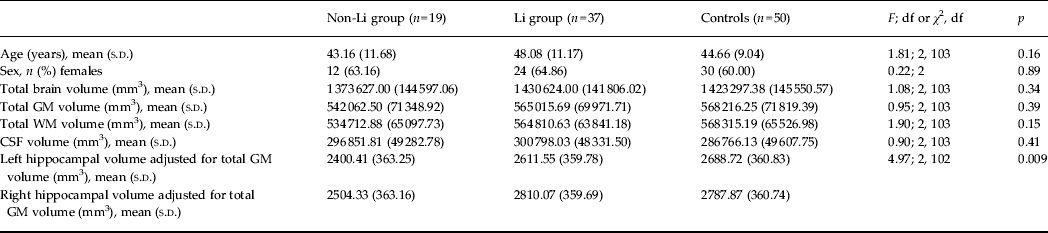
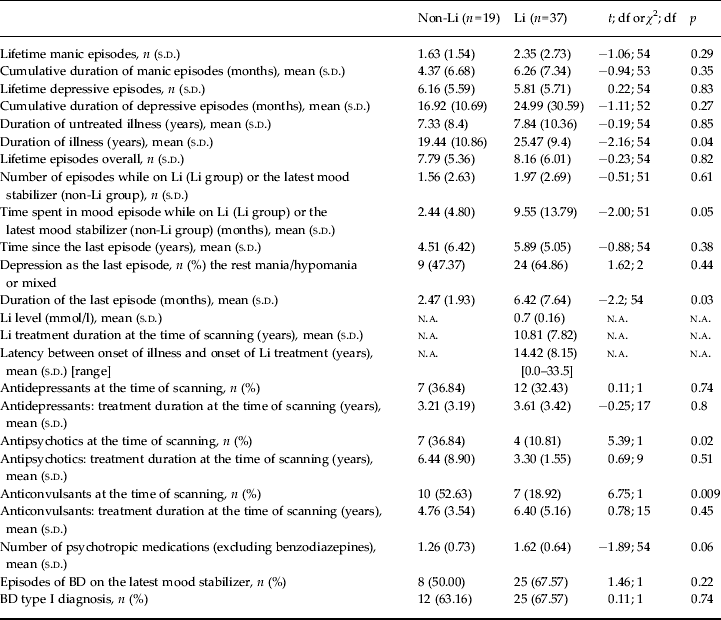
We recruited 19 non-Li, 37 Li-treated BD patients and 50 controls (Table 1). Both patient groups (Li and non-Li) had a marked burden of illness, with no significant differences between the Li and the non-Li groups in numbers of episodes, cumulative time spent in episodes, or age of onset (Table 2). The time spent in a mood episode while on the current mood stabilizer, the duration of the last episode and the overall duration of illness (time since the first episode) were longer in the Li than the non-Li group (Table 2). Non-Li participants were predominantly treated with anticonvulsants and antipsychotics. One of the BD patients in the non-Li group had had lifetime exposure to Li 9 years prior to the scanning, but did not reach therapeutic levels at that time. The rest of the non-Li group were Li naïve. The duration of Li treatment in the Li group was 10.81 ± 7.82 years, with Li levels of 0.70 ± 0.16 mmol/l at the time of scanning. There were no differences between the groups in the volumes of the whole brain, GM, white matter or cerebrospinal fluid (CSF) (Table 1).
Description of the sample

Li, Lithium; GM, gray matter; WM, white matter; CSF, cerebrospinal fluid; df, degrees of freedom; s.d., standard deviation.
Comparison of clinical variables between the non-Li and Li groups

Li, Lithium; df, degrees of freedom; BD, bipolar disorder; s.d., standard deviation; n.a., not applicable.
Hippocampal volumes
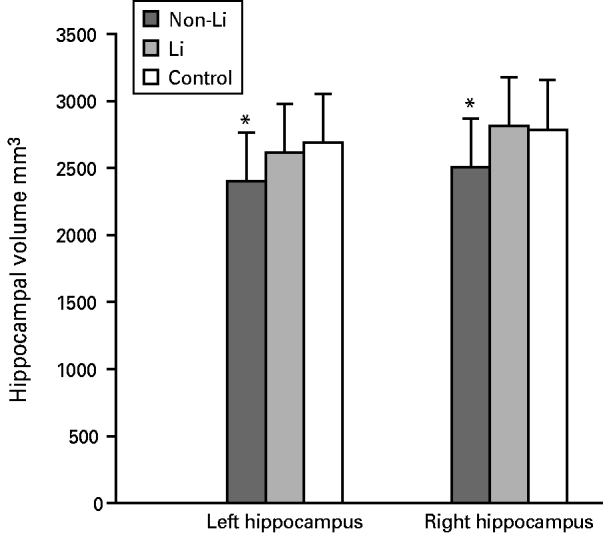
As shown in Fig. 1 and Table 1, we found significant differences between the groups in hippocampal volumes (F 2,102 = 4.97, p = 0.009). This difference was caused by significantly smaller hippocampal volumes among the non-Li group relative to controls (t 67 = −3.06, corrected p = 0.005) and also relative to the Li-treated BD participants (t 54 = −2.66, corrected p = 0.02). The pattern of the smallest hippocampal volumes in the non-Li group was found in each of the sites. The Li-treated participants had comparable hippocampal volumes to control subjects. The right hippocampus was significantly larger than the left hippocampus (F 1,103 = 32.07, p < 0.001) in all groups (no interaction between the group and side; F 2,103 = 2.28, p = n.s.).
Left and right hippocampal volumes adjusted for total gray matter volume in lithium (Li), non-Li and control groups (mean ± standard deviation). * p < 0.05 in comparison with Li and the healthy control groups.

The group differences remained significant when we used z scores instead of raw hippocampal volumes (F 2,103 = 3.82, p = 0.02) or when we included site as another factor (main effect of group: F 2,65 = 4.94, p = 0.01). There were no differences between the sites in the pattern of findings, as indicated by no interaction between the site and group (F 4,65 = 1.96, p = n.s.).
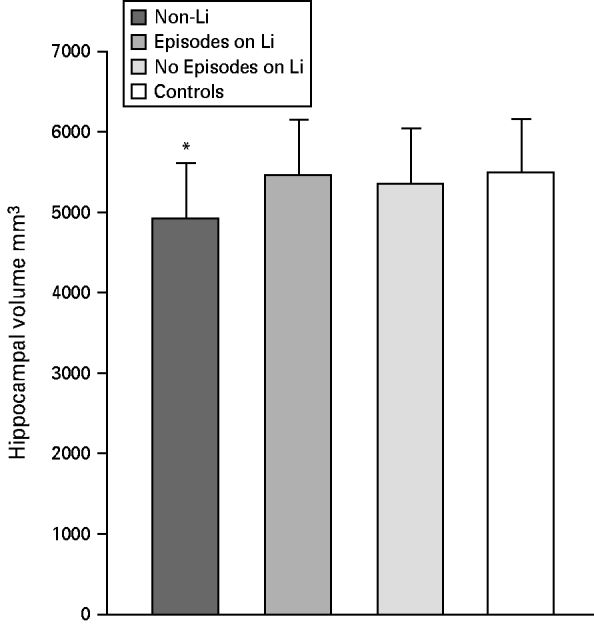
Li-treated patients who continued to experience episodes of illness while on Li (n = 25) had larger hippocampal volumes than participants in the non-Li group (t 42 = 2.62, corrected p = 0.02) and did not differ from controls (t 73 = –0.13, p = n.s.) or the Li-treated patients with no episodes while on Li (n = 12; t 36 = 0.43, p = n.s.) (see Fig. 2).
Total hippocampal volumes adjusted for total gray matter volume in participants divided based on response to long-term lithium (Li) treatment (mean ± standard deviation). * p < 0.05 in comparison to the other groups.

Hippocampal volumes did not correlate significantly with any of the clinical measures listed in Table 2 in either the Li or the non-Li group. When we excluded patients treated with anticonvulsants or antipsychotics, there continued to be the same pattern of significant differences between the groups, caused by the smallest hippocampal volumes among the non-Li participants (F 2,85 = 4.32, p = 0.02 and F 2,92 = 3.18, p < 0.05 respectively).
Discussion
Among BD participants with substantial illness burden, the group with no or limited lifetime exposure to Li had smaller hippocampal volumes than the Li-treated BD participants, who had hippocampal volumes comparable to controls. This was despite a higher activity of illness on the current mood stabilizer in the Li than the non-Li group, suggesting that the effects of Li on hippocampal volumes were unrelated to the long-term treatment response. Indeed, participants who continued to experience episodes of BD while being treated with Li had comparable hippocampal volumes to those with no episodes while on Li or controls and larger hippocampal volumes than patients not treated with Li. Consequently, because the effects of Li on hippocampal volumes seemed to be independent of its effects on episodes of BD, they might not be restricted to those with mood disorders.
Our findings are in keeping with other studies that have reported smaller hippocampal volumes in BD patients not treated with Li relative to controls or Li-treated participants (Hajek et al. Reference Hajek, Kopecek, Hoschl and Alda2012c ). One possibility is that the preserved hippocampal volumes in Li-treated subjects do not reflect the effects of Li, but rather the neurobiological differences between Li responders and non-responders. Treatment response to Li was not a selection criterion in this study and 69% of patients continued to experience episodes of illness while on Li. In addition, all but one of the non-Li participants were Li naive and there could have been Li responders among them. Consequently, potential neurobiological differences between Li responders and non-responders were highly unlikely to explain the results. A more parsimonious interpretation is that the observed differences were related to differential exposure to Li rather than to patient heterogeneity. Indeed, prospective studies have also suggested a causal association between Li exposure and brain structure, by showing GM increases pre- versus post-Li treatment (Moore et al. Reference Moore, Bebchuk, Wilds, Chen and Manji2000, Reference Moore, Cortese, Glitz, Zajac-Benitez, Quiroz, Uhde, Drevets and Manji2009; Monkul et al. Reference Monkul, Matsuo, Nicoletti, Dierschke, Hatch, Dalwani, Brambilla, Caetano, Sassi, Mallinger and Soares2007; Yucel et al. Reference Yucel, McKinnon, Taylor, Macdonald, Alda, Young and MacQueen2007) and, even more importantly, by demonstrating a greater GM change over time following randomly assigned treatment with Li compared with treatment with valproate or no treatment (Lyoo et al. Reference Lyoo, Dager, Kim, Yoon, Friedman, Dunner and Renshaw2010).
This is the first study to investigate the interplay between the long-term, prophylactic response to Li (i.e. prevention of episodes) and brain structural changes. Contrary to our findings, some previous prospective investigations reported a positive association between acute treatment response (i.e. symptom reduction) and brain structure (Moore et al. Reference Moore, Cortese, Glitz, Zajac-Benitez, Quiroz, Uhde, Drevets and Manji2009; Lyoo et al. Reference Lyoo, Dager, Kim, Yoon, Friedman, Dunner and Renshaw2010). This difference may be related to the fact that symptom reduction and episode prevention are clinically and neurobiologically distinct outcomes (Lenox & Hahn, Reference Lenox and Hahn2000; Machado-Vieira et al. Reference Machado-Vieira, Manji and Zarate2009; Willner et al. Reference Willner, Scheel-Kruger and Belzung2012). In addition, the previous studies investigated subjects after 4 weeks of Li treatment (Moore et al. Reference Moore, Cortese, Glitz, Zajac-Benitez, Quiroz, Uhde, Drevets and Manji2009; Lyoo et al. Reference Lyoo, Dager, Kim, Yoon, Friedman, Dunner and Renshaw2010), as opposed to a minimum of 2 years and an average of 10.8 years in this study. It is possible that an acute treatment response accelerates the short-term effects of Li on brain morphology, but long-term exposure to Li affects brain structure regardless of clinical response. This possibility is supported by a pharmacoepidemiological study in which only multiple prescriptions, but not a single prescription, of Li lowered the risk of neurodegenerative disorders in patients with BD (Kessing et al. Reference Kessing, Sondergard, Forman and Andersen2008, Reference Kessing, Forman and Andersen2010).
Our findings suggesting that the effects of Li on hippocampal volumes are independent of long-term treatment response are in keeping with pre-clinical studies, in which Li prevented neuronal damage in a range of neurotoxic models, including those unrelated to BD (Lauterbach & Mendez, Reference Lauterbach and Mendez2011). If the effects of Li on brain structure were simply secondary to its ability to control episodes of BD, they would be restricted to those with mood disorders and should not generalize to other conditions, such as Alzheimer's dementia (AD). Epidemiological studies have shown that Li reduces the generally elevated risk of neurodegenerative disorders among patients with BD (Kessing et al. Reference Kessing, Sondergard, Forman and Andersen2008, Reference Kessing, Forman and Andersen2010; da Silva et al. Reference da Silva, Goncalves-Pereira, Xavier and Mukaetova-Ladinska2013), which could still be related to prevention of episodes of BD. Although there are some promising results (Leyhe et al. Reference Leyhe, Eschweiler, Stransky, Gasser, Annas, Basun and Laske2009), Li may not successfully treat fully symptomatic AD (Macdonald et al. Reference Macdonald, Briggs, Poppe, Higgins, Velayudhan and Lovestone2008; Hampel et al. Reference Hampel, Ewers, Burger, Annas, Mortberg, Bogstedt, Frolich, Schroder, Schonknecht, Riepe, Kraft, Gasser, Leyhe, Moller, Kurz and Basun2009). It may be more effective in pre-symptomatic stages of the illness, where the neuropathological changes are less well pronounced. In keeping with the direct biochemical effects, Li-treated subjects with amnestic mild cognitive impairment without BD were cognitively more stable over time (Forlenza et al. Reference Forlenza, Diniz, Radanovic, Santos, Talib and Gattaz2011). Even more importantly, Li exerted a disease-modifying effect by reducing the levels of CSF biomarkers related to the pathophysiology of AD (Forlenza et al. Reference Forlenza, Diniz, Radanovic, Santos, Talib and Gattaz2011). Our study provides an additional proof of concept for further testing of Li in neurodegenerative disorders.
The hippocampal volumes among Li-treated patients in this study were comparable to controls, and not larger as reported in a previous meta-analysis (Hajek et al. Reference Hajek, Kopecek, Hoschl and Alda2012c ). There are two possible explanations for this discrepancy. First, the effects of Li on GM may be non-linear (Yucel et al. Reference Yucel, McKinnon, Taylor, Macdonald, Alda, Young and MacQueen2007). We did not find any correlations between the duration of Li treatment and hippocampal volumes. However, because all participants in this study had at least 2 years of Li treatment, this truncated distribution makes the investigation of the trajectory of Li-related changes difficult. Second, the discrepancy may be related to differences in duration of illness and Li treatment between this study and the meta-analysis (Hajek et al. Reference Hajek, Kopecek, Hoschl and Alda2012c ). Participants included in the meta-analysis had a markedly shorter duration of illness and Li treatment (weeks to years) than subjects in the current study (years to decades).
The non-Li group in our study showed smaller hippocampal volumes despite treatment with other mood stabilizers (anticonvulsants, atypical antipsychotics), with mostly pre-clinical evidence for neuroprotective effects (Zarate et al. Reference Zarate, Singh and Manji2006). In keeping with our results, previous studies, including prospective randomized comparisons (Lyoo et al. Reference Lyoo, Dager, Kim, Yoon, Friedman, Dunner and Renshaw2010), also showed greater effects of Li than of other mood stabilizers on hippocampal volumes (Beyer et al. Reference Beyer, Kuchibhatla, Payne, Moo-Young, Cassidy, MacFall and Krishnan2004; Yucel et al. Reference Yucel, Taylor, McKinnon, Macdonald, Alda, Young and MacQueen2008; Germana et al. Reference Germana, Kempton, Sarnicola, Christodoulou, Haldane, Hadjulis, Girardi, Tatarelli and Frangou2010; Hajek et al. Reference Hajek, Cullis, Novak, Kopecek, Hoschl, Blagdon, O'Donovan, Bauer, Young, MacQueen and Alda2012b ) or neuronal density (Silverstone et al. Reference Silverstone, Wu, O'Donnell, Ulrich, Asghar and Hanstock2003; Gallelli et al. Reference Gallelli, Wagner, Karchemskiy, Howe, Spielman, Reiss and Chang2005; Garcia et al. Reference Garcia, Huppertz, Ziyeh, Buechert, Schumacher and Mader2009; Hajek et al. Reference Hajek, Bauer, Pfennig, Cullis, Ploch, O'Donovan, Bohner, Klingebiel, Young, MacQueen and Alda2012a ). The effects of anticonvulsants or antipsychotics on brain structure in human subjects remain controversial, with some investigations suggesting positive effects (Garver et al. Reference Garver, Holcomb and Christensen2005; Molina et al. Reference Molina, Reig, Sanz, Palomo, Benito, Sanchez, Sarramea, Pascau and Desco2005; Atmaca et al. Reference Atmaca, Ozdemir, Cetinkaya, Parmaksiz, Belli, Poyraz, Tezcan and Ogur2007; Stip et al. Reference Stip, Mancini-Marie, Letourneau, Fahim, Mensour, Crivello and Dollfus2009), but the majority of studies reporting no or negative effects of these medications on the brain (Khorram et al. Reference Khorram, Lang, Kopala, Vandorpe, Rui, Goghari, Smith and Honer2006; Ebdrup et al. Reference Ebdrup, Skimminge, Rasmussen, Aggernaes, Oranje, Lublin, Baare and Glenthoj2011; Tariot et al. Reference Tariot, Schneider, Cummings, Thomas, Raman, Jakimovich, Loy, Bartocci, Fleisher, Ismail, Porsteinsson, Weiner, Jack, Thal and Aisen2011; for reviews see Moncrieff & Leo, Reference Moncrieff and Leo2010; Leung et al. Reference Leung, Cheung, Yu, Yip, Sham, Li, Chua and McAlonan2011). In light of these studies, we need to consider the possibility that the GM changes in the non-Li group were related to a greater exposure to antipsychotics or anticonvulsants. This is perhaps less likely because, in our study, several Li-treated patients were also exposed to anticonvulsants (18.9%) and antipsychotics (10.8%). More importantly, when we excluded patients treated with anticonvulsants or antipsychotics from both the Li and non-Li groups, there continued to be the same pattern of significant differences, with the smallest hippocampal volumes among the non-Li participants. This further supports the strength of the association, as it was confirmed in different subsamples of patients and remained significant despite a reduction in sample size.
Of note, although the non-Li participants showed smaller hippocampal volumes than the controls or the Li-treated BD patients, they were euthymic at the time of scanning, with an average of 4.5 years since the last episode. Previous studies have also reported lower hippocampal volumes in groups containing euthymic BD patients (Bearden et al. Reference Bearden, Thompson, Dutton, Frey, Peluso, Nicoletti, Dierschke, Hayashi, Klunder, Glahn, Brambilla, Sassi, Mallinger and Soares2008; Foland et al. Reference Foland, Altshuler, Sugar, Lee, Leow, Townsend, Narr, Asuncion, Toga and Thompson2008). Also similar to our result, Lyoo et al. (Reference Lyoo, Dager, Kim, Yoon, Friedman, Dunner and Renshaw2010) showed that valproate-treated BD patients improved clinically in the absence of GM increases following treatment. These findings may suggest that the normalization of brain structural changes by medications may not be necessary to achieve euthymia or mood stabilization.
This study has some limitations. Measuring hippocampal volumes prospectively would have better allowed us to establish the causality of the association between Li exposure and hippocampal volumes. Considering the extensive duration of Li exposure (average of 10.8 years), a prospective or randomized design would not have been feasible. Although we did not use randomization, the strict inclusion and exclusion criteria ensured that the groups were comparable in relevant variables known to affect hippocampal volumes. Use of other medications possibly affecting brain structure was allowed in both treatment groups. Exclusion of participants treated with antipsychotics or anticonvulsants did not change the results. The investigation of the long-term effects of Li on brain structure and their interplay with long-term clinical response required selected and relatively homogeneous samples of patients who were compliant with long-term treatment and did not have co-morbid conditions, which could have confounded the results. It is not known whether these findings would generalize to more heterogeneous samples, such as those with substance abuse or other co-morbid conditions, patients treated with more than two psychotropic medications or those with a history of multiple courses of ECT. We did not investigate the association between the potential neuroprotective effects of Li and any other clinical outcomes beyond the long-term treatment response. We do not know to what extent the above-mentioned effects on brain structure relate to the antisuicidal properties of Li (Baldessarini et al. Reference Baldessarini, Tondo, Davis, Pompili, Goodwin and Hennen2006), which also seem to be independent of the long-term, prophylactic response (Ahrens & Muller-Oerlinghausen, Reference Ahrens and Muller-Oerlinghausen2001).
A common limitation of structural MRI studies is that this technology does not allow us to distinguish whether volumetric alterations are related to changes in size or numbers of neuronal bodies, dendrites or glia, or even changes in vasculature, perfusion or shifts in water content, or whether these changes are an artifact caused by shortening of the GM T1 relaxation times by Li (Cousins et al. Reference Cousins, Aribisala, Nicol Ferrier and Blamire2013). General shortening of T1 relaxation times or shifts in water content would not explain the absence of global volumetric changes in the presence of regionally constrained variations in GM. In addition, the effects of Li on MRI signals would predominantly affect morphometric methods, which depend on tissue type segmentation, such as VBM (Cousins et al. Reference Cousins, Aribisala, Nicol Ferrier and Blamire2013), but less so those involving the manual tracing methods used here. Furthermore, a recent pre-clinical study demonstrated that male rats treated for 8 weeks with clinically relevant concentrations of Li showed an increase in whole-brain volume measured by manual segmentation of T2-weighted MR images (Vernon et al. Reference Vernon, Natesan, Crum, Cooper, Modo, Williams and Kapur2012). This effect was maintained 8 weeks after the drug withdrawal, when Li could no longer affect the MRI signal.
Although this was a multicenter study, with some differences in scanner types between the sites, the pattern of changes, with smallest hippocampal volumes among non-Li patients, was preserved in all sites. In addition, all three methods of statistically addressing potential differences between sites yielded results comparable to our primary analysis, thus suggesting that any scanner differences did not affect the findings.
The current study provides several key benefits. With 106 participants, this is one of the largest studies of hippocampal volumes in BD patients. The study was a priori designed to test the effects of Li on brain structure. We used stringent criteria for both exposure and absence of exposure to Li. By controlling for lifetime treatment with Li, we minimized any carry-over effect of past history of Li exposure on GM volumes (Atmaca et al. Reference Atmaca, Ozdemir, Cetinkaya, Parmaksiz, Belli, Poyraz, Tezcan and Ogur2007). We used inclusion criteria to maximize the effect of illness on the brain and to minimize differences between the Li-exposed and non-exposed BD patients in relevant variables affecting brain structure. Because of the strict inclusion criteria, the participants in our study had the greatest illness burden (average of 25.8 years and eight episodes) and the longest duration of Li exposure (average of 10.8 years) reported in any neuroimaging study investigating the effects of Li. It is notable that the positive effects of Li on brain structure were still evident in patients with an average of 25 years of highly recurrent illness (eight episodes on average). It is also of interest that the non-Li group had smaller hippocampal volumes even after an average of 4.5 years since the last episode of BD. The detailed clinical information allowed us to address important knowledge gaps regarding the interplay between the long-term, prophylactic treatment response and effects of Li on brain structure.
To conclude, in support of the neuroprotective effects of Li, the Li-treated BD patients had hippocampal volumes comparable to controls and larger than the non-Li group, with comparable numbers of episodes or cumulative time spent in episodes. These effects of Li did not seem to be related to clinical heterogeneity and were still evident in patients with an average of 25 years of highly recurrent illness. Furthermore, the association between Li treatment and hippocampal volume was independent of long-term treatment response and occurred even in participants with episodes of BD while on Li. These results raise the possibility that the effects of Li on hippocampal volumes may generalize to patients with neuropsychiatric illnesses other than BD.
Acknowledgments
This study was supported by grants from the Canadian Institutes of Health Research (103703, 106469 and 64410), the Nova Scotia Health Research Foundation and a Dalhousie Clinical Research Scholarship to Dr T. Hajek. We thank C. Slaney, J. Garnham and C. McParland for technical assistance.
Declaration of Interest
None.